
Life, 1905-02-09 · page 4 of 22
Life — February 9, 1905 — page 4: what you’re looking at
What you’re looking at
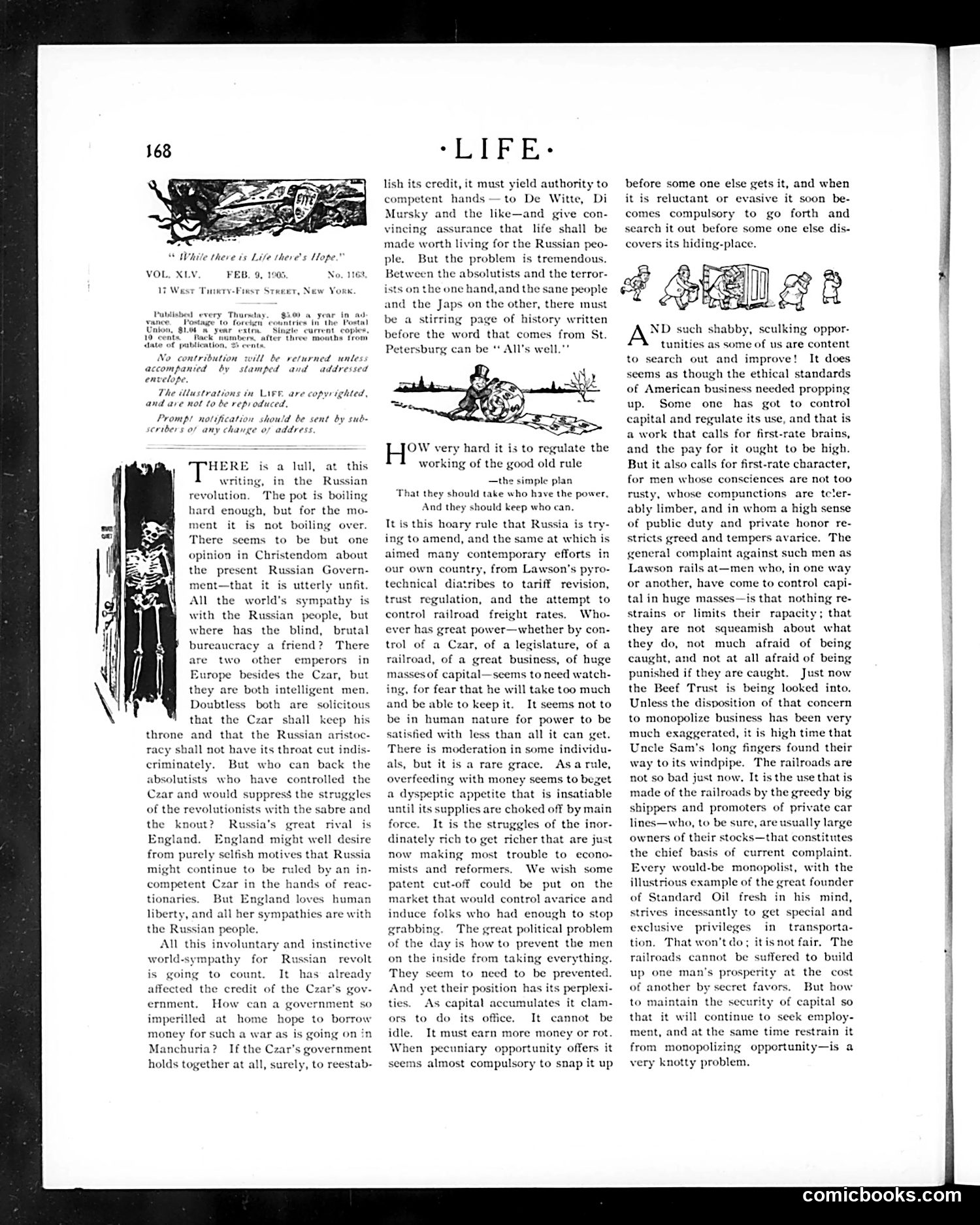
This page presents editorial commentary on Russian revolutionary politics rather than traditional cartoons. The illustrated vignettes show figures in conflict—appearing to depict revolutionary struggle and state authority clashing. The text critiques Russia's difficulty regulating its economy and controlling capital accumulation. It discusses the tension between revolutionary ideals and practical governance, referencing struggles between "absolutists and the terrorists" in Russian politics. The author argues that preventing revolutionary upheaval requires addressing economic grievances, particularly regarding railroad monopolies and capital concentration. The piece suggests that even sympathetic observers worry the Russian government cannot maintain order while restraining capitalist excess—a core political problem of the era. The commentary reflects early-20th-century anxieties about revolution, state power, and economic justice in Russia.
📄 Transcribed text from this page (OCR, searchable)
Machine-transcribed from the original scan — historical spelling and the odd misread are preserved.
“White there ts Life there's Hope.” VOL. XLY. FEB. 9, 1906, 17 West No. 1168 Tiunry-Finst Street, New Yorx. isbed every Thurslay. — §: a year in vance. Postage to foreign countries In the Postal Union, $106 8 year extra Single current copies 10 cents. "Rack humbers after three mouths from date of publication, No contribution accompanied by envelope. The illustrations in LIFE. are copyrighted, and ave not to be reproduced. will be returned unte: stamped and addressed Prompt notification should be sent by sub- cribers of any change of address. HERE is writing revolution. this. n lull, at the Russi ‘The pot is boiling hard enough, but for the mo- ment it is not boiling over. There seems to be but one opinion in Christendom about the present Russian Govern- ment—that it is utterly unfit. All the world’s sympathy is with the Russian people, but where has the blind, brutal bureaucracy a friend? There are two other emperors in Europe besides the Czar, but they are both intelligent men. Doubtless both that the Czar shall keep his throne and that the Russian aris} racy shall not have its throat cut indis- are solicitous ro criminately. But who back the absolutists who have controlled the Czar and would suppress the struggles of the revolutionists with the sabre and the knout? Russia's great rival is England. England might well desire from purely selfish motives that Russia might continue to be ruled by an in- competent Czar in the hands of reac- tionaries. But England loves human liberty, and all her sympathies are with the Russian people. All this involuntary and instinctive world-sympathy for Russian revolt is going to count. It has already affected the credit of the Czar’s ernment. How can a government so imperilled at home hope to borrow money for such a war as is going on in Manchuria? holds together at all, surely, to reestab- rov- If the Czar's government “HLF Ee lish its credit, it must yield authority competent hands —to De Witte, Di Mursky and the like—and give con- vincing assurance that life shall be made worth living for the Russian peo- ple. But the problem is tremendous. Between the absolutists and the terror- n the one hand, and the sane people and the Japs on the other, there must be a stirring page of history written before the word that comes from St. Petersburg can be * All's well."' OW very hard it is to regulate the working of the good old rule —the simple plan ‘That they should take who have the power, And they should keep who can, Tt is this hoary rule that Russia is try- ing to amend, and the same at which is aimed many contemporary efforts in our own country, from Lawson's pyto- technical diatribes to tariff revision, trust regulation, and the attempt to control railroad freight Who- ever has great power—whether by con- trol of a Czar, of a legislature, of a railroad, of a great business, of huge masses of capital—seems to need watch- ing, for fear that he will take too much and be able to keep it. It seems not to be in human nature for power to be satisfied with less than all it can get. There is moderation in some individu- als, but it is a rare grace. Asa rule, overfeeding with money seems to beget a dyspeptic appetite that is insatiable until its supplies are choked off by main force. It is the struggles of the inor- dinately rich to get richer that are just now making most trouble to econo- mists and reformers. We wish some patent cut-off could be put on the market that would control avarice and induce folks who had enough to stop grabbing. The great political problem of the day is how to prevent the men on the inside from taking everything. They seem to need to be prevented. And yet their position has its perplexi- ties. “As capital accumulates it clam- ors to do its office, It cannot be idle, It must carn more money or rot. When pecuniary opportunity offers it seems almost compulsory to snap it up before some one else gets it, and when it is reluctant or evasive it soon be- comes compulsory to go forth and rch it out before some one else dis- covers its hiding-place. # EIS h ND such shabby, sculking oppor- tunities as some of us are content to search out and improve! It does seems as though the ethical standards of American business needed propping up. Some one has got to control capital and regulate its use, and that is a work that calls for first-rate brains, and the pay for it ought to be high. But it also calls for first-rate character, for men whose consciences are not too rusty, whose compunctions are tete ably limber, and in whom a high sens of public duty and private honor re- stricts greed and tempers avari The general complaint against such men as Lawson rails at—men who, in one way or another, have come to control capi- talin huge masses—is that nothing re- strains or limits their rapacity; that they are not squeamish about what they do, not much afraid of being caught, and not at all afraid of being punished if they are caught. Just now the Beef Trust is being looked into. Unless the disposition of that concern to monopolize business has been very much exaggerated, it is high time that Uncle Sam's long fingers found their way to its windpipe. The railroads are not so bad just now, It is the use that is made of the railroads by the greedy big shippers and promoters of private car lines—who, to be sure, are usually large owners of their stocks—that constitutes the chief basis of current complaint. Every would-be monopolist, with the example of the great founder rd Oil fresh in his mind, ntly to get special and privileges in transporta- tion. That won't do; itisnot fair, The railroads cannot be suffered to build up one man's prosperity at the cost of another by secret favors. But how sea exclusive to maintain the security of capital so that it will continue to seek employ- ment, and at the same time restrain it from monopolizing opportunity—is a very knotty problem. comicbooks.com