
Life, 1905-02-09 · page 13 of 22
Life — February 9, 1905 — page 13: what you’re looking at
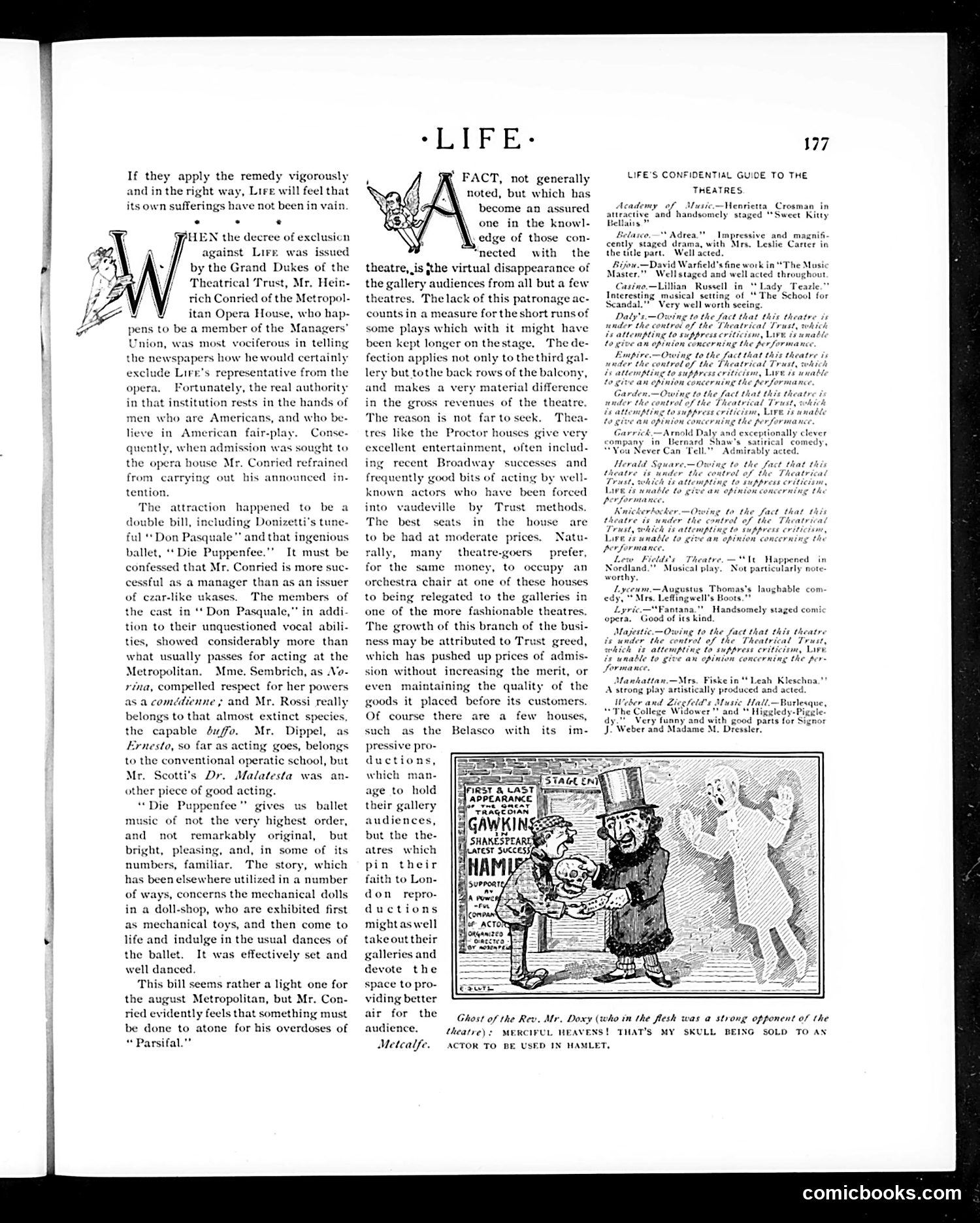
What you’re looking at
This page critiques the **Theatrical Trust**, a monopoly controlling American theater that exploited both performers and audiences. The main cartoon shows two figures (likely Trust representatives) arguing over a skull labeled "Hamlet"—a visual pun on selling theatrical properties and the Trust's death-grip on the industry. The text discusses **Heinrich Conried** of the Metropolitan Opera, a Trust member who initially tried to exclude Life's theater critic but was overruled by American managers who believed in "fair play." The article also attacks Trust greed: by raising ticket prices while cutting quality, they drove working-class "gallery" audiences to cheaper vaudeville theaters like Proctor's, which offered better entertainment value. This backfired economically, reducing box office revenue. The page represents Life magazine's role as a **satirical watchdog** against corporate monopolies that exploited both artists and audiences during the Progressive Era.
📄 Transcribed text from this page (OCR, searchable)
Machine-transcribed from the original scan — historical spelling and the odd misread are preserved.
If they apply the remedy vigorously and in the right way, Lire will feel t its own sufferings have not been in vai HEN the decree of exclusion against Lire. was issued by the Grand Dukes of the Theatrical Trust, Mr. Hei rich Conried of the Metropol- itan Opera House, who hap- nens to be a member of the Managers’ nion, was most vociferous in telling the newspapers how he would certain! exclude Lire’s representative from the opera. Fortunately, the real authority in that institution rests in the hands of men who are Americans, and who be- Conse- quently, when admission was sought to the opera house Mr. Conried refrained from carrying out his announced in- lieve in American fair-play tention. The attraction happened to be a double bill, including Donizetti's tune- Don Pasquale" and that ingenious ballet, Die Puppenfee."’ It must be confessed that Mr. Conried is more suc- ful as a manager than as an issuer of czar-like ukases. The members of the cast in ‘*Don Pasquale,” in addi- tion to their unquestioned vocal abili- ties, showed considerably more than what usually passes for acting at the Metropolitan. Mme. Sembrich, as .Vo- rina, compelled respect for her powers as a comddtenne ; and Mr. Rossi really belongs to that almost extinct species, the capable éufo. Mr. Dippel, as Ernesto, so far as acting goes, belongs to the conventional operatic school, but Mr. Scotti's Dr. Malatesta was an- other piece of good acting. “Die Puppenfee” gives us ballet music of not the very highest order, and not remarkably original, but bright, pleasin; , and, in some of its numbers, familiar. The story, which has been elsewhere utilized in a number of ways, concerns the mechani dolls in a doll-shop, who are exhibited first as mechanical toys, and then come to life and indulge in the usual dances of the ballet. It was effectively set and well danced This bill seems rather a light one for the august Metropolitan, but Mr. Con- ried evidently feels that something must be done to atone for his overdoses of “ Parsifal."" “GEE. FACT, not generally noted, but which has become an assured one in the knowl- edge of those con- “nected with the theatre, is the virtual disappearance of the gallery audiences from all but a few theatres. The lack of this patronage ac- counts in a measure for the short runs of some plays which with it might have been kept longer on thestage, The de- fection applies not only to the third gal- lery but tothe back rows of the balcony, and makes a very material difference in the gross revenues of the theatre. The reason is not fartoseek. Th tres like the Proctor houses give very excellent entertainment, often includ- ing recent Broadway successes and frequently good bits of acting by well- known actors who have been forced into vaudeville by Trust methods. The best seats in the house are to be had at moderate prices. Natu- ral many theatre-goers __ prefer, for the same money, to occupy an orchestra chair at one of these houses to being relegated to the galleries in one of the more fashionable theatres. The growth of this branch of the busi- ness may be attributed to Trust greed, which has pushed up prices of admis- sion without increasing the merit, or even maintaining the quality of the goods it placed before its customers. Of course there are a few houses, such as the Belasco with its im- pressive pro- 177 LIFE’S CONFIDENTIAL GUIDE TO THE THEATRES, Academy of Music.—Wenrietta Crosman in ictive and handsomely staged “Sweet Kitty Jasco.—"* Adtea."” Impressive and mag cently staged drama, with Mrs. Leslie Carter ir the title part, Well acted. Bijou. —Dayid Warfield’s fine work in Master.” Well staged and well acted ¢ Casino.—Lillian Russell in“ Lady Teazle.”* Interesting musical setting of The School for Scandal."”” Very well worth seeing. Daty's.—Otwing to the fact that this t under the contro: of the Theatrical Trus is attempting to suppress criticism, LAVY. és fo give an epinion concerning the ferformanece Empire ing to the fact t under the control of the Theatrical Tris The Musi oughout on t, which is attempting to suppress criticism, Lave ts unable Garden.—Owing to th ld Daly and exceptionally roard Shaw’ 1 cc Tell.” rably acted. Herald Square. —Or teat ug the perform fact that this theatre i ing te the fact that this ts under the control of the Theatrical hich ts attempting to suppress cviticisnty nable fact that this of the Theatrical fo Suppress criticism, der the contre Trust, which is attempt Lire #5 unatle 10 ¢ Lew Fields's Theatre. ~ "Ut Happ Nordland." Musical play. Not particularly worthy, tus Thomas's laughable com- well’s Boots." Vo Mrs, Leff Lyric.—“Fantana."” Handsomely staged co opera. Good of its kind. Majestic.—Owing to the fact that this theatre is under the controt of the Theatrical Trust, ‘hich is attempting to suppress criticitmy Lavy is unable to give an opinion concerning the per= forman Manhattan.—Mrs. Fiske in“ Leah Kleschna."’ A'strong play artistically produced and acted. Weber and Zieefeld's Music Hall.—Burlesque, “The College Widower i dy," Very funny and with good parts for Signor J. Weber and Madame M. Dressler. ductions, which n+ age to hold their gallery audiences, but the the- atres which pin their faith to Lon- don repro- ductions might aswell takeout their galleries and devote the space to pro- viding better air for the audience. Metcalfe. 5] APPEARANCE "TRAGEOIAN Ghost of the Rev. Mr. Doxy (who in the flesh was a strong opponent of the theatre): MERCIFUL HEAVEN ACTOR TO BE USED IN HAMLET, ! THAT'S MY SKULL REING SOLD TO AN comicbooks.com