
A complete issue · 22 pages · 1904
Life — December 3, 1904
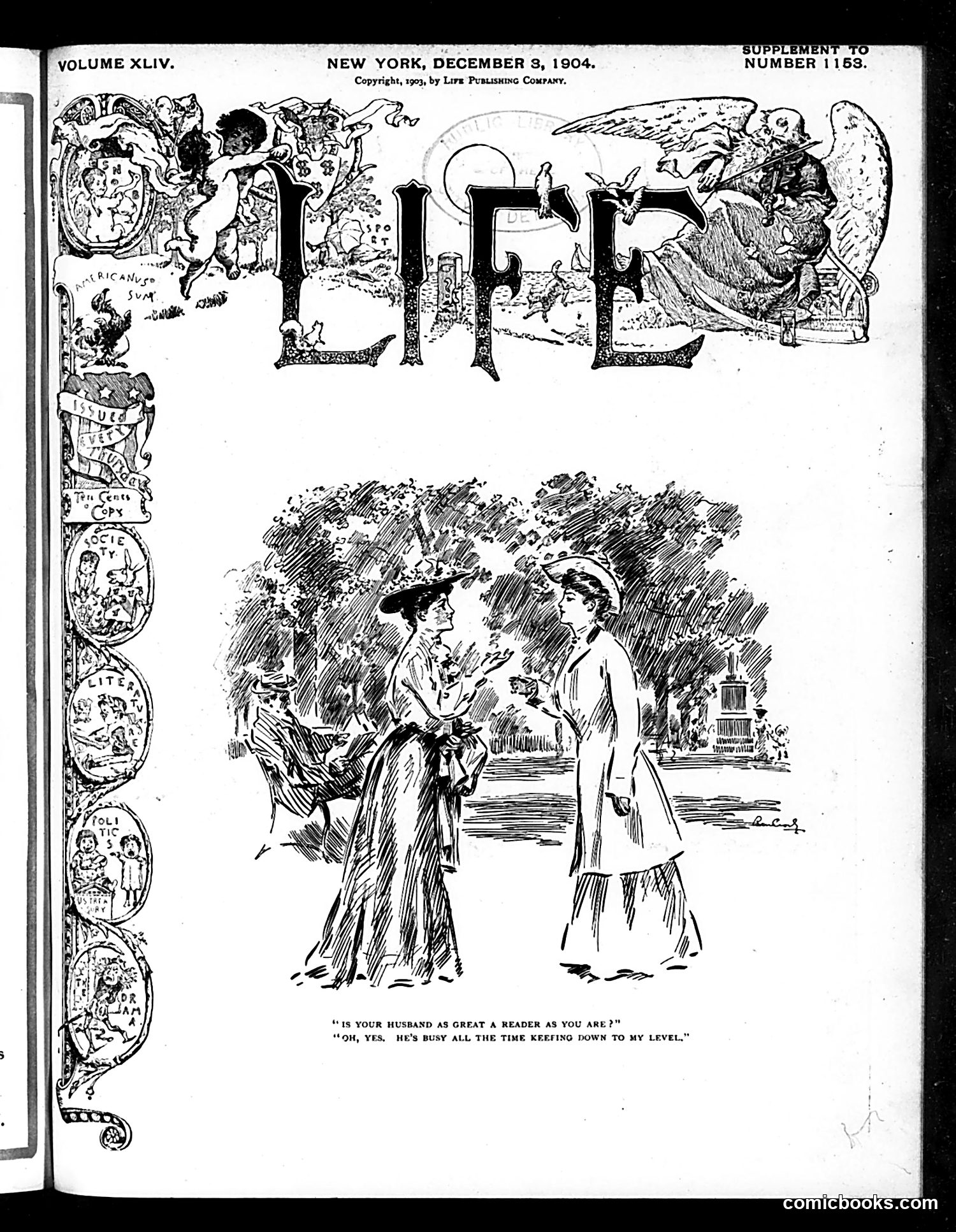
This page from Life (December 9, 1904) features a single-panel cartoon with two women in conversation. The dialogue reads: "Is your husband as great a reader as you are?" / "Oh, yes. He's busy all the time keeping down to my level." The satire targets gender dynamics and intellectual pretension of the early 1900s. The woman's boastful claim that her husband must "keep down to [her] level" to match her reading suggests either genuine intellectual superiority or, more likely, self-deluded vanity about her intellectual accomplishments. The cartoon mocks women who overestimate their own learning while implying their husbands are actually more intelligent but tactfully humoring them—a common misogynistic trope of the era.
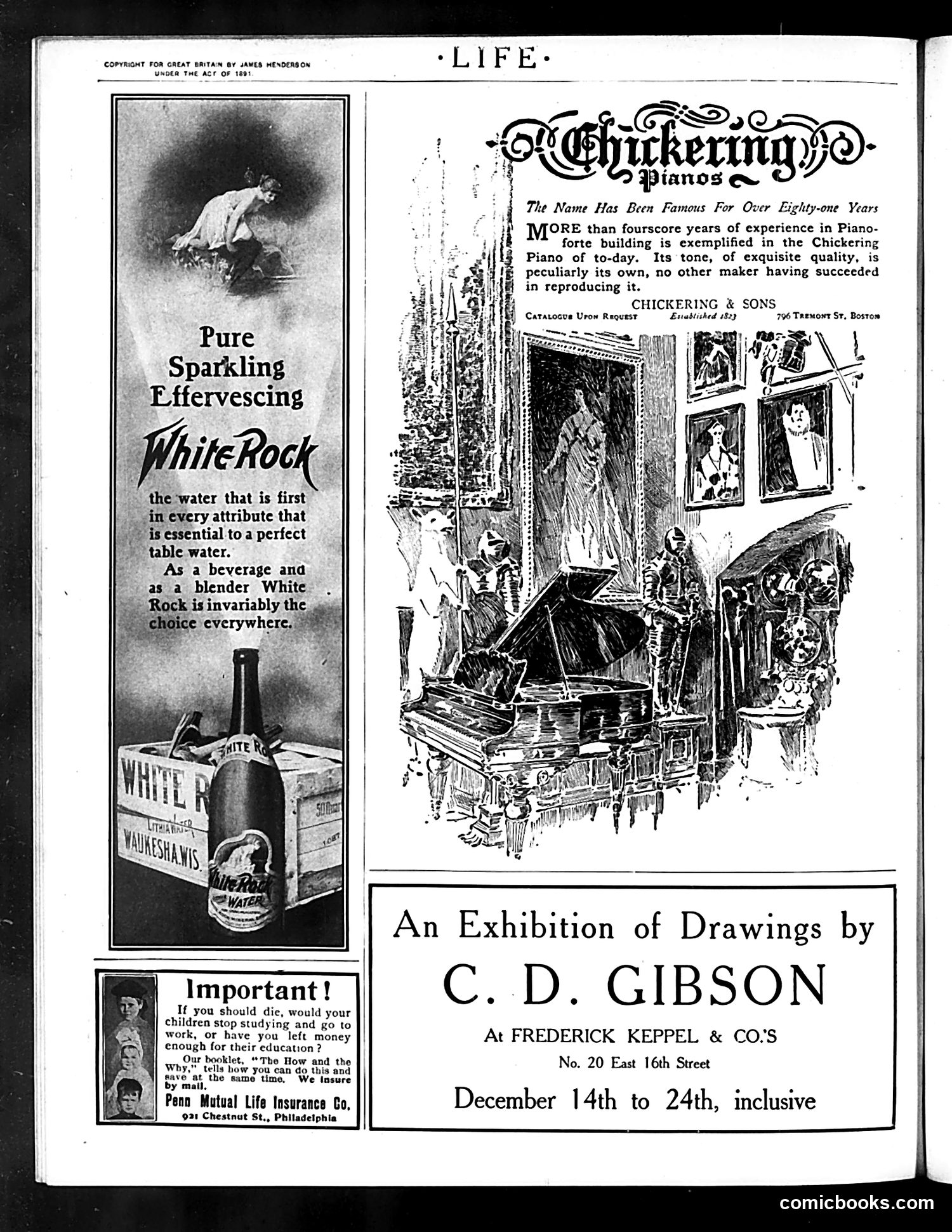
This page is **primarily advertising** rather than editorial content or satire. It contains three advertisements: 1. **White Rock water** (left): Features a classical female figure and emphasizes purity, positioning the product as ideal for both drinking and mixing beverages. 2. **Chickering Pianos** (top right): Highlights the brand's 81+ year reputation, with an illustration of an elegant parlor piano in an ornate home setting, appealing to affluent consumers. 3. **C.D. Gibson Exhibition** (bottom right): Announces an art showing at a New York gallery (December 14-24). Gibson was a famous illustrator known for "Gibson Girl" drawings—idealized depictions of American women that defined early 20th-century aesthetics. 4. **Penn Mutual Life Insurance** (bottom left): Uses family imagery to promote financial security for children's education. No political satire is evident on this page.
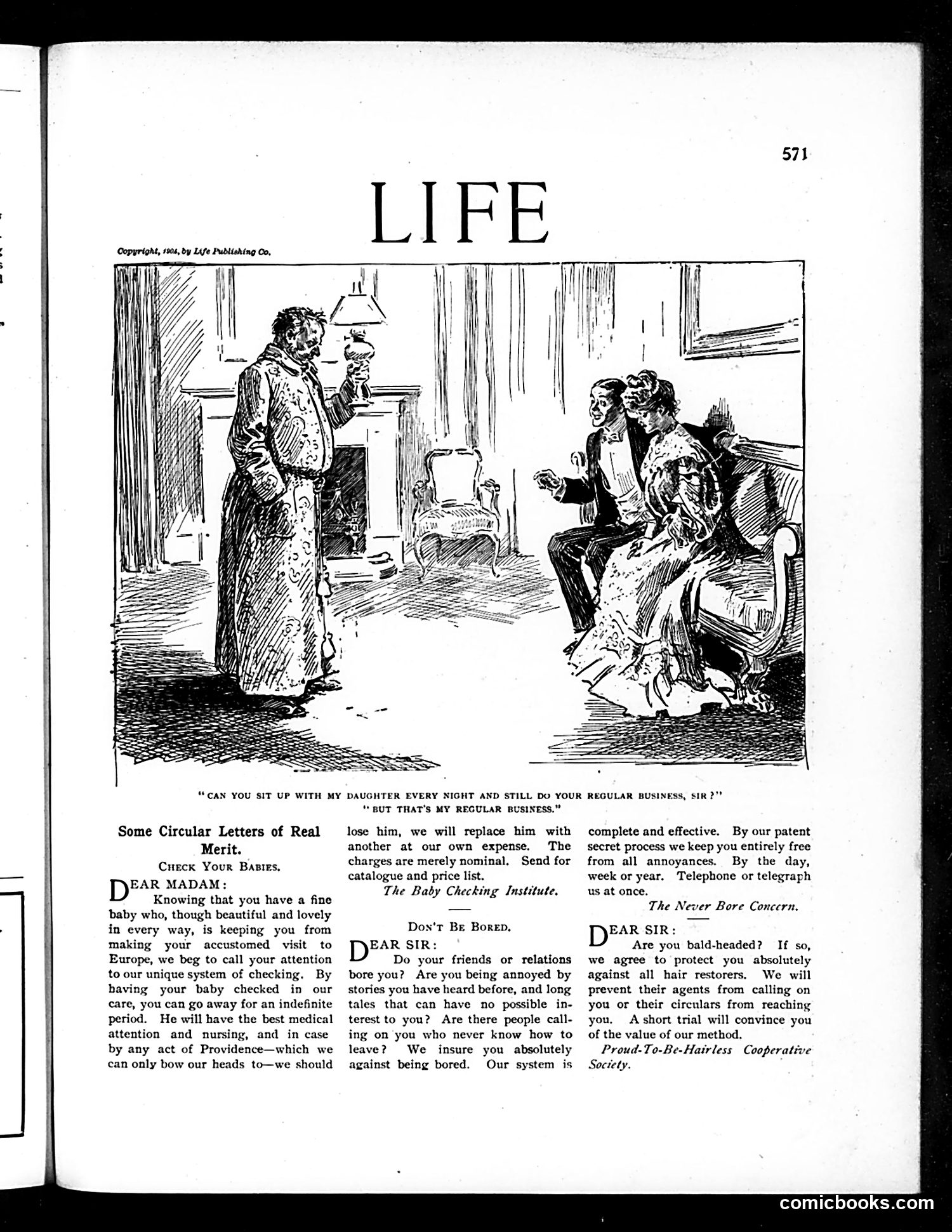
This page from *Life* magazine contains humorous classified advertisements disguised as "Circular Letters of Real Merit." The cartoon depicts a man addressing three seated figures, with the caption: "Can you sit with my daughter every night and still do your regular business, sir?" / "But that's my regular business." The joke satirizes opportunistic businessmen advertising dubious services. The advertisements below parody common scams and services: - A "baby-checking" service offering to monitor infants abroad - An anti-boredom insurance scheme - A "hair-loss cooperative society" promising to protect clients from aggressive hair-restoration salesmen The satire targets both fraudulent businesses exploiting consumer anxieties and the gullible public willing to pay for absurd "solutions" to everyday problems. It's social commentary on commercialism and consumer culture.
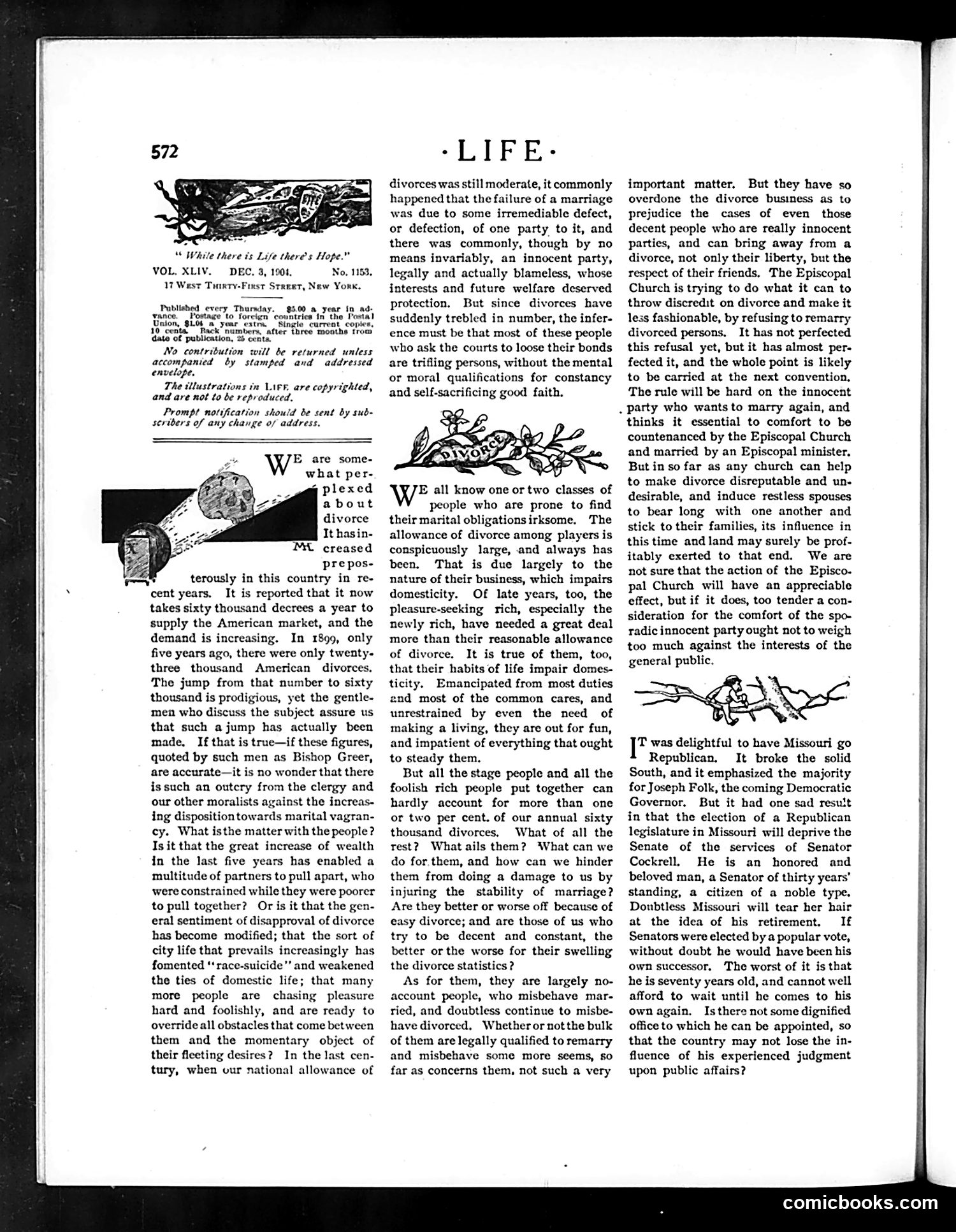
This page discusses the rise of divorce in America, presenting it as a social problem driven by wealthy, pleasure-seeking individuals. The text critiques both the frivolous rich who treat divorce casually and the Episcopal Church's difficulty in discouraging remarriage after divorce. The small cartoon illustrations (appearing as decorative vignettes) seem to depict figures in leisure activities, supporting the text's argument that wealthy Americans pursue "fun, and impatient of everything that ought to steady them." The second section shifts to political commentary about Missouri's Republican legislature and Senator Cockrell, praising his long service and lamenting his impending retirement due to age (seventy years old). The page blends social criticism with political commentary typical of Life's satirical approach.
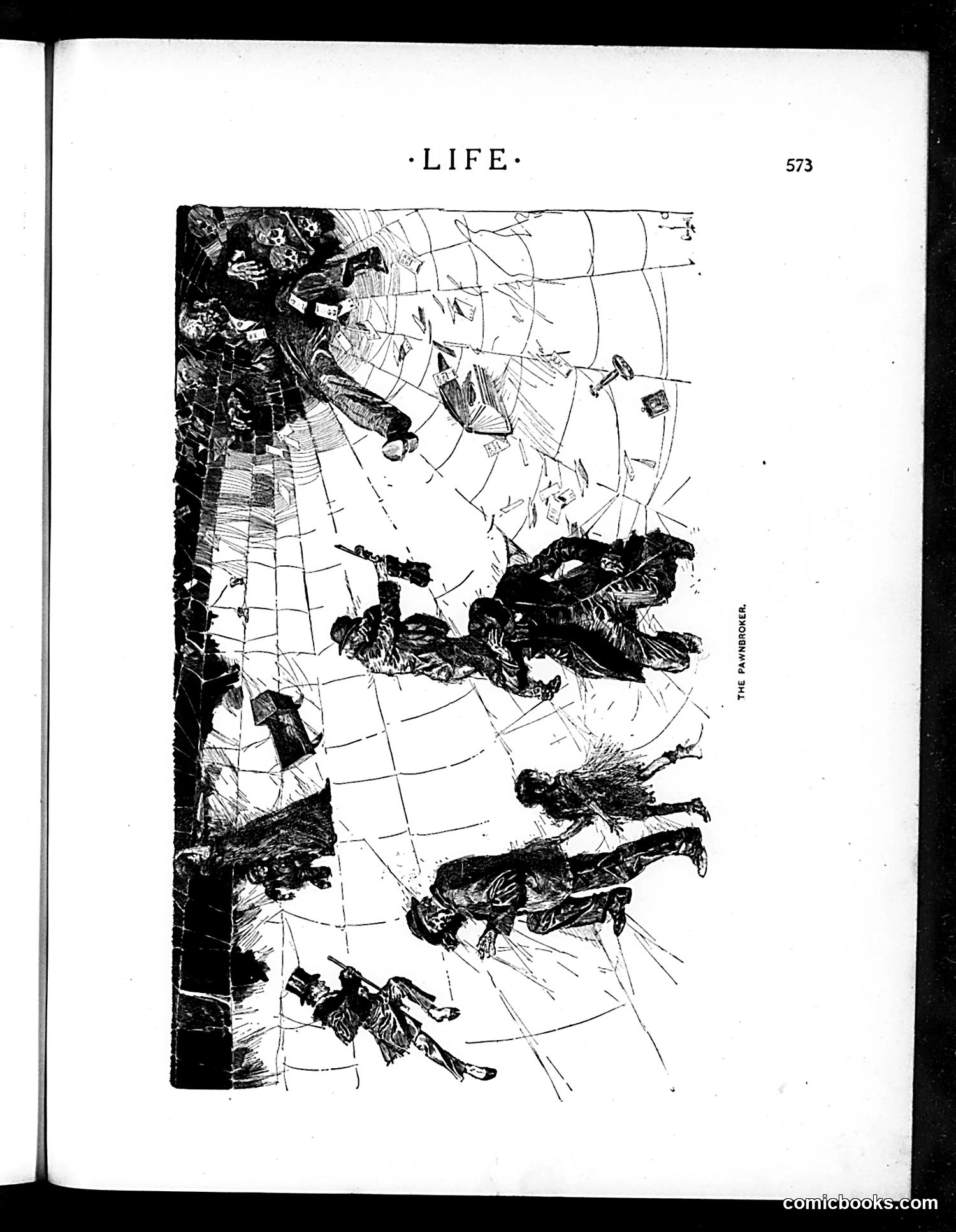
This is a satirical illustration (rotated 90 degrees) depicting multiple figures caught in what appears to be wind or chaos, with a ship's rigging visible on the left. The title "The Windpour" suggests tumultuous conditions—likely political or social upheaval. The figures appear to be careening or falling, their clothing and postures suggesting loss of control or panic. Without clearer identification of specific individuals or visible captions, the exact political references remain unclear. However, the chaotic composition and nautical imagery suggest commentary on turbulent times—possibly economic crisis, political scandal, or social disorder from the early-to-mid 20th century when Life magazine was prominent. The satire works through visual metaphor: powerful forces beyond individuals' control sweeping them away.
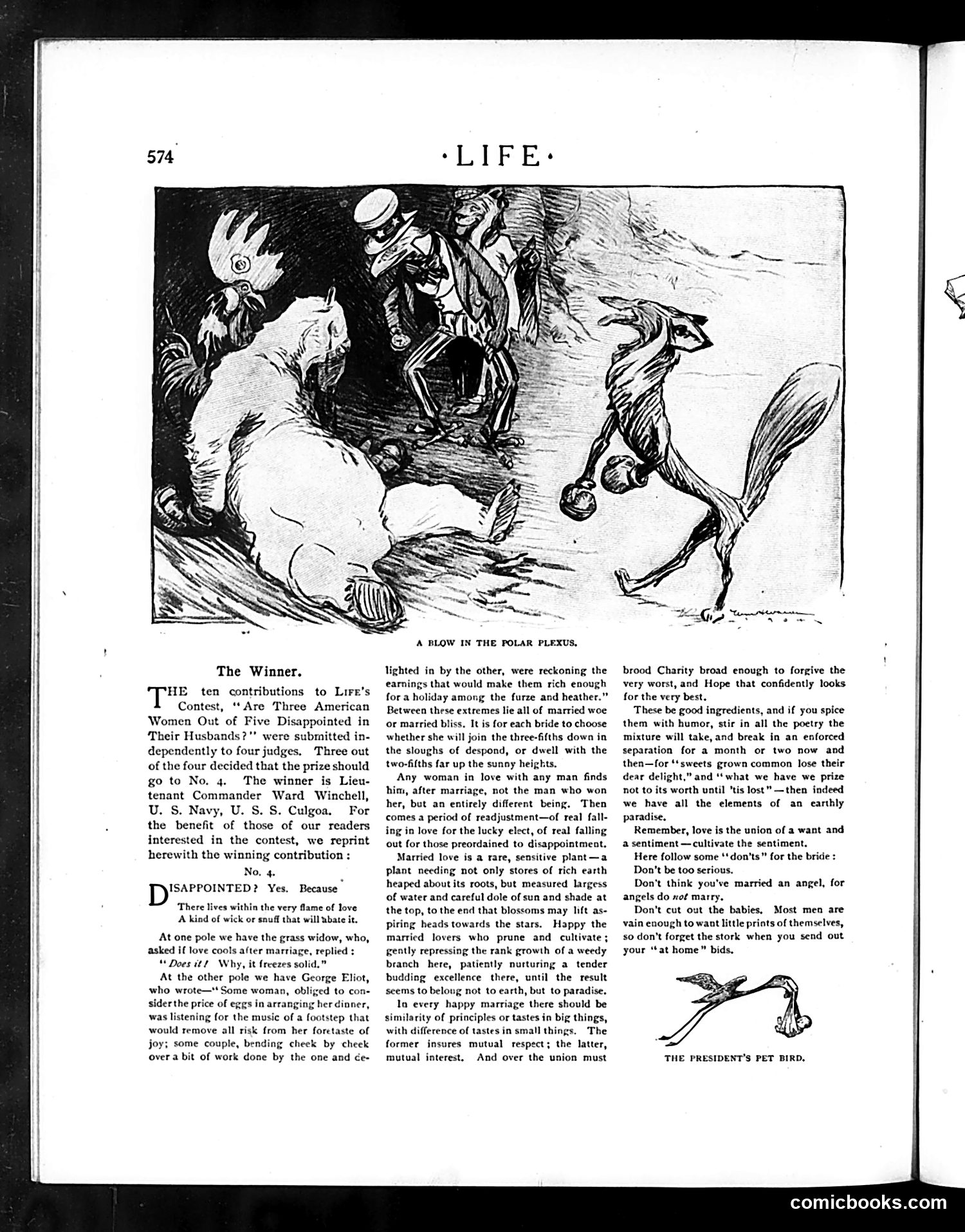
The main cartoon, titled "A Blow in the Polar Flexus," depicts what appears to be a slapstick scene with anthropomorphic animals (possibly dogs or wolves) engaged in physical combat or struggle, with one figure wearing what looks like military attire with a hat. The accompanying text discusses "The Winner" of Life's contest asking "Are Three American Women Out of Five Disappointed in Their Husbands?" The article presents winning entries about marriage expectations and disappointment, offering commentary on domestic relationships and gender dynamics of the era. The smaller illustration labeled "The President's Pet Bird" appears unrelated. The content reflects early-20th-century attitudes toward marriage, women's roles, and domestic expectations, presented through satirical humor typical of Life magazine's style.
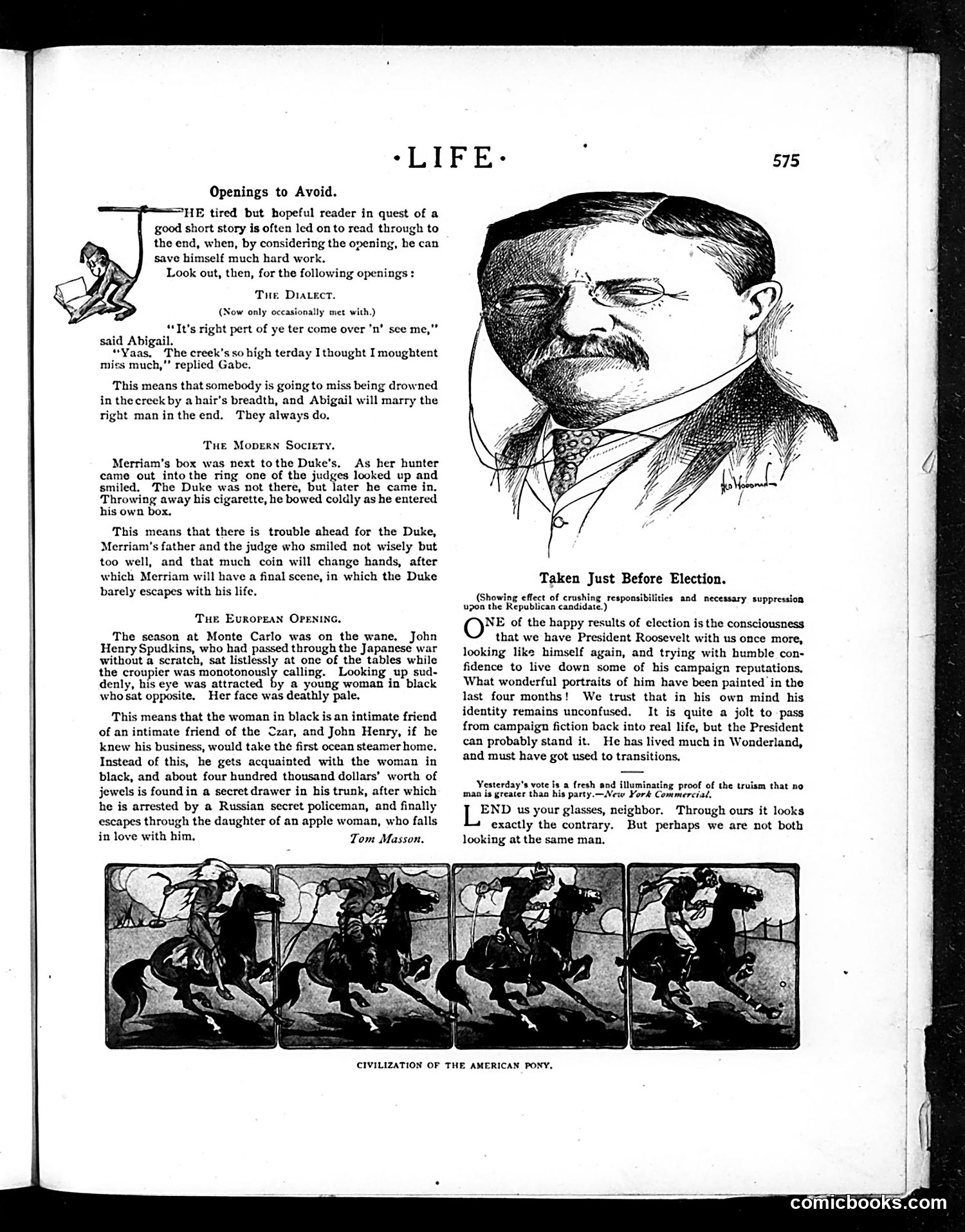
The large portrait shows a bearded man in formal attire, captioned "Taken Just Before Election." The accompanying text explains this depicts President Roosevelt "looking like himself again" after his campaign, suggesting he regained composure transitioning from campaign fiction back to real life. The satirical point: the President appears worn and transformed by campaigning, implying the stress of electoral politics altered his appearance or demeanor. The subtitle notes this shows "effect of crushing responsibilities and necessary suppression upon the Republican candidate." Below, "Civilization of the American Pony" depicts a horse progressively bucking its rider—likely satirizing either political instability or the untamed nature of American politics/voters. The exact meaning requires additional historical context about this specific election cycle.
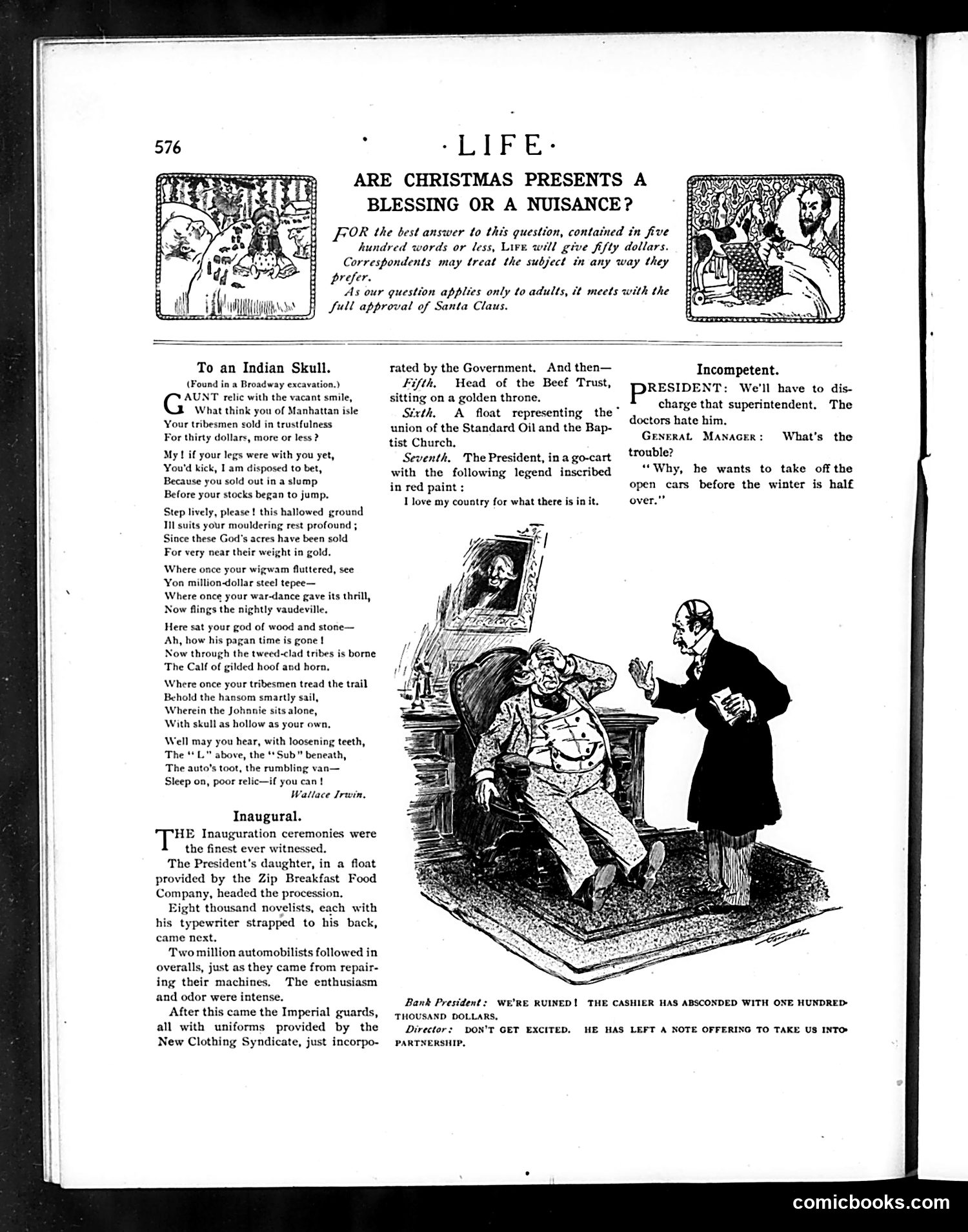
This page from *Life* magazine contains satirical content about early 20th-century American society. **"To an Indian Skull"** is a poem by Wallace Irwin mocking American industrialization and wealth accumulation, contrasting Native American traditions with modern capitalism ("steel tepee," "million-dollar"). **"Inaugural"** section describes an elaborate presidential parade where wealthy businessmen display new automobiles and promotional merchandise—satire of commercialized civic ceremony. **The cartoon** (right) depicts a bank president reporting to a director that a cashier has absconded with $100,000. The director offers partnership as a solution—satirizing how embezzlement could be overlooked through business accommodation rather than prosecution, reflecting Gilded Age corruption and lax financial regulation. The overall page critiques American materialism, corporate malfeasance, and the erosion of authentic culture by commercial interests.
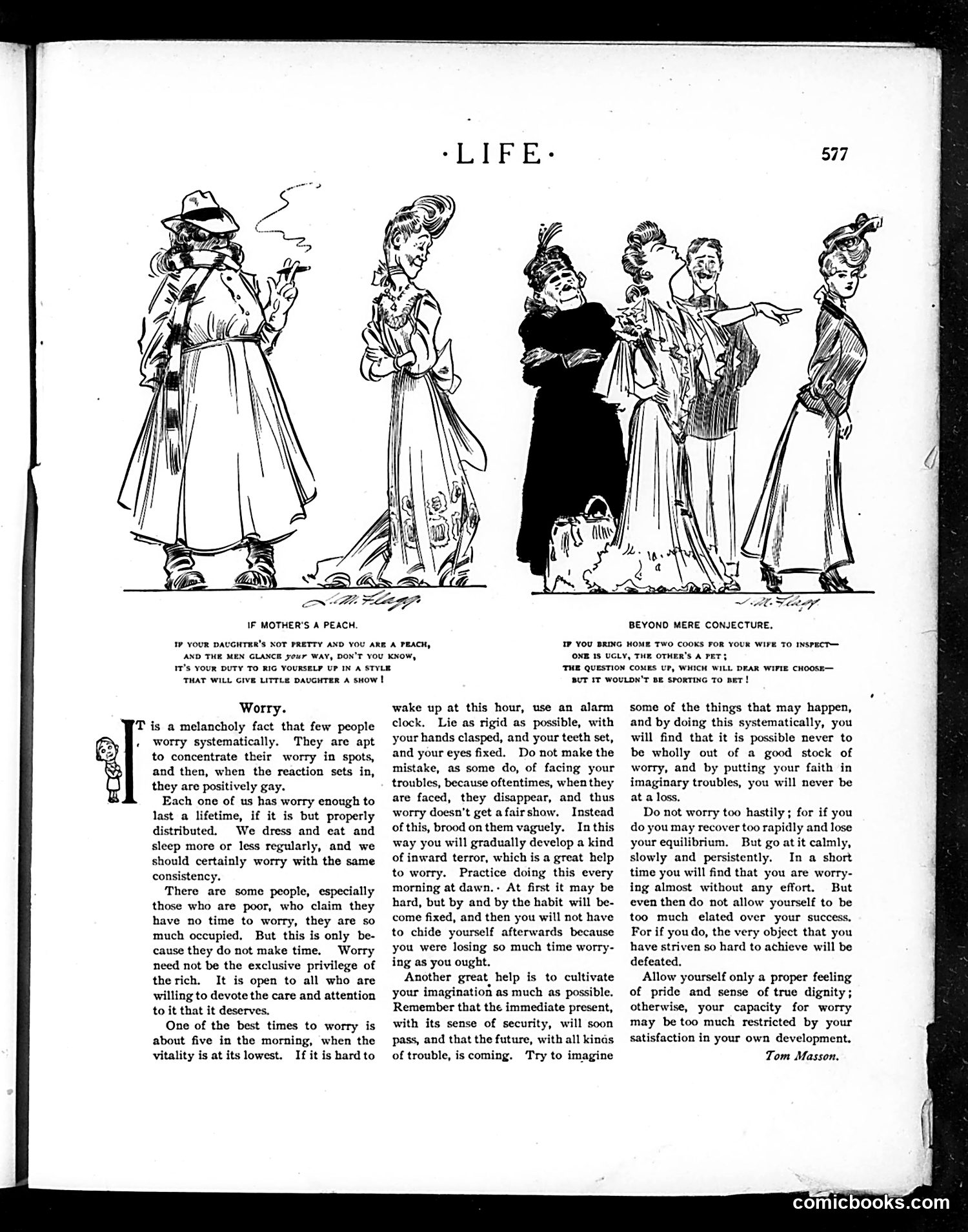
This page contains two cartoon panels satirizing female social types, paired with an essay on worry by Tom Masson. **"If Mother's a Peach"** (left): A portly woman with a hat and cigarette represents a desirable mother-figure. The caption suggests if your daughter isn't pretty and you are a peach, men will notice you instead—a barb at mothers competing with their daughters for male attention. **"Beyond Mere Conjecture"** (right): Shows women gossiping about inspecting a potential wife. The joke concerns assumptions about character based on appearance and family traits—suggesting people judge marriage prospects based on superficial observations rather than substance. Both panels mock early-20th-century social anxieties about women's appearance, courtship, and family reputation.
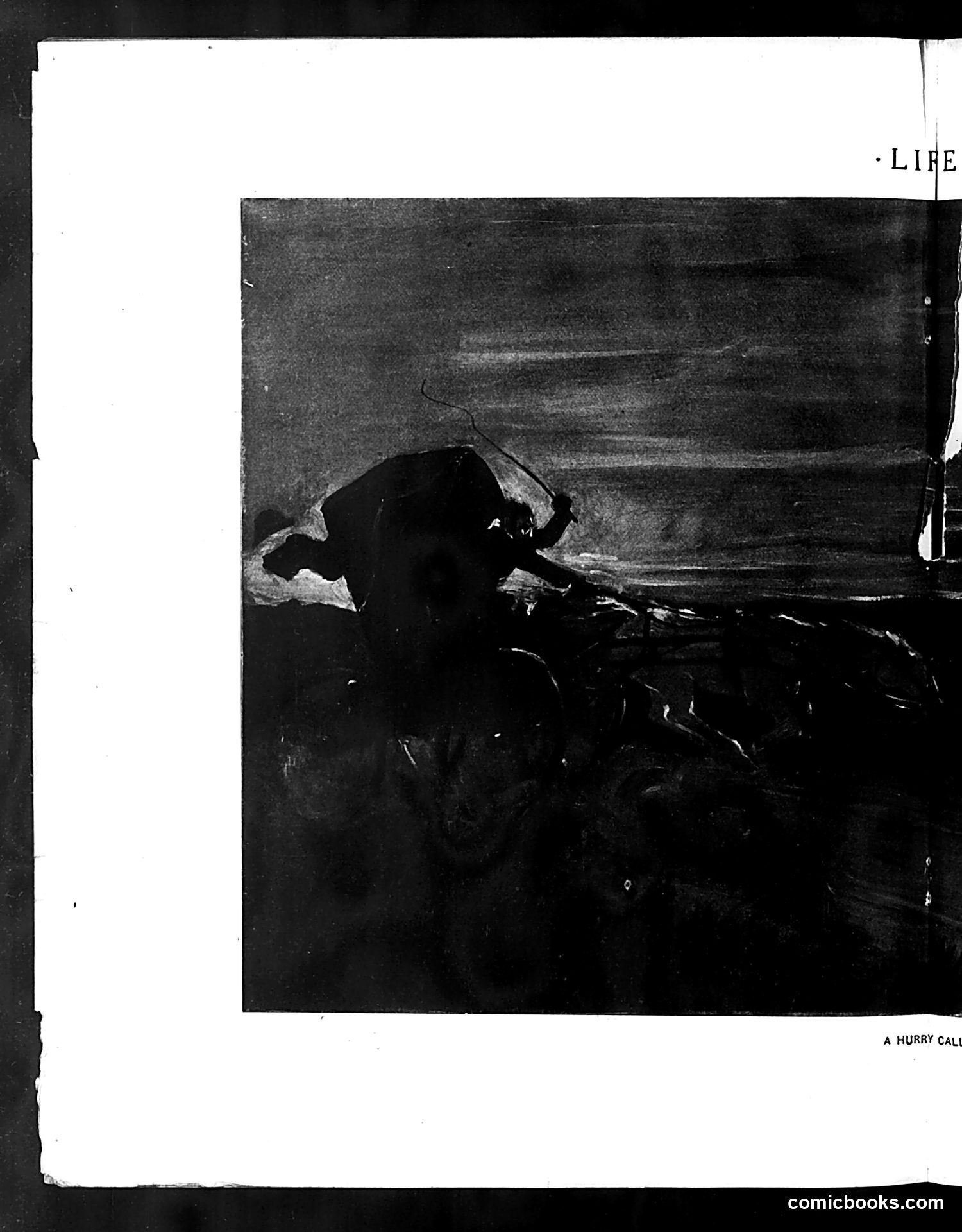
This appears to be a satirical illustration from Life magazine showing a figure in dark clothing bending over or leaning urgently toward what looks like industrial or mechanical equipment in shadow. The caption "A Hurry Call" suggests urgency or emergency response. Without being able to clearly identify the specific figure or read additional context clues in the image, I cannot confidently explain the particular political or social reference intended. The dark, dramatic lighting and the figure's posture suggest this is meant as sharp satire—possibly critiquing some political figure's hasty response to a crisis or problem—but the specific target and historical context remain unclear from the image alone. To accurately explain this cartoon's meaning, I would need additional information about Life magazine's publication date and the contemporary events it was responding to.
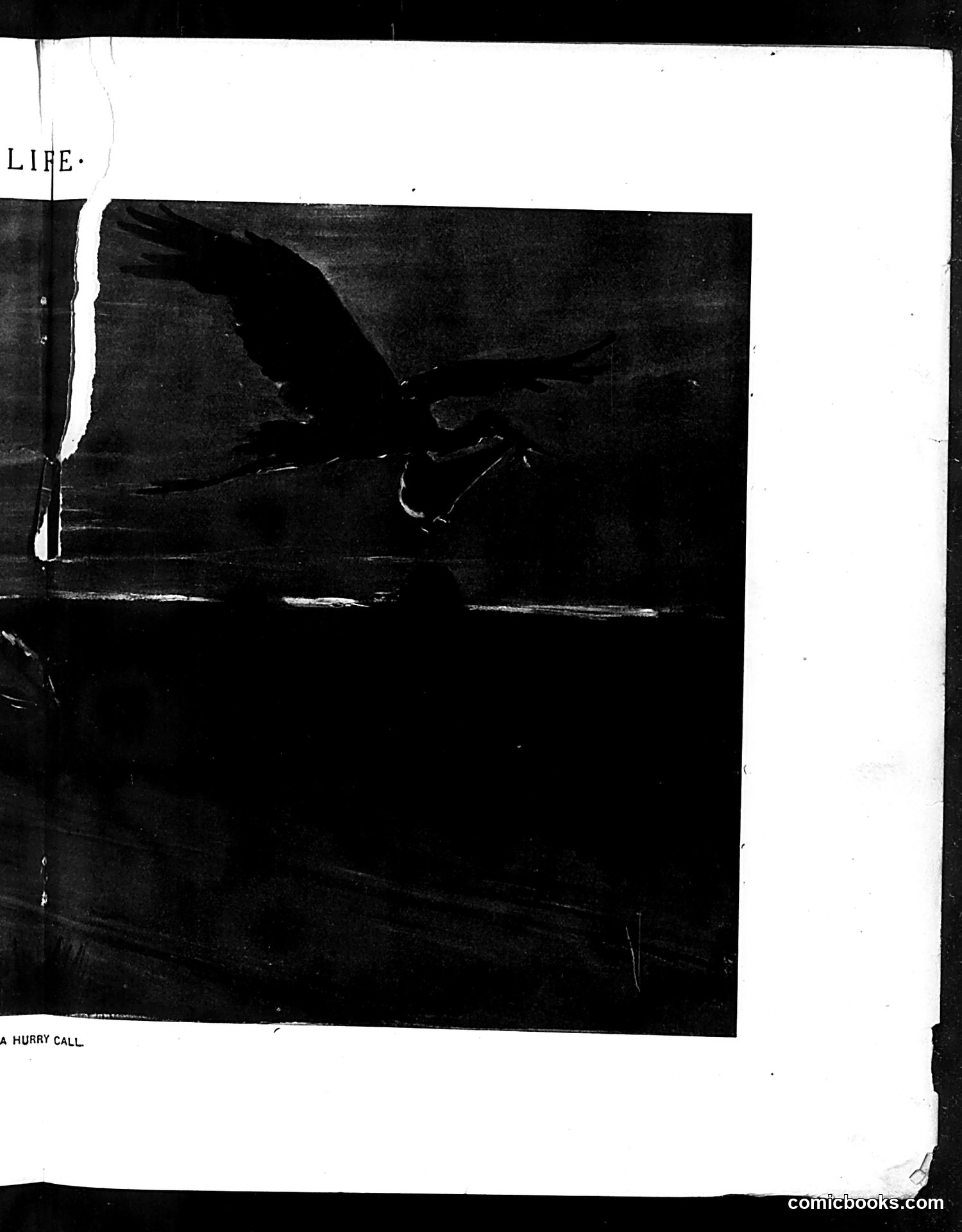
The page header reads "LIFE" with a caption at bottom reading "A HURRY CALL." The image itself is quite dark and difficult to discern in detail—it appears to show a silhouetted figure, possibly on horseback or in motion, rendered in high contrast black and white. The composition suggests urgency or action. Without clearer visibility of specific figures, facial features, or additional contextual text on the page, I cannot confidently identify who is being caricatured or what specific political or social event is being satirized. The "hurry call" caption suggests some kind of urgent summons or emergency situation is the subject, but the exact nature of the satire remains unclear from this reproduction.
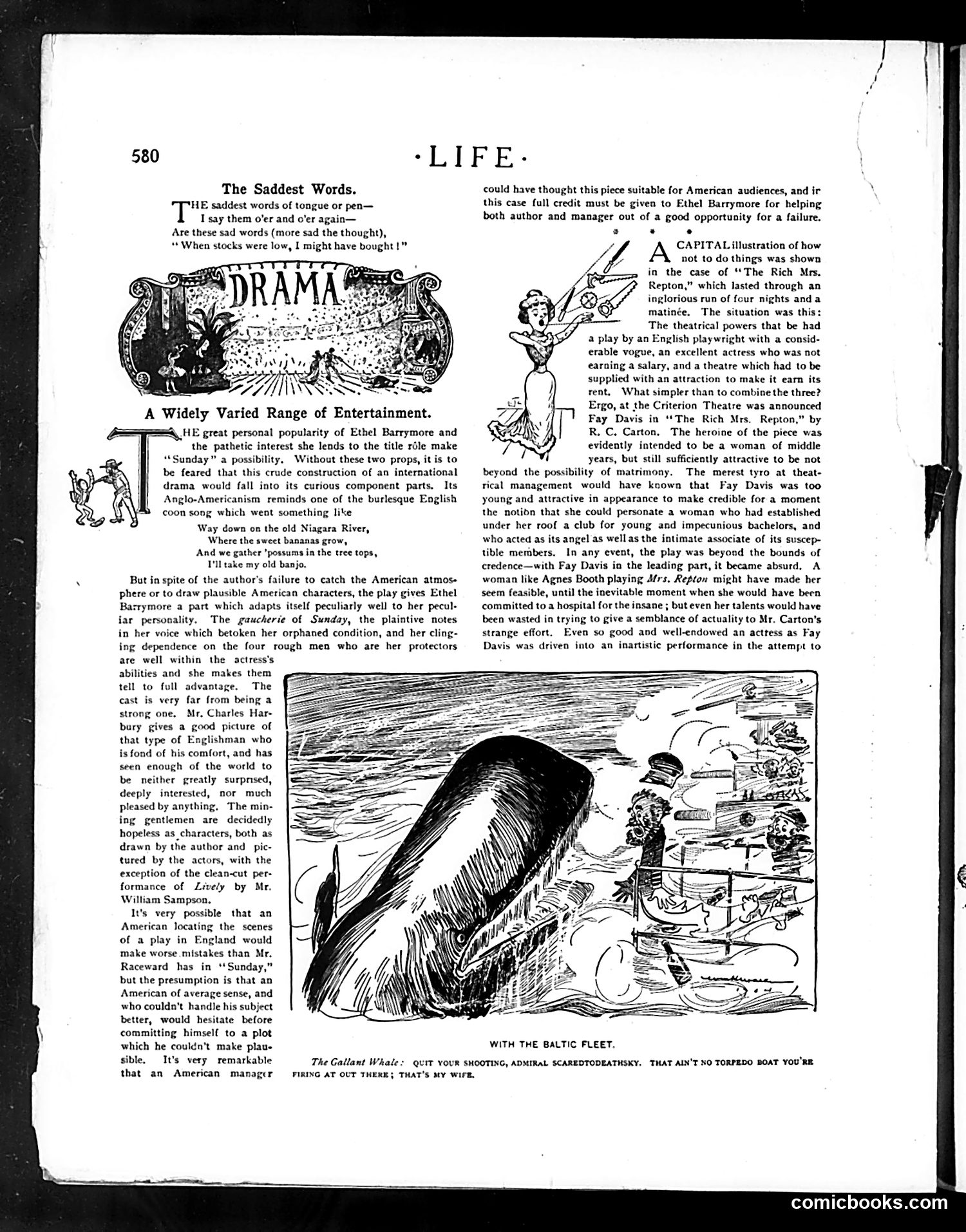
This page discusses theatrical productions and includes a satirical illustration titled "WITH THE BALTIC FLEET." The main cartoon depicts a large whale with what appears to be a military vessel or fleet scene in the background. The caption reads: "The Gallant Whale: 'OUT YOUR SHOOTING, ADMIRAL SCAREDIGOSTRATSKY. THAT AIN'T NO TORPEDO BOAT YOU'RE FIRING AT OUT THERE; THAT'S MY WIFE.'" This is likely satirizing early 1900s naval conflicts, possibly the Russo-Japanese War or Baltic Sea tensions. The joke mocks military incompetence—soldiers mistake a whale for enemy vessels. The mock-Russian name "Scaredigostratsky" parodies Russian military leadership of that era. The upper sections discuss Ethel Barrymore and theatrical productions, including "The Rich Mrs. Repton," contextualizing the page as entertainment and drama criticism mixed with political satire.
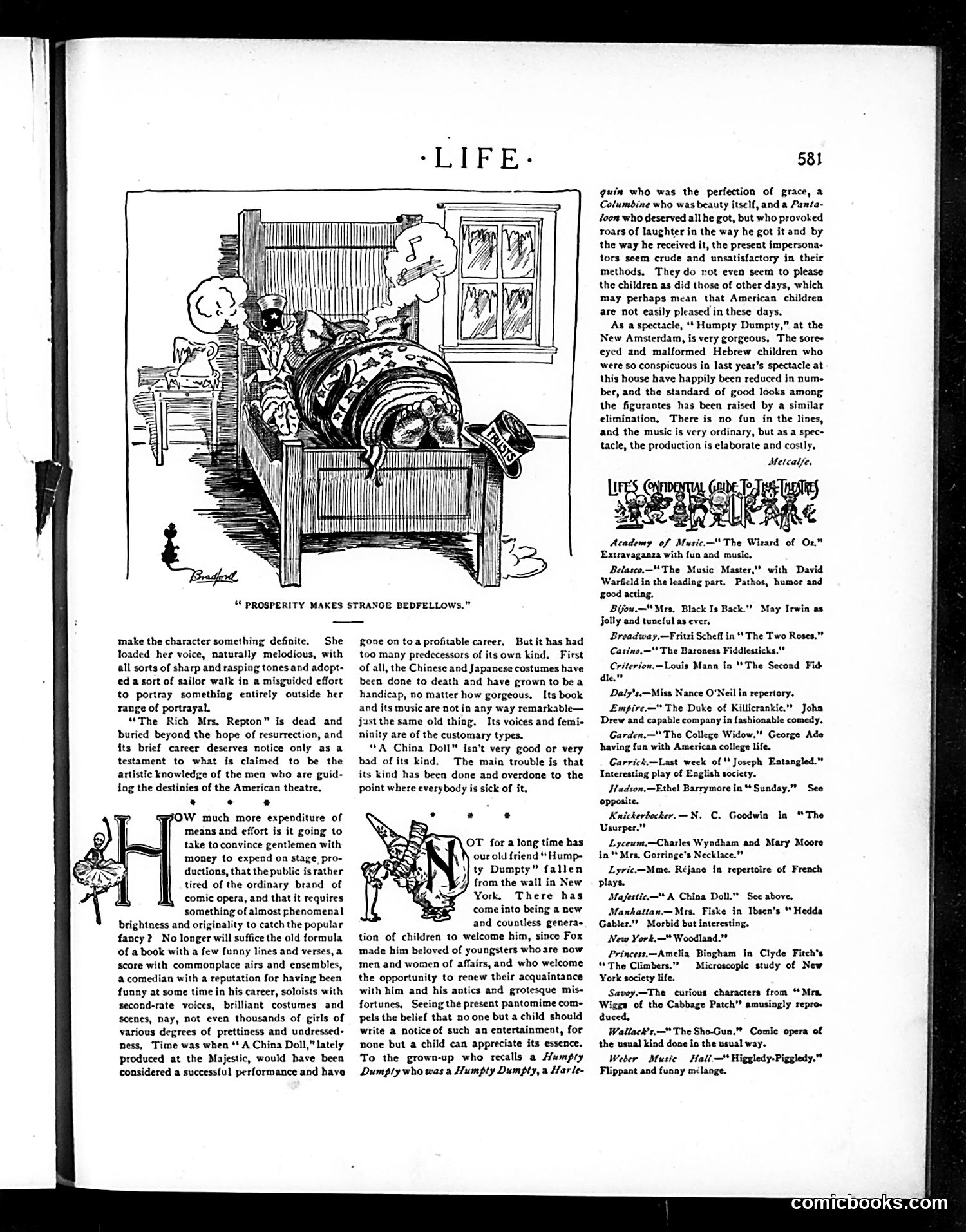
This page critiques the state of American theater circa the early 1900s. The main cartoon shows a disheveled man and woman in bed together—a visual metaphor for the title's phrase about unlikely partnerships. The accompanying text argues that theatrical producers, flush with money during prosperous times, waste resources on tired formulas: cheap comic operas with mediocre scores, aging comedians trading on past reputations, and spectacles relying on pretty choruses rather than genuine talent or originality. The critic specifically attacks "A China Doll" at the Majestic as exemplifying exhausted material—Chinese/Japanese costumes and plots done "to death." He also dismisses the current "Humpty Dumpty" pantomime at the New Amsterdam as crude compared to earlier versions, noting even children aren't amused. The only praise goes to its elaborate (if costly) visual production. The satire's point: prosperity enables lazy theater-making rather than artistic innovation.
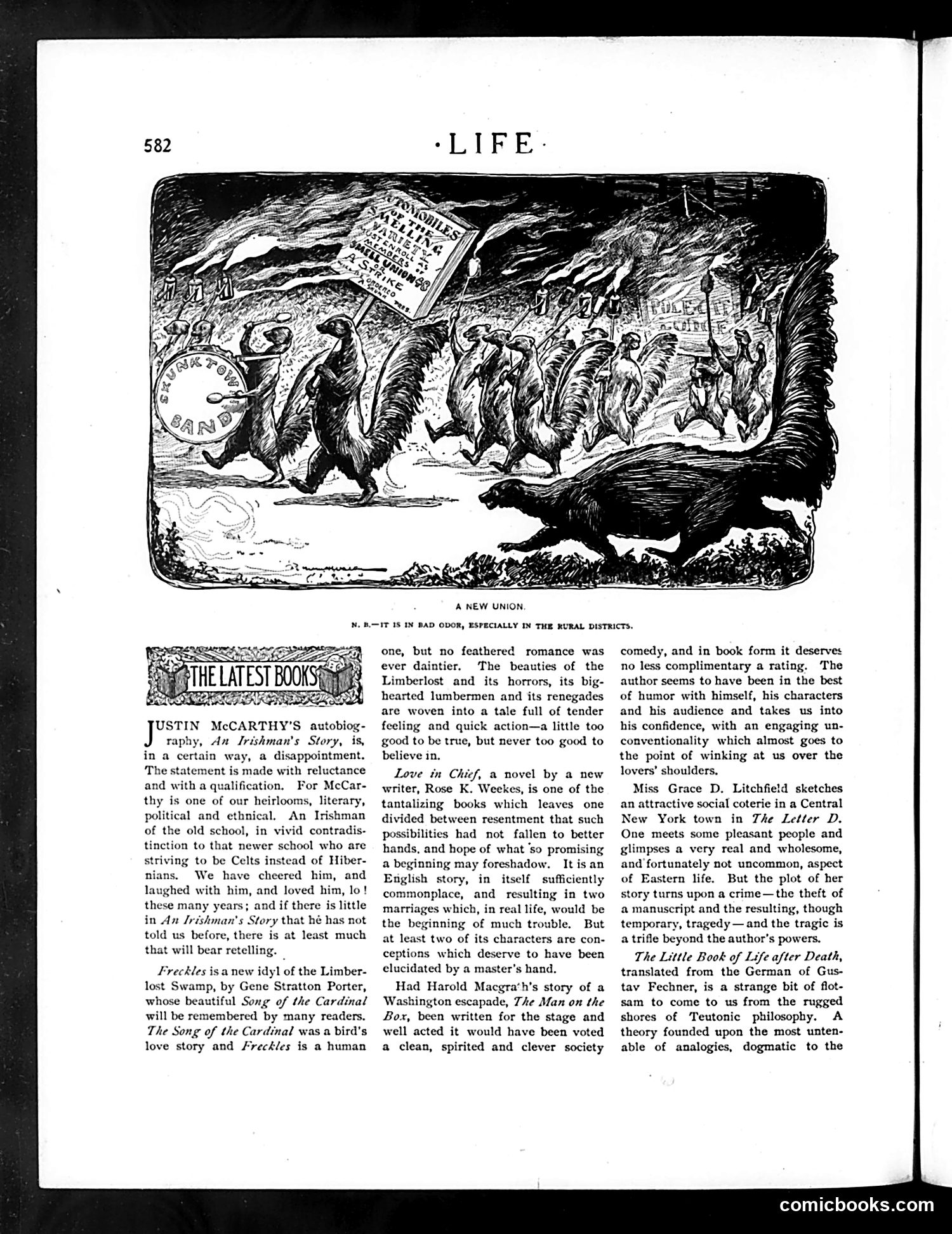
The cartoon depicts bears and dogs in apparent conflict or negotiation, with a sign reading "Yankee's Healing Salve" floating above. The caption states the depicted union "IS IN BAD ODOR, ESPECIALLY IN THE RURAL DISTRICTS." This appears to be satire about a political or social merger unpopular with rural America. The animals likely represent different political factions or regions attempting to unite. The "healing salve" references attempting to remedy discord, while "bad odor" suggests the union is widely disliked, particularly among rural voters. Without knowing the specific publication date, the exact political conflict remains unclear—this could reference post-Civil War Reconstruction, labor union disputes, or a proposed political alliance. The rural resistance suggests tension between urban and agricultural interests. The satirical presentation through animal characters was typical of Life magazine's political commentary style, allowing indirect criticism of contemporary issues.
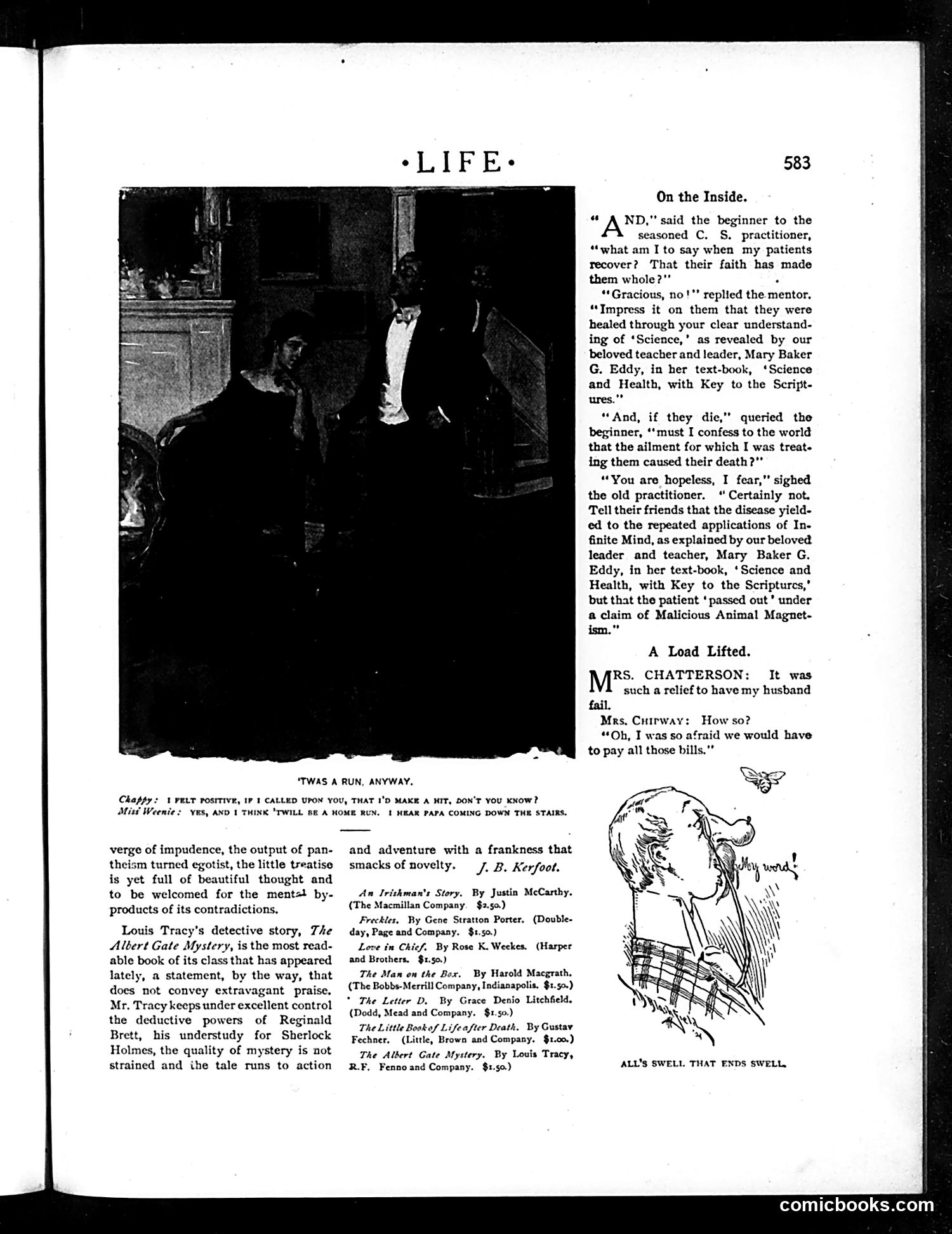
This page contains two satirical pieces targeting early 20th-century concerns: **"On the Inside"** mocks Christian Science practitioners and Mary Baker G. Eddy's teachings. A seasoned practitioner instructs a beginner to claim patients' recoveries result from understanding "Science" (Eddy's doctrine), and if patients die, to blame "Malicious Animal Magnetism" rather than admit treatment failure. The satire exposes how Christian Science rhetoric allows practitioners to claim credit for healing while deflecting blame for deaths—a common criticism of the movement at the time. **"Twas a Run, Anyway"** is a brief flirtation comic where a young man claims he'd "make a hit" with a woman, but she assumes he means a "home run" (sexual conquest). The joke relies on baseball metaphors as euphemisms for romantic/sexual progress, with her father's approach interrupting the encounter. **"A Load Lifted"** presents dark humor: a woman is relieved her husband's business failed because it means avoiding bill payments—suggesting financial desperation among the middle class.
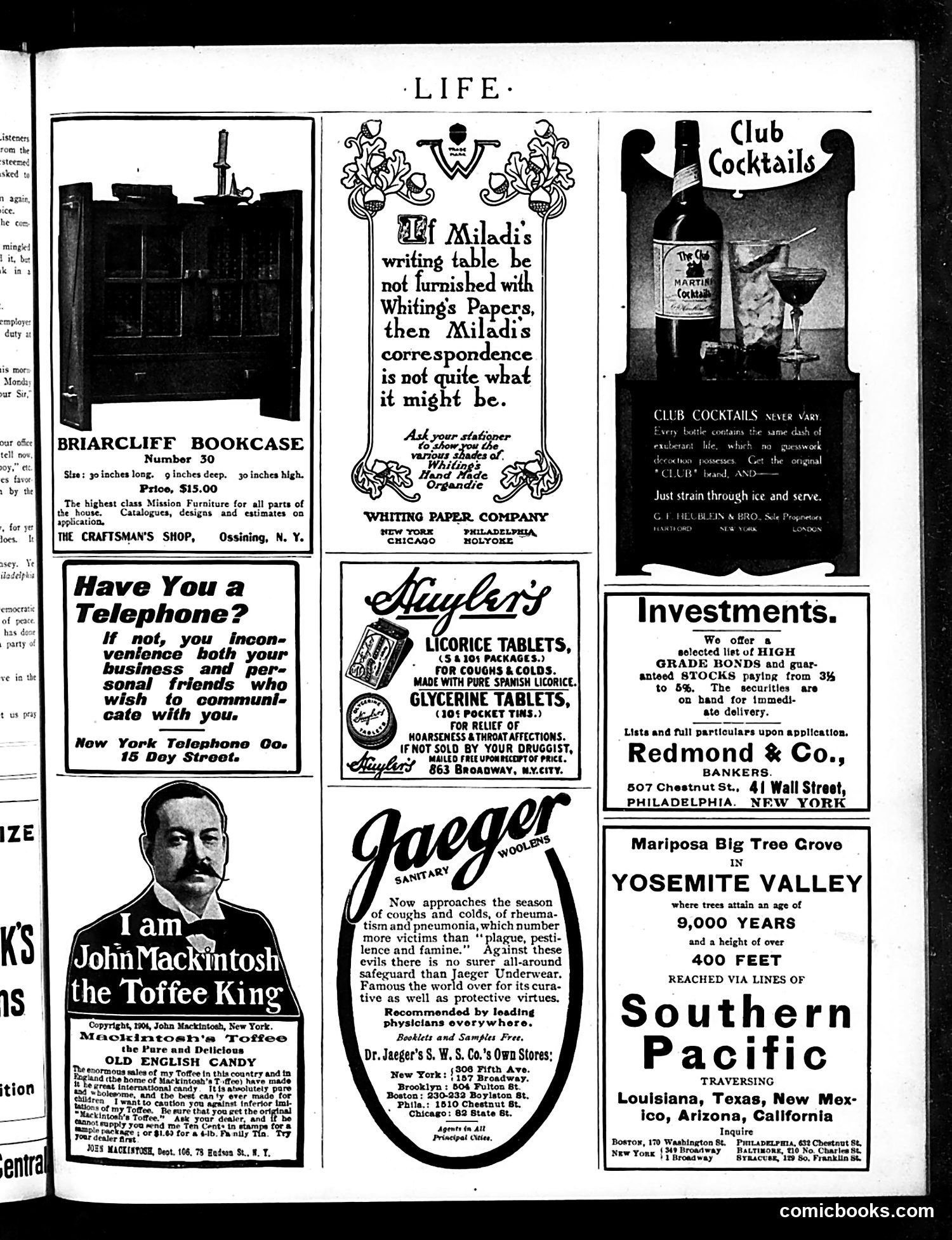
This is primarily an **advertising page** with one notable satirical element. The page contains mostly commercial ads for products and services typical of early 1900s America: furniture, candy, licorice tablets, underwear, financial services, and travel. The **satirical content** appears in the **John Mackintosh toffee advertisement** (lower left), which uses a caricatured portrait of a mustachioed man identified as "the Toffee King." This is a humorous celebrity endorsement playing on the notion of marketing products through exaggerated personality cult—a common advertising practice of the era. The remaining advertisements reflect period concerns: telephone adoption, proper stationery for correspondence, patent medicines (licorice and glycerin tablets for coughs), thermal underwear, and investment opportunities. The Southern Pacific ad promotes Yosemite tourism, appealing to leisure travel among the wealthy. Overall, this page demonstrates **Life's** dual function as both satirical publication and advertising vehicle for upscale consumer goods.
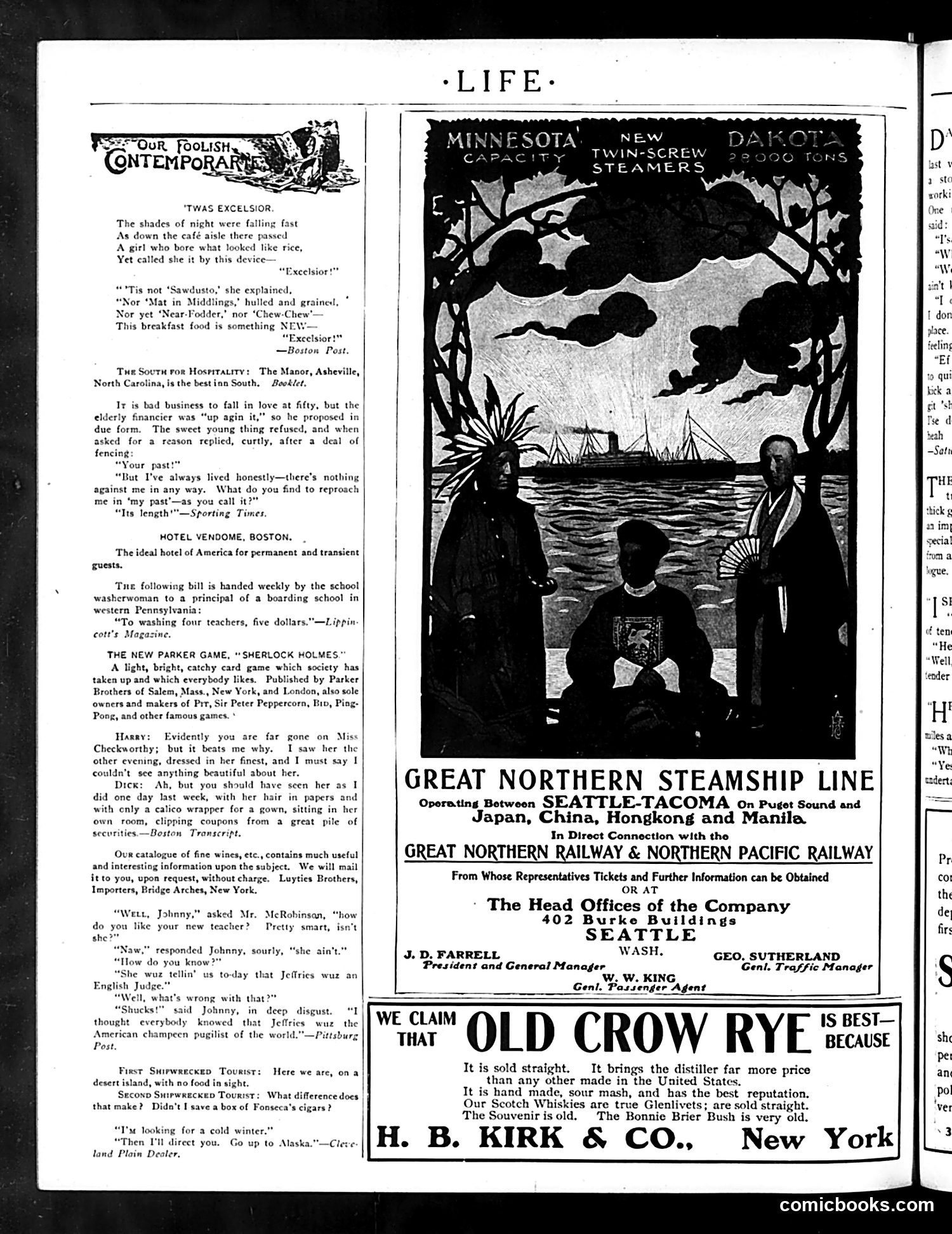
This page is primarily **advertising**, with brief satirical items interspersed. The main visual is a **large woodcut-style illustration** advertising the Great Northern Steamship Line, showing two Native Americans observing steamships on water—likely depicting indigenous peoples' perspective on modern transportation technology arriving in the Pacific Northwest. The text items are short humor pieces typical of Life's format: - **"'Twas Excelsior"** mocks a new breakfast cereal marketed with an inflated name, suggesting consumers are fooled by branding over substance - **The "Miss Checkworthy" joke** satirizes male vanity—a man notices a woman's appearance only when she's disheveled at home, contrasting idealized public presentation with reality - **The teacher/Jeffries joke** pokes fun at an educator who misstates facts (claiming boxer Jeffries was an English judge) The advertisements promote shipping lines, hotels, card games, wines, and whiskey—typical turn-of-century luxury goods marketed to Life's affluent readership. Overall, this reflects Life's satirical voice mocking pretension, false advertising, and human folly among the educated classes.
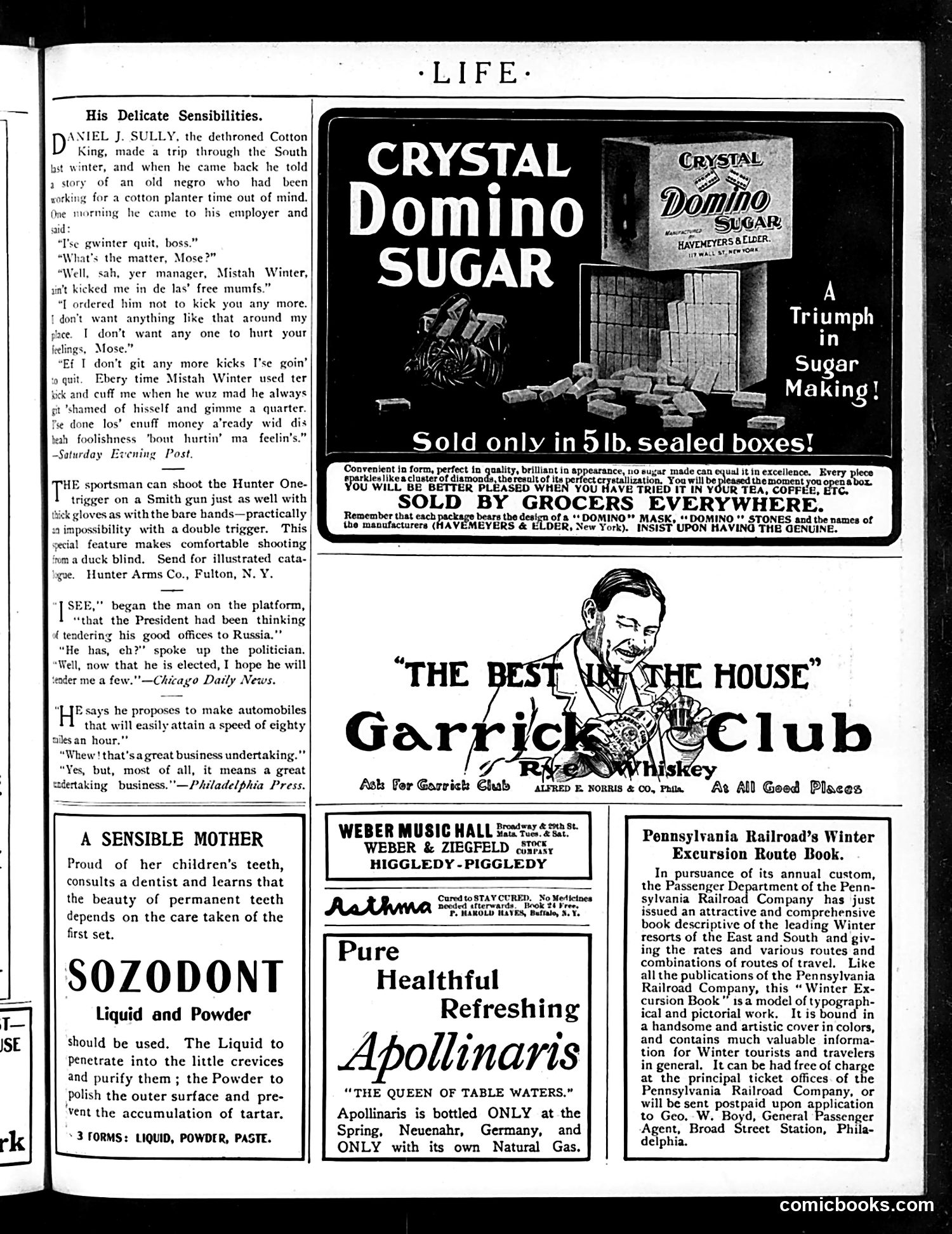
This cartoon satirizes the economic anxiety of formerly wealthy Southern planters after the Civil War. Daniel J. Sully, identified as a "dethroned Cotton King," tells a story about an elderly enslaved man who demands to quit his job because the new manager stopped physically beating him. The joke's bitter irony: the worker claims he's losing money because he no longer receives the quarters the old manager would guiltily give him after beatings. He preferred the brutal system because it was economically predictable, even profitable. The satire targets post-war Southern nostalgia—the idea that slavery was somehow "gentler" or more paternalistic than it was. By placing economic logic in the worker's mouth, the cartoon mocks both the "kind master" mythology and the notion that freed workers wouldn't want freedom if it meant losing financial scraps. It's a sharp critique of romantic revisionism about plantation life.
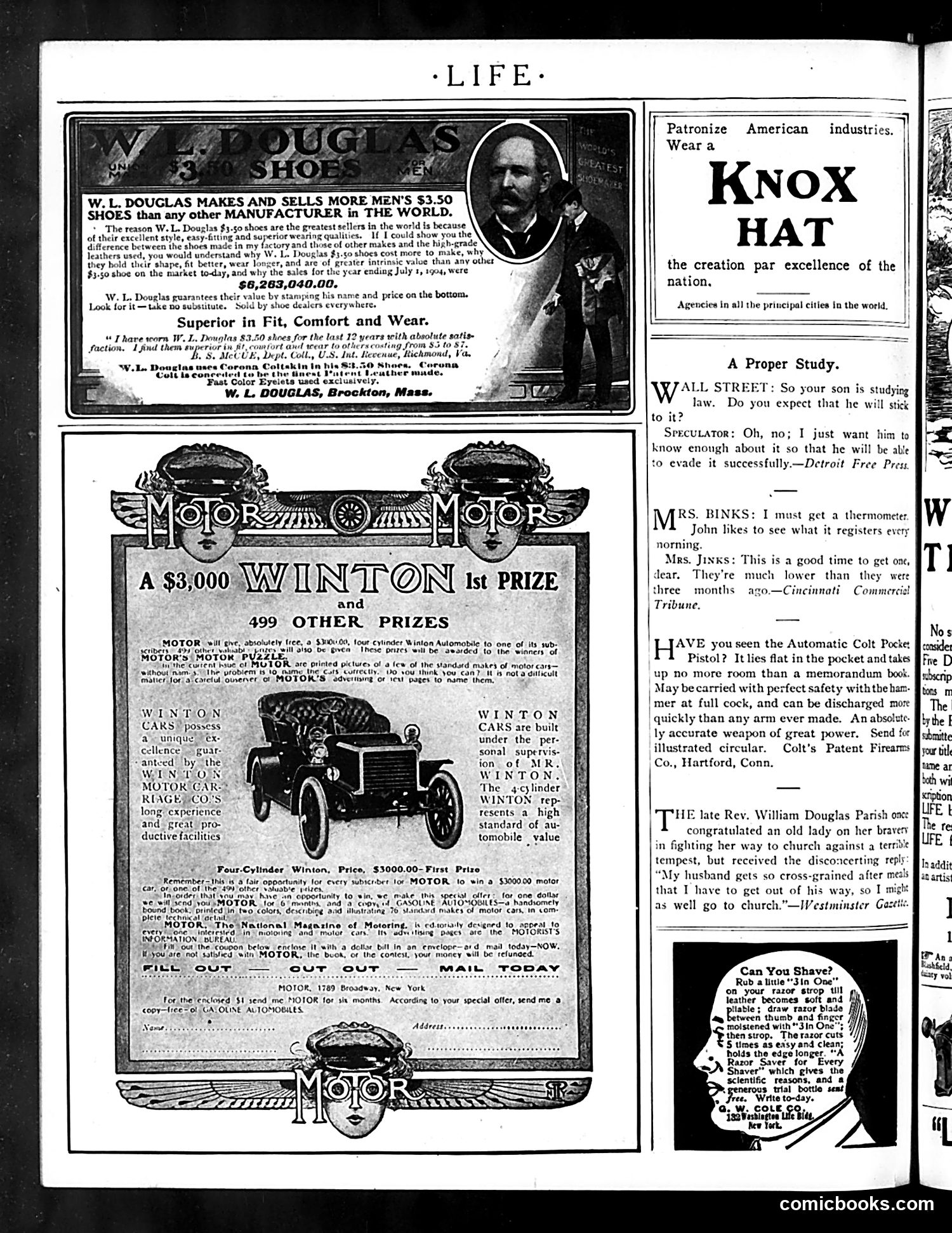
This page consists primarily of **advertisements rather than satirical cartoons**. The main content includes: 1. **W.L. Douglas Shoes ad**: A manufacturer boasting he sells more $3.50 men's shoes than any competitor, emphasizing quality and value. The text claims $6.26 million in annual sales—a significant figure meant to establish market dominance. 2. **Winton Automobile contest**: Motor magazine offers a $3,000 Winton automobile as first prize plus 499 other prizes for solving a puzzle identifying automobile makes from pictures. 3. **Knox Hat ad**: A patriotic appeal to "patronize American industries." 4. **Small humor pieces**: Brief jokes about studying law (to evade it), thermometer purchasing, and product advertisements for razors and Colt pistols. The page reflects early 1900s consumer culture, emphasizing American manufacturing, competitive pricing, and promotional contests. The "satire" is minimal—mainly gentle domestic humor rather than political commentary.
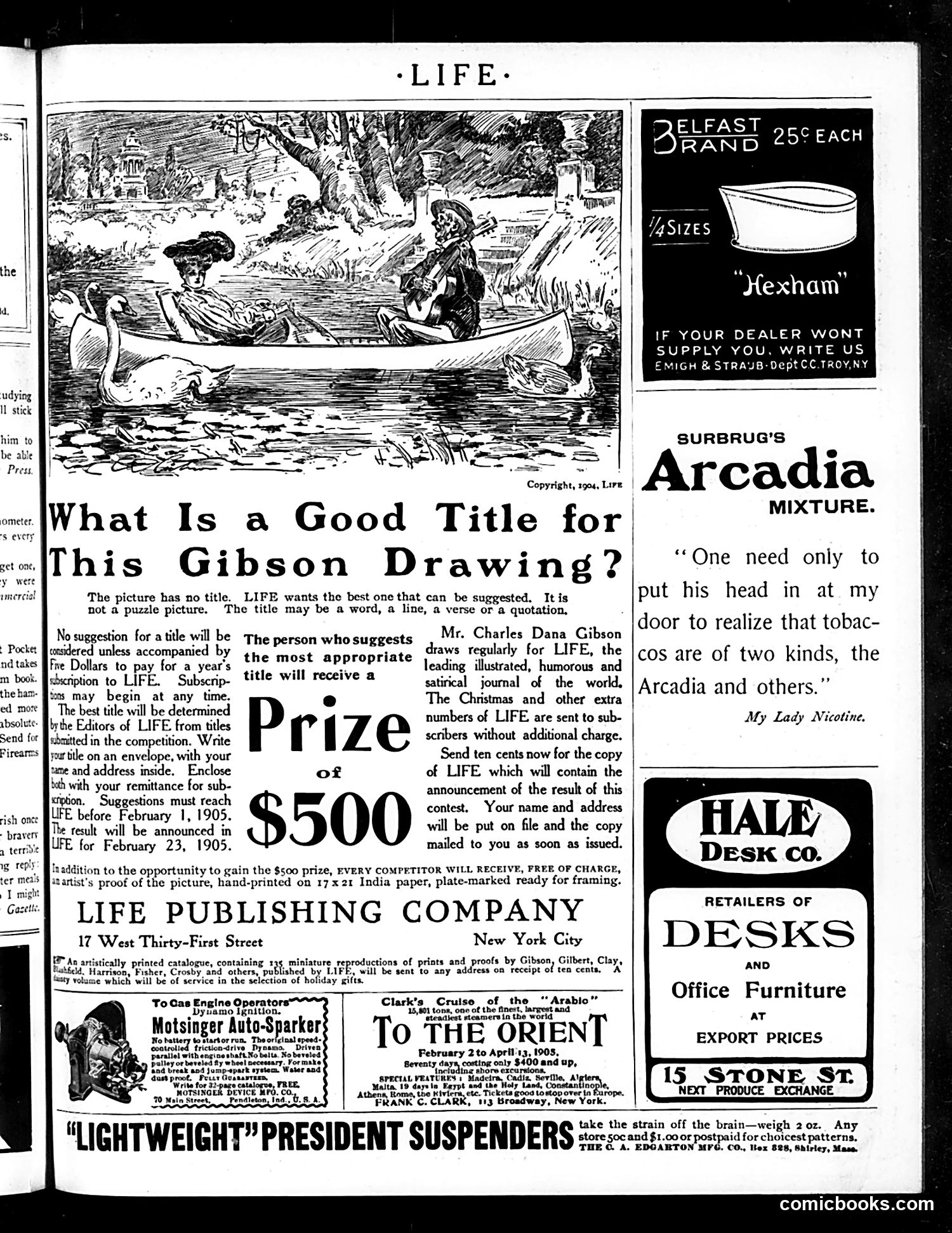
This is primarily an **advertising and contest page** from Life magazine (copyright 1904). The main feature is a **Charles Dana Gibson drawing** of two figures in a rowboat on a pastoral river, with the magazine running a contest asking readers to suggest the best title for it. The contest offers a **$500 prize** to whoever submits the most appropriate title, plus a free artist's proof for all entrants. Gibson was Life's star illustrator, known for his satirical and humorous work. The rest of the page comprises **period advertisements**: tobacco (Arcadia Mixture), office furniture (Hale Desk Co.), a luxury cruise to the Orient, auto parts, and other products typical of early 1900s commerce. **No political or social satire is present here**—this is essentially a reader-participation contest page combined with commercial sponsorships, common in magazines of this era.
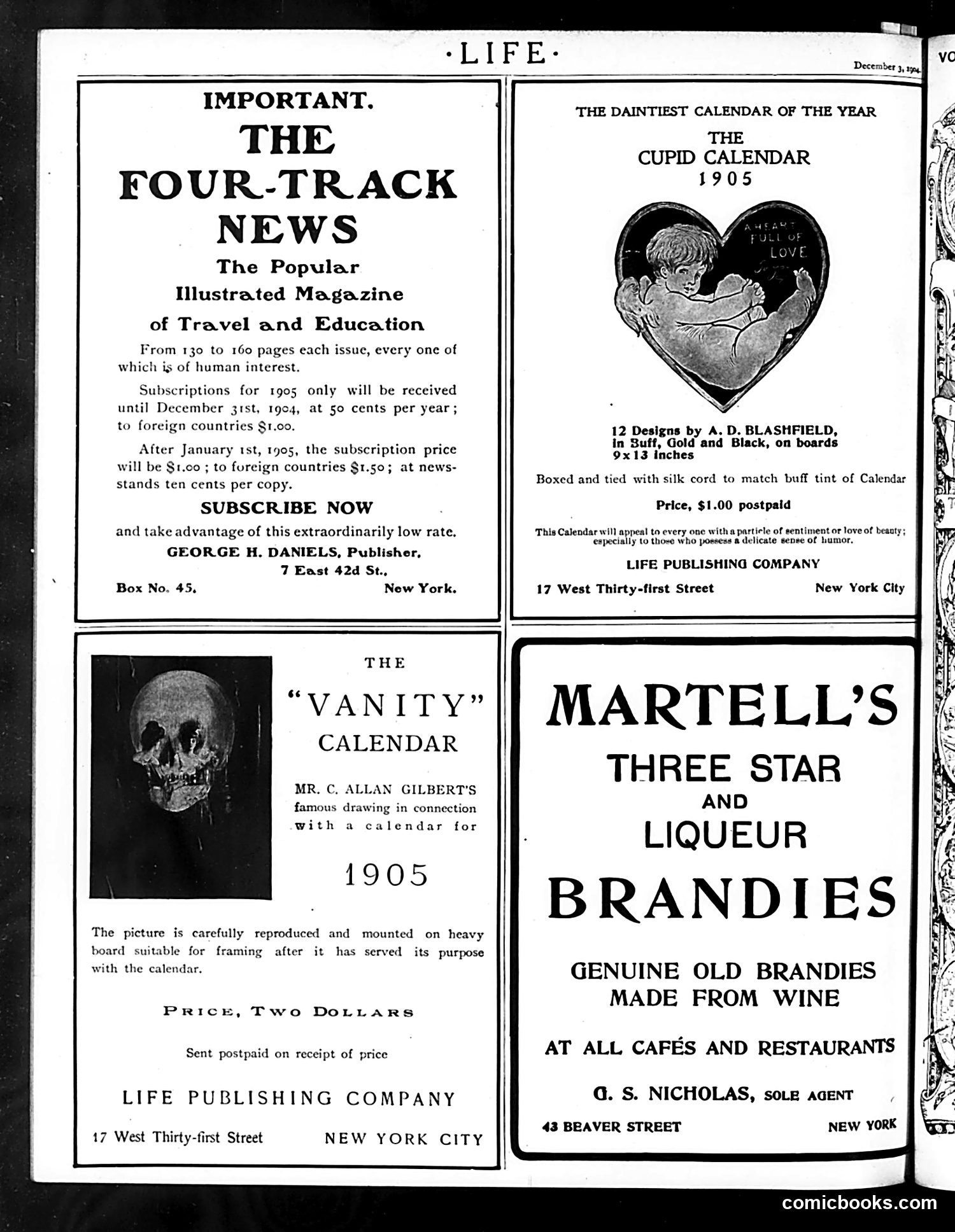
This is primarily an **advertising page**, not a satirical cartoon page. It contains four advertisements for 1905 products and subscriptions: 1. **Four-Track News** — a travel and education magazine offering early-bird subscription rates before a price increase in January 1905 2. **Cupid Calendar** — a romantic 1905 calendar featuring cupid imagery, marketed as sentimental and humorous gift for those with refined taste 3. **Vanity Calendar** — features C. Allan Gilbert's famous drawing (likely his well-known "Vanity" artwork showing a skull and naked woman), reproducible as framed art after serving as calendar 4. **Martell's Brandies** — advertisement for French brandy available at restaurants and cafés The page reflects early 1900s consumer culture: calendars were popular promotional/gift items, illustrated magazines emphasized travel and education, and alcohol advertising was openly displayed. No political satire is evident; this represents straightforward commercial promotion in Life magazine.