
Life, 1904-12-03 · page 12 of 22
Life — December 3, 1904 — page 12: what you’re looking at
What you’re looking at
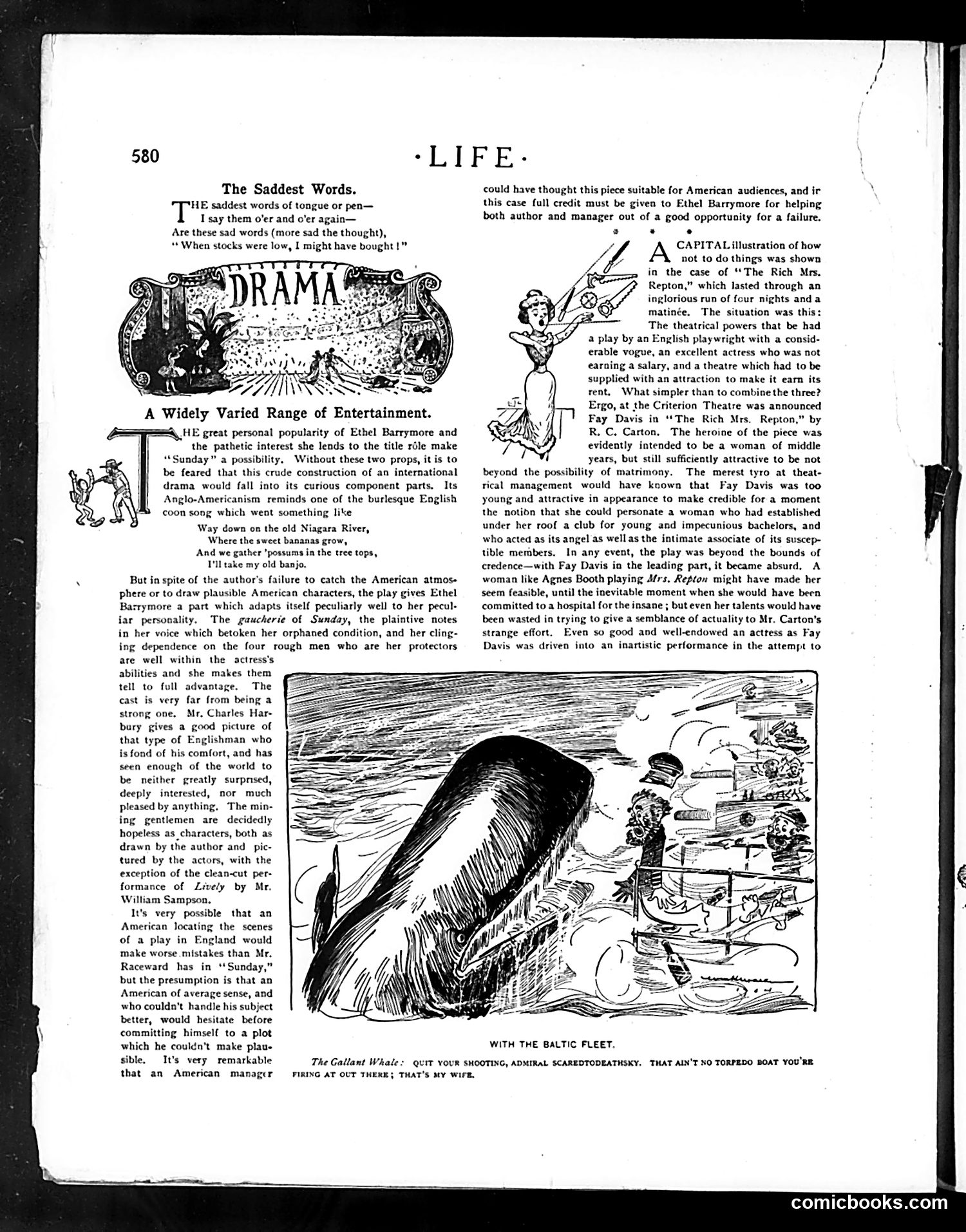
This page discusses theatrical productions and includes a satirical illustration titled "WITH THE BALTIC FLEET." The main cartoon depicts a large whale with what appears to be a military vessel or fleet scene in the background. The caption reads: "The Gallant Whale: 'OUT YOUR SHOOTING, ADMIRAL SCAREDIGOSTRATSKY. THAT AIN'T NO TORPEDO BOAT YOU'RE FIRING AT OUT THERE; THAT'S MY WIFE.'" This is likely satirizing early 1900s naval conflicts, possibly the Russo-Japanese War or Baltic Sea tensions. The joke mocks military incompetence—soldiers mistake a whale for enemy vessels. The mock-Russian name "Scaredigostratsky" parodies Russian military leadership of that era. The upper sections discuss Ethel Barrymore and theatrical productions, including "The Rich Mrs. Repton," contextualizing the page as entertainment and drama criticism mixed with political satire.
📄 Transcribed text from this page (OCR, searchable)
Machine-transcribed from the original scan — historical spelling and the odd misread are preserved.
-LIF E: The Saddest Words. HE saddest words of tongue or pen— I say them o'er and o'er again— Are these sad words (more sad the thought), “When stocks were low, I might have bought! A Widely Varied Range of Entertainment. HE great personal popularity of Ethel Barrymore and the pathetic interest she lends to the title réle make “*Sunday” a possibility, Without these two props, it is to be feared that this crude construction of an international drama would fall into its curious component parts. Its Anglo-Americanism reminds one of the burlesque English coon song which went something like Way down on the old Niagara River, Where the sweet bananas grow, And we gather "possums in the tree tops, I'll take my old banjo. But in spite of the author's failure to catch the American atmos- phere or to draw plausible American characters, the play gives Ethel Barrymore a part which adapts itself peculiarly well to her pecul- iar personality. The gaucherie of Sunday, the plaintive notes in her voice which betoken her orphaned condition, and her cling- ing dependence on the four rough men who are her protectors are well within the actress's abilities and she makes them tell to full advantage. The cast is very far from being a strong one, Mr, Charles Har+ bury gives a good picture of that type of Englishman who is fond of his comfort, and has seen enough of the world to be neither greatly surpnsed, deeply interested, nor much pleased by anything. The min- ing gentlemen are decidedly hopeless as characters, both as drawn by the author and. pic- tured by the actors, with the exception of the clean-cut per- formance of Lively by Mr, William Sampson, It's very possible that an American locating the scenes of a play in England would make worse mistakes than Mr, Raceward has in “Sunday,” but the presumption is that an American of average sense, and who couldn't handle his subject better, would hesitate before committing himself to a plot which he couldn't make plau- sible. It's very remarkable that an American manager —FiRiNG AT OUT THERE; THAT'S MY WIFE, could have thought this piece suitable for American audiences, and ir this case full credit must be given to Ethel Barrymore for helping both author and manager out of a good opportunity for a failure. ° CAPITAL illustration of how not to do things was shown in the case of “The Rich Mrs. Repton,” which lasted through an inglorious run of four nights anda matinée, The situation was this: The theatrical powers that be had a play by an English playwright with a consid- erable vogue, an excellent actress who was not earning a salary, and a theatre which had to be supplied with an attraction to make it earn its rent, What simpler than to combine the three? Ergo, at the Criterion Theatre was announced Fay Davis in “The Rich Mrs. Repton,” by R. C. Carton, The heroine of the piece was evidently intended to be a woman of middle years, but still sufficiently attractive to be not beyond the possibility of matrimony. The merest tyro at theat- rical management would have koown that Fay Davis was too young and attractive in appearance to make credible for a moment the notidn that she could personate a woman who had established under her roof a club for young and impecunious bachelors, and who acted as its angel as wellas the intimate associate of its suscep- tible merabers. In any event, the play was beyond the bounds of credence—with Fay Davis io the leading part, it became absurd, A woman like Agnes Booth playing Mrs. Repton might have made her seem feasible, until the inevitable moment when she would have been committed to a hospital for the insane ; but even her talents would have been wasted in trying to give a semblance of actuality to Mr. Carton’s strange effort. Even so good and well-endowed an acttess as Fay Davis was driven into an inartistic performance in the attempt to WITH THE BALTIC FLEET. The Gallant Whale: QUIT YOUR SHOOTING, ADMIRAL SCAREDTODEATHSKY, THAT AIN'T NO TORPEDO BOAT YOU'RE comicbooks.com