
Life, 1904-12-03 · page 4 of 22
Life — December 3, 1904 — page 4: what you’re looking at
What you’re looking at
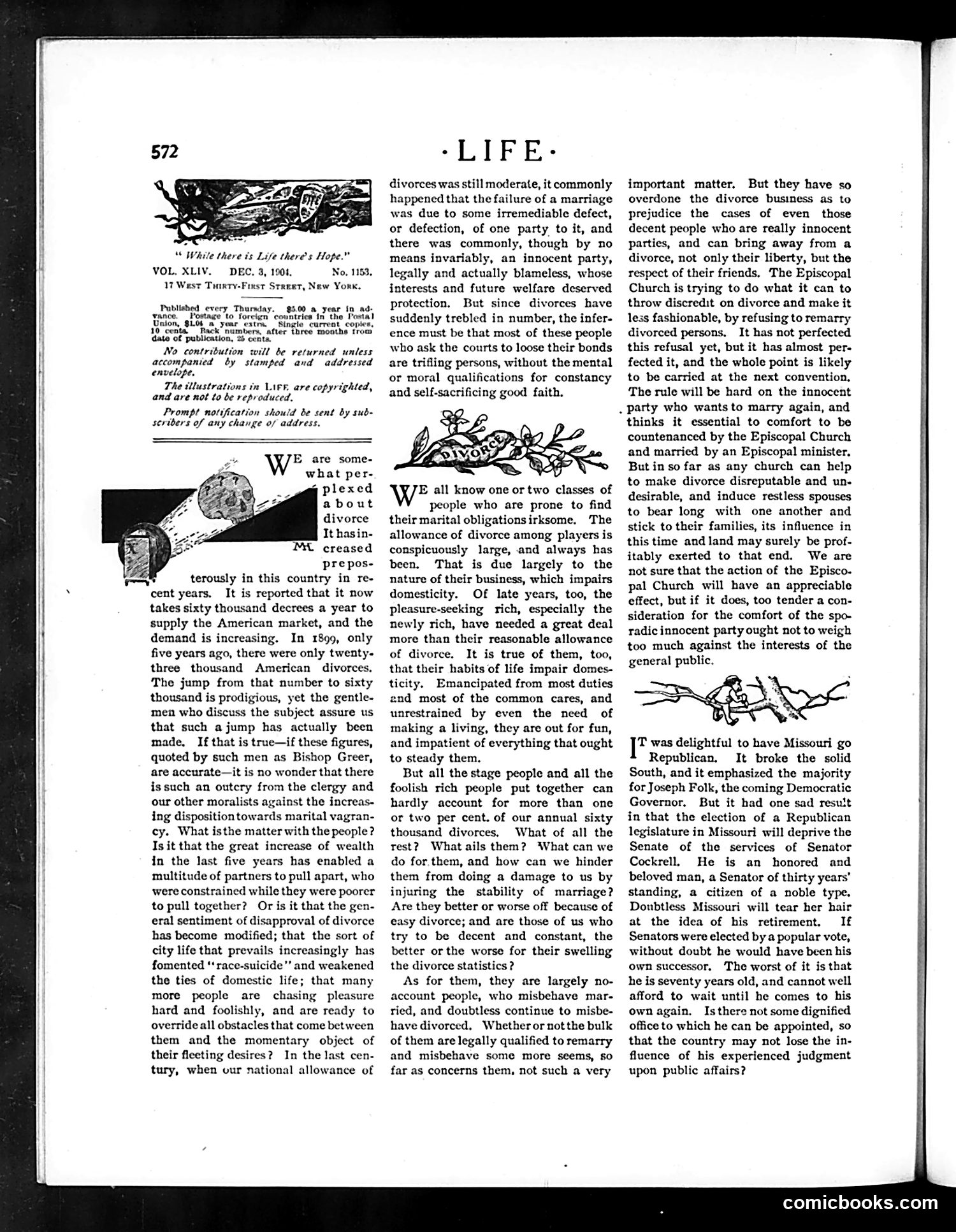
This page discusses the rise of divorce in America, presenting it as a social problem driven by wealthy, pleasure-seeking individuals. The text critiques both the frivolous rich who treat divorce casually and the Episcopal Church's difficulty in discouraging remarriage after divorce. The small cartoon illustrations (appearing as decorative vignettes) seem to depict figures in leisure activities, supporting the text's argument that wealthy Americans pursue "fun, and impatient of everything that ought to steady them." The second section shifts to political commentary about Missouri's Republican legislature and Senator Cockrell, praising his long service and lamenting his impending retirement due to age (seventy years old). The page blends social criticism with political commentary typical of Life's satirical approach.
📄 Transcribed text from this page (OCR, searchable)
Machine-transcribed from the original scan — historical spelling and the odd misread are preserved.
“ While there is Life there's Hope.” VOL. XLIV. DEC. 3, 1904, No, 1153, 17 West Tonety-Fixst Street, New York. Published every Thursday. $5.00 © year in ad- ¥Yance. Postage to foreign countrics in the Postal Union, $106 a year extra. Single current copies, 10. conta. Rack’ numbers. after three mouths {row dato of publication, 2 conte: No contribution will be returned unless accompanied by stamped and addressed envelope. The illustrations in Lier, are copyrighted, and are not to be reproduced. Prompt notification should be sent by sub- seribers of any change of address, E are some- what per- plexed about divorce It hasin- ML creased pre pos- terously in this country in re- cent years. It is reported that it now takes sixty thousand decrees a year to supply the American market, and the demand is increasing. In 1899, only five years ago, there were only twenty- three thousand American divorces. The jump from that number to sixty thousand is prodigious, yet the gentle- men who discuss the subject assure us that such a jump has actually been made, If that is true—if these figures, quoted by such men as Bishop Greer, are accurate—it is no wonder that there is such an outcry from the clergy and our other moralists against the increas- ing disposition towards marital vagran- cy. What isthe matter with the people? Isit that the great increase of wealth in the last five years has enabled a multitude of partners to pull apart, who were constrained while they were poorer to pull together? Or is it that the gen- eral sentiment of disapproval of divorce has become modified; that the sort of city life that prevails increasingly has fomented ‘‘race-suicide’’ and weakened the ties of domestic life; that many more people are chasing pleasure hard and foolishly, and are ready to override all obstacles that come between them and the momentary object of their flecting desires? In the last cen- tury, when our national allowance of -LIFE: divorces was still moderate, it commonly happened that the failure of a marriage was due to some irremediable defect, or defection, of one party to it, and there was commonly, though by no means invariably, an innocent party, legally and actually blameless, whose interests and future welfare deserved protection, But since divorces have suddenly trebled in number, the infer- ence must be that most of these people who ask the courts to loose their bonds are trifling persons, without the mental or moral qualifications for constancy and self-sacrificing good faith, E all know one or two classes of people who are prone to find their marital obligations irksome. The allowance of divorce among players is conspicuously large, and always has been. That is due largely to the nature of their business, which impairs domesticity. Of late years, too, the pleasure-seeking rich, especially the newly rich, have needed a great deal more than their reasonable allowance of divorce. It is true of them, too, that their habits of life impair domes- ticity. Emancipated from most duties end most of the common cares, and unrestrained by even the need of making a living, they are out for fun, and impatient of everything that ought to steady them, But all the stage people and all the foolish rich people put together can hardly account for more than one or two per cent. of our annual sixty thousand divorces, What of all the rest? What ails them? What can we do for.them, and how can we hinder them from doing a damage to us by injuring the stability of marriage? Are they better or worse off because of easy divorce; and are those of us who try to be decent and constant, the better or the worse for their swelling the divorce statistics ? As for them, they are largely no- account people, who misbehave mar- ried, and doubtless continue to misbe- have divorced. Whether or not the bulk of them are legally qualified to remarry and misbehave some more seems, 50 far as concerns them, not such a very important matter. But they have so overdone the divorce business as to prejudice the cases of even those decent people who are really innocent parties, and can bring away from a divorce, not only their liberty, but the respect of their friends. The Episcopal Church is trying to do what it can to throw discredit on divorce and make it less fashionable, by refusing to remarry divorced persons, It has not perfected this refusal yet, but it has almost per- fected it, and the whole point is likely to be carried at the next convention. The rule will be hard on the innocent . party who wants to marry again, and thinks it essential to comfort to be countenanced by the Episcopal Church and married by an Episcopal minister. But in so far as any church can help to make divorce disreputable and un- desirable, and induce restless spouses to bear long with one another and stick to their families, its influence in this time and land may surely be prof- itably exerted to that end. We are not sure that the action of the Episco- pal Church will have an appreciable effect, but if it does, too tender a con- sideration for the comfort of the spo- radic innocent party ought not to weigh too much against the interests of the general public. ig was delightful to have Missouri go Republican, It broke the solid South, and it emphasized the majority for Joseph Folk, the coming Democratic Governor. But it had one sad resutt in that the election of a Republican legislature in Missouri will deprive the Senate of the services of Senator Cockrell, He is an honored and beloved man, a Senator of thirty years’ standing, a citizen of a noble type. Doubtless Missouri will tear her hair at the idea of his retirement. If Senators were elected by a popular vote, without doubt he would have been his own successor, The worst of it is that he is seventy years old, and cannot well afford to wait until he comes to his own again, Isthere not some dignified office to which he can be appointed, so that the country may not lose the in- fluence of his experienced judgment upon public affairs? comicbooks.com