
Life, 1904-12-03 · page 14 of 22
Life — December 3, 1904 — page 14: what you’re looking at
What you’re looking at
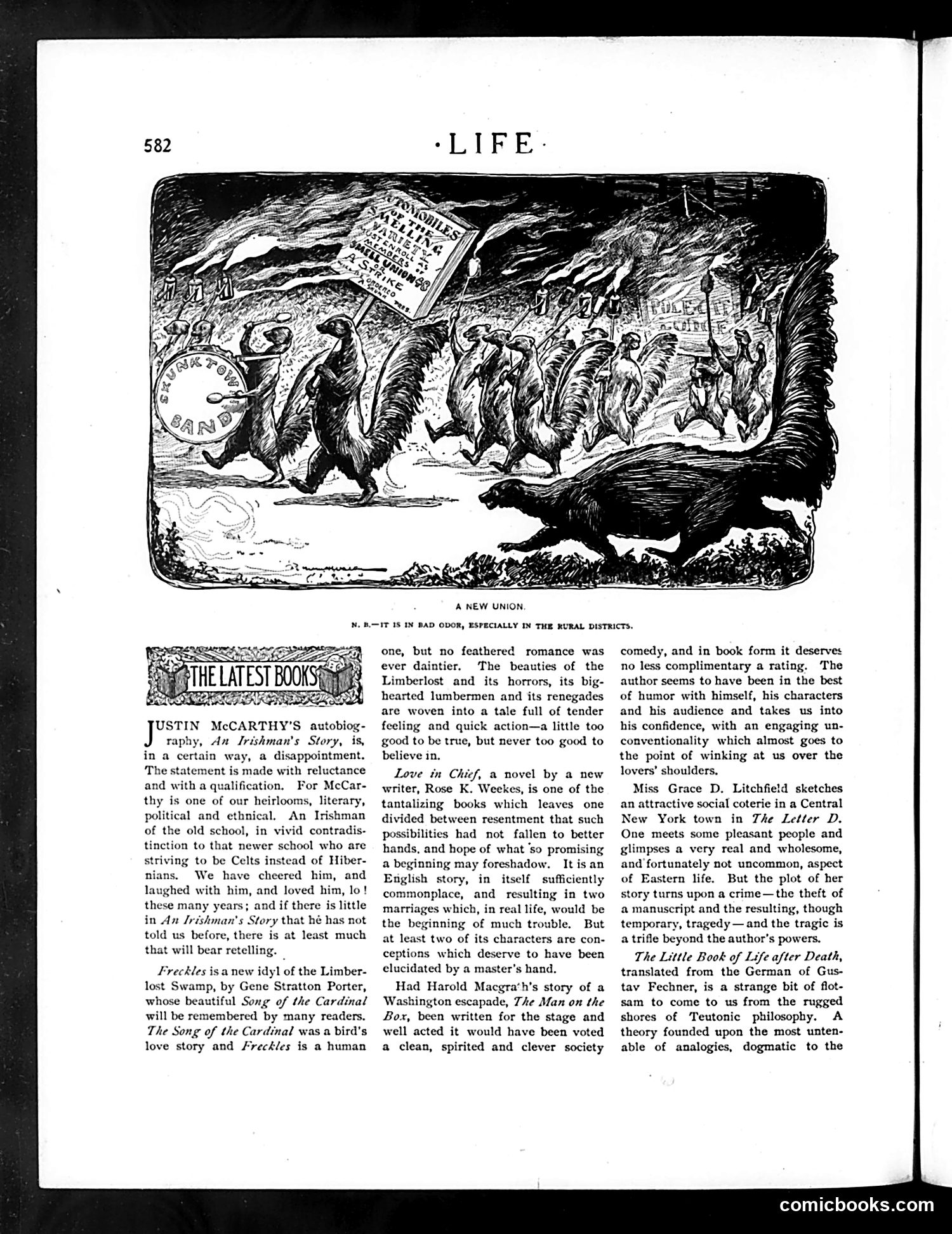
The cartoon depicts bears and dogs in apparent conflict or negotiation, with a sign reading "Yankee's Healing Salve" floating above. The caption states the depicted union "IS IN BAD ODOR, ESPECIALLY IN THE RURAL DISTRICTS." This appears to be satire about a political or social merger unpopular with rural America. The animals likely represent different political factions or regions attempting to unite. The "healing salve" references attempting to remedy discord, while "bad odor" suggests the union is widely disliked, particularly among rural voters. Without knowing the specific publication date, the exact political conflict remains unclear—this could reference post-Civil War Reconstruction, labor union disputes, or a proposed political alliance. The rural resistance suggests tension between urban and agricultural interests. The satirical presentation through animal characters was typical of Life magazine's political commentary style, allowing indirect criticism of contemporary issues.
📄 Transcribed text from this page (OCR, searchable)
Machine-transcribed from the original scan — historical spelling and the odd misread are preserved.
A NEW UNION. N, BIT IS IN BAD ODOR, ESPECIALLY IN THE RURAL DISTRICTS. USTIN McCARTHY’S autobiog- raphy, Aa Irishman's Story, is, in a certain way, a disappointment. The statement is made with reluctance and with a qualification, For McCar- thy is one of our heirlooms, literary, political and ethnical. An Irishman of the old school, in vivid contradis- ion to that newer school who are ng to be Celts instead of Hiber- nians. We have cheered him, and laughed with him, and loved him, lo! these many years; and if there is little in An Jrishman's Story that hé has not told us before, there is at least much that will bear retelling. Freckles isa new idy] of the Limber- lost Swamp, by Gene Stratton Porter, whose beautiful Song of the Cardinal will be remembered by many readers. The Song of the Cardinal was a bird's love story and Freckles is a human one, but no feathered romance was ever daintier. The beauties of the Limberlost and its horrors, its big- hearted lumbermen and its renegades are woven into a tale full of tender fecling and quick action—a little too good to be true, but never too good to believe in. Love in Chief, a novel by a new writer, Rose K. Weekes, is one of the tantalizing books which leaves one divided between resentment that such possibilities had not fallen to better hands, and hope of what ‘so promising a beginning may foreshadow. It is an English story, in itself sufficiently commonplace, and resulting in two marriages which, in real life, would be the beginning of much trouble. But at least two of its characters are con- ceptions which deserve to have been elucidated by a master's hand, Had Harold Macgra‘h’s story of a Washington escapade, The Man on the Box, been written for the stage and well acted it would have been voted a clean, spirited and clever society comedy, and in book form it deserves no less complimentary a rating. The author seems to have been in the best of humor with himself, his characters and his audience and takes us into his confidence, with an engaging un- conventionality which almost goes to the point of winking at us over the lovers’ shoulders. Miss Grace D. Litchfield sketches an attractive social coterie in a Central New York town in The Letter D. One meets some pleasant people and glimpses a very real and wholesome, and fortunately not uncommon, aspect of Eastern life. But the plot of her story turns upon a crime—the theft of a manuscript and the resulting, though temporary, tragedy — and the tragic is a trifle beyond the author's powers. The Little Book of Life after Death, translated from the German of Gus- tav Fechner, is a strange bit of flot- sam to come to us from the rugged shores of Teutonic philosophy. A theory founded upon the most unten- able of analogies, dogmatic to the comicbooks.com