
Life, 1904-12-03 · page 13 of 22
Life — December 3, 1904 — page 13: what you’re looking at
What you’re looking at
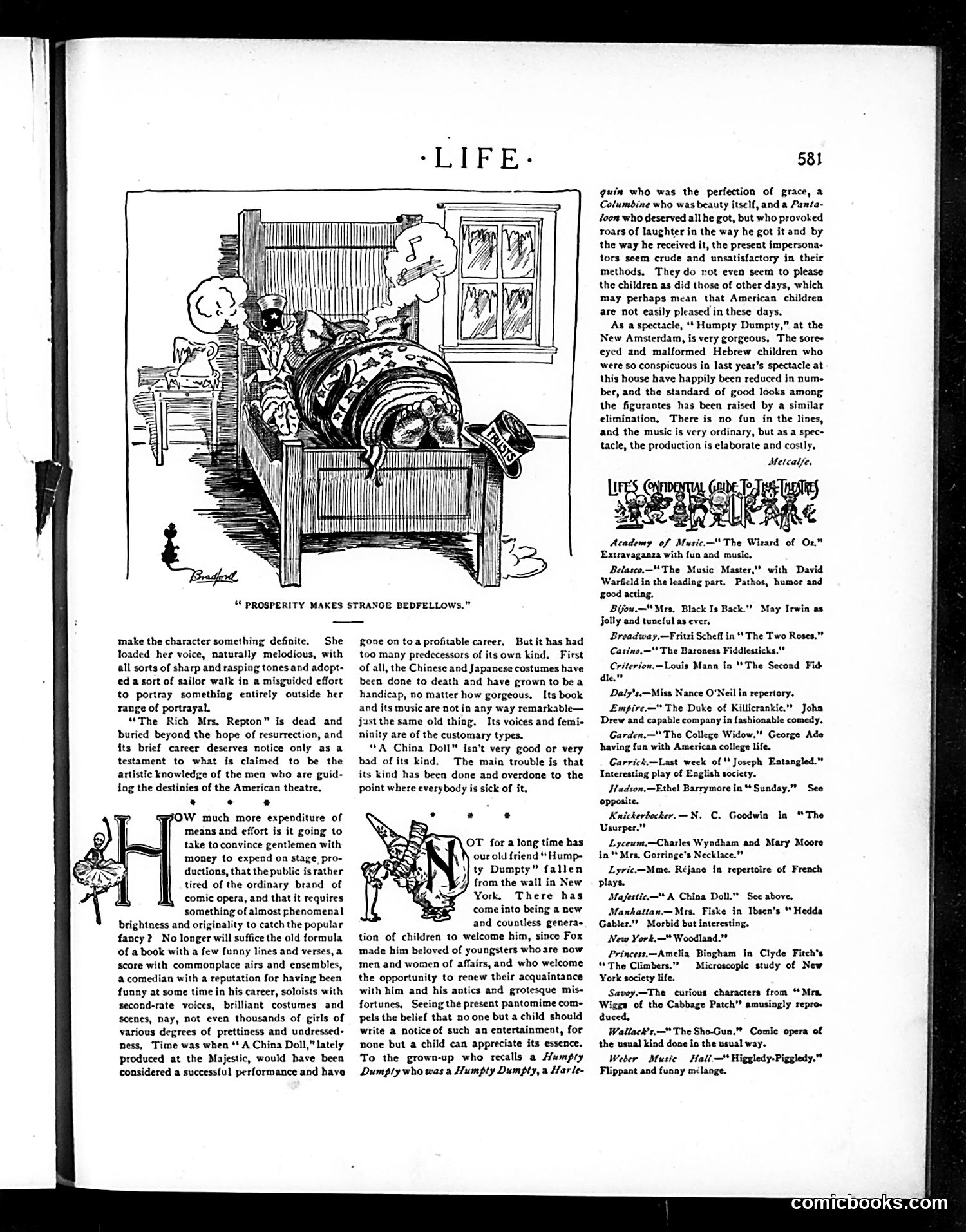
This page critiques the state of American theater circa the early 1900s. The main cartoon shows a disheveled man and woman in bed together—a visual metaphor for the title's phrase about unlikely partnerships. The accompanying text argues that theatrical producers, flush with money during prosperous times, waste resources on tired formulas: cheap comic operas with mediocre scores, aging comedians trading on past reputations, and spectacles relying on pretty choruses rather than genuine talent or originality. The critic specifically attacks "A China Doll" at the Majestic as exemplifying exhausted material—Chinese/Japanese costumes and plots done "to death." He also dismisses the current "Humpty Dumpty" pantomime at the New Amsterdam as crude compared to earlier versions, noting even children aren't amused. The only praise goes to its elaborate (if costly) visual production. The satire's point: prosperity enables lazy theater-making rather than artistic innovation.
📄 Transcribed text from this page (OCR, searchable)
Machine-transcribed from the original scan — historical spelling and the odd misread are preserved.
““ PROSPERITY MAKES STRANGE BEDFELLOWS.” make the character something definite. She loaded her voice, naturally melodious, with all sorts of sharp and rasping tones and adopt- ed a sort of sailor walk in a misguided effort to portray something entirely outside her range of portrayal. “The Rich Mrs, Repton” is dead and buried beyond the hope of resurrection, and {ts brief career deserves notice only as a testament to what is claimed to be the artistic knowledge of the men who are guid- ing the destinies of the American theatre, . . * W much more expenditure of means and effort is it going to take toconvince gentlemen with money to expend on stage, pro- ductions, that the public israther tired of the ordinary brand of comic opera, and that it requires something of almost phenomenal brightness and originality to catch the popular fancy? No longer will suffice the old formula of a book with a few funny lines and verses, a score with commonplace airs and ensembles, acomedian with a reputation for having been funny at some time in his career, soloists with second-rate voices, brilliant costumes and scenes, nay, not even thousands of girls of various degrees of prettiness and undressed- ness, Time was when ‘A China Doll,” lately produced at the Majestic, would have been considered a successful performance and have Rone on toa profitable career, But it has had too many predecessors of its own kind, First of all, the Chinese and Japanese costumes have been done to death and have grown to be a handicap, no matter how gorgeous, Its book and its music are not in any way remarkable— jast the same old thing. Its voices and femi- ninity are of the customary types. “A China Doll” isn't very good or very bad of its kind. The main trouble is that its kind has been done and overdone to the point where everybody is sick of it. * * OT for along time has our old friend “Hump- ty Dumpty” fallen from the wall in New York, There has come into being a new and countless genera- tion of children to welcome him, since Fox made him beloved of youngsters whoare now men and women of affairs, and who welcome the opportunity to renew their acquaintance with him and his antics and grotesque mis- fortunes, Seeing the present pantomime com- pels the belief that noone but a child should write a notice of such an entertainment, for none but a child can appreciate its essence. To the grown-up who recalls a Humpty Dumpty who was a Humpty Dumpty, a Harle- 584 guin who was the perfection of grace, a Columbine who was beauty itself, and a Panta- Joon who deserved allhe got, but who provoked roars of laughter in the way he got it and by the way he received it, the present impersona- tors seem crude and unsatisfactory in their methods, They do rot even seem to please the children as did those of other days, which may perhaps mean that American children are not easily pleased in these days. As a spectacle, ‘‘ Humpty Dumpty,” at the New Amsterdam, is very gorgeous, The sore= eyed and malformed Hebrew children who were so conspicuous in last year’s spectacle at this house have happily been reduced in num- ber, and the standard of good looks among the figurantes has been raised by a similar elimination, There is no fun in the lines, and the music is very ordinary, but as a spec- tacle, the production is elaborate and costly, Metcalfe. Academy of, Music.—""The Wizard of Oz." Extravaganza with fun and music, Belasco,—"The Music Master,” with David Warfield in the leading part. Pathos, humor and good acting. Bijou." Mrs, Black Is Back.” May Irwin as Jolly and tuneful as ever. Breadway.—Fritzi Schefl in “The Two Roses."* Casino." The Baroness Fiddlesticks."* Criterion.—Louis Mann ia “The Second Fid dle.” Daly's.—Miss Nance O'Neil in repertory. Empire.—" The Duke of Killicrankie.” Joho Drew and capable company in fashionable comedy. Garden.—" The College Widow." George Ade having fun with American college life. Garrick.—Last week of Joseph Entangled.” Interesting play of English society. Hudson.—Ethel Barrymore in “ Sunday.” opposite. Knickerbocker. N.C. Usurper.”* Lyceum,—Charles Wyndham and Mary Moore in“ Mrs, Gorringe’s Necklace.” Lyrie.—Mme. Réjane in repertoire of French plays. Majestic. Manhattan.— Mrs. Fiske in Ibsen's “Hedda Gabler.” Morbid but interesting. New York,—" Woodland.” Princerz-—Amelia Bingham in Clyde Fitch's “The Climbers.” Microscopic study of New York society life. See Goodwin in “The Savey.—The curious characters from “Mra, Wiggs of the Cabbage Patch” amusingly repro- duced, Wallack's.—"The Sho-Gua.” Comic opera of the usual kind done in the usual way. Weber Music Hall. —* Higgledy-Piggledy.” Flippant and funny mélange,