
A complete issue · 20 pages · 1904
Life — November 10, 1904
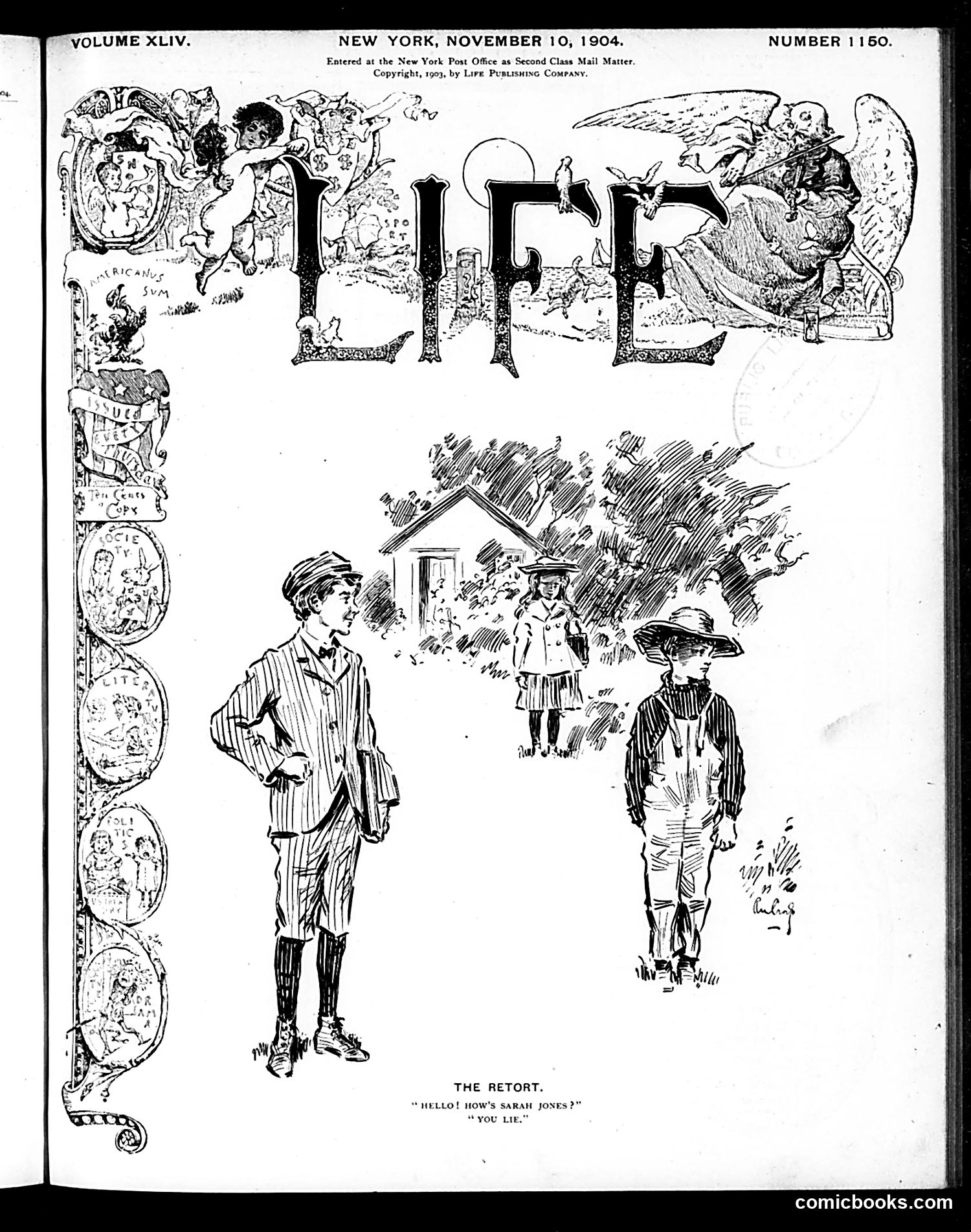
This page features "The Retort," a cartoon depicting two young boys in early 1900s attire. The dialogue reads: "HELLO! HOW'S SARAH JONES?" / "YOU LIE." The humor appears to rest on a sharp comeback—one boy's abrupt denial suggests the other boy has made an inappropriate or insulting remark about a girl named Sarah Jones. The cartoon likely satirizes childhood social dynamics and the quick-tempered responses of young people to perceived slights regarding girls they know. The elaborate decorative borders and ornamental header with fantastical creatures are typical of Life's art nouveau design aesthetic from this era. Without additional context about "Sarah Jones," the specific social reference remains unclear, but the cartoon captures a moment of youthful indignation.
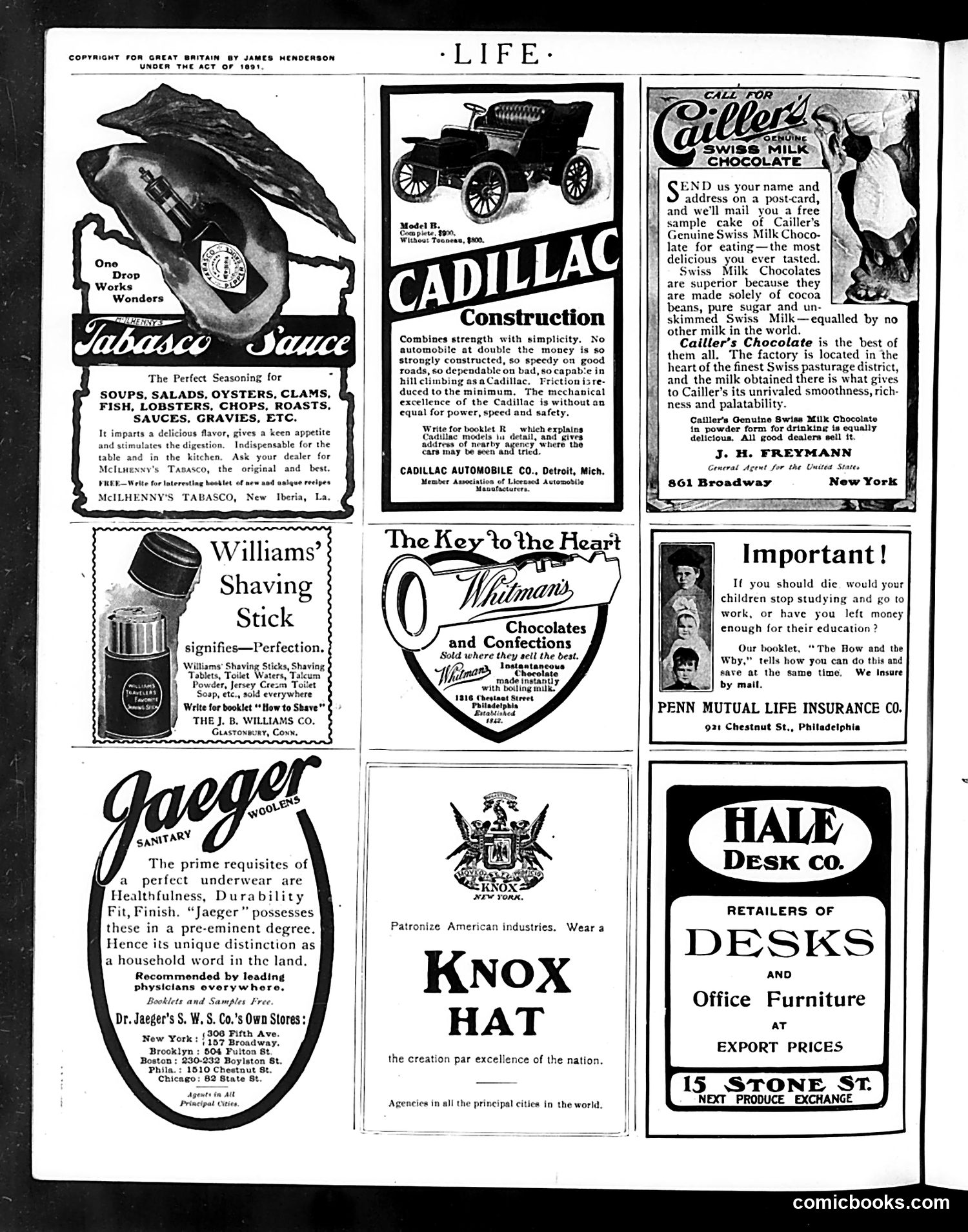
This page is **primarily advertising**, not editorial content or satire. It contains nine commercial advertisements from the early 20th century, including: - Tabasco Sauce (seasoning) - Cadillac automobiles - Callard & Stewart Swiss Milk Chocolate - Williams' Shaving Stick - Whitman's Chocolates - Penn Mutual Life Insurance - Jaeger woolens (undergarments) - Knox Hat (with patriotic "Patronize American industries" messaging) - Hale Desk Co. (office furniture) There are **no political cartoons or satirical commentary** on this page. The only potentially notable element is the Knox Hat advertisement's explicit call to buy American products, reflecting early 20th-century nationalist sentiment. Otherwise, this represents standard commercial advertising from *Life* magazine's revenue model.
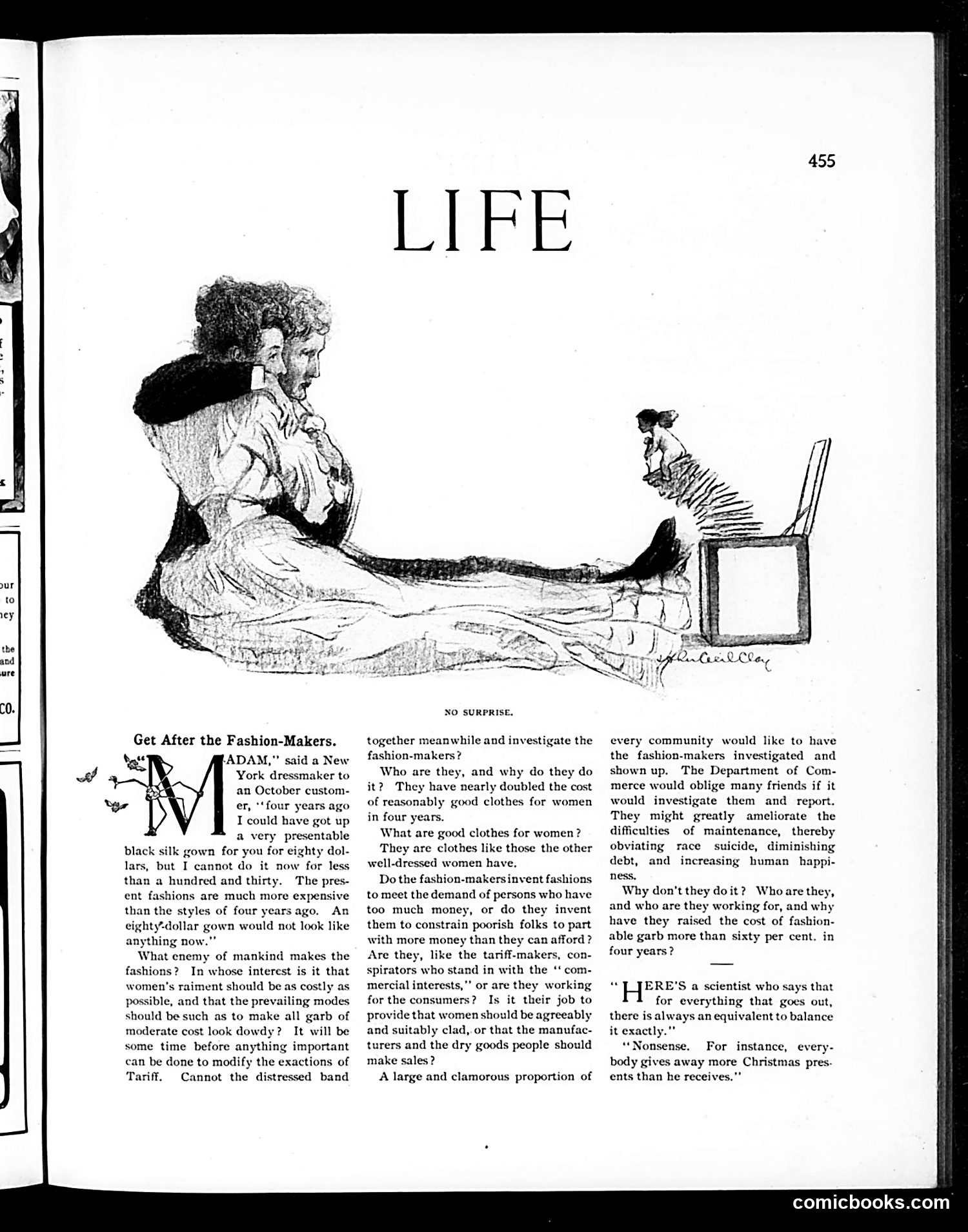
This page satirizes the fashion industry's practices and influence on women's clothing costs. The main cartoon shows a reclining woman with an extremely elongated train on her dress, while a tiny figure (likely representing a fashion designer or manufacturer) sits atop the excess fabric. The accompanying article, "Get After the Fashion-Makers," critiques how designers artificially drive up clothing prices—a woman notes she paid eighty dollars for a dress that costs less than one hundred in materials. The satire questions whether fashion-makers serve consumers or exploit them for profit, suggesting their designs are deliberately wasteful and expensive. The piece attacks what it views as conspiratorial collusion between manufacturers and "tariff-makers" to keep prices artificially high, ultimately harming ordinary women.
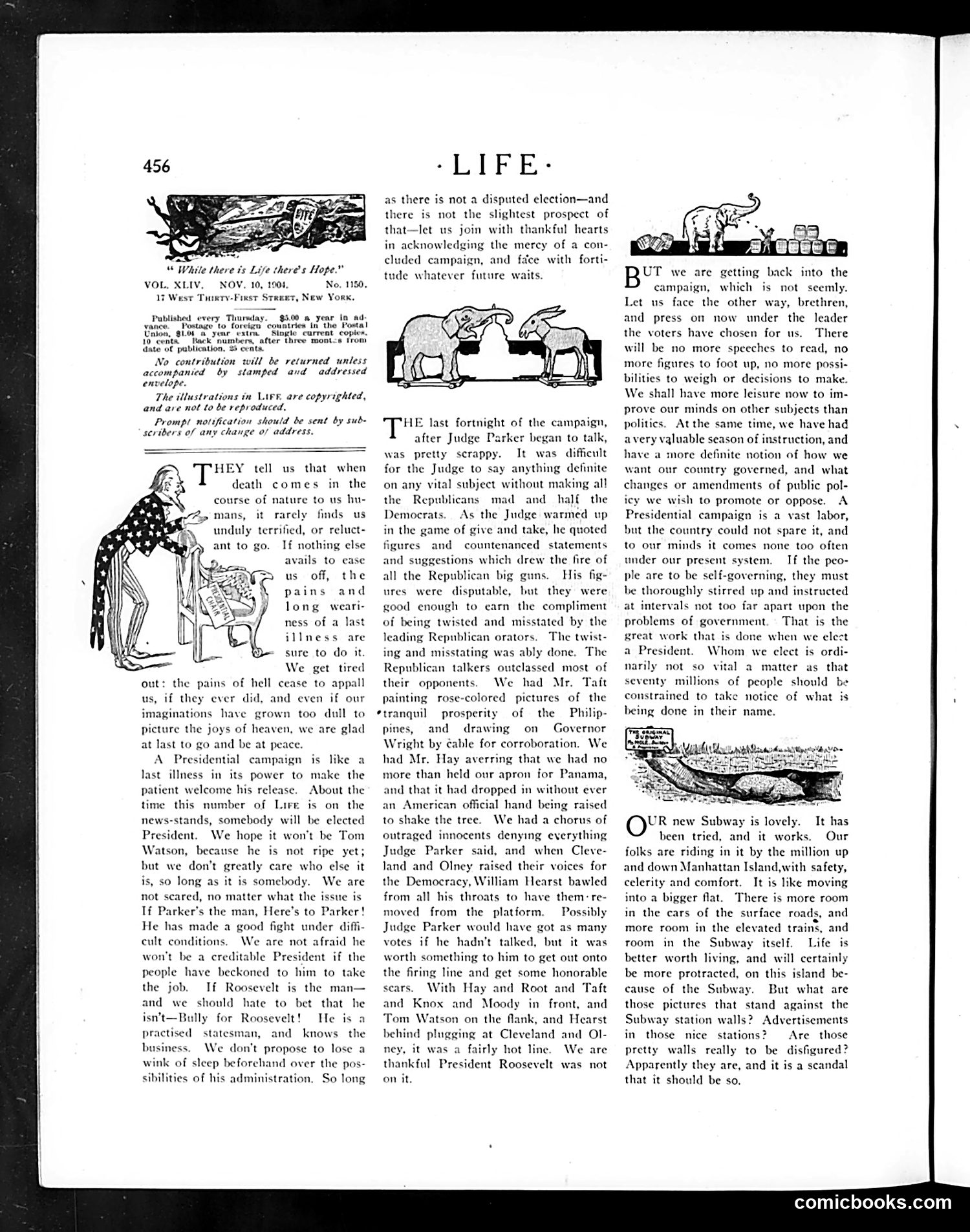
This November 1901 *Life* magazine page contains editorial commentary on an ongoing U.S. Presidential campaign. The text criticizes Republican campaign messaging as repetitive and misleading, accusing Republicans of "twisting and misstating" Democratic positions while deploying favorable imagery (rose-colored pictures of prosperity, references to the Philippines). The large illustration on the left depicts Death visiting a sick man, using this memento mori imagery to argue that a Presidential campaign, while labor-intensive, brings welcome relief from life's burdens—a darkly humorous point about voter exhaustion. The separate commentary on "our new Subway" discusses the newly opened New York City Subway system, praising its safety and comfort while criticizing the advertising in subway station walls as visually inappropriate.
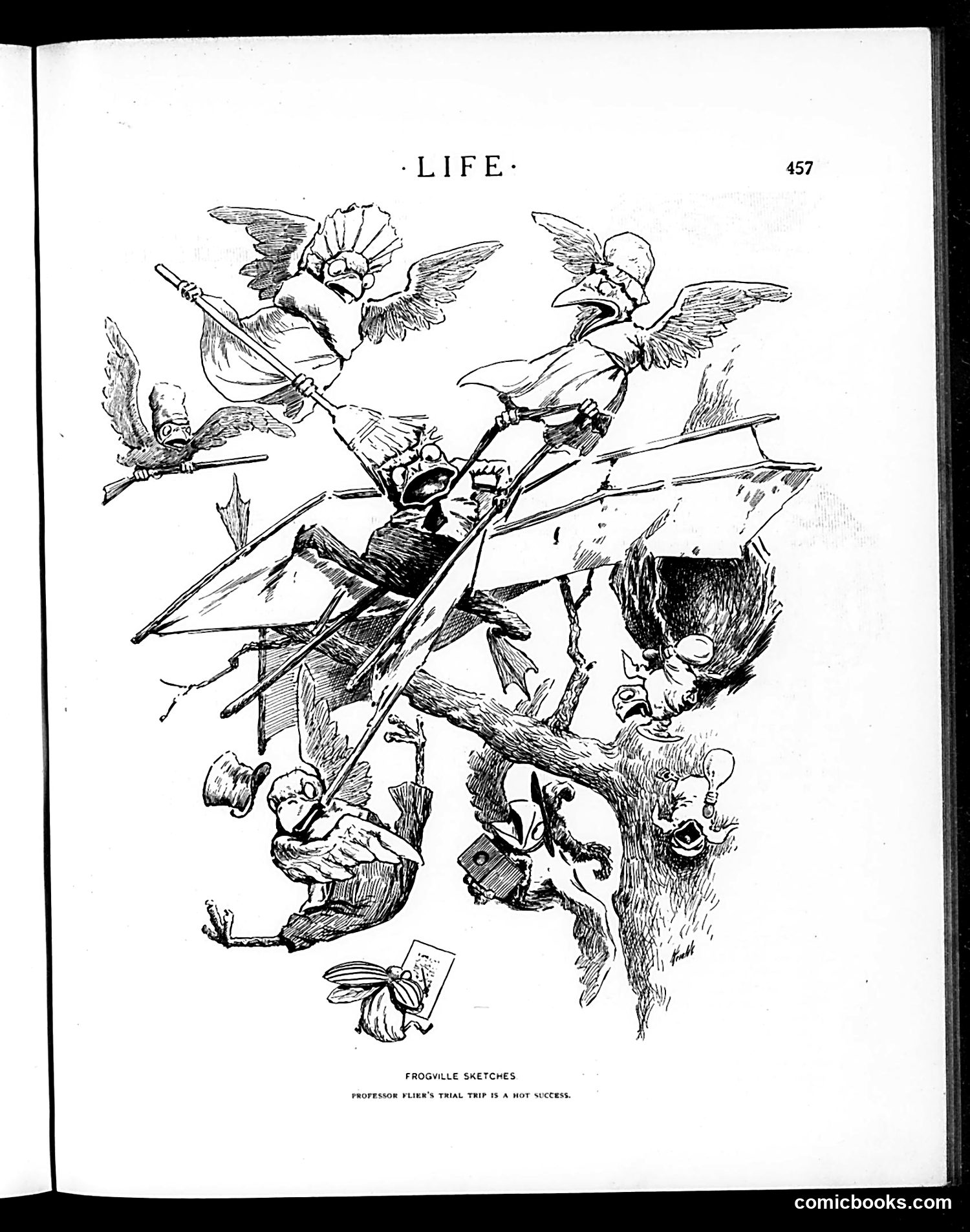
This is a satirical illustration titled "Frogville Sketches" with the caption "Professor Flick's Trial Trip Is a Hot Success." The cartoon depicts anthropomorphic frogs engaging in various activities on tree branches and in a natural setting. The frogs appear to be engaged in different pursuits—some flying (with wings), some climbing, some with tools or implements—suggesting various human occupations and behaviors. Without additional context about who "Professor Flick" is or what specific event this references, the satire's exact target remains unclear. However, the "trial trip" and "hot success" caption suggest this may be mocking a contemporary scientific experiment, inventor's demonstration, or expedition. The chaotic, overlapping activity of the frogs performing human-like actions creates humor through anthropomorphic absurdity.
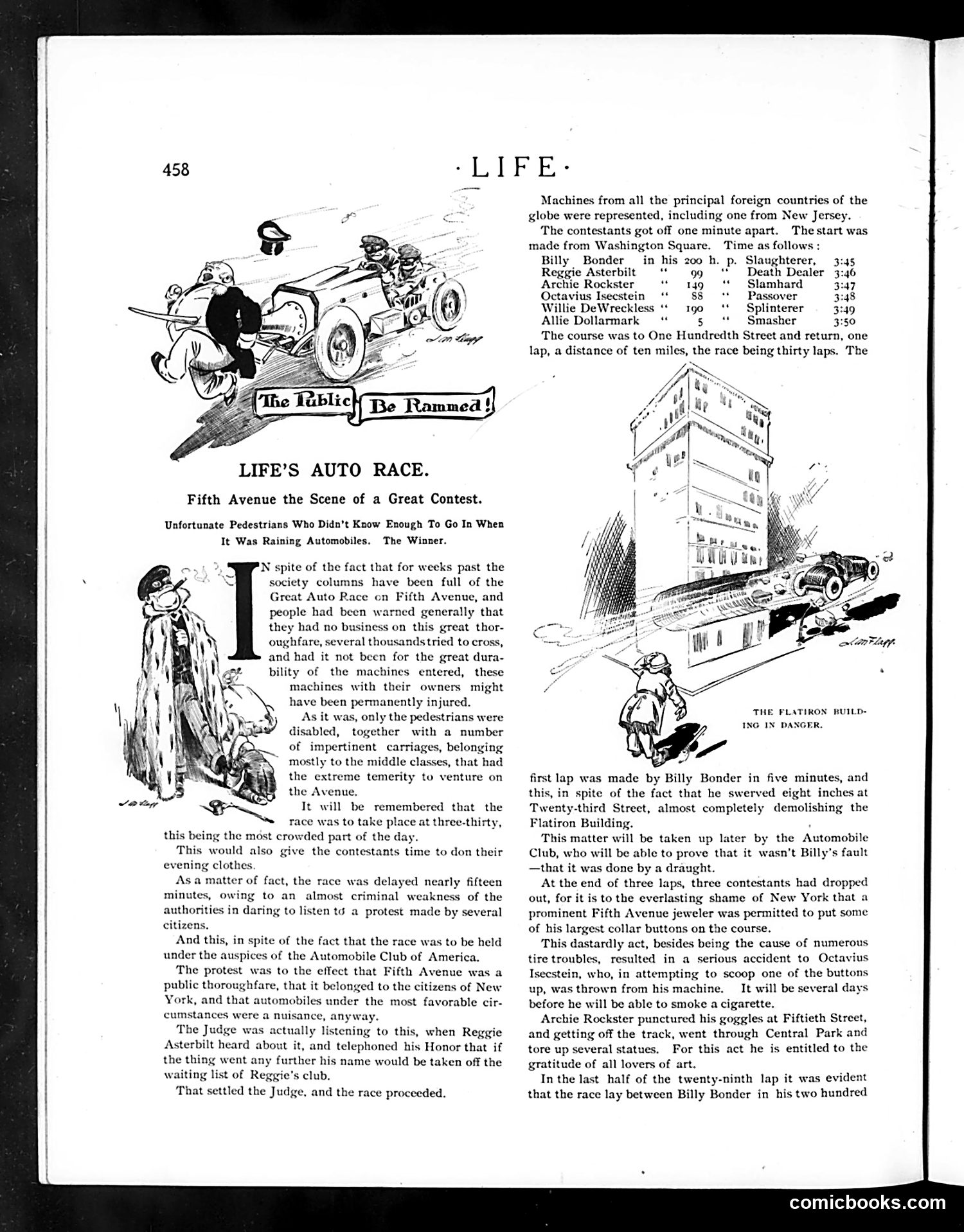
This satirical piece mocks New York City's chaotic early automobile era. The article describes a race held on Fifth Avenue organized by the Automobile Club of America, ostensibly to demonstrate vehicle safety—yet the event nearly caused serious accidents. The cartoon critiques the absurdity: pedestrians (shown as bewildered figures) were endangered by speeding cars on a crowded city street. One driver, Octavius Isecstein, was thrown from his vehicle; another, Archie Rockster, tore through Central Park. The satire targets both the pretentious automobile club (claiming the race proved cars safe) and the broader social chaos of introducing high-speed machines into urban pedestrian spaces. The joke: automobiles promised progress but delivered danger to ordinary citizens unprepared for this new technology.
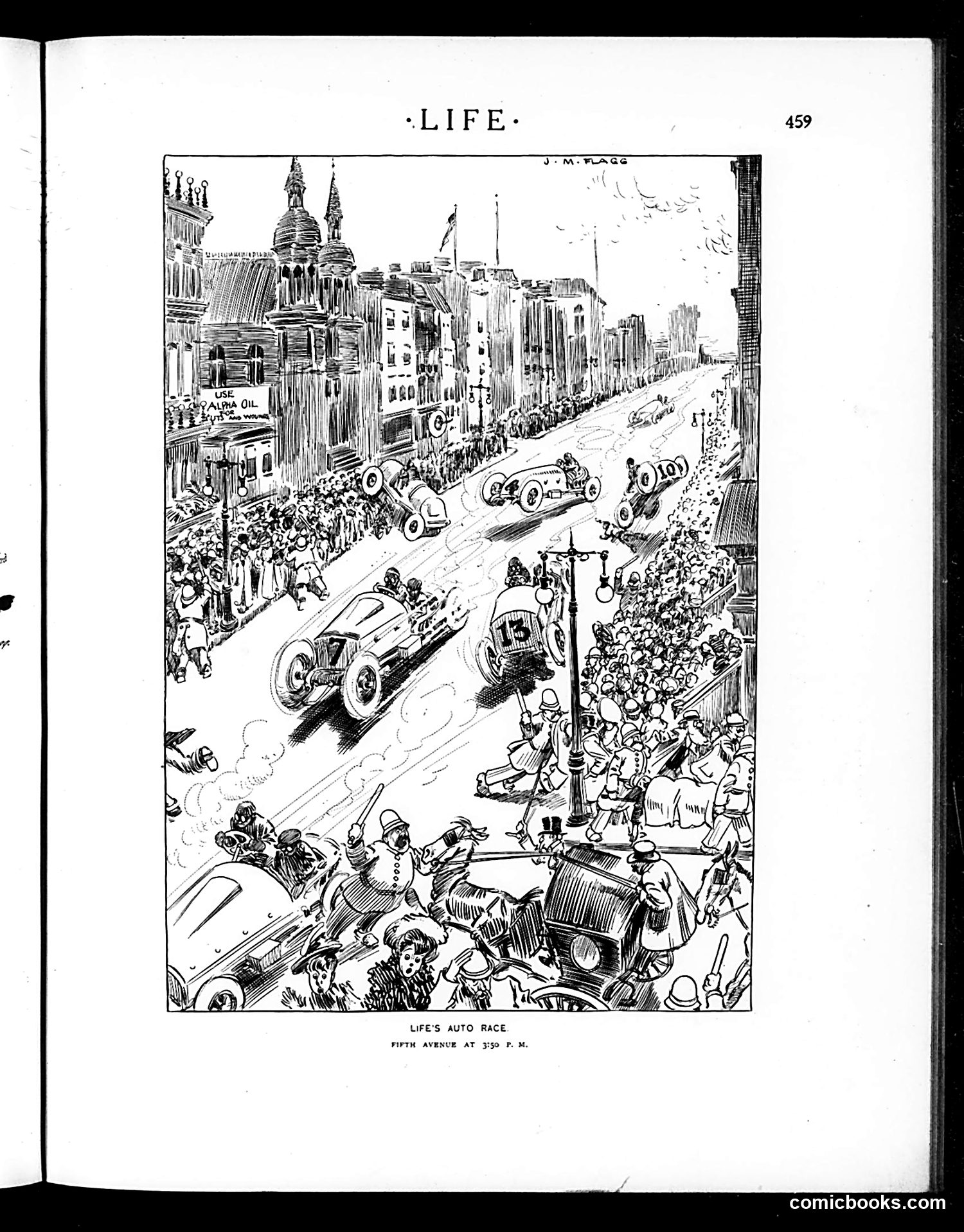
This is a satirical illustration of an automobile race on Fifth Avenue at 3:30 P.M. The drawing depicts early 20th-century racing cars speeding down a crowded Manhattan street, with massive crowds of pedestrians lining both sides. The satire mocks the danger posed by automobile racing in urban areas—the vehicles are racing recklessly through a heavily populated avenue, endangering the large crowds of onlookers and pedestrians. The joke criticizes the absurdity and public safety hazard of holding high-speed motor races in densely populated city streets rather than on proper racing circuits. This reflects contemporary concerns about automobiles as dangerous novelties in cities where they competed for space with pedestrians, carriages, and crowds.
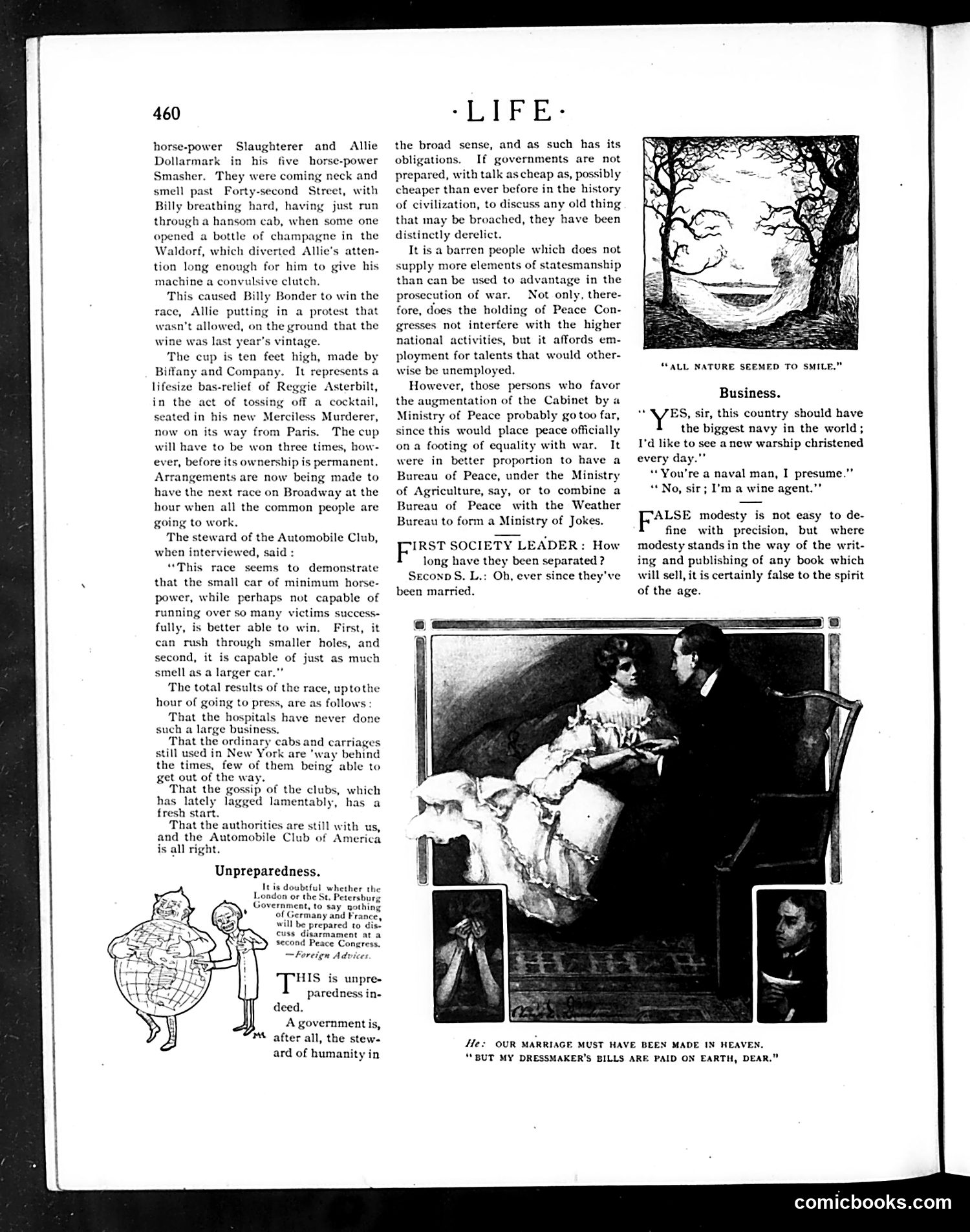
This page contains satirical commentary on post-World War I politics and society. The section titled **"Unpreparedness"** includes a small cartoon mocking Germany and Russia's lack of preparation for a peace congress, depicted as a figure struggling with a globe. The main photograph spread illustrates the "Business" section's dialogue about naval power and government priorities. The accompanying caption—"Her: OUR MARRIAGE MUST HAVE BEEN MADE IN HEAVEN. 'But my dressmaker's bills are paid on earth, dear'"—satirizes the disconnect between romantic ideals and practical financial realities, a common theme in post-war satire about domestic economics and gender relations. The overall page critiques government unpreparedness and domestic consumer culture during the interwar period.
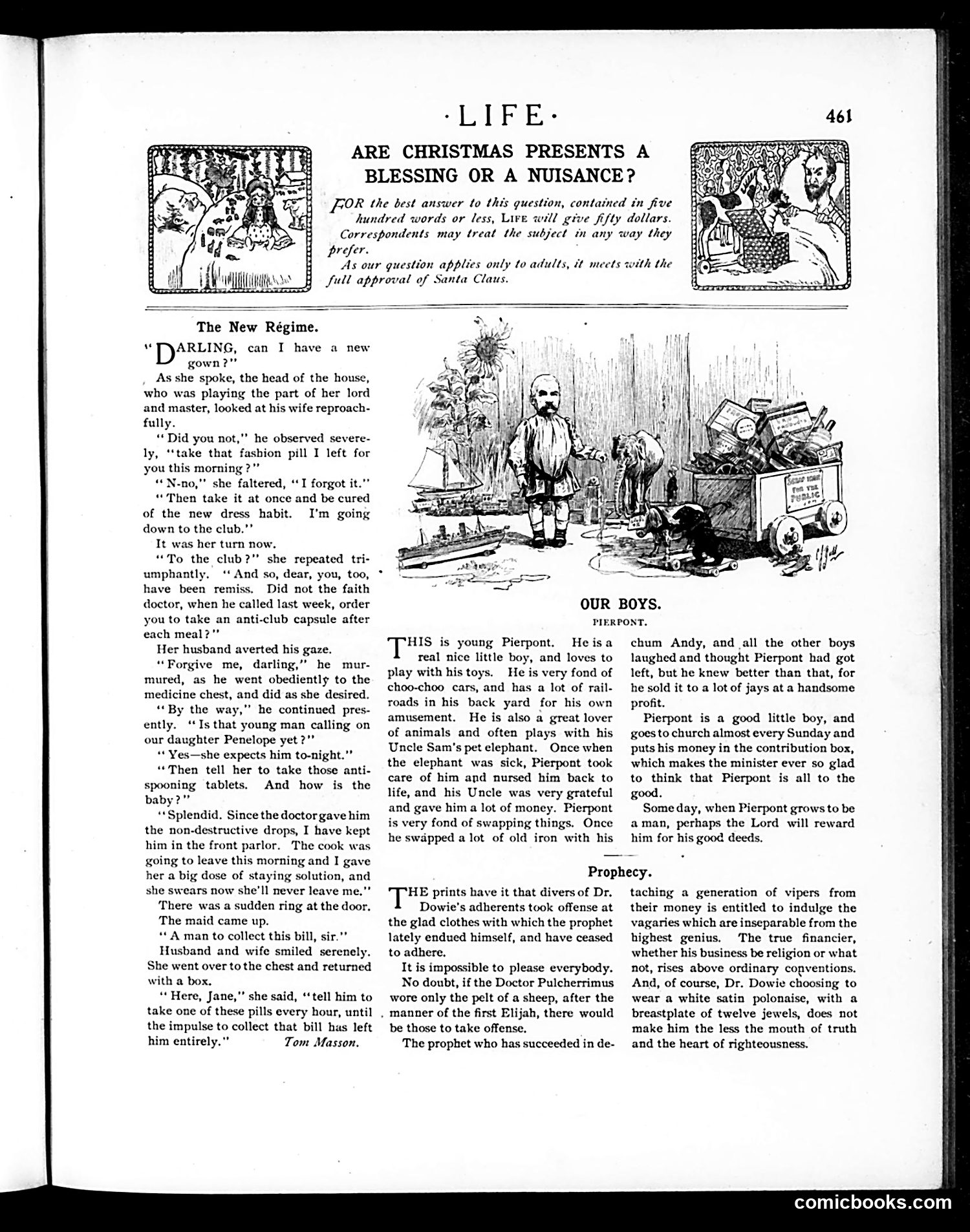
This page contains three distinct pieces: 1. **Christmas Presents Question**: A contest asking readers whether Christmas presents are "a blessing or a nuisance," with $50 prize money offered. 2. **"The New Régime"**: A domestic humor piece depicting a husband and wife negotiating about a new dress. The satire targets gender dynamics—the wife manipulates her husband by invoking their doctor's advice about her health, ultimately getting her way. The humor relies on the wife's cunning strategy to override her husband's financial objections. 3. **"Our Boys" and "Prophecy"**: Two separate short pieces about children and religious commentary. "Our Boys" profiles a boy named Pierpoint who plays with toys and helps animals. "Prophecy" satirizes Dr. Dowie (a real religious figure of the era), mocking his followers' devotion and his flamboyant white satin clothing as signs of spiritual pretension rather than genuine religiousness.
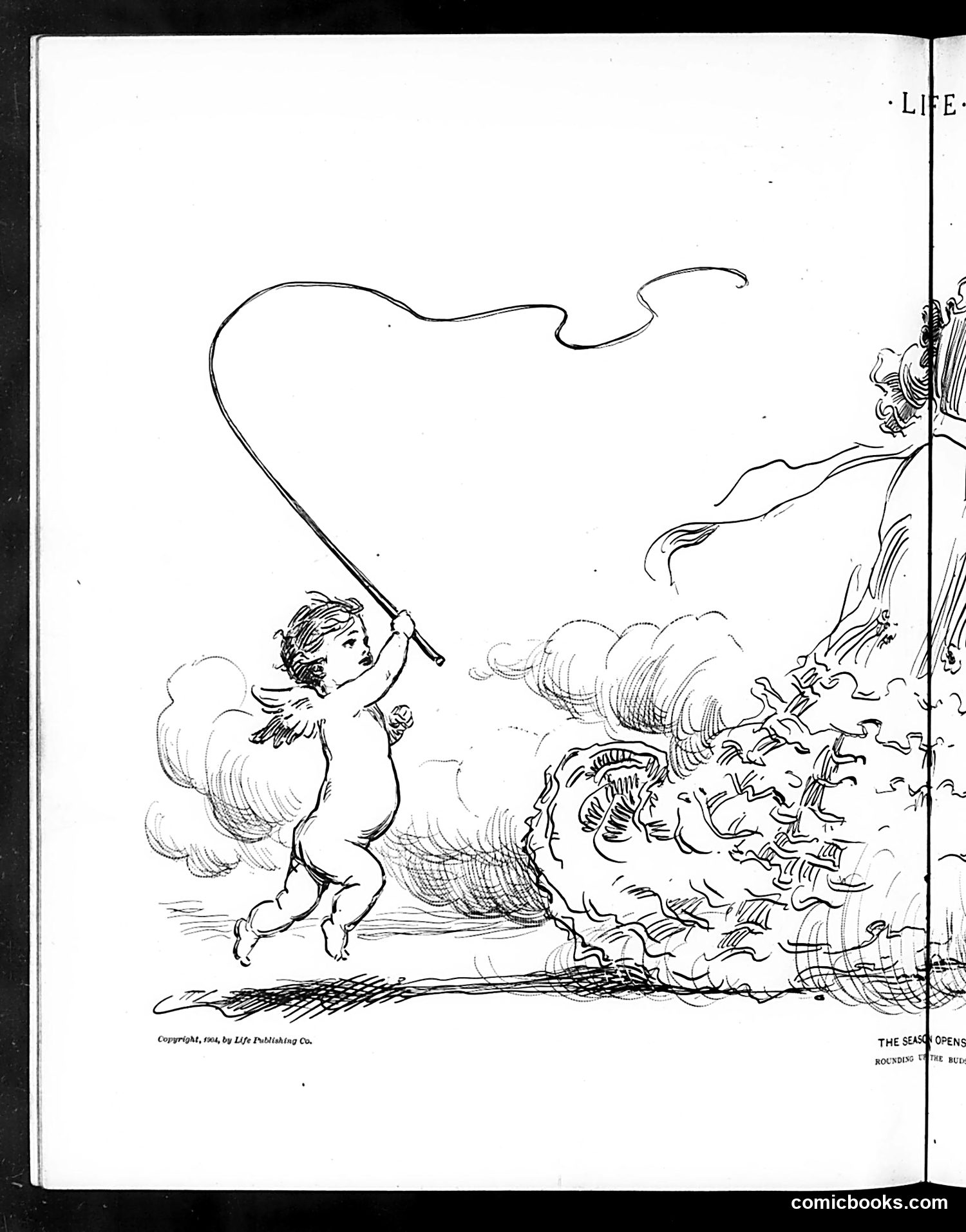
This is a satirical cartoon from Life magazine (copyright 1904) titled "The Season Opens—Rocking the Rube." The image depicts a cherub or cupid figure wielding a fishing rod with an exaggerated, heart-shaped lasso, appearing to fish in turbulent waters. The target of this "fishing" appears to be rocky, chaotic terrain or possibly a struggling figure in the water. The satire likely concerns romantic deception or seduction—"rocking the rube" suggests fooling or manipulating a naive person ("rube" being period slang for an unsophisticated person). The cupid imagery conventionally represents love and romance, so the cartoon appears to mock romantic season-opening activities, portraying love as a kind of calculated con game where the naive are "caught" through trickery rather than genuine affection. The turbulent setting emphasizes the chaotic, dangerous nature of such schemes.
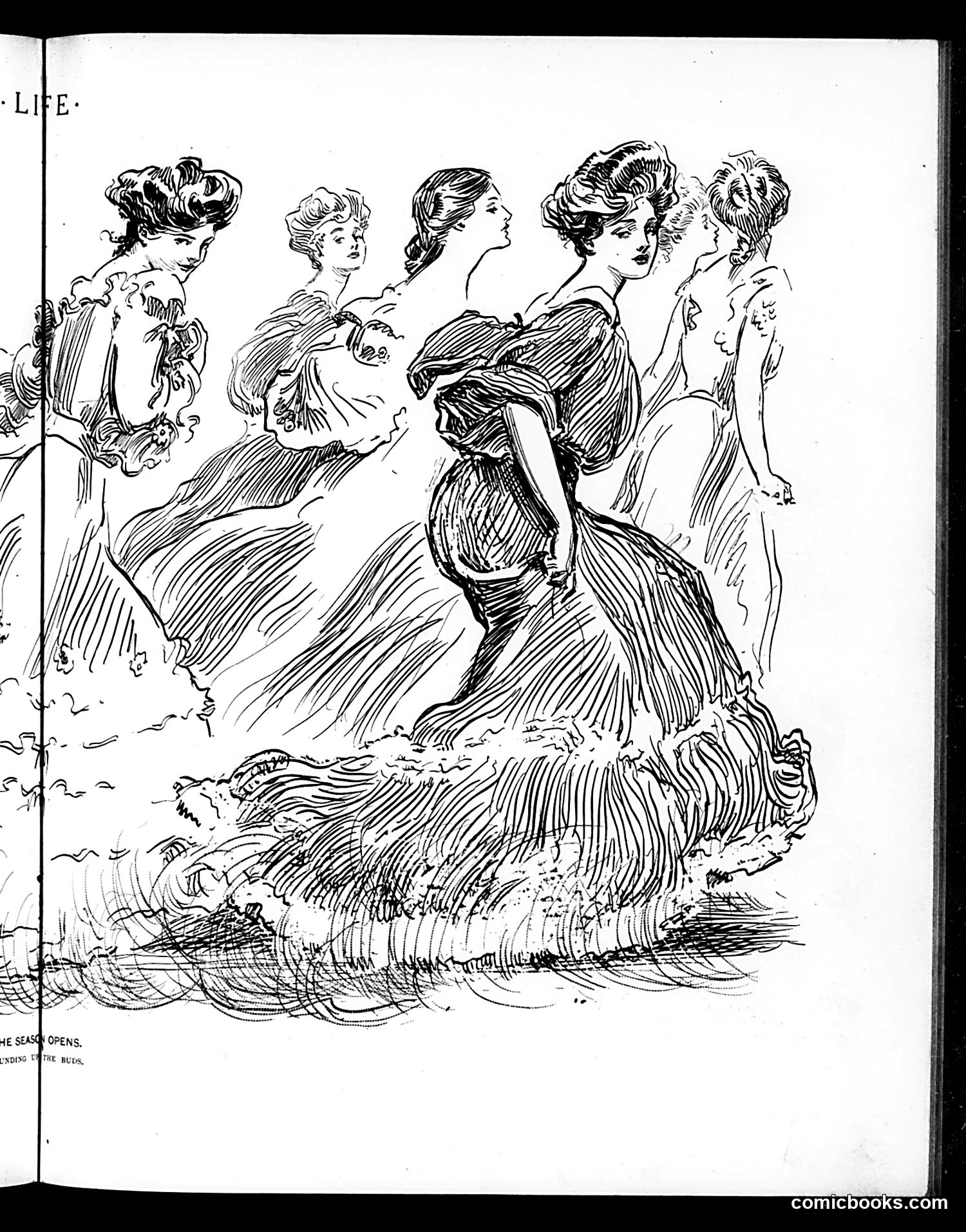
This page from *Life* magazine shows an illustration titled "THE SEASON OPENS" (visible at bottom). The drawing depicts five elegantly dressed women in elaborate Edwardian-era gowns with full skirts, elaborate hairstyles, and decorative details, standing together as if at a social gathering. The satire appears to target high society's social season—likely the opening of the fashionable social calendar for wealthy women. The exaggerated rendering of their clothing, with heavy cross-hatching emphasizing the voluminous fabrics and ornate details, suggests mockery of the extravagance and conspicuous display of wealth characteristic of upper-class social events. The phrase "season opens" implies this is satirizing the annual ritual of society women engaging in formal social activities and competitive fashion displays. The artwork style and subject matter are typical of early 20th-century social satire in *Life*.
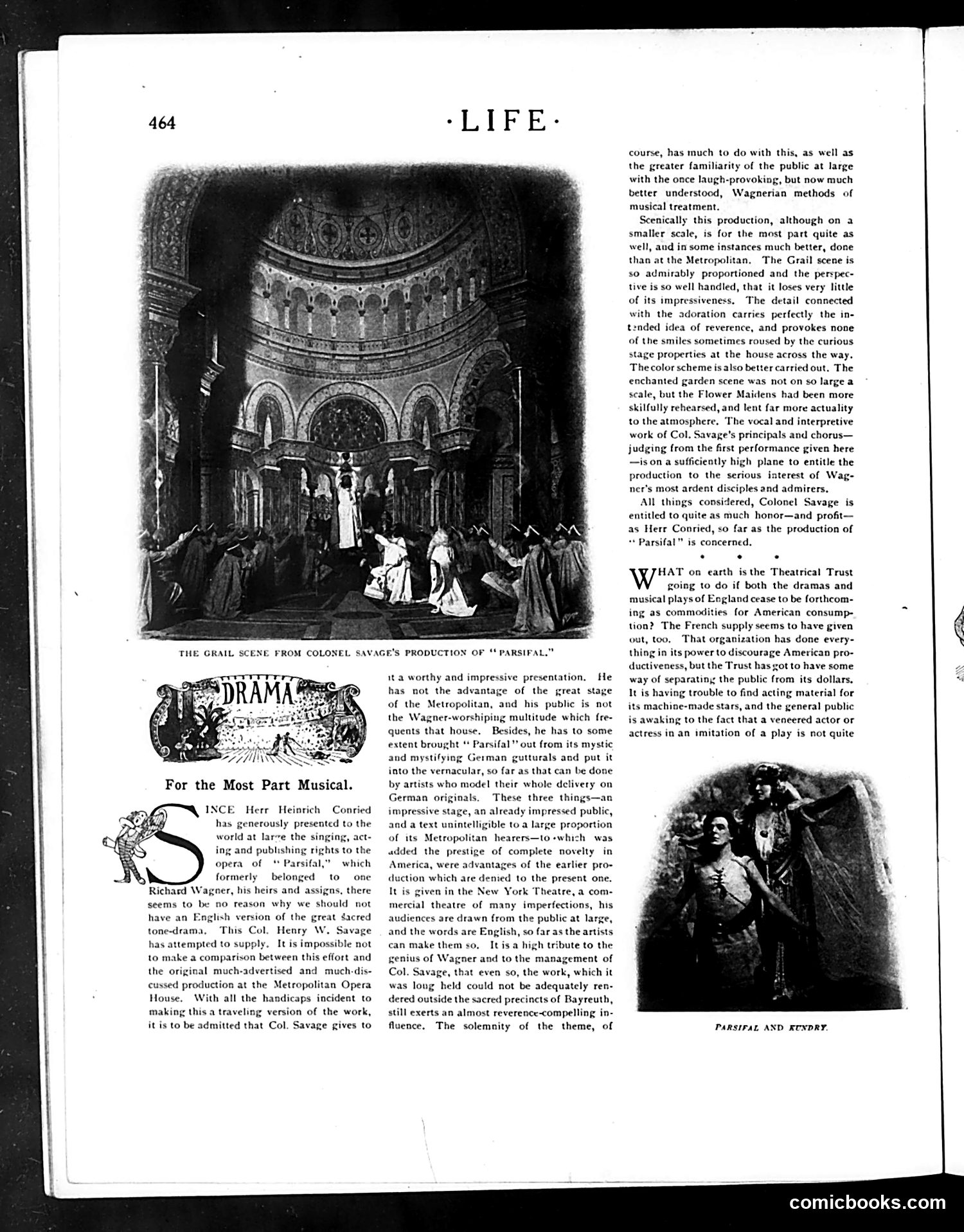
This page discusses Colonel Henry W. Savage's theatrical production of Wagner's opera *Parsifal*. The main image shows the Grail Scene from Savage's production. The article critiques the Theatrical Trust's monopoly on American musical theater. It notes that French opera companies are abandoning American stages, suggesting the Trust's control discourages American producers. The piece praises Savage's *Parsifal* as "a worthy and impressive presentation" despite lacking Metropolitan Opera's resources. The author argues that even though performed in English rather than German, and on a smaller scale, Savage's production maintains artistic integrity and reverence for Wagner's work. The satire targets theatrical monopolies limiting artistic competition and innovation in American theater.
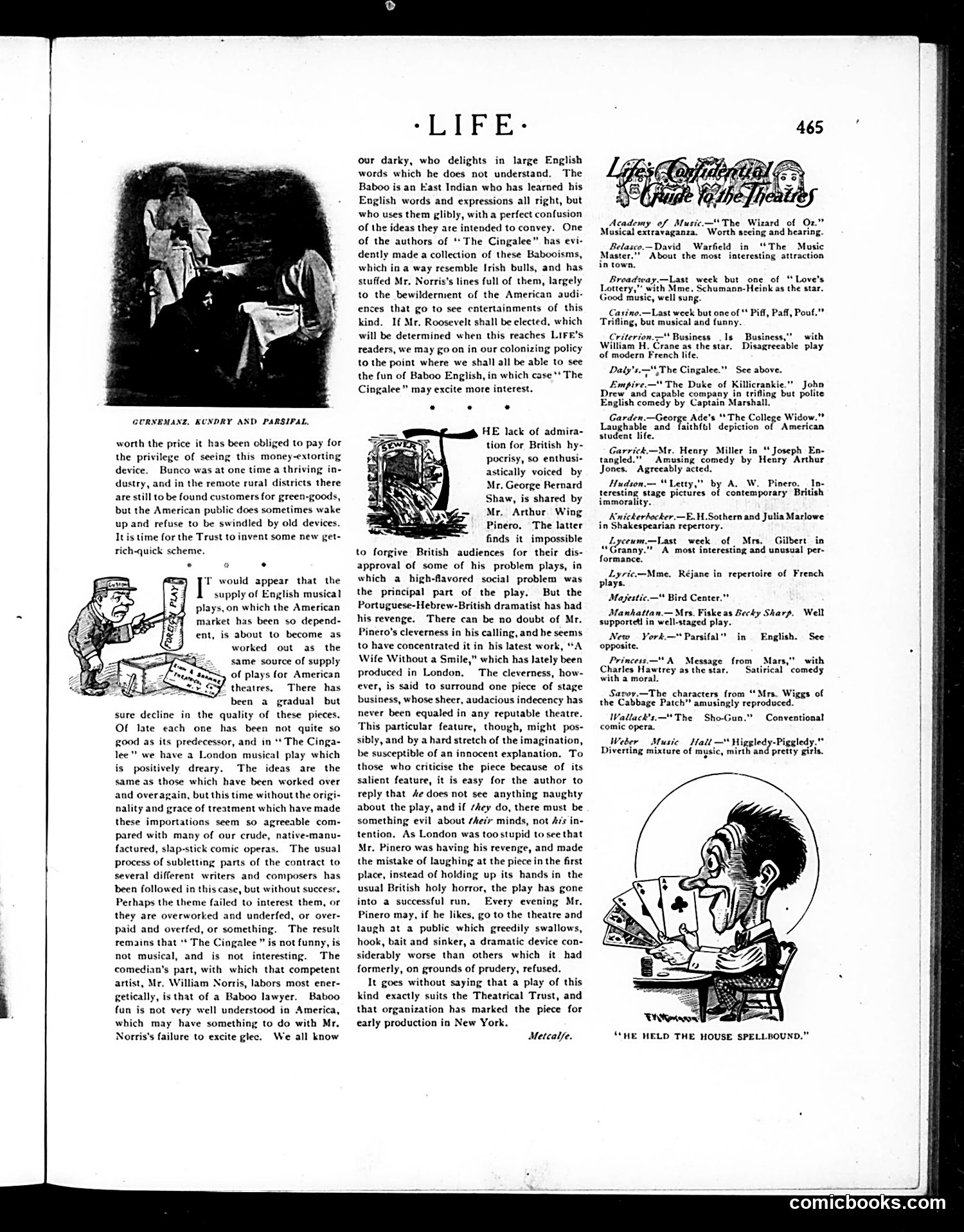
This page reviews theatrical productions, primarily critiquing "The Cingalee," a London musical play starring comedian William Norris as a Baboo lawyer. A "Baboo" is an English-educated Indian who misuses English words and expressions—the humor relies on ethnic stereotyping common to the era. The article dismisses the play as derivative and unfunny, suggesting American audiences won't understand "Baboo" humor unless America's colonial expansion continues (a reference to Theodore Roosevelt's imperial policies, which were being decided around this publication date). The page also discusses playwright Arthur Wing Pinero's revenge against British audiences through his play "A Wife Without a Smile," hinting at controversial stage business of "audacious indecency." The illustrations include a theatrical scene and a cartoon captioned "He Held the House Spellbound" depicting an entertainer. The satirical point: English theatrical imports are declining in quality, and American audiences remain culturally dependent on them.
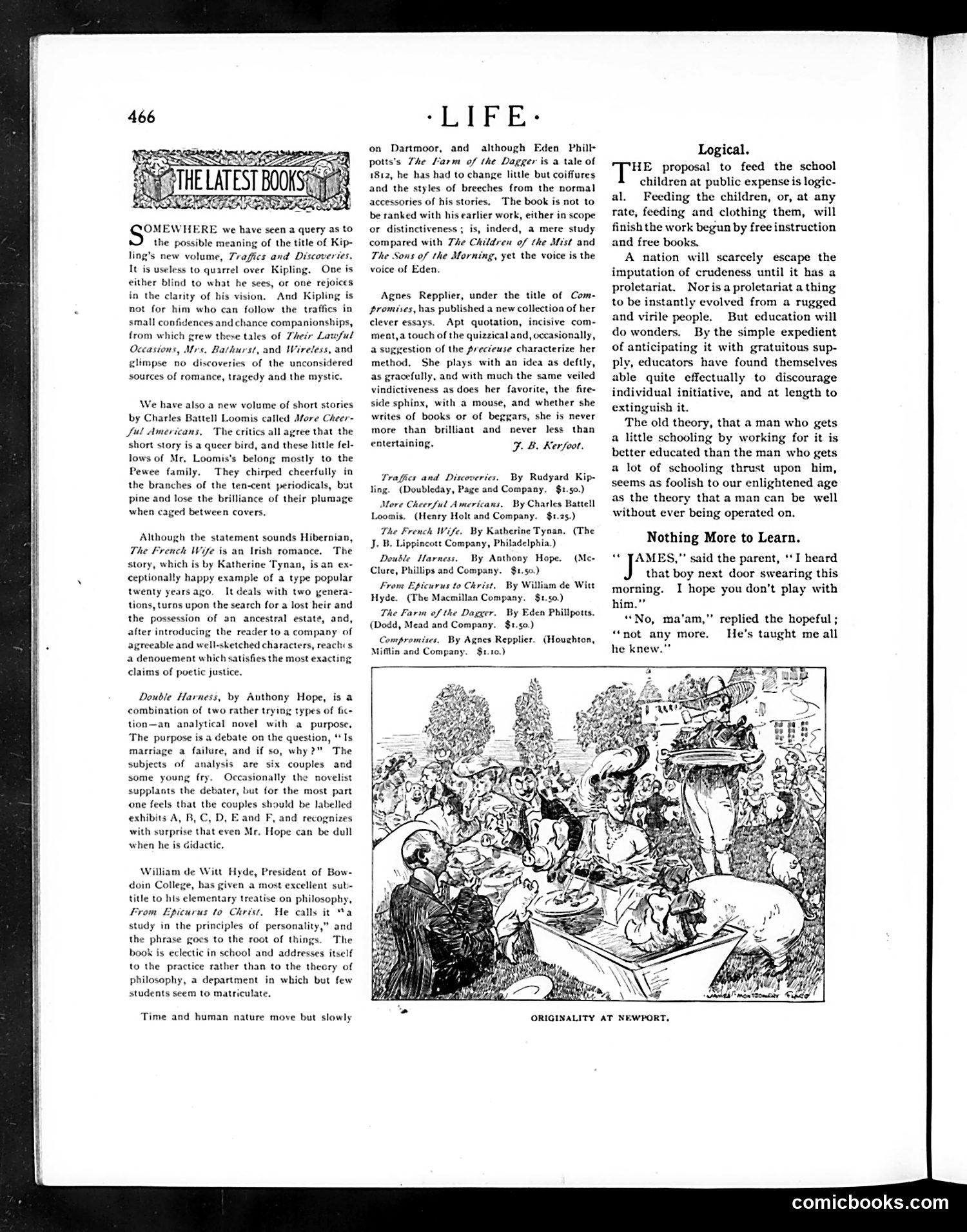
This page contains literary book reviews rather than political cartoons. The main content discusses new publications by prominent authors of the era (Kipling, Loomis, Anthony Hope, Agnes Repplier). The single illustration, captioned "ORIGINALITY AT NEWPORT," depicts a satirical scene of wealthy socialites at Newport, Rhode Island's exclusive resort. The sketch mocks the pretensions and frivolity of high society—showing elaborately dressed figures in exaggerated poses amid ornate surroundings. The satire targets the contradiction between Newport society's claims to sophistication and taste versus their actual shallow materialism and conformity. The "originality" title is ironic: these wealthy elites are portrayed as uniform in their vapid pursuits despite their pretensions to distinction. This reflects Life magazine's recurring critique of American upper-class affectation and social climbing during the Gilded Age.
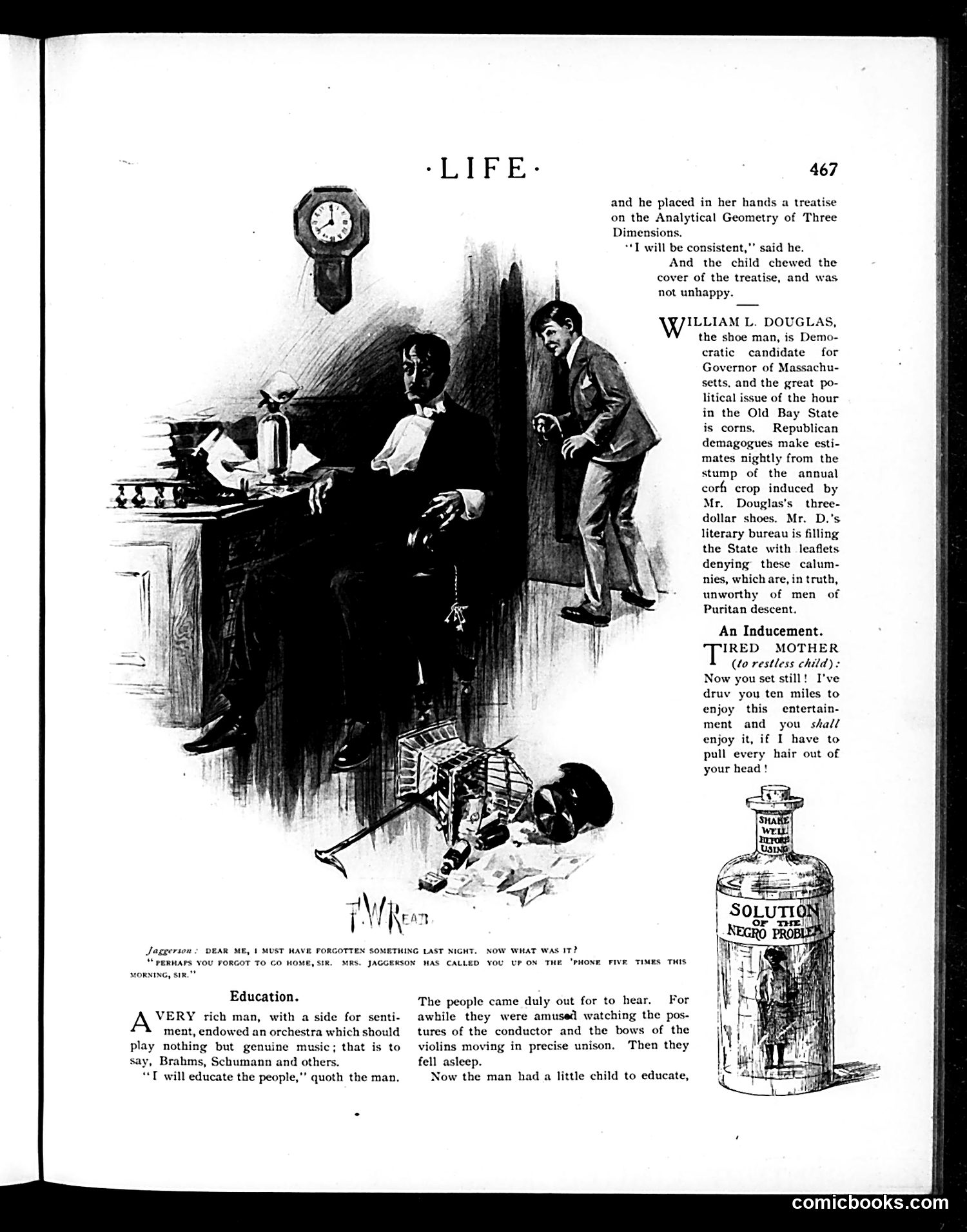
This page contains two distinct satirical pieces from *Life* magazine: **"Education" cartoon**: Mocks a wealthy philanthropist's misguided attempt to "educate the people" by funding an orchestra playing only serious classical music (Brahms, Schumann). The satire: the audience finds it boring and falls asleep. When he tries the same approach with his own child—giving her a dense mathematics treatise instead of age-appropriate material—she's similarly unhappy. The point: education imposed without regard for the audience's actual needs or interests fails, regardless of how refined or well-intentioned. **"An Inducement" advertisement**: Promotes a product called "Solution to the Negro Problem" (a racist remedy product). The adjacent joke mocks William L. Douglas, a Democratic shoe manufacturer running for Massachusetts Governor. Republicans attacked him over "corns"—a pun on both the agricultural crop and foot ailments allegedly caused by his cheap three-dollar shoes. The page reflects early 20th-century American attitudes: condescending views of mass audiences, casual racism in advertising, and political mudslinging over consumer goods.
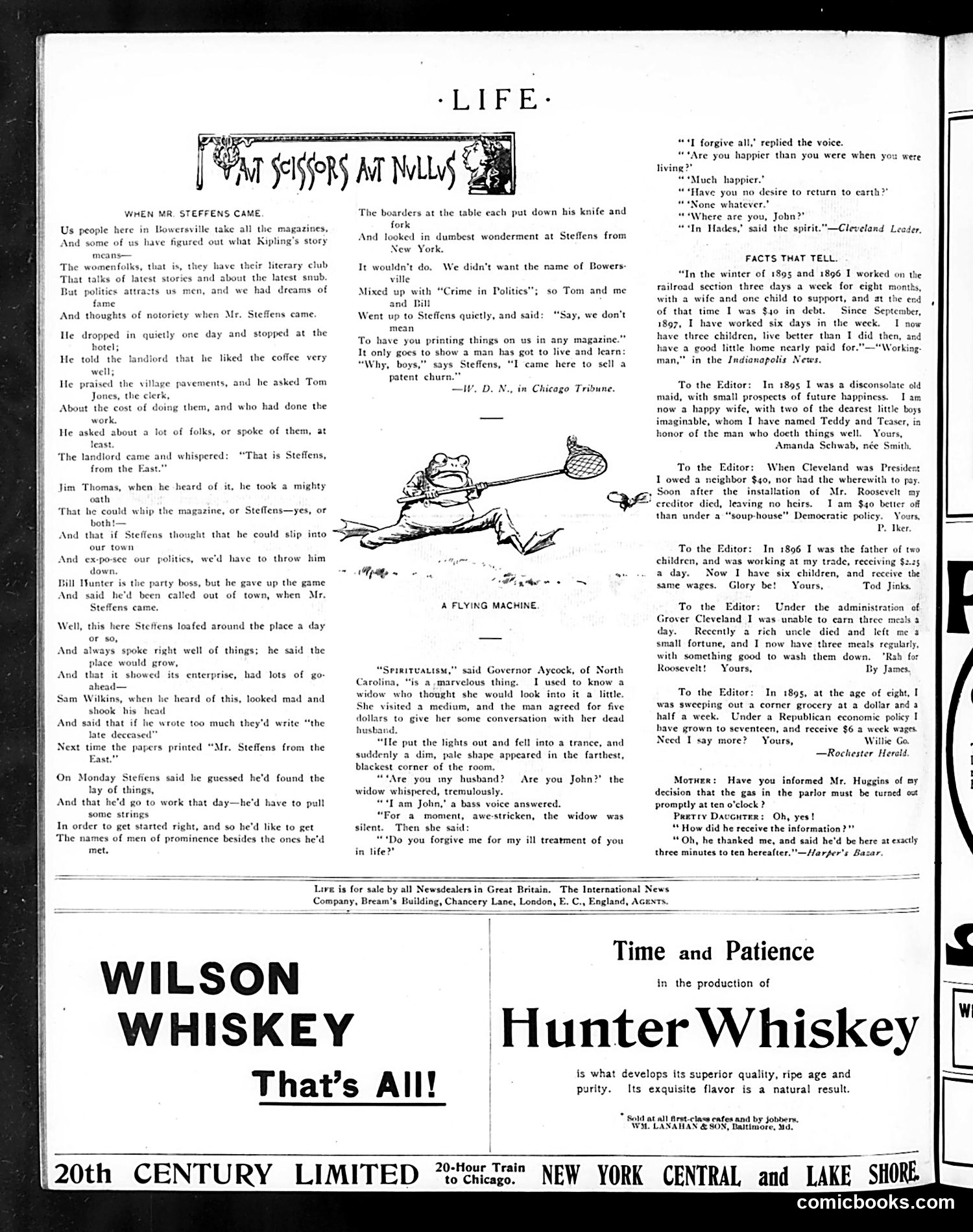
This cartoon satirizes the arrival of a muckraking journalist (identified as "Steffens," likely Lincoln Steffens, the famous Progressive Era investigative reporter) in a small town called Bowersville. The locals initially fear his presence, assuming he's come to expose corruption in local politics—a genuine concern given Steffens' reputation for publishing exposés of municipal corruption. The joke: the townspeople grow anxious and defensive, with the party boss abandoning town entirely. However, Steffens reveals he's actually there to sell a *patent churn*, not investigate them. The satire mocks both the town's paranoia about reformers and the gap between the public's inflated expectations of journalists and their actual mundane purposes. The "Flying Machine" story below is unrelated humor about spiritualism and the afterlife.
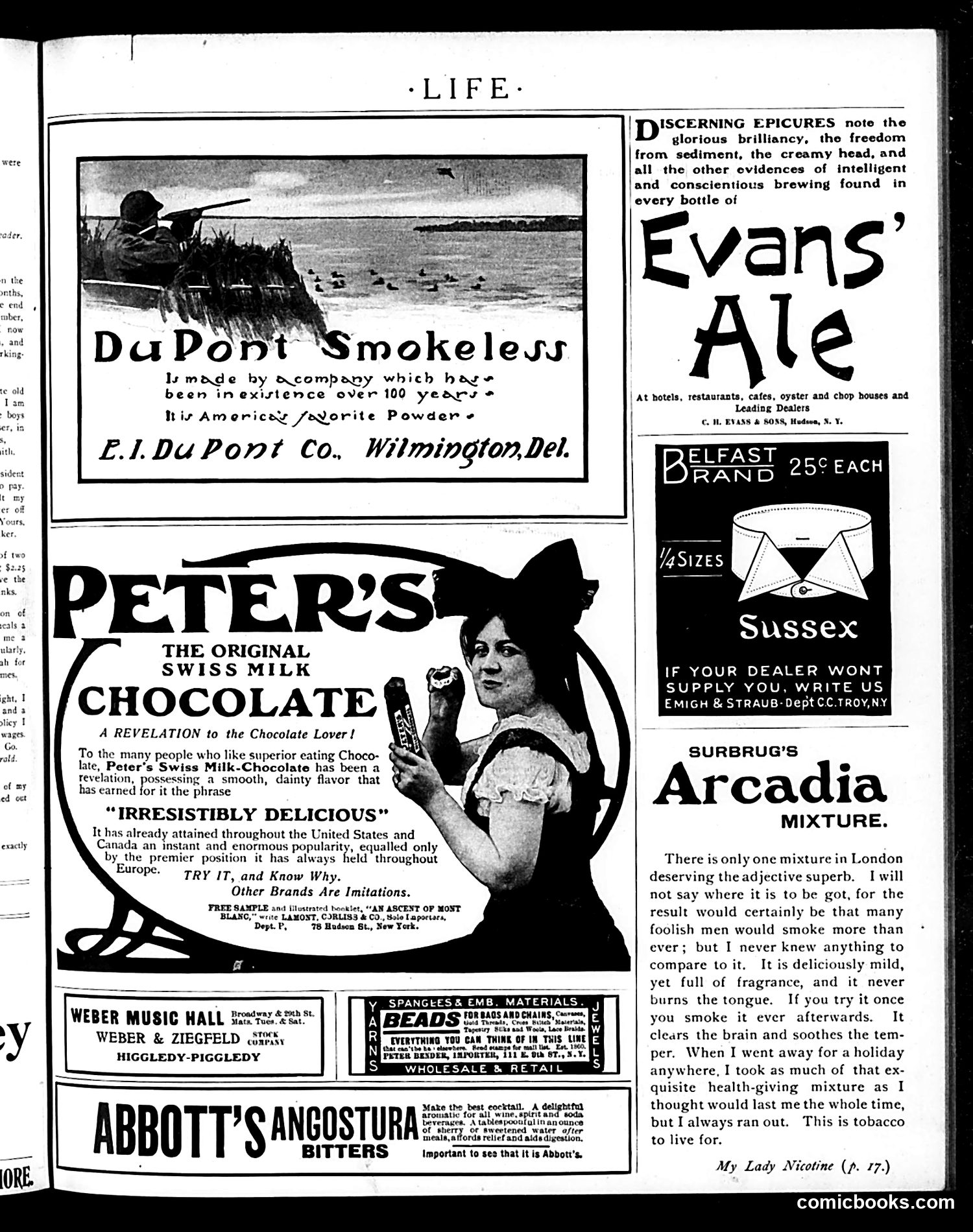
This is primarily an **advertisement page**, not a political cartoon. It contains five product ads for early 1900s consumer goods: 1. **DuPont Smokeless Powder** — emphasizes the company's 100+ year history and American popularity 2. **Peter's Swiss Milk Chocolate** — claims superiority over imitations, advertises free samples 3. **Evans' Ale** — Belfast Brand beer, 25¢ per bottle 4. **Abbott's Angostura Bitters** — a cocktail ingredient/digestive aid 5. **Surbrug's Arcadia Mixture** — tobacco product, with a testimonial claiming it's superior and never burns the tongue The only satirical content is the **Peter's Chocolate ad**, which features a woman in Victorian dress with a large bow—likely mocking the exaggerated femininity used in early advertising to sell luxury goods to women. The page reflects Edwardian-era consumer culture, emphasizing products as "superior," "irresistibly delicious," and distinctly branded—a period when brand loyalty was being actively marketed.
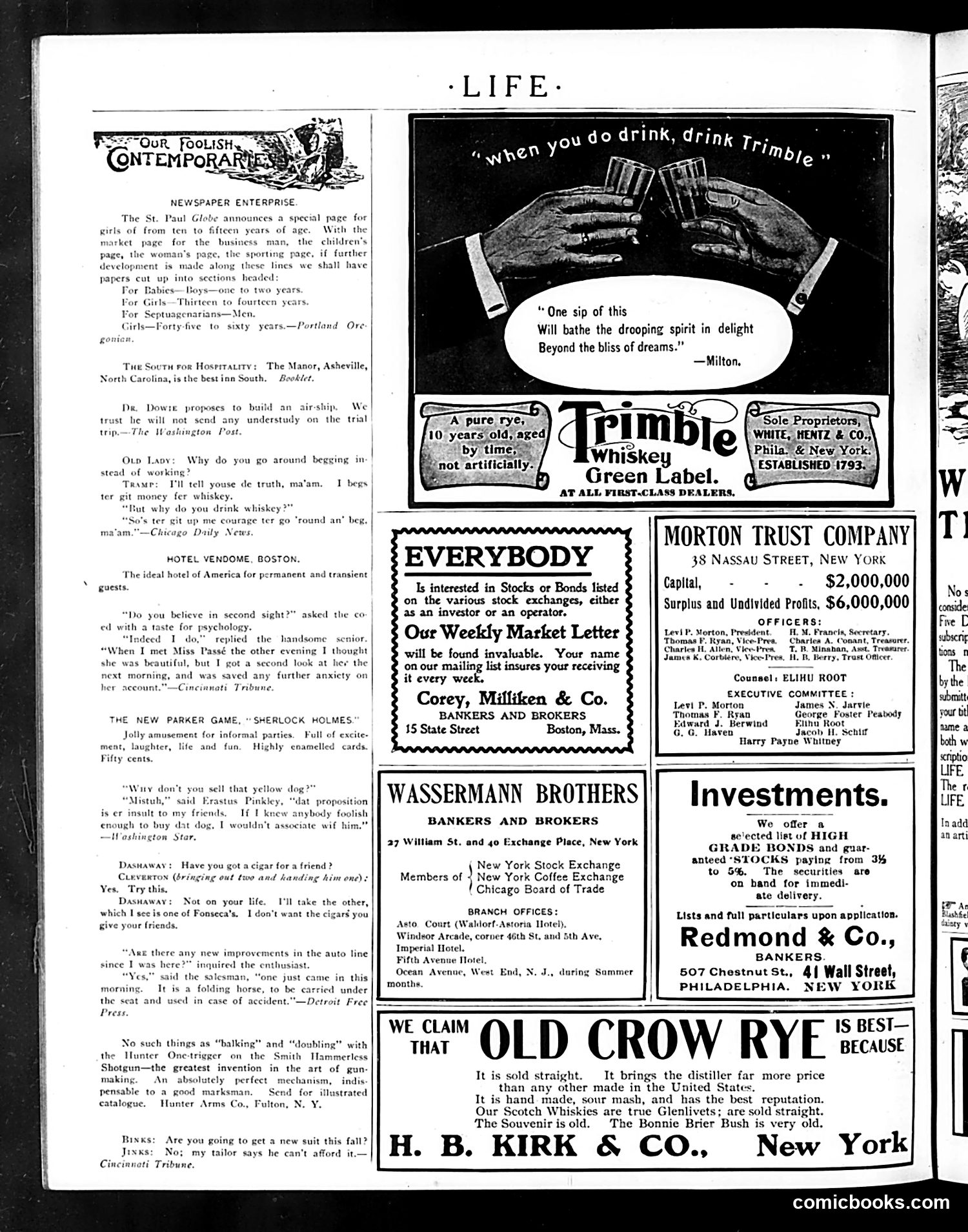
This is primarily a **page of advertisements and humor columns** from Life magazine, a satirical weekly. The content reflects early 20th-century American leisure and financial interests. The **Trimble Whiskey ad** (top right) uses a Milton quote to sell liquor with romantic language about spirits and bliss—standard advertising rhetoric of the era. The **humor items** are brief anecdotes mocking social pretension: a tramp explains he begs to fund whiskey; a man brags about his car's folding horse feature (absurdly impractical); tailor and friend jokes about affordability and cigars. The **financial advertisements**—Morton Trust Company, Wassermann Brothers, Redmond & Co.—reflect the period's investment culture and stock market enthusiasm. The **Old Crow Rye ad** emphasizes authenticity ("sold straight," hand-made, Scottish reputation) to distinguish premium whiskey in a crowded market. Overall, this represents genteel humor and commercial culture aimed at educated, prosperous readers interested in stocks, fine spirits, and witty banter.
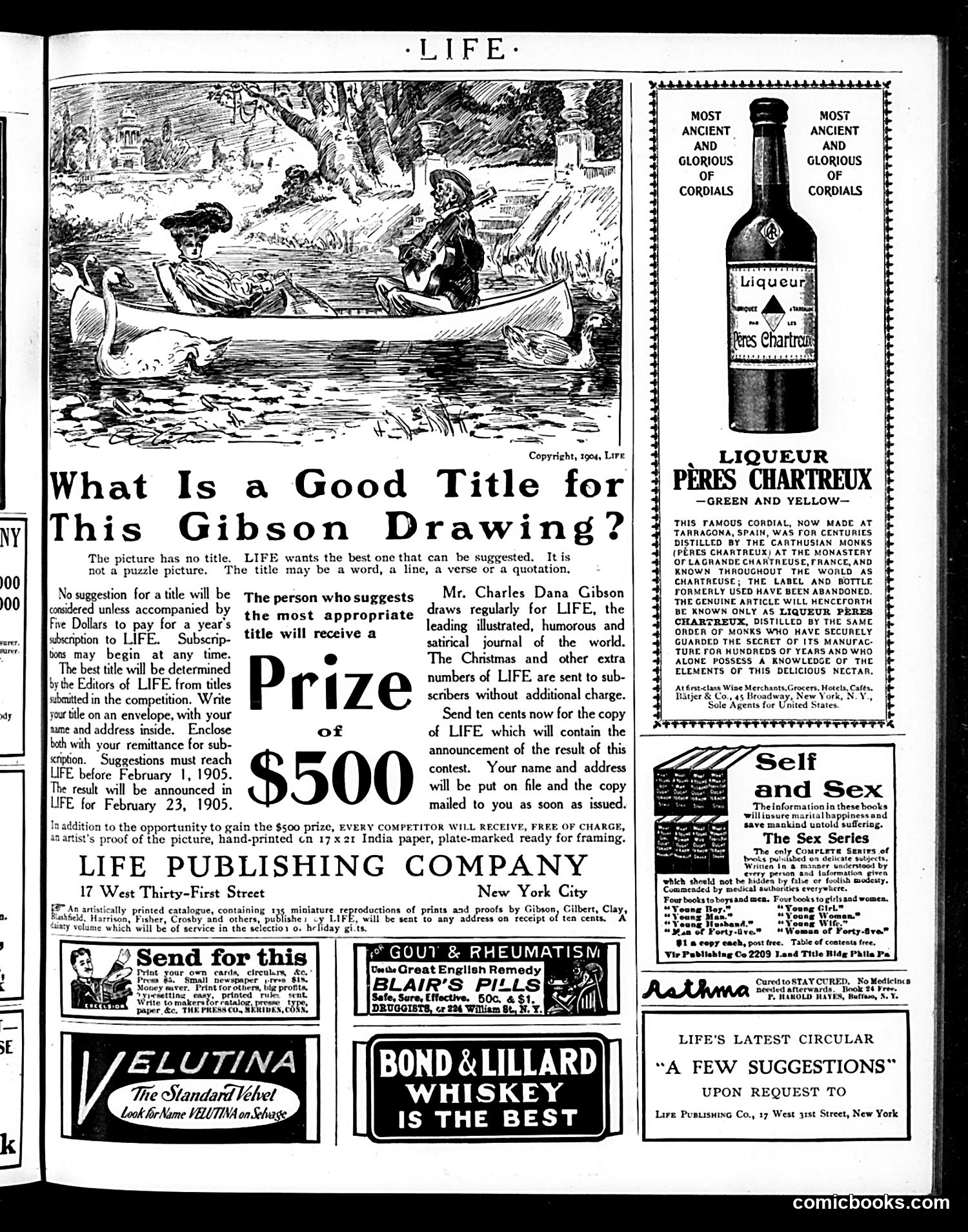
This page is primarily a **contest announcement** rather than a satirical cartoon page. The main Gibson drawing—a comedic scene of two figures in a boat surrounded by mermaids and aquatic creatures—is presented without a caption, and Life magazine invites readers to suggest the best title, offering a $500 prize (substantial for 1904). **The appeal to Gibson**: Charles Dana Gibson was Life's star illustrator, famous for the "Gibson Girl" and humorous satirical drawings. His work was the magazine's primary draw. **Context for modern readers**: This represents Life's business model—engaging readers through contests while promoting subscriptions and building the Gibson brand. The accompanying advertisements (for liqueurs, patent medicines, self-help books on sexuality) reflect 1904 consumer culture and the era's unregulated marketing practices. The page demonstrates how early-20th-century magazines functioned as entertainment, advertising platforms, and community engagement tools simultaneously.
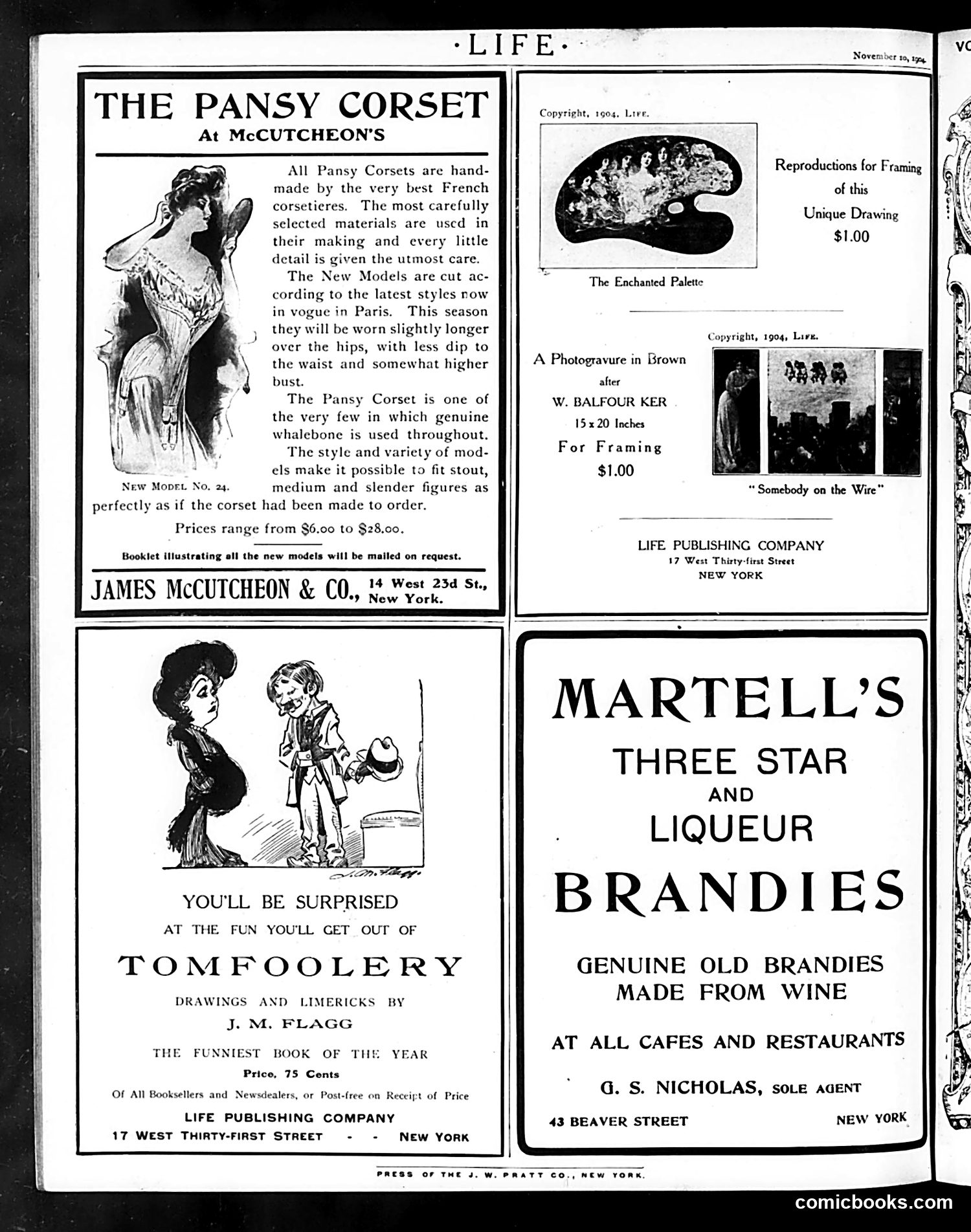
This page is primarily **advertising**, not editorial content or political satire. It contains: 1. **Pansy Corset ad** (top left): Features an illustration of a woman in fashionable dress, promoting French-made corsets with whalebone construction. Text emphasizes Paris fashion trends—corsets worn longer over hips with higher busts, reflecting 1904 silhouette preferences. 2. **"Tomfoolery" book promotion** (bottom left): Advertises J.M. Flagg's humorous drawings and limericks, marketed as "the funniest book of the year" at 75 cents. 3. **Art reproductions and Martell's brandy ads** (right side): Sell framed artwork and imported French brandies. The page reflects early 20th-century consumer culture and American fascination with French fashion and luxury goods. There is **no political satire or social commentary**—this is straightforward commercial content typical of Life magazine's advertising pages.