
Life, 1904-11-10 · page 14 of 20
Life — November 10, 1904 — page 14: what you’re looking at
What you’re looking at
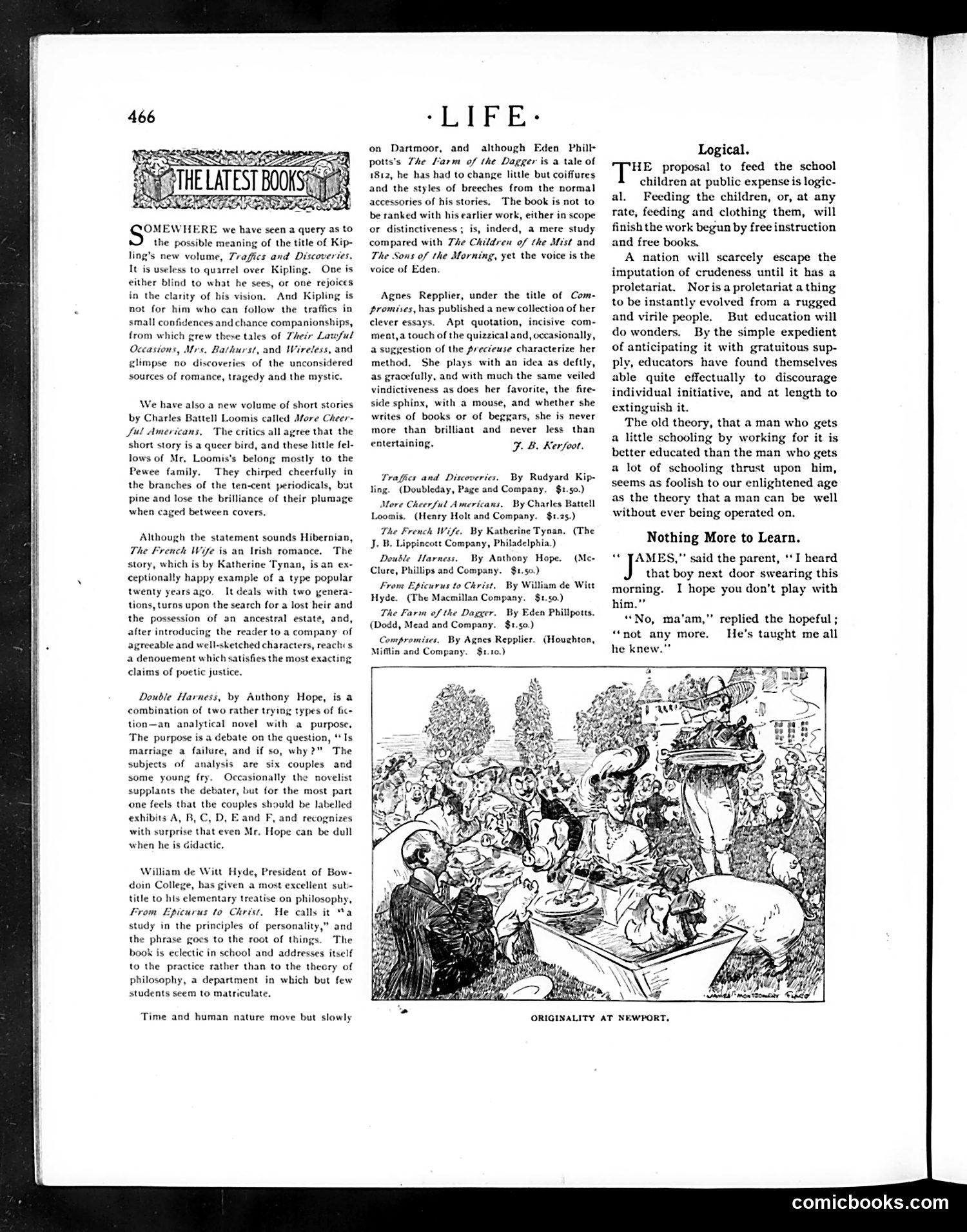
This page contains literary book reviews rather than political cartoons. The main content discusses new publications by prominent authors of the era (Kipling, Loomis, Anthony Hope, Agnes Repplier). The single illustration, captioned "ORIGINALITY AT NEWPORT," depicts a satirical scene of wealthy socialites at Newport, Rhode Island's exclusive resort. The sketch mocks the pretensions and frivolity of high society—showing elaborately dressed figures in exaggerated poses amid ornate surroundings. The satire targets the contradiction between Newport society's claims to sophistication and taste versus their actual shallow materialism and conformity. The "originality" title is ironic: these wealthy elites are portrayed as uniform in their vapid pursuits despite their pretensions to distinction. This reflects Life magazine's recurring critique of American upper-class affectation and social climbing during the Gilded Age.
📄 Transcribed text from this page (OCR, searchable)
Machine-transcribed from the original scan — historical spelling and the odd misread are preserved.
ai OMEWHERE we have seen a query as to the possible meaning of the title of Kip- ling’s new volume, Trafics and Discoveries. It is useless to quarrel over Kipling. One is either blind to what he sees, or one rejoices in the clarity of bis vision. And Kipling is not for him who can follow the traffics in small confidences and chance companionships, from which grew these tales of Their Lawful Occasions, Mrs. Bathurst, and Wireless, and glimpse no discoveries of the unconsidered sources of romance, tragedy and the mystic. We have also a new volume of short stories by Charles Battell Loomis called More Cheer= Jul Americans, ‘The critics all agree that the short story is a queer bird, and these little fel- lows of Mr. Loomis's belong mostly to the Pewee family. They chirped cheerfully in the branches of the ten-cent periodicals, but pine and lose the brilliance of their plumage when caged between covers. Although the statement sounds Hibernian, The French Wife is an Irish romance, The story, which is by Katherine Tynan, isan ex- ceptionally happy example of a type popular twenty years ago. It deals with two genera- tions, turns upon the search for a lost heir and the possession of an ancestral estate, and, after introducing the reader to a company of agreeable and well-sketched characters, reach« s a denouement which satisfies the most exacting claims of poetic justice. Double Harness, by Authony Hope, is a combination of two rather trying types of fic tion—an analytical novel with a purpose, ‘The purpose is a debate on the question, “Is marriage a failure, and if so, why?” The subjects of analysis are six couples and Occasionally the novelist supplants the debater, but for the most part one feels that the couples should be labelled exhibits A, B, C, D, Eand F, and recognizes with surprise that even Mr. Hope can be dull when he is didactic. some young fry. William de Witt Hyde, Presideat of Bow- doin College, has given a most excellent sub- title to his elementary treatise on philosophy, From Epicurus to Christ, He calls it “a study in the principles of personality,” and the phrase goes to the root of things. The book is eclectic in school and addresses itself to the practice rather than to the theory of philosophy, a department in which but few students seem to matriculate, Time and human nature move but slowly oa 0) (Sal Oe on Dartmoor, and although Eden Phill- potts's The Farm of the Dagger is a tale of 1812, he has had to change little but coiffures and the styles of breeches from the normal accessories of his stories. The book is not to be ranked with his earlier work, either in scope or distinctiveness ; is, indeed, a mere study compared with The Children of the Mist and The Sons of the Morning, yet the voice is the voice of Eden. Agnes Repplier, under the title of Com- Promises, bas published a new collection of her clever essays. Apt quotation, incisive com- ment, a touch of the quizzical and, occasionally, a suggestion of the precieuse characterize her method, She plays with an idea as deftly, as gracefully, and with much the same veiled vindictiveness as does her favorite, the fire- side sphinx, with a mouse, and whether she writes of books or of beggars, she is never more than brilliant and never less than entertaining. 7. B. Kerfoot. ‘raffics and Discoveries. By Rudyard Kip- ling. (Doubleday, Page and Company. $1.50.) More Cheerful Americans. By Charles Battell Loomis. (Henry Holt and Company. $1.25.) The French Wife. By Katherine Tynan, (The J. B, Lippincott Company, Philadelphia.) Double Harness. By Anthony Hope. Clure, Phillips and Company. $1.50.) ‘picurus to Christ, By William de Witt (The Macmillan Company. $t.s0.) The Farm of the Dagger. By Eden Phillpotts. (Dodd, Mead and Company. $1.50.) Compromises, By Agnes Repplier. (Houghton, Mifflin and Company. $r.10.) (Me- From Hyde Logical. wa lig E proposal to feed the school children at public expense is logic- al. Feeding the children, or, at any rate, feeding and clothing them, will finish the work begun by free instruction and free books. A nation will scarcely escape the imputation of crudeness until it has a proletariat. Norisa proletariat a thing to be instantly evolved from a rugged and virile people. But education will do wonders. By the simple expedient of anticipating it with gratuitous sup- ply, educators have found themselves able quite effectually to discourage individual initiative, and at length to extinguish it. The old theory, that a man who gets a little schooling by working for it is better educated than the man who gets a lot of schooling thrust upon him, seems as foolish to our enlightened age as the theory that a man can be well without ever being operated on. Nothing More to Learn. ‘* TAMES,” said the parent, ‘I heard J that boy next door swearing this morning. I hope you don’t play with him No, ma'am,” replied the hopeful ; “not any more. He's taught me all he knew.”" ORIGINALITY AT NEWPORT, comicbooks.com