
Life, 1904-11-10 · page 13 of 20
Life — November 10, 1904 — page 13: what you’re looking at
What you’re looking at
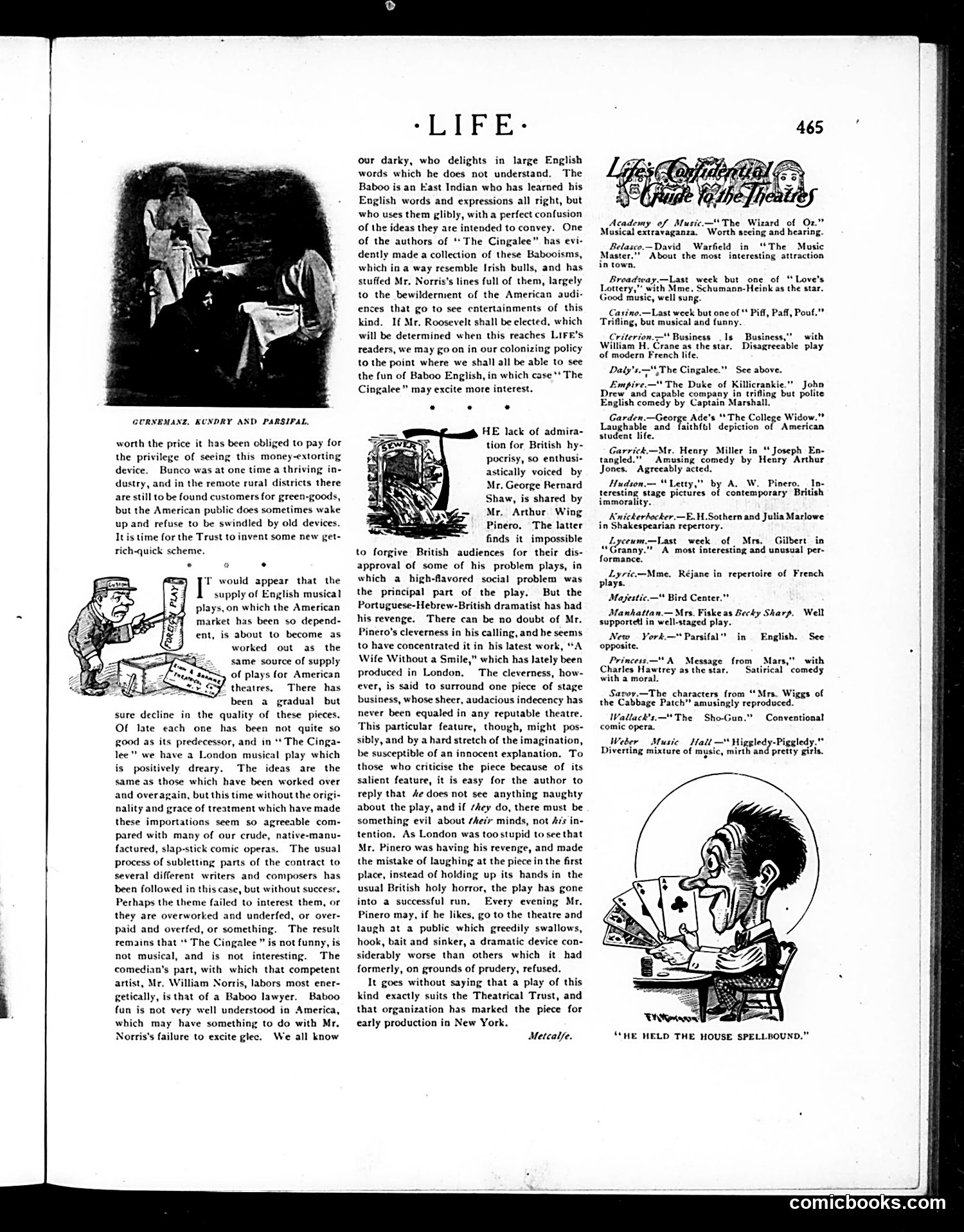
This page reviews theatrical productions, primarily critiquing "The Cingalee," a London musical play starring comedian William Norris as a Baboo lawyer. A "Baboo" is an English-educated Indian who misuses English words and expressions—the humor relies on ethnic stereotyping common to the era. The article dismisses the play as derivative and unfunny, suggesting American audiences won't understand "Baboo" humor unless America's colonial expansion continues (a reference to Theodore Roosevelt's imperial policies, which were being decided around this publication date). The page also discusses playwright Arthur Wing Pinero's revenge against British audiences through his play "A Wife Without a Smile," hinting at controversial stage business of "audacious indecency." The illustrations include a theatrical scene and a cartoon captioned "He Held the House Spellbound" depicting an entertainer. The satirical point: English theatrical imports are declining in quality, and American audiences remain culturally dependent on them.
📄 Transcribed text from this page (OCR, searchable)
Machine-transcribed from the original scan — historical spelling and the odd misread are preserved.
GURNEMANZ, KUNDRY AND PARSIPAL, worth the price it has been obliged to pay for the privilege of seeing this money-extorting device. Bunco was at one time a thriving in- dustry, and in the remote rural districts there are still to be found customers for green-goods, but the American public does sometimes wake upand refuse to be swindled by old devices. Itis time for the Trust to invent some new get- rich-quick scheme. 5 . T would appear that the | supply of English musical plays,on which the American market has been so depend- ent, is about to become as worked out as the same source of supply of plays for American theatres. There has been a gradual but sure decline in the quality of these pieces. Of late each one has been not quite so good as its predecessor, and in ** The Cinga- lee” we have a London musical play which is positively dreary. The ideas are the same as those which have been worked over and overagain, but this time without the origi- nality and grace of treatment which have made these importations seem so agreeable com- pared with many of our crude, native-manu- factured, slap-stick comic operas. The usual process of subletting parts of the contract to several different writers and composers has been followed in this case, but without success. Perhaps the theme failed to interest them, or they are overworked and underfed, or over- paid and overfed, or something. The result remains that ‘ The Cingalee ” is not funny, not musical, and is not interesting. The comedian's part, with which that competent artist, Mr. William Norris, labors most ener- getically, is that of a Baboo lawyer. Baboo fan is not very well understood in America, which may have something to do with Mr. Norris's failure to excite glee. We all know gp ey I See our darky, who delights in large English words which he does not understand. The Baboo is an East Indian who has learned his English words and expressions all right, but who uses them glibly, with a perfect confusion of the ideas they ate intended to convey. One of the authors of * The Cingalee” has evi- dently made a collection of these Babooisms, which in a way resemble Irish bulls, and has stuffed Mr, Norris’s lines full of them, largely to the bewilderment of the American audi- ences that go to see entertainments of this kind. If Mr. Roosevelt shall be elected, which will be determined when this reaches LIFE": readers, we may go on in our colonizing policy to the point where we shall all be able to see the fun of Baboo English, in which case** The Cingalee” may excite more interest. . . . HE lack of admira- tion for British hy- pocrisy, so enthusi- astically voiced by Mr. George Bernard Shaw, is shared by Mr, Arthur Wing Pinero, The latter finds it impossible to forgive British audiences for their dis- approval of some of his problem plays, in which a high-flavored social problem was the principal part of the play. But the Portuguese-Hebrew-British dramatist has had his revenge. There can be no doubt of Mr. Pinero’s cleverness in his calling, and he seems to have concentrated it in his latest work, “A Wife Without a Smile,” which has lately been produced in London. The cleverness, how- ever, is said to surround one piece of stage business, whose sheer, audacious indecency has never been equaled in any reputable theatre. This particular feature, though, might pos- sibly, and by a hard stretch of the imagination, be susceptible of an innocent explanation. To those who criticise the piece because of its salient feature, it is easy for the author to reply that Ae does not see anything naughty about the play, and if /tey do, there must be something evil about sheir minds, not Ais in- tention. As London was too stupid to see that Mr. Pinero was having his revenge, and made the mistake of laughing at the piece in the first place, instead of holding up its hands in the usual British holy horror, the play has gone into a successful run, Every evening Mr. Pinero may, if he likes, go to the theatre and laugh at a public which greedily swallows, hook, bait and sinker, a dramatic device con- siderably worse than others which it had formerly, on grounds of prudery, refused. It goes without saying that a play of this kind exactly suits the Theatrical Trust, and that organization has marked the piece for early production in New York. Metcalfe. Academy of Music—'The Wizard of Oz.” Musical extravaganza. Worth seeing and hearing. Belasco.—David Warfield in “The Music Master.” About the most interesting attraction in town. Broadway.—Last week but one of “Love's Lottery,” with Mme. Schumann-Heink as the star. Good music, well sung. Casino.—Last week but one of ** Piff, Paf, Pout.” Trifling, but musical and funny. Criterion. —" Business 1s Business," with William H. Grane as the star. Disagreeable play of modern French life. Daly's.—",The Cingalee.” See above. Empire.—* The Duke of Killicrankie." John Drew. and capable company in trifling but polite English comedy by Captain Marshall. Garden,—George Ade's ‘The College Widow.” Laughable and faith(tl’ depiction of American student life. Garrick.—Mr. Henry Miller in “Joseph En- tangled.” Amusing comedy by Henry Arthur Jones. Agreeably acted, Hudson — “Letty.” by A. W. Pinerg, | Ine teresting stage pictures of contemporary British immorality. Knickerkocker.—E.H Sothern and Julia Marlowe in Shakespearian repertory. Last week of Mrs, Gilbert in ‘A most interesting and unusual per- formance. Lyric—Mme. Réjane in repertoire of French plays. Majestic.—"' Bird Center.” Manhattan.— Mrs. Fiske as Becky Sharp, Well supportell in well-staged play. New York.—*Parsifal” in English. See opposite. Princess—"K Message from Mars," with Charles Hawtrey asthe star. Satirical ' comedy with a moral. Savoy.—The characters from “Mrs. Wiggs of the Cabbage Patch” amusingly reproduced. Wallack's.—"The Sho-Gun.” Conventional comic opera. Weber Music Hall — Higgledy-Piggledy."” Diverting mixture of mysic, mirth and pretty girls. “ME HELD THE HOUSE SPELLBOUND.” J comicbooks.com