
Life, 1904-11-10 · page 3 of 20
Life — November 10, 1904 — page 3: what you’re looking at
What you’re looking at
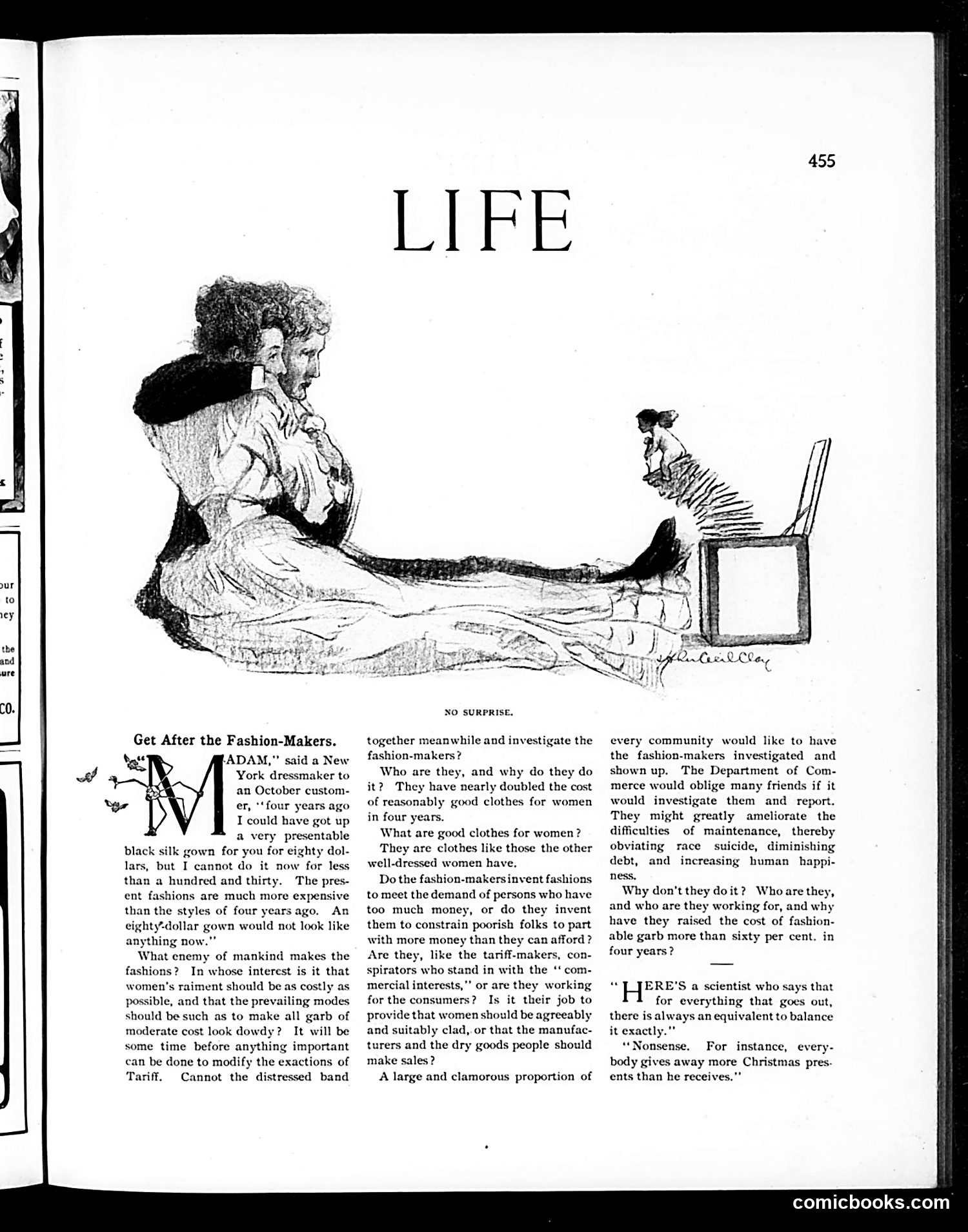
This page satirizes the fashion industry's practices and influence on women's clothing costs. The main cartoon shows a reclining woman with an extremely elongated train on her dress, while a tiny figure (likely representing a fashion designer or manufacturer) sits atop the excess fabric. The accompanying article, "Get After the Fashion-Makers," critiques how designers artificially drive up clothing prices—a woman notes she paid eighty dollars for a dress that costs less than one hundred in materials. The satire questions whether fashion-makers serve consumers or exploit them for profit, suggesting their designs are deliberately wasteful and expensive. The piece attacks what it views as conspiratorial collusion between manufacturers and "tariff-makers" to keep prices artificially high, ultimately harming ordinary women.
📄 Transcribed text from this page (OCR, searchable)
Machine-transcribed from the original scan — historical spelling and the odd misread are preserved.
Get After the Fashion-Makers. LADAM,” said a New York dressmaker to an October custom- er, ‘‘four years ago I could have got up a very presentable black silk gown for you for eighty dol- lars, but I cannot do it now for less than a hundred and thirty. The pres- ent fashions are much more expensive than the styles of four years ago. An cighty-dollar gown would not look like anything now.” What enemy of mankind makes the fashions? In whose interest is it that women's raiment should be as costly as possible, and that the prevailing modes should be such as to make all garb of moderate cost look dowdy? It will be some time before anything important can be done to modify the exactions of Tariff. Cannot the distressed band ‘oe NO SURPRISE, together meanwhile and investigate the fashion-makers? Who are they, and why do they do it? They have nearly doubled the cost of reasonably good clothes for women in four years. What are good clothes for women? They are clothes like those the other well-dressed women have, Do the fashion-makersinvent fashions to meet the demand of persons who have too much money, or do they invent them to constrain poorish folks to part with more money than they can afford? Are they, like the tariff-makers, con- spirators who stand in with the ‘‘ com- mercial interests,"’ or are they working for the consumers? Is it their job to provide that women should be agreeably and suitably clad, or that the manufac- turers and the dry goods people should make sales? A large and clamorous proportion of every community would like to have the fashion-makers investigated and shown up. The Department of Com- merce would oblige many friends if it would investigate them and report. They might greatly ameliorate the difficulties of maintenance, thereby obviating race suicide, diminishing debt, and increasing human happi- ness, Why don’t they doit? Who are they and who are they working for, and why have they raised the cost of fashion- able garb more than sixty per cent. in four years? a ERE'’S a scientist who says that for everything that goes out, there is always an equivalent to balance it exactly “Nonsense. For instance, every- body gives away more Christmas pres. ents than he receives."" comicbooks.com