
A complete issue · 20 pages · 1904
Life — October 27, 1904
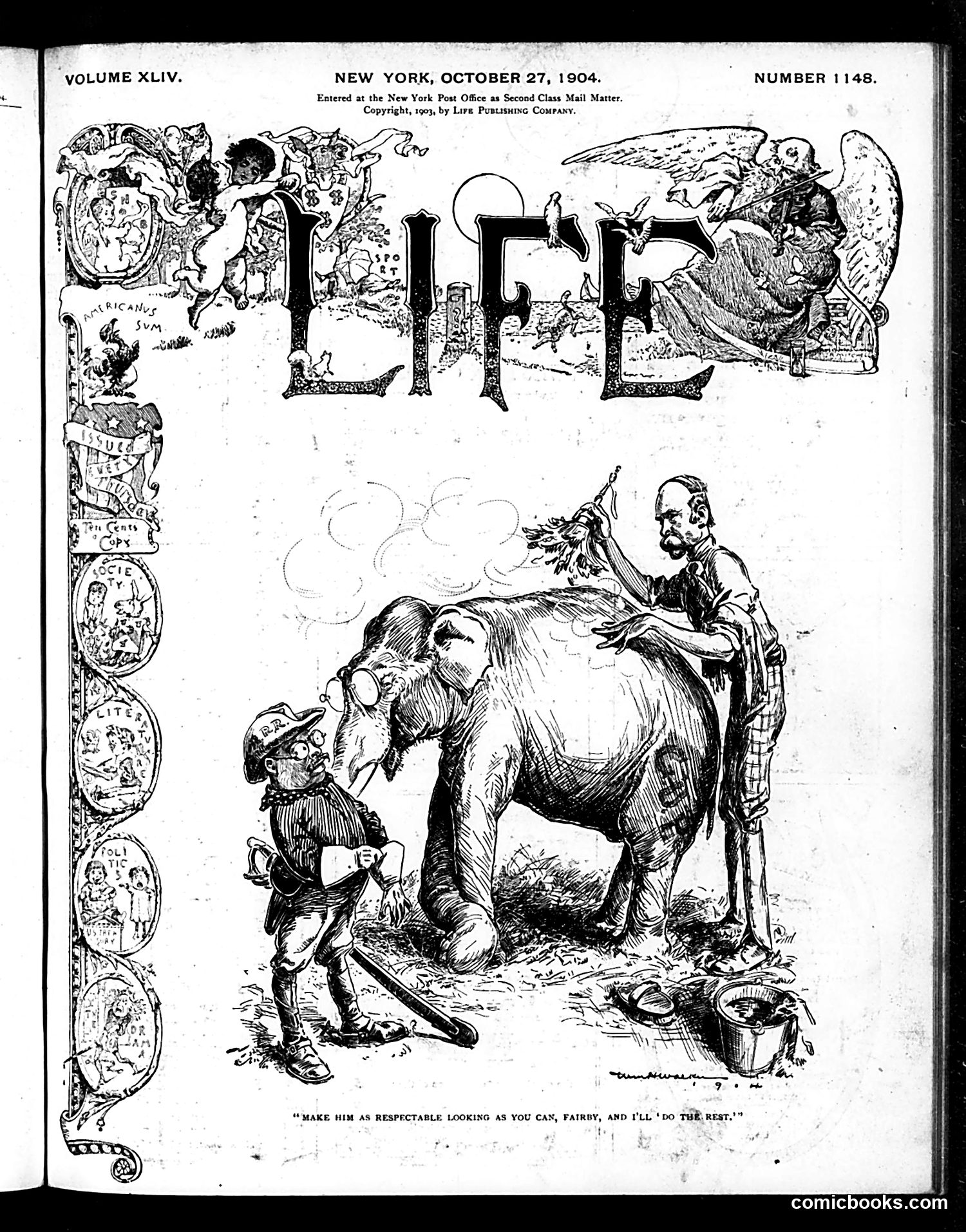
This page features a satirical cartoon titled "Make him as respectable looking as you can, Fairy, and I'll do the rest." The image depicts two figures attempting to groom or refurbish an elephant—a traditional symbol of the Republican Party in American political cartoons. The caption suggests a political makeover effort: one figure (appearing to be a fairy or magical helper) works on the elephant's appearance while another man supervises, implying he will handle the remaining work. This likely satirizes efforts to make a Republican candidate or the party itself more presentable to voters before the 1904 election, suggesting underlying flaws requiring cosmetic improvements rather than substantive change.
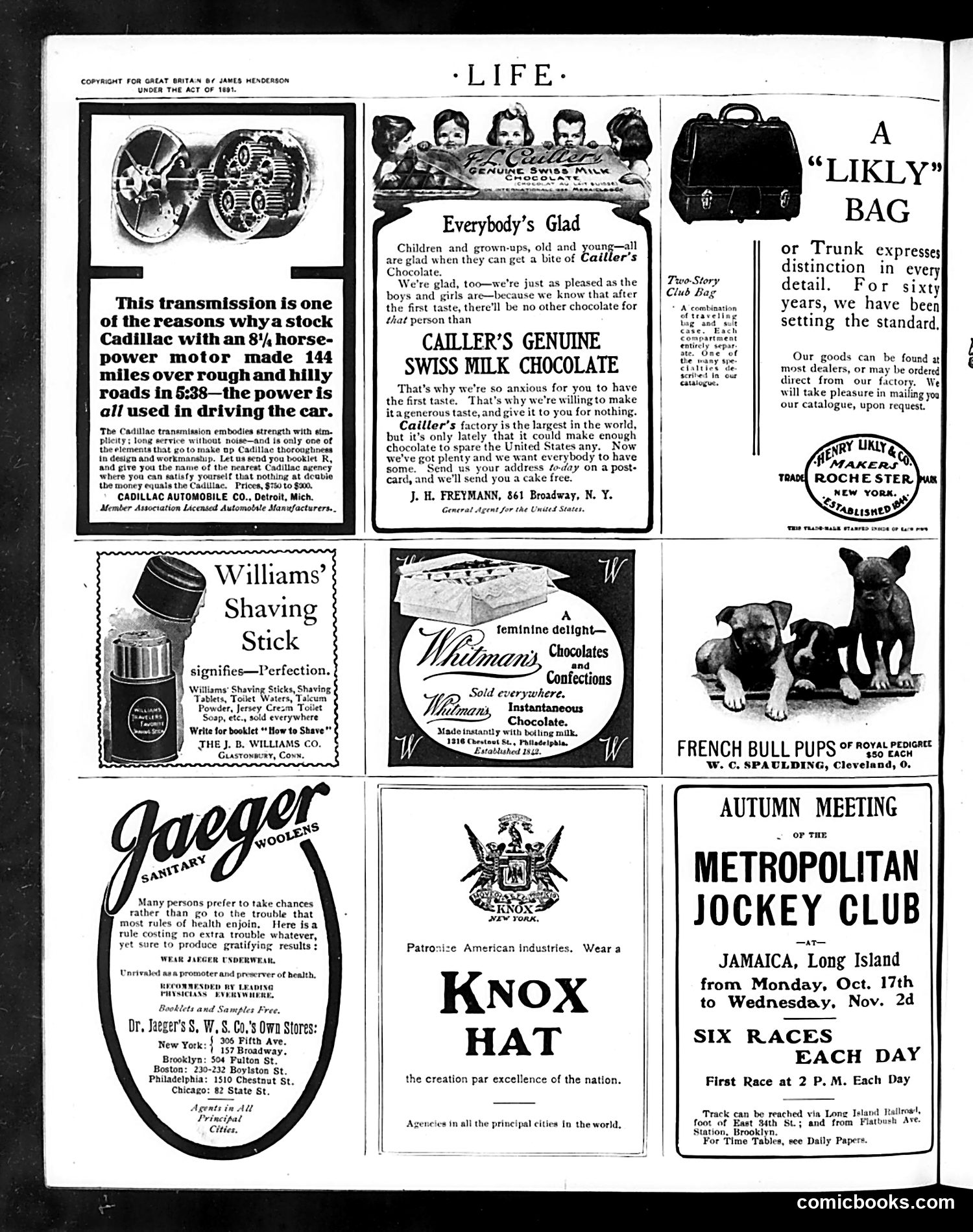
This page is **primarily advertisements** with no political cartoons or satirical content. The ads represent early 20th-century consumer products: - **Cadillac automobiles** and transmission technology - **Caillier's Swiss milk chocolate** - **Williams' Shaving Stick** grooming product - **Whitman's chocolates and confections** - **French Bull Pups** (dogs for sale) - **Jaeger sanitary woolens** (underwear) - **Knox Hat** (described as "creation par excellence of the nation") - **Henry Lilly & Co.** luggage ("Likly" bag) - **Metropolitan Jockey Club** autumn racing event announcement (Jamaica, Long Island) The page reflects consumer culture and leisure activities of the era, with no discernible satire or political commentary.
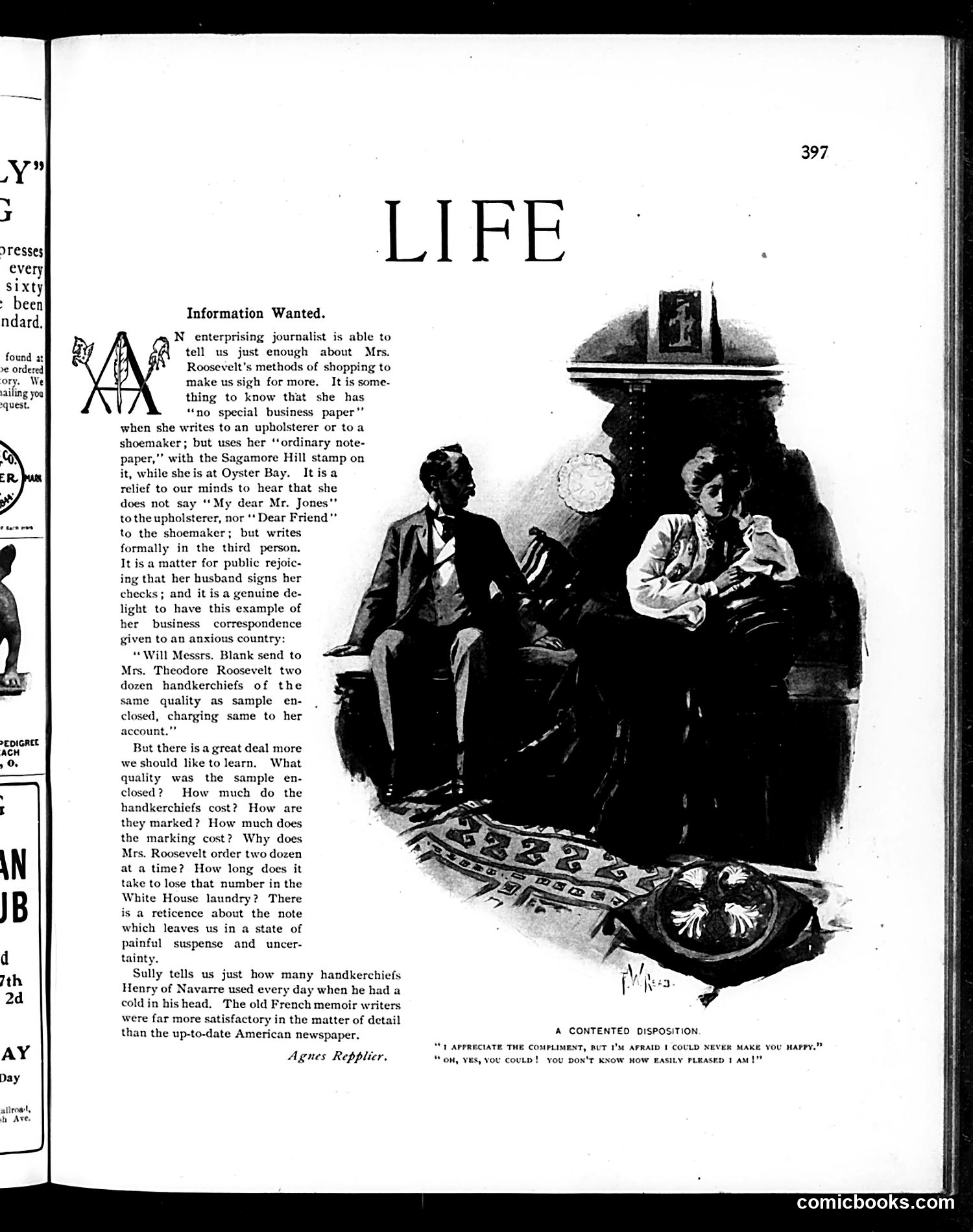
This page satirizes **Mrs. Theodore Roosevelt's shopping habits and business correspondence**. The article humorously questions the First Lady's methods: she apparently uses ordinary notepaper with a Sagamore Hill stamp (her estate) for business letters to upholsterers and shoemakers, rather than formal stationery. The satire escalates with absurd queries: What quality were the samples? How much do handkerchiefs cost? Why order two dozen at a time? How long do items stay in White House laundry? The accompanying illustration titled "A Contented Disposition" appears to show people examining fabric samples or merchandise, likely visualizing the shopping scenario being mocked. The piece gently ridicules the disconnect between First Lady protocol and Mrs. Roosevelt's practical, informal business approach—treating high-society purchasing like everyday transactions.
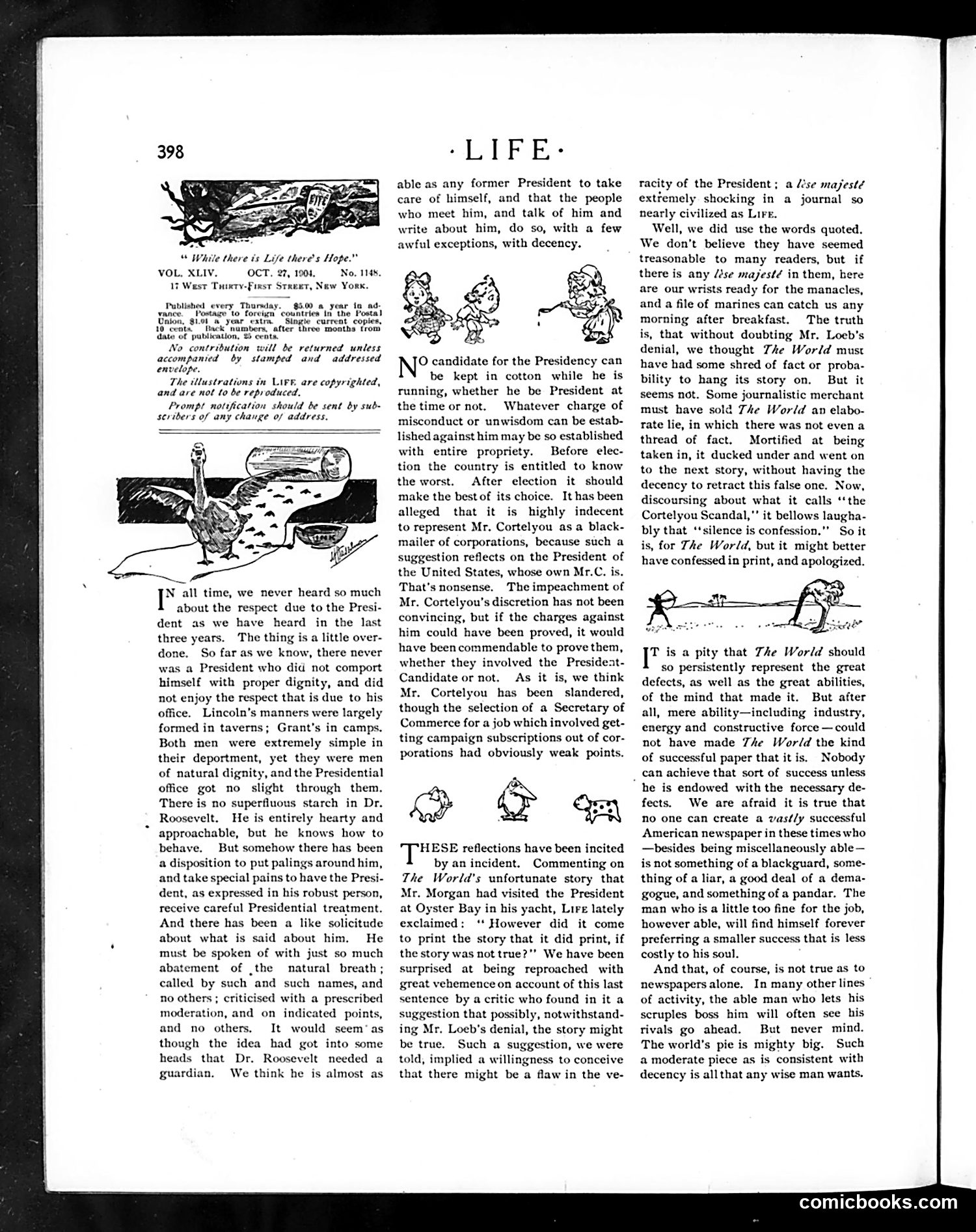
This page contains editorial commentary on presidential conduct and press relations. The text discusses respect due to the President's office while critiquing alleged misconduct by President Roosevelt and his Secretary of Commerce, Cortelyou. The cartoons (small illustrations scattered through the text) appear to depict everyday scenes rather than specific political figures. They likely serve as visual breaks in the dense editorial text. The main argument defends the press's right to scrutinize presidential actions, arguing that even presidents deserve criticism when warranted. The piece criticizes *The World* newspaper for printing an unverified story about J.P. Morgan visiting the President's yacht, while also noting that journalistic integrity matters more than sensationalism. The commentary reflects early 1900s debates over press freedom and presidential accountability.
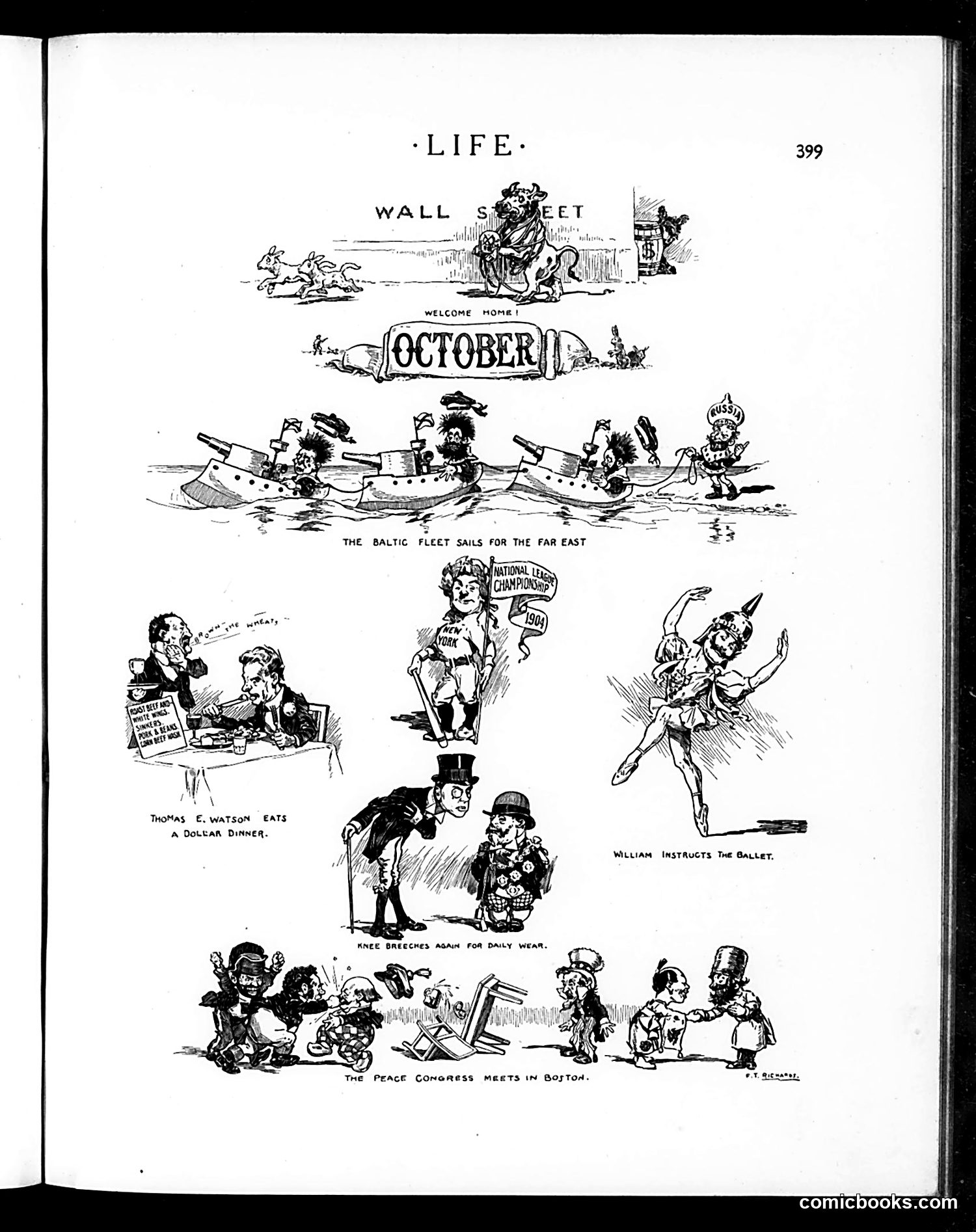
This satirical page celebrates October's arrival with several political cartoons: **"Thomas E. Watson Eats a Dollar Dinner"** mocks the Populist candidate's campaign rhetoric about wealth distribution. **"National Tennis Championship 1904"** features a female figure (likely depicting a prominent woman of the era) holding the trophy, commenting on women's athletics or suffrage debates. **"Knee Breeches Again for Daily Wear"** satirizes fashion trends, showing figures in old-fashioned clothing styles being revived. **"William Instructs the Ballet"** appears to comment on theatrical or artistic direction. **"The Peace Congress Meets in Boston"** references peace negotiations or political meetings of that period. The page exemplifies *Life*'s approach: mixing domestic politics, social commentary, and cultural observation through caricature and satire.
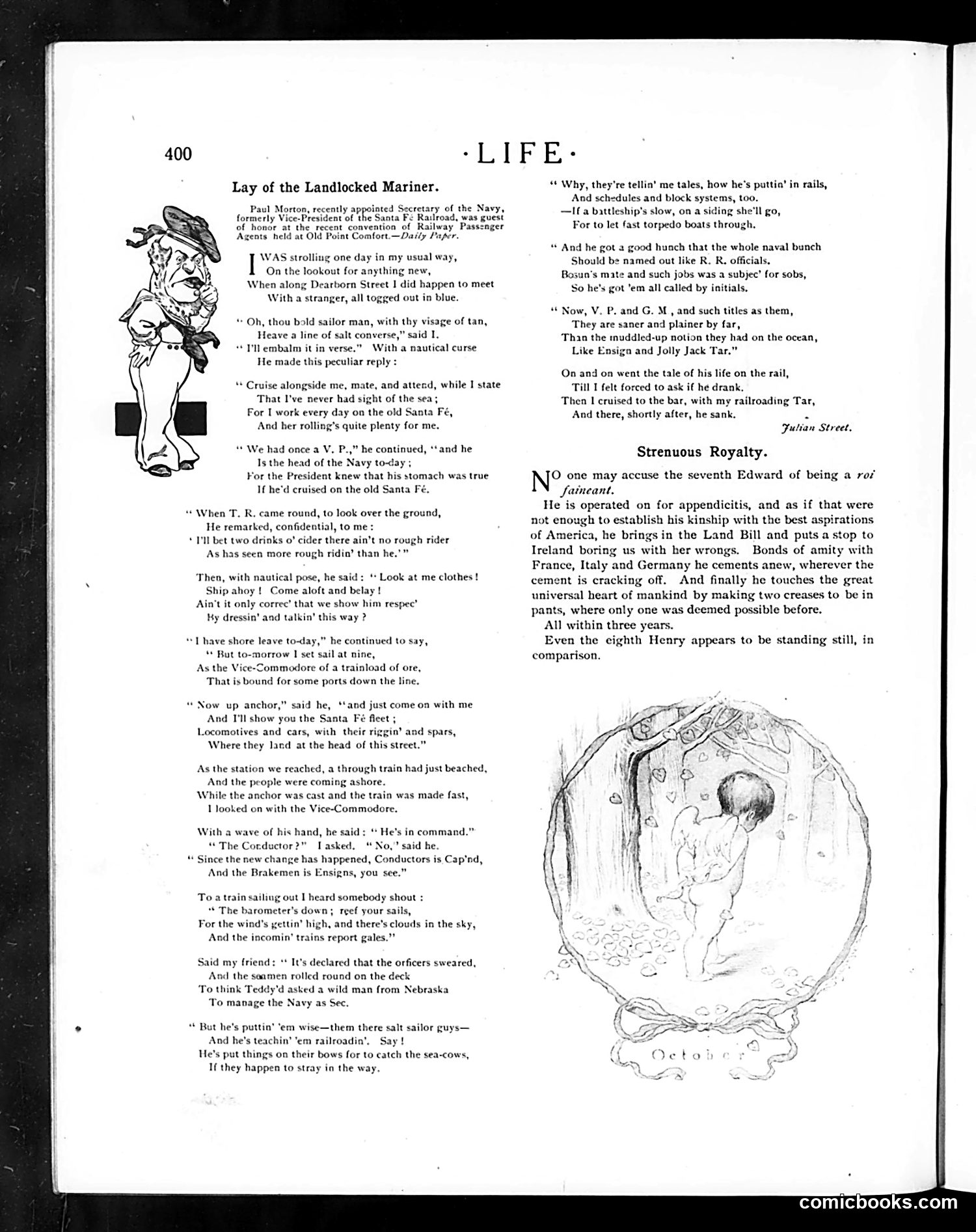
The left column features "Lay of the Landlocked Mariner," a humorous poem with an accompanying illustration of a sailor in exaggerated naval dress. The cartoon depicts a stereotypical "old salt" complaining about life on a railroad, comparing it unfavorably to seafaring. The satire appears to mock both the sailor archetype and, possibly, the incongruity of naval officers or personnel being assigned to railroad work—suggesting confusion between maritime and land-based transportation roles. The right column, "Strenuous Royalty," critiques King Edward VII, referencing his health issues and his obsession with maintaining royal dignity despite physical ailments. The text sarcastically catalogs his various ailments while suggesting his determination to preserve the monarchy's image remains unshaken compared to earlier monarchs. The circular illustration on the right remains unclear in its specific reference.
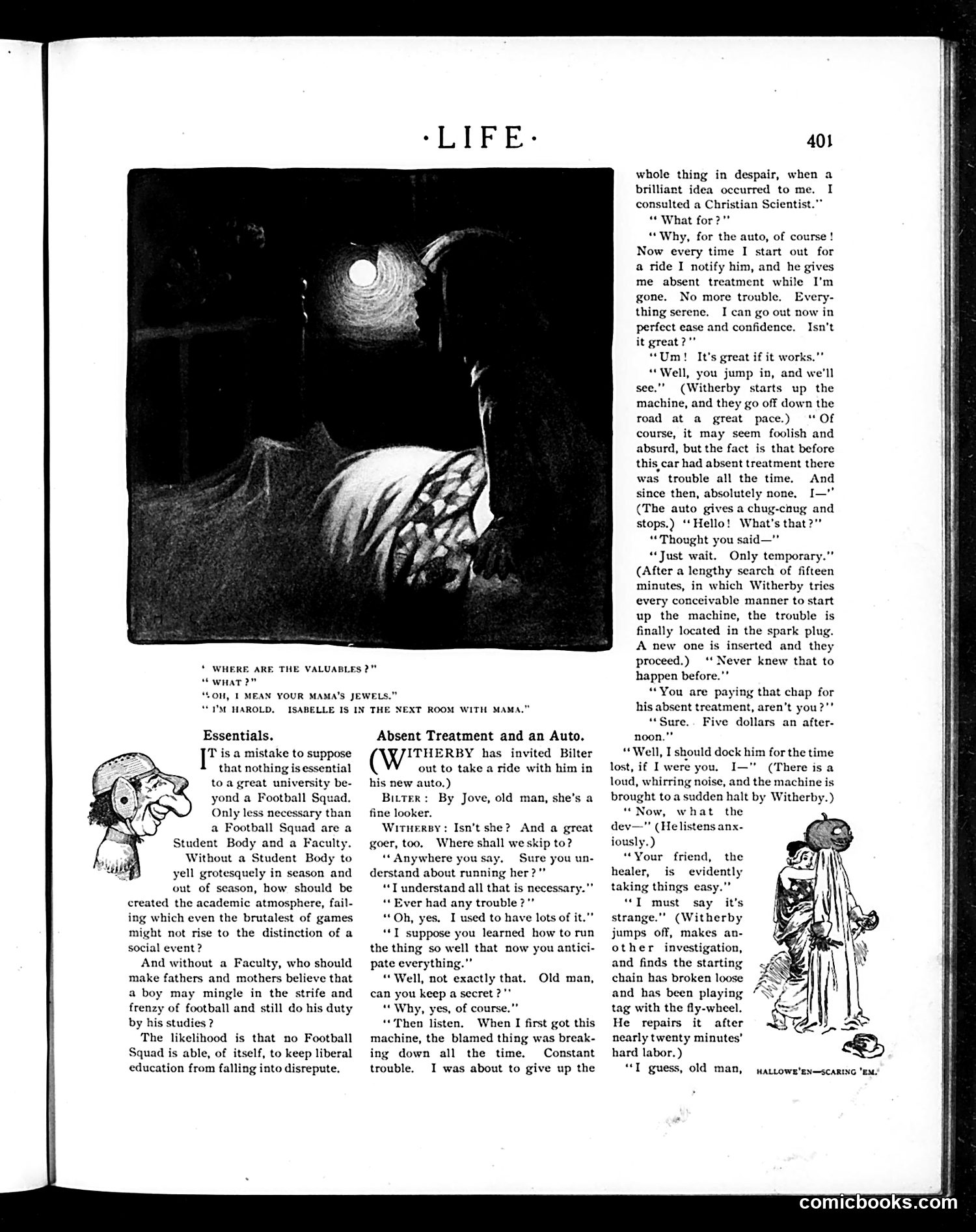
This page contains two separate pieces of satirical content: **"Essentials"** (left column) argues that a university football squad is unnecessary for liberal education. The cartoonist satirizes the belief that football is essential to campus life, suggesting instead that a faculty and proper academics serve that purpose better. **"Absent Treatment and an Auto"** (main story) depicts a humorous exchange between characters named Witherby and Bitter about Witherby's new automobile. The joke centers on "absent treatment" — likely a reference to Christian Science healing practices (mentioned in the dialogue). Witherby claims that by notifying his Christian Scientist of car trips, he receives "absent treatment" that prevents mechanical troubles. The satire mocks both automotive unreliability of the era and New Thought religious practices. The accompanying illustrations show a car headlight and period-dressed figures.
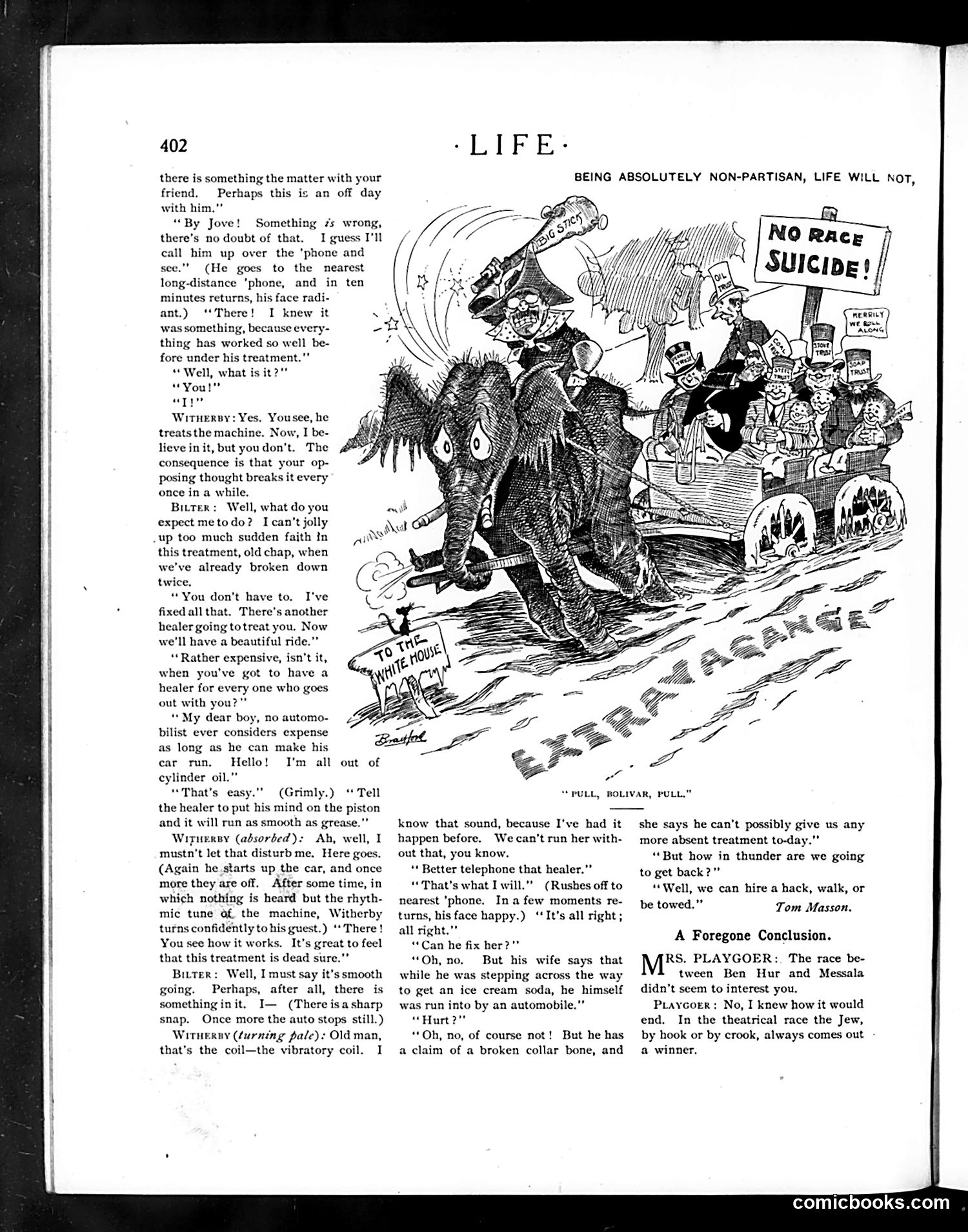
This cartoon depicts an elephant (representing the Republican Party) driving a chaotic vehicle labeled "TO THE WHITE HOUSE" while towing a sign reading "NO RACE SUICIDE!" The elephant carries passengers representing various political figures or factions. The "race suicide" slogan references early-1900s nativist anxieties about immigration and birth rates among white Americans. The cartoon satirizes Republican electoral strategy, suggesting they're cynically exploiting these racial fears to win voters. The crowded, out-of-control vehicle implies the GOP campaign is chaotic and haphazardly assembled. The sign itself—prominent and somewhat absurd—suggests the party is using inflammatory rhetoric on race to mobilize support rather than addressing substantive issues. The overall message critiques both the party's tactics and the social panic they're exploiting.
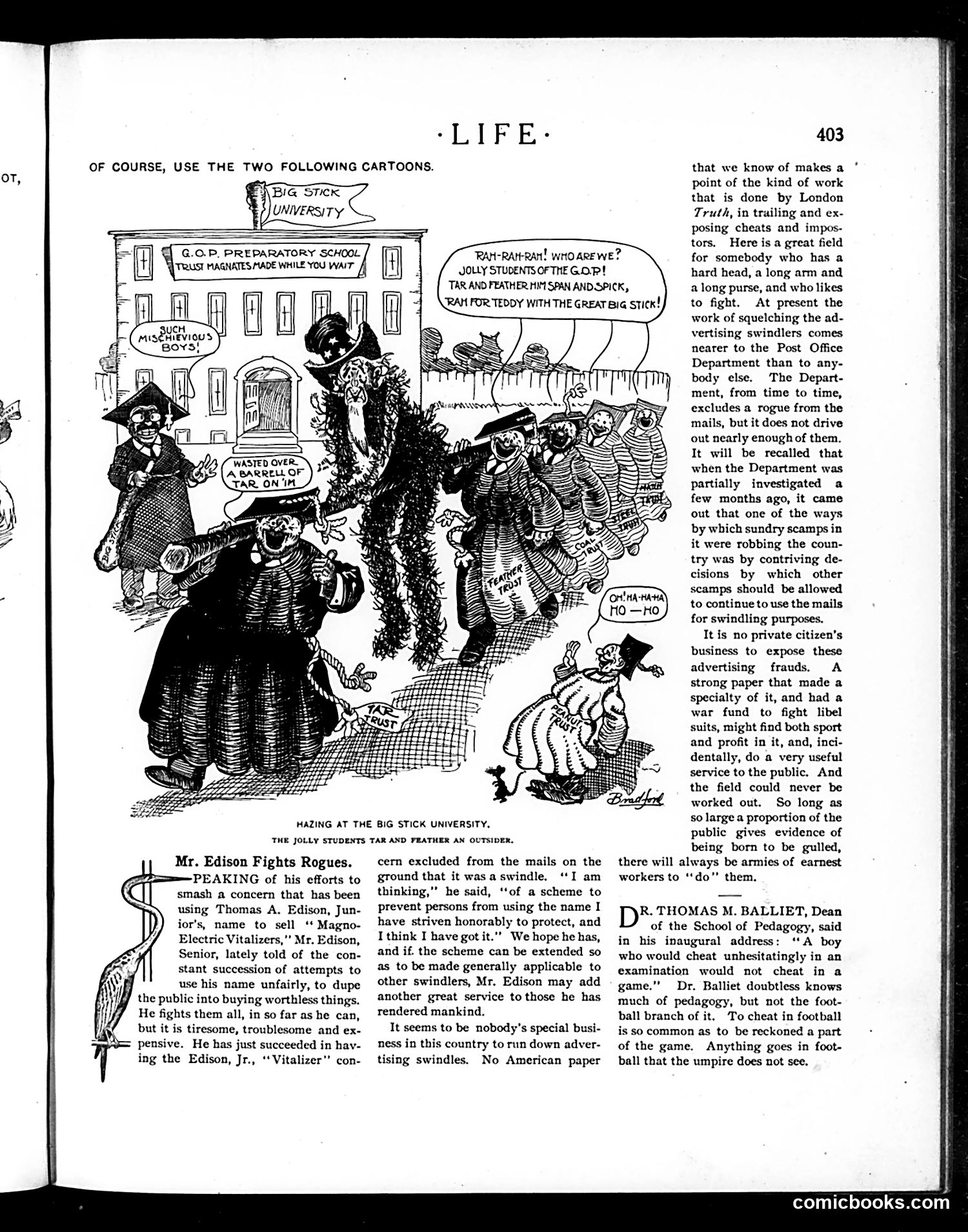
This political cartoon satirizes President Theodore Roosevelt's "Big Stick" foreign policy through a university hazing metaphor. The cartoon shows G.O.P. (Republican) Preparatory School students hazing an outsider labeled "Tar," representing a target of Roosevelt's interventionist policies. The joke conflates Roosevelt's aggressive diplomatic approach—famously expressed as "speak softly and carry a big stick"—with fraternity hazing rituals. The "jolly students" tar and feather the victim while the institution profits from the chaos, satirizing how Roosevelt's muscular foreign policy, while presented as righteous, actually caused disruption and harm under the guise of American superiority and strength.
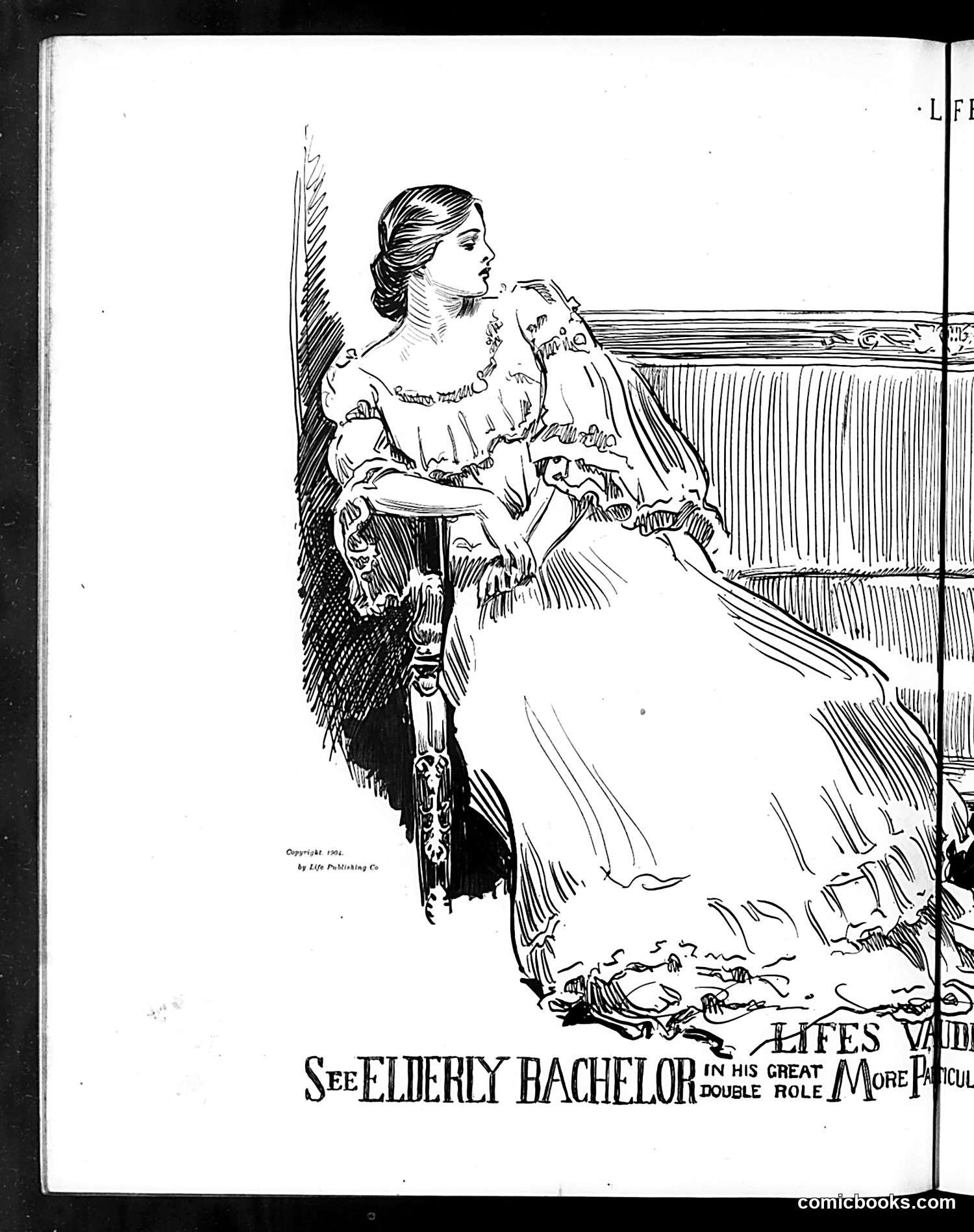
This is a movie advertisement from *Life* magazine (copyright 1904, per visible text). It promotes a film called "The Elderly Bachelor" featuring a double role performance. The illustration shows a fashionably dressed woman in Edwardian attire—high-necked blouse with puffed sleeves, long skirt—seated indoors in an elegant interior. The advertisement is straightforward promotional material rather than political satire. It capitalizes on the theatrical convention of "double roles" (one actor playing two characters), which was popular entertainment in early cinema. The woman depicted likely represents a character from the film, though without additional context, her specific role remains unclear. The artwork employs the refined illustrative style typical of early 1900s magazine advertising.
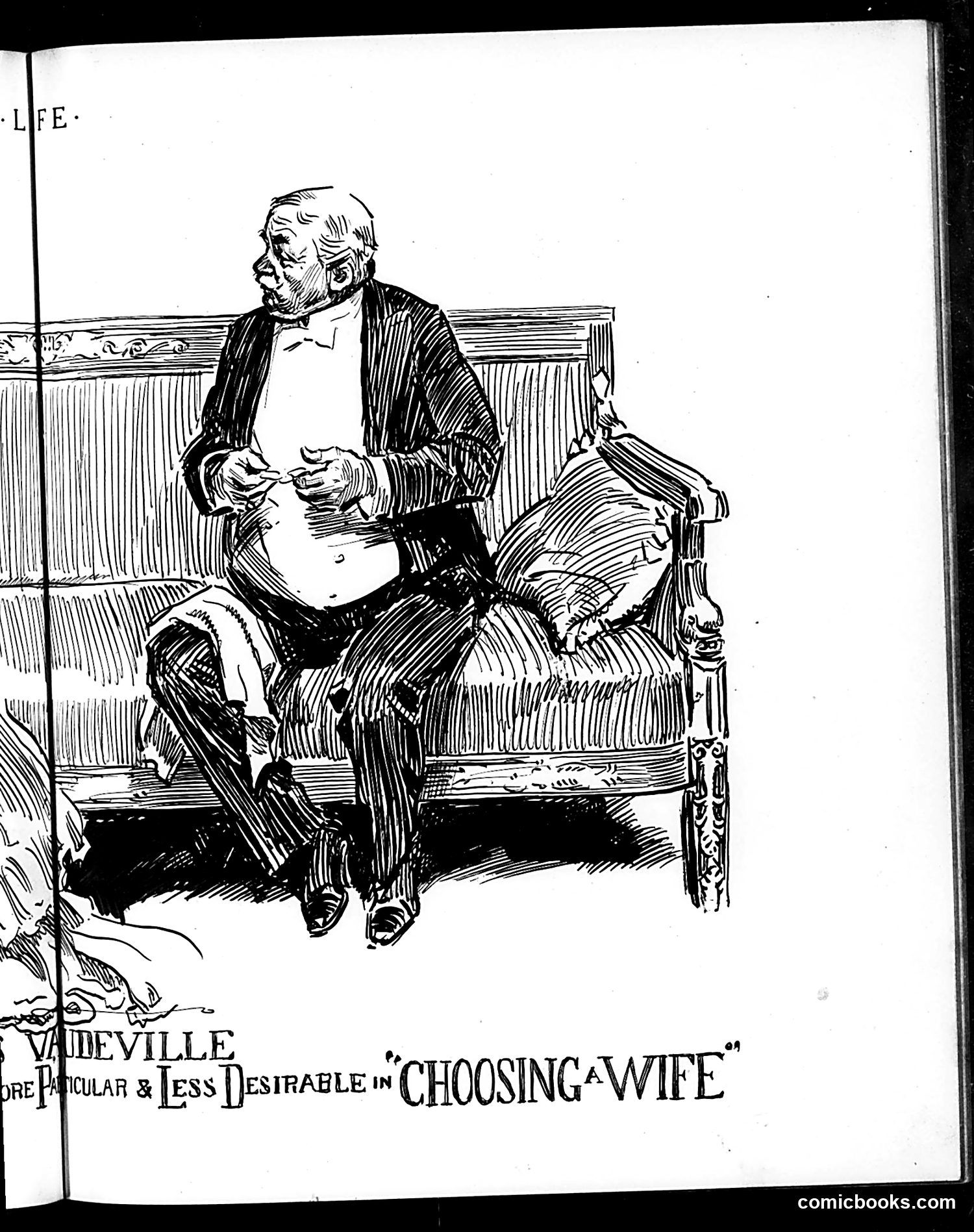
This satirical cartoon by Vaudeville artist depicts a portly, well-dressed gentleman seated on a sofa, appearing to contemplate marriage prospects. The caption suggests the cartoon critiques men who become "more particular" yet "less desirable" when selecting wives—a commentary on marriage standards and hypocrisy. The humor appears to target wealthy or prominent men who make exacting demands in wives despite being themselves undesirable matches: the figure's physical appearance (heavyset, aging) contrasts sharply with presumably high expectations. The satire critiques the disconnect between men's self-regard and their actual marriageability, likely reflecting early-20th-century social anxieties about courtship, class, and matrimony. The page appears from *Life* magazine's satirical commentary section.
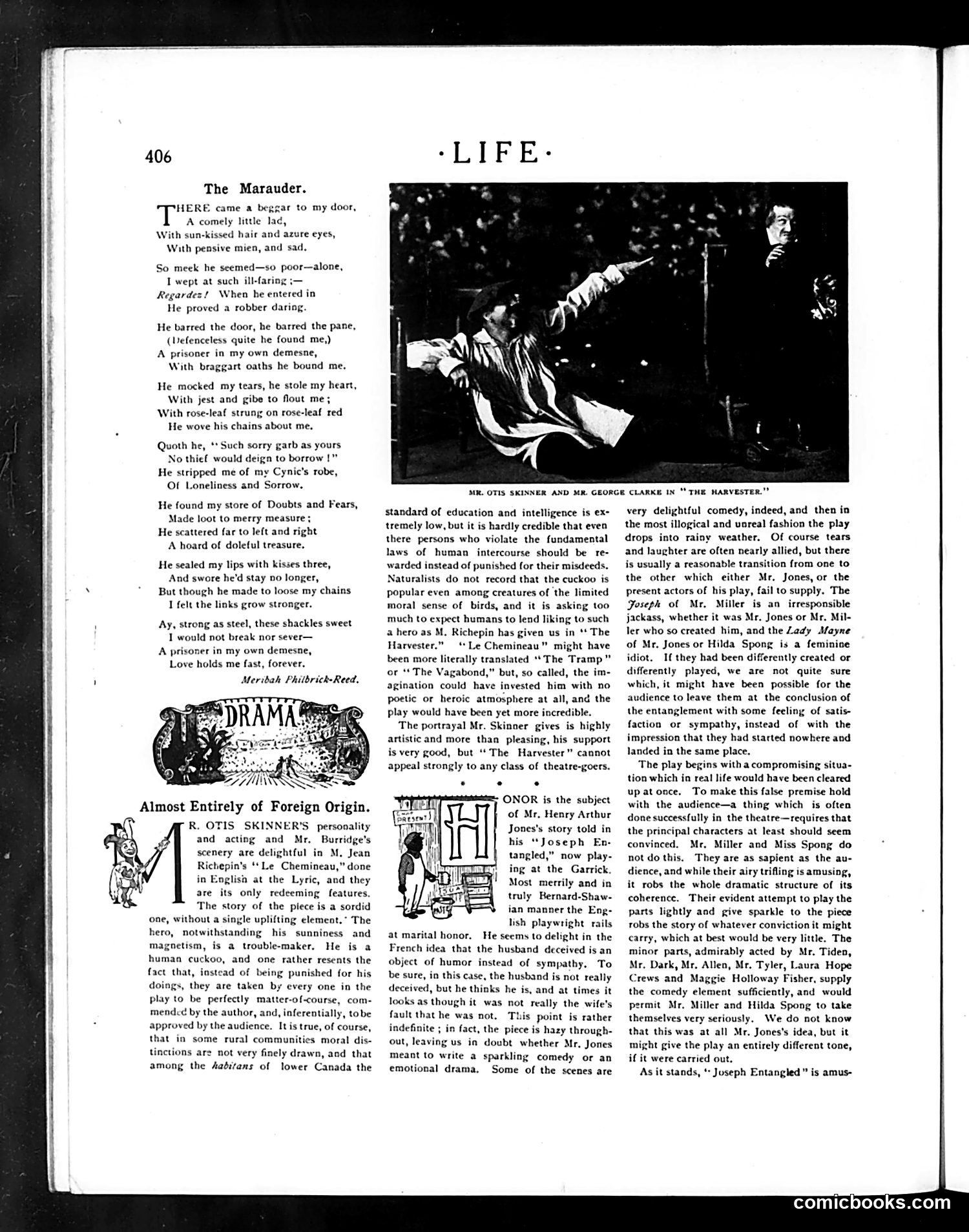
This page contains a poem titled "The Marauder" and a theater review. The image shows two men in what appears to be a dramatic scene from "The Harvester," featuring actors Mr. Otis Skinner and Mr. George Clarke. The review discusses Mr. Henry Arthur Jones's play "Joseph Entangled," currently at the Garrick Theatre. The critic notes the play's compromising premise—presenting a false situation to the audience—requires suspension of disbelief. The review praises actors Miller and Miss Spoong's performance while critiquing the play's overall coherence and ambiguous tone regarding whether it's comedy or drama. The "Marauder" poem appears to be a romantic or melodramatic narrative about a beggar who enters someone's home, though its exact satirical target isn't entirely clear from this excerpt alone.
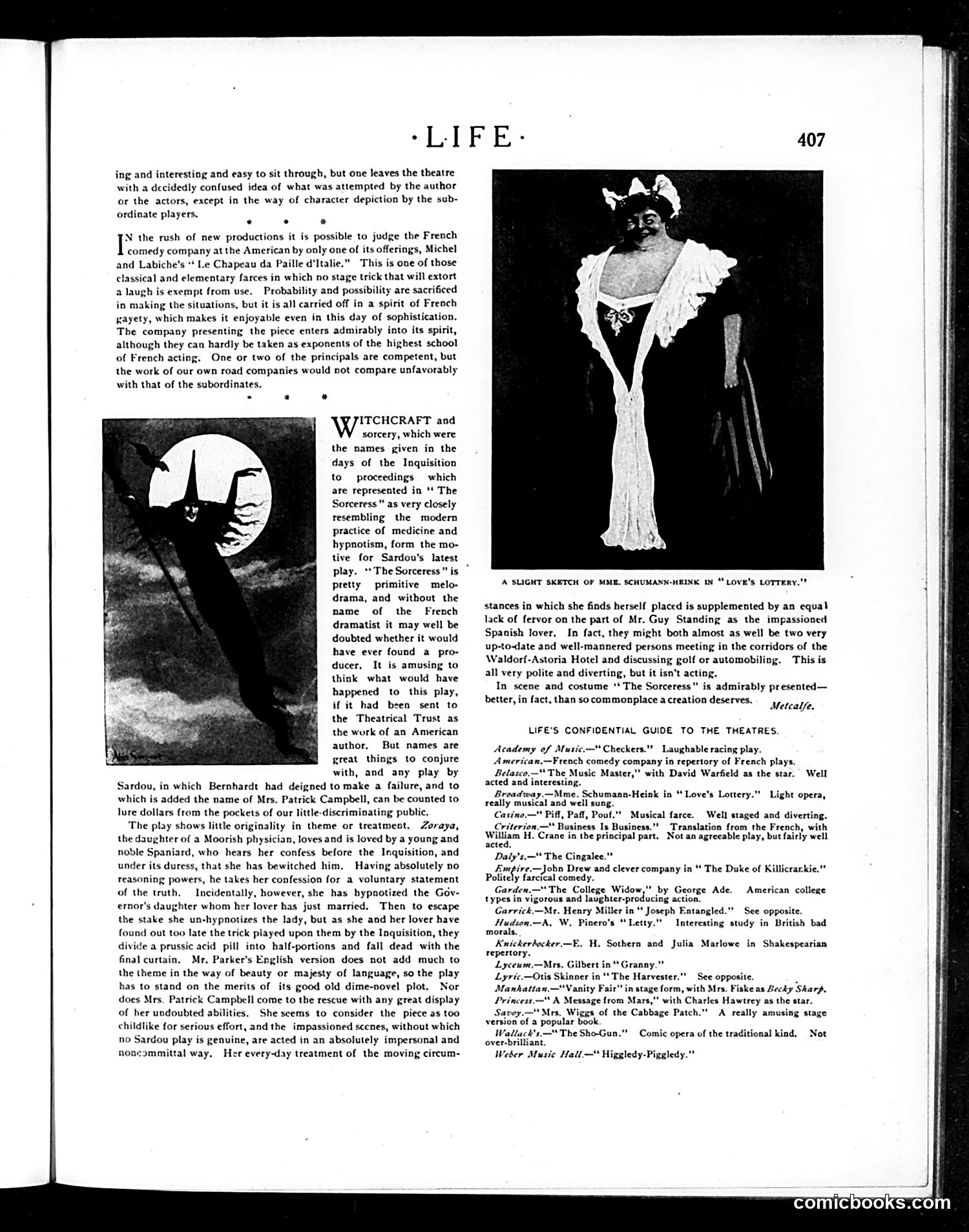
This page reviews theatrical productions, featuring two main critiques: **"Le Chapeau de Paille d'Italie"** (a French farce by Michel and Labiche): The reviewer praises the piece's spirited French style while noting the American production company's subordinate actors don't match high standards of French performance. **"The Sorceress"** (Sardou play): The left illustration depicts a witch figure—referencing the play's Inquisition-era witchcraft theme. The review is scathing, criticizing the melodrama as derivative and unoriginal. The text mocks how Sardou's name alone attracts audiences, while Mrs. Patrick Campbell's "impersonal and noncommittal" performance lacks passion. The plot involves hypnotism masquerading as witchcraft—the reviewer sarcastically notes this resembles modern medicine and hypnotism. The right image shows Mme. Schumann-Heink in "Love's Lottery," another production receiving mixed commentary about polite but undramatic acting. The page exemplifies *Life* magazine's satirical theater criticism, using performance reviews to critique both artistic merit and public taste.
This page contains literary reviews and two short humorous stories, not political cartoons. The main content is H.W. Boynton's commentary on contemporary books (circa early 1900s), including novels by Nelson Lloyd, George Barr McCutcheon, and others. Two fictional vignettes appear: "Laudator Temporis Acti" (a Latin phrase meaning "praiser of past times") depicts a concerned mother whose daughter returns drunk from a party—the humor lies in the father's dismissive response that "clothes don't make the man" and her son should learn auto repair. "An Easy Winner" shows two rivals competing for a girl's affection, with the successful suitor noting his competitor was slovenly and poorly dressed. Both stories gently mock social pretensions and courtship rituals of the era, while the book reviews reflect early 20th-century literary tastes and publishing success.
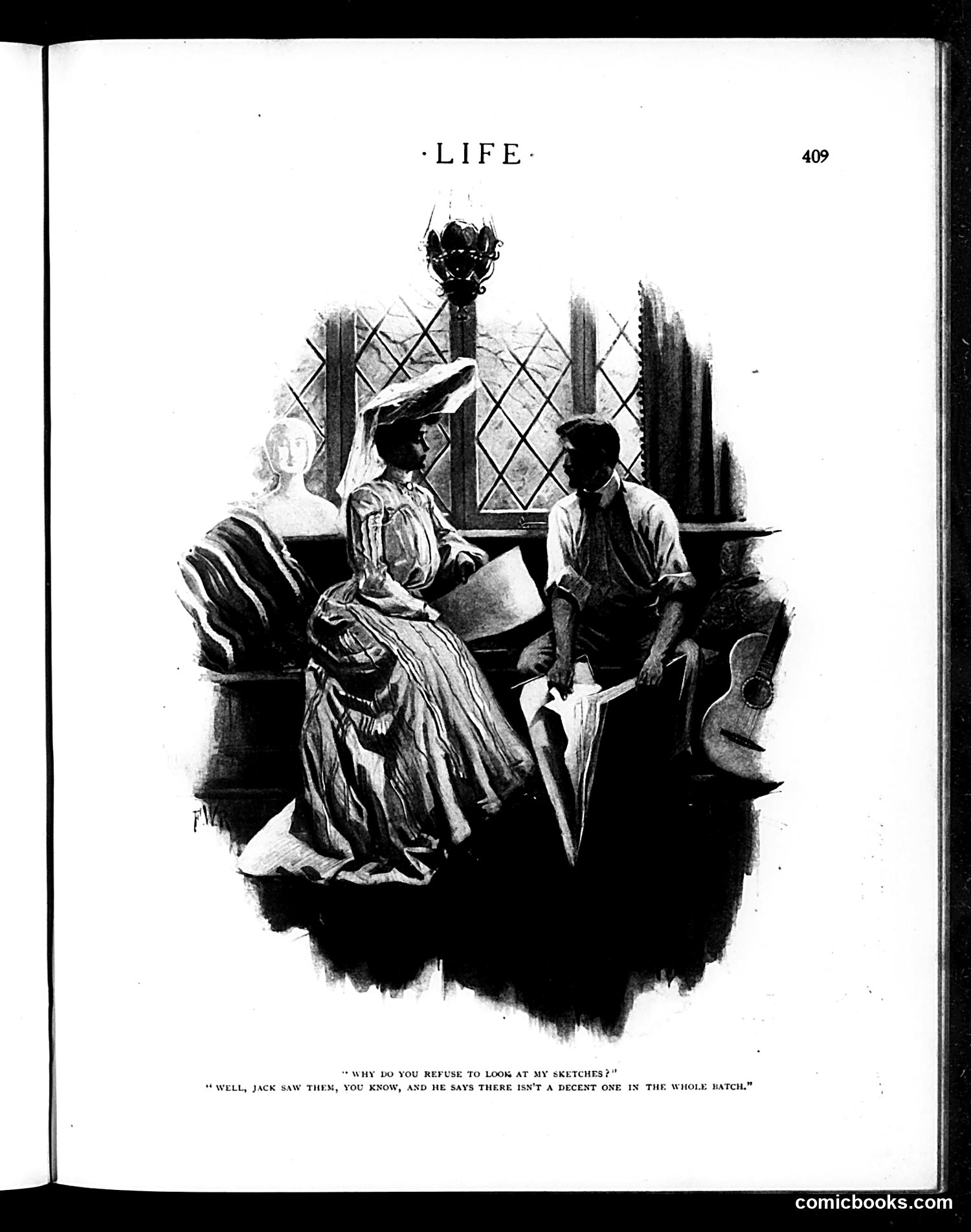
This is a social satire about artistic criticism and reputation. A woman shows her sketches to a man, who refuses to look at them. When she asks why, he explains that "Jack" (apparently someone whose opinion carries weight) has already pronounced the entire batch worthless. The joke critiques how people defer to authority figures rather than forming independent judgments. The man won't even examine the sketches himself—he's simply accepting Jack's dismissal secondhand. The woman's elaborate dress and the domestic interior suggest this occurs in polite society, implying that such deference to influential taste-makers was common among the educated classes. The satire targets both the uncritical acceptance of expert opinion and the social dynamics that allow one person's judgment to suppress others' engagement with art.
This page satirizes the emerging phenomenon of divorce and casual attitudes toward marriage in early 20th-century America. The main comic strip "A La Meredith" depicts marriage as a renewable business contract rather than a lifelong commitment. A couple agrees to marry for only ten years with the option to renew, treating matrimony like a commercial agreement. The punchline comes five years later when their child, "Uncle Sam's little boy," casually reports that both parents have moved on to other partners with expiring contracts of their own. Below, "Threw Them Off the Scent" depicts a young couple deliberately disguising themselves as business associates (discussing the stock market) rather than newlyweds to avoid passengers' suspicion—the joke being the bride has rice in her shoes, revealing their ruse. Both pieces mock the increasing secularization and commodification of marriage, treating it as transactional rather than sacred, reflecting anxieties about changing social institutions in the Progressive Era.
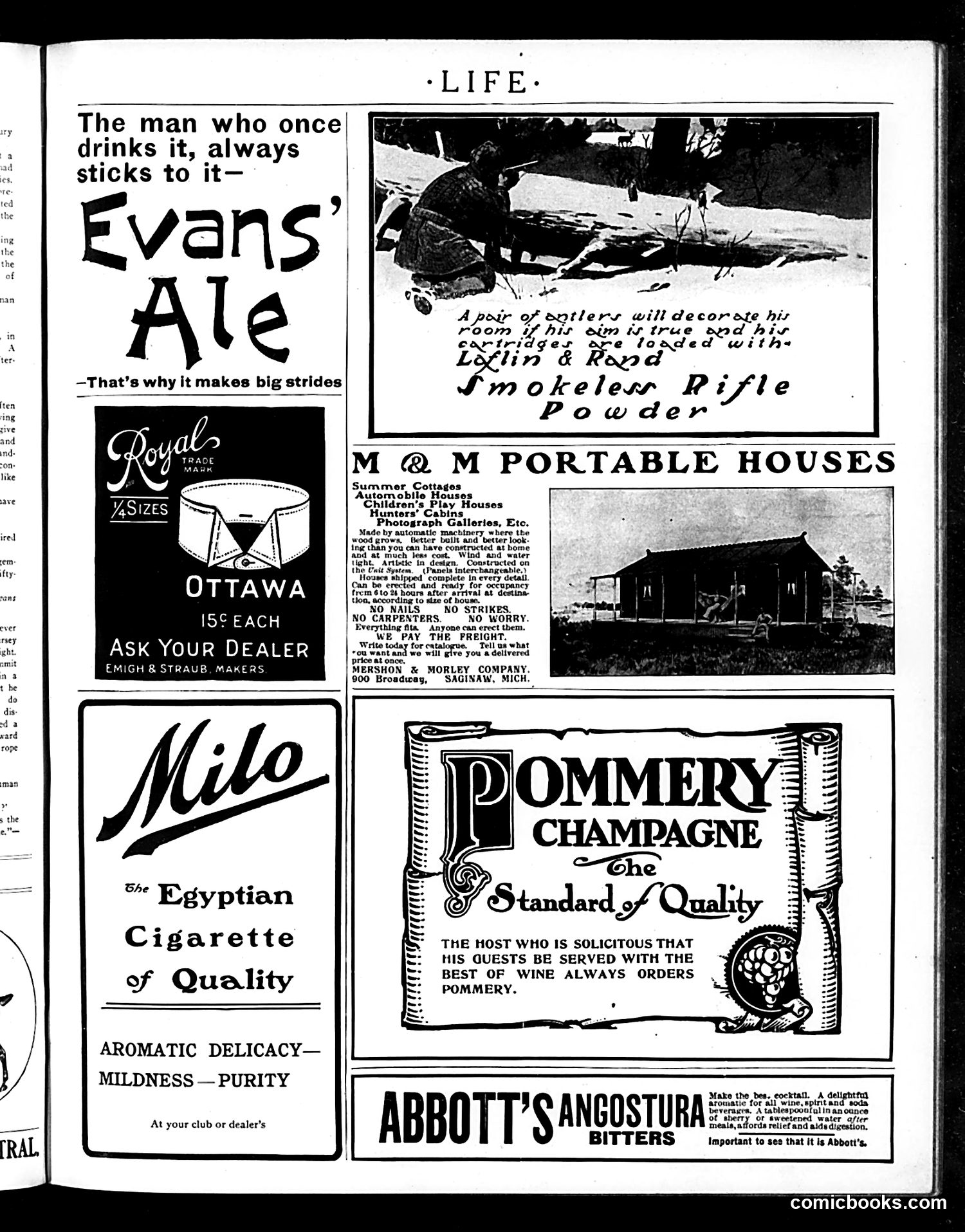
This page contains **primarily advertisements**, not political satire or editorial cartoons. The content includes: - **Evans' Ale**: A beverage advertisement claiming customer loyalty - **Royale tablecloths**: Household products marketed at 15¢ - **Milo cigarettes**: "Egyptian" tobacco product emphasizing quality - **M&M Portable Houses**: Prefabricated structures (cottages, cabins, playhouses) marketed as easy to assemble without carpenters or nails - **Pommery Champagne**: Wine advertisement targeting hospitable hosts - **Abbott's Angostura Bitters**: A cocktail ingredient The single illustrative image (top right) shows a rifle with ammunition and appears to be advertising smokeless powder for hunting rifles. This reflects early 20th-century consumer culture and advertising conventions. The "portable houses" ad is historically notable as an early example of prefabrication marketing. Modern readers would find the casual promotion of cigarettes and alcohol, plus the gender assumptions (housewives as primary consumers), most striking.
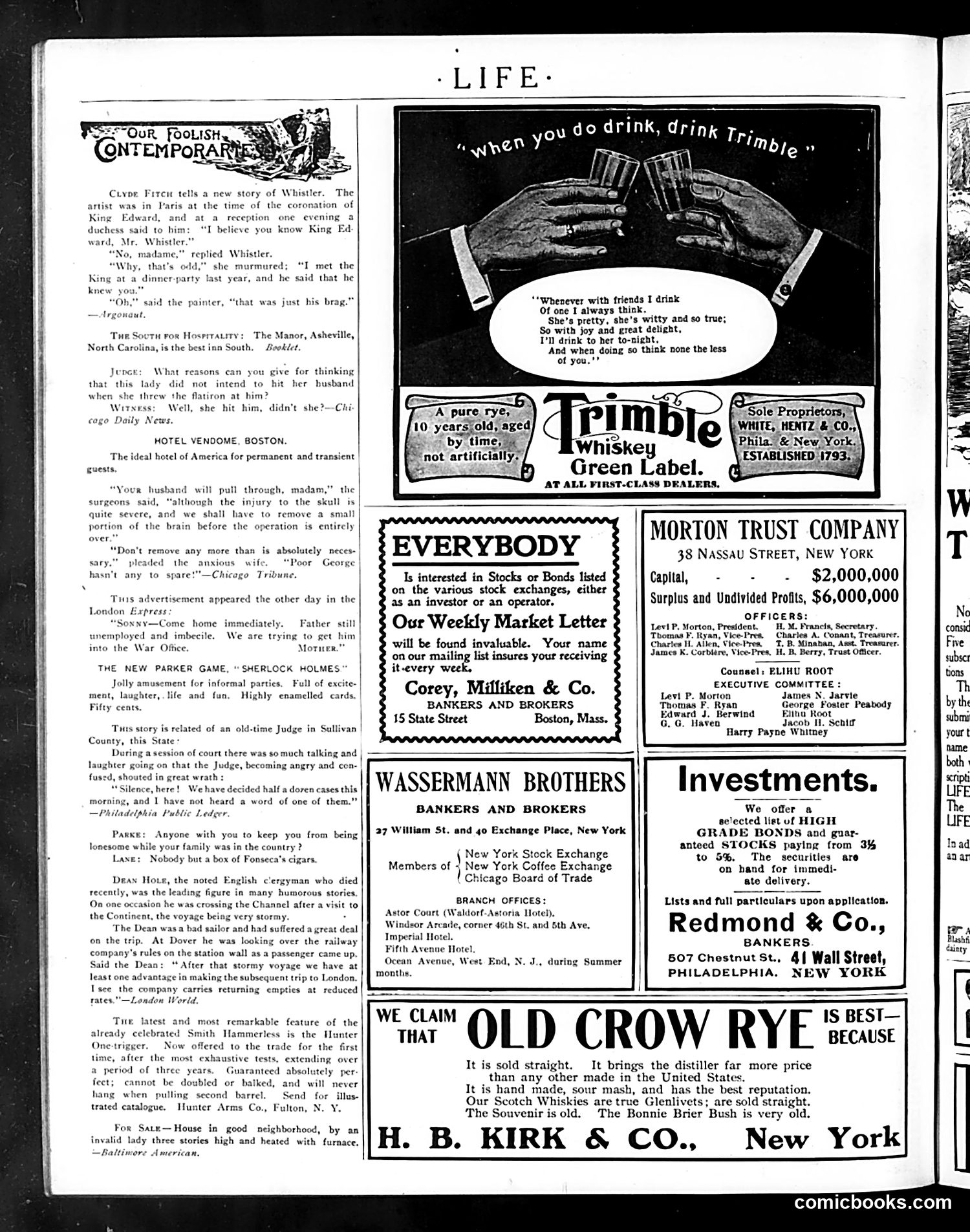
This page from *Life* magazine contains **mostly advertisements and brief humorous anecdotes** rather than political cartoons. The main content includes: **"Our Foolish Contemporaries"** — a humor column featuring brief jokes about notable figures, including an anecdote about painter **James McNeill Whistler** and his encounter with someone claiming to know King Edward VII. The joke plays on Whistler's reputation for witty arrogance. Other short humorous items mock matrimonial disputes, medical mishaps, and clerical mishaps — typical light satirical fare of the era. **The advertisements** dominate the page, promoting financial services (stock brokers, trust companies), hotels, and notably **alcohol** — Trimble Whiskey and Old Crow Rye whiskey ads are prominently featured. This reflects the pre-Prohibition era (the page predates 1920). The page reflects early 1900s American leisure-class humor and commercial culture rather than deep political satire. The tone is genteel and aimed at educated, affluent readers.
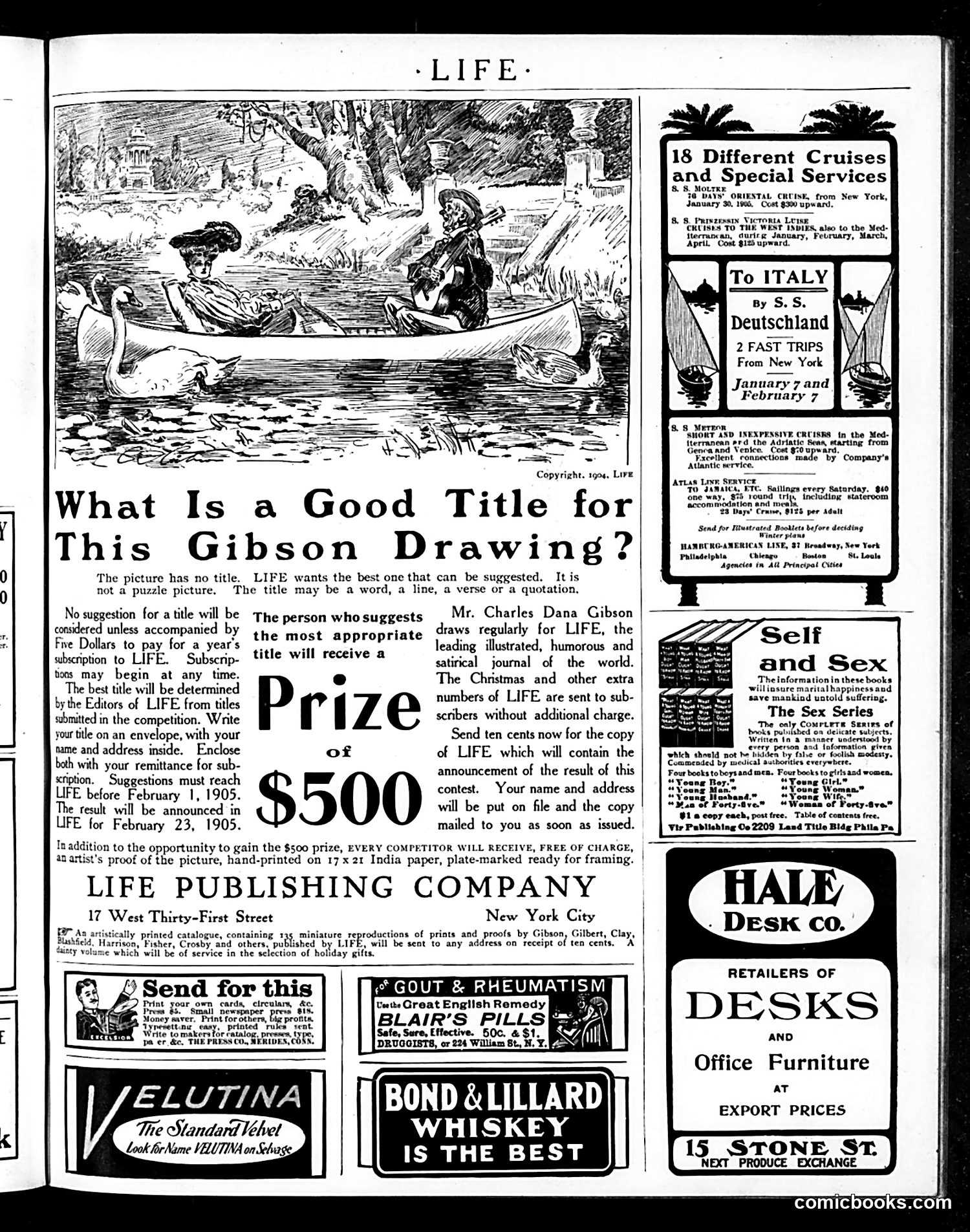
This page centers on a **contest by Life magazine** inviting readers to title a Charles Dana Gibson drawing. The illustration depicts an idyllic Edwardian romantic scene: a woman and man in a boat on a river, with swans nearby—typical of Gibson's "Gibson Girl" aesthetic that defined early 1900s idealized femininity and courtship. **The Contest:** Life offers a $500 prize (substantial for 1904) plus a free artist's proof to whoever suggests "the most appropriate title." Entries required a $5 subscription fee. This was a common circulation-building strategy. **The Satire/Joke:** Gibson's drawing, though charming and romantic on its surface, apparently lacks an obvious title—suggesting the scene's very conventionality made it difficult to name. The contest itself pokes gentle fun at readers' creative pretensions. **Supporting Content:** The page is largely advertisements (whiskey, pills, cruise ships, furniture, medical sex-education books)—typical of Life's revenue model. The masthead identifies Gibson as Life's regular illustrator, cementing his celebrity status in early American popular culture.
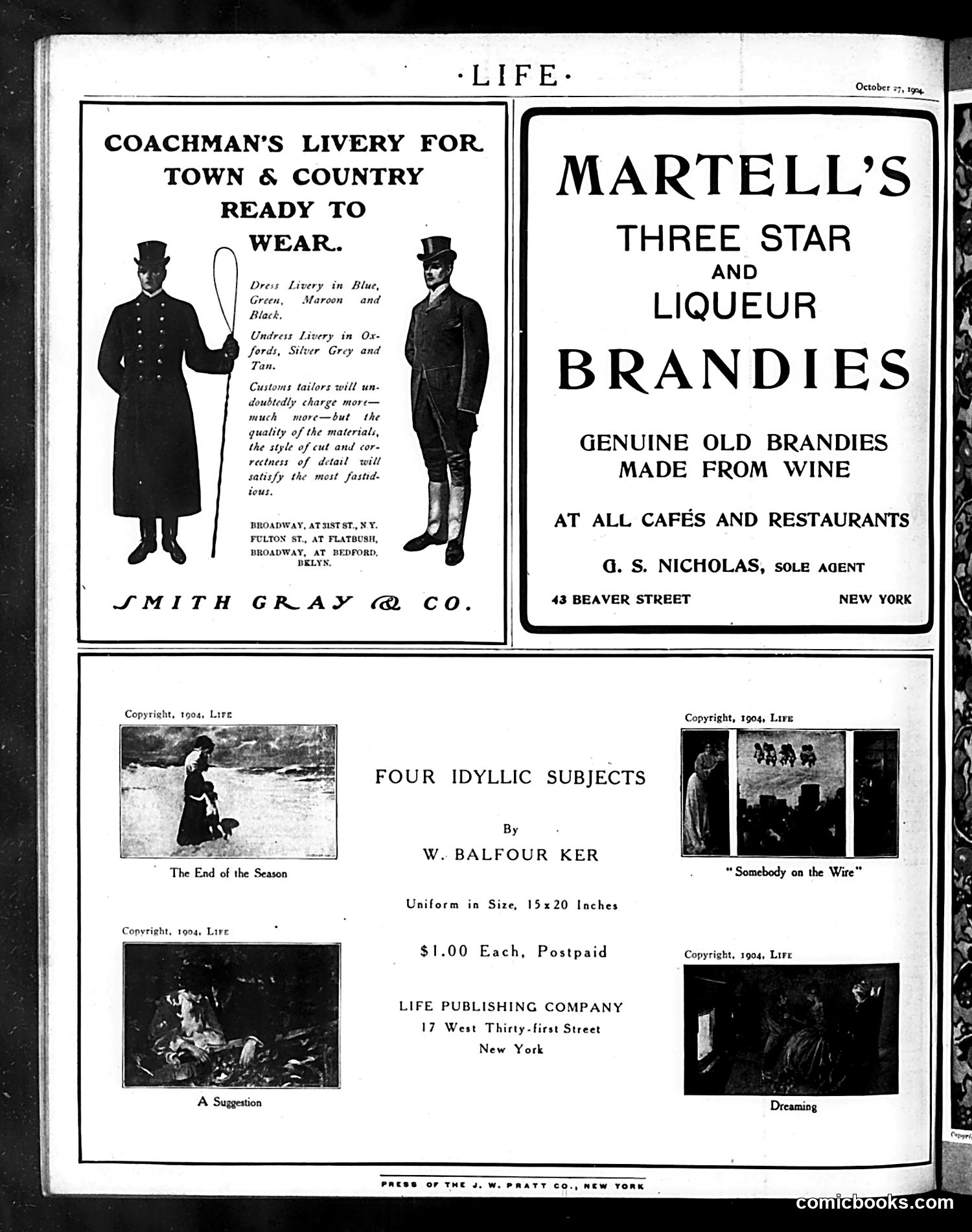
This page is primarily **advertising and product promotion**, not political satire. It contains three distinct advertisements: 1. **Coachman's Livery** (Smith Gray & Co.): Offers formal servant uniforms in various colors for wealthy households requiring staff for "town & country" occasions. 2. **Martell's Brandy** (G.S. Nicholas): Promotes French brandy available at restaurants and cafés. 3. **Four Idyllic Subjects by W. Balfour Ker**: Advertises art prints ($1.00 each) with romantic titles—"The End of the Season," "Somebody on the Wire," "A Suggestion," and "Dreaming"—available from Life Publishing Company. The page reflects early 1900s consumer culture targeting wealthy readers, showcasing luxury goods (formal wear, imported spirits, decorative art). There is no political commentary or social satire visible. The date header shows October 27, 1904—a period when *Life* magazine functioned as both humor publication and upscale advertising vehicle.