
Life, 1904-10-27 · page 3 of 20
Life — October 27, 1904 — page 3: what you’re looking at
What you’re looking at
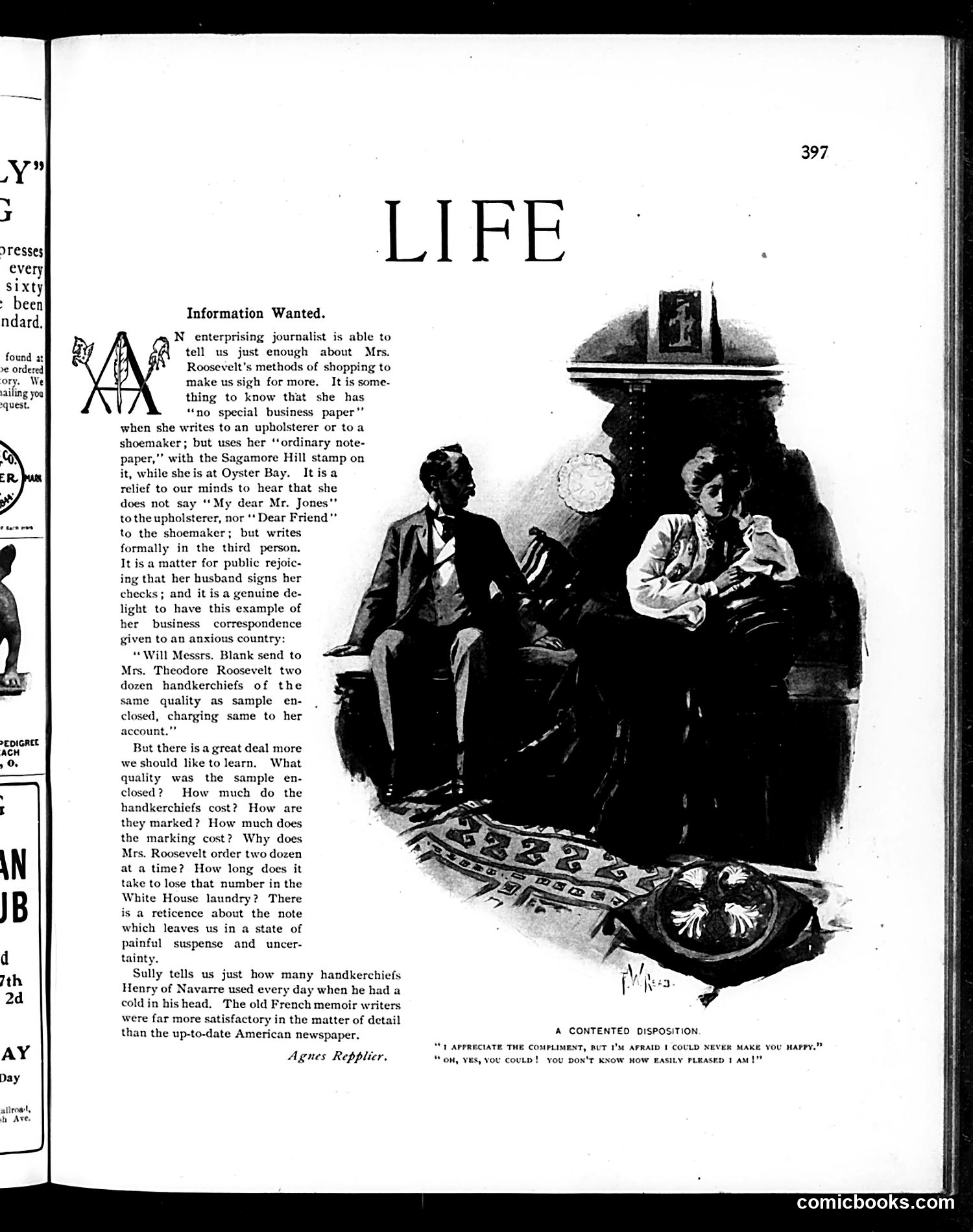
This page satirizes **Mrs. Theodore Roosevelt's shopping habits and business correspondence**. The article humorously questions the First Lady's methods: she apparently uses ordinary notepaper with a Sagamore Hill stamp (her estate) for business letters to upholsterers and shoemakers, rather than formal stationery. The satire escalates with absurd queries: What quality were the samples? How much do handkerchiefs cost? Why order two dozen at a time? How long do items stay in White House laundry? The accompanying illustration titled "A Contented Disposition" appears to show people examining fabric samples or merchandise, likely visualizing the shopping scenario being mocked. The piece gently ridicules the disconnect between First Lady protocol and Mrs. Roosevelt's practical, informal business approach—treating high-society purchasing like everyday transactions.
📄 Transcribed text from this page (OCR, searchable)
Machine-transcribed from the original scan — historical spelling and the odd misread are preserved.
Information Wanted. N enterprising journalist is able to tell us just enough about Mrs. Roosevelt's methods of shopping to make us sigh for more. It is some- thing to know that she has “no special business paper”? when she writes to an upholsterer or toa shoemaker; but uses her ‘ordinary note- paper,” with the Sagamore Hill stamp on it, while she is at Oyster Bay. Itisa relief to our minds to hear that she does not say “My dear Mr. Jone: tothe upholsterer, nor ‘Dear Friend to the shoemaker; but writes formally in the third person, It is a matter for public rejoic- ing that her husband signs her checks; and it isa genuine de- light to have this example of her business correspondence given to an anxious country: “Will Messrs. Blank send to Mrs. Theodore Roosevelt two dozen handkerchiefs of the same quality as sample en- closed, charging same to her account."” But there is a great deal more we should like to learn. What quality was the sample en- closed? How much do the handkerchiefs cost? How are they marked? How much does the marking cost? Why does Mrs. Roosevelt order two dozen ata time? How long does it take to lose that number in the White House laundry? There is a reticence about the note which leaves us in a state of painful suspense and uncer- tainty. Sully tells us just how many handkerchiefs Henry of Navarre used every day when he had a cold in hishead. The old French memoir writers were far more satisfactory in the matter of detail than the up-to-date American newspaper. A CONTENTED: DISPOSITION. “1 APPRECIATE THE COMPLIMENT, BUT I'M AFRAID I COULD NEVER MAKE YOU HAPPY.” Agnes Repplier, “om, ves, vou couLD! You DON'T KNOW Mow EASILY FLEASKD 1 ast!” comicbooks.com