
Life, 1904-10-27 · page 14 of 20
Life — October 27, 1904 — page 14: what you’re looking at
What you’re looking at
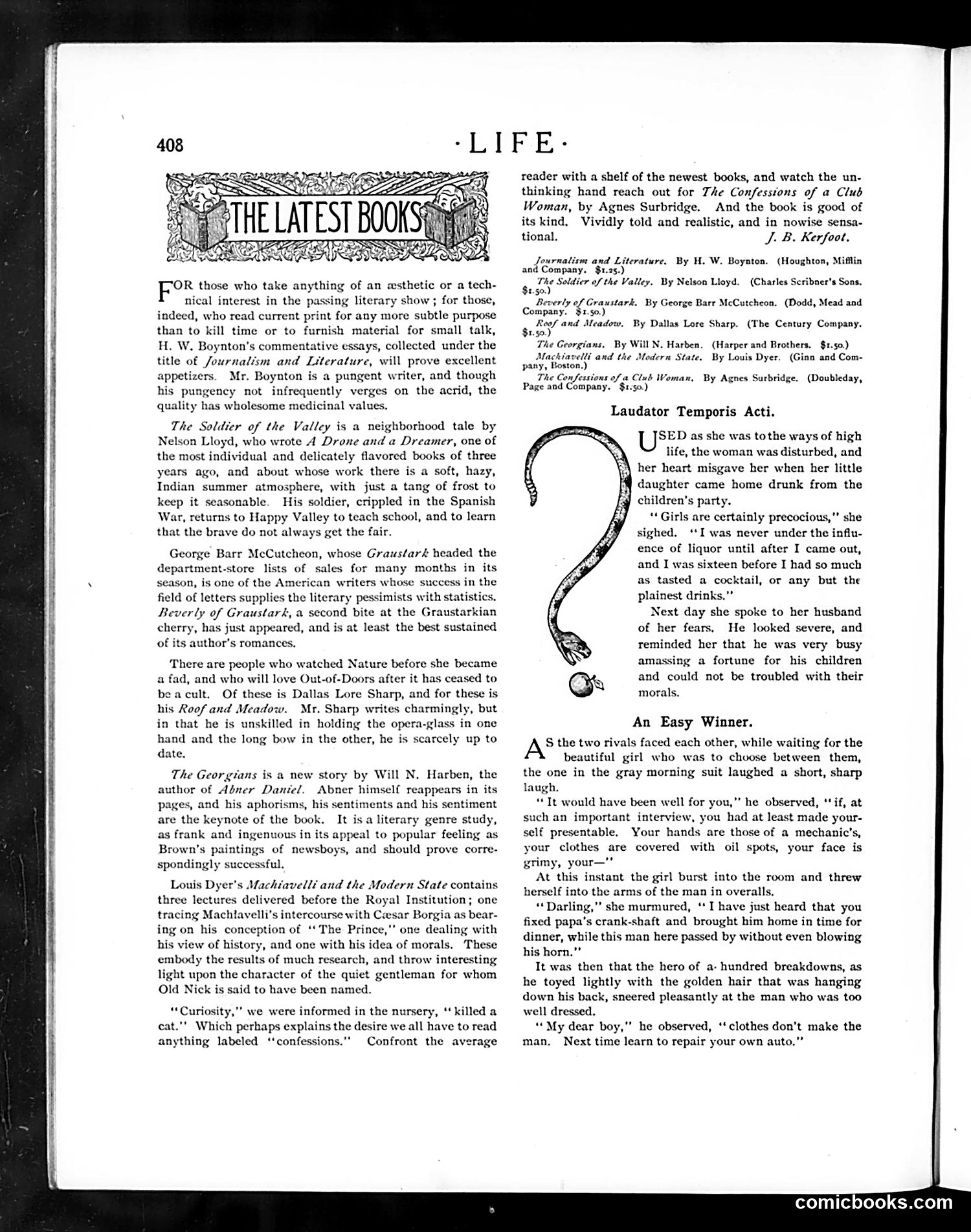
This page contains literary reviews and two short humorous stories, not political cartoons. The main content is H.W. Boynton's commentary on contemporary books (circa early 1900s), including novels by Nelson Lloyd, George Barr McCutcheon, and others. Two fictional vignettes appear: "Laudator Temporis Acti" (a Latin phrase meaning "praiser of past times") depicts a concerned mother whose daughter returns drunk from a party—the humor lies in the father's dismissive response that "clothes don't make the man" and her son should learn auto repair. "An Easy Winner" shows two rivals competing for a girl's affection, with the successful suitor noting his competitor was slovenly and poorly dressed. Both stories gently mock social pretensions and courtship rituals of the era, while the book reviews reflect early 20th-century literary tastes and publishing success.
📄 Transcribed text from this page (OCR, searchable)
Machine-transcribed from the original scan — historical spelling and the odd misread are preserved.
| Bae those who take anything of an asthetic or a tech- nical interest in the passing literary show ; for those, indeed, who read current print for any more subtle purpose than to kill time or to furnish material for small talk, H. W. Boynton’s commentative essays, collected under the title of Journalism and Literature, will prove excellent appetizers. Mr. Boynton is a pungent writer, and though his pungency not infrequently verges on the acrid, the quality has wholesome medicinal values. The Soldier of the Valley is a neighborhood tale by Nelson Lloyd, who wrote A Drone and a Dreamer, one of the most individual and delicately flavored books of three years ago, and about whose work there is a soft, hazy, Indian summer atmosphere, with just a tang of frost to keep it seasonable. His soldier, crippled in the Spanish War, returns to Happy Valley to teach school, and to learn that the brave do not always get the fair. George Barr McCutcheon, whose Graustark headed the department-store lists of sales for many months in its season, is one of the American writers who: field of letters supplies the literary pe Beverly of Graustark, a second bite at the Gra cherry, has just appeared, and is at least the best sustained of its author's romances, ‘There are people who watched Nature before she became a fad, and who will love Out-of-Doors after it has ceased to beacult. Of these is Dallas Lore Sharp, and for these is his Roof and Meadow. Mr. Sharp writes charmingly, but in that he is unskilled in holding the opera-glass in one hand and the long bow in the other, he is scarcely up to date. The Georgians is a new story by Will N. Harben, the author of Abner Daniel. Abner himself reappears in its pages, and his aphorisms, his sentiments and his sentiment are the keynote of the book. It isa literary genre study, as frank and ingenuous in its appeal to popular feeling as Brown's paintings of newsboys, and should prove corre- spondingly successful. Louis Dyer's Machtavell? and the Modern State contains three lectures delivered before the Royal Institution; one tracing Machiavelli’s intercourse with Caesar Borgia as bear- ing on his conception of ‘‘ The Prince,"’ one dealing with his view of history, and one with his idea of morals, These embody the results of much research, and throw interesting light upon the character of the quiet gentleman for whom Old Nick is said to have been named. “Curiosity,” we were informed in the nursery, “killed a cat."" Which perhaps explains the desire we all have to read anything labeled ‘‘confessions.” Confront the average reader with a shelf of the newest books, and watch the un- thinking hand reach out for The Confessions of a Club Woman, by Agnes Surbridge. And the book is good of its kind, Vividly told and realistic, and in nowise sensa- tional. J. B. Kerfoot, Journalism and Literature, By H.W. Boynton. (Houghton, Mifflin and Company. $1.25.) ree Soldier of the Valley, By Nelson Lloyd. 1.50. Beverly of Graustark, By George Barr McCutcheon. (Dodd, Mead and Company. $1.50.) gn £59/ and Meadow. By Dallas Lore Sharp. (The Century Company. 1.50. The Georgians. By Will N. Harben. (Harper and Brothers. $1.50.) Machiavelli and the Modern State. By Louis Dyer. (Ginn and Com- pany, Boston.) The Confessions of a Club Woman, By Agnes Surbridge. (Doubleday, Page and Company. $1.50.) (Charles Scribner's Sons, Laudator Temporis Acti. SED as she was tothe ways of high life, the woman was disturbed, and her heart misgave her when her little daughter came home drunk from the children’s party. “*Girls are certainly precocious,” she sighed. ‘I was never under the influ- ence of liquor until after I came out, and I ixteen before I had so much as tasted a cocktail, or any but the plainest drinks.” Next day she spoke to her husband of her fears, He looked severe, and reminded her that he was very busy amassing a fortune for his children and could not be troubled with their morals, An Easy Winner. S the two rivals faced each other, while waiting for the beautiful girl who was to choose between them, the one in the gray morning suit laughed a short, sharp laugh. “Tt would have been well for you,” he observed, ‘if, at such an important interview, you had at least made your- self presentable, Your hands are those of a mechanic your clothes are covered with oil spots, your face is grimy, your—"" At this instant the girl burst into the room and threw herself into the arms of the man in overalls. “Darling,” she murmured, ‘I have just heard that you fixed papa’s crank-shaft and brought him home in time for dinner, while this man here passed by without even blowing his horn.”” It was then that the hero of a- hundred breakdowns, as he toyed lightly with the golden hair that was hanging down his back, sneered pleasantly at the man who was too well dressed. “My dear boy,” he observed, ‘clothes don’t make the man, Next time learn to repair your own auto.” comicbooks.com