
A complete issue · 20 pages · 1904
Life — October 20, 1904
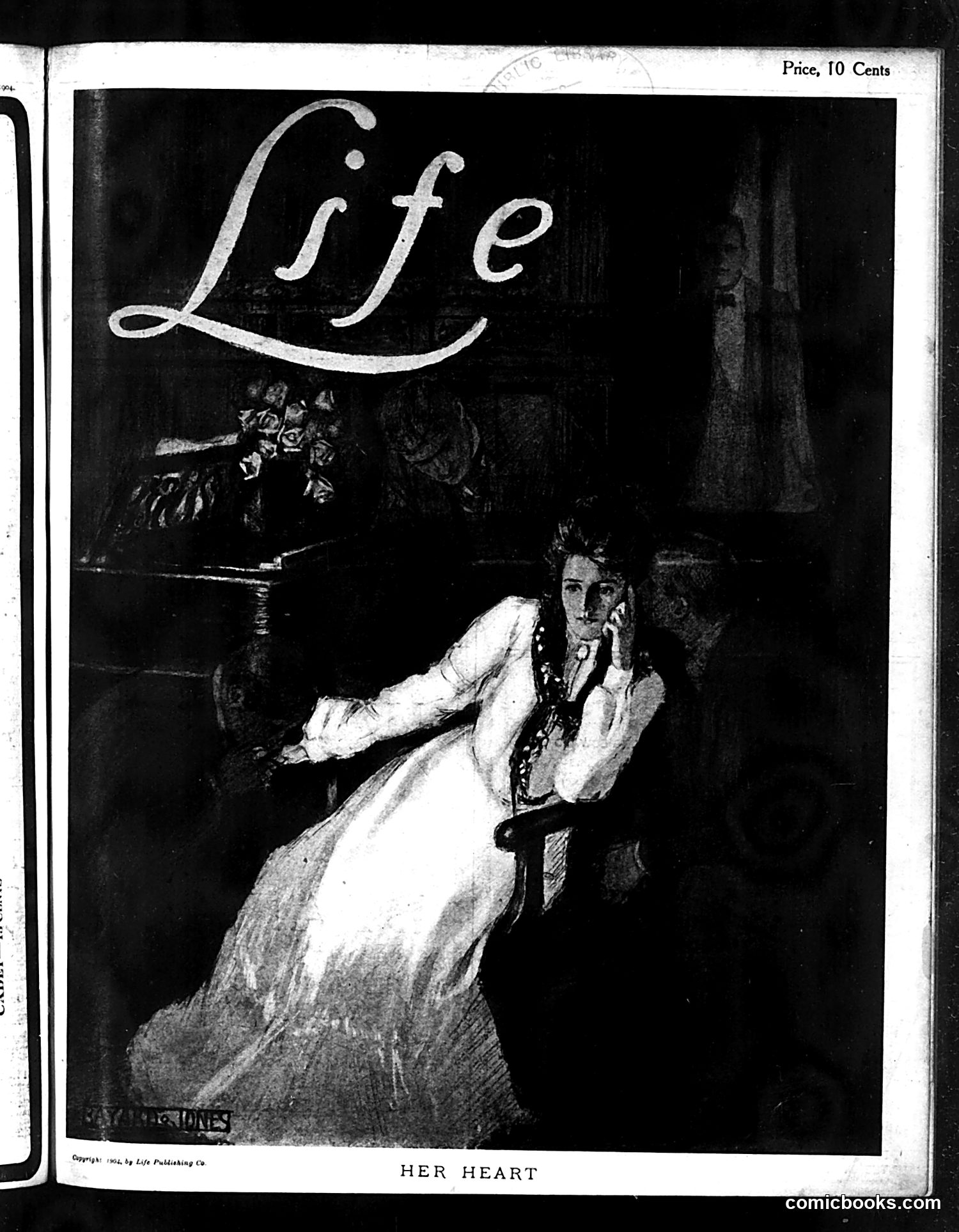
This appears to be a cover or story illustration from Life magazine, priced at 10 cents (suggesting early 20th century publication). The image shows a woman in an elegant white gown reclining dramatically, with her hand to her face in a gesture of emotional distress or romantic anguish. The title "Her Heart" suggests the illustration accompanies a story about romantic or emotional conflict. The dramatic lighting, flowing dress, and theatrical pose reflect the sentimental melodrama popular in period literature and theater. Without additional text visible, the specific narrative context remains unclear, but the imagery exemplifies how Life magazine illustrated contemporary romantic fiction and social commentary for its educated, middle-class readership.
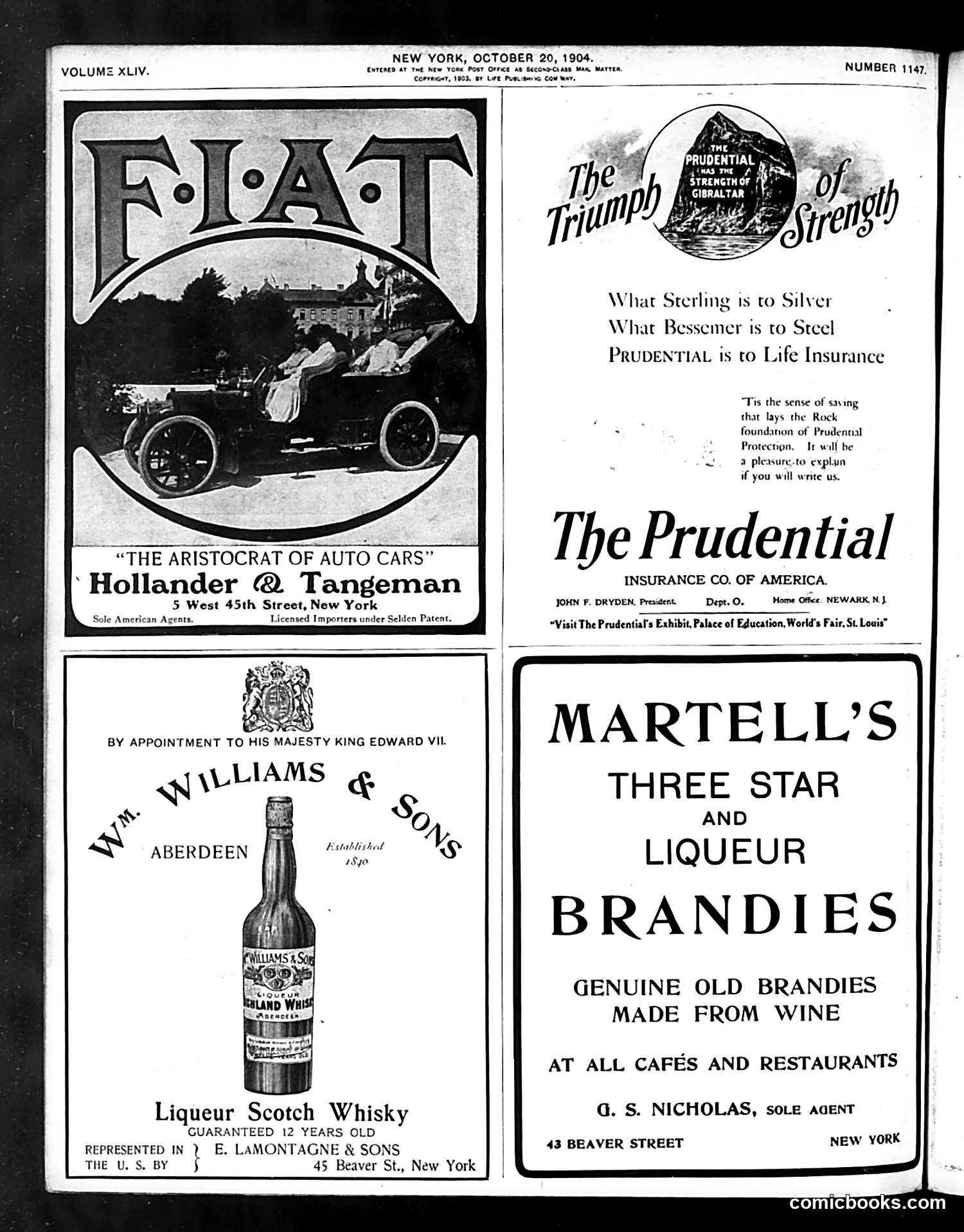
This page is primarily **advertising content**, not political satire. It contains four advertisements from October 20, 1904: 1. **F.I.A.T. automobiles** - A luxury car advertisement showing an early motorcar with passengers, marketed as "The Aristocrat of Auto Cars" by Hollander & Tangeman in New York. 2. **Prudential Insurance** - Using the famous slogan comparing their service to established industries ("What Sterling is to Silver...Prudential is to Life Insurance"). 3. **Williams & Sons liquor** - A Scottish whisky advertisement from Aberdeen, claiming royal appointment. 4. **Martell's brandy** - An advertisement for genuine old brandies available at cafés and restaurants. The page reflects early 1900s consumer culture with luxury goods marketed to affluent readers. There is no discernible political or satirical cartoon content present.
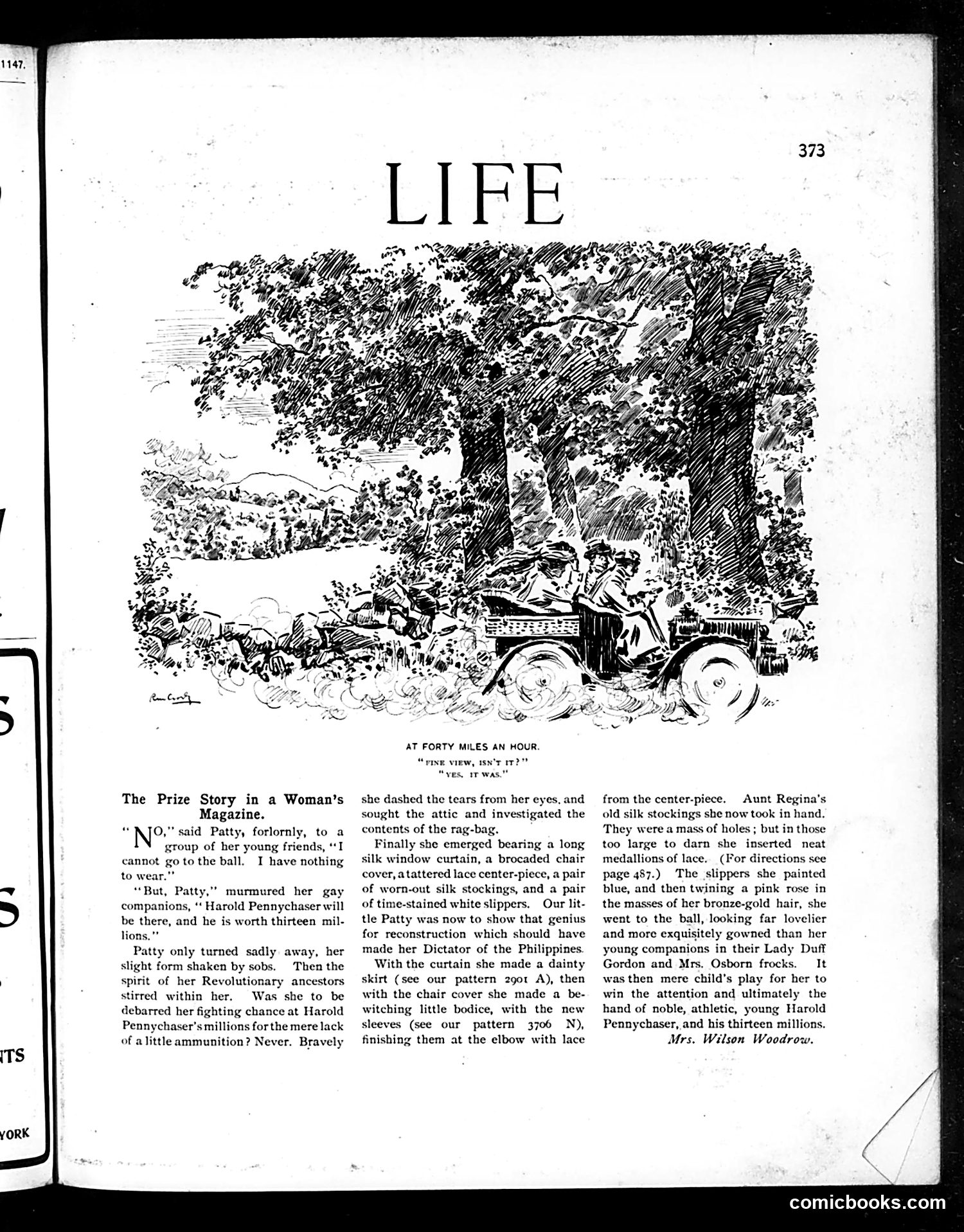
The page features an illustration titled "LIFE" showing a couple in an early automobile (traveling at "forty miles an hour") beneath large trees, with the caption "FINE VIEW, ISN'T IT?" / "YES, IT WAS." Below is a short story called "The Prize Story in a Woman's Magazine" about a character named Patty. The narrative describes Patty refusing a suitor (Harold Pennychaser) due to lack of wealth, then discovering she can create valuable textile items—including a decorative skirt and chair cover using vintage materials. The story concludes with Patty ultimately winning Harold's affection and "thirteen millions." This appears to be satirizing popular women's magazine fiction tropes: the penniless suitor eventually becoming wealthy, and narratives where resourceful women achieve romance and financial security through domestic craftsmanship.
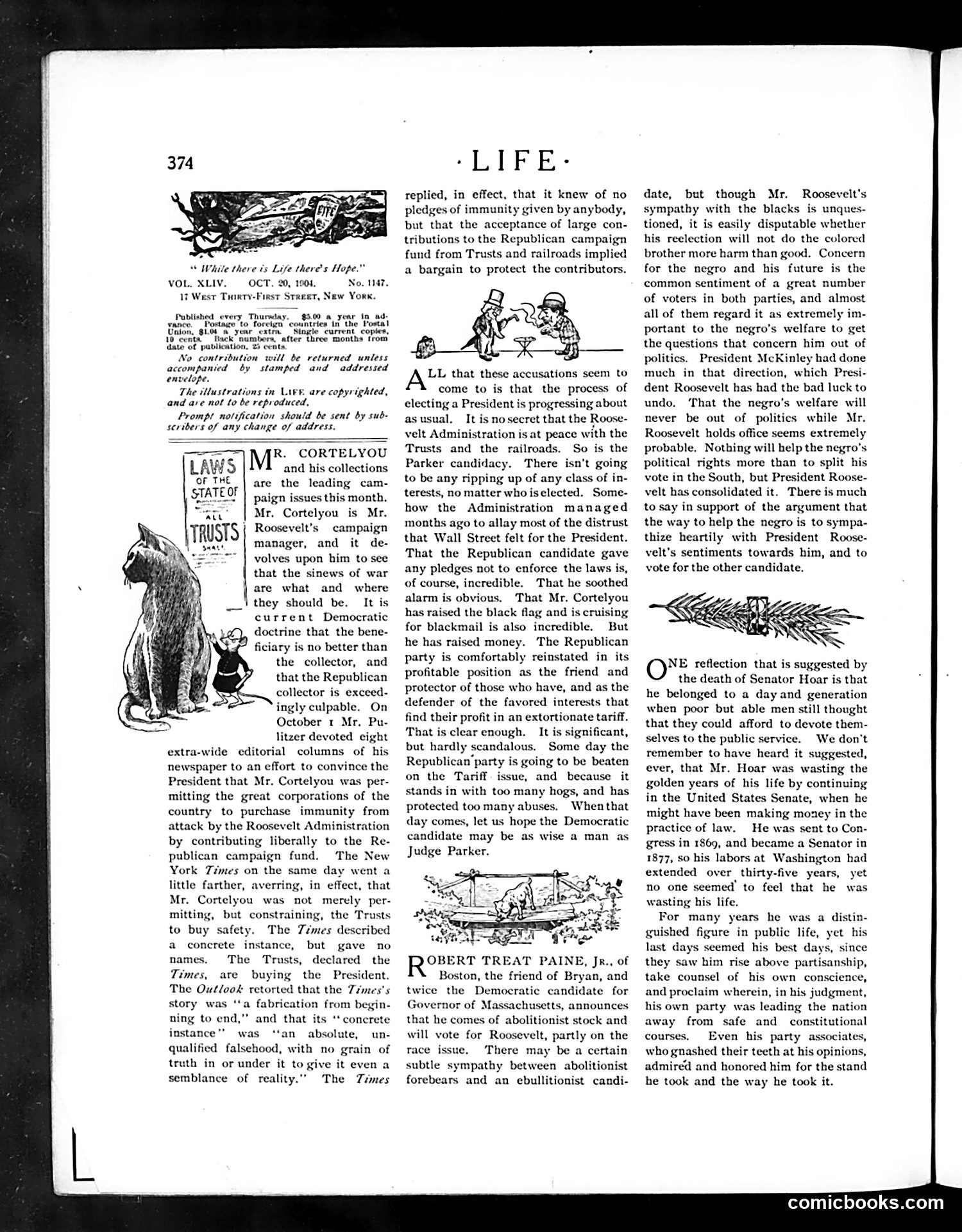
This page critiques the 1904 presidential campaign, particularly Theodore Roosevelt's relationship with corporate interests. The central cartoon shows a large bear (representing trusts/monopolies) being controlled by a small figure, satirizing Roosevelt's claims to regulate big business while allegedly accepting campaign contributions from railroad and trust executives. The text discusses accusations that Roosevelt's administration made deals with Wall Street interests despite anti-trust rhetoric. A section on "Laws of the State" (shown with illustration) mocks the contradiction between Roosevelt's public stance against trusts and his actual political arrangements with them. The page also includes commentary on Senator Hoar's death and Democratic candidate judge Parker, suggesting broader debates about corporate influence in American politics during this election cycle.
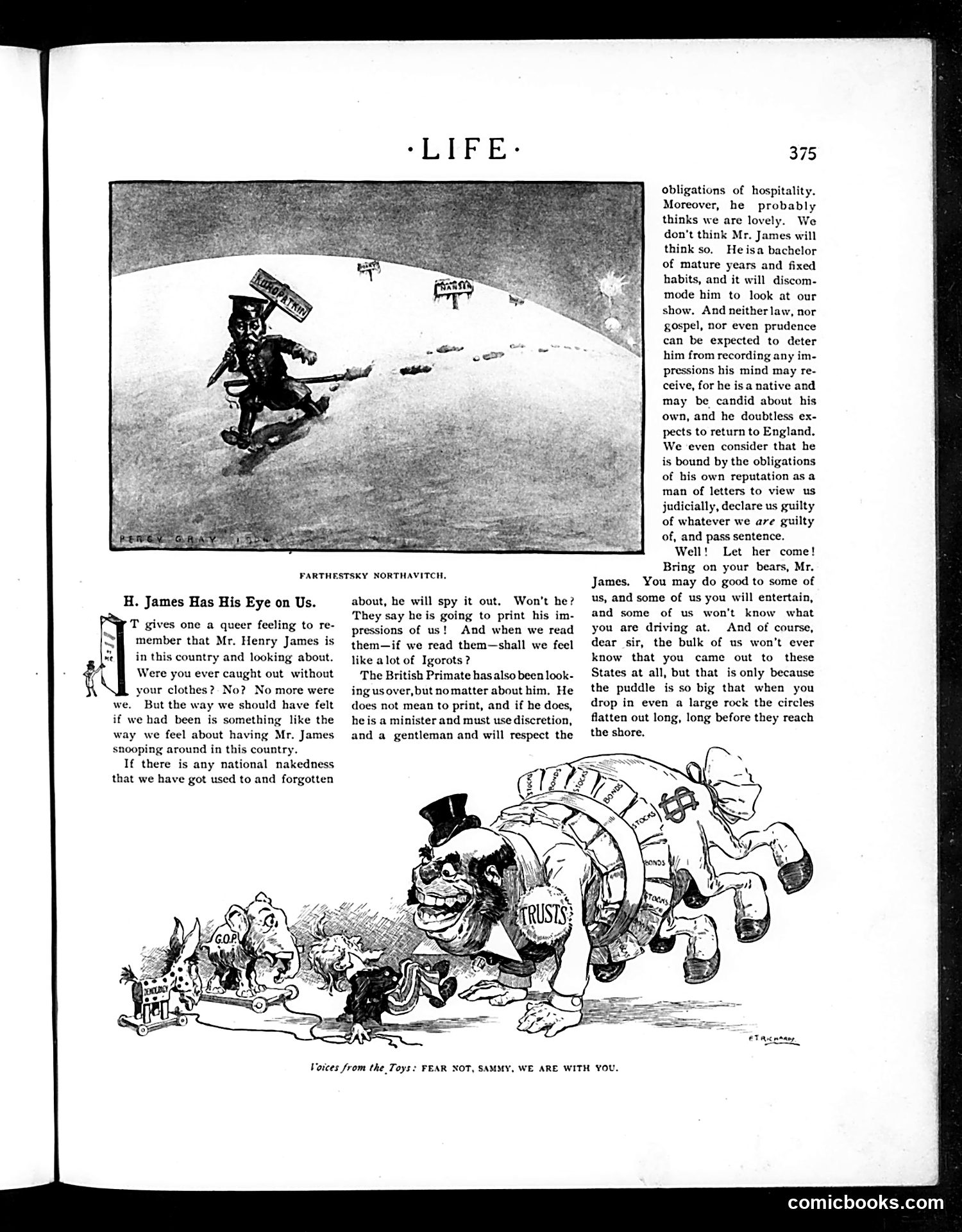
This page contains two political cartoons about Henry James, the American-British writer. The top cartoon ("Parthensky Northavitch") depicts James as a spy in snow, apparently referencing concerns that he would report unfavorably on America to British readers. The article "H. James Has His Eye on Us" expresses anxiety that James will publish critical impressions of the United States. The text reassures readers that James, as "a man of letters," won't print everything, and that Americans shouldn't worry excessively about his observations. The bottom cartoon ("Voices from the Toys") uses a grotesque figure labeled "Trusts" carrying smaller figures, satirizing American corporate monopolies. The caption "Fear not, Sammy, we are with you" suggests trusts claim to support the common person while dominating the economy—likely critiquing their actual exploitative power.
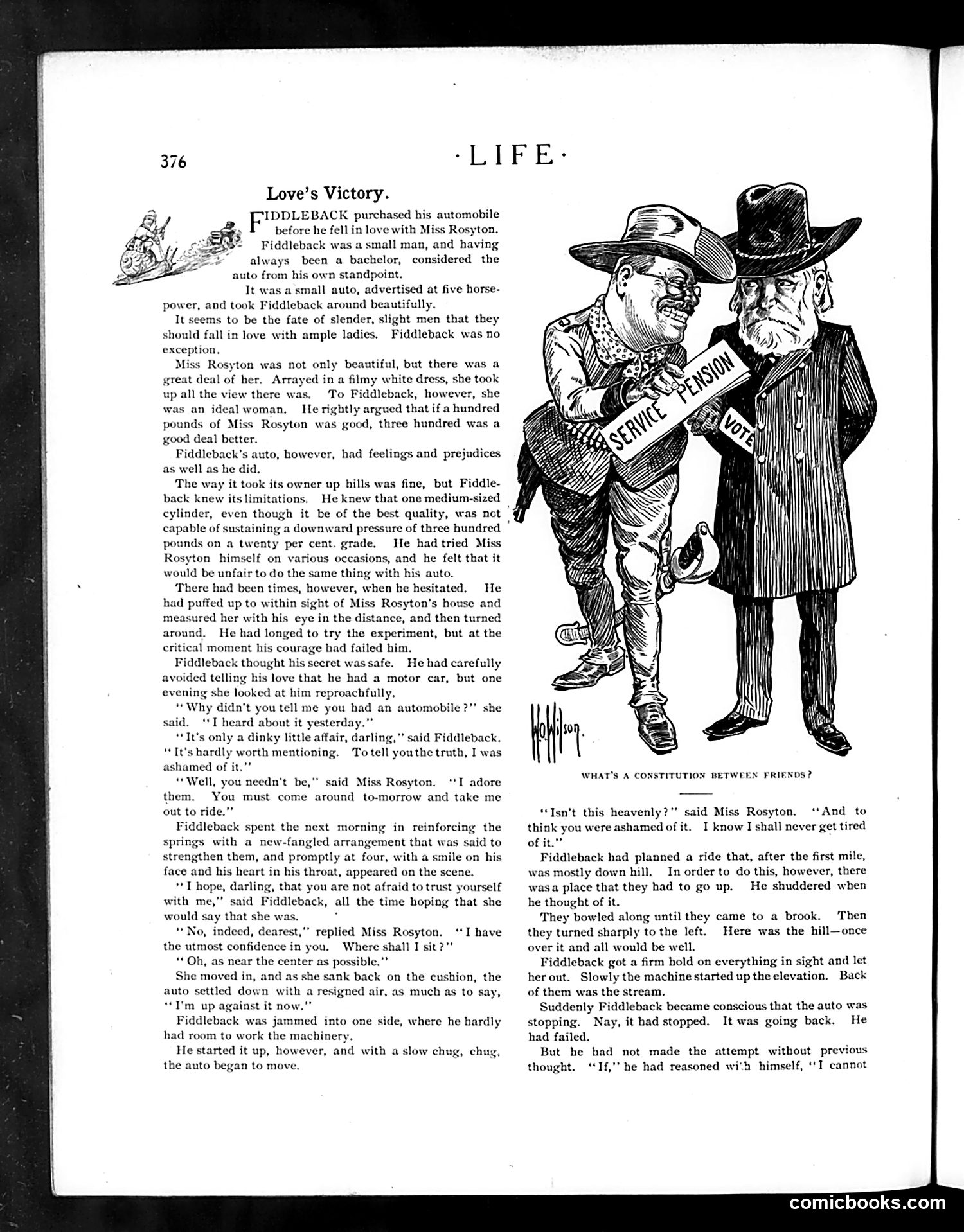
This page contains a short story titled "Love's Victory" rather than political satire. The accompanying illustration shows two men in conversation, with one appearing to be a rotund figure and the other taller and thinner, both wearing hats and period clothing. The narrative concerns Fiddleback, a bachelor who purchases an automobile before falling in love with Miss Rosyton. The story humorously explores whether his small, five-horsepower car can adequately impress her. The text reveals Fiddleback's insecurity about the vehicle's limitations and his eventual attempt to take Miss Rosyton for a ride, which fails when the car breaks down on a hill. The cartoon illustration likely depicts a moment from this romantic/comedic narrative, though the specific scene isn't entirely clear from the image alone. The page is primarily entertainment rather than political commentary.
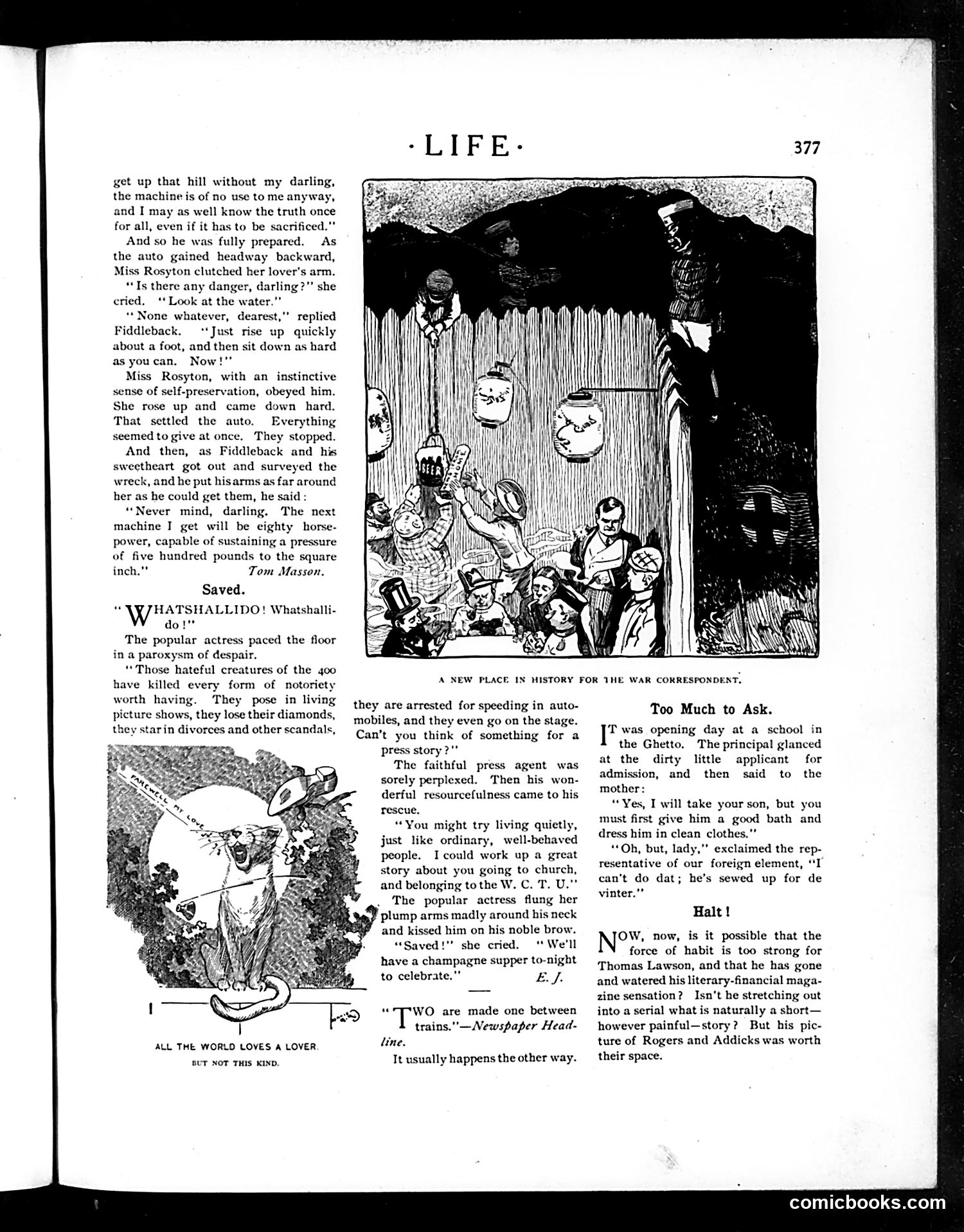
This page contains several short fiction pieces and illustrations rather than political cartoons. The main content includes: 1. **"Saved"** - A narrative about an automobile accident involving characters named Miss Roxyton and Fiddleback, with dialogue about dangerous driving. 2. **"Too Much to Ask"** - A school admission anecdote where a principal requests the applicant be cleaned up before enrollment, and the mother replies the child is "sewed up for de vinter" (winter dialect speech). 3. **"Halt!"** - A brief piece questioning whether Thomas Lawson's literary-financial magazine sensation has become a serial story. The illustrations are decorative line drawings accompanying these humorous social vignettes. The page satirizes early 20th-century American manners, class anxieties, and contemporary publishing trends rather than specific political figures or events.
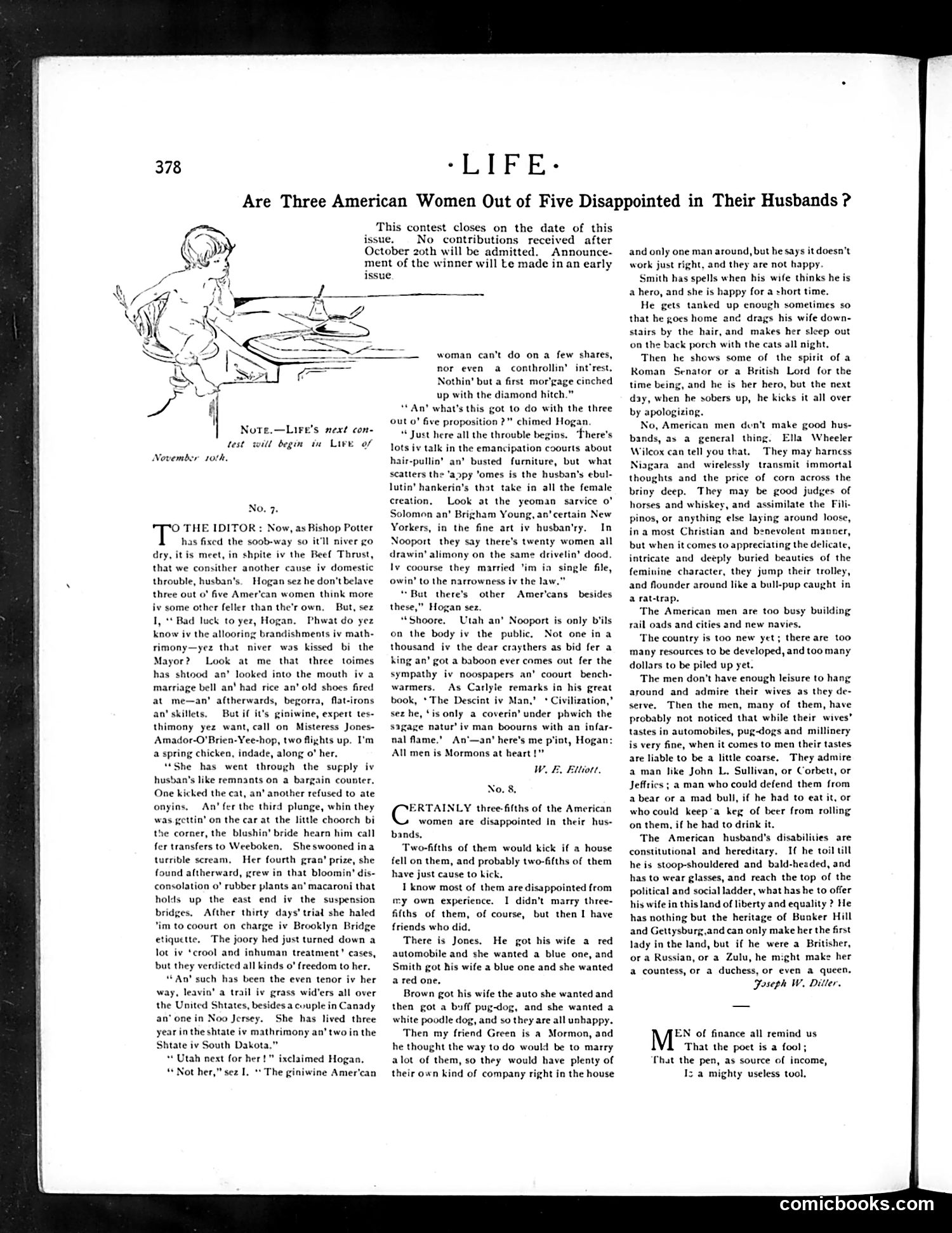
This page presents a satirical contest about marital disappointment, specifically asking "Are Three American Women Out of Five Disappointed in Their Husbands?" The cartoon at top-left shows a woman at a desk, apparently submitting entries. The contest solicits humorous anecdotes about disappointed wives—wives complain their husbands are lazy, cheap, or spend money foolishly on automobiles instead of household items they want. The responses mock typical husband stereotypes: men who drink, won't work, spend recklessly on cars, or neglect domestic responsibilities. One woman mentions her husband dragged her downstairs by her hair. Another notes husbands ignore their wives' input on major purchases. The satire targets both sexes—wives are portrayed as materialistic and complaining, while husbands are depicted as irresponsible spenders, drinkers, and neglectful partners. This reflects early 20th-century gender tensions and marital discord commentary in American popular media.
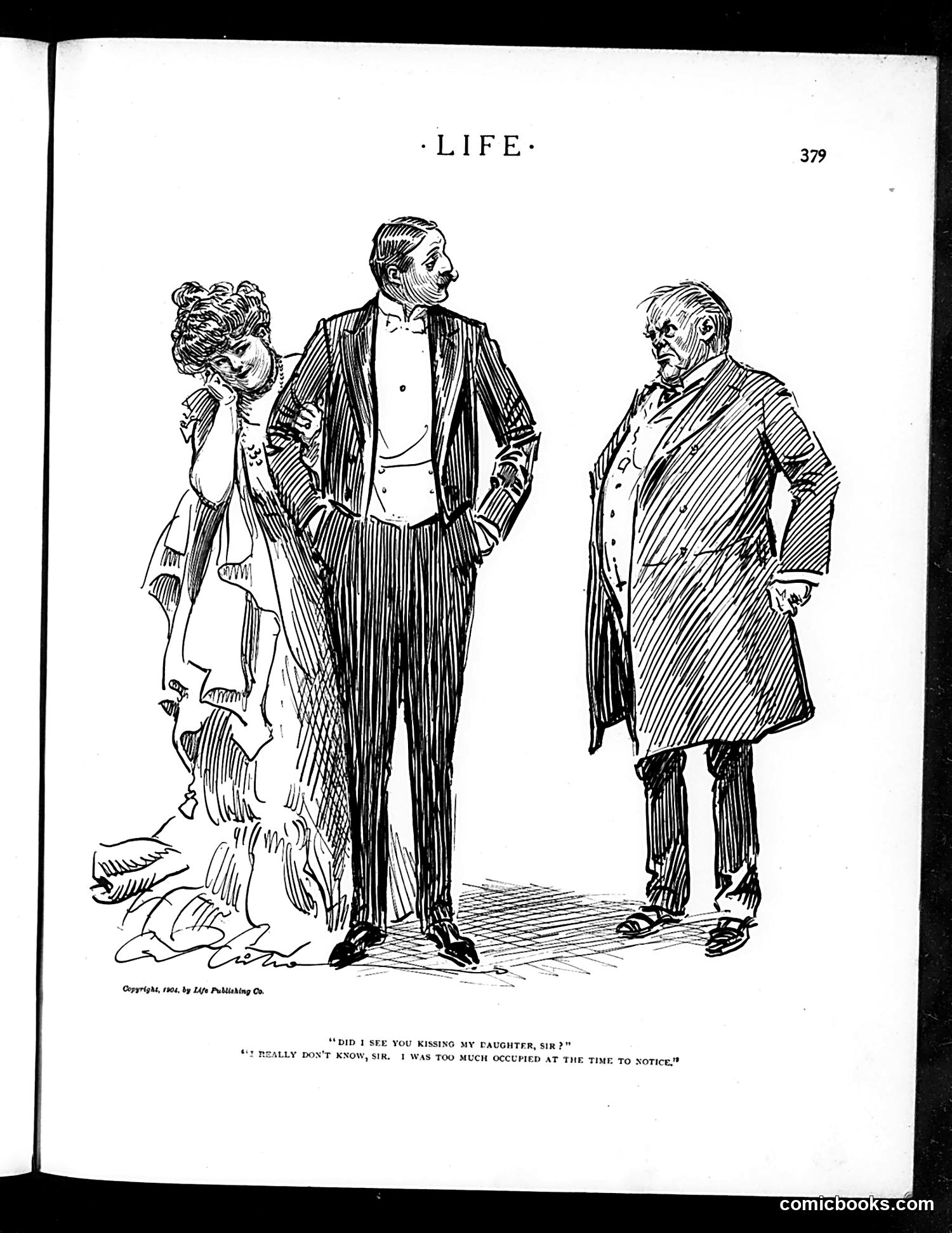
This is a satirical cartoon from *Life* magazine depicting three figures in formal evening wear. The caption reads: "Did I see you kissing my daughter, sir?" "I really don't know, sir. I was too much occupied at the time to notice." The cartoon satirizes a common social scenario of the era: a father confronting a young man about improper conduct with his daughter. The humor lies in the suitor's deliberately obtuse response—claiming he was "too occupied" to notice whether he was kissing her, which is absurd and evasive simultaneously. This reflects early 20th-century anxieties about courtship propriety, parental authority, and young men's behavior. The joke mocks both the father's indignation and the suitor's transparent dodge of accountability through feigned obliviousness.
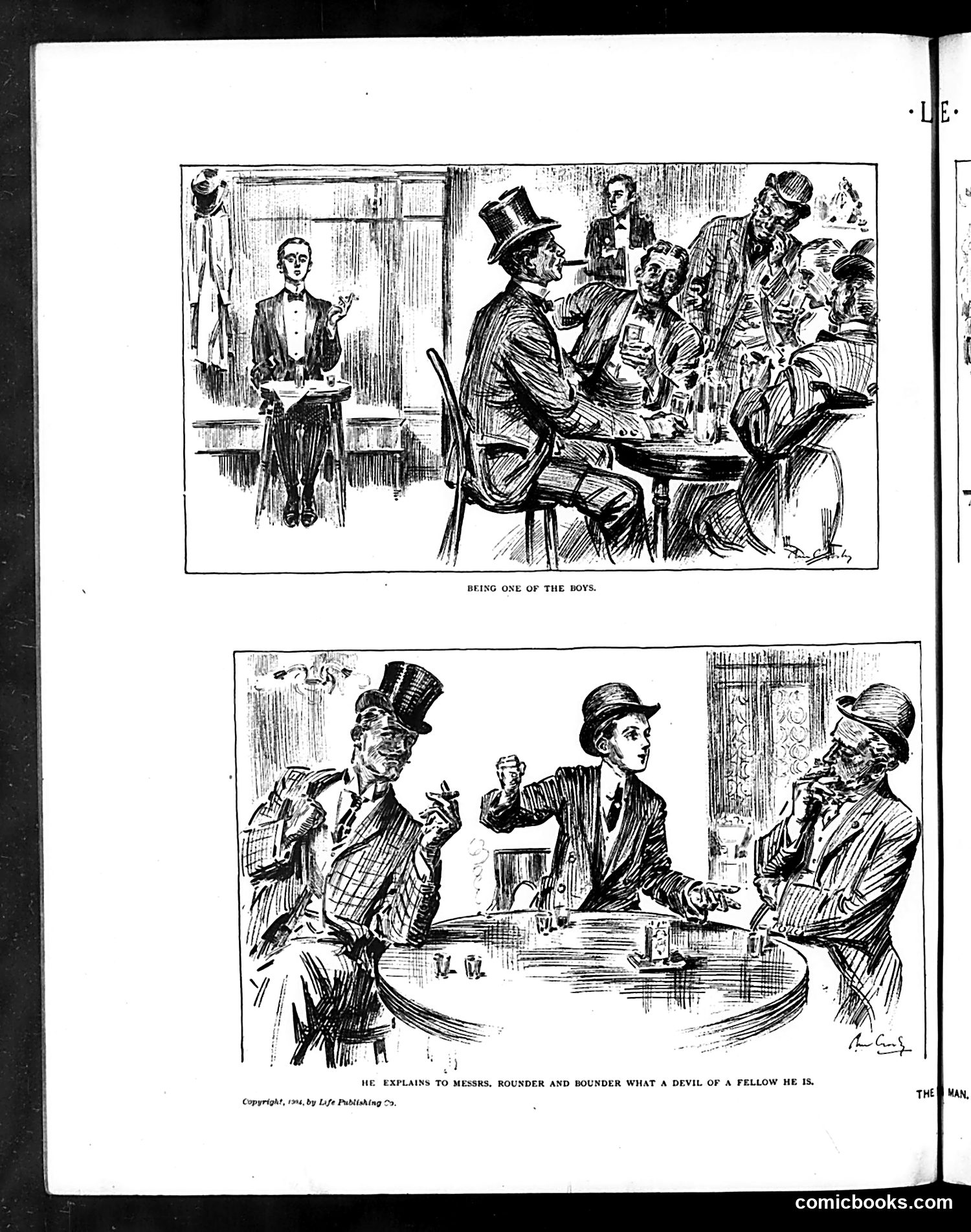
These two panels from *Life* magazine (copyright 1901) satirize gentlemen's social behavior. The top panel, "Being One of the Boys," shows a young man joining an established group of well-dressed men at what appears to be a social gathering or club. The bottom panel, "He Explains to Messrs. Rounder and Bounder What a Devil of a Fellow He Is," depicts the same young man boasting to two men at a table, apparently exaggerating his own wildness or mischievous character. The satire targets social pretension—specifically how men attempt to gain acceptance by performing toughness or rakishness. The names "Rounder" and "Bounder" (period slang for dissolute men) emphasize that this fellow is imitating disreputable behavior to seem sophisticated to his peers.
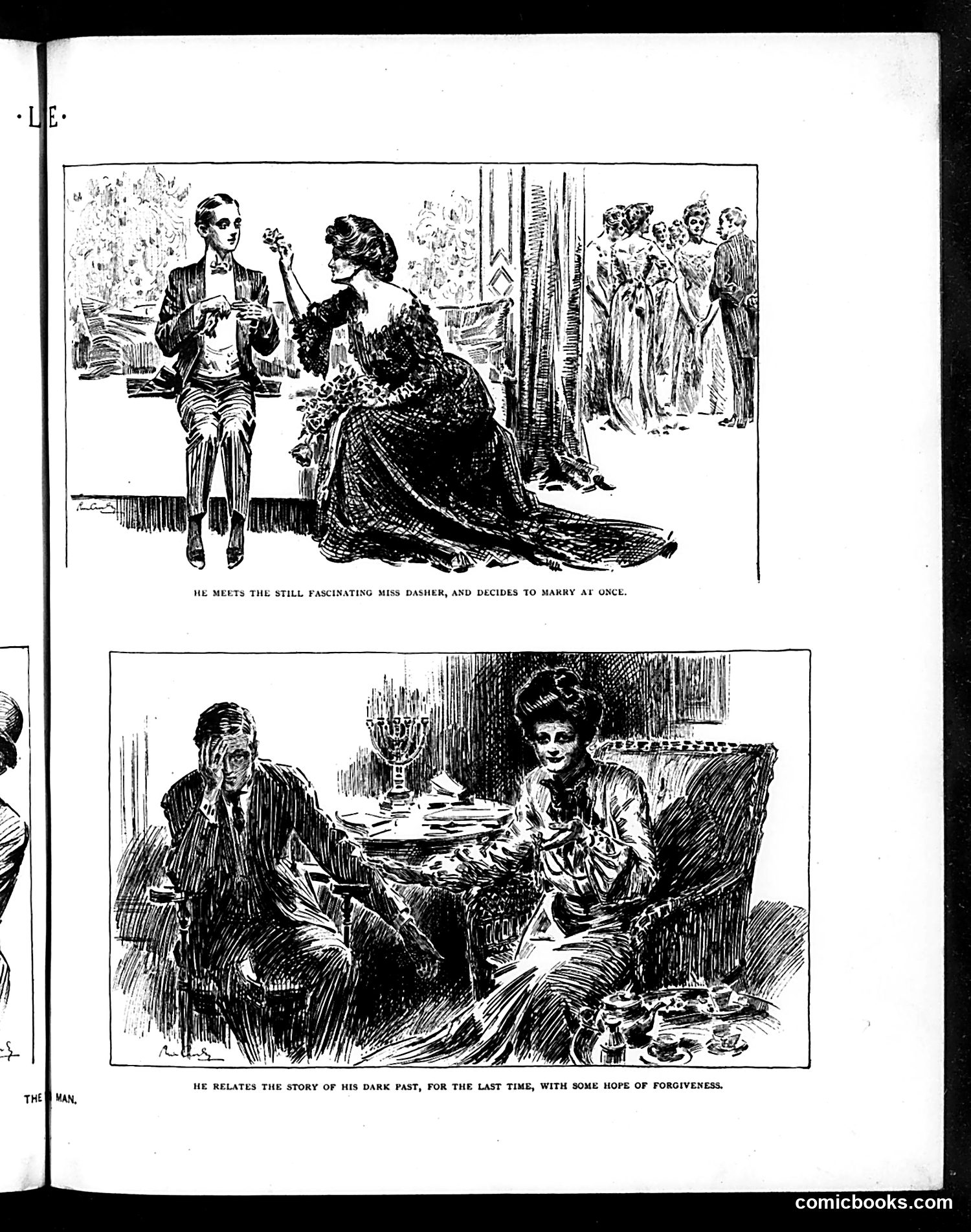
This page contains two sequential illustrations from what appears to be a serialized story titled "The Man" (visible at bottom left). The first panel shows a formal social gathering where a man in evening dress meets a woman in an elaborate gown with a train. The caption reads: "HE MEETS THE STILL FASCINATING MISS DASHER, AND DECIDES TO MARRY AT ONCE." The second panel depicts an intimate domestic scene where the same man, now appearing distressed with his hand to his face, sits across from the woman. The caption states: "HE RELATES THE STORY OF HIS DARK PAST, FOR THE LAST TIME, WITH SOME HOPE OF FORGIVENESS." The narrative arc satirizes romantic courtship and marriage—the impulsive decision to marry upon meeting an attractive woman contrasted with the inevitable complications of revealing one's personal history. The humor lies in the implicit suggestion that his "dark past" has become a recurring marital conflict requiring repeated explanation and forgiveness.
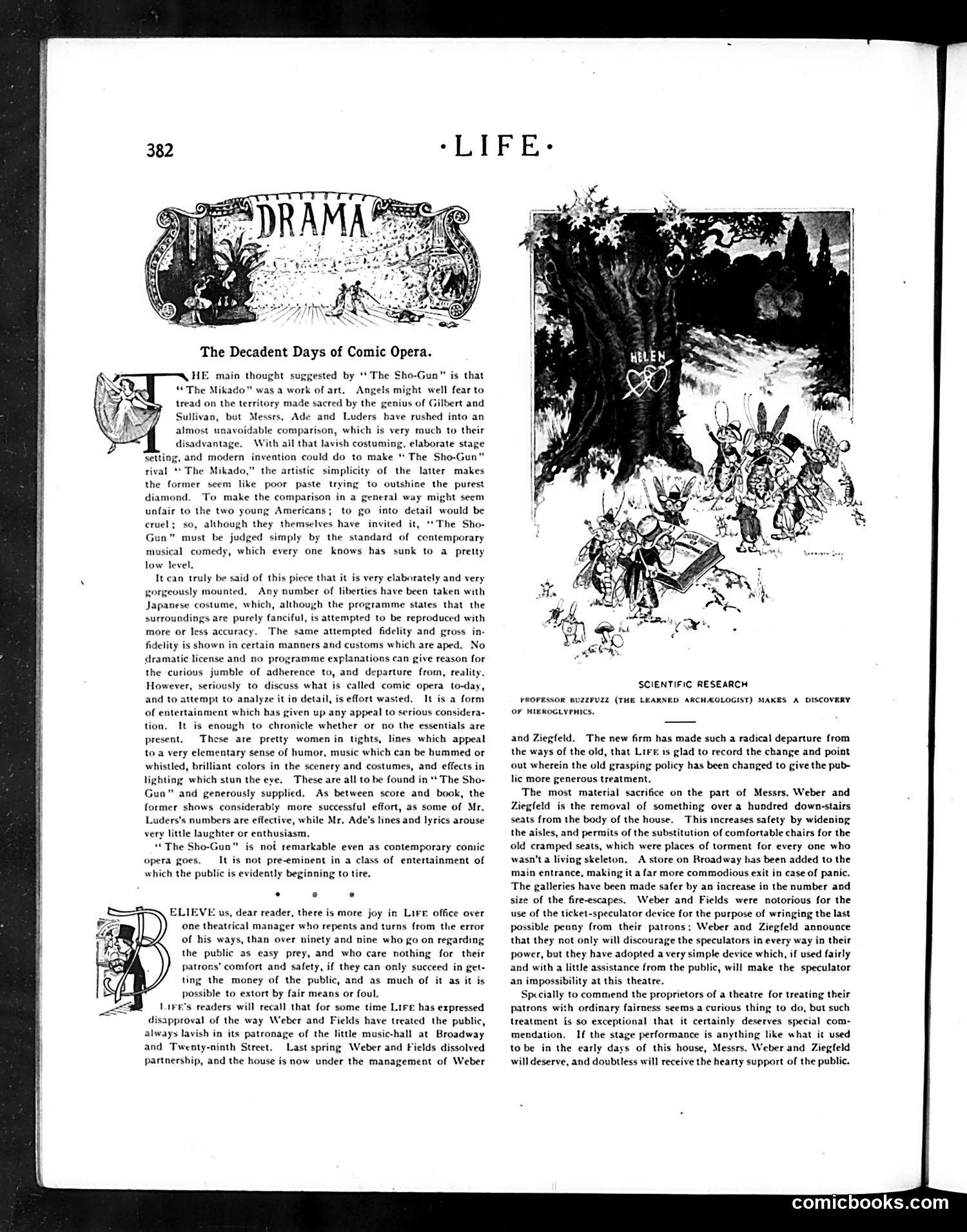
This page contains two distinct sections: **Left side ("The Decadent Days of Comic Opera"):** A drama critique discussing "The Sho-Gun," a comic opera. The reviewer argues the production is "elaborately and gorgeously mounted" but critiques its artistic merit, claiming it relies on spectacle rather than substance. The author suggests it represents declining standards in musical comedy entertainment. **Right side ("Scientific Research"):** An illustration and accompanying text about Professor Buzzpuzz (a learned archaeologist) discovering hieroglyphics, alongside discussion of Weber and Ziegfeld's theatrical management improvements—specifically removing cramped theater seats and improving patron comfort. Both sections are satirical commentary on contemporary entertainment and cultural institutions, though the specific theatrical productions and managers referenced are not immediately identifiable to modern readers without additional research.
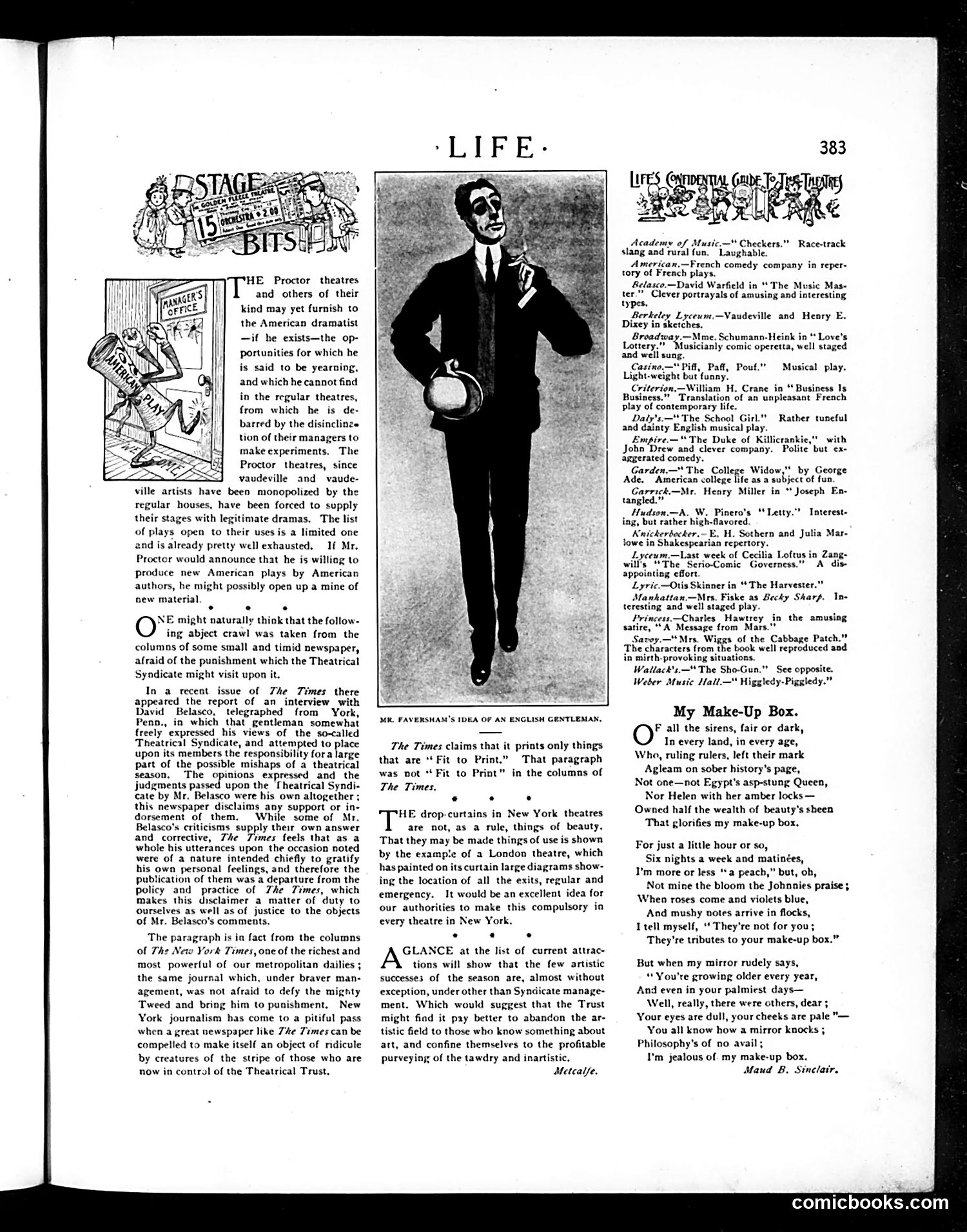
This page critiques the **Theatrical Trust** (also called the "Syndicate"), a monopolistic control system dominating American theater at the turn of the 20th century. The central cartoon depicts **Mr. Faversham** as an idealized English gentleman—well-dressed, composed, holding a cane—seemingly mocking the contrast between refined theatrical ideals and the Trust's commercial ruthlessness. The text attacks the Trust's stranglehold on legitimate drama production. Life argues that smaller theaters (like Proctor's) were forced into vaudeville because the Trust controlled regular theaters and discouraged experimental American plays. The piece also ridicules the *New York Times* for publishing—then disclaiming—David Belasco's criticism of the Trust, suggesting the newspaper feared retaliation from these powerful theater monopolists. Life advocates for artistic merit over profit-driven mediocrity, noting that successful productions tend to operate *outside* Trust control. The page represents Progressive-era anti-monopoly sentiment, positioning artistic integrity against corporate consolidation.
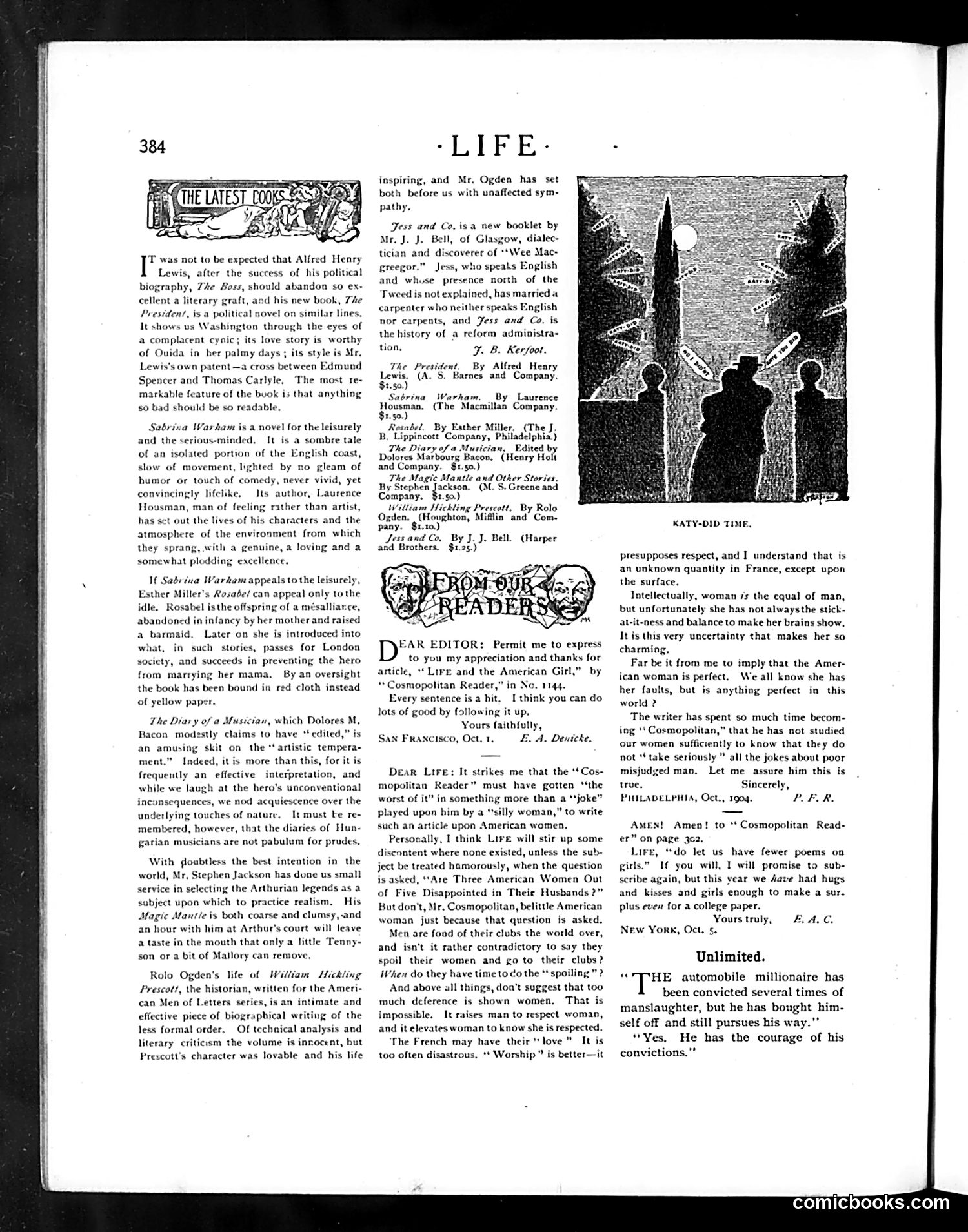
This is a book review section, not primarily a political cartoon page. The visible illustration labeled "KATY-DID TIME" appears to be a small domestic scene, though its satirical point isn't entirely clear from the image alone. The reviews themselves are satirical commentary on contemporary literature. The critic mocks Alfred Henry Lewis's political novel *The President* as derivative "literary graft," ridicules Stephen Jackson's attempt at realistic Arthurian legend as "coarse and clumsy," and dismisses Esther Miller's *Rosabel* as so poorly bound it came in red cloth "instead of yellow paper"—suggesting it's worthless. The tone throughout is that of an urbane cynic skewering pretentious or mediocre literary efforts. The reviews assume readers share the critic's cultivated disdain for unconventional plots, weak characterization, and authorial pretension—typical of Life's satirical approach to contemporary culture.
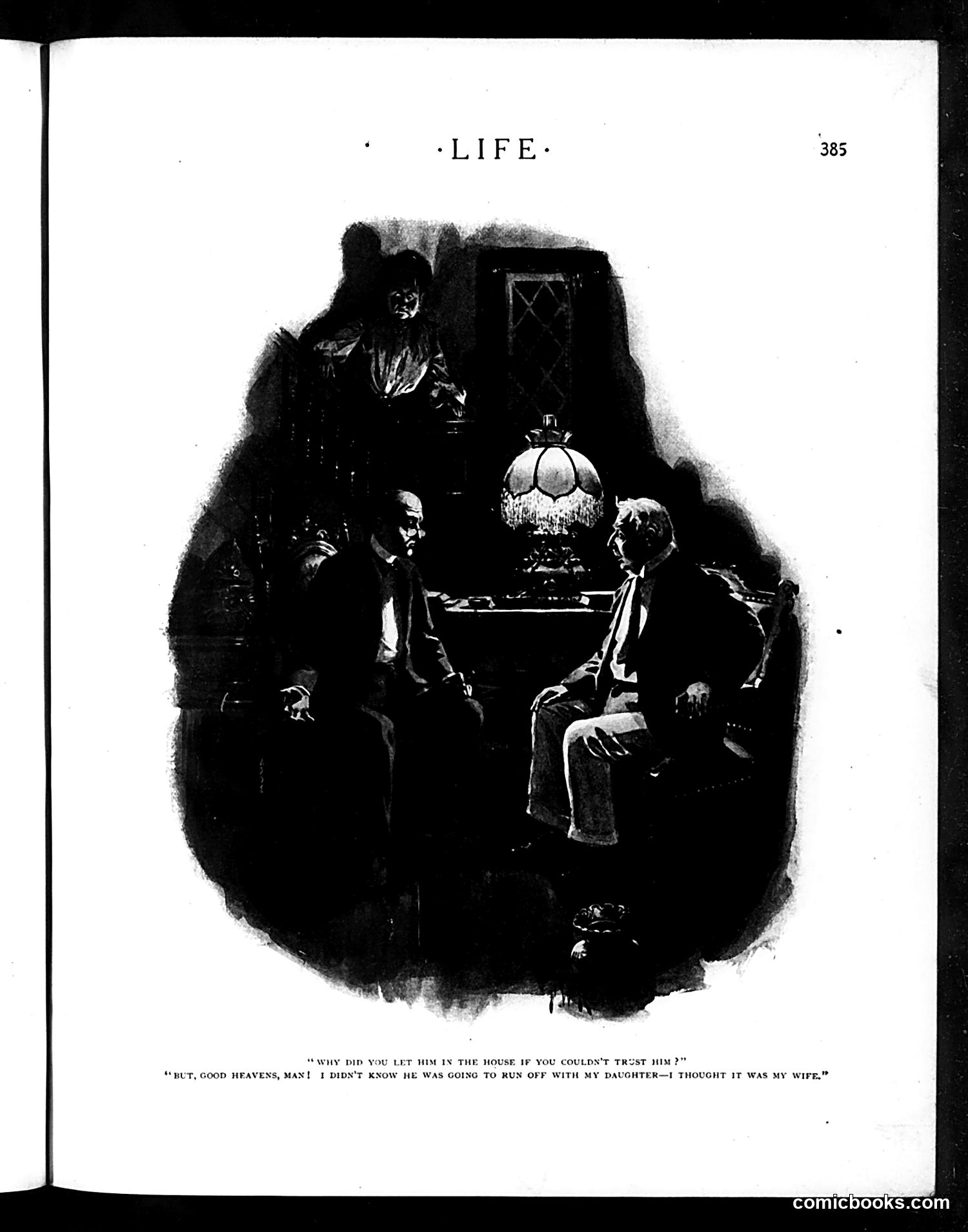
This single-panel cartoon satirizes domestic infidelity and class anxiety. A well-dressed man confronts another about allowing a suspicious visitor into his home. The punchline reveals the speaker's marital troubles: he feared his wife might elope with the stranger, but instead the man ran off with his daughter—implying the wife is either faithless or undesirable compared to their younger daughter. The joke trades on period assumptions about women's fidelity and family honor. The dark, shadowy illustration style and formal Victorian dress suggest this targets upper-middle-class respectability. The cartoon mocks both the speaker's cynical view of his wife and the vulnerability of families to social-climbing seducers—common satirical targets in early 20th-century Life magazine's humor about bourgeois life.
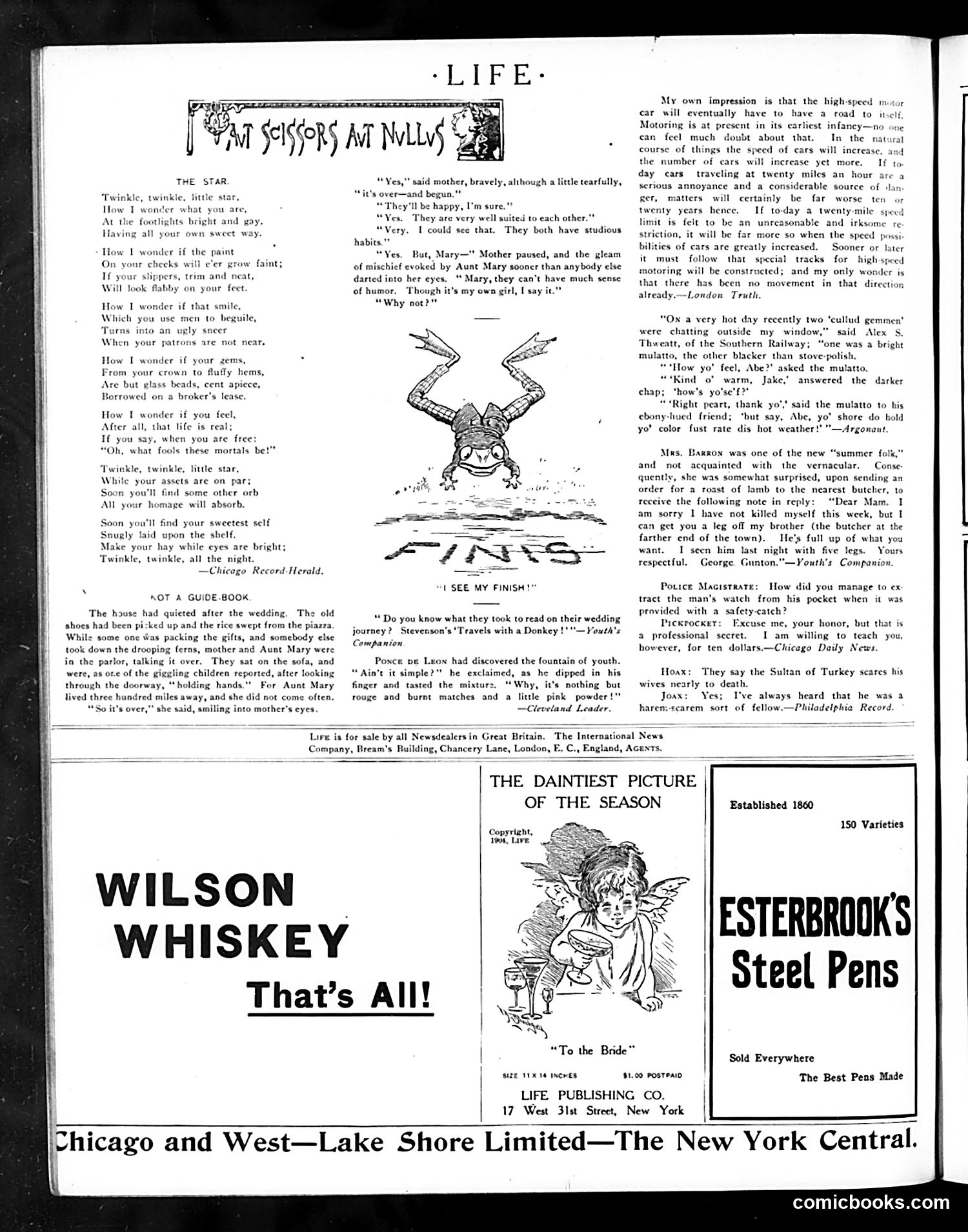
This page from Life magazine (a satirical weekly) contains several pieces of social commentary typical of early 20th-century American humor: **"The Star"** — A poem mocking theatrical actresses, questioning whether their beauty, charm, and apparent wealth are genuine or merely stage illusions. It satirizes the superficiality of theater culture and warns that fame is temporary. **The wedding journey anecdote** — A humorous dialogue between a mother and aunt about newlyweds who chose to read Stevenson's "Travels with a Donkey" on their honeymoon—implying they lack romantic sensibility or sense of humor. **Ponce de Leon reference** — A joke about the mythical fountain of youth, suggesting it's merely theatrical makeup (rouge and burnt matches). **Motor car commentary** — A serious editorial observation that high-speed automobiles will eventually require dedicated roadways, predicting future traffic problems. **"Cullud gemmen" dialogue** — A racial humor piece featuring African American characters discussing heat, using dialect humor typical of the era's stereotypical representations. The page reflects turn-of-the-century concerns about modernization, entertainment, and social pretense.
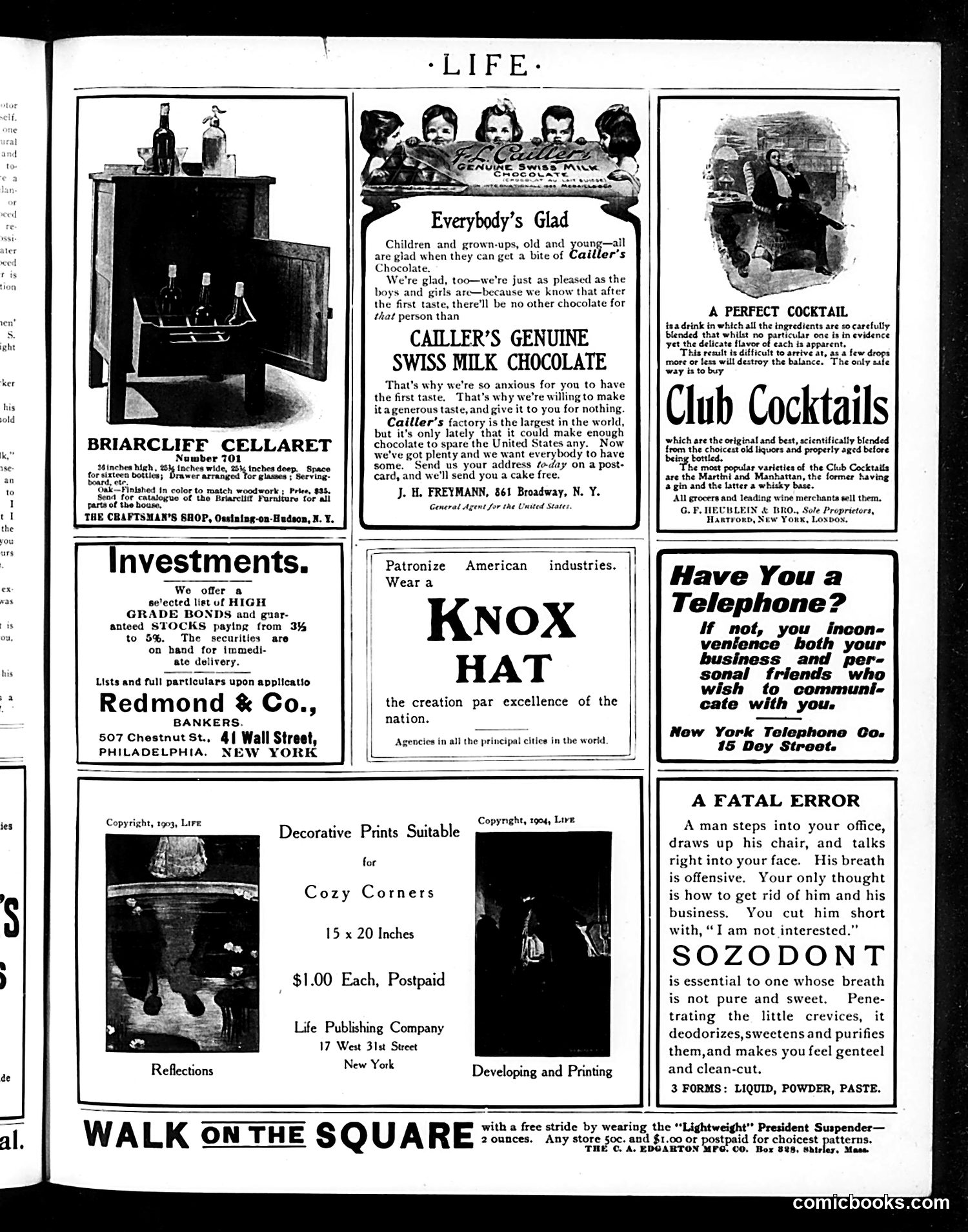
This is primarily an **advertising page** from Life magazine (circa 1903-1904), with minimal satirical content. The page features commercial advertisements rather than political cartoons. The main advertisements include: - **Cailler's Swiss Milk Chocolate**: A straightforward pitch emphasizing quality and offering free samples - **Briarcliff Cellaret**: A wine storage cabinet for home use - **Knox Hat**: Described as "creation par excellence of the nation" - **Investment stocks** through Redmond & Co. bankers - **New York Telephone service**: Argues having a telephone prevents inconveniencing friends - **Sozodont**: A dental product addressing the social embarrassment of bad breath (the "Fatal Error" section) - Various decorative prints and a "Walk on the Square" suspender advertisement The **only satirical element** is the "Fatal Error" ad, which uses mild social humor—the scenario of an offensive-breathed visitor ruining a business interaction—to sell mouthwash. This reflects period anxieties about social propriety and personal hygiene as markers of respectability.
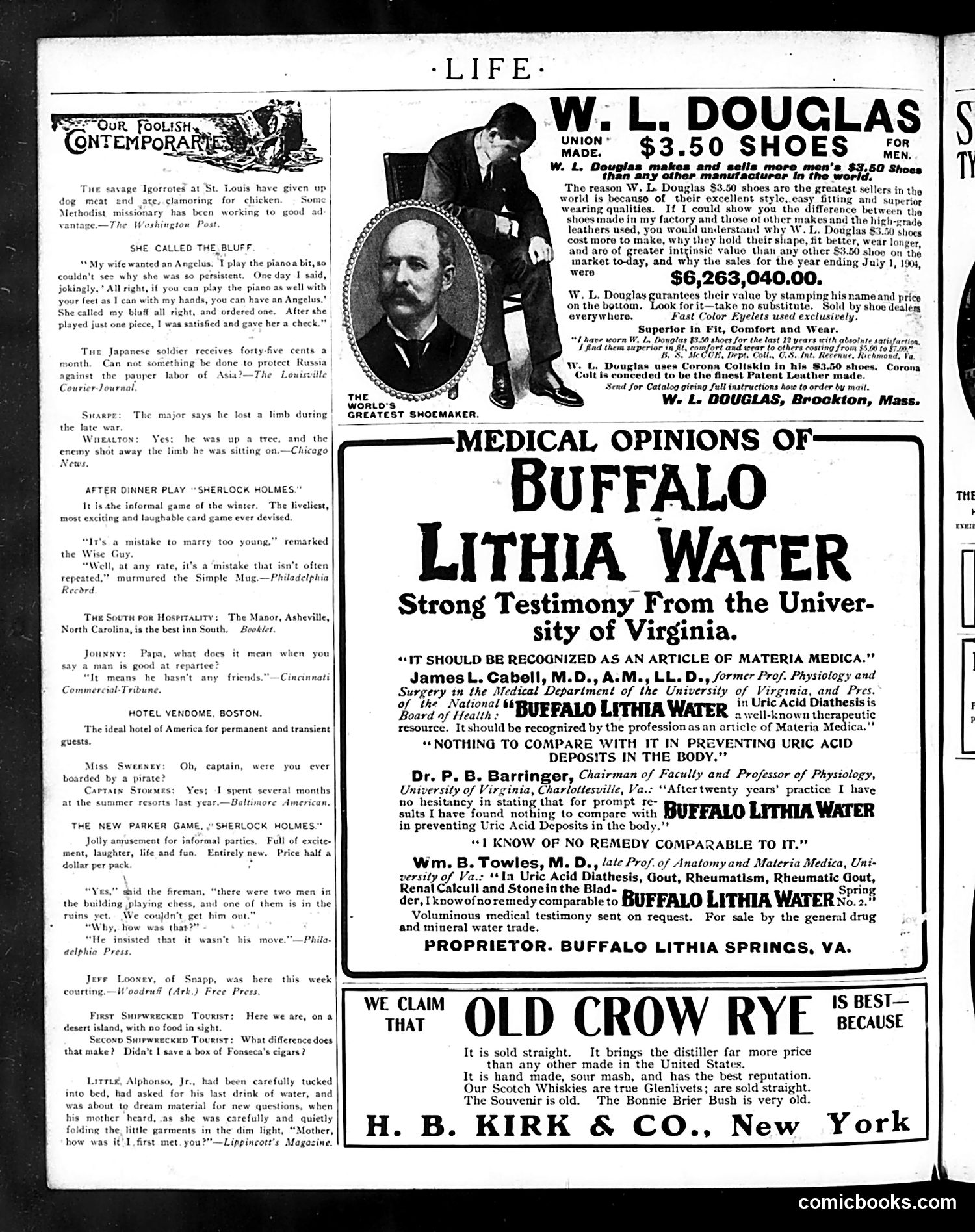
This page is primarily **advertising**, featuring a prominent W. L. Douglas shoe advertisement dominating the right side, alongside smaller ads for Buffalo Lithia Water and Old Crow Rye whiskey. The left column contains brief satirical anecdotes typical of Life magazine's humor format: - **"Our Foolish Contemporaries"** mocks a newspaper story about Igorrotes (indigenous Filipinos displayed at the 1904 St. Louis World's Fair) abandoning dog meat for chicken—satirizing contemporary attitudes toward colonized peoples. - Other brief jokes target marriage, war injuries, and domestic life, reflecting early 1900s American middle-class concerns. The most substantial advertisement is Douglas's $3.50 shoes claim—emphasizing American manufacturing superiority and value. The supporting testimonials from University of Virginia professors lend pseudo-scientific credibility typical of early 20th-century advertising before modern consumer protection laws. The overall page reflects Life's dual function: satirizing contemporary social follies while carrying lucrative advertisements.
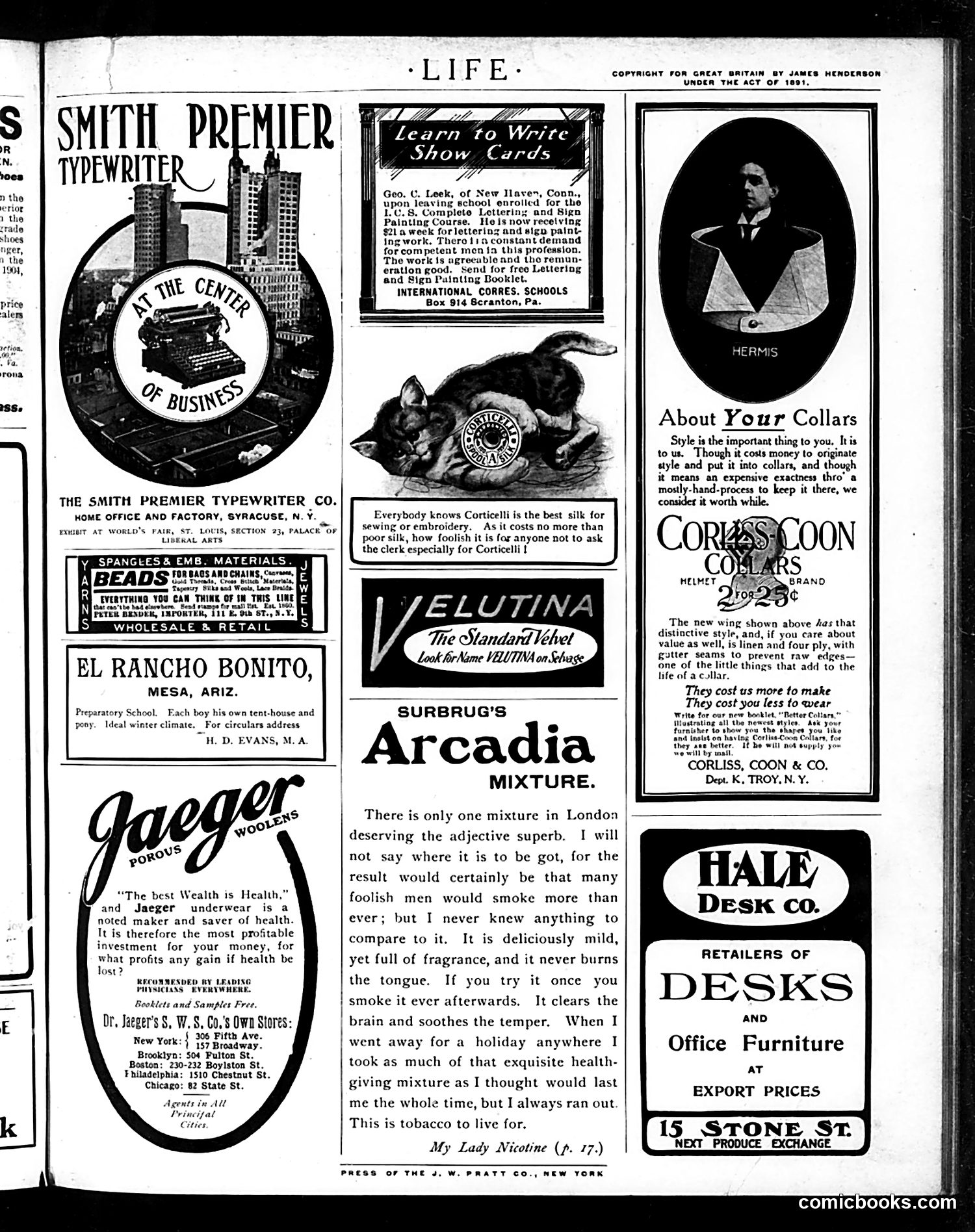
This is primarily a **commercial advertising page** with no political cartoons or satire. The content consists entirely of product advertisements typical of early 1900s American business publications. Notable ads include: - **Smith Premier Typewriter**: Emphasizes business utility - **Jaeger Underwear**: Health-focused marketing claiming wool underwear prevents illness - **Corticelli Silk**: Quality embroidery thread - **Surburg's Arcadia Mixture**: Tobacco product with a literary testimonial (attributed to "My Lady Nicotine," p. 17—likely referencing J.M. Barrie's 1890 work) - **Corliss, Coon & Co. Collars**: Emphasizes quality construction and style - **Hale Desk Co.**: Office furniture at "export prices" The page reflects Edwardian-era advertising conventions: health claims, quality assertions, and appeals to professional/business identity. There is **no visible satire or political commentary**—this is straightforward commercial promotion.
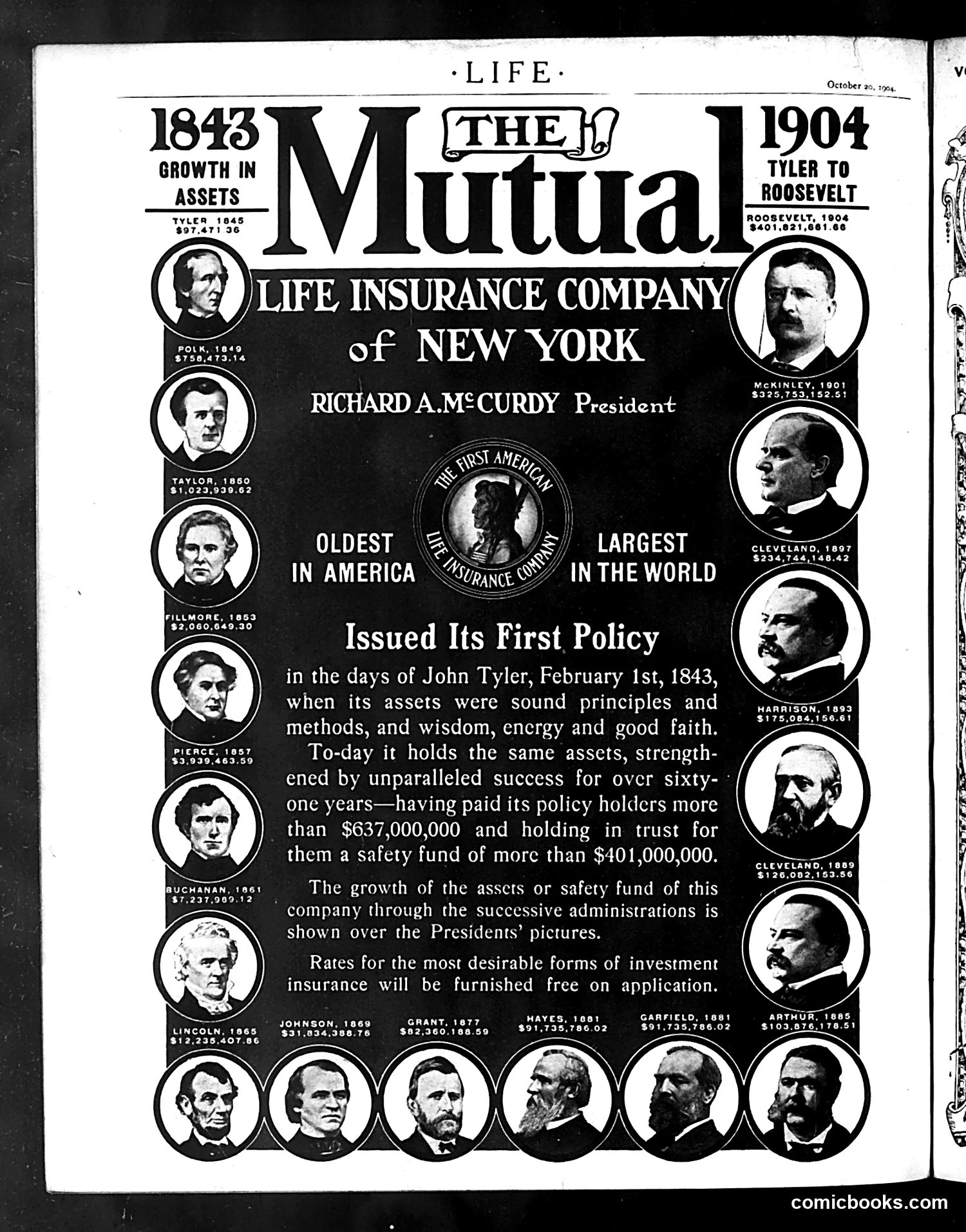
This is **not satire but straightforward corporate advertising** from *Life* magazine (October 25, 1904). The Mutual Life Insurance Company of New York uses an ingenious patriotic marketing strategy: displaying the company's asset growth alongside portraits of U.S. presidents from John Tyler (1843, company founding) through Theodore Roosevelt (1904). The implicit message: just as America grew stronger under successive presidential administrations, so did Mutual Life Insurance—from $57,471.36 under Polk to $401,921,681.66 under Roosevelt. By visually linking corporate and national prosperity, the ad suggests that investing in Mutual Life is as safe and patriotic as trusting American governance. The layout frames the company as "oldest in America" and "largest in the world," establishing institutional credibility through historical longevity and demonstrated financial stewardship across six decades.