
Life, 1904-10-20 · page 13 of 20
Life — October 20, 1904 — page 13: what you’re looking at
What you’re looking at
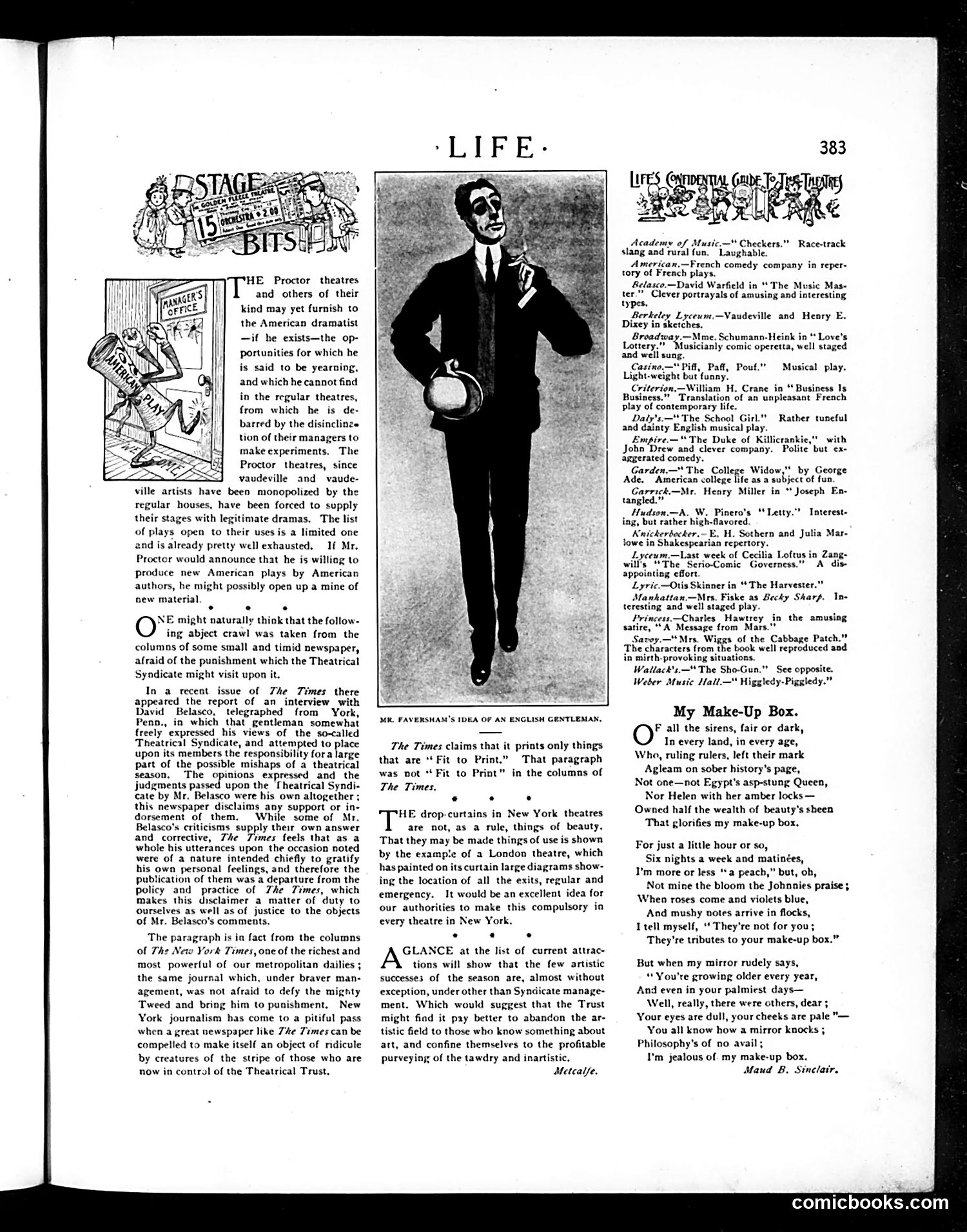
This page critiques the **Theatrical Trust** (also called the "Syndicate"), a monopolistic control system dominating American theater at the turn of the 20th century. The central cartoon depicts **Mr. Faversham** as an idealized English gentleman—well-dressed, composed, holding a cane—seemingly mocking the contrast between refined theatrical ideals and the Trust's commercial ruthlessness. The text attacks the Trust's stranglehold on legitimate drama production. Life argues that smaller theaters (like Proctor's) were forced into vaudeville because the Trust controlled regular theaters and discouraged experimental American plays. The piece also ridicules the *New York Times* for publishing—then disclaiming—David Belasco's criticism of the Trust, suggesting the newspaper feared retaliation from these powerful theater monopolists. Life advocates for artistic merit over profit-driven mediocrity, noting that successful productions tend to operate *outside* Trust control. The page represents Progressive-era anti-monopoly sentiment, positioning artistic integrity against corporate consolidation.
📄 Transcribed text from this page (OCR, searchable)
Machine-transcribed from the original scan — historical spelling and the odd misread are preserved.
HE Proctor theatres IT and others of their kind may yet furnish to the American dramatist if he exists—the op- portunities for which he is said to be yearning, and which he cannot find in the regular theatres, from which he is de- barred by the disinclinze tion of their managers to make experiments. The Proctor theatres, since — = vaudeville and vaude- ville artists have been monopolized by the regular houses, have been forced to supply their stages with legitimate dramas. The list of plays open to their uses is a limited one and is already pretty well exhausted. If Mr. Proctor would announce that he is willing to produce new American plays by American authors, he might possibly open up a mine of new material, . . . ON. might naturally think that the follow- ing abject crawl was taken from the columns of some small and timid newspaper, afraid of the punishment which the Theatrical Syndicate might visit upon it. In a recent issue of Zhe Times there appeared the report of an interview with David Belasco, telegraphed from York, Penn., in which that gentleman somewhat freely expressed his views of the so-called ‘Theatrical Syndicate, and attempted to place upon its members the responsibility fora large part of the possible mishaps of a theatrical season, The opinions expressed and the judgments passed upon the Theatrical Syndi- cate by Mr. Belasco were his own altogether ; this newspaper disclaims any support or in- dorsement of them. While some of Mr. Belasco's criticisms supply their_ own answer and corrective, The Times feels that as a whole his utterances upon the occasion noted were of a nature intended chiefly to gratify own personal feelings, and therefore the publication of them was a departure from the policy and practice of Zhe Times, which makes this disclaimer a matter of duty to Ourselves as well as of justice to the objects of Mr. Belasco's comments. The paragraph is in fact from the columns of The New York Times, one of the richest and most powerful of our metropolitan dailies ; the same journal which, under braver man- agement, was not afraid to defy the mignty Tweed and bring him to punishment, New York journalism has come to a pitiful pass when a great newspaper like Zhe Times can be compelled to make itself an object of ridicule by creatures of the stripe of those who are now in control of the Theatrical Trust. MR. PAVERSHAM'S IDEA OF AN ENGLISH GENTLEMAN, The Times claims that it prints only things that are “Fit to Print.” That paragraph was not ‘Fit to Print” in the columns of The Times. . . . HE drop-curtains in New York theatres are not, as a rule, things of beauty. That they may be made things of use is shown by the exampie of a London theatre, which has painted on its curtain large diagrams show- ing the location of all the exits, regular and emergency. It would be an excellent idea for our authorities to make this compulsory in every theatre in New York. . A . GLANCE at the list of current attrac- tions will show that the few artistic successes of the season are, almost without exception, under other than Syndicate manage- ment. Which would suggest that the Trust might find it pay better to abandon the ar- tistic field to those who know something about att, and confine themselves to the profitable purveying of the tawdry and inartistic. Metcalfe. Academy of Music.— Checkers." slang and rural fun. Laughable. American.—French comedy company in reper- tory of French plays. eg eases Felasco.—David Warfield in * The Music Mas- ter.” Clever portrayals of amusing and interesting types. Berkeley Lyceum.—Vaudeville and Henry E. Dixey in sketches, Broadway —Mme: Schumano-Heink in * Love's lusicianly comic operetta, well staged Race-track Casino.—" P Light-weight b: iterion.—William H. Crane in “Business Is Business.” “Translation of an unpleasant French play of contemporary life, Daty's:—" The School Girl and dainty English musical play Empire.—“'The Duke of Killicrankie," with John Drew and clever company. Polite’ but ex- aggerated comedy. Garden.—" The College Widow," by George Ade. American college life as a subject of fun Garrick.—Mr. Heary Miller in “Joseph En- tangled.” Hudson.—A. W, Pinero’s “Letty.” ing, but rather high-lavored Knickerbocker. E, H. Sothern and Julia Mar- lowe in Shakespearian repertory. m.—Last week of Cecilia Loftus in Zang- “The SerioComic Governess.” A dis appointing effort. Lyric.—Otis Skinner in “The Harvester.” Manhattan.—Mrs, Fiske as Becky Sharp. In- teresting and well staged play. Princess.~Charles Hawtrey in the amusing satire, “A Message from Mars.”* Sary.—"*Mrs. Wiggs of the Cabbage Patch.” The characters from the book well reproduced and in mirth-provoking situations. Wallack's:—“ The Sho-Gun.” See opposite. Weber Music Hall.—" Higgledy-Piggledy.” ,, Paff, Pouf."” Musical play. Rather tuneful Interest- My Make-Up Box. F all the sirens, fair or dark, O In every land, in every age, Who, ruling rulers, left their mark Agleam on sober history's page, Not one—not Egypt's asp-stung Queen, Nor Helen with her amber locks — Owned half the wealth of beauty’s sheen ‘That glorifies my make-up box. For just a little hour or so, Six nights a week and matinées, I’m more or less “a peach,” but, ob, Not mine the bloom the Johnnies praise; When roses come and violets blue, And mushy notes arrive in flocks, I tell myself, “They're not for you; They're tributes to your make-up box.” But when my mirror rudely says, “You're growing older every year, And even in your palmiest days— Well, really, there were others, dear Your eyes are dull, your cheeks are pale "— You all know how a mirror knocks ; Philosophy's of no avail; I'm jealous of my make-up box. Maud B, Sinclair. comicbooks.com