
Life, 1904-10-20 · page 8 of 20
Life — October 20, 1904 — page 8: what you’re looking at
What you’re looking at
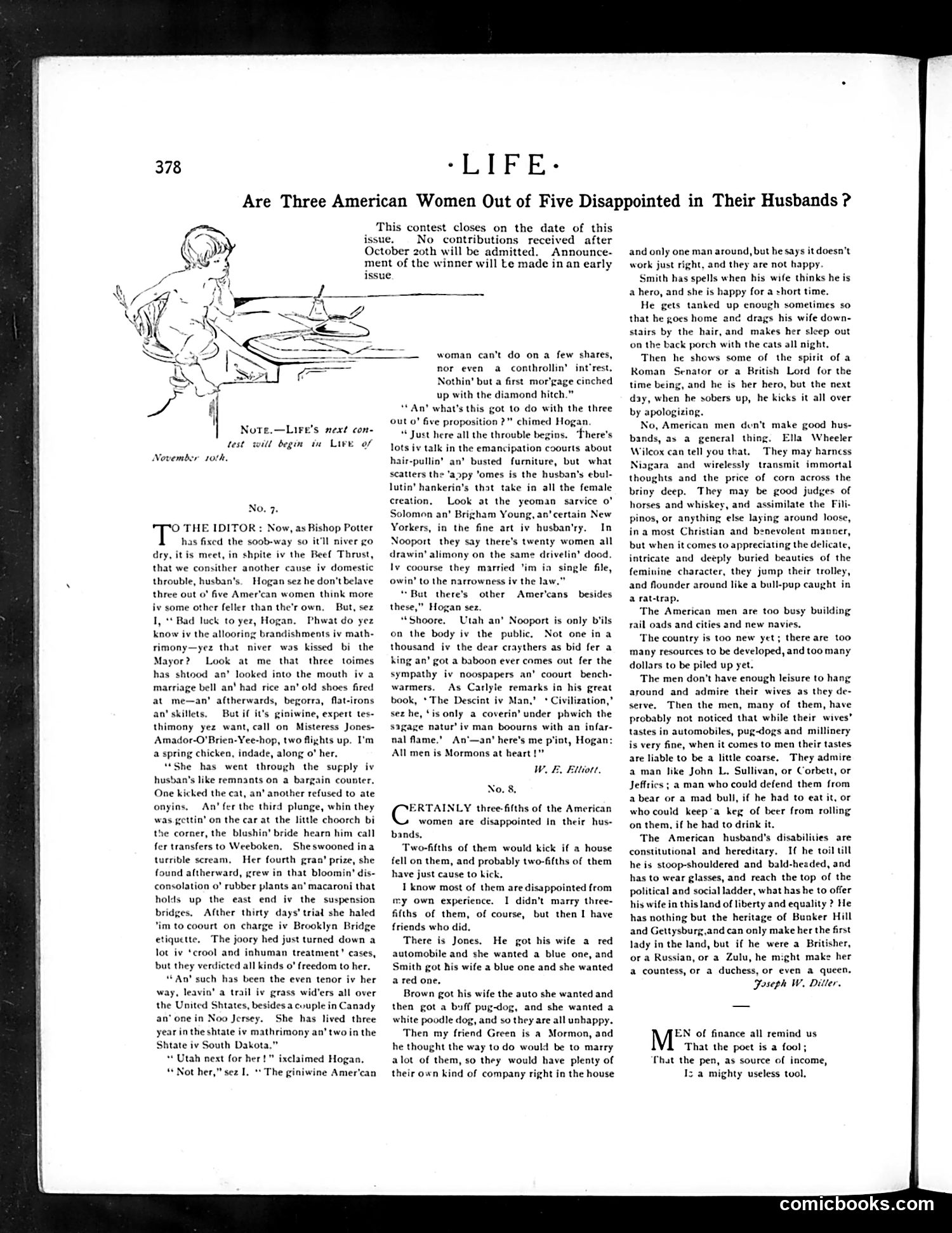
This page presents a satirical contest about marital disappointment, specifically asking "Are Three American Women Out of Five Disappointed in Their Husbands?" The cartoon at top-left shows a woman at a desk, apparently submitting entries. The contest solicits humorous anecdotes about disappointed wives—wives complain their husbands are lazy, cheap, or spend money foolishly on automobiles instead of household items they want. The responses mock typical husband stereotypes: men who drink, won't work, spend recklessly on cars, or neglect domestic responsibilities. One woman mentions her husband dragged her downstairs by her hair. Another notes husbands ignore their wives' input on major purchases. The satire targets both sexes—wives are portrayed as materialistic and complaining, while husbands are depicted as irresponsible spenders, drinkers, and neglectful partners. This reflects early 20th-century gender tensions and marital discord commentary in American popular media.
📄 Transcribed text from this page (OCR, searchable)
Machine-transcribed from the original scan — historical spelling and the odd misread are preserved.
-LIFE- Three American Women Out of Five Disappointed in Their Husbands ? This contest closes on the date of this issue, October 20th No contributions received after ll be admitted. Announce- ment of the winner will te made in an early issue Note.—Lire’s next con- test will begin in Live of November 10th, No, 3. ‘O THE IDITOR : Now, as Bishop Potter has fixed the soob-way so it'll niver go dry, it is meet, in shpite iv the Beef Thrust, that we consither another cause iv domestic throuble, husban's. Hogan sez he don't belave three out o' five Amer'can women think more iv some other feller than the'r own, But, sez I, * Bad luck to yez, Hogan, Phwat do yez know iv the allooring brandishments iv math- rimony—yez that niver was kissed bi the Mayor? Look at me that three toimes has shtood an’ looked into the mouth iv a marriage bell an’ had rice an’ old shoes fired at me—an’ aftherwards, begorra, flat-irons an’ skillets. But if it’s giniwine, expert tes- thimony yez want, call on Misteress Jones- Amador-O'Brien-Yee-hop, two flights up. I'm a spring chicken, indade, along o' her. “She has went through the supply iv husban’s like remnants on a bargain counter. One kicked the cat, an’ another refused to ate onyins, An’ fer the third plunge, whin they was gettin’ on the car at the little choorch bi the corner, the blushin’ bride hearn him call fer transfers to Weeboken. She swooned ina turrible scream, Her fourth gra’ prize, she found aftherward, grew in that Bloomin’ dis- consolation o' rubber plants an’ macaroni that holds up the east end iv the suspension bridges. Afther thirty days’ triad she haled ‘im to coourt on charge iv Brooklyn Bridge etiquette. The joory hed just turned down a lot iv ‘crool and inhuman treatment’ cases, but they verdicted all kinds o' freedom to her. ‘An’ such has been the even tenor iv her way, leavin’ a trail iv grass wid’ers all over the United Shtates, besides a couple in Canady an’ one in Noo Jersey. She has lived three year in the shtate iv mathrimony an’ two in the Shtate iv South Dakota,” * Utah next for her!" ixclaimed Hogan, “Not her,” sez I. ** The giniwine Amer‘can woman can't do on a few shares, conthrollin’ int'rest, Nothin’ but a first mor'gage cinched up with the diamond hitch.” n’ what’s this got to do with the three out o' five proposition ?” chimed Hogan “ Just here all the throuble begins. ‘There's lots iv talk in the emancipation coourts about hair-pullin? an’ busted furniture, but what scatters the 'appy 'omes is the husban’s ebul- lutin’ hankerin’s that take in all the female creation, Look at the yeoman sarvice o° Solomon an’ Brigham Young, an' certain New Yorkers, in the fine art iv husban'ry, In Nooport they say there's twenty women all drawin’ alimony on the same drivelin’ dood, Iv coourse they married ‘im ia single file, owin’ to the narrowness iv the law.” ‘But there's other Amer'cans these,” Hogan sez. “Shoore. Utah an’ Nooport is only biils on the body iv the public, Not one in a thousand iv the dear craythers as bid fer a king an’ got a baboon ever comes out fer the sympathy iv noospapers an’ coourt bench- warmers. As Carlyle remarks in his great book, *The Descint iv Man,’ * Civilization,’ sez he, ‘is only a coverin’ under phwich the sagage natur’ iv man boourns with an infar- nal flame,’ An'—an’ here's me p'int, Hogan: All men is Mormons at heart!” W. E, Eltiott. nor even a besides No. 8, RTAINLY three-fifths of the American women are disappointed in their hus- bands. Two-fifths of them would kick if a house fell on them, and probably two-fifths of them have just cause to kick, I know most of them are disappointed from my own experience. 1 didn’t marry three- fifths of them, of course, but then I have friends who did. There is Jones. He got his wife a red automobile and she wanted a blue one, and Smith got his wife a blue one and she wanted a red one. Brown got his wife the auto she wanted and then got a buff pug-dog, and she wanted a white poodle dog, and so they are all unhappy. Then my friend Green is a Mormon, and he thought the way to do would be to marry alot of them, so they would have plenty of their own kind of company right in the house and only one man around, but he says it doesn’t work just right, and they are not happy. Smith has spells when his wife thinks he is a hero, and she is happy for a short time. He gets tanked up enough sometimes so that he goes home and drags his wife down- stairs by the hair, and makes her sleep out on the back porch with the cats all night. Then he shows some of the spirit of a Roman Senator or a British Lord for the time being, and he is ber hero, but the next day, when he sobers up, he kicks it all over by apologizing. No, American men don't make good hus- bands, as a general thing. Ella Wheeler Wilcox can tell you that. They may harness Niagara and wirelessly transmit immortal thoughts and the price of corn across the briny deep. They may be good judges of horses and whiskey, and assimilate the Fili- pinos, or anything else laying around loose, ina most Christian and benevolent manner, but when it comes to appreciating the delicate, intricate and deeply buried beauties of the feminine character, they jump their trolley and flounder around like a bull-pup caught in a rat-trap. The American men are too busy building rail oads and cities and new navies. ‘The country is too new yet; there are too many resources to be developed, and too many dollars to be piled up yet. The men don't have enough leisure to hang around and admire their wives as they de- serve. Then the men, many of them, have probably not noticed that while their wives? tastes in automobiles, pug-dogs and millinery is very fine, when it comes to men their tastes are liable to be a little coarse. They admire a man like John L, Sullivan, or Corbett, or Jefftics ; a man who could defend them from a bear or a mad bull, if he had to eat it, or who could keep’a keg of beer from rolling on them, if he had to drink it. ‘The American husband's disabilities are constitutional and hereditary, If he toil till he is stoop-shouldered and bald-headed, and has to wear glasses, and reach the top of the political and social ladder, what has he to offer his wife in this land of liberty and equality ? He has nothing but the heritage of Bunker Hill and Gettysburg,and can only make her the first lady in the land, but if he were a Britisher, ora Russian, or a Zulu, he might make her a countess, or a duchess, or even a queen, Joseph W. Diller. EN of finance all remind us That the poet is a fool ; That the pen, as source of income, Iz a mighty useless tool, comicbooks.com