
Life, 1904-10-20 · page 4 of 20
Life — October 20, 1904 — page 4: what you’re looking at
What you’re looking at
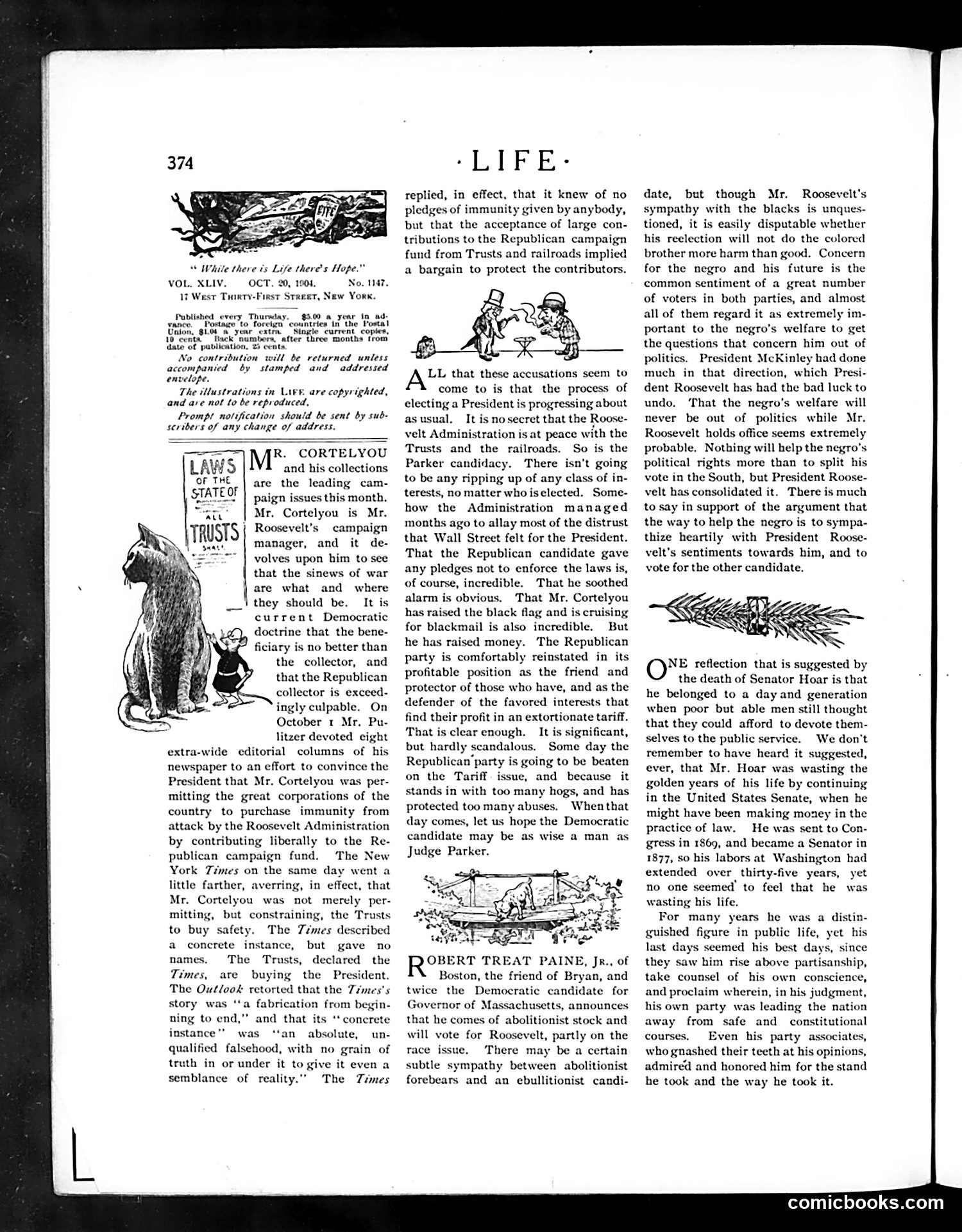
This page critiques the 1904 presidential campaign, particularly Theodore Roosevelt's relationship with corporate interests. The central cartoon shows a large bear (representing trusts/monopolies) being controlled by a small figure, satirizing Roosevelt's claims to regulate big business while allegedly accepting campaign contributions from railroad and trust executives. The text discusses accusations that Roosevelt's administration made deals with Wall Street interests despite anti-trust rhetoric. A section on "Laws of the State" (shown with illustration) mocks the contradiction between Roosevelt's public stance against trusts and his actual political arrangements with them. The page also includes commentary on Senator Hoar's death and Democratic candidate judge Parker, suggesting broader debates about corporate influence in American politics during this election cycle.
📄 Transcribed text from this page (OCR, searchable)
Machine-transcribed from the original scan — historical spelling and the odd misread are preserved.
“* While there és Life there's Hope.” VOL. XLIV. OCT. 20, 1904. No. 1147. 17 West Tinery-Finst Street, Naw York. Published every Thursday, $3.00 a year in ad: vance. Postage to foreign countries in the Hostal Union, $1.00 a year extra. Single current copies, lo cents. Mack numbers. after three months from date of publication, 25 cents will be returned untess addressed No contribution accompanied by stamped and envelope. The illustrations in Litt, are copyrighted, and ave not to be reproduced. Prompt notification should be sent by sub- scribers of any change of address. R. CORTELYOU and his collections are the leading cam- paign issues this month. Mr. Cortelyou is Mr. Roosevelt’s campaign manager, and it de- volves upon him to see that the sinews of war are what and where they should be. It is current Democratic doctrine that the bene- ficiary is no better than the collector, and that the Republican collector is exceed- ingly culpable. On October 1 Mr. Pu- litzer devoted cight extra-wide editorial columns of his newspaper to an effort to convince the President that Mr. Cortelyou was per- mitting the great corporations of the country to purchase immunity from attack by the Roosevelt Administration by contributing liberally to the Re- publican campaign fund. The New York Times on the same day went a little farther, averring, in effect, that Mr. Cortelyou was not merely per- mitting, but constraining, the Trusts to buy safety, The Times described a concrete instance, but gave no names. The Trusts, declared the Times, are buying the Presiden The Outlook retorted that the 77m. story was ‘a fabrication from begin- ning to end,"’ and that its ‘* concrete instance’ was ‘tan absolute, un- qualified falsehood, with no grain of truth in or under it to give it even a semblance of reality." The Tsmes LAWS OF THE STATE OF -LIFE- replied, in effect, that it knew of no pledges of immunity given by anybody, but that the acceptance of large con- tributions to the Republican campaign fund from Trusts and railroads implied a bargain to protect the contributors. ee r LL that these accusations seem to come to is that the process of electing a President is progressing about as usual. It is no secret that the Roose- velt Administration is at peace with the Trusts and the railroads. So is the Parker candidacy. There isn't going to be any ripping up of any class of in- terests, no matter who iselected. Some- how the Administration managed months ago to allay most of the distrust that Wall Street felt for the President. That the Republican candidate gave any pledges not to enforce the laws is, of course, incredible. That he soothed alarm is obvious. That Mr. Cortelyou has raised the black flag and is cruising for blackmail is also incredible. But he has raised money. The Republican party is comfortably reinstated in its profitable position as the friend and protector of those who have, and as the defender of the favored interests that find their profit in an extortionate tariff. ‘That is clear enough. It is significant, but hardly scandalous. Some day the Republican’party is going to be beaten on the Tariff issue, and because it stands in with too many hogs, and has protected too many abuses. Whenthat day comes, let us hope the Democratic candidate may be as w a man as Judge Parker. OBERT TREAT PAINE, Jr., of Boston, the friend of Bryan, and -e the Democratic candidate for Governor of Massachusetts, announces. that he comes of abolitionist stock and will vote for Roosevelt, partly on the race issue, There may be a certain subtle sympathy between abolitionist forebears and an ebullitionist candi- date, but though Mr. Roosevelt's sympathy with the blacks is unques- tioned, it is easily disputable whether his reelection will not do the colored brother more harm than good. Concern for the negro and his future is the common sentiment of a great number of voters in both parties, and almost all of them regard it as extremely im- portant to the negro’s welfare to get the questions that concern him out of politics. President McKinley had done much in that direction, which Presi- dent Roosevelt has had the bad luck to undo, ‘That the negro’s welfare will never be out of politics while Mr. Roosevelt holds office seems extremely probable. Nothing will help the negro’s political rights more than to split his vote in the South, but President Roose- velt has consolidated it. There is much to say in support of the argument that the way to help the negro is to sympa- thize heartily with President Roose- velt's sentiments towards him, and to vote for the other candidate. Ove reflection that is suggested by the death of Senator Hoar is that he belonged to a day and generation when poor but able men still thought that they could afford to devote them- selves to the public service. We don't remember to have heard it suggested, ever, that Mr. Hoar was wasting the golden years of his life by continuing in the United States Senate, when he might have been making money in the practice of law. He was sent to Con- gress in 1869, and became a Senator in 1877, so his labors at Washington had extended over thirty-five years, yet no one seemed’ to feel that he was wasting his life. For many years he was a distin- guished figure in public life, yet his last days seemed his best days, since they saw him rise above partisanship, take counsel of his own conscience, and proclaim wherein, in his judgment, his own party was leading the nation away from safe and constitutional courses. Even his party associates, who gnashed their teeth at his opinions, admired and honored him for the stand he took and the way he took it. comicbooks.com