
A complete issue · 22 pages · 1904
Life — October 13, 1904
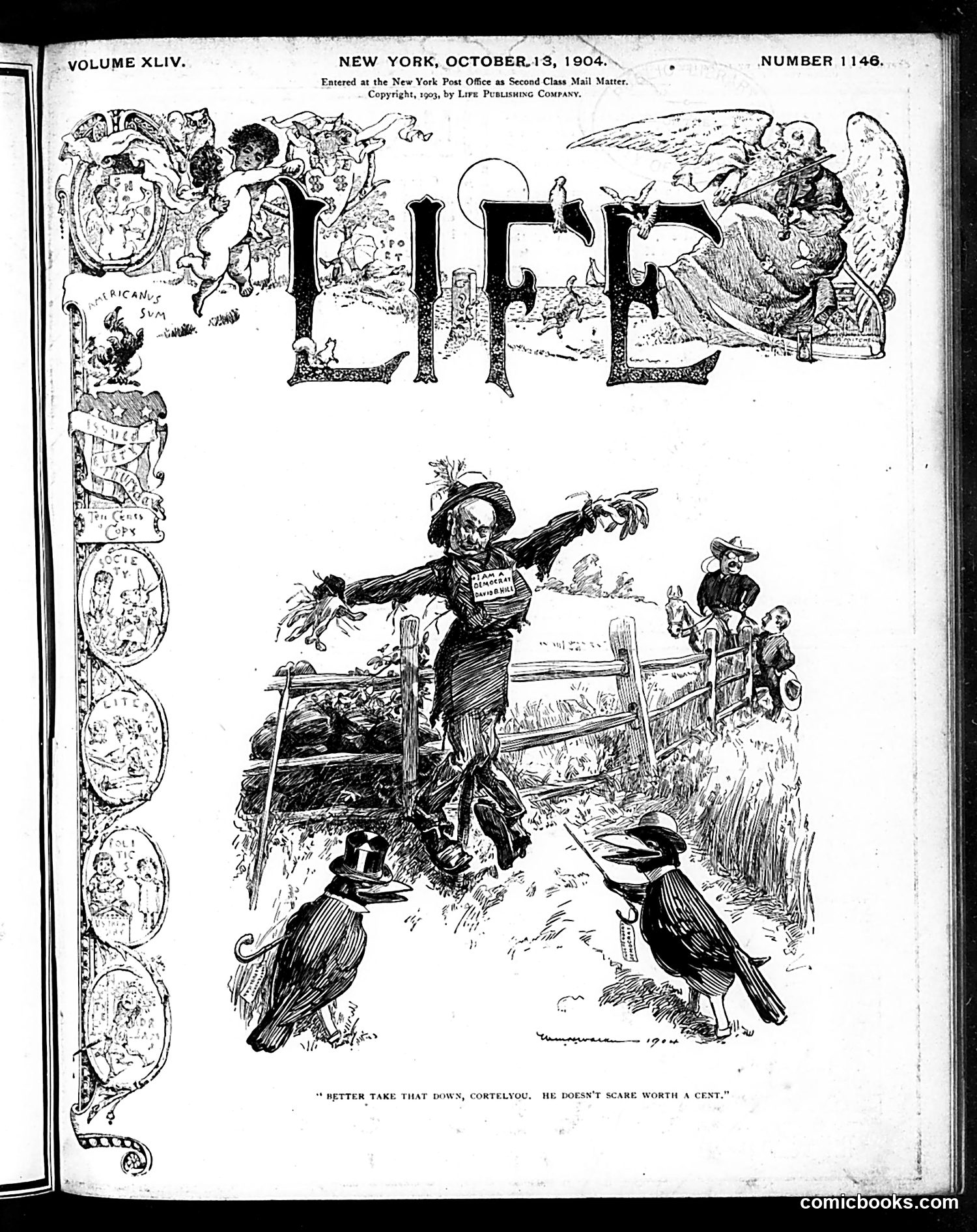
This satirical illustration depicts a scarecrow labeled "PROTECTION" standing in a field, with two crows nearby. The caption reads: "Better take that down, Cortelyou. He doesn't scare worth a cent." **Context:** This references Secretary of Commerce and Labor George B. Cortelyou, likely during Theodore Roosevelt's 1904 presidential campaign. The "scarecrow" represents the Republican Party's protective tariff policy—a major campaign issue. The crows (representing business interests or political opponents) are unimpressed, suggesting the protection policy isn't effectively deterring criticism or opposition. The cartoon critiques the ineffectiveness of Republican protectionist rhetoric during the election season, implying their policy arguments aren't convincing voters or constituencies anymore.
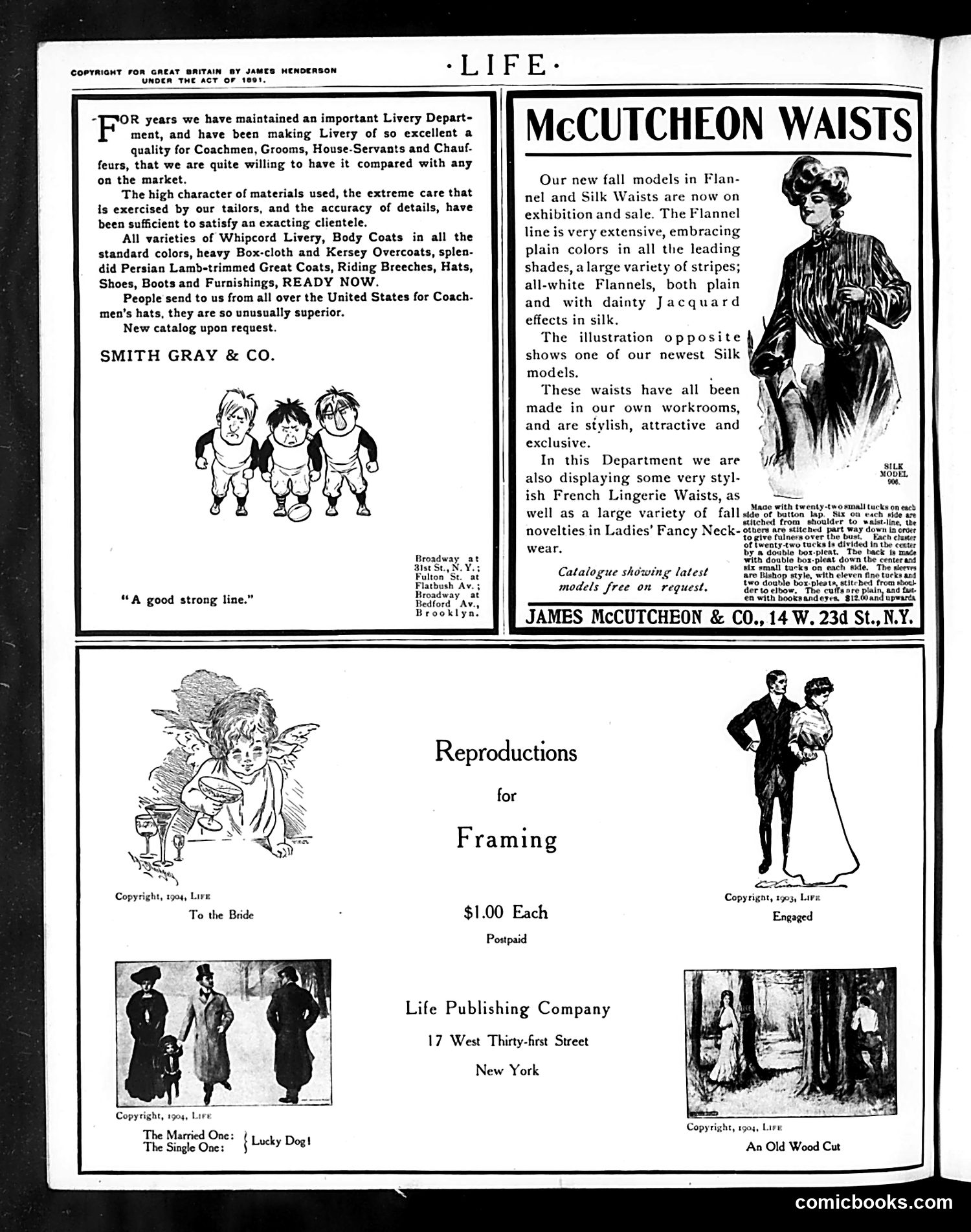
This page is primarily **advertising content** rather than editorial satire. The upper half features two ads: Smith Gray & Co. (livery/coachmen services) with a cartoon of three rotund figures and the tagline "A good strong line," and James McCutcheon & Co. (women's clothing) advertising silk waists. The lower half showcases "Reproductions for Framing" sold by Life Publishing Company—four illustrations available for $1.00 each, copyrighted by *Life* magazine. These appear to be sentimental or humorous domestic scenes: "To the Bride" (cherub), "Engaged" (couple), "The Married One/The Single One/Lucky Dog" (street fashion), and "An Old Wood Cut" (woodland scene). The page reflects early 20th-century consumer culture, mixing product marketing with decorative art sales.
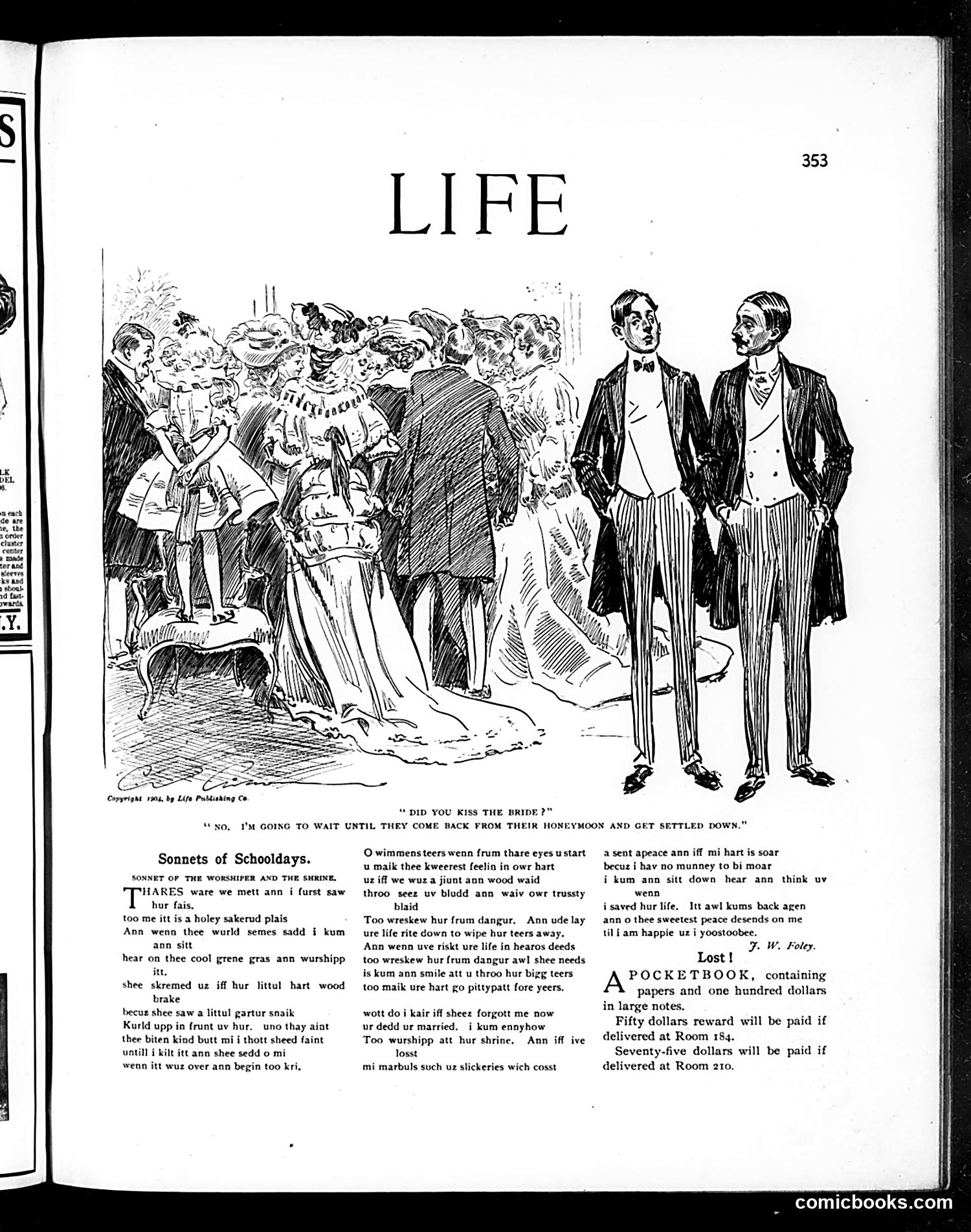
The main cartoon depicts a formal social scene—likely a wedding reception or high-society event. Two well-dressed men in tuxedos stand apart, observing a crowded gathering of elaborately dressed women and men in the background. The caption reads: "DID YOU KISS THE BRIDE?" with the response "NO. I'M GOING TO WAIT UNTIL THEY COME BACK FROM THEIR HONEYMOON AND GET SETTLED DOWN." This is a satirical commentary on opportunistic male behavior—the joke being that the man intends to pursue the bride romantically *after* her marriage, when she's presumably more "settled" and available. It's social satire mocking both masculine presumption and the brittle morality of high society. The "Sonnets of Schooldays" and lost pocketbook notice below are unrelated advertisements/classifieds.
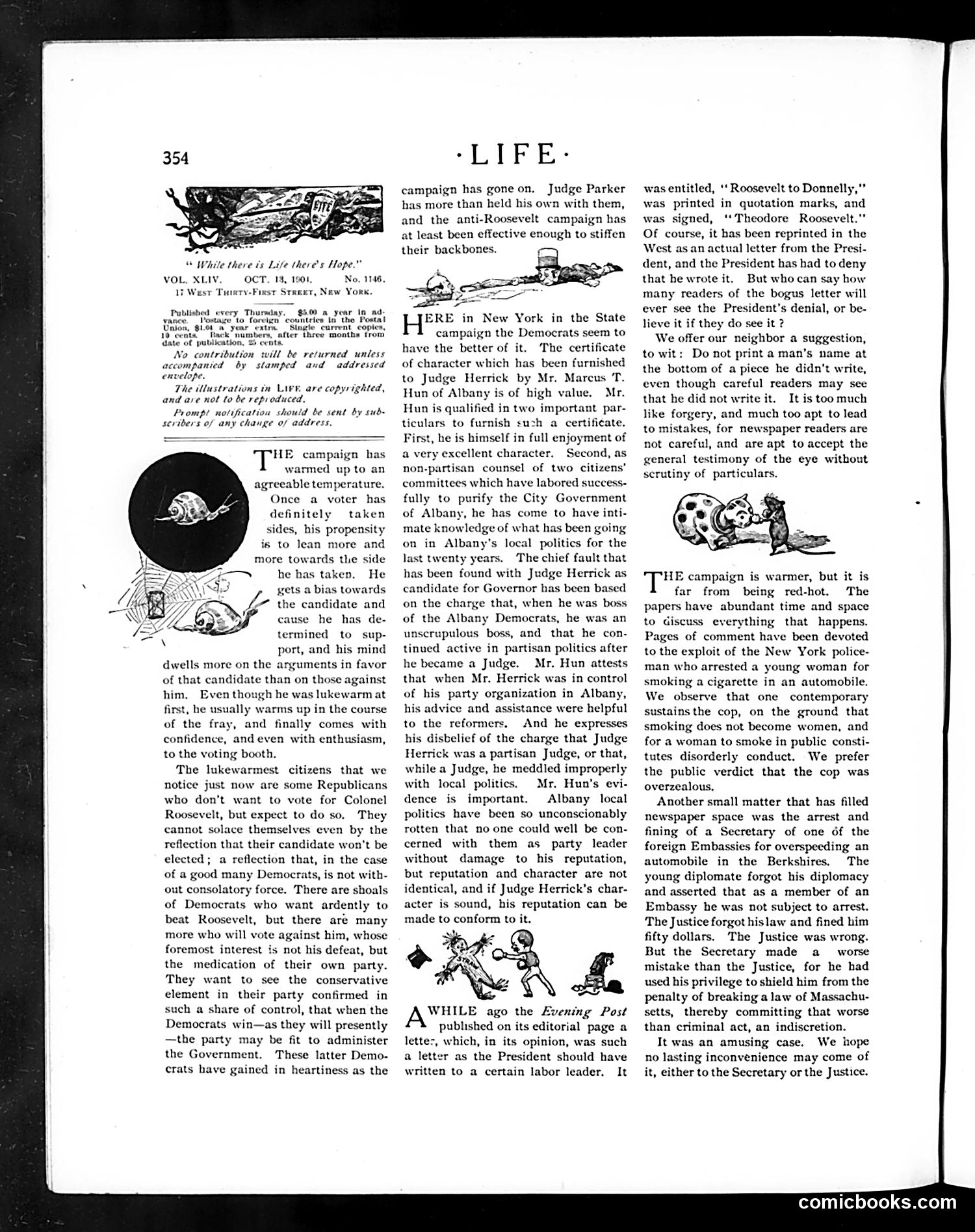
This page discusses the 1904 presidential campaign, focusing on Judge Herrick as a New York gubernatorial candidate. The text defends Herrick's character against Democratic attacks, arguing his reputation is sound despite claims he was a "partisan boss" with Albany political ties. The cartoons (small illustrations with playing children and figures) appear to satirize campaign mudslinging—though their exact meaning is unclear without clearer visibility. The page critiques both parties' campaign tactics, particularly criticizing Democratic attacks on Herrick while also mocking a young diplomat's diplomatic immunity controversy. The overall tone suggests Life magazine viewed the 1904 campaign as increasingly bitter and character-focused rather than issue-based.
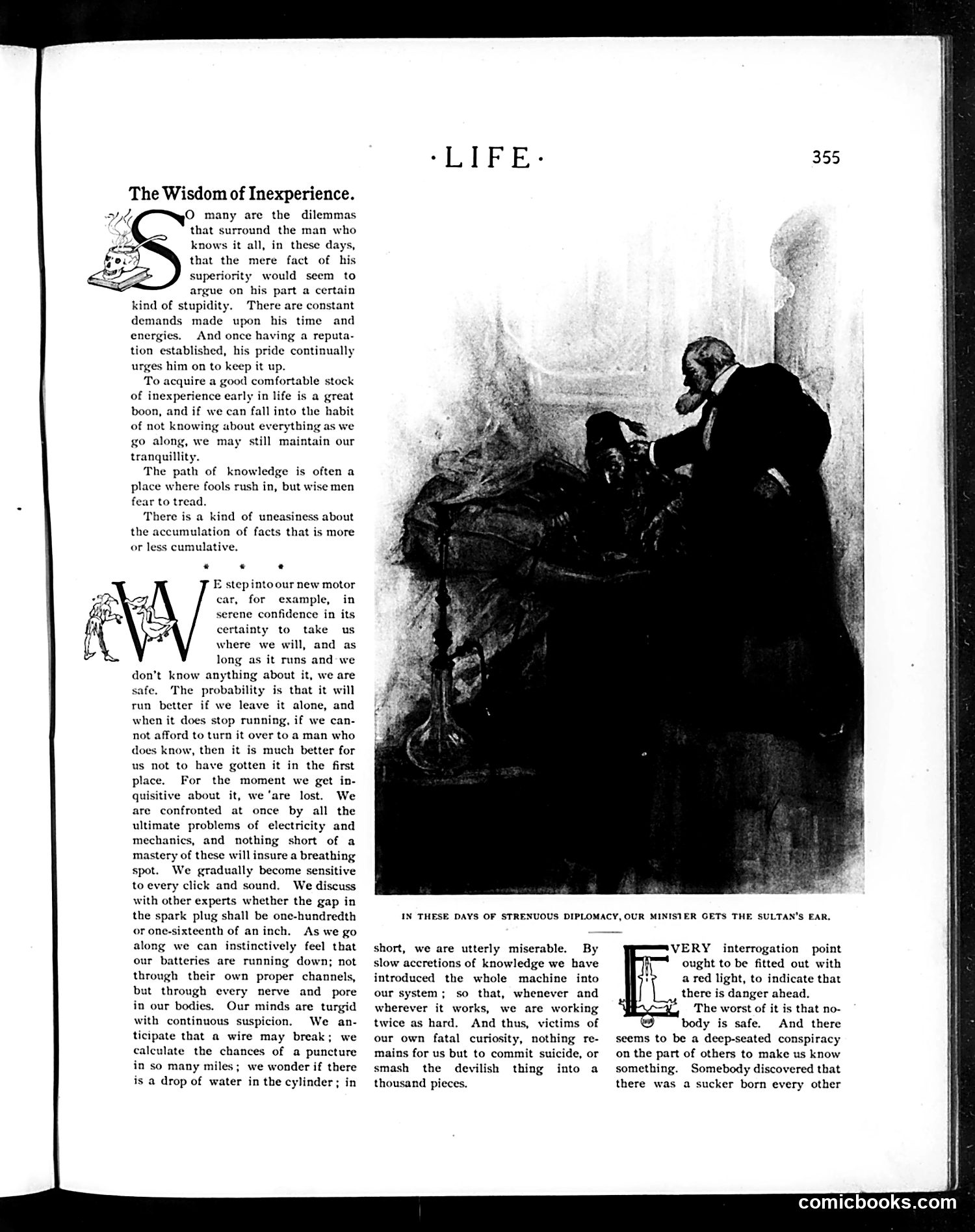
The page contains an essay titled "The Wisdom of Inexperience" discussing how accumulated knowledge can create problems and anxiety. The accompanying illustration shows two figures in what appears to be diplomatic or formal dress examining or manipulating something, with a caption reading "IN THESE DAYS OF STRENUOUS DIPLOMACY, OUR MINISTER GETS THE SULTAN'S EAR." This cartoon likely satirizes early 20th-century diplomatic negotiations, possibly referencing American or European ministers dealing with Ottoman officials. The "Sultan's ear" suggests the minister has gained favor or influence through diplomacy. The illustration's dark, somewhat ominous tone suggests skepticism about such diplomatic maneuvering—implying that achieving political influence through persistent negotiation might be ethically questionable or produce undesirable results, supporting the essay's broader theme about knowledge and its consequences.
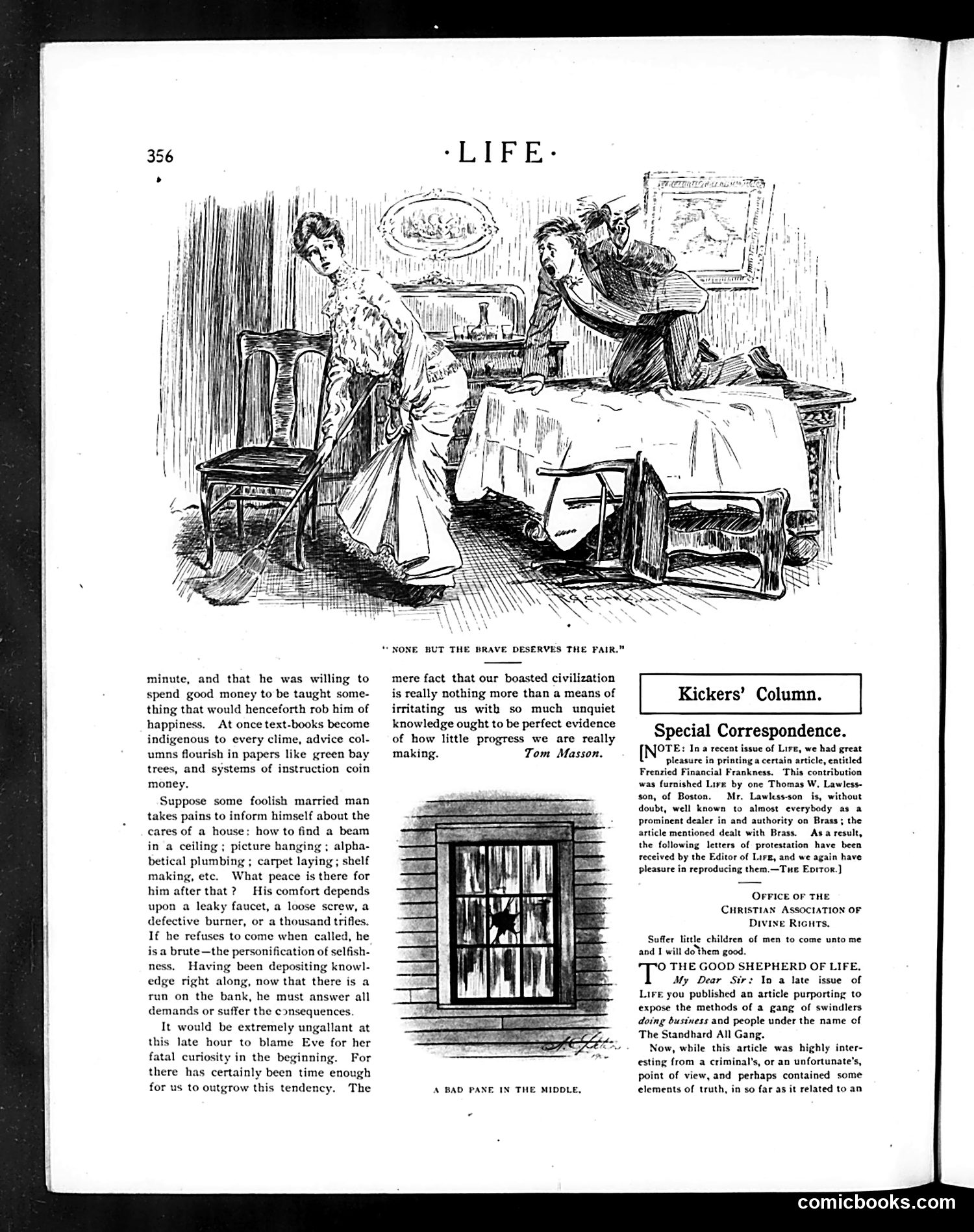
The top cartoon shows a domestic scene captioned "None But the Brave Deserves the Fair," depicting a man apparently injured or incapacitated in bed while a woman stands nearby and another man gestures animatedly in the background. This appears to be satirizing romantic rivalry or marital complications—likely mocking the notion that only courageous men deserve romantic attention. The lower illustration titled "A Bad Pane in the Middle" shows a window with broken glass, a visual pun playing on "pain" (suffering) versus "pane" (window glass). It's a simple joke cartoon. The right column contains "Kickers' Column" with a letter to the editor regarding a previous Life article about financial fraud and con artists, suggesting reader engagement with the magazine's investigative satire.
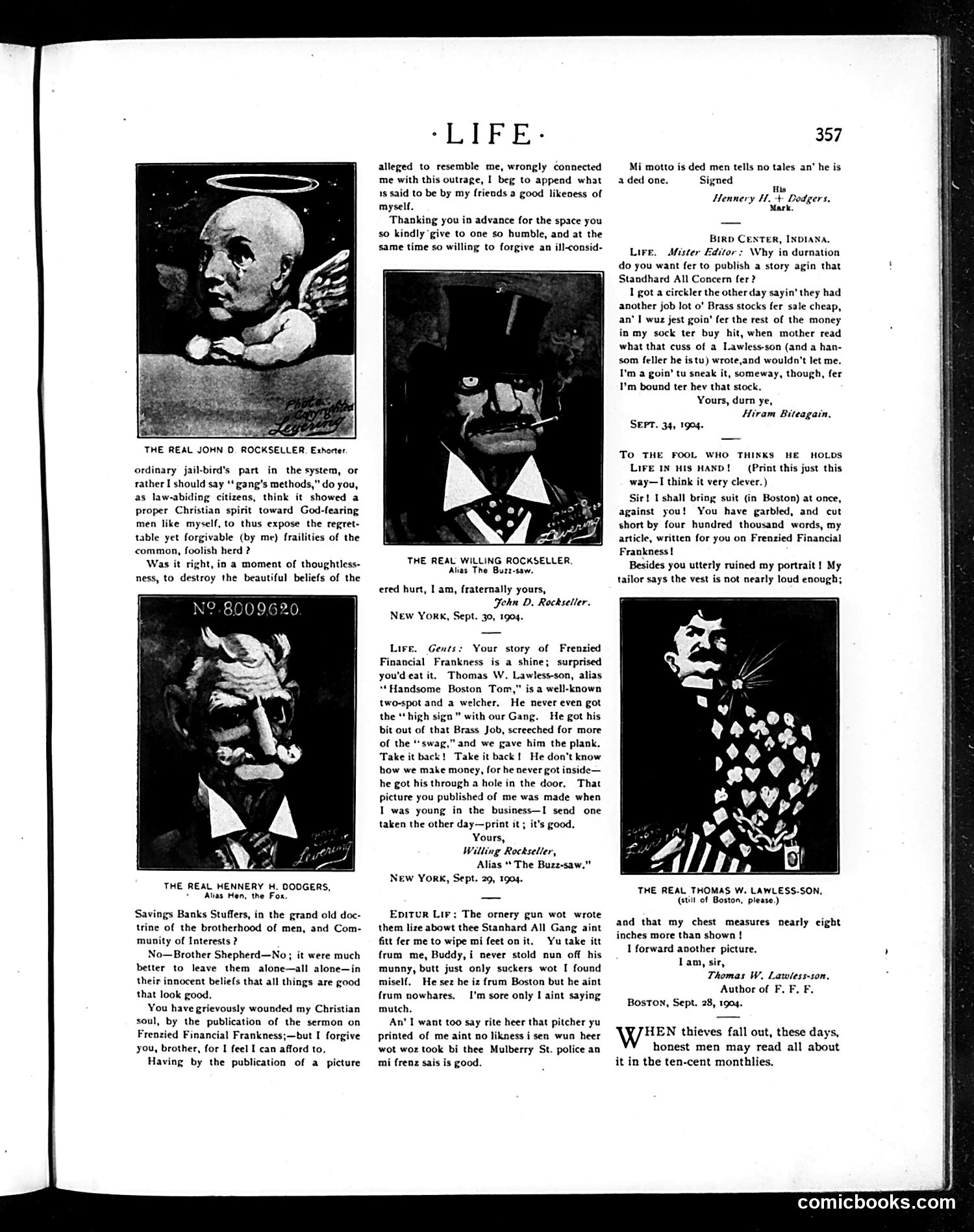
This page features satirical portraits of actual figures from turn-of-the-century American crime and business scandals, labeled as "The Real" versions of notorious characters: 1. **John D. Rockefeller** - depicted as an angelic figure with a halo, mocking his public image versus his ruthless business practices 2. **Willing Rockefeller** - shown as a demonic/villainous character, contrasting with his brother's saintly portrayal 3. **Hennery H. Dodgers** (likely a fictional name representing a con artist) 4. **Thomas W. Lawless-Son** - caricatured holding money, referencing the text's mention of "Handsome Boston Tom," a known swindler The accompanying letters are reader responses criticizing Life's editorial choices. The satire targets wealthy industrialists and criminals, exposing the gap between their public personas and actual conduct during the Gilded Age.
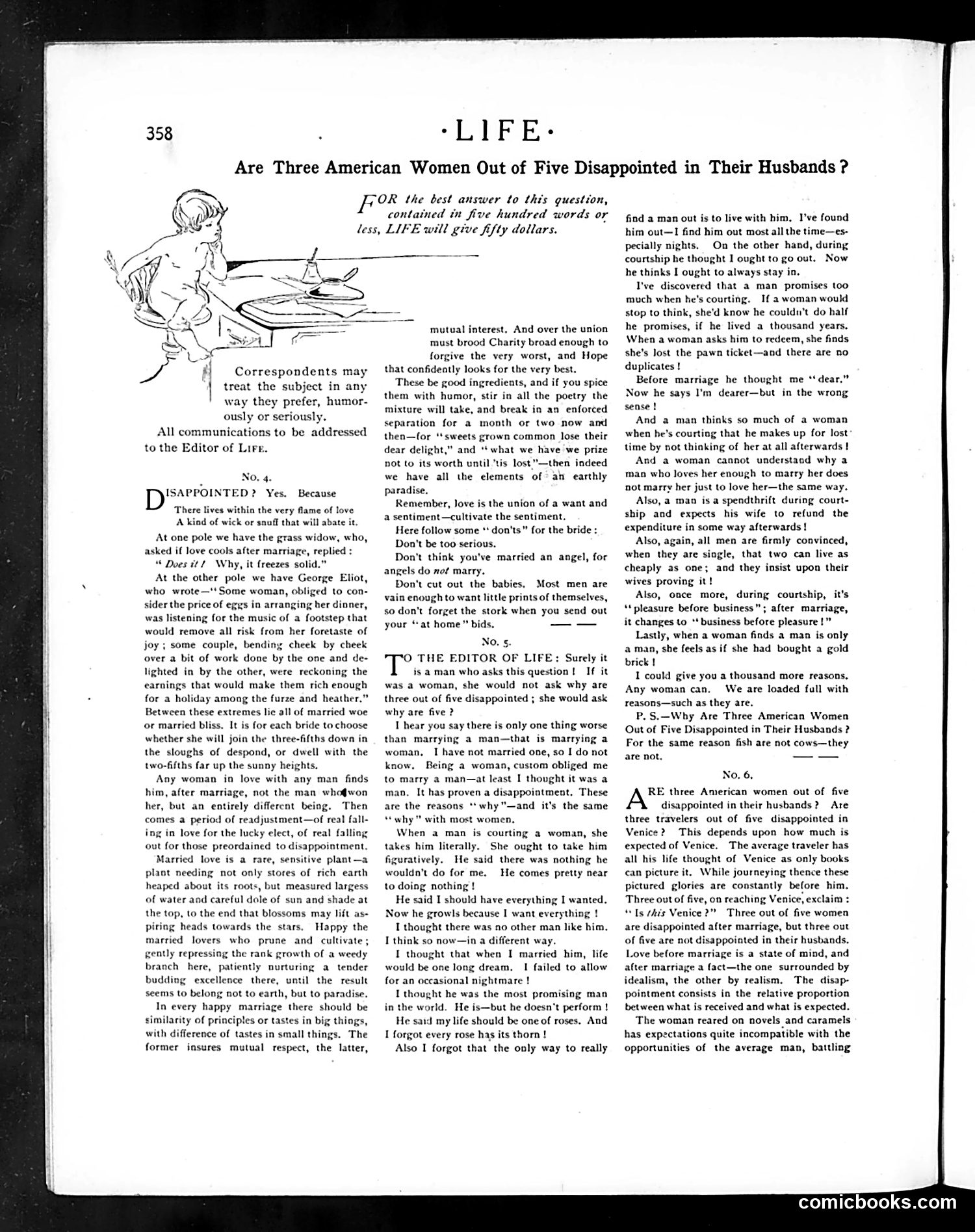
This page addresses a question posed to *Life* magazine's editor: "Are Three American Women Out of Five Disappointed in Their Husbands?" The illustration shows a woman sitting at a desk, presumably writing correspondence. The page publishes reader responses debating whether women's marital disappointment stems from unrealistic expectations versus actual male shortcomings. The satire targets both genders: men who make exaggerated courtship promises they don't keep after marriage, and women who harbor romantic ideals incompatible with ordinary husbands. One response sardonically notes that a woman who buys a man expecting to change him has essentially "bought a gold brick"—a period slang term for a worthless purchase or confidence scheme. The piece critiques the gap between romantic idealization and marital reality in early 20th-century American relationships.
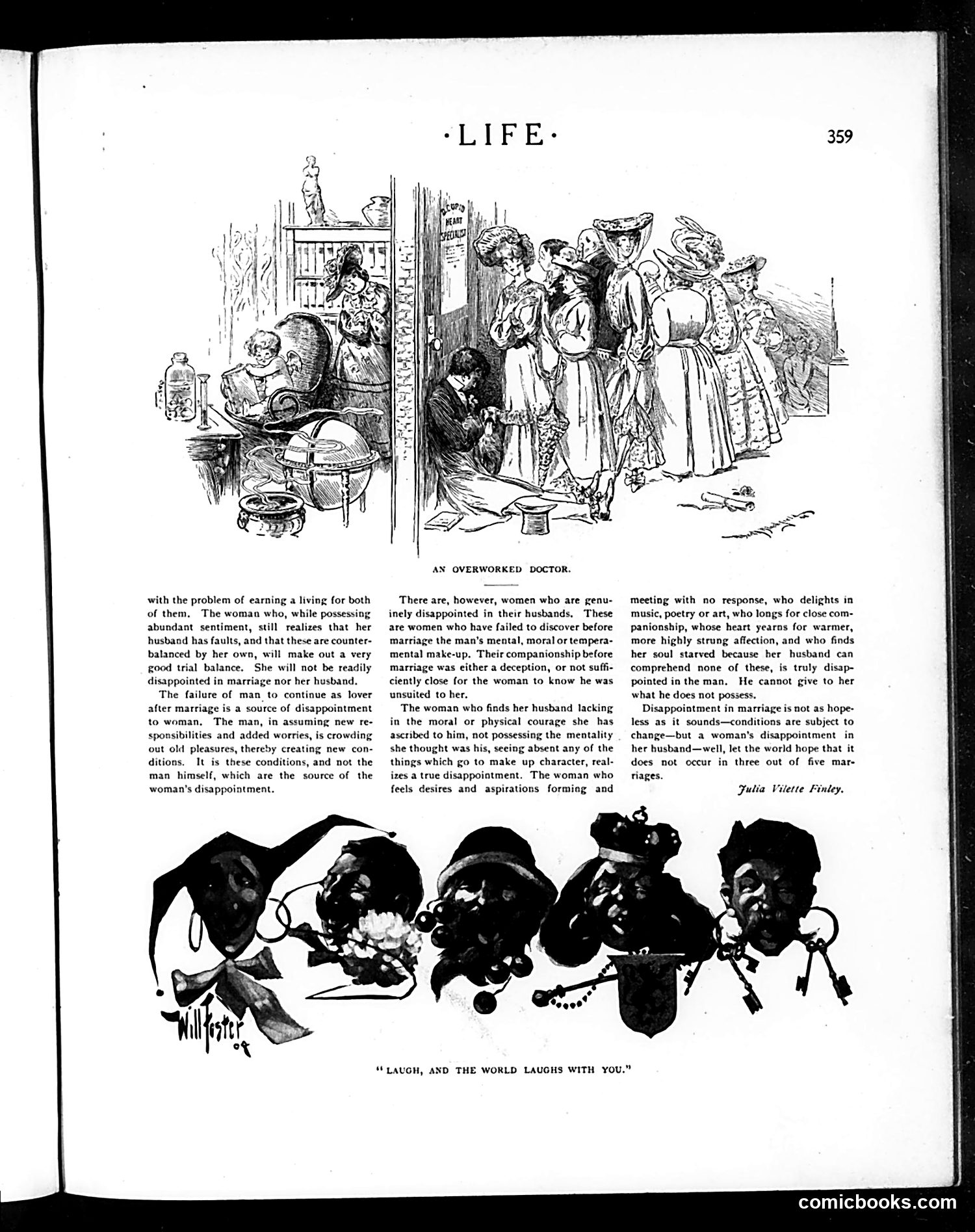
**Top Illustration: "An Overworked Doctor"** Shows a male physician exhausted at his desk while a crowd of female patients waits outside his office. The accompanying text critiques marriages where husbands fail to provide emotional or moral support, leaving wives disappointed. The illustration suggests the doctor—likely a metaphor for husbands—is overwhelmed and neglectful. **Bottom Illustration: "Laugh, and the World Laughs with You"** Features five grotesque caricatured faces in profile, likely representing different female types or social stereotypes. The caption is a play on the common proverb about shared laughter. The page overall addresses marital disappointment and women's dissatisfaction in marriage, a recurring theme in Life's early satirical content about domestic life and gender relations.
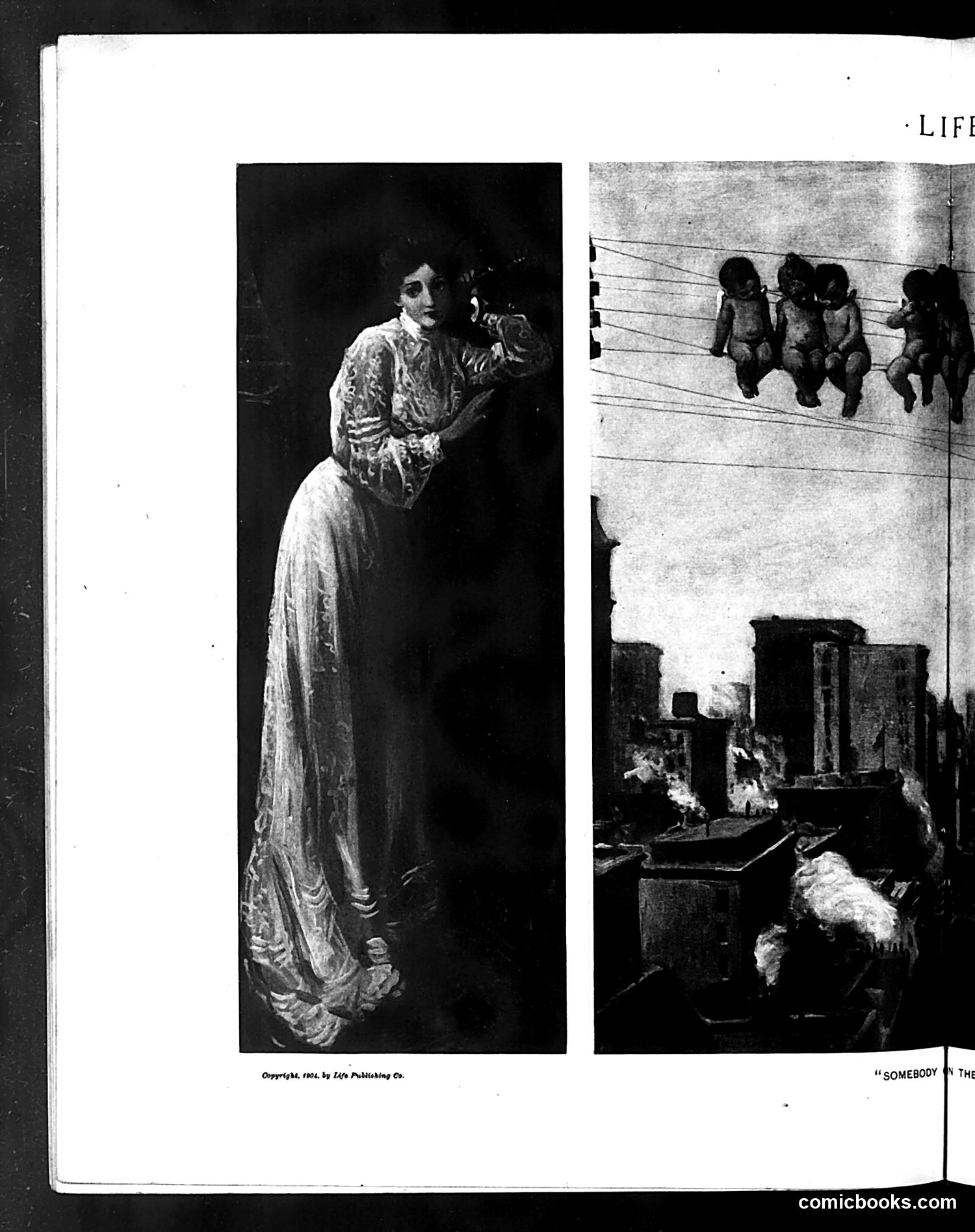
This page from Life magazine contains two black and white photographs or illustrations. The left image shows a woman in an ornate, flowing gown posed dramatically against a dark background—appears to be a theatrical or artistic portrait. The right image depicts what looks like an urban or industrial scene with figures perched on a structure above, and buildings or structures below. The copyright notice reads "Copyright, 1904, by Life Publishing Co." and partial text at bottom reads "SOMEBODY IN THE..." (text cut off). Without complete caption text visible, I cannot definitively identify the specific figures, satirical subjects, or political references intended. The theatrical quality of the left image and the compositional nature of the right suggest these may be commentary on contemporary entertainment, social conditions, or public figures of 1904, but precise interpretation requires additional context.
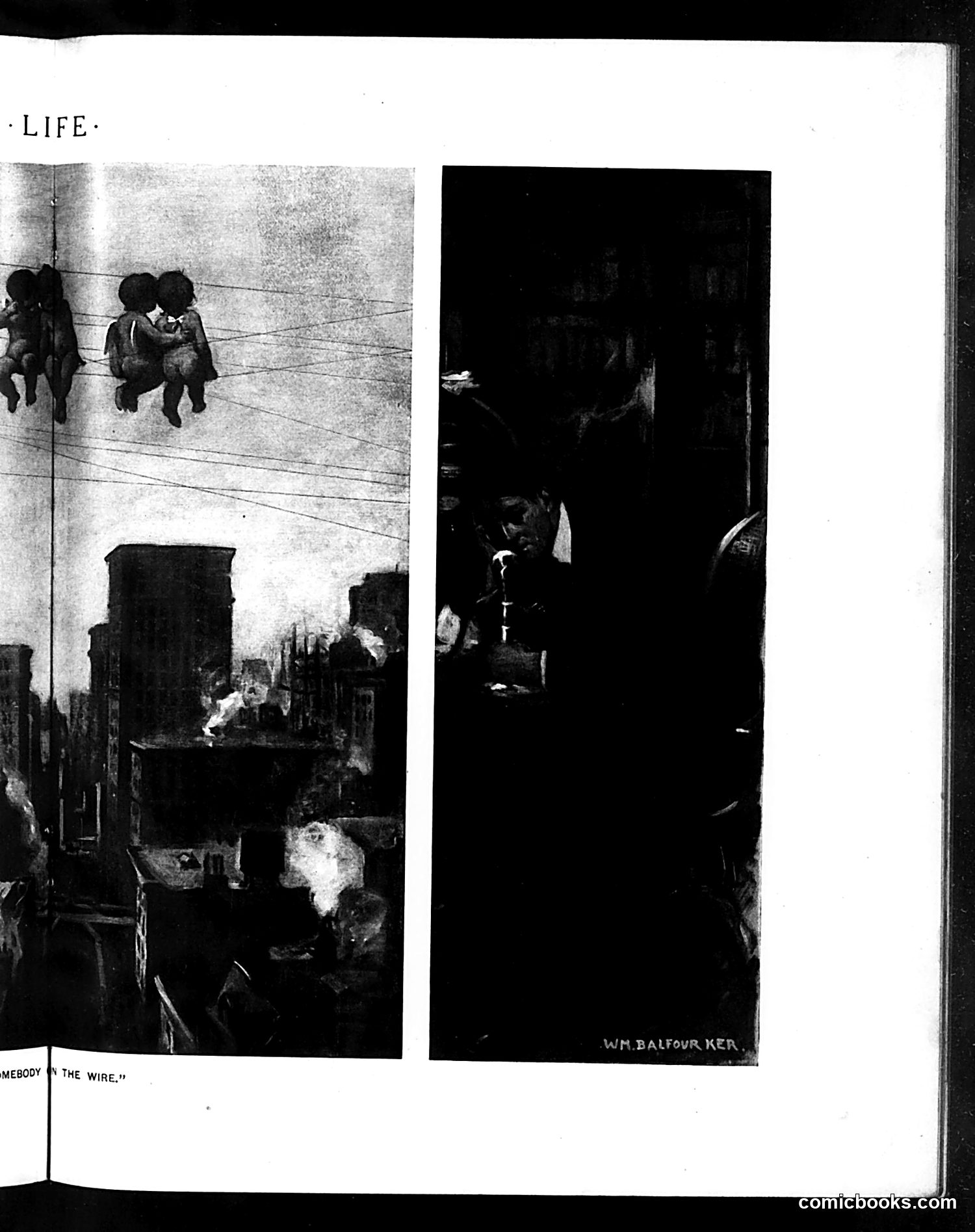
This page presents two black and white photographs credited to W.M. Balfour under the heading "LIFE." The left image, titled "The Wire," shows an urban tenement scene with clotheslines and figures on a building facade, depicting working-class domestic life in a crowded city environment. The right image is heavily underexposed and mostly illegible, showing what appears to be an indoor scene with multiple figures but insufficient detail for confident interpretation. Without complete caption text visible, the precise satirical intent remains unclear. However, the juxtaposition of these photographic studies appears to contrast urban living conditions or social circumstances, consistent with Life magazine's tradition of visual social commentary on American life and class conditions.
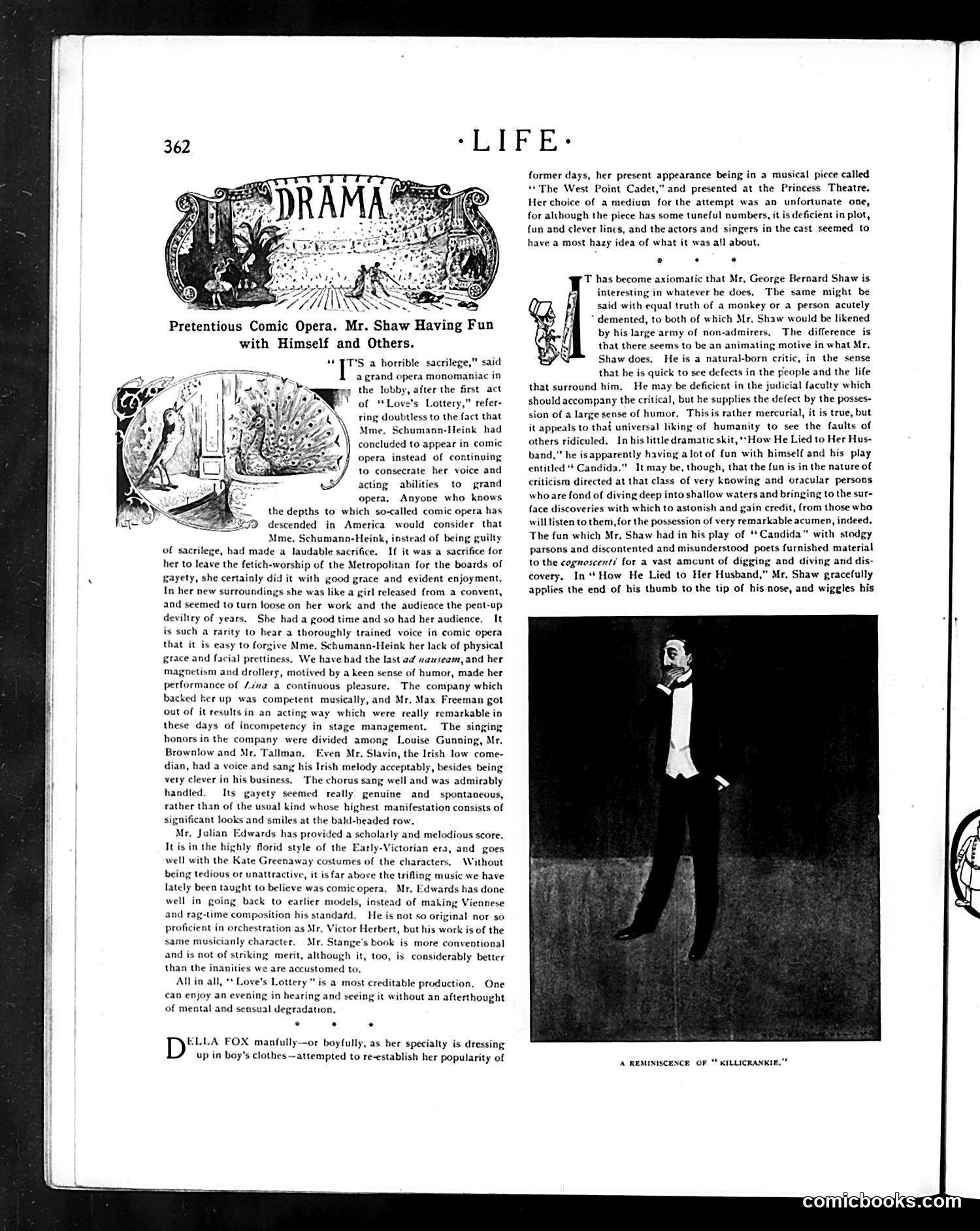
This page reviews theatrical productions, specifically comic operas. The main heading criticizes "Mr. Shaw Having Fun with Himself and Others," likely referring to George Bernard Shaw's involvement in theater criticism and production. The article discusses Mme. Schumann-Heinck's performance in comic opera, noting she left the Metropolitan Opera to perform in lighter works. The text critiques both her artistic choices and the state of American comic opera generally. The photograph labeled "A Reminiscence of 'Killicranckie'" shows a performer in theatrical costume, apparently demonstrating the physical comedy involved in comic opera performance. The review expresses skepticism about pretentious comic opera while acknowledging genuine entertainment value when executed competently. The page represents *Life*'s satirical commentary on contemporary American theater and its performers.
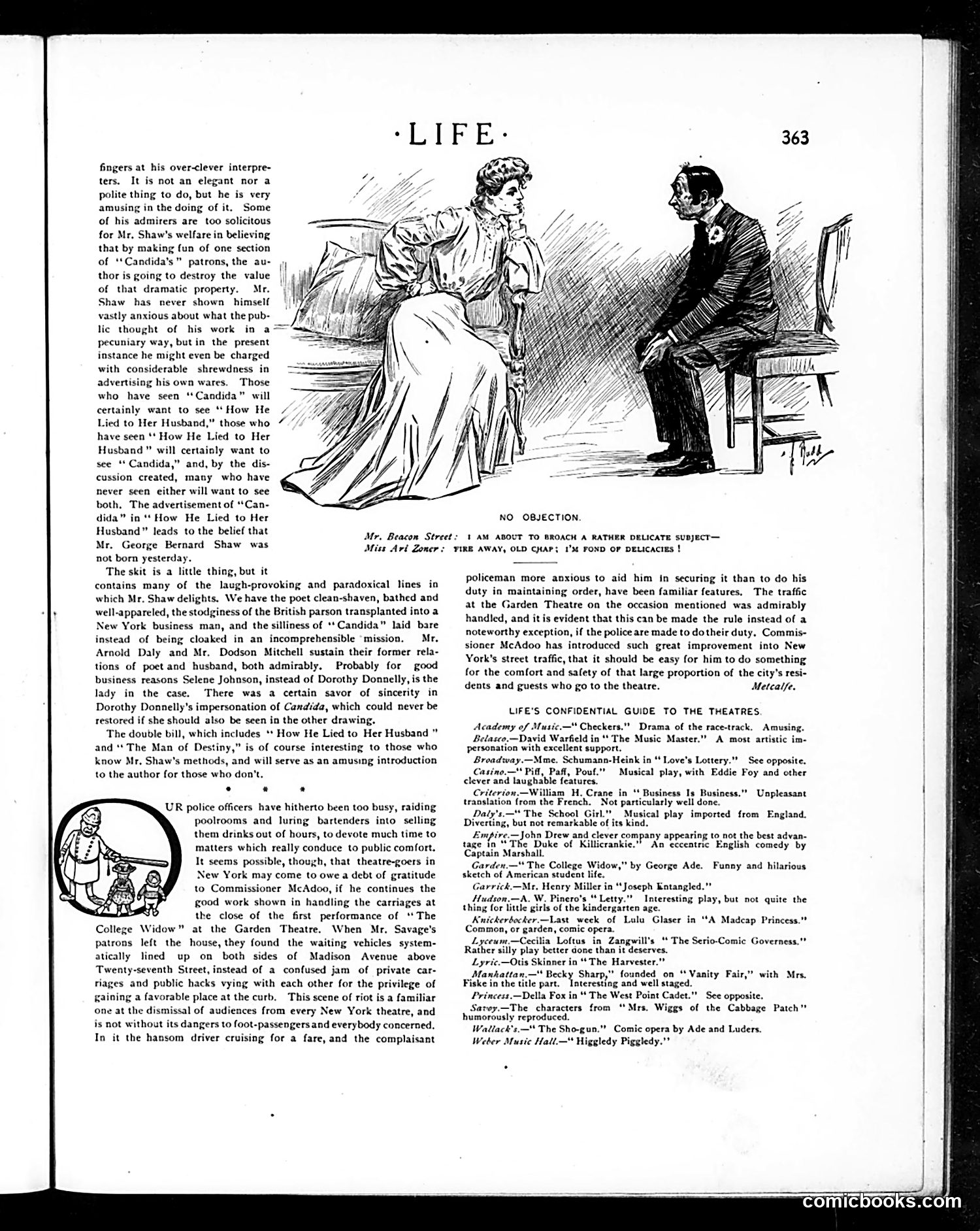
## The Main Cartoon ("No Objection") The sketch depicts two figures in conversation—a well-dressed man seated and a woman in elaborate dress. The caption identifies them as "Mr. Beacon Street" and "Miss Art Zoner." The joke hinges on a double entendre: the man says he wants to discuss "a rather delicate subject" while offering "delicacies," to which the woman replies she has "no objection." The humor relies on the suggestion of impropriety—implying a wealthy gentleman is propositioning a woman of questionable virtue, who eagerly accepts. ## The Text Content The bulk of the page reviews George Bernard Shaw's play *Candida* and its companion piece *How He Lied to Her Husband*, praising Shaw's wit and the production's cast. It also discusses Police Commissioner McAdoo's successful traffic management at theaters, presenting this as a model for public order. **Note:** This is primarily theater criticism with one social-commentary cartoon using period innuendo humor typical of early 1900s Life magazine satire.
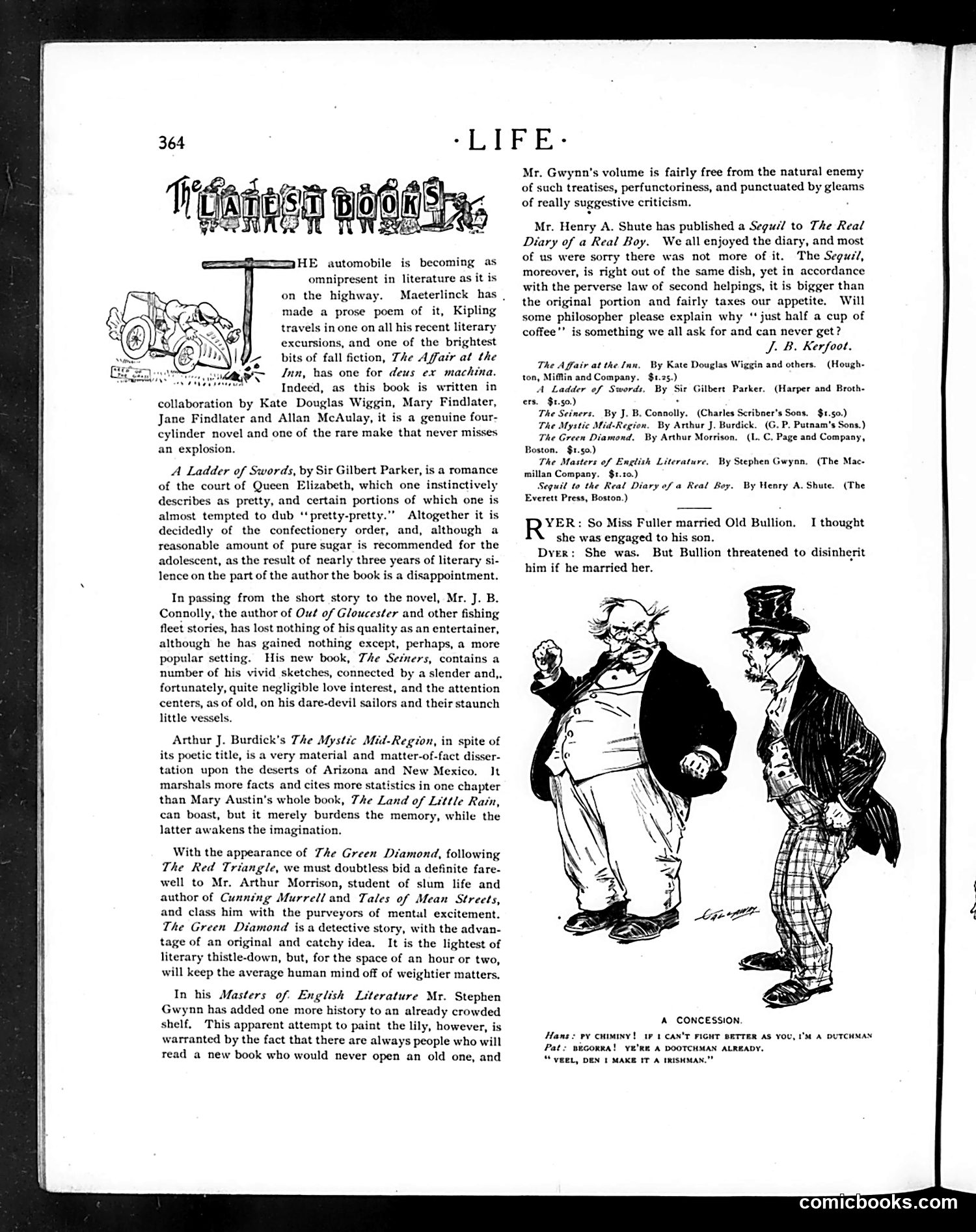
This cartoon satirizes gender relations and marriage negotiations in the early 1900s. The illustration shows three men in formal dress engaged in conversation. Based on the caption dialogue, the scenario depicts a negotiation between a suitor (center) and what appears to be the father or guardian (right) of a prospective bride, while a third man observes. The humor relies on the suitor's desperate assertion that he's "a dutchman" (presumably meaning honest or straightforward) and willing to become a "bootchman already"—suggesting he'll accept any humble role to win the bride. The father's response implies he'll only permit marriage if the suitor accepts being permanently reduced in status. The satire targets the transactional nature of marriage arrangements and the father's patriarchal control over his daughter's prospects, presenting marriage negotiation as literally trading away a man's dignity and independence.
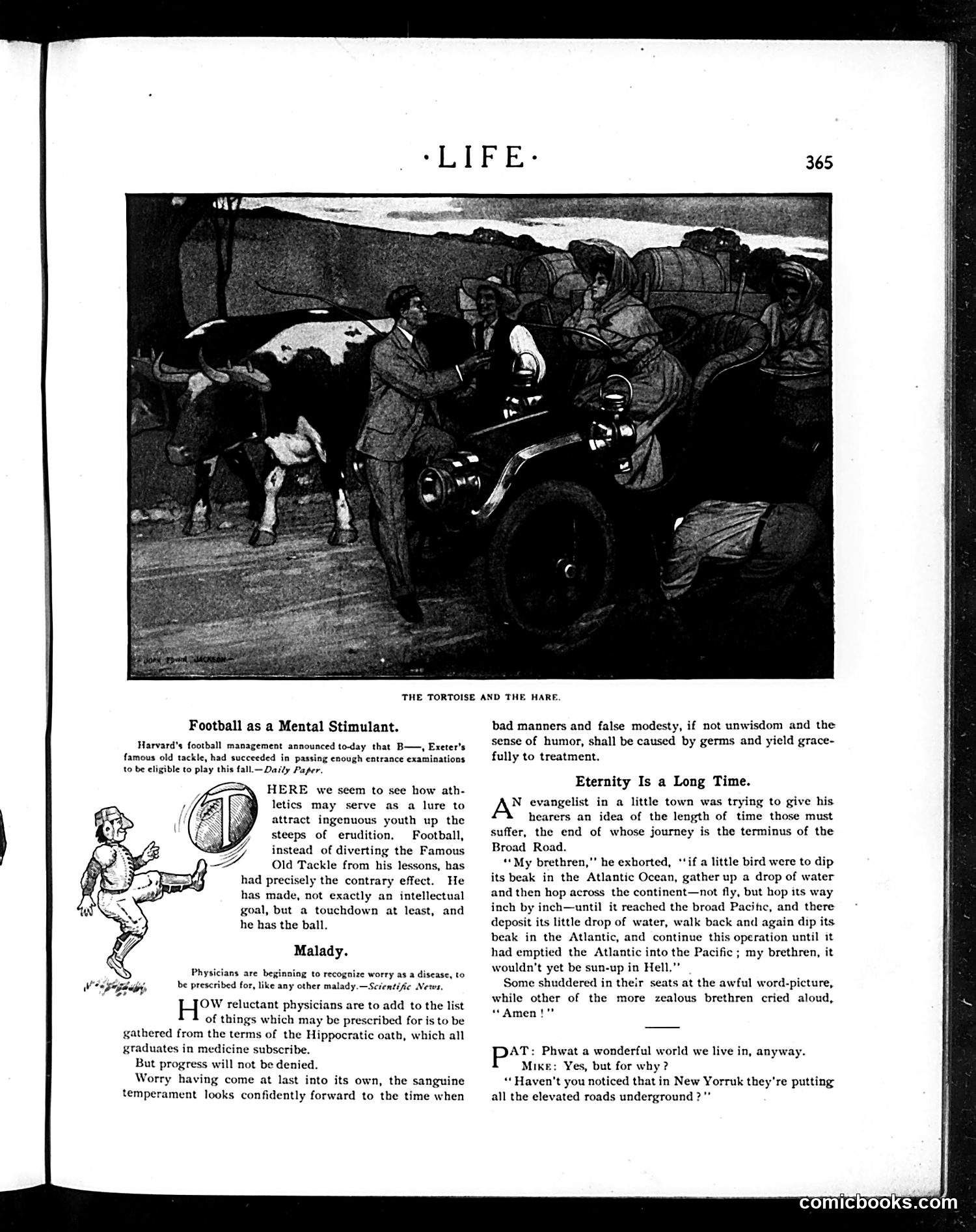
**"The Tortoise and the Hare"** (top illustration): This mocks Harvard's admission of a football player ("B—, Exeter's famous old tackle") who barely passed entrance exams. The satire suggests athletics distracted rather than aided his education—the "touchdown" joke plays on football terminology while questioning whether he actually learned anything. **"Malady"** (middle section): This satirizes the emerging medical tendency to pathologize human behavior. The piece wryly predicts that if "worry" becomes a treatable disease, doctors will soon claim that bad manners, modesty, and poor humor are also caused by germs—mocking the overreach of medical authority. **"Eternity Is a Long Time"** (bottom): A preacher's sermon illustration about hell's duration, using an absurd metaphor of a bird emptying the Atlantic into the Pacific drop-by-drop. The final joke (Pat and Mike dialogue) provides comic relief, contrasting theological horror with mundane New York infrastructure concerns. These are typical Life magazine fare: intellectual humor targeting education, medicine, and religion.
This page from *Life* magazine features several humorous anecdotes and two whiskey advertisements. The cartoons and jokes reflect early 20th-century American social attitudes: **The Content:** - A joke about a husband buying his wife a "dust protector"—a trap to silence her talking (misogynistic humor about chatty wives) - An anecdote about playwright Edmond Rostand being asked his occupation at a French town hall, with officials treating "man of letters" as a legitimate vocation - A newspaper reporter who fails to get an original interview because a scientist already spoke to the *Herald* - A joke about fatalism and economic hardship—a working man resigned to merchants taking his wages - A farmer whose beard became a beehive (humorous Americana) - Commentary on "speed madness" as a modern nervous disease caused by the pace of industrial life **The Satire:** The page satirizes gender relations, bureaucracy, newspaper competition, economic inequality, and anxieties about modernity's effects on health.
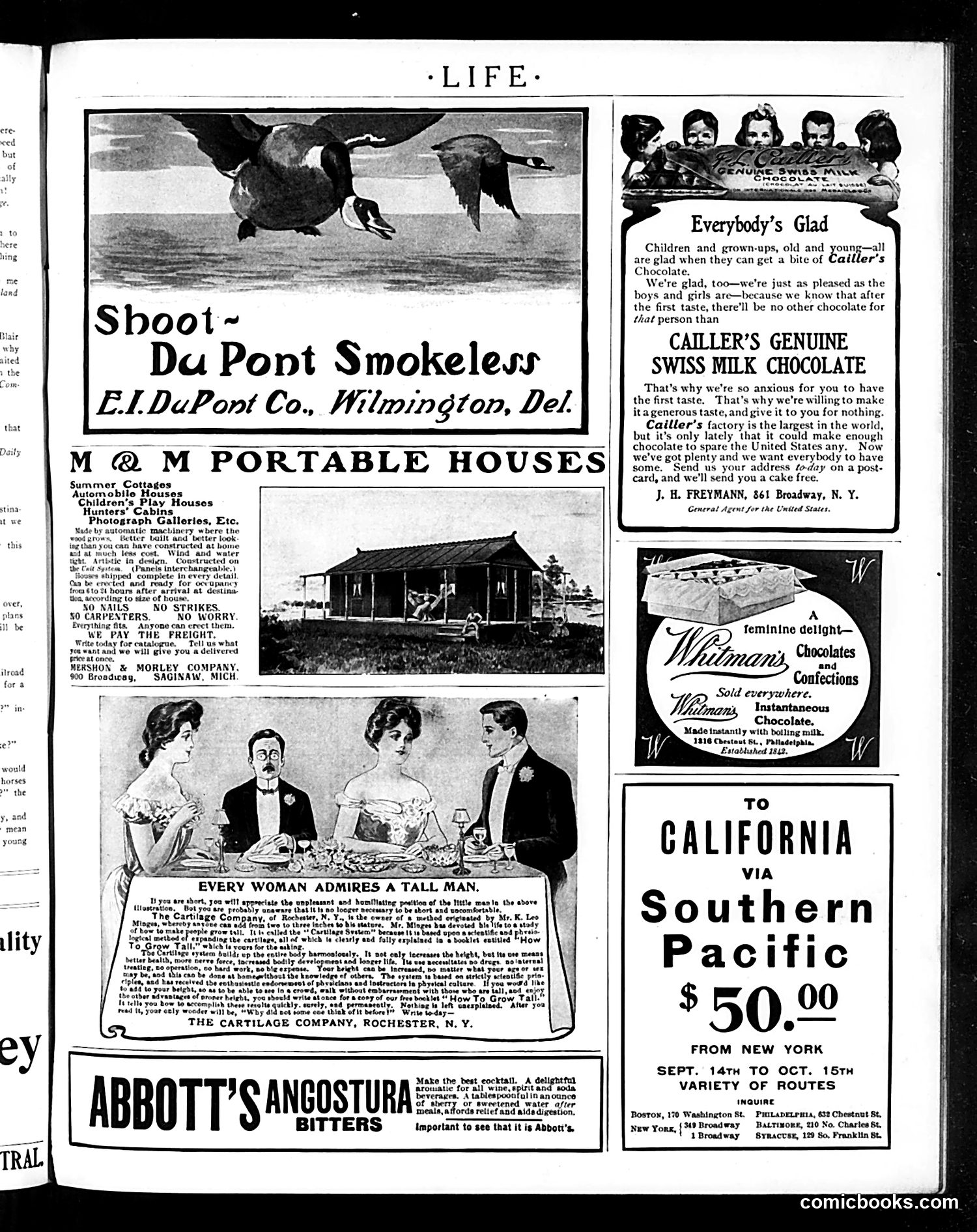
This is primarily an **advertising page** with multiple commercial products and services, not political satire. The notable content includes: **"Every Woman Admires a Tall Man"** — An advertisement for a spinal/posture corrective device by The Cartilage Company (Rochester, N.Y.). It uses pseudo-scientific claims about how poor posture makes men appear shorter and less attractive, promoting their product as a solution. This reflects early 20th-century anxieties about masculinity and physical appearance. **Other advertisements** promote: - Du Pont smokeless gunpowder - Portable prefabricated houses ("M & M Portable Houses") - Cailler's Swiss Milk Chocolate (offering free samples) - Whitman's Chocolates - Abbott's Angostura Bitters - Southern Pacific railroad tickets to California ($50 from New York) The page reflects commercial advertising strategies of the era, emphasizing social insecurity (height/status for men), convenience (prefab homes), and product sampling (free chocolate). There is no political cartoon or satire visible.
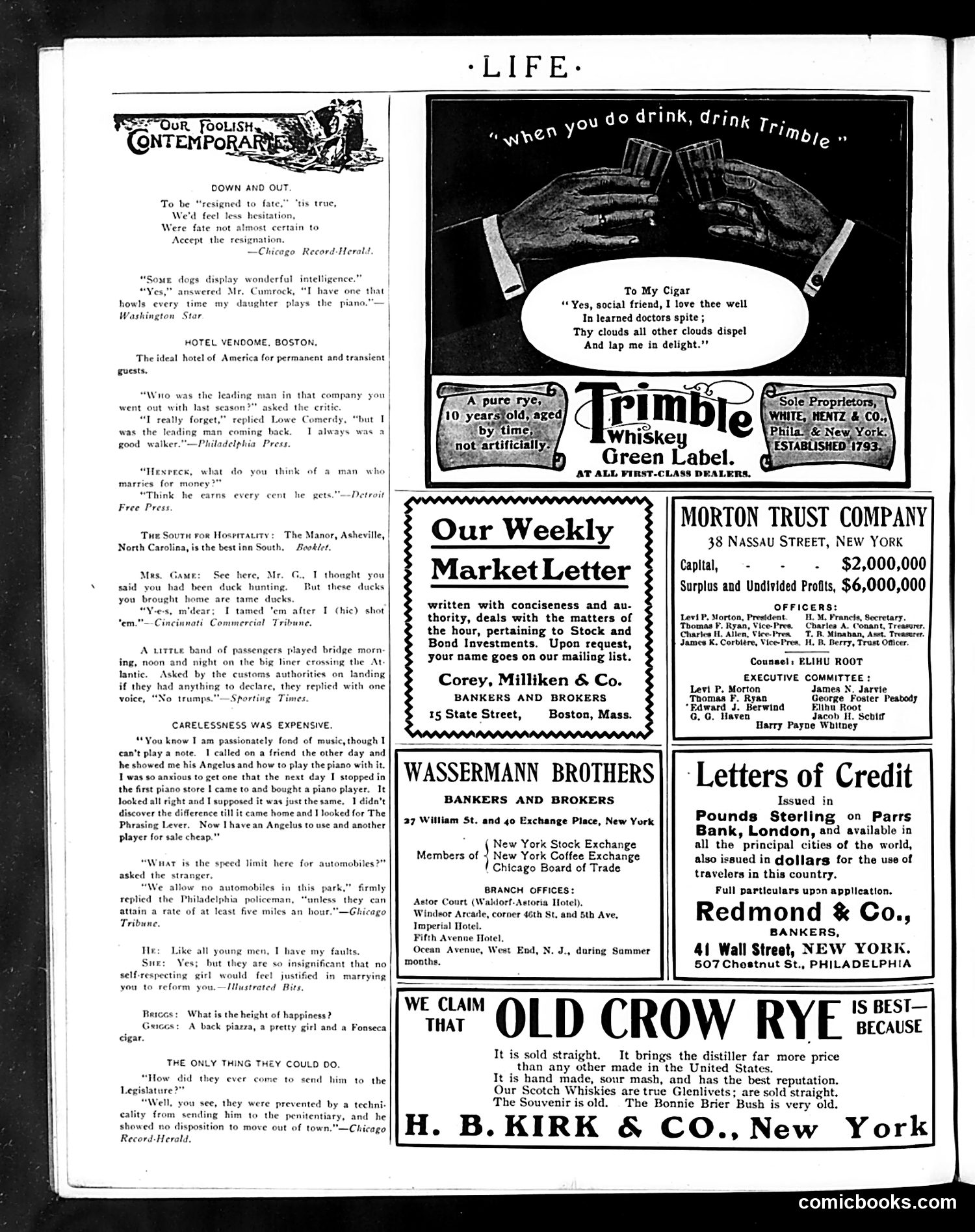
This page from Life magazine is primarily **advertisements and brief humorous anecdotes**, rather than political cartoons. The content reflects early 20th-century American social commentary through short jokes. The humor targets familiar subjects: a woman criticizing her husband's piano-playing daughter, a dog that "howls" at bad music, passengers playing bridge on an ocean liner declaring "No trumps" (a bridge term) to customs officials, and a man who impulsively buys a player piano after seeing an Angelus demonstration. One anecdote satirizes American politics: a man sent to the Legislature because authorities couldn't legally send him to the penitentiary—suggesting political corruption or judicial inadequacy as alternatives to criminal prosecution. The advertisements feature whiskey brands (Trimble, Old Crow Rye), banking/investment services (Morton Trust Company, Wassermann Brothers), and hotels, typical of Life's commercial content from this era. The page lacks identifiable caricatures or specific political figures—instead offering genteel, observational humor about contemporary American society.
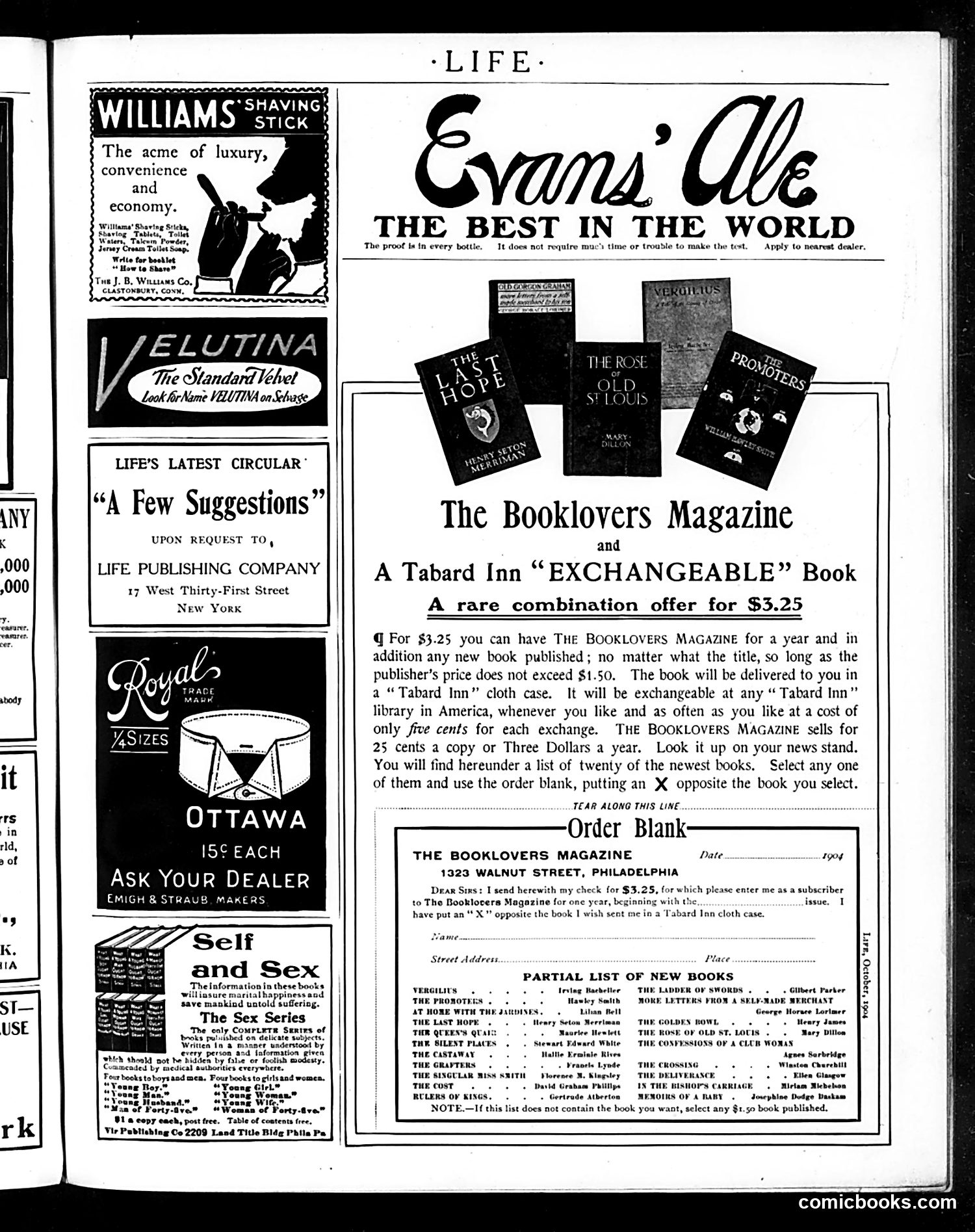
This page is primarily **advertising**, not satire or political commentary. It contains five commercial advertisements typical of early 1900s publications: 1. **Williams' Shaving Stick** — luxury grooming product 2. **Velutina** — a standard velvet product 3. **"Self and Sex" book series** — instructional books on marital relations and sex education, marketed as medically endorsed information for "boys and girls" 4. **Royal Ottawa** — a folding ruler/measuring tool 5. **The Booklovers Magazine** — subscription offer bundling a year's magazine plus exchangeable books for $3.25 The page reflects period attitudes: medical/scientific framing of sexual education (note the claims of doctor endorsement), mass-market publishing expansion, and consumer product proliferation. The "Self and Sex" series' prominent placement suggests such educational materials were considered respectable enough for mainstream magazine advertising, though the discretion of language ("delicate subjects") reflects contemporary Victorian sensibilities about discussing sexuality publicly. No cartoon or satirical content is present.
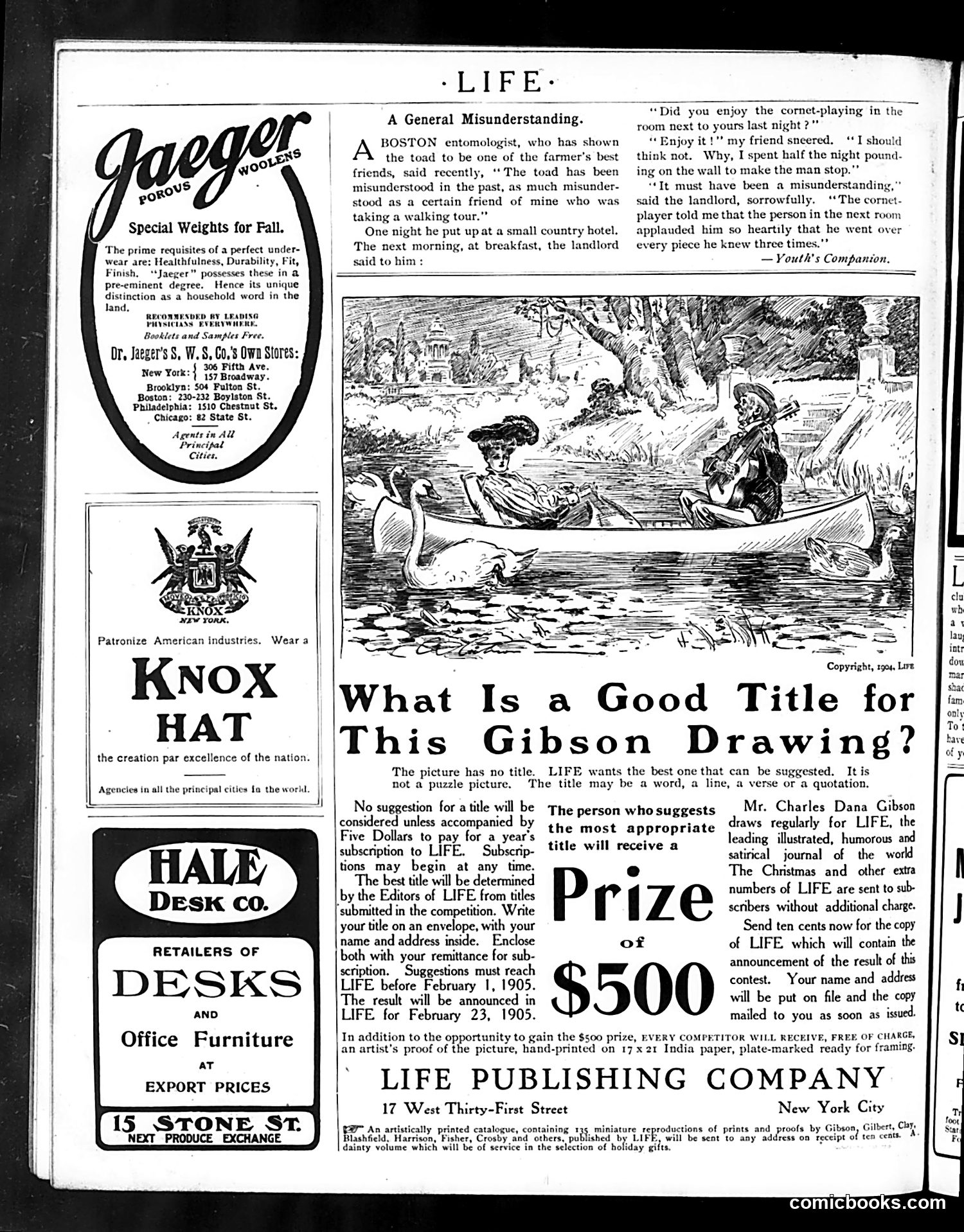
This page is primarily **advertising and a contest announcement** rather than political satire. The main content is a Gibson drawing contest where *Life* magazine invites readers to suggest titles for a Charles Dana Gibson illustration depicting people in a rowboat. The prize is $500 (substantial in 1904). The small anecdote titled "A General Misunderstanding" is a mild joke about miscommunication: a hotel guest pounds on the wall to stop a cornet player's loud practicing at night, but the musician interprets the pounding as enthusiastic applause and plays even more pieces. The surrounding advertisements (Jaeger underwear, Knox hats, Hale Desk Company) represent typical early-1900s print marketing. The "Patronize American Industries" slogan reflects period nationalism. Overall, this is a standard magazine page mixing editorial content with commercial appeals—not satirical commentary.
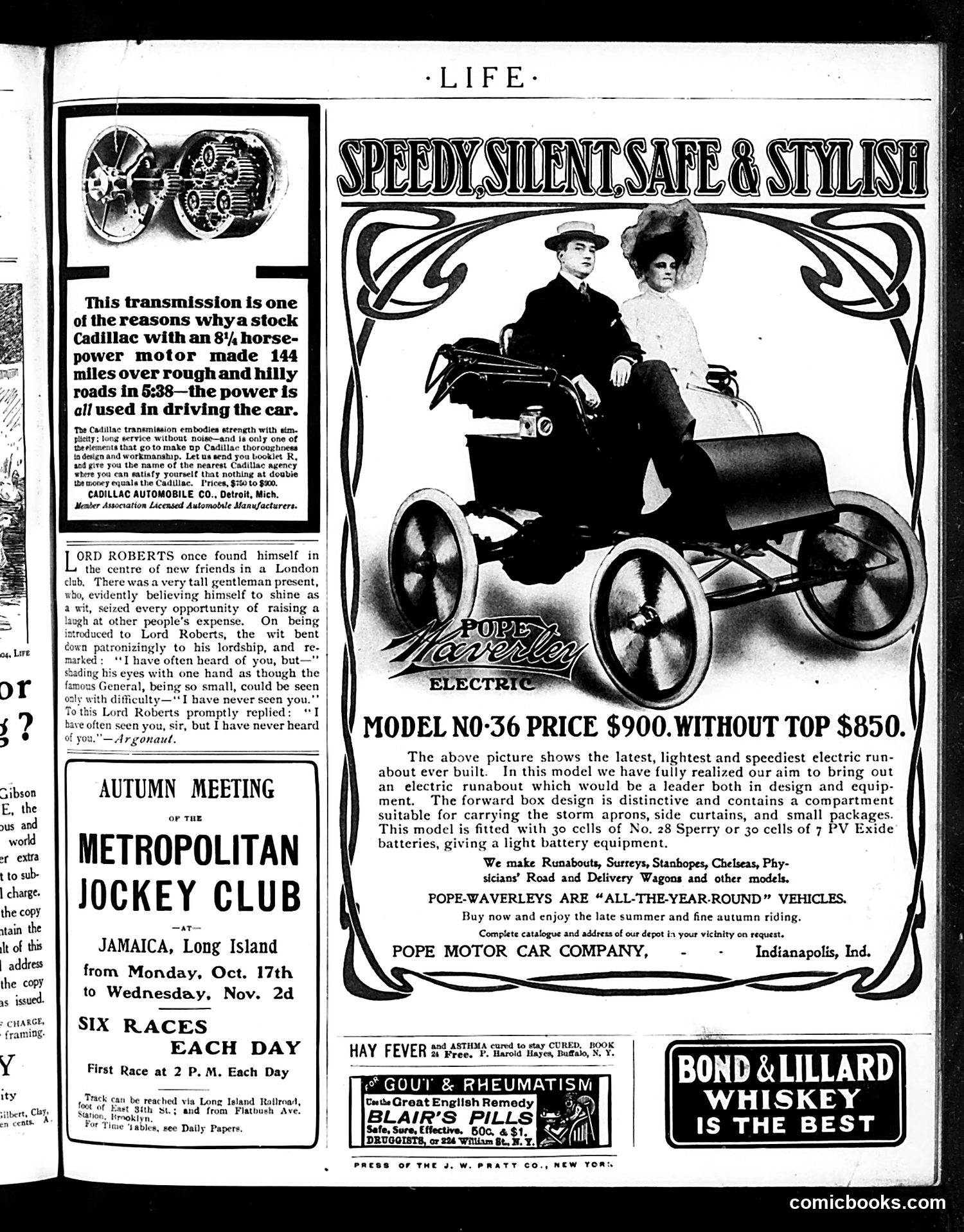
This page is primarily **advertising**, with one brief satirical anecdote. The **Lord Roberts joke** references Frederick Roberts, a famous British military general. The humor lies in a classic wit-battle: a tall gentleman at a London club patronizes the famously short Lord Roberts, remarking he's "never seen" him due to his small stature. Roberts delivers a cutting retort: he's often *seen* the tall man but never *heard* him say anything worthwhile—implying the man is all appearance and no substance. The advertisements showcase early **automobile and electric vehicle technology** (Cadillac, Pope-Waverley electric runabout), reflecting the nascent automotive age. Other ads hawked patent medicines (hay fever cures, gout remedies, whiskey as a "cure") typical of the era's unregulated medical claims. The **Metropolitan Jockey Club races** announcement represents leisure activities for the wealthy. Overall, this page reflects Edwardian-era consumer culture and satirizes pretension.
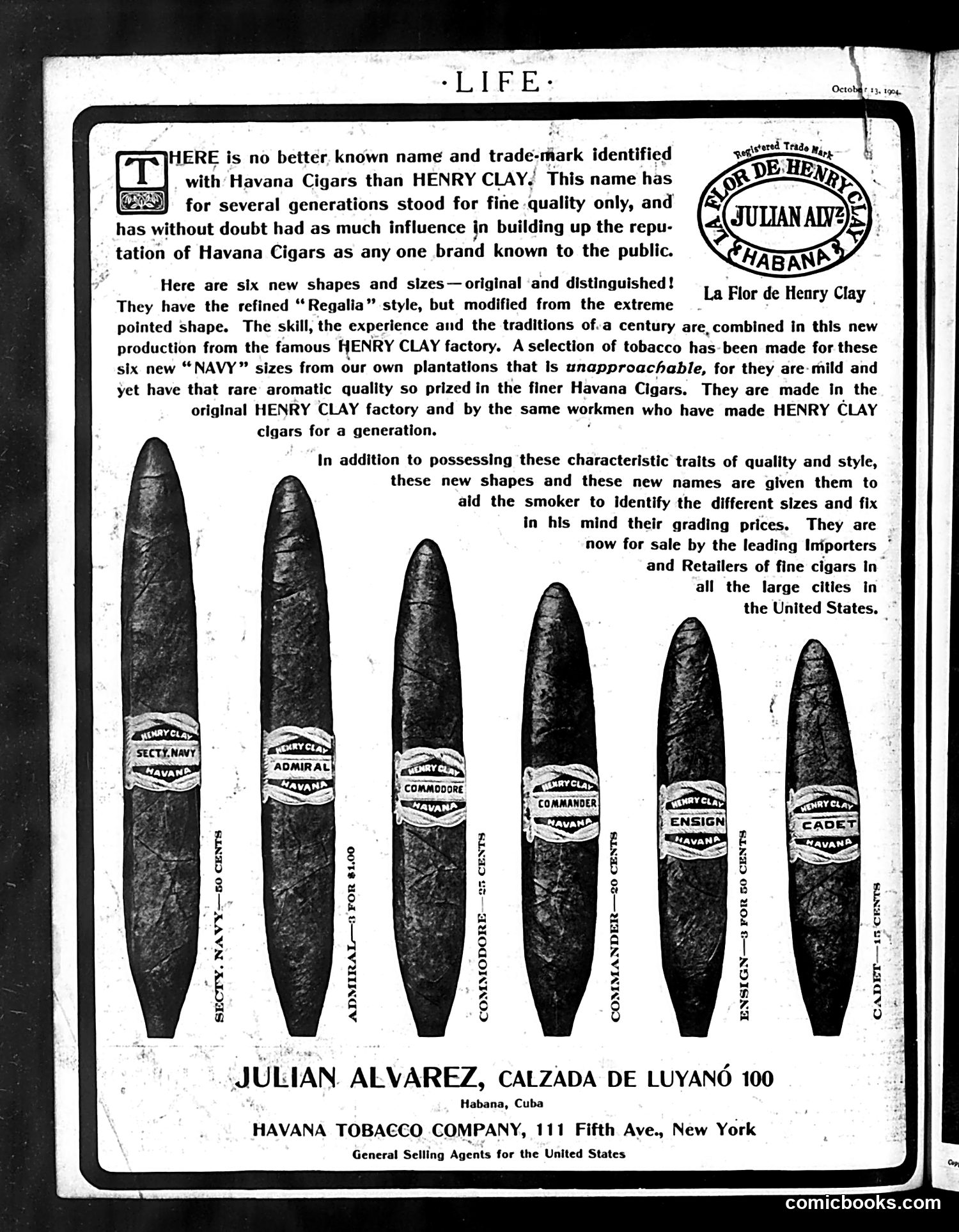
This is **not a cartoon or satirical content**—it's a straightforward **advertisement for Henry Clay cigars** appearing in *Life* magazine (October 13, 1904). The page showcases six new cigar sizes with military-themed names: Secretary Navy, Admiral, Commodore, Commander, Ensign, and Cadet. The naming scheme appears designed to appeal to American nationalism and masculine identity during the early 20th century, when the U.S. Navy was a source of national pride. The ad emphasizes that Henry Clay is an established, prestigious brand associated with Havana cigars for "several generations," positioning it as a quality product. The cigars are manufactured in Havana, Cuba, but sold through New York distributors to major U.S. cities. This represents typical early-1900s luxury tobacco marketing—targeting affluent male consumers through appeals to tradition, quality, naval prestige, and specific pricing tiers for different sizes.