
Life, 1904-10-13 · page 13 of 22
Life — October 13, 1904 — page 13: what you’re looking at
What you’re looking at
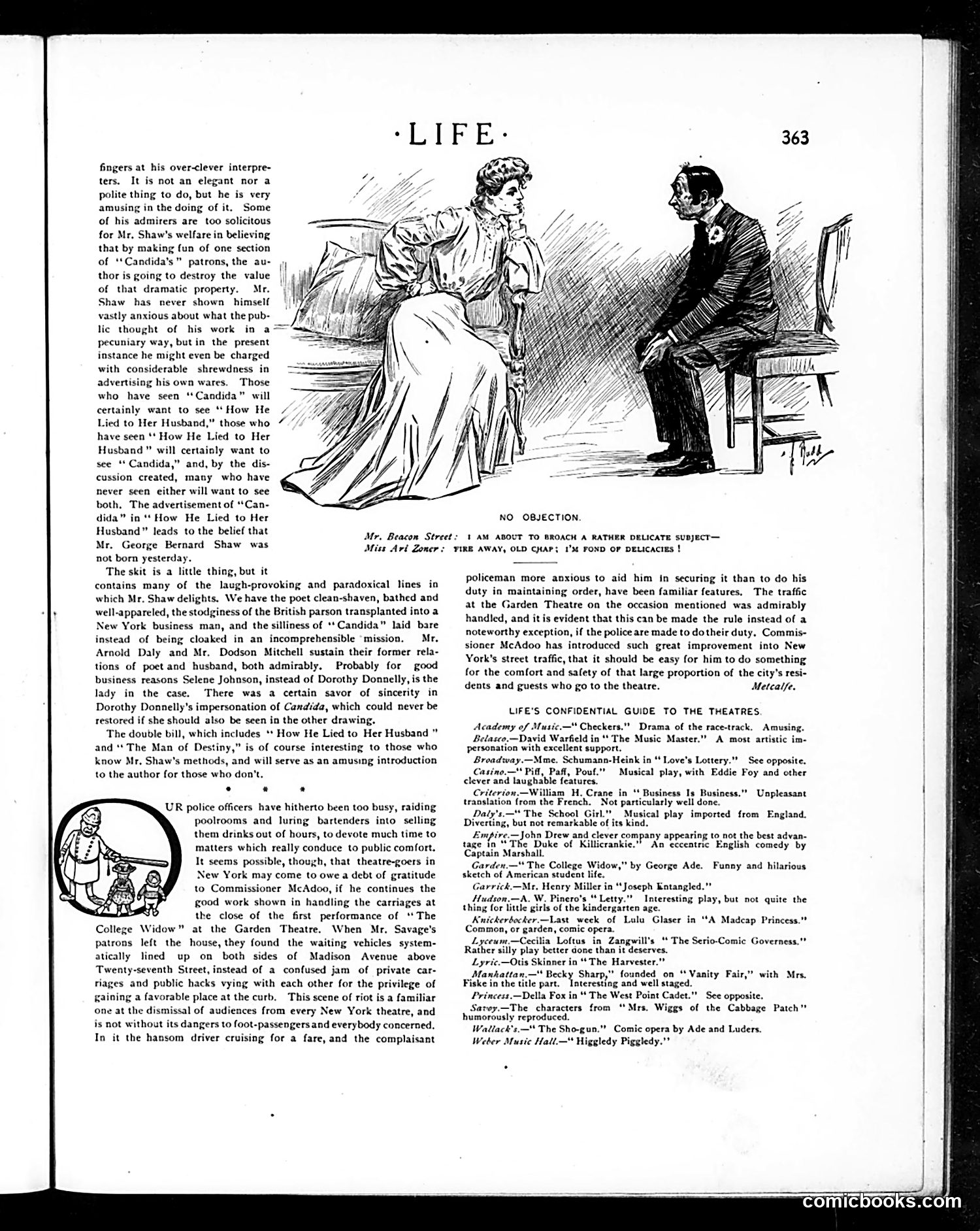
## The Main Cartoon ("No Objection") The sketch depicts two figures in conversation—a well-dressed man seated and a woman in elaborate dress. The caption identifies them as "Mr. Beacon Street" and "Miss Art Zoner." The joke hinges on a double entendre: the man says he wants to discuss "a rather delicate subject" while offering "delicacies," to which the woman replies she has "no objection." The humor relies on the suggestion of impropriety—implying a wealthy gentleman is propositioning a woman of questionable virtue, who eagerly accepts. ## The Text Content The bulk of the page reviews George Bernard Shaw's play *Candida* and its companion piece *How He Lied to Her Husband*, praising Shaw's wit and the production's cast. It also discusses Police Commissioner McAdoo's successful traffic management at theaters, presenting this as a model for public order. **Note:** This is primarily theater criticism with one social-commentary cartoon using period innuendo humor typical of early 1900s Life magazine satire.
📄 Transcribed text from this page (OCR, searchable)
Machine-transcribed from the original scan — historical spelling and the odd misread are preserved.
fingers at his over-clever interpre- ters. It is not an elegant nor a polite thing to do, but he is very amusing in the doing of it, Some of his admirers are too solicitous for Mr, Shaw's welfare in believing that by making fun of one section of ‘Candida’s" patrons, the au- thor is going to destroy the value of that dramatic property. Mr. Shaw has never shown himself vastly anxious about what the pub- lic thought of his work in a pecuniary way, but in the present instance he might even be charged with considerable shrewdness in advertising his own wares. Those who have seen “Candida” will certainly want to see “ How He Lied to Her Husband,” those who have seen ** How He Lied to Her Husband ” will certainly want to sce “ Candida,” and, by the dis- cussion created, many who have never seen either will want to see both, The advertisement of *Can- dida” in * How He Lied to Her Husband” leads to the belief that Mr. George Bernard Shaw was not born yesterday. The skit is a little thing, but it contains many of the laugh-provoking and paradoxical lines in which Mr. Shaw delights. We have the poet clean-shaven, bathed and well-appareled, the stodginess of the British parson transplanted into a New York business man, and the silliness of ** Candida” laid bare instead of being cloaked in an incomprehensible ‘mission. Mr. Arnold Daly and Mr. Dodson Mitchell sustain their former rela- tions of poet and husband, both admirably. Probably for good business reasons Selene Johnson, instead of Dorothy Donnelly, is the lady in the case, There was a certain savor of sincerity in Dorothy Donnelly’s impersonation of Candida, which could never be restored if she should also be seen in the other drawing. The double bill, which includes * How He Lied to Her Husband " and‘ The Man of Destiny,” is of course interesting to those who know Mr, Shaw's methods, and will serve as an amusing introduction to the author for those who don't. . * * UR police officers have hitherto been too busy, raiding poolrooms and luring bartenders into selling them drinks out of hours, to devote much time to matters which really conduce to public comfort. It seems possible, though, that theatre-goers in New York may come to owe a debt of gratitude to Commissioner McAdoo, if he continues the good work shown in handling the carriages at the close of the first performance of * The College Widow” at the Garden Theatre. When Mr. Savage's patrons left the house, they found the waiting vehicles system- atically lined up on both sides of Madison Avenue above Twenty-seventh Street, instead of a confused jam of private car- riages and public hacks vying with each other for the privilege of gaining a favorable place at the curb, This scene of riot is a familiar one at the dismissal of audiences from every New York theatre, and is not without its dangers to foot-passengers and everybody concerned, In it the hansom driver cruising for a fare,and the complaisant Mr. Beacon Street: Miss Art Zoner; YiRE AWAY, OLD CHAP; I'M POND OF DELICACIES ! NO OBJECTION. 1 AM ABOUT TO BROACH A RATHER DELICATE SUBJECT— policeman more anxious to aid him in securing it than to do his duty in maintaining order, have been familiar features. The traffic at the Garden Theatre on the occasion mentioned was admirably handled, and it is evident that this can be made the rule instead of a noteworthy exception, if the police are made to do their duty, Commis- sioner McAdoo has introduced such great improvement into New York's street traffic, that it should be easy for him to do something for the comfort and safety of that large proportion of the city’s resi- dents and guests who go to the theatre. Metcalfe. LIFE'S CONFIDENTIAL GUIDE TO THE THEATRES, Academy of Music.—* Checkers.” Drama of the race-track. Amusing. Belasco.—David Warfield in“ The Music Master.” A most artistic im- personation with excellent support. Broadway.—Mme. Schumann-Heink in ‘* Love's Lottery.” See opposite. Casino." Piff, Paff, Pouf."” Musical play, with Eddie Foy and other clever and laughable features. Criterion —William H. Crane in “ Business Is Business.” translation from the French. Not particularly well done. Daly's.—"" The School Gir sical play imported from England. Diverting, but not remarkable of its kind. Empire —John Drew and clever company appearing to not the best advan- tage In “The Duke of Killicrankie.” An eccentric English comedy by Captain Marshall. Garden.—* The College Widow," by George Ade. sketch of American student life. Garrick.—Mr, Henry Miller in “Joseph Katangled.”* Hudson.—A. W. Pinero's “ Letty.” Interesting play, but not quite the thing for little girls of the kindergarten age. Knickerbocker —Last_ week of Lulu Glaser in “A Madcap Princess.” Common, or garden, comic opera. Lyceum —Cecilia Loftus in Zangwill’s Rather silly play better done than it deserves. Lyric. —Otis Skinner in “The Harvester.” Manhattan.—" Becky Sharp," founded on “Vanity Fair,” with Mrs. Fiske in the title part, Interestiog and well staged. Princess.—Della Fox in “ The West Point Cadet." See opposite, Satoy.—The characters from “Mrs. Wiggs of the Cabbage Patch”? humorously reproduced. Watlack's.—" The Sho-gun."” Comic opera by Ade and Luders. Weber Music Hall.— Higgledy Piggledy.”” Unpleasant Funny and hilarious ‘The Serio-Comic Governess."*