
Life, 1904-10-13 · page 12 of 22
Life — October 13, 1904 — page 12: what you’re looking at
What you’re looking at
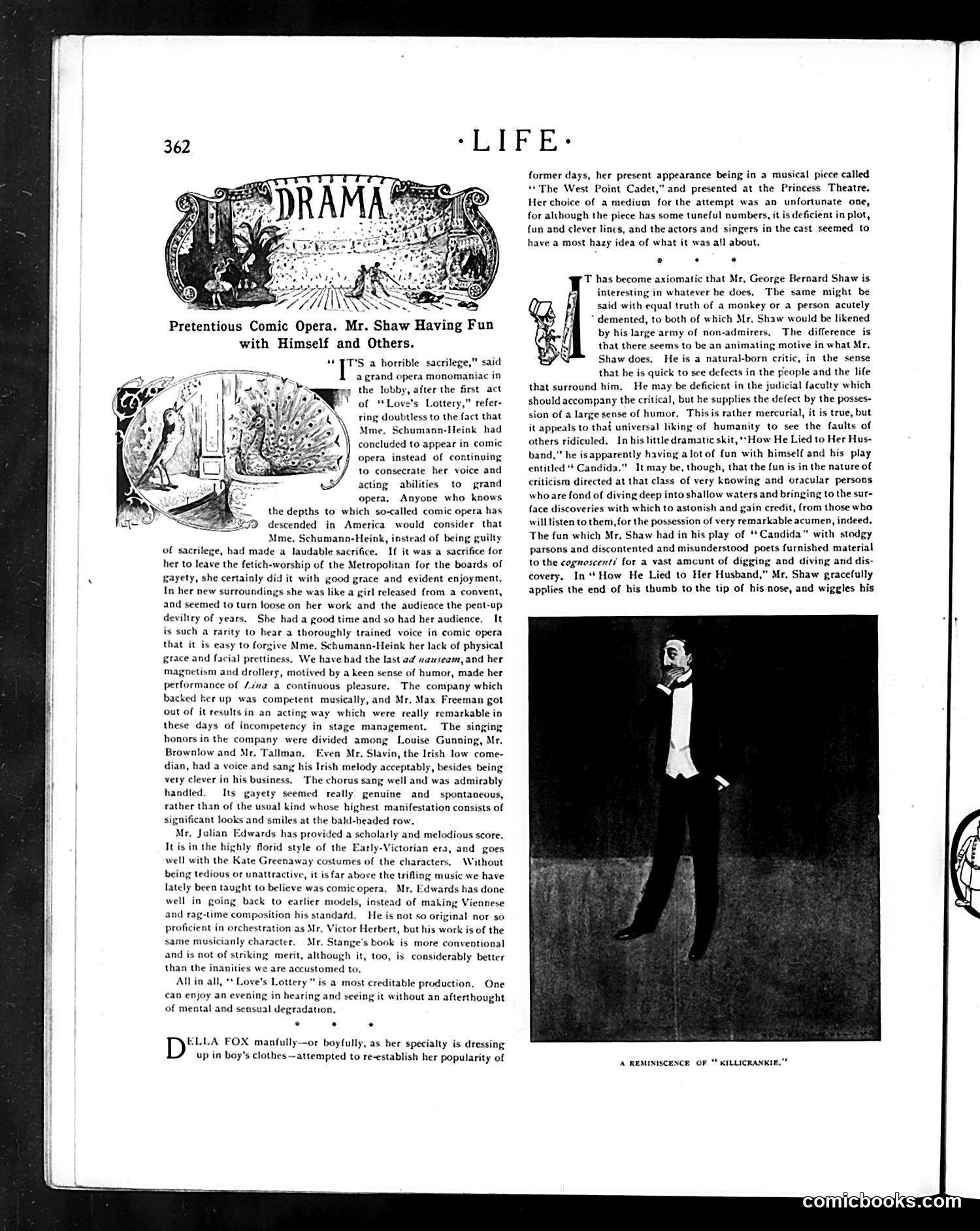
This page reviews theatrical productions, specifically comic operas. The main heading criticizes "Mr. Shaw Having Fun with Himself and Others," likely referring to George Bernard Shaw's involvement in theater criticism and production. The article discusses Mme. Schumann-Heinck's performance in comic opera, noting she left the Metropolitan Opera to perform in lighter works. The text critiques both her artistic choices and the state of American comic opera generally. The photograph labeled "A Reminiscence of 'Killicranckie'" shows a performer in theatrical costume, apparently demonstrating the physical comedy involved in comic opera performance. The review expresses skepticism about pretentious comic opera while acknowledging genuine entertainment value when executed competently. The page represents *Life*'s satirical commentary on contemporary American theater and its performers.
📄 Transcribed text from this page (OCR, searchable)
Machine-transcribed from the original scan — historical spelling and the odd misread are preserved.
‘LIFE: Pretentious Comic Opera. Mr. Shaw Having Fun with Himself and Others. “JT'S a horrible sacrilege,” said a grand opera monomaniac in the lobby, after the first act of “Love's Lottery,” refer- ring doubtless to the fact that Mme, Schumann-Heink had concluded to appear in comic opera instead of continuing to consecrate her voice and acting abilities to grand opera, Anyone who knows the depths to which so-called comic opera has descended in America would consider that Mme. Schumana-Heink, instead of being guilty of sacrilege, had made a laudable sacrifice. If it was a sacrifice for her to leave the fetich-worship of the Metropolitan for the boards of gayety, she certainly did it with good grace and evident enjoyment. In her new surroundings she was like a girl released {rom a convent, and seemed to turn loose on her work and the audience the pent-up deviltry of years. She had a good time and so had her audience. It is such a rarity to hear a thoroughly trained voice in comic opera that it is easy to forgive Mme, Schumann-Heink her lack of physical grace and facial prettiness. We have bad the last ad nauseam, and her magnetism and drollers, motived by a keen sense of humor, made her performance of /ina a continuous pleasure. The company which backed her up was competent musically, and Mr, Max Freeman got out of it results in an acting way which were really remarkable in these days of incompetency in stage management. The singing honors in the company were divided among Louise Gunning, Mr. Brownlow and Mr. Tallman, Even Mr, Slavin, the Irish low come- dian, had a voice and sang his Irish melody acceptably, besides being very clever in his business. The chorus sang well and was admirably handled. Its_gayety seemed really genuine and spontaneous, rather than of the usual kind whose highest manifestation consists of significant looks and smiles at the bald-headed row. Mr. Julian Edwards has provided a scholarly and melodious score. It isin the highly florid style of the Early-Victorian era, and goes well with the Kate Greenaway costumes of the characters. Without being tedious or unattractive, it isfar above the trifling music we have lately been taught to believe was comic opera, Mr. Edwards has done well in going back to earlier models, instead of making Viennese and rag-time composition his standafd. He is not so original nor so proficient in orchestration as Mr. Victor Herbert, but his work is of the same musicianly character. Mr. Stange’s book is more conventional and is not of striking merit, although it, too, is considerably better than the inanities we are accustomed to. Allin all, * Love's Lottery” is a most creditable production. One can enjoy an evening in hearing and seeing it without an afterthought of mental and sensual degradation. . . . ELLA FOX manfully—or boyfully, as her specialty is dressing up in boy’s clothes —attempted to re-establish her popularity of former days, her present appearance being in a musical piece called “<The West Point Cadet,” and presented at the Princess Theatre. Her choice of a medium for the attempt was an unfortunate one, for although the piece has some tuneful numbers, it is deficient in plot, fun and clever lincs, and the actors and singers in the cast seemed to have a most hazy idea of what it was all about, T has become axiomatic that Mr, George Bernard Shaw is interesting in whatever he does, The same might be said with equal truth of a monkey or a person acutely * demented, to both of which Mr, Shaw would be likened by his large army of non-admirers, The difference is that there seems to be an animating motive in what Mr, Shaw does, He is a natural-born critic, in the sense that he is quick to sce defects in the people and the life that surround him, He may be deficient in the judicial faculty which should accompany the critical, but he supplies the defect by the posses- sion of a large sense of humor. Thisis rather mercurial, it is true, but it appeals to that universal liking of humanity to see the faults of others ridiculed. In his little dramatic skit, “How He Lied to Her Hus- band,” he is apparently having alot of fun with himself and his play entitled“ Candida.” It may be, though, that the fun is in the nature of criticism directed at that class of very knowing and oracular persons who are fond of diving deep into shallow waters and bringing to the sur- face discoveries with which to astonish and gain credit, from those who will listen to them, for the possession of very remarkable acumen, indeed. The fun which Mr, Shaw had in his play of “Candida” with stodgy parsons and discontented and misunderstood poets furnished material to the cognoscenti for a vast amcunt of digging and diving and dis- covery. In “How He Lied to Her Husband,” Mr. Shaw gracefully applies the end of his thumb to the tip of his nose, and wiggles his A REMINISCENCE OF * KILLICRANKIE,"”