
Life, 1904-10-13 · page 4 of 22
Life — October 13, 1904 — page 4: what you’re looking at
What you’re looking at
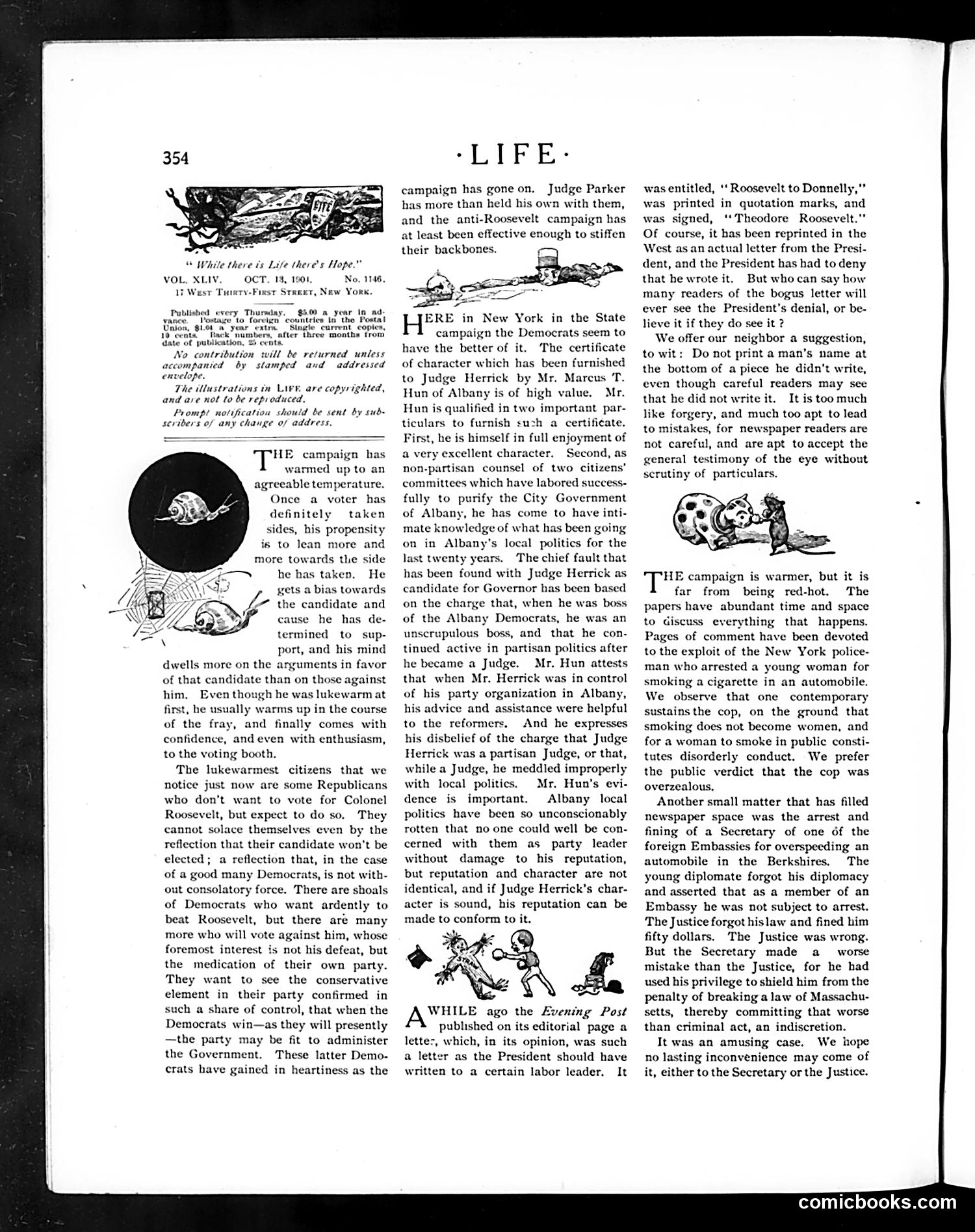
This page discusses the 1904 presidential campaign, focusing on Judge Herrick as a New York gubernatorial candidate. The text defends Herrick's character against Democratic attacks, arguing his reputation is sound despite claims he was a "partisan boss" with Albany political ties. The cartoons (small illustrations with playing children and figures) appear to satirize campaign mudslinging—though their exact meaning is unclear without clearer visibility. The page critiques both parties' campaign tactics, particularly criticizing Democratic attacks on Herrick while also mocking a young diplomat's diplomatic immunity controversy. The overall tone suggests Life magazine viewed the 1904 campaign as increasingly bitter and character-focused rather than issue-based.
📄 Transcribed text from this page (OCR, searchable)
Machine-transcribed from the original scan — historical spelling and the odd misread are preserved.
“ While there is Life there's Hope.” VOL. XLIV. OCT. 13, 1901. No. 1146, 17 West Tutery-Fixst Street, New York. Published every Thurwl 3.09 a year in ad. i $. auge to forvign counteies in the Postat Slagle current. copies, ‘after three months trom 8 No contribution accompanied by envelope. The illustrations tn Lik, are copyrighted, and are not to be reproduced, Prompt notification should be sent by sub- scribers of any change of address. will be returned unless stamped and addressed HE campaign bas warmed up to an agreeable temperature. Once a voter has definitely taken sides, his propensity to lean more and more towards the side he has taken, He gets a bias towards “ the candidate and cause he has de- termined to sup- port, and his mind dwells more on the arguments in favor of that candidate than on those against him. Even though he was lukewarm at first, he usually warms up in the course of the fray, and finally comes with confidence, and even with enthusiasm, to the voting booth. The lukewarmest citizens that we notice just now are some Republicans who don’t want to vote for Colonel Roosevelt, but expect to do so, They cannot solace themselves even by the reflection that their candidate won't be elected ; a reflection that, in the case of a good many Democrats, is not with- out consolatory force. There are shoals of Democrats who want ardently to beat Roosevelt, but there are many more who will vote against him, whose foremost interest is not his defeat, but the medication of their own party. They want to see the conservative element in their party confirmed in such a share of control, that when the Democrats win—as they will presently —the party may be fit to administer the Government. These latter Demo- crats have gained in heartiness as the -LIFE- campaign has gone on, Judge Parker has more than held his own with them, and the anti-Roosevelt campaign has at least been effective enough to stiffen their backbone: in New York in the State campaign the Democrats seem to have the better of it. The certificate of character which has been furnished to Judge Herrick by Mr. Marcus ‘T. Hun of Albany is of high value. Mr. Hun is qualified in two important par- ticulars to furnish such a certificate. First, he is himself in full enjoyment of excellent character. Second, as san counsel of two citizens’ committees which have labored succes fully to purify the City Government of Albany, he has come to have inti- mate knowledge of what has been going on in Albany's local politics for the last twenty years. The chief fault that has been found with Judge Herrick as candidate for Governor has been based on the charge that, when he was boss of the Albany Democrats, he was an unscrupulous boss, and that he con- tinued active in partisan politics after he became a Judge. Mr. Hun attes that when Mr. Herrick was in control of his party organization in Albany, his advice and assistance were helpful to the reformers, And he expresses his disbelief of the charge that Judge Herrick was a partisan Judge, or that, while a Judge, he meddled improperly with local politics. Mr, Hun’s evi- dence is important, Albany local politics have been so unconscionably rotten that no one could well be con- cerned with them as party leader without damage to his reputation, but reputation and character are not identical, and if Judge Herrick’s char- acter is sound, his reputation can be made to conform to it. sy WHILE ago the Evening Post published on its editorial page a lette>, which, its opinion, was such a letter as the President should have written to a certain labor leader. It was entitled, ‘‘ Roosevelt to Donnelly,” was printed in quotation marks, and was signed, ‘Theodore Roosevelt.”" Of course, it has been reprinted in the West as an actual letter from the Presi- dent, and the President has had to deny that he wrote it. But who can say how many readers of the bogus letter will ever see the President's denial, or be- lieve it if they do see it ? We offer our neighbor a suggestion, to wit: Do not print a man’s name at the bottom of a piece he didn’t write, even though careful readers may see that he did not write it. It is too much like forgery, and much too apt to lead to mistakes, for newspaper readers are not careful, and are apt to accept the general testimony of the eye without scrutiny of particulars. pes campaign is warmer, but it is far from being red-hot. The papers have abundant time and space to discuss everything that happens. Pages of comment have been devoted to the exploit of the New York police- man who arrested a young woman for smoking a cigarette in an automobile. We observe that one contemporary sustains the cop, on the ground that smoking docs not become women, and for a woman to smoke in public consti- tutes disorderly conduct. We prefer the public verdict that the cop was overzealous, Another small matter that has filled newspaper space was the arrest and fining of a Secretary of one of the foreign Embassies for overspeeding an automobile in the Berkshires. The young diplomate forgot his diplomacy and asserted that as a member of an Embassy he was not subject to arrest. The Justice forgot hislaw and fined him fifty dollars. The Justice was wrong. But the Secretary made a_ wo mistake than the Justice, for he had used his privilege to shield him from the penalty of breaking a law of Massachu- setts, thereby committing that worse than criminal act, an indiscretion. It was an amusing case. We hope no lasting inconvenience may come of it, either to the Secretary or the Justice. comicbooks.com