
Life, 1904-10-13 · page 14 of 22
Life — October 13, 1904 — page 14: what you’re looking at
What you’re looking at
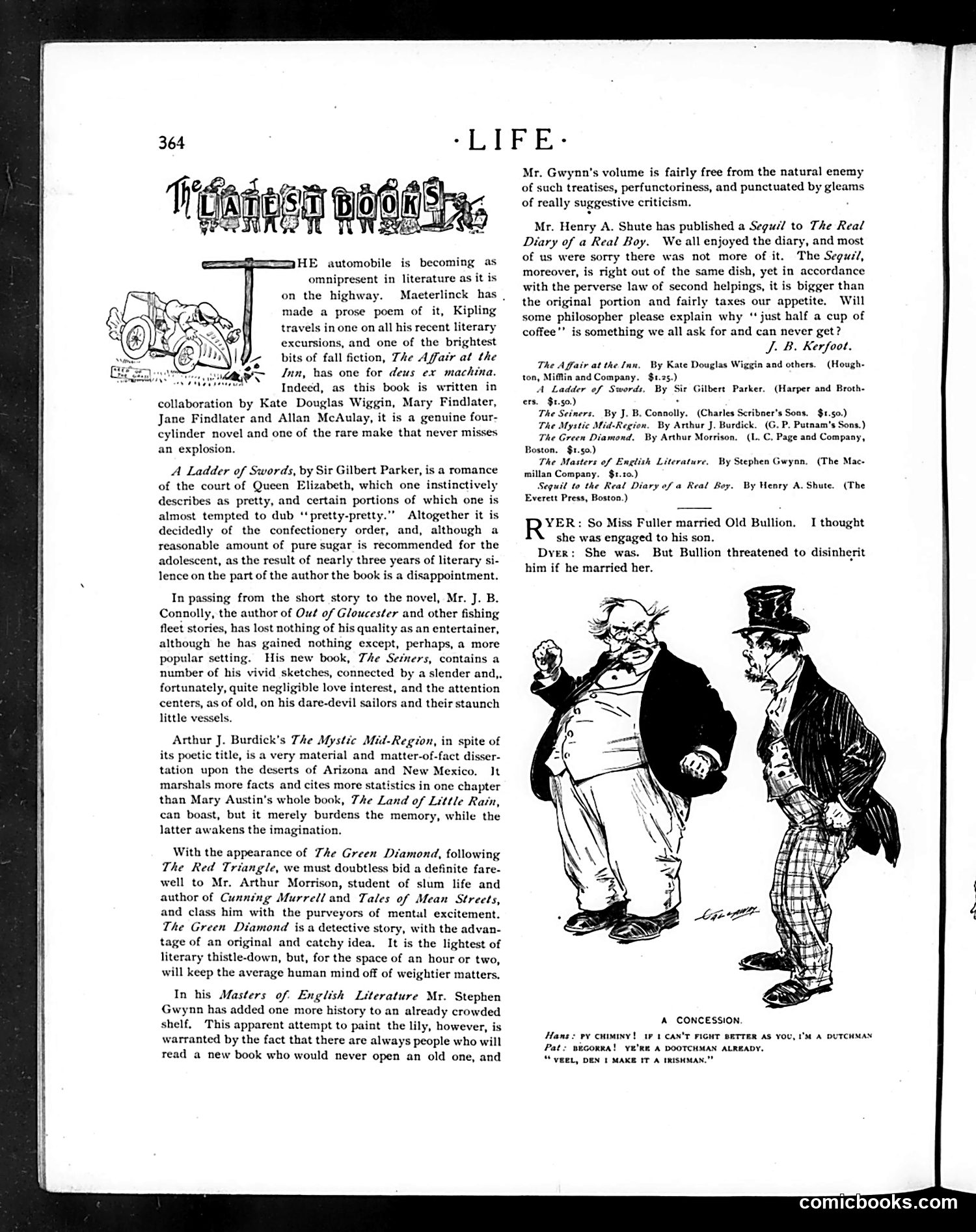
This cartoon satirizes gender relations and marriage negotiations in the early 1900s. The illustration shows three men in formal dress engaged in conversation. Based on the caption dialogue, the scenario depicts a negotiation between a suitor (center) and what appears to be the father or guardian (right) of a prospective bride, while a third man observes. The humor relies on the suitor's desperate assertion that he's "a dutchman" (presumably meaning honest or straightforward) and willing to become a "bootchman already"—suggesting he'll accept any humble role to win the bride. The father's response implies he'll only permit marriage if the suitor accepts being permanently reduced in status. The satire targets the transactional nature of marriage arrangements and the father's patriarchal control over his daughter's prospects, presenting marriage negotiation as literally trading away a man's dignity and independence.
📄 Transcribed text from this page (OCR, searchable)
Machine-transcribed from the original scan — historical spelling and the odd misread are preserved.
‘LTP BE» HE automobile is becoming as omnipresent in literature as it is on the highway. made a prose poem of it, Kipling travels in one on all his recent literary excursions, and one of the brightest bits of fall fiction, The Affair at the Jnn, bas one for deus ex machina. Indeed, as this book is written in collaboration by Kate Douglas Wiggin, Mary Findlater, Jane Findlater and Allan McAulay, it is a genuine four- cylinder novel and one of the rare make that never misses an explosion. A Ladder of Swords, by Sir Gilbert Parker, is a romance of the court of Queen Elizabeth, which one instinctively describes as pretty, and certain portions of which one almost tempted to dub ‘‘pretty-pretty.”” Altogether it is decidedly of the confectionery order, and, although a reasonable amount of pure sugar is recommended for the adolescent, as the result of nearly three years of literary si- lence on the part of the author the book is a disappointment. In passing from the short story to the novel, Mr. J. B. Connolly, the author of Out of Gloucester and other fishing fleet stories, has lost nothing of his quality as an entertainer, although he has gained nothing except, perhaps, a more popular setting. His new book, The Setners, contains a number of his vivid sketches, connected by a slender and,, fortunately, quite negligible love interest, and the attention of old, on his dare-devil sailors and their staunch little vessels. Arthur J. Burdick’s The Mystic Mid-Region, in spite of its poetic title, is a very material and matter-of-fact disser- tation upon the deserts of Arizona and New } marshals more facts and cites more statistics in one chapter than Mary Austin’s whole book, The Land of Little Rain, can boast, but it merely burdens the memory, while the latter awakens the imagination. With the appearance of The Green Diamond, following The Red Triangle, we must doubtless bid a definite fare- well to Mr. Arthur Morrison, student of slum life and author of Cunning Murrell and Tales of Mean Streets, and class him with the purveyors of mental excitement. The Green Diamond is a detective story, with the advan- tage of an original and catchy idea, It is the lightest of literary thistle-down, but, for the space of an hour or two, will keep the average human mind off of weightier matters. In his Masters of. English Literature Mr. Stephen Gwynn has added one more history to an already crowded shelf, This apparent attempt to paint the lily, however, is warranted by the fact that there are always people who will read a new book who would never open an old one, and Maeterlinck has , Mr. Gwynn's volume is fairly free from the natural enemy of such treatises, perfunctoriness, and punctuated by gleams of really suggestive criticism. Mr. Henry A. Shute has published a Segui? to The Real Diary of a Real Boy. We all enjoyed the diary, and most of us were sorry there was not more of it. The Seguil, moreover, is right out of the same dish, yet in accordance with the perverse law of second helpings, it is bigger than the original portion and fairly taxes our appetite. Will some philosopher please explain why “just half a cup of coffee’’ is something we all ask for and can never get? J. B. Kerfoot. The Affair at the Inn, By Kate Douglas Wiggin and others. (Hough- ton, MiMin and Company. $1.25.) A Ladder of Swords, By Sit Gilbert Parker. (Harper and Broth- ers. $1.50.) : The Seiners. By J. B. Connolly. (Charles Scribner's Sons. $1.50.) The Mystic Mid-Region. By Arthur J. Burdick. (G. P. Putnam's Sons.) The Green Diamond. By Arthur Morrison. (L. C, Page and Company, Boston. $1.50.) The Masters of English Literature, By Stephen Gwyon, (The Mac- millan Company. $1.10.) Seguit to the Real Diary of a Real Boy. By Wenty A. Shute. (The Everett Press, Boston.) YER: So Miss Fuller married Old Bullion. she was engaged to his son. Dyer: She was. him if he married her. I thought But Bullion threatened to disinherit A CONCESSION. Hans: Py CMIMINY! IF t CAN'T FIGHT BETTER AS YOU, I'M A DUTCHMAN Pat: BkGORRA! YE'RE A DOOTCHMAN ALREADY. “VEEL, DEN I MAKE IT A IRISHMAN”? comicbooks.com