
A complete issue · 20 pages · 1904
Life — August 11, 1904
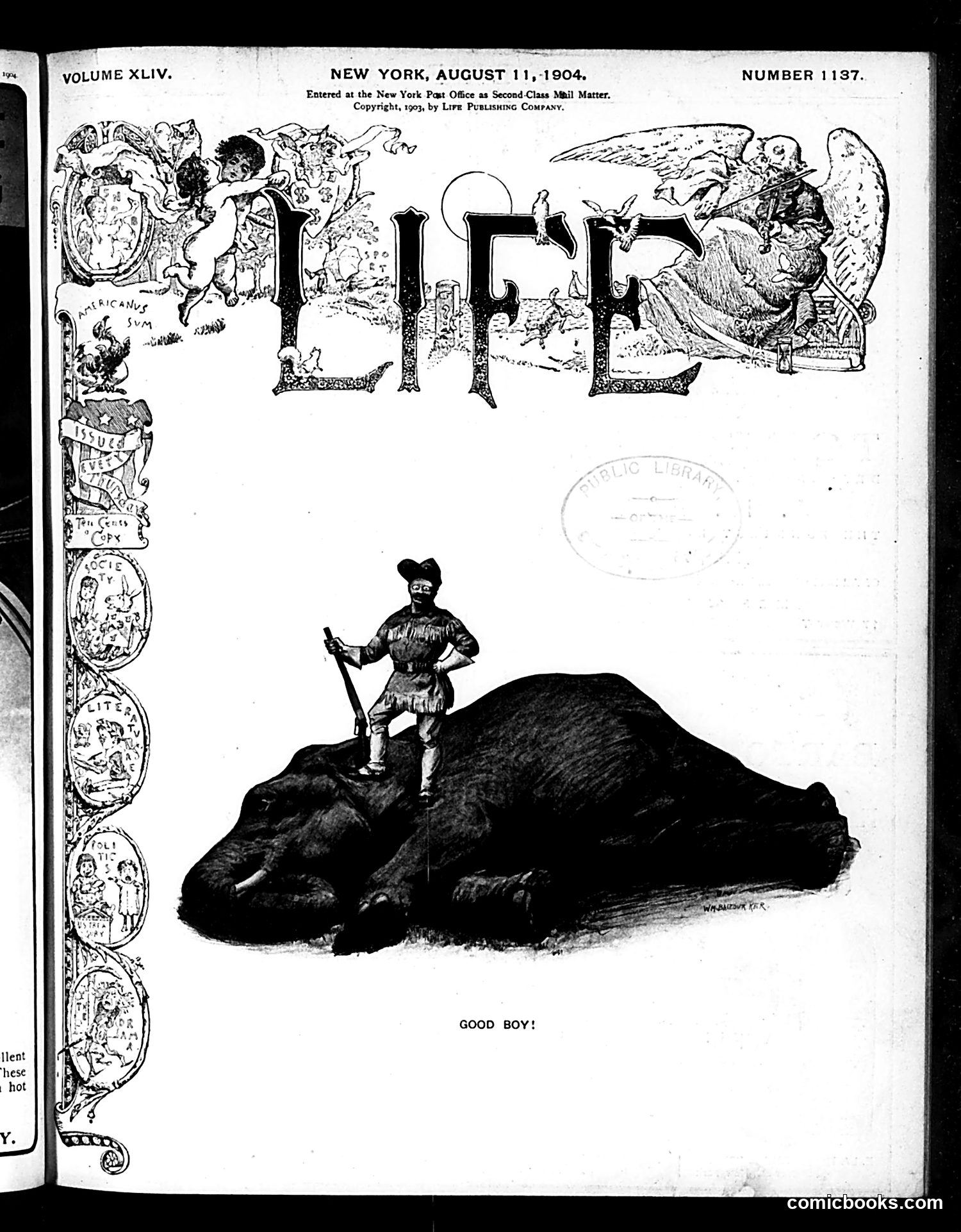
This page features a satirical illustration titled "Good Boy!" depicting a woman standing triumphantly atop a large hippopotamus, holding what appears to be a rifle or hunting weapon. The image likely references **big-game hunting**, a popular upper-class pursuit in the early 1900s. The caption "Good Boy!" sarcastically suggests the hippopotamus has been successfully hunted—treating the massive animal like an obedient pet rather than a dangerous wild beast. The ornamental border on the left contains zodiac-like circular vignettes, typical of Life's decorative style. Without additional context from the article text, the specific satirical target remains unclear—whether this mocks hunting culture, a particular hunter, colonial imperialism, or contemporary gender roles—though the woman's prominent positioning suggests commentary on female agency or accomplishment in this male-dominated activity.
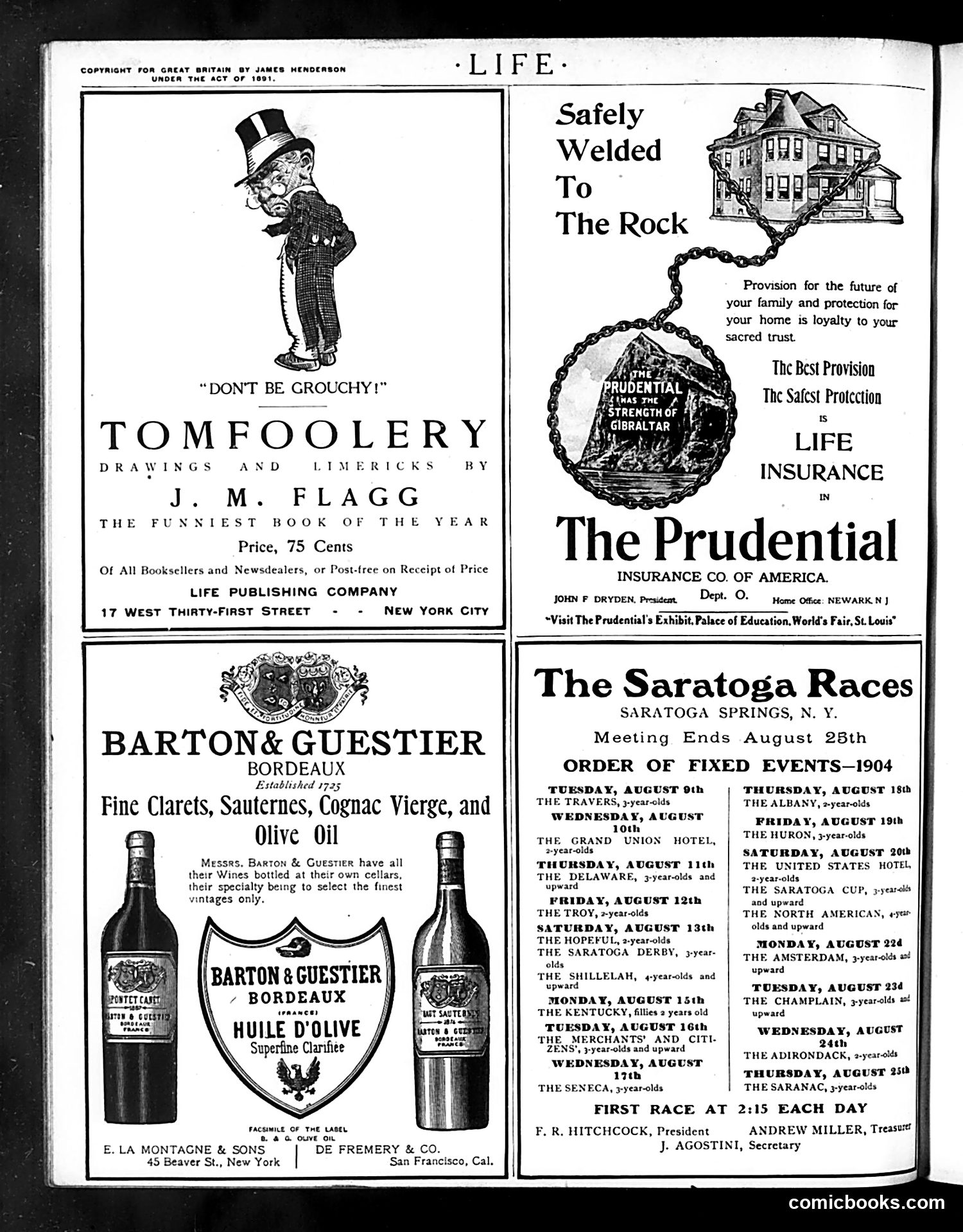
This page contains primarily **advertisements** rather than political satire. The main content includes: **Left side:** An ad for "Tomfoolery," a humor book by J.M. Flagg featuring caricatured drawings and limericks, priced at 75 cents. **Center-left:** A wine advertisement for Barton & Guestier Bordeaux wines, emphasizing fine clarets and cognacs established since 1725. **Right side:** Life Insurance advertising from The Prudential Insurance Company, using family security imagery (a house "welded to the rock"). **Bottom-right:** The Saratoga Races schedule for August 1904, listing thoroughbred racing events. The only cartoon element—the exaggerated facial caricature in the Flagg book ad—reflects early 1900s humor conventions, now considered offensive. The page is essentially a commercial publication mixing advertising with light entertainment.
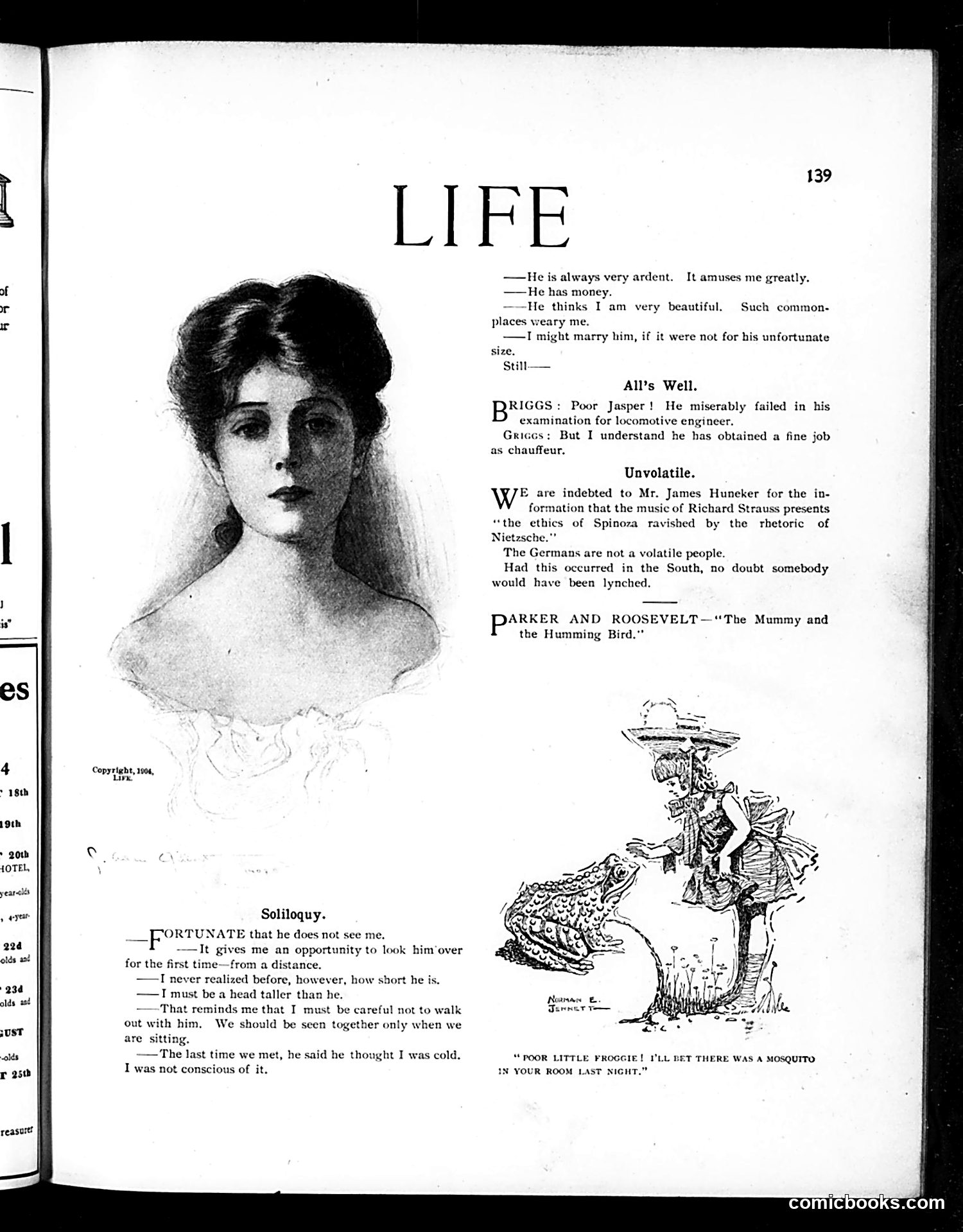
This page contains several satirical items rather than a single cohesive cartoon: **"All's Well"** mocks a man named Jasper who failed his locomotive engineer exam but obtained work as a chauffeur—suggesting lower standards for automobile driving positions. **"Unvolatile"** references Richard Strauss's music and Nietzsche's philosophy, noting Germans aren't volatile people, with a dark joke about lynching in the American South. **"Parker and Roosevelt"** appears to reference a political comparison, though specifics are unclear without additional context. The **soliloquy** depicts a woman observing a man from a distance, commenting on his short stature and their limited public interactions. The **illustration** at bottom shows a frog and figure in a humorous scenario about a mosquito, likely a comedic aside.
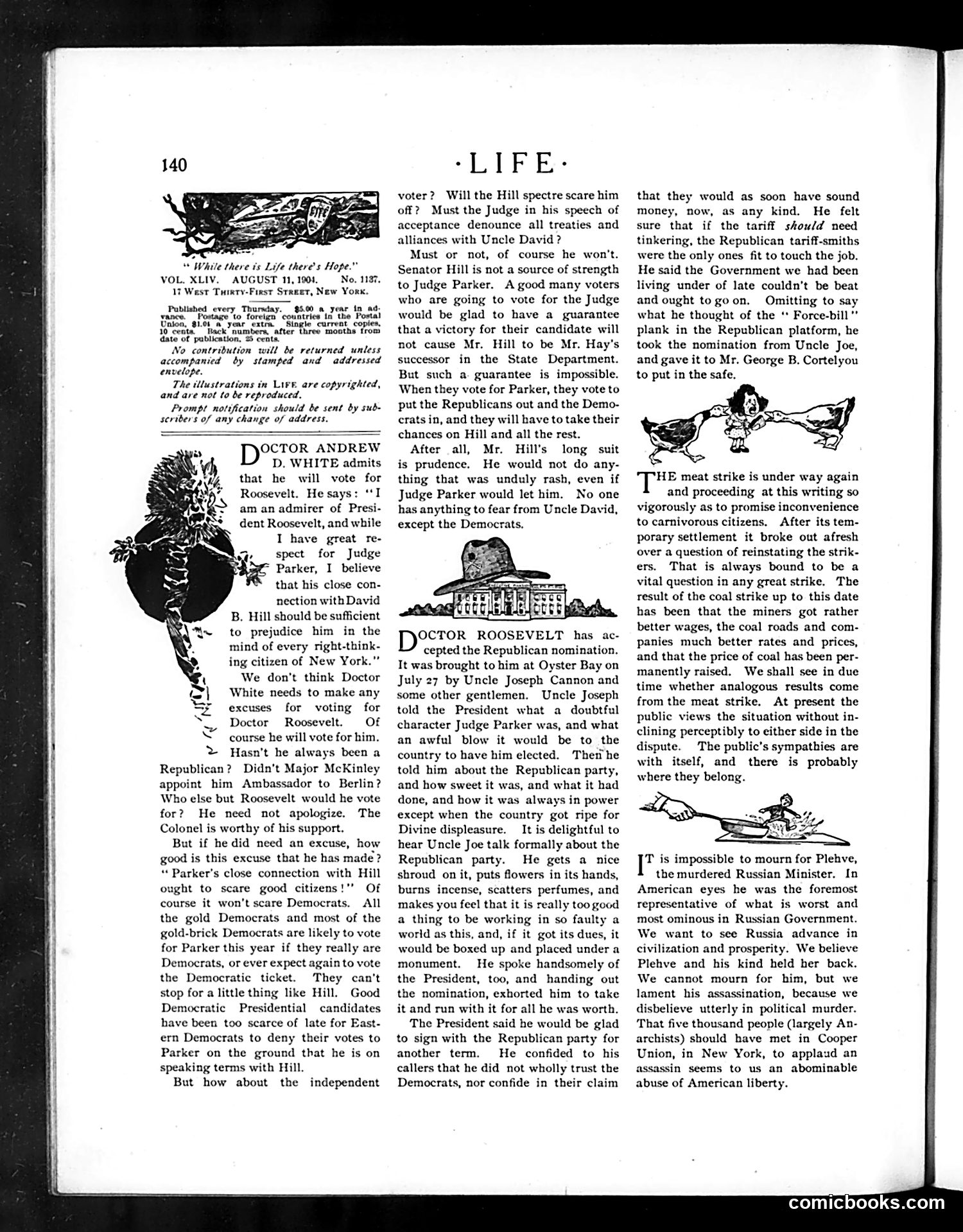
This page from *Life* magazine (August 11, 1904) contains political commentary rather than traditional cartoons. The text discusses Judge Parker as the Democratic presidential nominee and his relationship with David B. Hill. The satirical point: Republican voters are assured that voting for Roosevelt won't result in Hill gaining power in state government—a guarantee the writer admits is "impossible" to actually provide. The piece mocks both parties' internal politics. The second section defends Roosevelt's Republican nomination, sarcastically praising "Uncle Joseph Cannon" for bringing the President good character references. The final section discusses the meat strike and Russian politics, condemning the assassination of a Russian minister. The overall tone is skeptical political commentary on campaign promises and party loyalties during the 1904 election season.
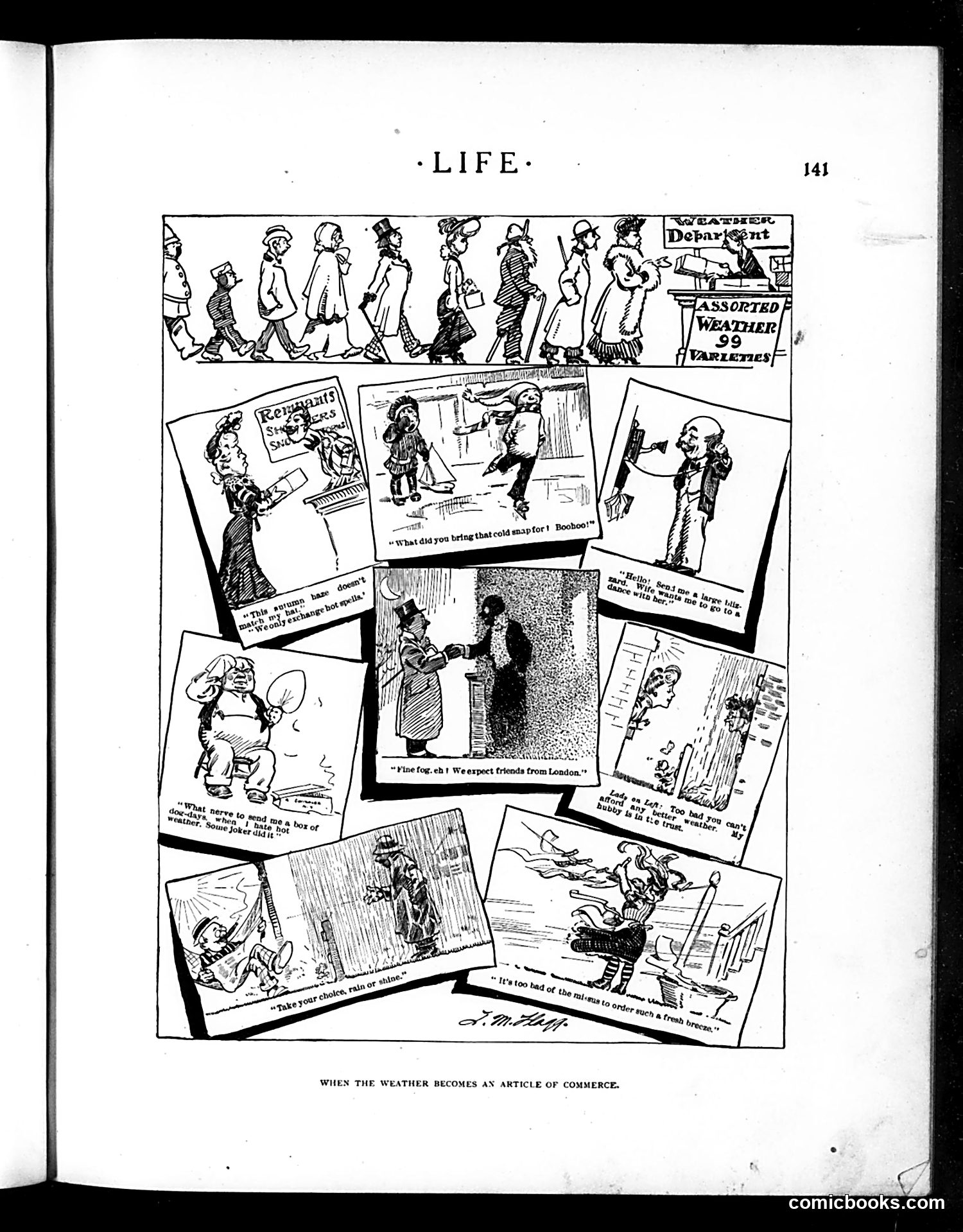
This satirical page mocks how people obsess over weather forecasts and use them as topics of conversation and commerce. The top strip shows a line of people at what appears to be a "Weather Department" window, suggesting weather has become a commodity to purchase or consult. The surrounding vignettes depict various characters using weather as social currency: discussing forecasts, complaining about conditions, and treating meteorological predictions as urgent news. One panel references "expect friends from London," implying weather discussions dominate social interaction. The satire targets early 20th-century American culture's growing reliance on weather forecasting services and the tendency to make weather a central topic of daily life—treating atmospheric conditions as if they were commercial products worth buying and selling.
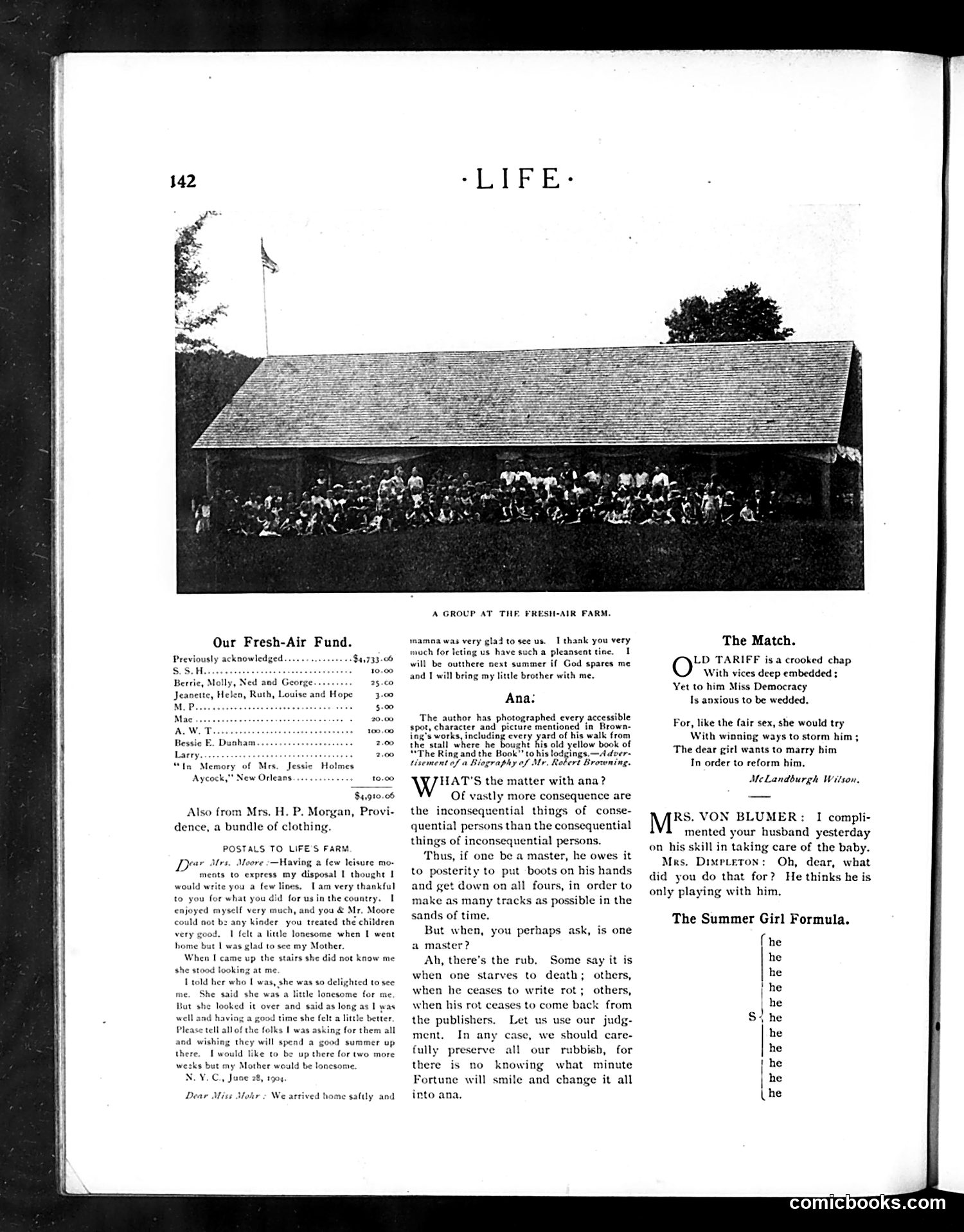
This page primarily contains reader correspondence and announcements rather than political satire. The "Fresh-Air Fund" section lists donations to send poor urban children to countryside farms—a genuine charitable cause of the era. Letters describe personal experiences at these farms. The only apparent satirical content is "The Match," a brief poem about OLD TARIFF (personified as an old man) wooing "Miss Democracy." The satire targets protectionist trade policy, suggesting tariffs are an old-fashioned suitor trying to win over democratic principles through manipulative courting. The remaining content—including "The Summer Girl Formula"—appears to be light humor rather than political commentary. The magazine functions here more as a civic platform for charitable fundraising than as political satire.
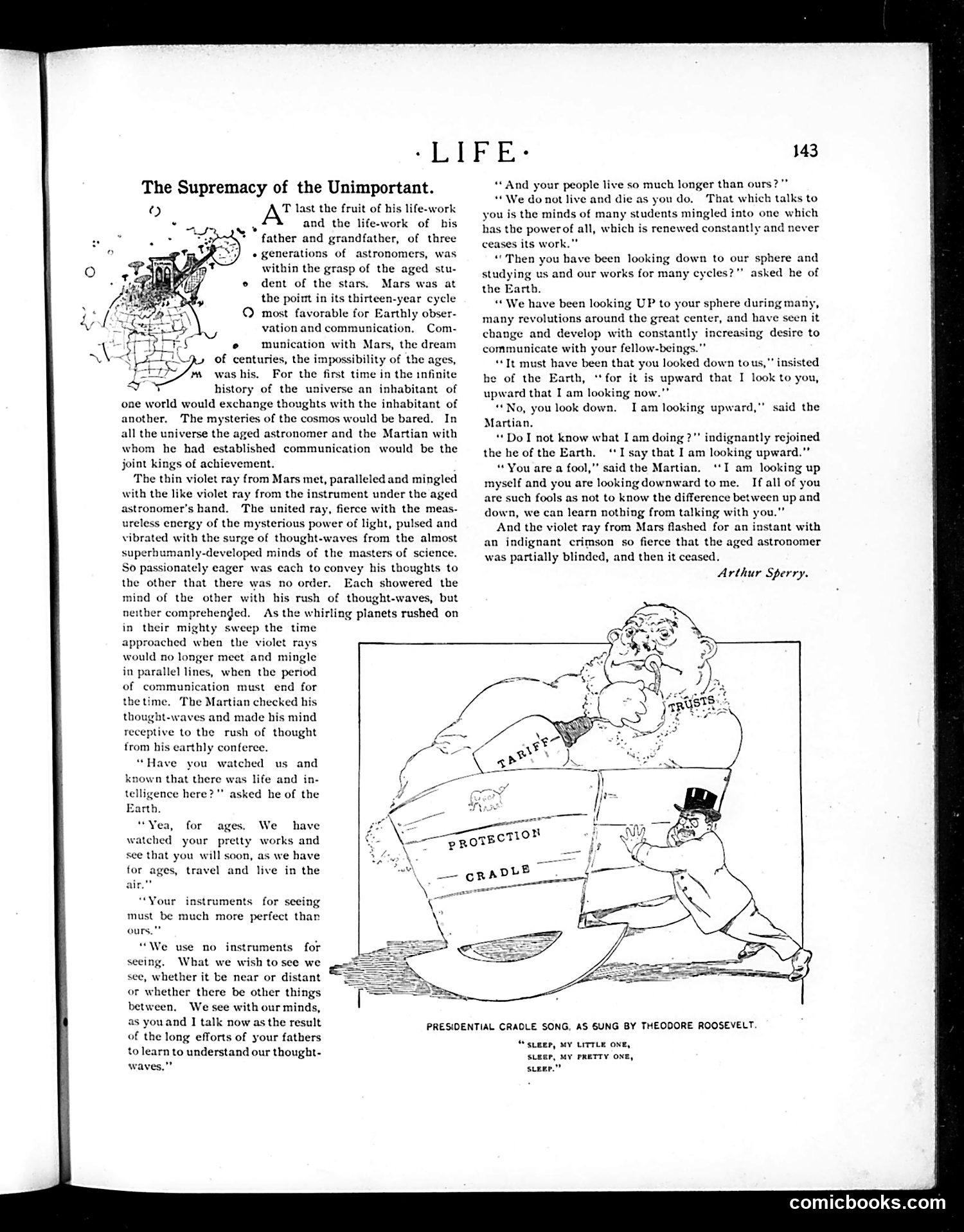
This page from *Life* magazine contains a science fiction story titled "The Supremacy of the Unimportant" by Arthur Sperry, depicting communication between Earth and Mars. The narrative describes an aged astronomer on Earth conversing with a Martian, debating whether they're "looking up" or "down" at each other—a metaphor for Earth's arrogance about its place in the cosmos. The accompanying political cartoon shows Theodore Roosevelt as a figure cradling a large baby labeled "CRADLE," with protective wrappings marked "PROTECTION" and "TARIFFS." The caption indicates Roosevelt singing a "Presidential Cradle Song." This satirizes Roosevelt's paternalistic policies—likely referencing protective tariffs or imperialist interventions he championed, depicted as coddling and infantilizing rather than empowering.
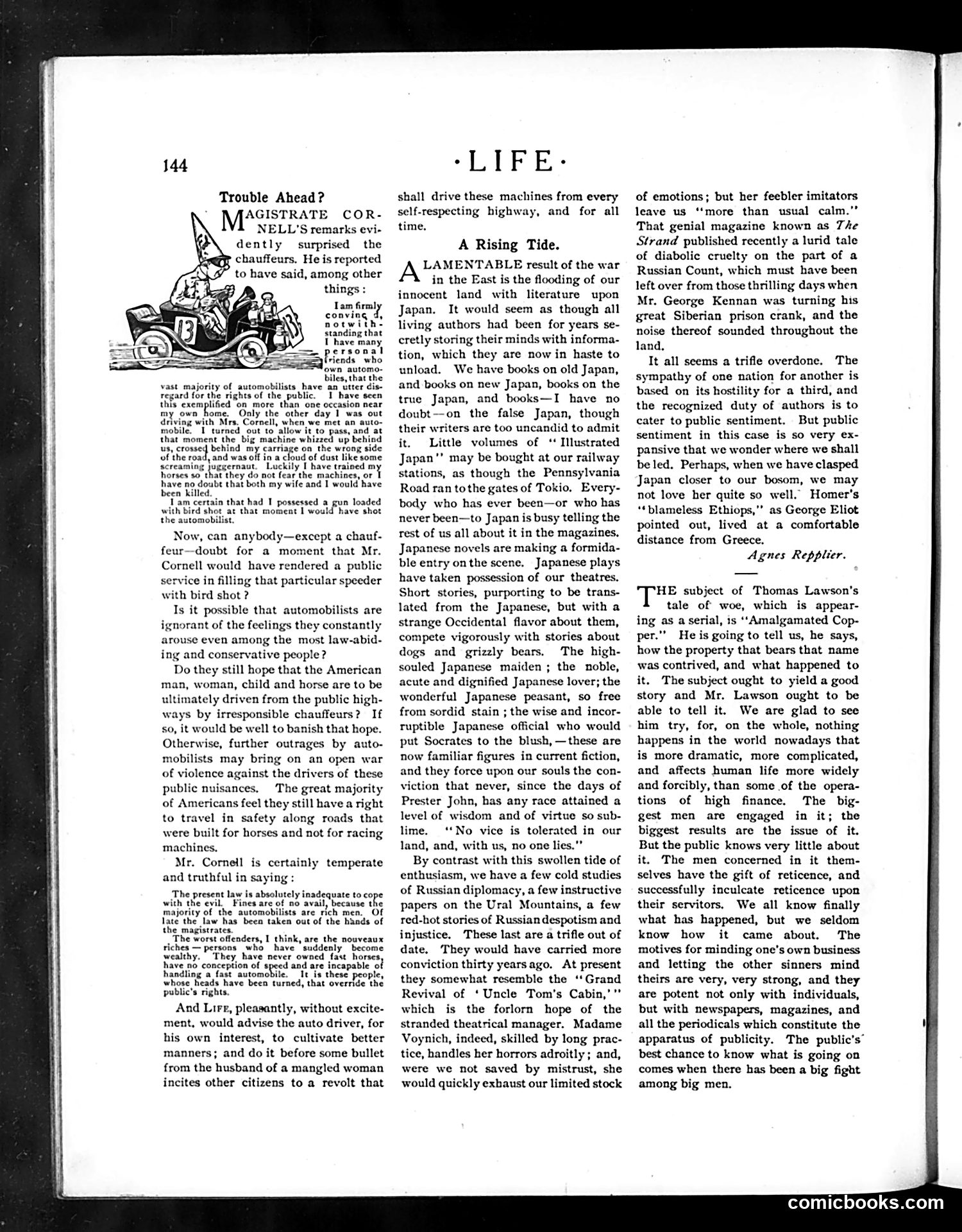
The left column features a cartoon titled "Trouble Ahead?" showing a chauffeur-driven automobile with a bird (possibly representing fate or warning) perched on top. The accompanying article by Mr. Montague Cornell criticizes automobile drivers for ignoring pedestrian safety and public rights. Cornell argues that automobiles are driven recklessly on highways by inconsiderate operators who endanger others. The satire targets the early automobile era's dangerous driving culture. The bird symbolizes an omen of catastrophe resulting from drivers' negligence. Cornell ironically suggests that if such careless driving continues, it will provoke public backlash and potentially lead to restrictive legislation against automobiles themselves—a prescient warning about consequences of ignoring safety concerns.
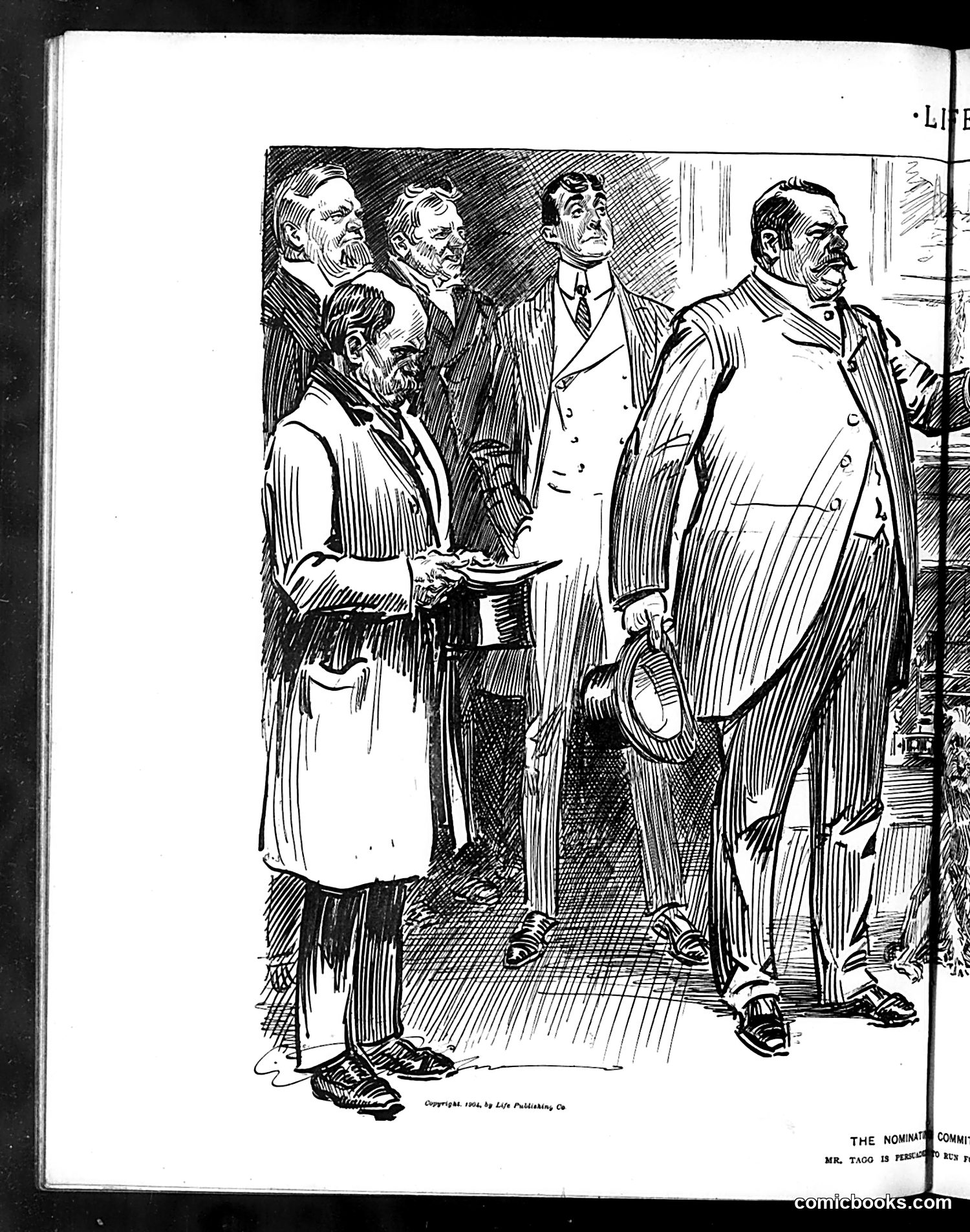
This Life magazine cartoon depicts **"The Nominating Committee"** with the caption mentioning "Mr. Tao is presented to Ben..." (text partially cut off). The image shows five men in formal attire in what appears to be an indoor setting. The leftmost figure wears a white apron or coat, suggesting he may be a servant or waiter. Four well-dressed men in suits stand behind/around him, appearing to present or nominate him for something. **Without complete caption text visible**, the specific political reference is unclear. However, the setup suggests satire about political nominations or appointments, possibly mocking how a candidate (the figure in the apron) is being "presented" by committee members. The formal setting and composition indicate this comments on some contemporary political selection process, likely from the early 20th century based on the art style and "Life" publication era.
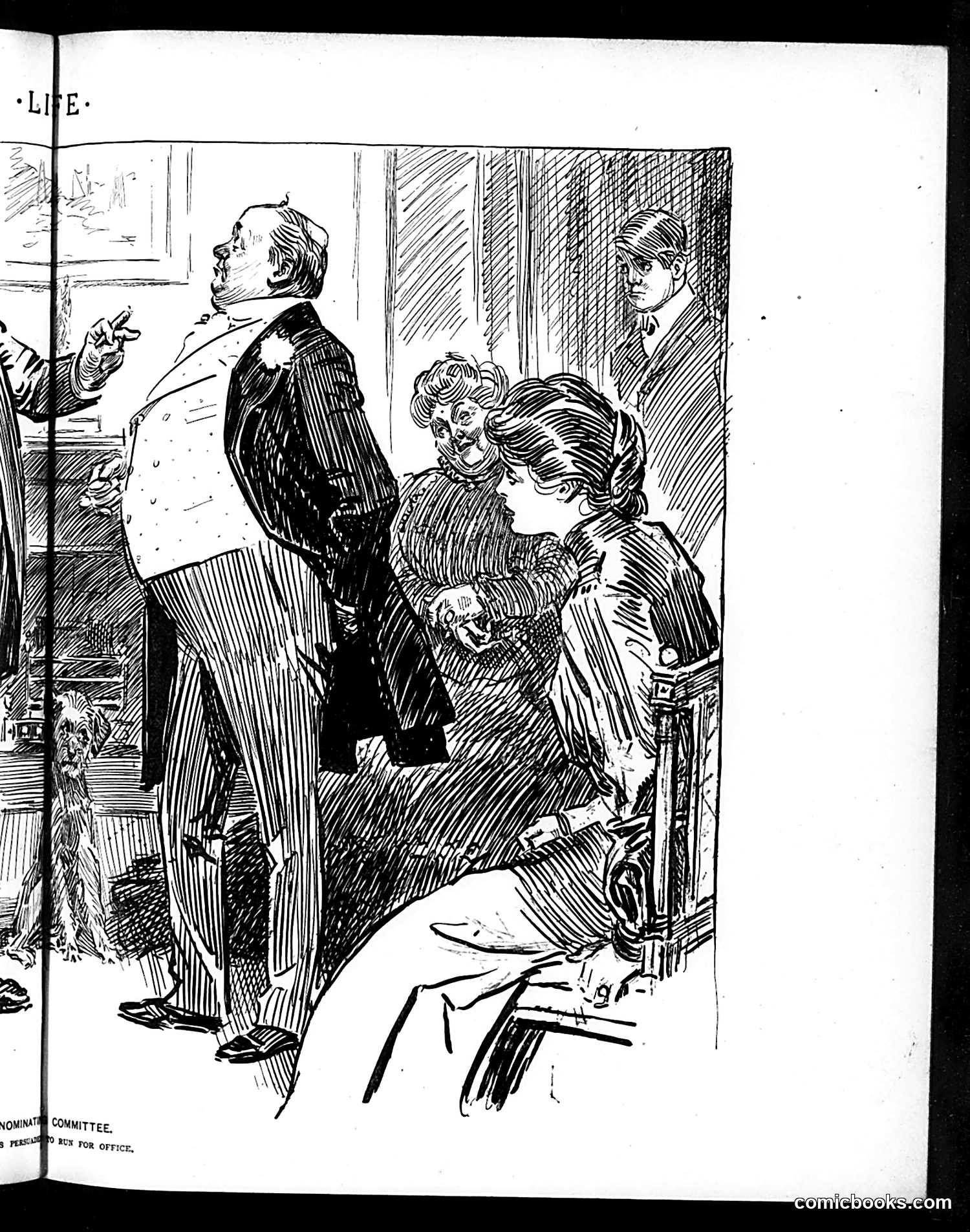
This Life magazine cartoon depicts what appears to be a **nominating committee** scene (visible in partial text at bottom). The central figure is a **portly, well-dressed man** being presented or discussed by committee members—two women seated and a younger man standing in the background. The satire likely mocks **political nomination processes**, possibly satirizing how candidates are selected or "packaged" by party insiders. The man's prominent physique and formal dress suggest wealth or establishment status. The women's engaged expressions and body language indicate they're scrutinizing or evaluating him as a potential candidate. Without a visible title or clearer date markers, the specific political reference remains unclear, but the cartoon ridicules how political elites orchestrate nominations rather than allowing genuine democratic selection. The informal, intimate setting emphasizes backroom dealings.
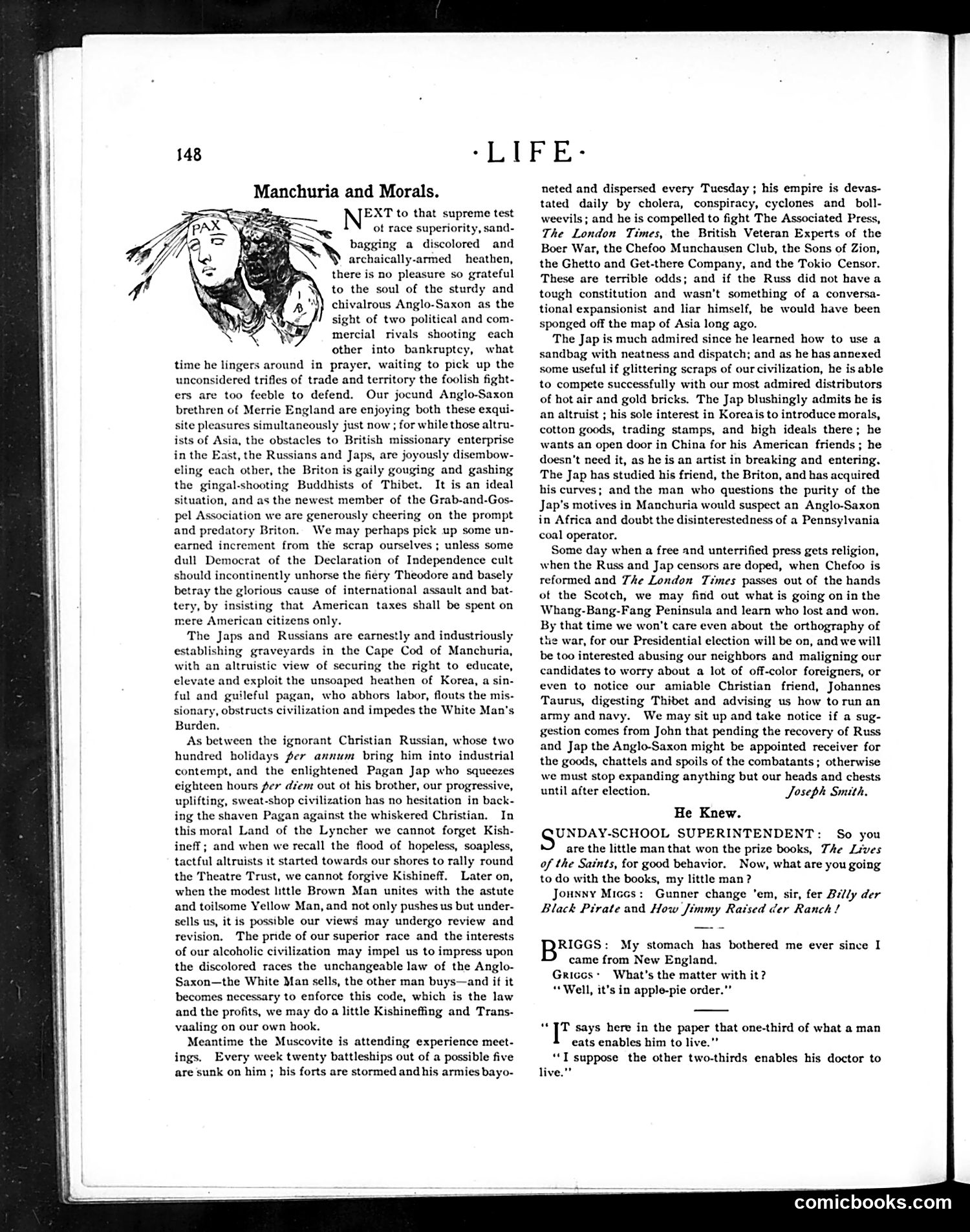
The page contains two distinct sections: **"Manchuria and Morals"** (left column with illustration): A satirical editorial by Joseph Smith criticizing British and Russian imperial competition in Asia. The illustration shows a grotesque caricatured face, likely representing one of these powers. The piece argues that while Western nations condemn Japanese colonial practices, they hypocritically pursue similar expansion. It references the "Muscovite" attending "experience meetings" where battleships are sunk—mocking Russia's naval losses, likely from the Russo-Japanese War. **"He Knew"** (right column): A brief humorous dialogue between a Sunday School Superintendent and student Johnny Miggs about prize books, followed by unrelated jokes about digestion and newspaper statistics. The satire targets imperialist hypocrisy and geopolitical rivalries of the early 20th century.
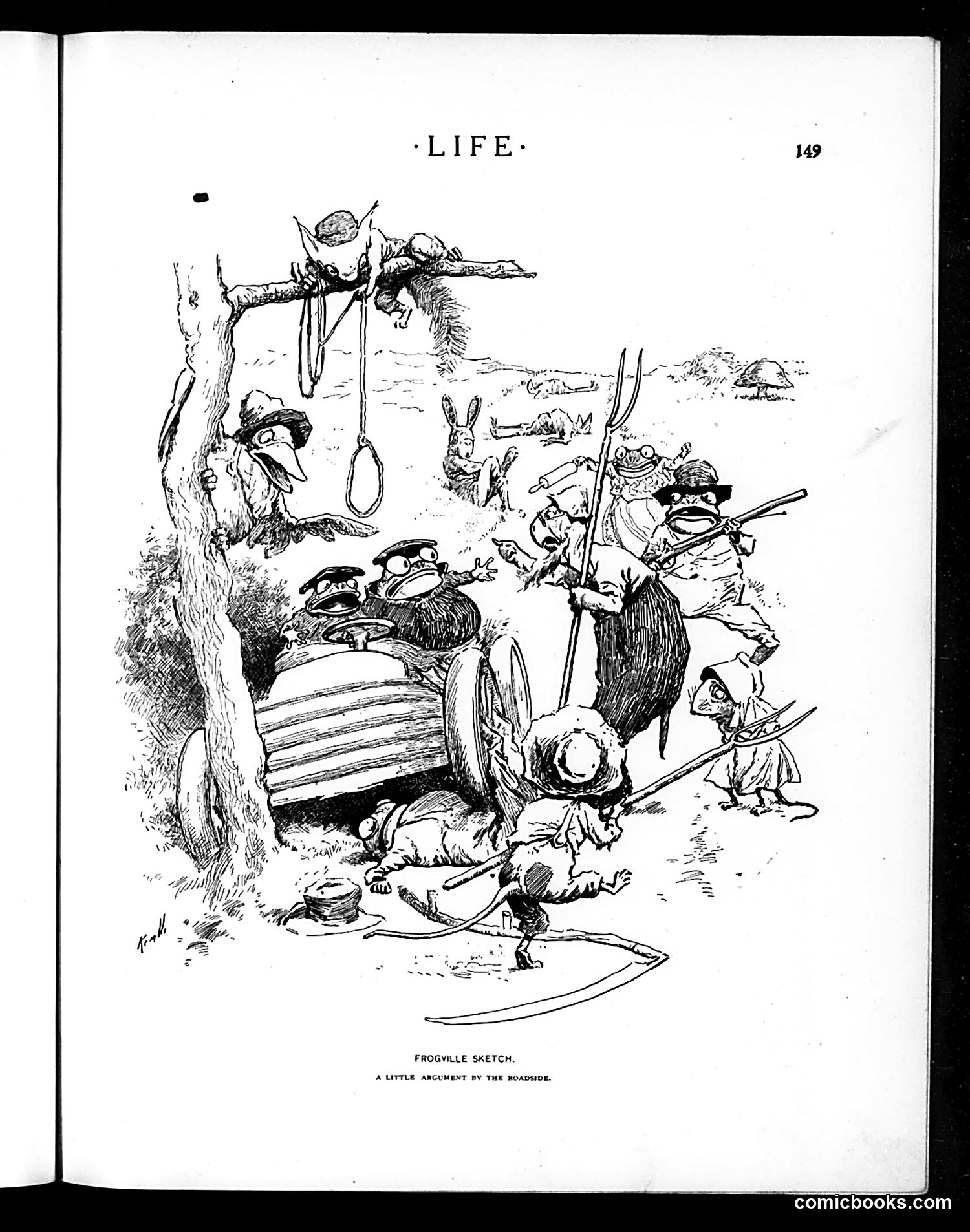
This is a satirical illustration titled "Frogville Sketch" depicting anthropomorphic frogs engaged in what appears to be a roadside dispute or "argument." The scene shows frogs in various animated poses around a cart or wagon, with some appearing aggressive or confrontational, while others observe. The cartoon likely satirizes human behavior by portraying it through animal characters—a common device in 19th-century American satire. "Frogville" suggests a fictional amphibian community, allowing the artist to comment on everyday social conflicts, possibly quarreling, violence, or public disruption, through the absurdist lens of frog characters. The cartoonist's intent appears humorous rather than politically pointed, using animal substitution to gently mock common human disputes and social disorder. Without additional historical context, the specific incident referenced remains unclear.
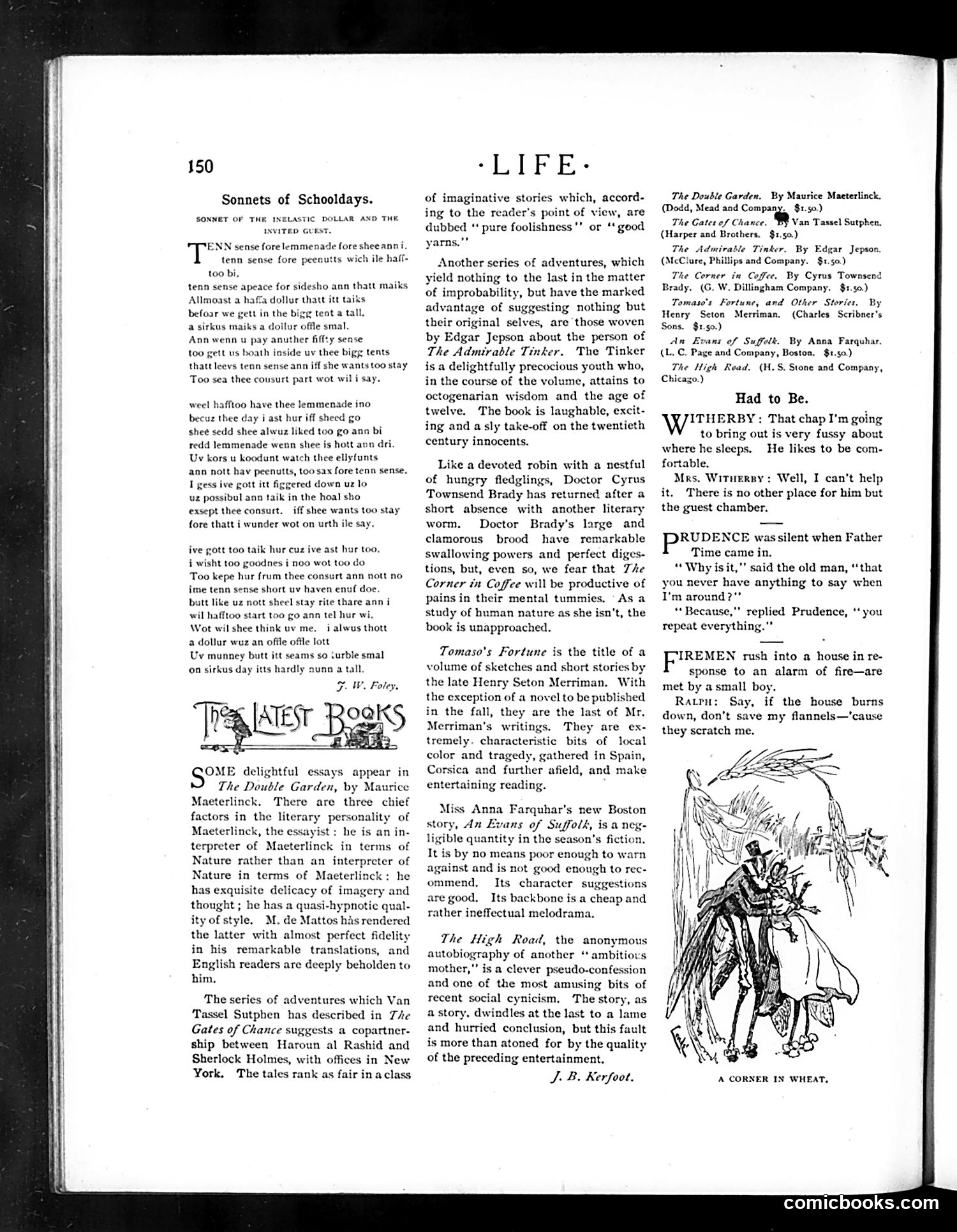
This page contains literary reviews and a humorous poem, not political cartoons. The main content includes: **"Sonnets of Schooldays"** — a deliberately misspelled, phonetically written poem about a young man's financial struggles taking a girl to the circus. The joke is the contrast between formal "sonnet" structure and crude dialect/spelling (representing working-class speech). He calculates expenses: lemonade (10¢), peanuts (10¢), sideshows (10¢), circus tent (50¢)—totaling nearly a dollar, which he fears will deplete his meager budget. The satire mocks both pretentious poetry forms and the economic anxiety of ordinary people managing small incomes. **Book Reviews** — The page critiques contemporary fiction, praising Maurice Maeterlinck's essays and Edgar Jepson's comedic novel "The Admirable Tinker" (about a precocious child acquiring adult wisdom). **The Illustration** — "A Corner in Wheat" shows a woman in a wheat field, likely referencing contemporary agrarian social concerns or a literary work discussed. The page reflects early 1900s Life magazine's blend of literary criticism and satirical humor targeting class economics and cultural pretension.
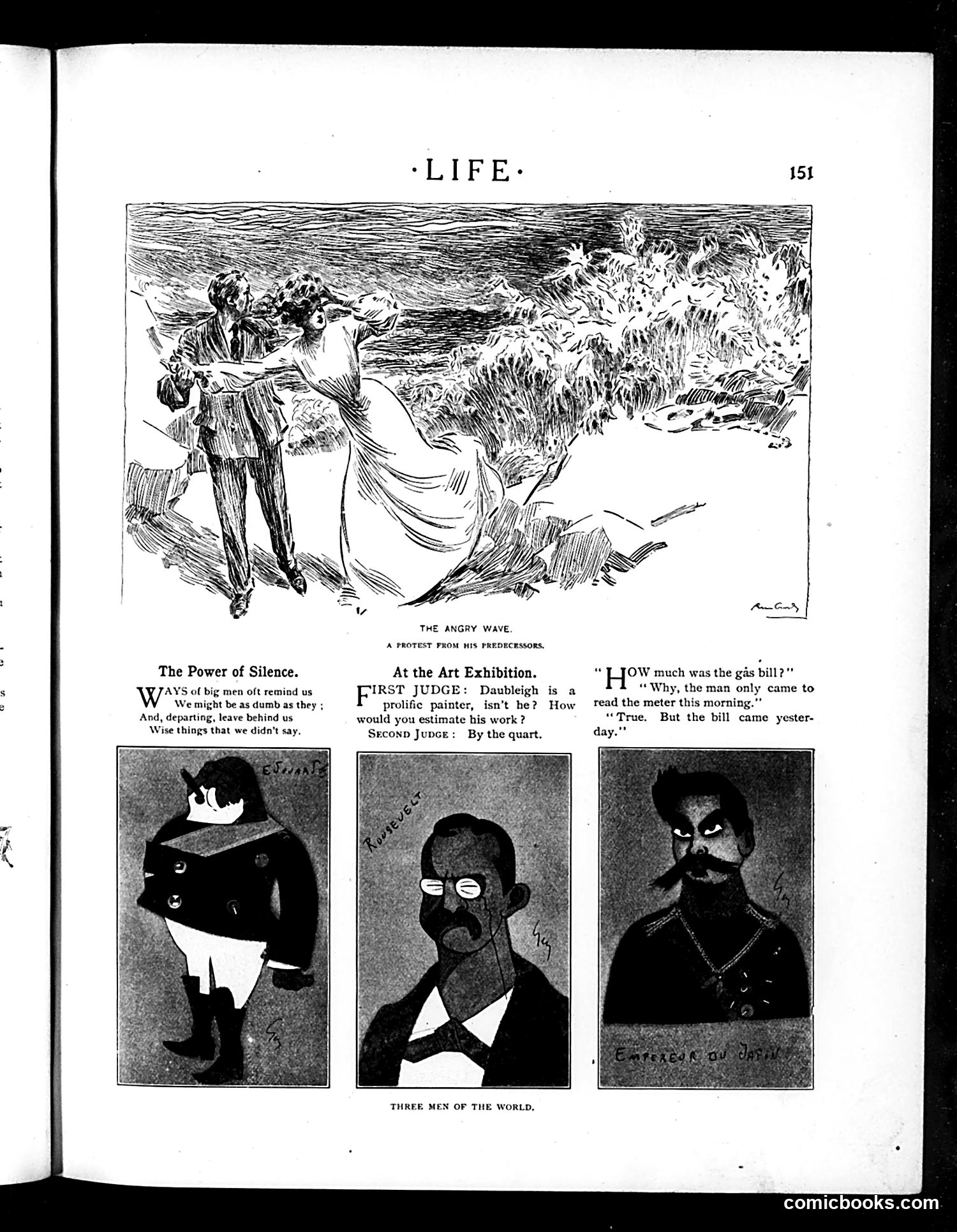
This page contains three separate satirical pieces: **"The Angry Wave"** (top): A sketch showing a couple by the seaside, captioned as "a protest from his predecessors." The meaning is unclear without additional context. **"The Power of Silence"** (left): A poem mocking taciturnity, suggesting that powerful men stay silent and appear wise, when they might actually be foolish. The accompanying portrait shows a man with his face hidden/covered. **"At the Art Exhibition"** (center): Two art judges discussing a prolific painter named Daubleigh. The joke is the second judge's dismissive response—"By the quart"—implying Daubleigh produces art in bulk/poor quality, like cheap liquor sold by quantity rather than quality. **"Gas Bill" dialogue** (right): A domestic comedy where a wife asks about the gas bill, and the husband replies it only arrived yesterday—a mild joke about delayed bills or male absentmindedness. **"Three Men of the World"** (bottom): Three caricatured male faces, likely representing recognizable public figures of the era, though identification is unclear without additional context.
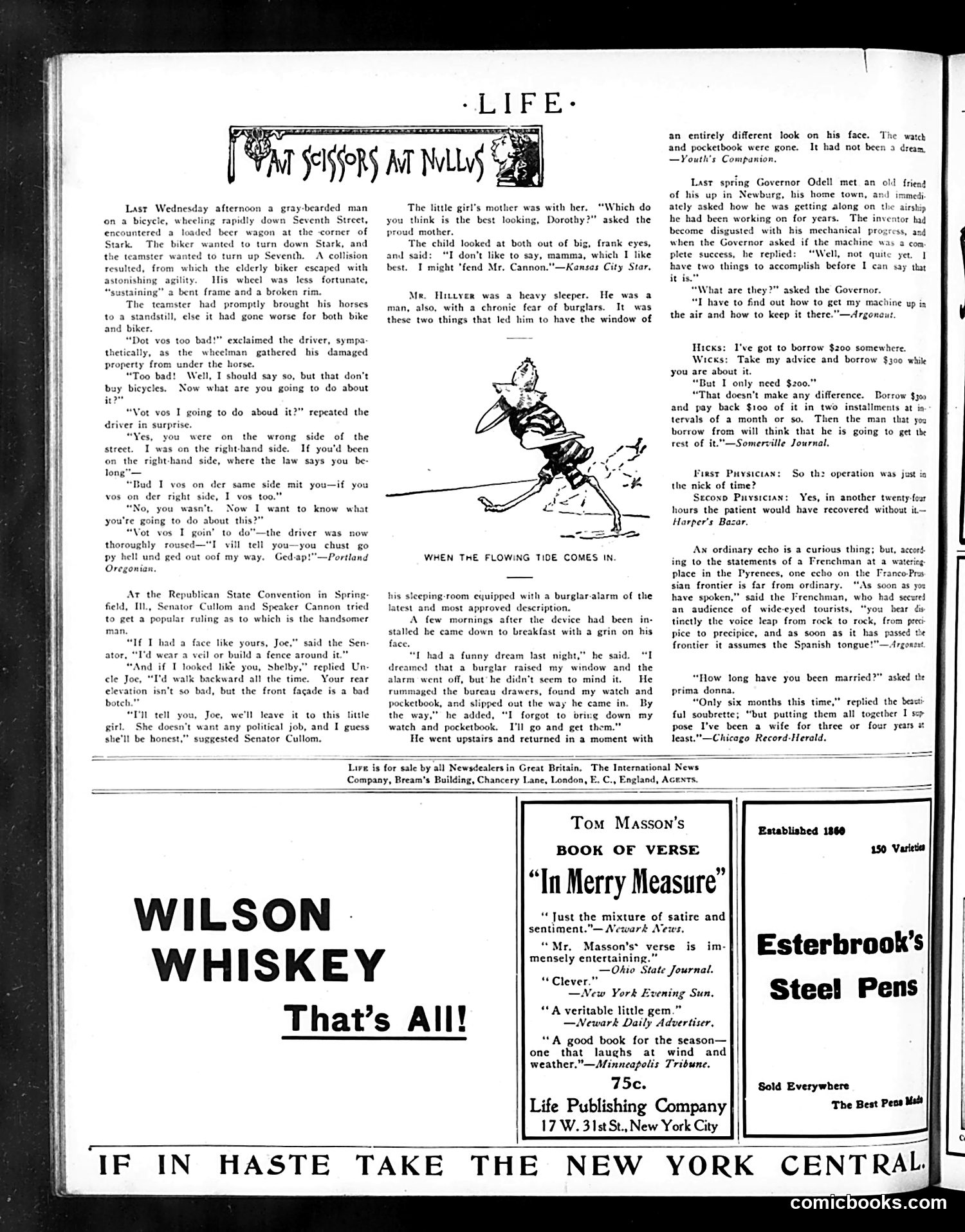
This page contains several short humorous anecdotes typical of *Life* magazine's satirical content: **The Main Cartoon** ("When the Flowing Tide Comes In") depicts a man being swept away by water—likely satirizing someone caught in unexpected circumstances or social upheaval, though the specific reference is unclear without additional context. **The Anecdotes** mock various figures: - A German-accented teamster and bicycle accident victim argue over liability - Two Republican politicians (Senator Cullom and Speaker Cannon) compete over who's better-looking, asking a young girl to judge—satirizing vanity among political figures - A man discovers his burglar alarm didn't prevent an actual theft (dark humor about false security) - An inventor tells Governor Odell his airship needs work on two things: getting it airborne and keeping it there—mocking early aviation's impracticality The humor relies on dialect humor (German accent), political mockery, and absurdist situations typical of early 1900s American satire. The page is primarily text-based with one illustration, surrounded by period advertisements.
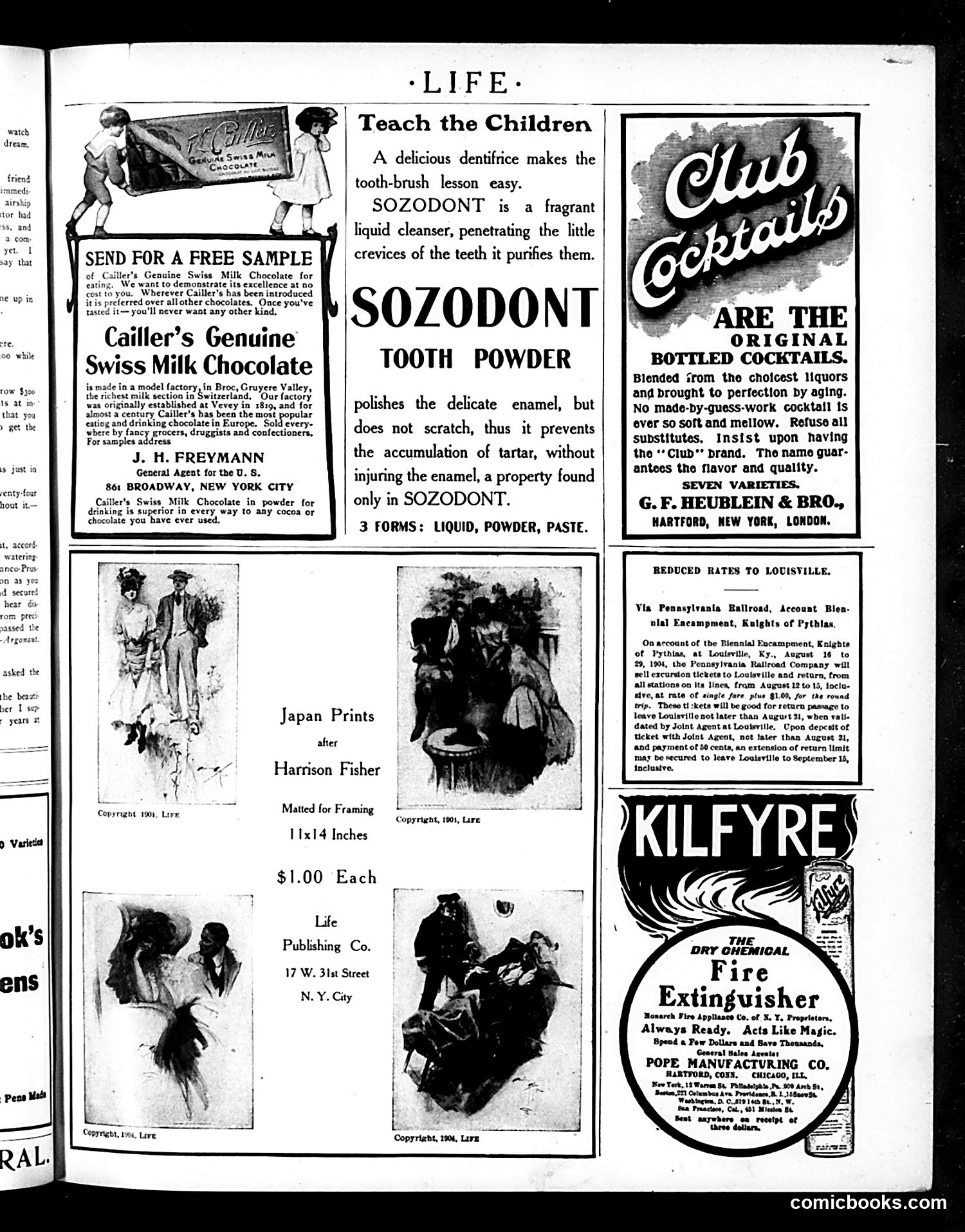
This is primarily an **advertising page** from Life magazine (circa 1901, based on the Knights of Pythias encampment reference). It contains no political cartoons or satire requiring historical context. The page features period product advertisements: - **Cailler's Swiss Milk Chocolate**: Imported confectionery marketed as superior to domestic brands - **Sozodont Tooth Powder**: Dental hygiene product emphasizing gentleness ("does not scratch") - **Club Cocktails**: Pre-mixed bottled cocktails by Heublein & Bros., reflecting the era's cocktail culture - **Japan Prints by Harrison Fisher**: Decorative artwork available for framing ($1.00) - **Kilfyre Fire Extinguisher**: Safety equipment marketed to businesses - **Pennsylvania Railroad announcement**: Reduced rates to Louisville for a fraternal organization's convention The advertisements reflect early 20th-century consumer culture, when imported goods were prestigious, pre-packaged cocktails were novel, and mail-order commerce was expanding. There is no satirical content to interpret.
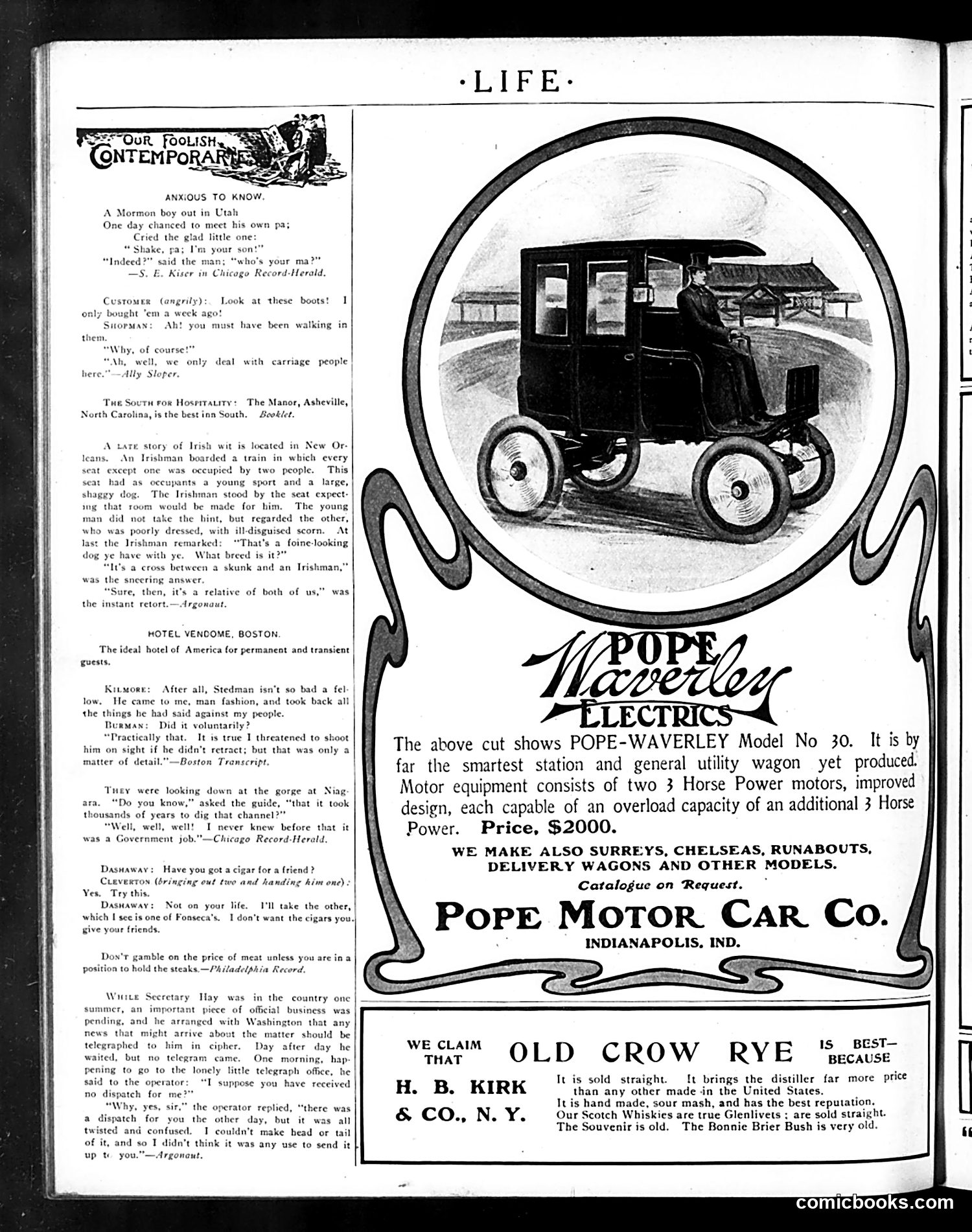
This page is primarily **advertising with humorous filler content**—typical of early 1900s Life magazine format. The left column contains short joke pieces (labeled "Our Foolish Contemporaries"), including ethnic humor standard to the era: a Mormon polygamy joke, an Irish wit anecdote, and a class-based shoe-shop exchange. These jokes mock various groups through stereotypes common at the time. The central advertisement showcases the **Pope-Waverley Model No. 30 electric automobile**, marketed as a utility wagon with dual 3-horsepower motors, priced at $2000—positioning it as luxury transportation for the wealthy. Below are additional advertisements for **Old Crow Rye whiskey** and hotel/travel services. The scattered anecdotes also mock government inefficiency (the Niagara Falls joke about it being a "Government job") and bureaucratic incompetence (Secretary John Hay's telegraph operator story). Overall, this represents **vintage commercial magazine content**: light satire mixed with luxury goods advertising targeting the affluent readership.
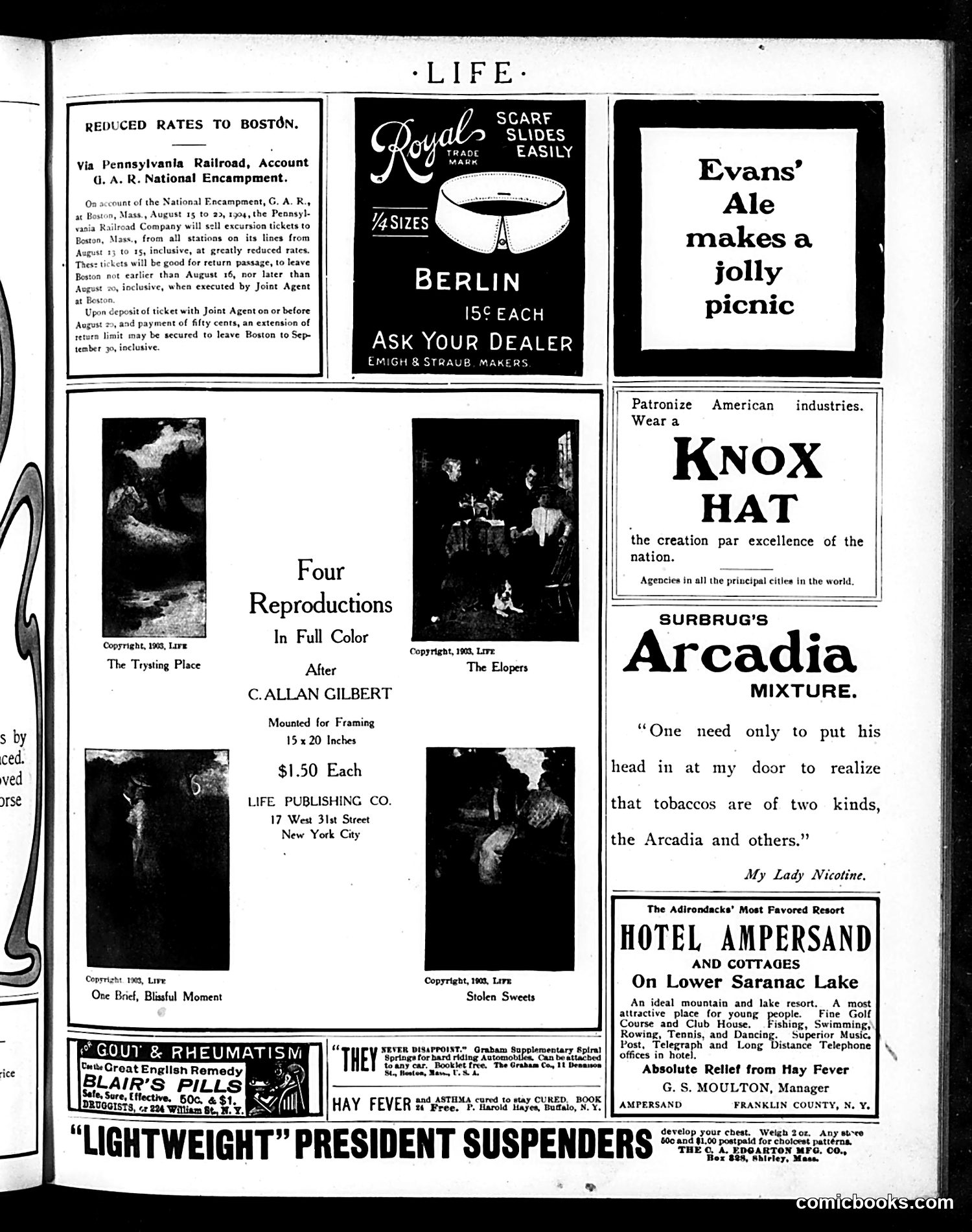
This is primarily an **advertising page** from Life magazine, circa 1908, with minimal editorial content. The page features: **Main Content:** - A central display of four framed art reproductions by C. Allan Gilbert, titled "The Trysting Place," "The Elopers," "One Brief, Blissful Moment," and "Stolen Sweets"—romantic/sentimental scenes typical of the era, available for purchase at $1.50 each. **Advertisements include:** - Travel promotions (Pennsylvania Railroad to Boston) - Consumer goods (Royal scarf slides, Evans' Ale, Knox Hats) - Patent medicines (hay fever cure, rheumatism remedy) - A resort hotel advertisement **Historical Context:** The ads reflect early-1900s consumer culture and American optimism about industrialization ("Patronize American industries"). The G.A.R. (Grand Army of the Republic) reference indicates a veterans' encampment. The "hay fever cure" advertisements were common in this era before modern medicine. There is **no political satire** on this page—it is a straightforward commercial compilation typical of Life's revenue model.
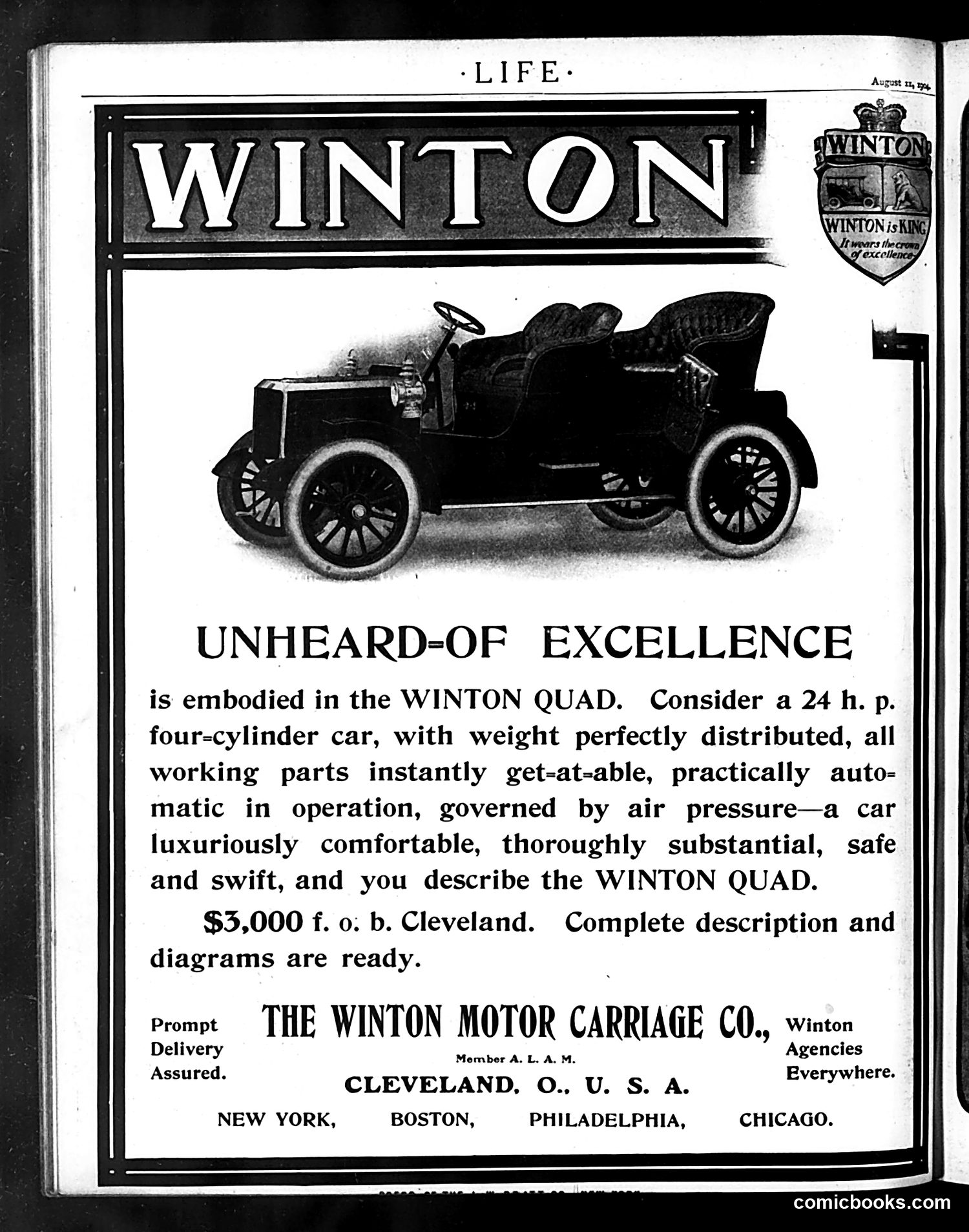
This page is **not a cartoon or satire**—it's a straightforward advertisement for the Winton automobile, circa early 1900s (based on the vehicle design and "Life" magazine's masthead style). The Winton Motor Carriage Company advertises their "Quad" model, a 24-horsepower four-cylinder car priced at $3,000 f.o.b. Cleveland. The ad emphasizes technical features—air-pressure governance, accessible parts, automatic operation—and appeals to luxury consumers seeking comfort and reliability. The company logo promises "Winton is King" quality. Multiple sales offices are listed (New York, Boston, Philadelphia, Chicago), indicating a national operation. For modern readers: this represents early automotive marketing targeting affluent buyers before cars became mass-market commodities. The $3,000 price point (roughly $100,000 today) reflects cars' luxury status in this era.