
Life, 1904-08-11 · page 4 of 20
Life — August 11, 1904 — page 4: what you’re looking at
What you’re looking at
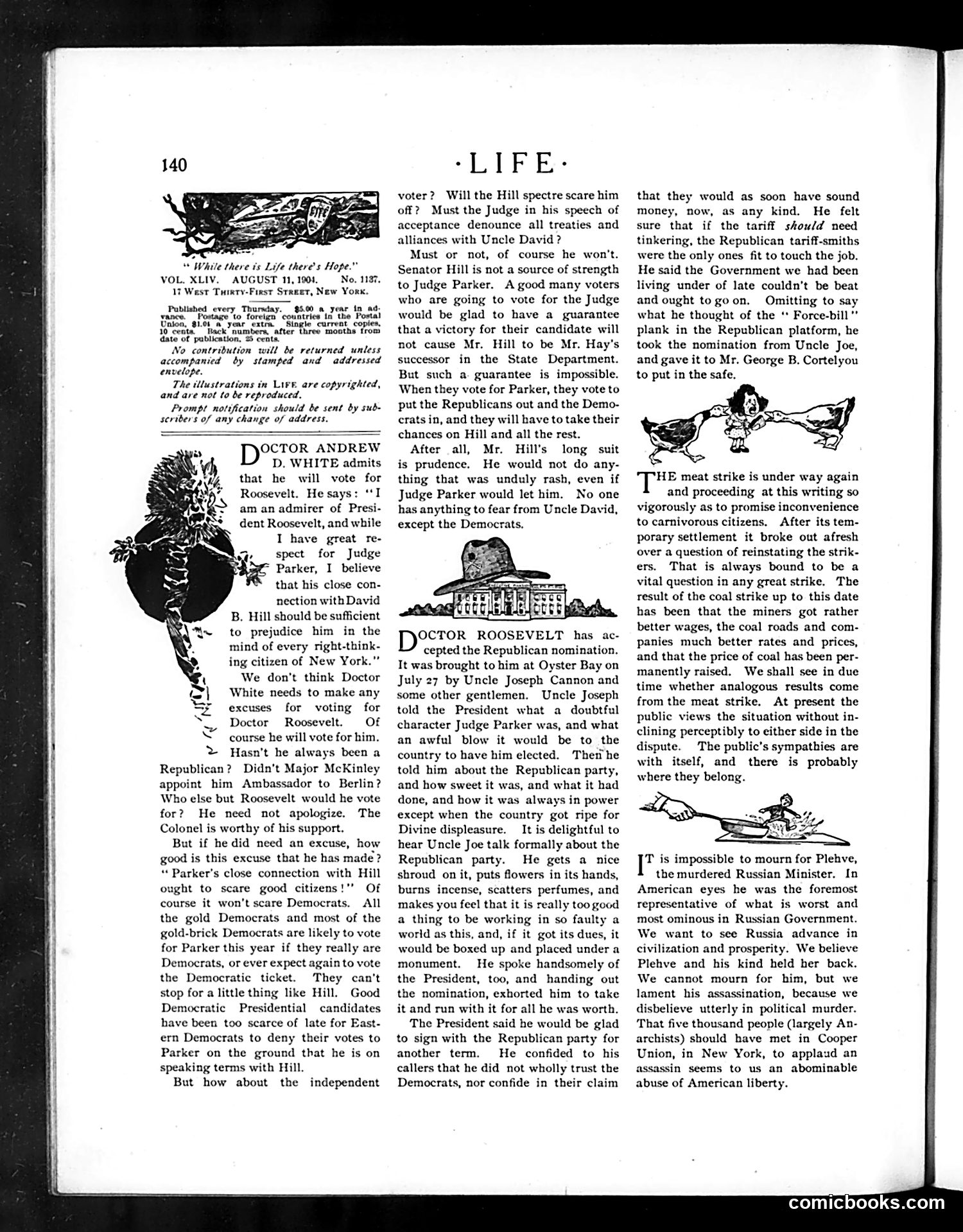
This page from *Life* magazine (August 11, 1904) contains political commentary rather than traditional cartoons. The text discusses Judge Parker as the Democratic presidential nominee and his relationship with David B. Hill. The satirical point: Republican voters are assured that voting for Roosevelt won't result in Hill gaining power in state government—a guarantee the writer admits is "impossible" to actually provide. The piece mocks both parties' internal politics. The second section defends Roosevelt's Republican nomination, sarcastically praising "Uncle Joseph Cannon" for bringing the President good character references. The final section discusses the meat strike and Russian politics, condemning the assassination of a Russian minister. The overall tone is skeptical political commentary on campaign promises and party loyalties during the 1904 election season.
📄 Transcribed text from this page (OCR, searchable)
Machine-transcribed from the original scan — historical spelling and the odd misread are preserved.
“While there is Life there's Hope.” VOL. XLIV. AUGUST 11, 1901, No. 1187. 11 Wast Tuiery-First Steeet, New Yorx. Published every, Thursday, in ad. Fowtage to foreige ‘counties 10 the Powtal Union, $1.01 a year extra. ‘Single current. copies, 10 cents, Back numbers after three months from date of publication, 2% cents, No contribution will be returned unless accompanied by stamped and addressed envelope. The illustrations in Live. are copyrighted, and are not to be reproduced. Prompt notification should be sent by sub- seribers of any change of address. OCTOR ANDREW D. WHITE admits that he will vote for Roosevelt. He says: ‘I am an admirer of Presi- dent Roosevelt, and while I have great re- spect for Judge Parker, I believe that his close con- nection with David B. Hill should be sufficient to prejudice him in the mind of every right-think. ing citizen of New York." We don't think Doctor White needs to make any excuses for voting for Doctor Roosevelt. Of course he will vote for him. Hasn't he always been a Republican? Didn't Major McKinley appoint him Ambassador to Berlin? Who else but Roosevelt would he vote for? He need not apologize. The Colonel is worthy of his support. But if he did need an excuse, how good is this excuse that he has made? “ Parker's close connection with Hill ought to scare good citizens!" Of course it won't scare Democrats. All the gold Democrats and most of the gold-brick Democrats are likely to vote for Parker this year if they really are Democrats, or ever expect again to vote the Democratic ticket. They can't stop fora little thing like Hill. Good Democratic Presidential candidates have been too scarce of late for East- ern Democrats to deny their votes to Parker on the ground that he is on speaking terms with Hill. But how about the independent ‘LIF Ee voter? Will the Hill spectre scare him off? Must the Judge in his speech of acceptance denounce all treaties and alliances with Uncle David ? Must or not, of course he won't. Senator Hill is not a source of strength to Judge Parker. A good many voters who are going to vote for the Judge would be glad to have a guarantee that a victory for their candidate will not cause Mr. Hill to be Mr. Hay’s successor in the State Department. But such a. guarantee is impossible. When they vote for Parker, they vote to put the Republicans out and the Demo- crats in, and they will have to take their chances on Hill and all the rest. After all, Mr. Hill's long suit is prudence. He would not do any- thing that was unduly rash, even if Judge Parker would let him. No one has anything to fear from Uncle David, except the Democrats. OCTOR ROOSEVELT has ac- cepted the Republican nomination. It was brought to him at Oyster Bay on July 27 by Uncle Joseph Cannon and some other gentlemen, Uncle Joseph told the President what a doubtful character Judge Parker was, and what an awful blow it would be to the country to have him elected. Ther he told him about the Republican party, and how sweet it was, and what it had done, and how it was always in power except when the country got ripe for Divine displeasure. It is delightful to hear Uncle Joe talk formally about the Republican party. He gets a nice shroud on it, puts flowers in its hands, burns incense, scatters perfumes, and makes you feel that it is really too good a thing to be working in so faulty a world as this, and, if it got its dues, it would be boxed up and placed under a monument. He spoke handsomely of the President, too, and handing out the nomination, exhorted him to take it and run with it for all he was worth. The President said he would be glad to sign with the Republican party for another term. He confided to his callers that he did not wholly trust the Democrats, nor confide in their claim that they would as soon have sound money, now, as any kind. He felt sure that if the tariff shou/d need tinkering, the Republican tariff-smiths were the only ones fit to touch the job. He said the Government we had been living under of late couldn't be beat and ought to goon, Omitting to say what he thought of the ‘* Force-bill” plank in the Republican platform, he took the nomination from Uncle Joe, and gave it to Mr. George B. Cortelyou to put in the safe. HE meat strike is under way again and proceeding at this writing so vigorously as to promise inconvenience to carnivorous citizens. After its tem- porary settlement it broke out afresh over a question of reinstating the strik- ers. That is always bound to be a vital question in any great strike. The result of the coal strike up to this date has been that the miners got rather better wages, the coal roads and com- panies much better rates and prices, and that the price of coal has been per- manently raised. We shall see in due time whether analogous results come from the meat strike. At present the public views the situation without in- clining perceptibly to either side in the dispute. The public’s sympathies are with itself, and there is probably where they belong. if is impossible to mourn for Plehve, tbe murdered Russian Minister. In American eyes he was the foremost representative of what is worst and most ominous in Russian Government. We want to see Russia advance in civilization and prosperity. We believe Plehve and his kind held her back. We cannot mourn for him, but we lament his assassination, because we disbelieve utterly in political murder. ‘That five thousand people (largely An- archists) should have met in Cooper Union, in New York, to applaud an assassin seems to us an abominable abuse of American liberty. comicbooks.com