
Life, 1904-08-11 · page 14 of 20
Life — August 11, 1904 — page 14: what you’re looking at
What you’re looking at
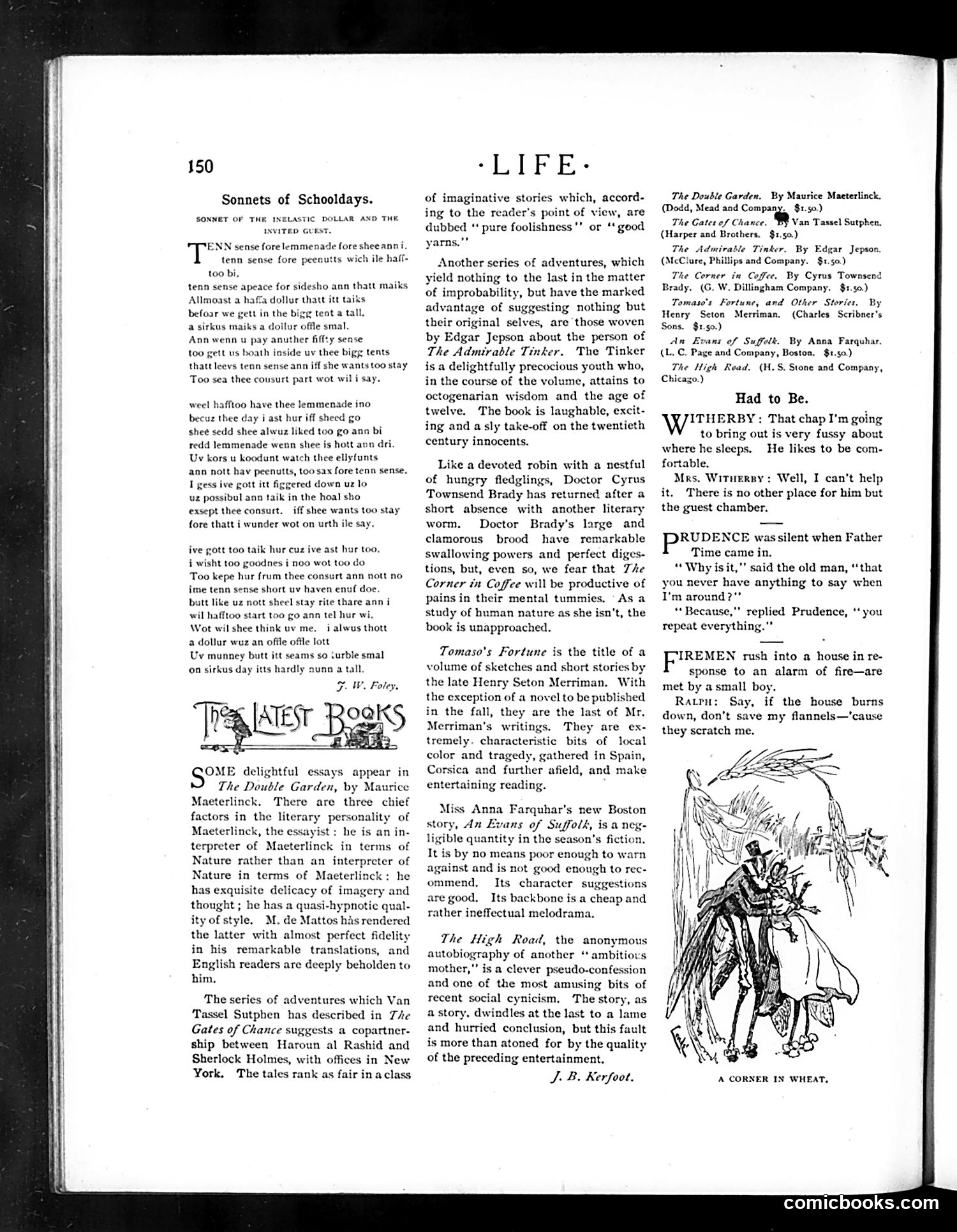
This page contains literary reviews and a humorous poem, not political cartoons. The main content includes: **"Sonnets of Schooldays"** — a deliberately misspelled, phonetically written poem about a young man's financial struggles taking a girl to the circus. The joke is the contrast between formal "sonnet" structure and crude dialect/spelling (representing working-class speech). He calculates expenses: lemonade (10¢), peanuts (10¢), sideshows (10¢), circus tent (50¢)—totaling nearly a dollar, which he fears will deplete his meager budget. The satire mocks both pretentious poetry forms and the economic anxiety of ordinary people managing small incomes. **Book Reviews** — The page critiques contemporary fiction, praising Maurice Maeterlinck's essays and Edgar Jepson's comedic novel "The Admirable Tinker" (about a precocious child acquiring adult wisdom). **The Illustration** — "A Corner in Wheat" shows a woman in a wheat field, likely referencing contemporary agrarian social concerns or a literary work discussed. The page reflects early 1900s Life magazine's blend of literary criticism and satirical humor targeting class economics and cultural pretension.
📄 Transcribed text from this page (OCR, searchable)
Machine-transcribed from the original scan — historical spelling and the odd misread are preserved.
150 Sonnets of Schooldays. SONNET OF THEE INELASTIC DOLLAR AND THE INVITED GUEST. ENN sense fore lemmenade fore sheeann i tenn sense fore peenutts wich ile half too bi, tenn sense apeace for sidesho ann thatt maiks, Allmoast a haffa dollur thatt itt taiks befoar we gett in the bigg tent a tall, a sirkus maiks a doitur offle smal. Ann wenn w pay anuther fiffty sease too gett us boath inside uv thee bigg tents that Ieevs tenn sense ann if she wants too stay Too sea thee cousurt part wot wil i say. weel hafftoo have thee lemmenade ino becuz thee day i ast hur iff sheed go sheé sedd shee alwuz liked too go ann bi redd lemmenade wenn shee is hott avn dei. Uv kors u koodunt watch thee ellyfunts. ann nott hay peenutts, too sax fore tenn sense. I gess ive got itt figgered down uz lo uz possibul ann taik in the hoal sho exsept thee consurt. iff shee wants too stay fore thatt i wunder wot on urth ile say. ive gott too taik hur cuz ive ast hur too, i wisht too goodnes i noo wot too do Too kepe hur frum thee consurt ann nott no ime tenn sense short uv haven enuf doe. butt like uz not sheel stay rite thare ann wil hafftoo start Wot wil shee think uv me. 90 go ann tel hur wi, i alwus thott a dollur wuz an offle ofile lott Uv munney butt itt seams so iurble smal on sirkus day itts hardly aunn a tall, 5. W. Foley, OME delightful essays appear in The Double Garden, by Maurice Maeterlinck. There are three chief factors in the literary personality of Maeterlinck, the he is an in- terpreter of Maeterlinck in terms of Nature rather than an interpreter of Nature in terms of Maeterlinck: he has exquisite delicacy of imagery and thought ; he has a quasi-hypnotic qual- ity of style. M. de Mattos has rendered the latter with almost perfect fidelity in his remarkable translations, and English readers are deeply beholden to him, ‘The series of adventures which Van ‘Tassel Sutphen has described in The Gates of Chance suggests a copartner- ship between Haroun al Rashid and Sherlock Holmes, with offices in New York. ‘The tales rank as fair in aclass “LIFE- of imaginative stories which, accord- ing to the reader's point of view, are dubbed “pure foolishness"? or ‘good yarns.”’ Another series of adventures, which yield nothing to the last in the matter of improbability, but have the marked advantage of suggesting nothing but their original selves, are’ those woven by Edgar Jepson about the person of The Admirable Tinker, The Tinker is a delightfully precocious youth who, in the course of the volume, attains to octogenarian wisdom and the age of twelve. The book is laughable, excit- ing and a sly take-off on the twentieth century innocents. Like a devoted robin with a nestful of hungry fledglings, Doctor Cyrus ‘Townsend Brady has returned after a short absence with another literary worm. Doctor Brady's large and clamorous brood have remarkable swallowing powers and perfect diges- tions, but, even so, we fear that The Corner in Coffee will be productive of pains in their mental tummies. ‘As a study of human nature as she isn’t, the book is unapproached. Tomaso's Fortune is the title of a volume of sketches and short stories by the late Henry Seton Merriman. With the exception of a novel to be published in the fall, they are the 1. of Mr. Merriman’s writings. They are ex- tremely. characteristic bits of local color and tragedy, gathered in Spain, Corsica and further afield, and make entertaining reading. Miss Anna Farquhar's new Boston An Evans of Suffolk, isa neg- ble quantity in the season's fiction. is by no means poor enough to warn against and is not good enough to r ommend, Its character suggestions are good, Its backbone cheap and rather ineffectual melodrama, The High Road, the anonymous autobiography of another ‘ambitious mother," is a clever pseudo-conf and one of the most amusing bits of recent social cynicism, The story, as a story, dwindles at the last to a lame and hurried conclusion, but this fault is more than atoned for by the quality of the preceding entertainment. J.B. Kerfoot. The Double Garden. By Maurice Maeterlinck. (Dodd, Mead and Company. $1.50.) The Gates of Chance. Yan Tassel Sutphen. (Harper and Brothers. $1.50.) The Admirable Tinker. By Edgar Jepsos. (McClure, Phillips and Company. $1.50.) The Corner in Coffee. By Cyras Townsend Brady. (G. W. Dillingham Company. $1.50.) Tomaso's Fortune, and Other Stories. By Henry Seton Merriman, (Charles Scribner's Sons. $1.50.) An Evans of Suffelk. By Anna Farquhar. (L. C. Page and Company, Boston, $1.50.) The High Read. (H.S. Stone and Company, Chicago.) Had to Be. ITHERBY: That chap I'm going to bring out is very fussy about where he sleeps. He likes to be com- fortable, Mrs, Wituerny: Well, I can’t help it. There is no other place for him but the guest chamber, RUDENCE ilent when Father Time came in. “Why is said the old man, ‘that you never have anything to say when I'm around ?"" “Because,” replied Prudence, ‘you repeat everything.” IREMEN rush into a house in re- sponse to an alarm of fire—are met by a small boy. Ratru: Say, if the house burns down, don’t save my flannels—'cause they scratch me, A CORNER IN WHEAT, comicbooks.com