
Life, 1904-08-11 · page 8 of 20
Life — August 11, 1904 — page 8: what you’re looking at
What you’re looking at
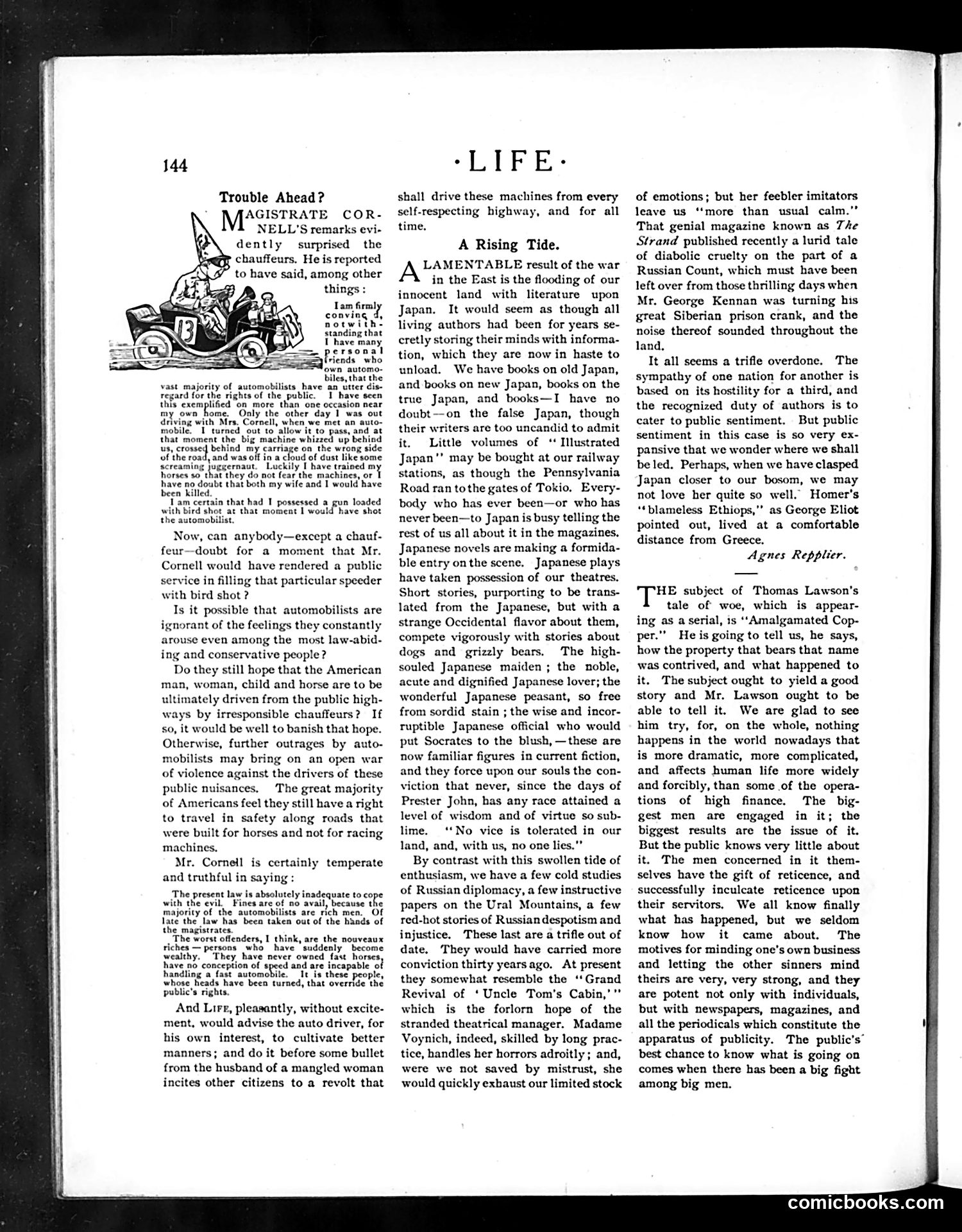
The left column features a cartoon titled "Trouble Ahead?" showing a chauffeur-driven automobile with a bird (possibly representing fate or warning) perched on top. The accompanying article by Mr. Montague Cornell criticizes automobile drivers for ignoring pedestrian safety and public rights. Cornell argues that automobiles are driven recklessly on highways by inconsiderate operators who endanger others. The satire targets the early automobile era's dangerous driving culture. The bird symbolizes an omen of catastrophe resulting from drivers' negligence. Cornell ironically suggests that if such careless driving continues, it will provoke public backlash and potentially lead to restrictive legislation against automobiles themselves—a prescient warning about consequences of ignoring safety concerns.
📄 Transcribed text from this page (OCR, searchable)
Machine-transcribed from the original scan — historical spelling and the odd misread are preserved.
Trouble Ahead? AGISTRATE COR- NELL'S remarks evi- dently surprised the Meg chauffeurs. He is reported to have said, among other things: am firmly 3) a conving 4, notwith- standing that T have many persons! riends who own biles, that the vast majority of automobilists have an utter dis- regard for the rights of the public. I have seen this exemplified on more than one occasion near my own home. Only the other day 1 was out driving with Mrs. Cornell, when we met an auto- mobile. I turned out to'allow it to pass, and at that moment the big machine whizzed up behind us, sued behind my fartare on the wrong side of the road, and was off in a cloud of dust like some screaming juggernaut. Luckily I have trained m: horses so that they do not fear the machines, or have no doubt that both my wife and I would have been killed Tam certain that had I possessed a gun loaded with bird shot at that moment I would have shot the automobilist tomo- Now, can anybody—except a chauf- feur—doubt for a moment that Mr. Cornell would have rendered a public service in filling that particular speeder with bird shot ? Is it possible that automobilists are ignorant of the feelings they constantly arouse even among the most law-abid- ing and conservative people? Do they still hope that the American man, woman, child and horse are to be ultimately driven from the public high- ways by irresponsible chauffeurs? If so, it would be well to banish that hope. Otherwise, further outrages by auto- mobilists may bring on an open war of violence against the drivers of these public nuisances, ‘The great majority of Americans feel they still have a right to travel in safety along roads that were built for horses and not for racing machines, Mr. Cornell is certainly temperate and truthful in saying : ‘The present law is absolutely inadequate to cope with the evil, Fines are of no avail, because the majority of the automobilists are nich men. Of late the law has been taken out of the hands of the magistrates. The worst offenders, I think, are the nouveaux riches — persons who have ‘suddenly become wealthy, They have never owned fast horses have no conception of speed and are incapable of handling a fast automobile, It is these people, whose heads have been turned, that override the public's rights. And Lire, pleasantly, without excite- ment, would advise the auto driver, for his own interest, to cultivate better manners; and do it before some bullet from the husband of a mangled woman incites other citizens to a revolt that -LIF Es shall drive these machines from every self-respecting highway, and for all time. A Rising Tide. LAMENTABLE result of the war in the East is the flooding of our innocent land with literature upon Japan. It would seem as though all living authors had been for years se- cretly storing their minds with informa- tion, which they are now in haste to unload. We have books on old Japan, and books on new Japan, books on the true Japan, and books—I have no doubt—on the false Japan, though their writers are too uncandid to admit it. Little volumes of ‘ Illustrated Japan"’ may be bought at our railway stations, as though the Pennsylvania Road ran tothe gates of Tokio. Every- body who has ever been—or who has never been—to Japan is busy telling the rest of us all about it in the magazines, Japanese novels are making a formida- ble entry onthe scene. Japanese plays have taken possession of our theatres. Short stories, purporting to be trans- lated from the Japanese, but with a strange Occidental flavor about them, compete vigorously with stories about dogs and grizzly bears. The high- souled Japanese maiden; the noble, acute and dignified Japanese lover; the wonderful Japanese peasant, so free from sordid stain ; the wise and incor- ruptible Japanese official who would put Socrates to the blush, —these are now familiar figures in current fiction, and they force upon our souls the con- viction that never, since the days of Prester John, has any race attained a level of wisdom and of virtue so sub- lime. ‘*No vice is tolerated in our land, and, with us, no one lies.” By contrast with this swollen tide of enthusiasm, we have a few cold studies of Russian diplomacy, a few instructive papers on the Ural Mountains, a few red-hot stories of Russian despotism and injustice. These last are a trifle out of date, They would have carried more conviction thirty years ago, At present they somewhat resemble the ‘Grand Revival of ‘Uncle Tom's Cabin,’" which is the forlorn hope of the stranded theatrical manager. Madame Voynich, indeed, skilled by long prac- tice, handles her horrors adroitly; and, were we not saved by mistrust, she would quickly exhaust our limited stock of emotions; but her feebler imitators leave us ‘‘more than usual calm." That genial magazine known as The Strand published recently a lurid tale of diabolic cruelty on the part of a Russian Count, which must have been left over from those thrilling days when Mr. George Kennan was turning his great Siberian prison crank, and the noise thereof sounded throughout the land, It all seems a trifle overdone. The sympathy of one nation for another is based on its hostility for a third, and the recognized duty of authors is to cater to public sentiment. But public sentiment in this case is so very ex- pansive that we wonder where we shall beled. Perhaps, when we have clasped Japan closer to our bosom, we may not love her quite so well. Homer's “blameless Ethiops,"" as George Eliot pointed out, lived at a comfortable distance from Greece. Agnes Repplier. HE subject of Thomas Lawson's tale of woe, which is appear- ing as a serial, 1s ‘‘Amalgamated Cop- per.” He is going to tell us, he says, how the property that bears that name was contrived, and what happened to it. The subject ought to yield a good story and Mr. Lawson ought to be able to tell it. We are glad to see him try, for, on the whole, nothing happens in the world nowadays that is more dramatic, more complicated, and affects human life more widely and forcibly, than some .of the opera- tions of high finance. The big- gest men are engaged in it; the biggest results are the issue of it. But the public knows very little about it. The men concerned in it them- selves have the gift of reticence, and successfully inculcate reticence upon their servitors, We all know finally what has happened, but we seldom know how it came about. The motives for minding one's own business and letting the other sinners mind theirs are very, very strong, and they are potent not only with individuals, but with newspapers, magazines, and all the periodicals which constitute the apparatus of publicity. The public's’ best chance to know what is going on comes when there has been a big fight among big men. comicbooks.com