
A complete issue · 20 pages · 1904
Life — July 28, 1904
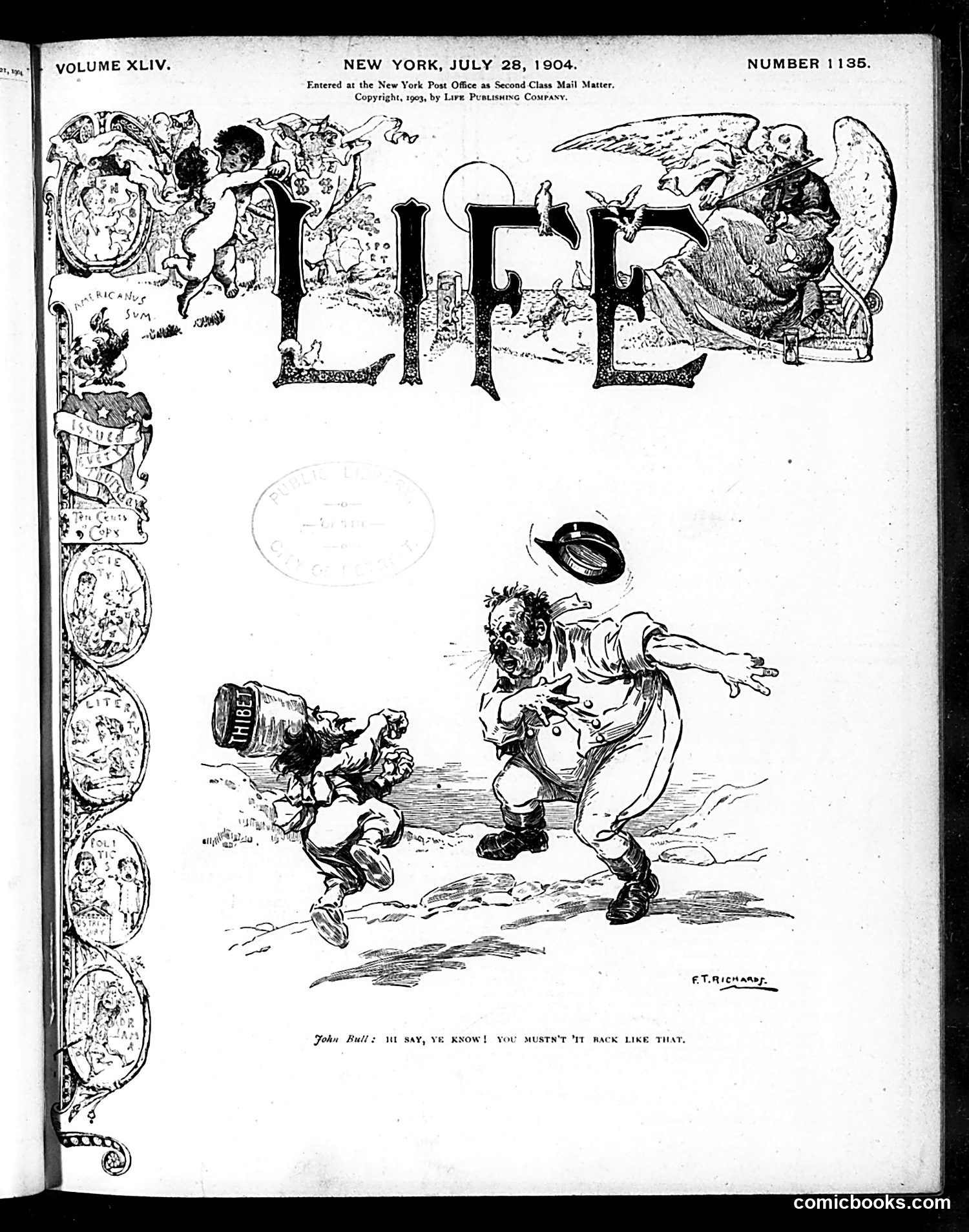
The cartoon depicts a bearded man in work clothes being scolded by what appears to be John Bull (the personification of Britain, identifiable by his characteristic top hat and rotund figure). The caption reads: "John Bull: 'Hi say, ye know! you mustn't hit back like that.'" This satirizes British hypocrisy regarding colonial violence. The bearded figure likely represents a colonial subject or smaller nation, while John Bull represents British imperial authority. The joke critiques Britain's double standard: they freely exercise military force across their empire, but condemn resistance or retaliation from those they dominate. The spilled bucket suggests domestic turmoil or violence within British colonial territories, making the cartoon's message about the arbitrary enforcement of "civilized" conduct particularly pointed.
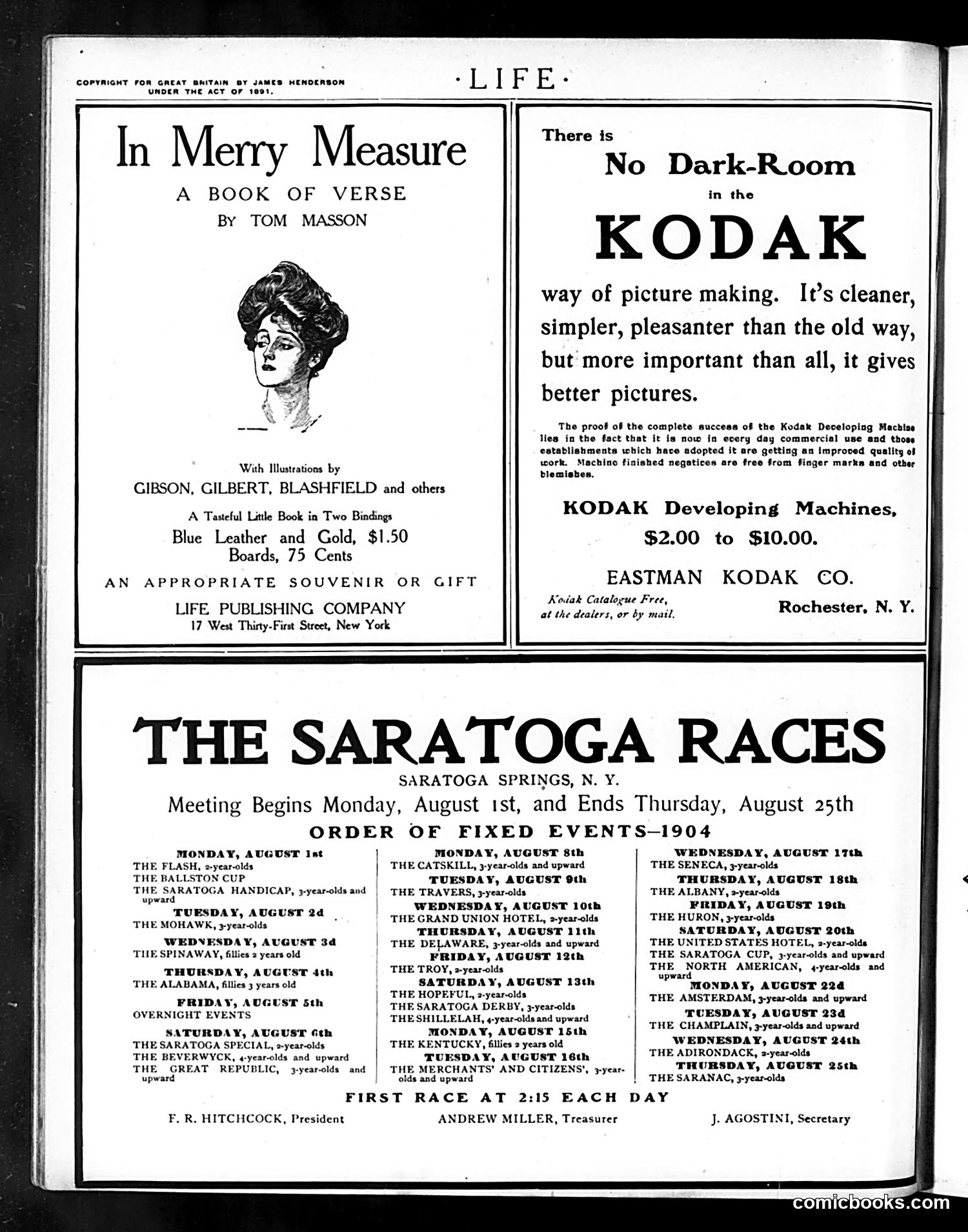
This page contains **no political cartoons or satirical content**. It consists entirely of advertisements and announcements: 1. **"In Merry Measure"** — an ad for a poetry book by Tom Masson with illustrations by Gibson, Gilbert, and Blashfield, published by Life Publishing Company. 2. **Kodak advertisement** — promoting Kodak developing machines as superior to traditional darkroom methods for photography. 3. **The Saratoga Races** — a schedule of horse racing events at Saratoga Springs, New York, running August 1-25, 1904. The page serves as a commercial document from an early 1900s publication, mixing book promotion, photography equipment marketing, and sporting event announcements rather than offering editorial satire or commentary.
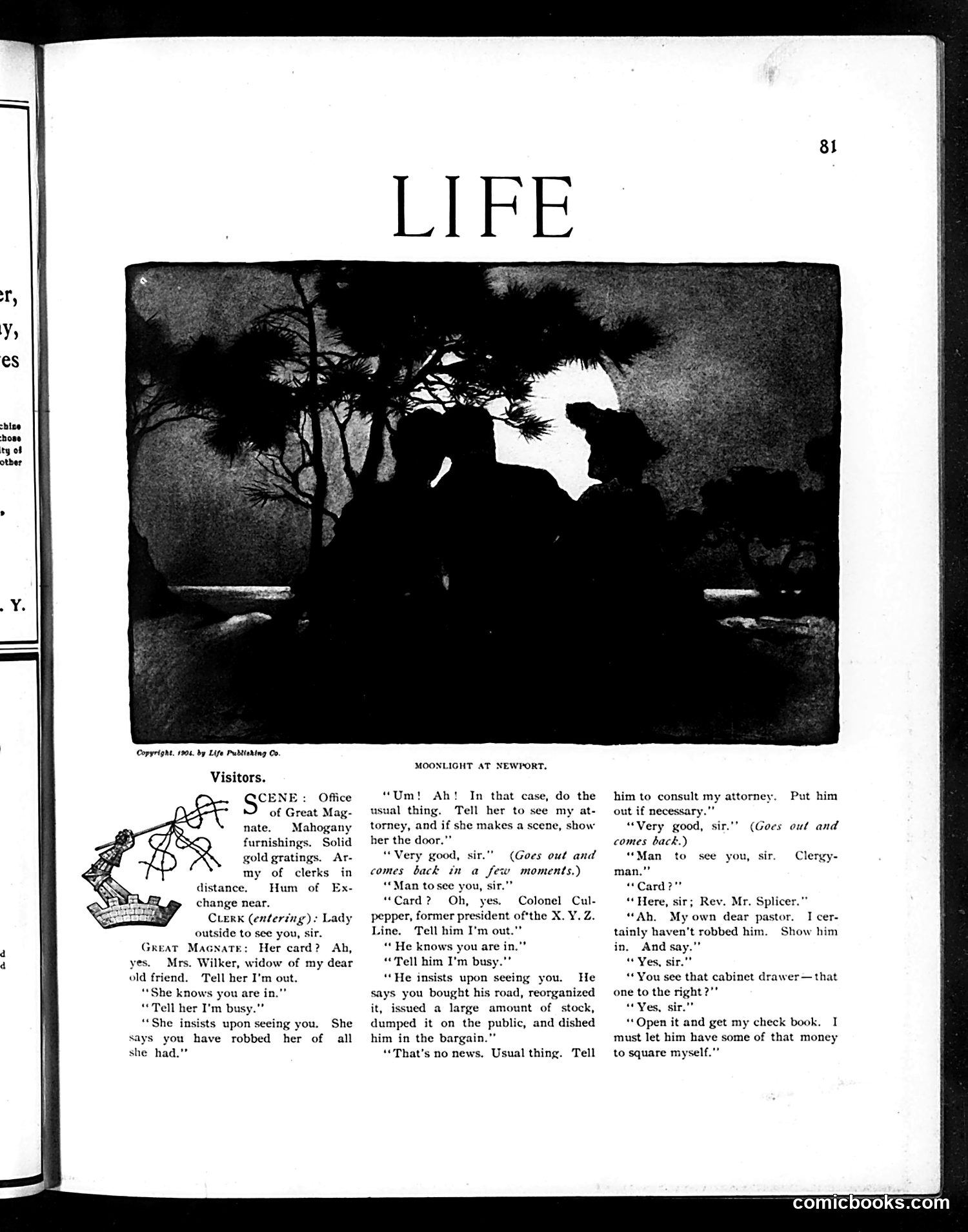
This page contains a dramatic silhouette illustration titled "Moonlight at Newport" showing figures in conversation beneath trees, accompanied by a theatrical script scene. The sketch depicts an office visit involving a Great Magazine (likely satirizing a prominent publication) and various characters including a clerk, Lady Culpepper (former X.Y.Z. Line president), and references to financial impropriety. The satire concerns a businessman who "bought his road, reorganized it, issued a large amount of stock, dumped it on the public, and dished him in the bargain"—a clear critique of Gilded Age corporate malfeasance and stock manipulation. The scene humorously presents the social awkwardness of wealthy circles confronting financial scandal and fraud, typical of Life's satirical commentary on wealthy Newport society and corrupt business practices of the era.
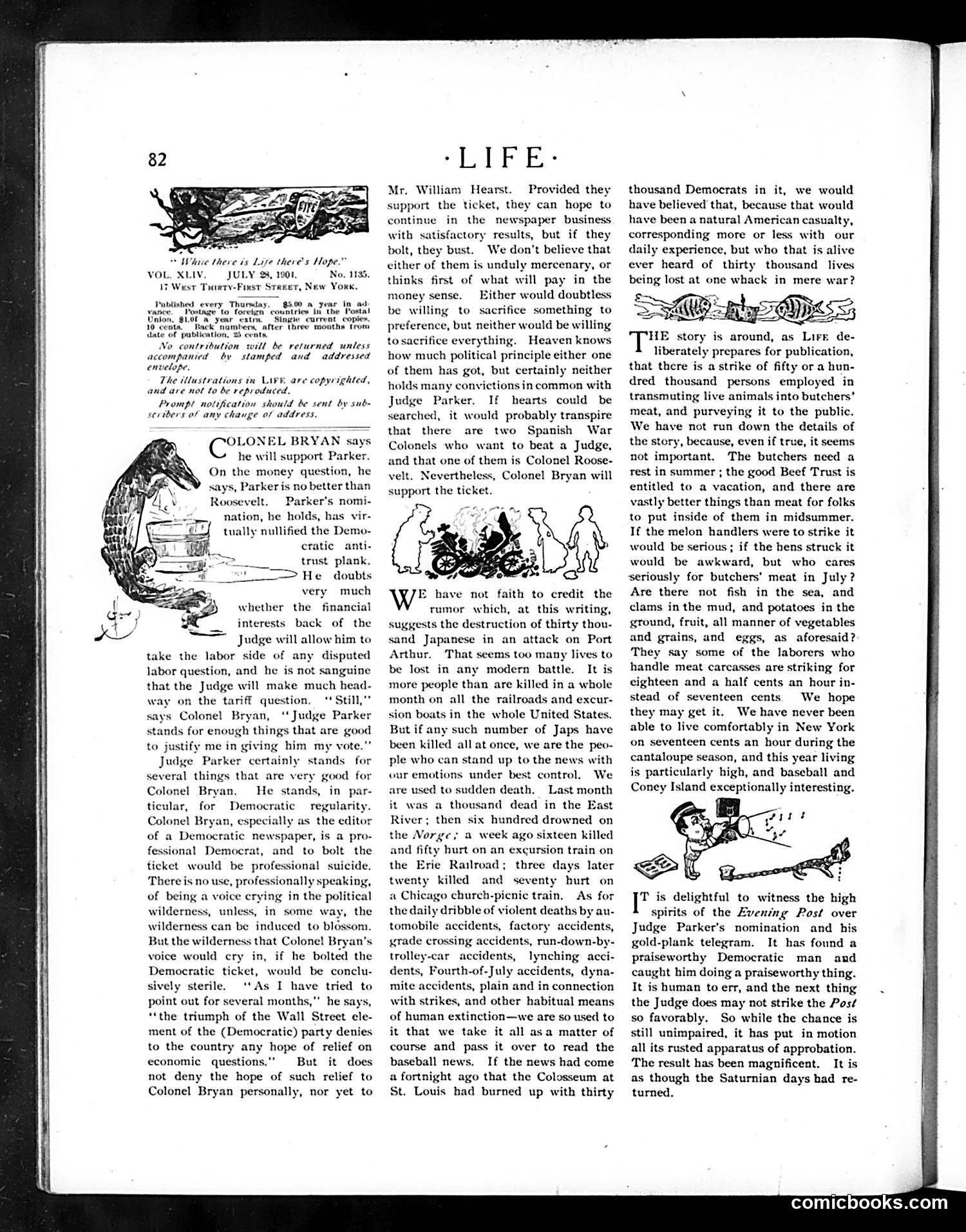
This page discusses the 1904 presidential election, specifically Judge Alton B. Parker's nomination as the Democratic candidate against incumbent Theodore Roosevelt. **Left cartoon**: Shows Colonel Bryan (William Jennings Bryan, three-time failed Democratic candidate) discussing Parker's nomination. The text reveals internal Democratic debate: Bryan prefers Parker to Roosevelt, though he questions whether Parker will actually challenge Roosevelt effectively on key issues like labor and tariffs. **Right section**: Addresses rumors of Japanese casualties in the Russo-Japanese War and various accident statistics, attempting to contextualize death tolls. It then pivots to praising Judge Parker's nomination as genuinely praiseworthy—a "Saturnian" moment (rare good news) for Democrats. The satire reflects Democratic anxiety about Parker as a viable challenger.
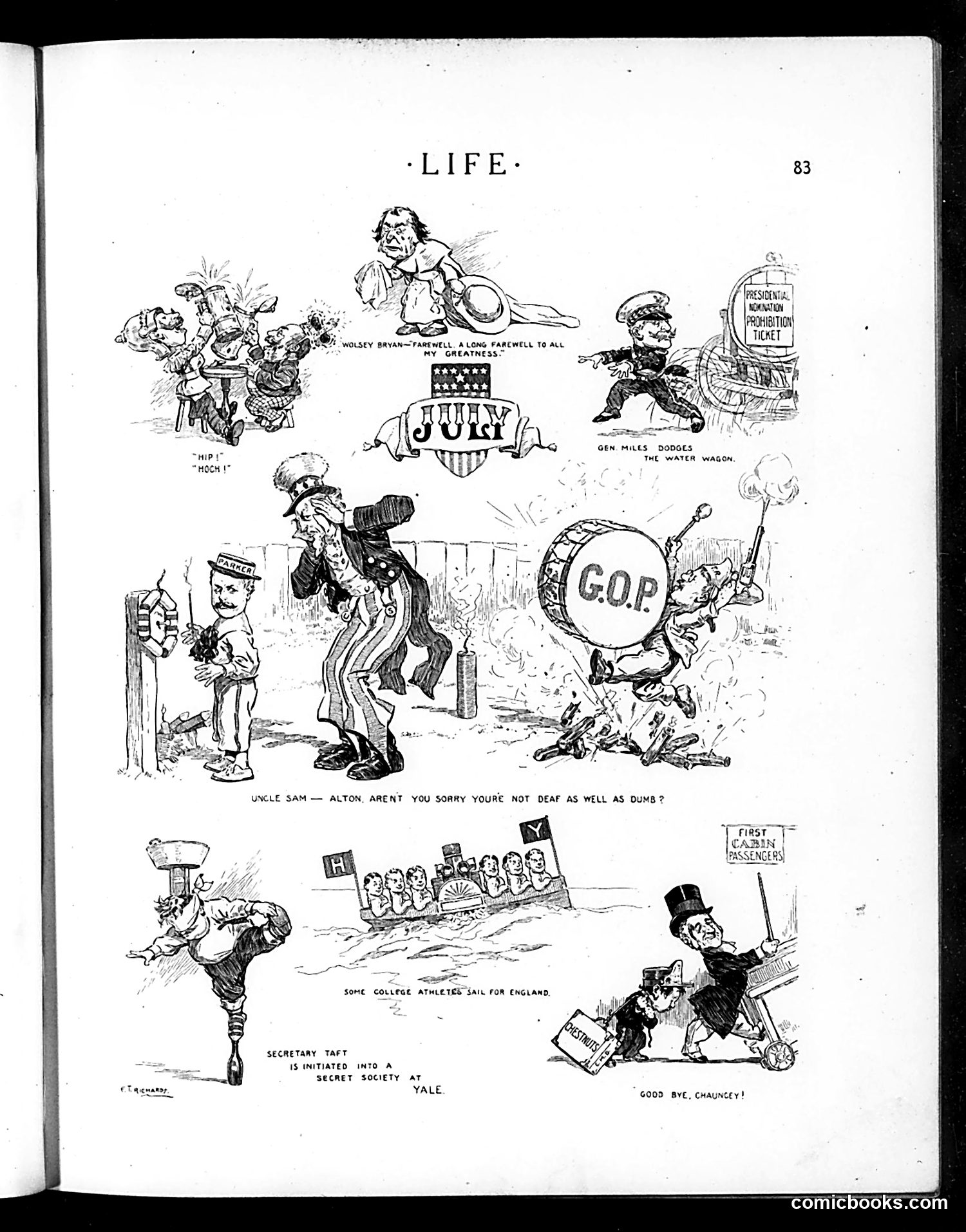
This page contains multiple satirical cartoons from the early 20th century commenting on American politics and society: **Top panels** reference Wolsey Bryan's farewell and General Miles Dodges, likely alluding to contemporary political figures and their departures or failures. **Center cartoon** shows Uncle Sam confronting a figure labeled "Alton," with dialogue mocking someone's hearing and intelligence—appears to be critical commentary on a political figure. **Lower panels** include: college athletes "sail for England," Secretary Taft's initiation into a secret society at Yale, and a farewell to "Chauncey" (unclear which Chauncey). The "G.O.P." drum and "Juicy" shield suggest Republican Party satire. Overall, the page ridicules political incompetence, elite social institutions, and specific contemporary figures through exaggerated caricature and visual humor typical of early-20th-century American political cartooning.
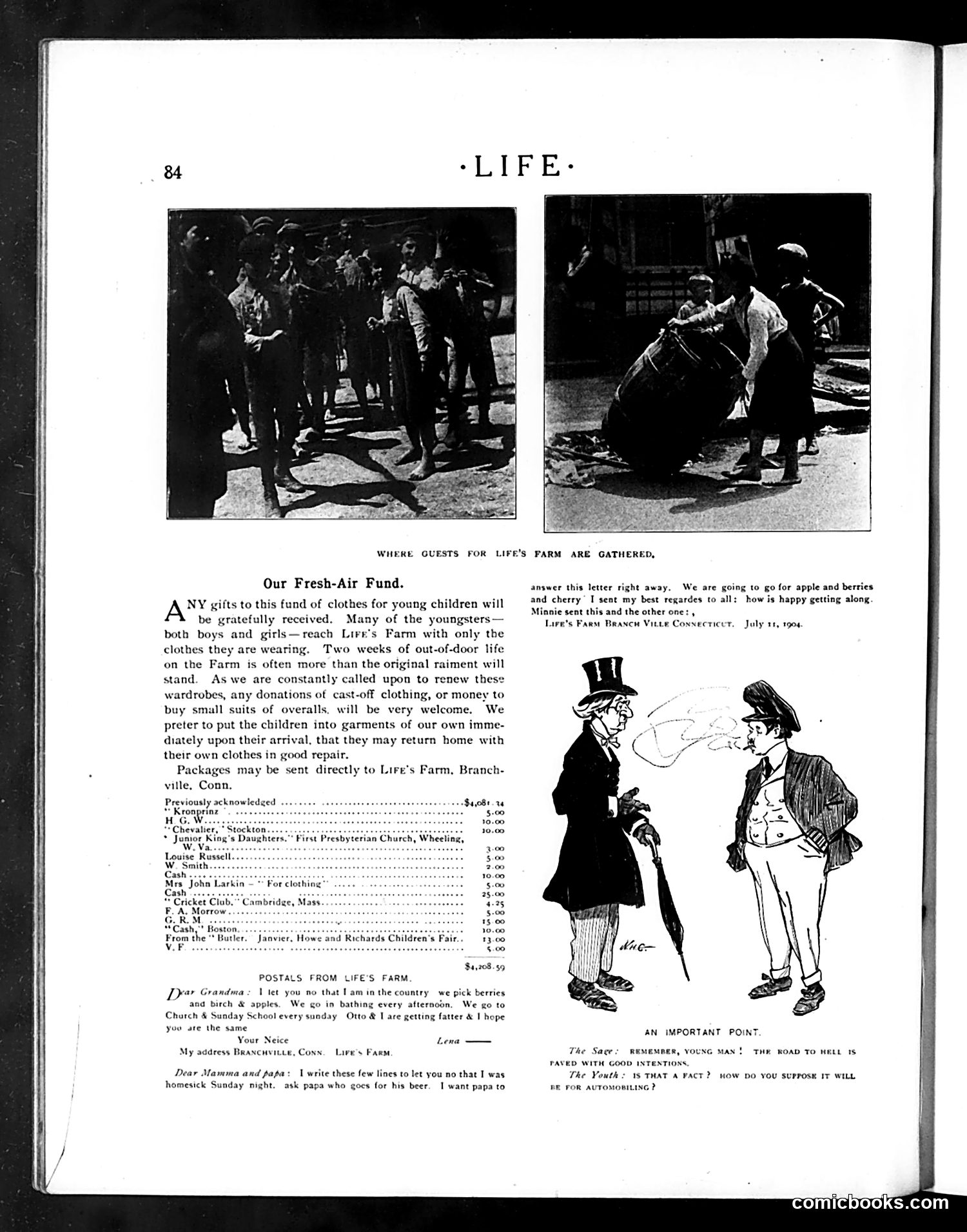
This page combines charitable fundraising with social satire. The top section announces Life's Farm's "Fresh-Air Fund," soliciting donations of children's clothing for poor urban youngsters sent to the countryside for health benefits—a genuine Progressive Era charity program. The cartoon below, titled "An Important Point," depicts two men in formal dress debating automobiles. The caption presents a cynical dialogue: the older man (appearing to represent established wealth/authority) warns the younger man that "the road to hell is paved with good intentions," while suggesting automobiles enable moral corruption. The youth counters that automobiles facilitate "automobilism"—implying the technology itself, rather than human choices, determines outcomes. The satire critiques how privileged classes blamed new technologies and social mobility for moral decline, rather than accepting personal responsibility.
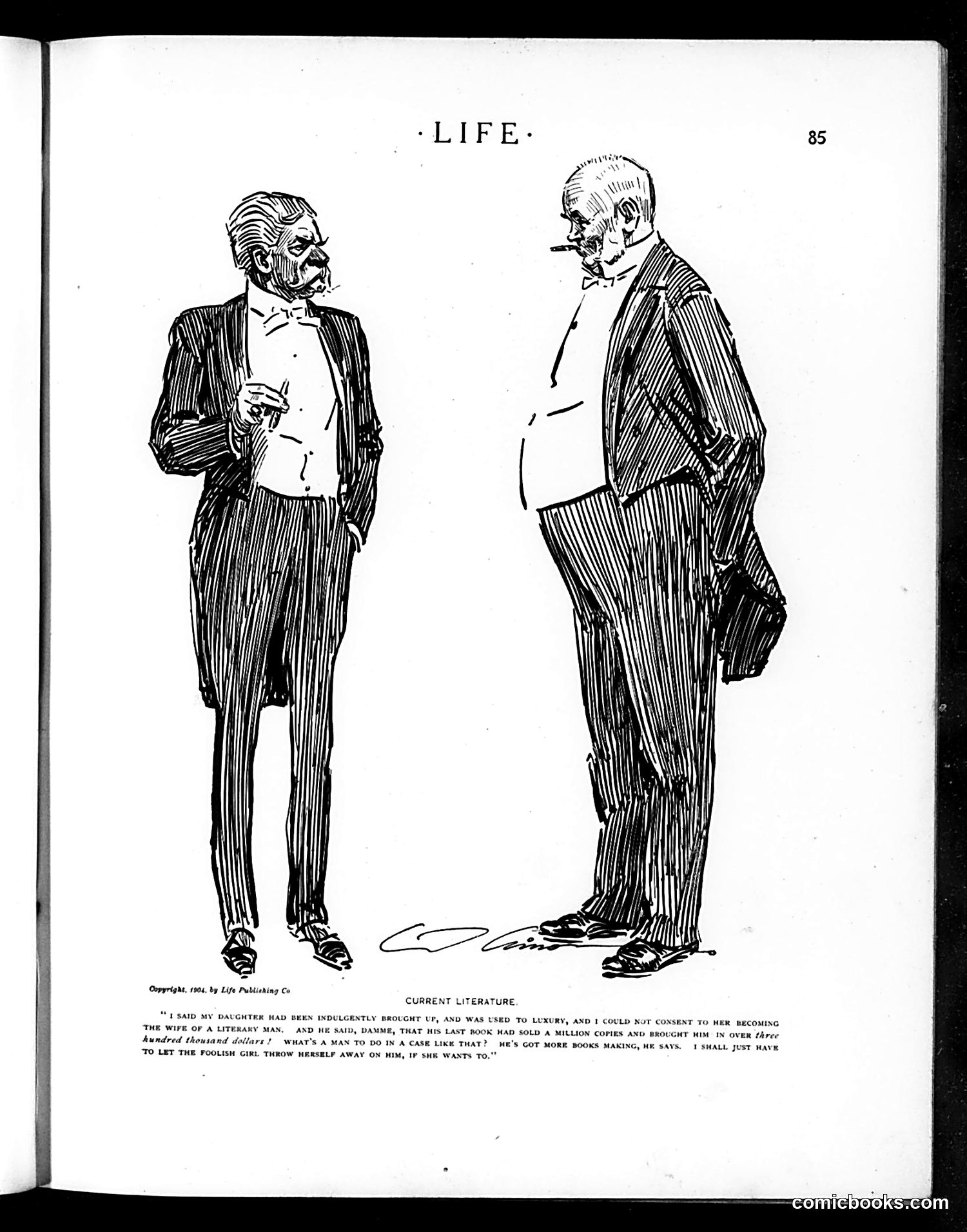
This satirical cartoon depicts two well-dressed men in conversation, labeled "Current Literature." The dialogue criticizes a father's concern about his daughter's literary education. He complains that his daughter has been "indulgently brought up" and exposed to luxury, making her unsuitable as a wife for a literary man whose last book sold only a million copies—"over three hundred thousand dollars." The satire targets wealthy American society's anxieties about marrying daughters to authors of modest commercial success, while mocking the pretension of treating literary achievement as a measure of financial worth. The joke highlights the absurdity of such status-conscious matchmaking among the privileged classes.
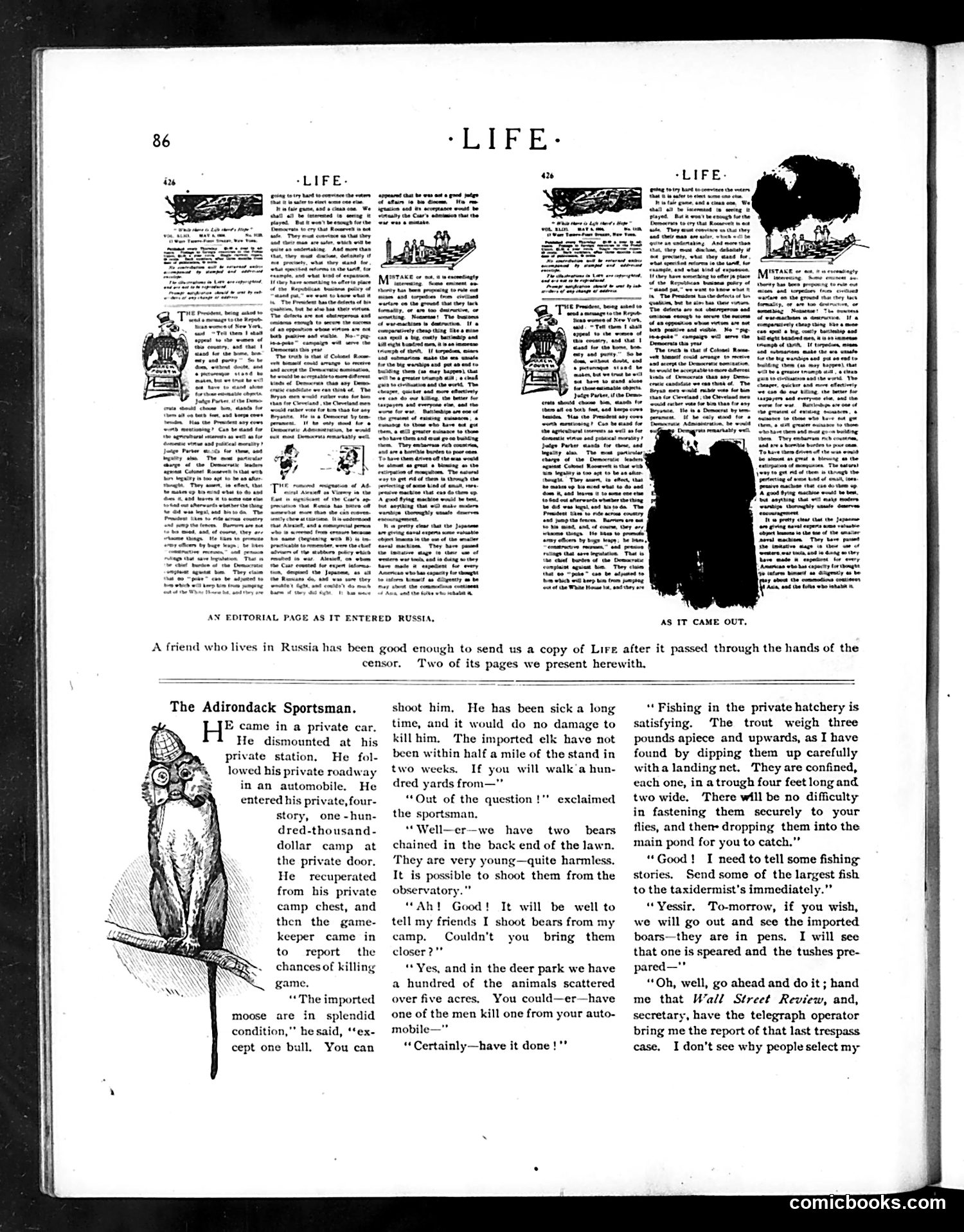
This page features "The Adirondack Sportsman," a satirical story about a wealthy businessman who arrives at a private camp via automobile and demands access to hunt. The illustrated figure shows a portly, well-dressed man carrying a rifle—a caricature of the nouveau riche businessman stereotype. The satire mocks capitalist excess: the man's entitlement, his casual approach to hunting (wanting imported game conveniently provided), and the obsequiousness of camp staff accommodating his demands. The conversation reveals the character's disconnect from actual outdoor skill—he expects animals "within half a mile" and killed bears to be hand-delivered. The page also shows redacted LIFE editorial content that passed Russian censorship, highlighting Cold War-era press suppression.
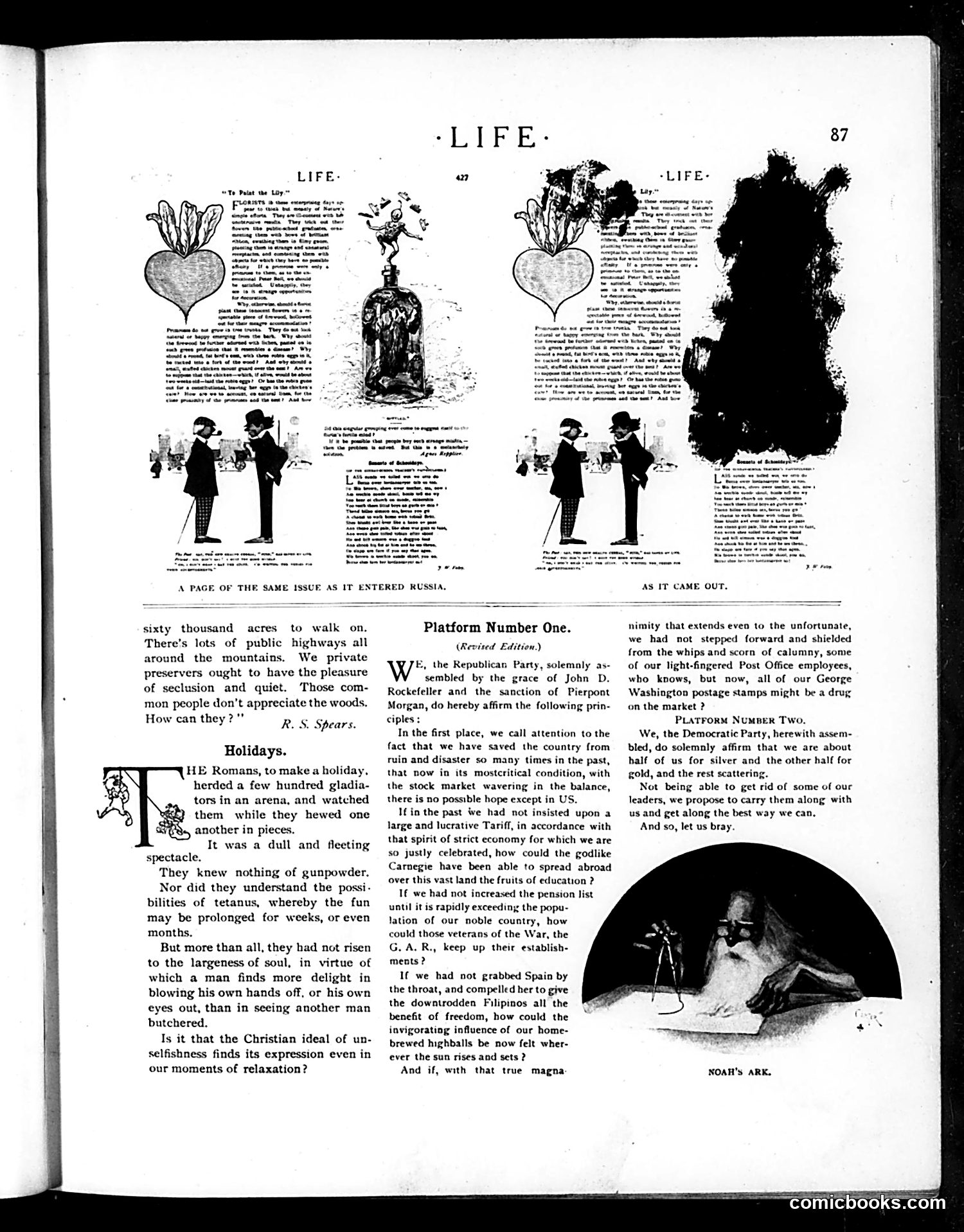
This page contains two political cartoons satirizing early 20th-century American politics. The left section shows "Platform Number One" and "Platform Number Two," presenting contrasting Republican and Democratic party positions. The Republican platform emphasizes economic stability and tariff protectionism, while the Democratic platform discusses monetary policy and critiques of Republican governance. Below these texts are illustrations of two men in formal dress appearing to make political arguments, likely representing party spokesmen. The image labeled "Noah's Ark" (bottom right) appears to be a separate satirical illustration, though its specific political reference is unclear from the visible text. The cartoons use dialogue and visual caricature to mock the competing claims and platforms of the two major parties, a typical strategy in Life magazine's political satire during the Progressive Era.
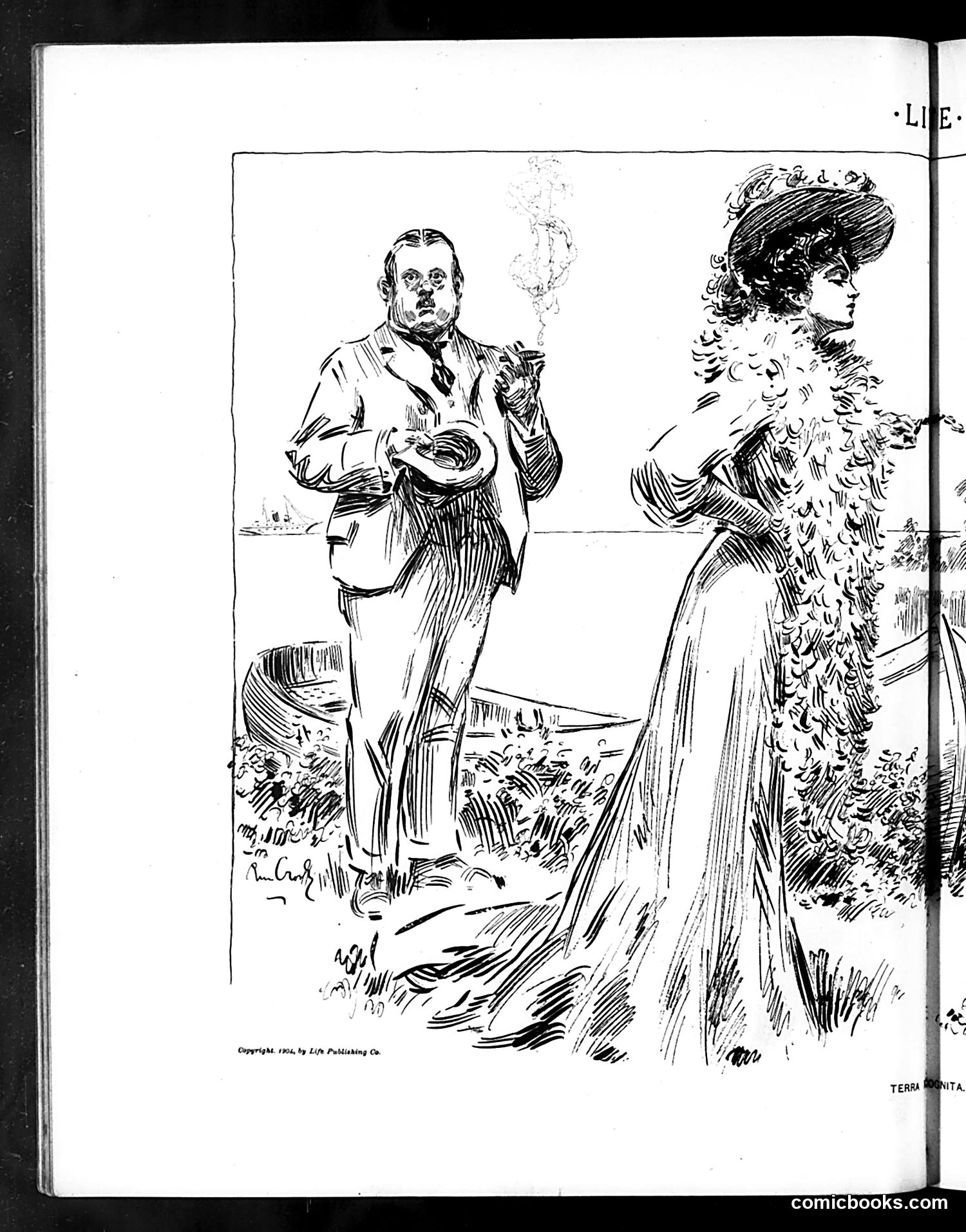
This appears to be a single illustration from *Life* magazine (copyright 1902, per the visible text). The cartoon depicts two figures in what seems to be a garden or outdoor setting: a man in a suit smoking a cigar, and an elegantly dressed woman in an elaborate feathered hat and gown shown in profile. The satire likely concerns gender roles and courtship dynamics of the Edwardian era. The woman's ostentatious clothing and the man's somewhat awkward or besotted expression suggest commentary on either romantic pursuits, marital relations, or female vanity and male indulgence of it. Without the accompanying article text, the specific social criticism remains unclear, though the contrast between the figures' presentations hints at class, fashion, or relationship power dynamics typical of *Life's* satirical focus.
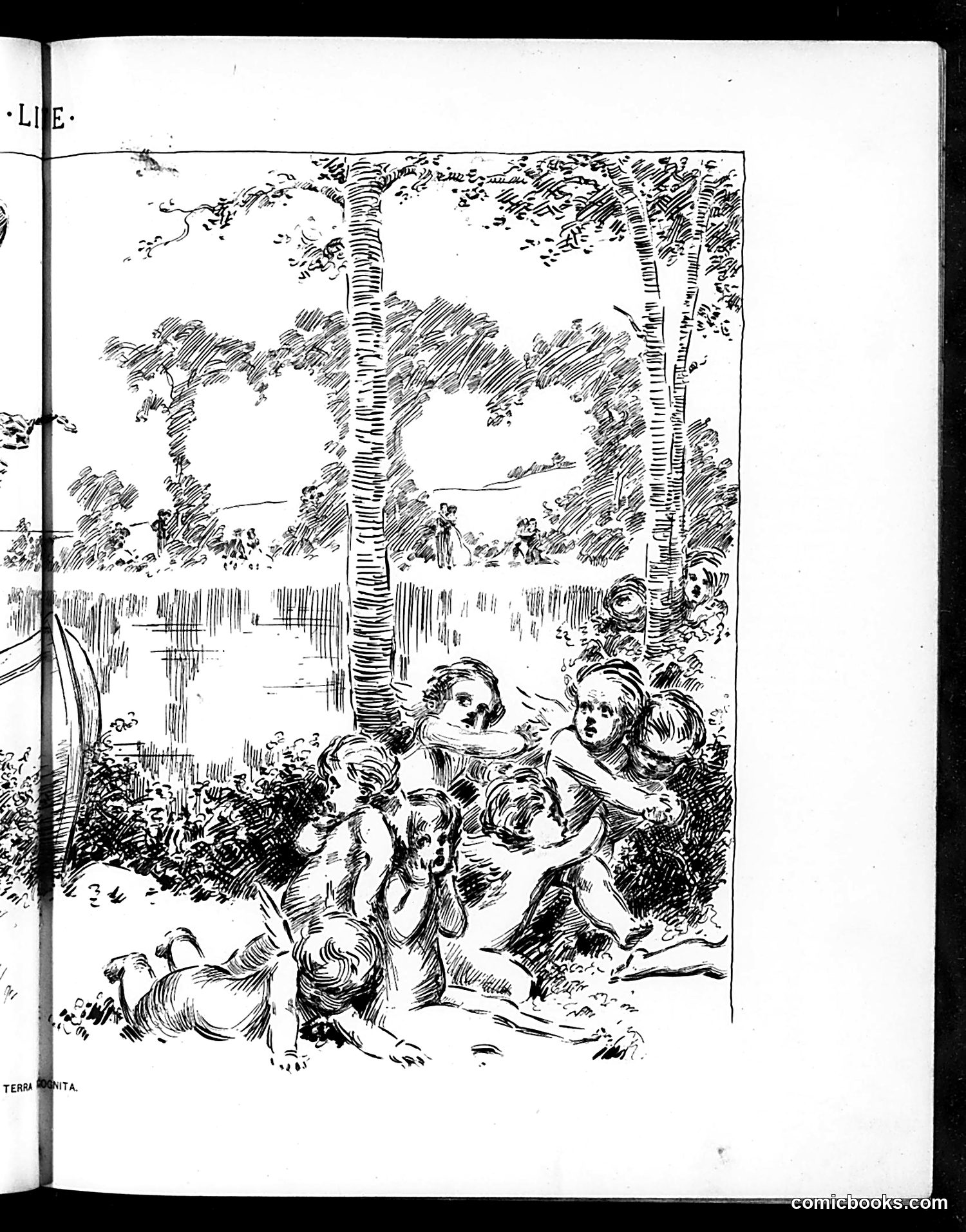
This is a satirical illustration titled "LIE" showing cherubs or putti (baby figures) in a pastoral woodland setting. The image depicts multiple nude or lightly-clothed child figures engaged in playful, innocent activity beneath tall trees. The satire appears to critique the romanticization of childhood innocence or nature through classical artistic conventions. By presenting these idealized figures with the simple label "LIE," the cartoonist suggests that such depictions—common in fine art and sentimental literature of the era—represent false or misleading representations of reality. The work likely comments on Victorian-era artistic pretension or the gap between idealized artistic portrayals and actual human experience. Without additional context from the magazine's publication date, the specific target of this satire remains somewhat unclear.
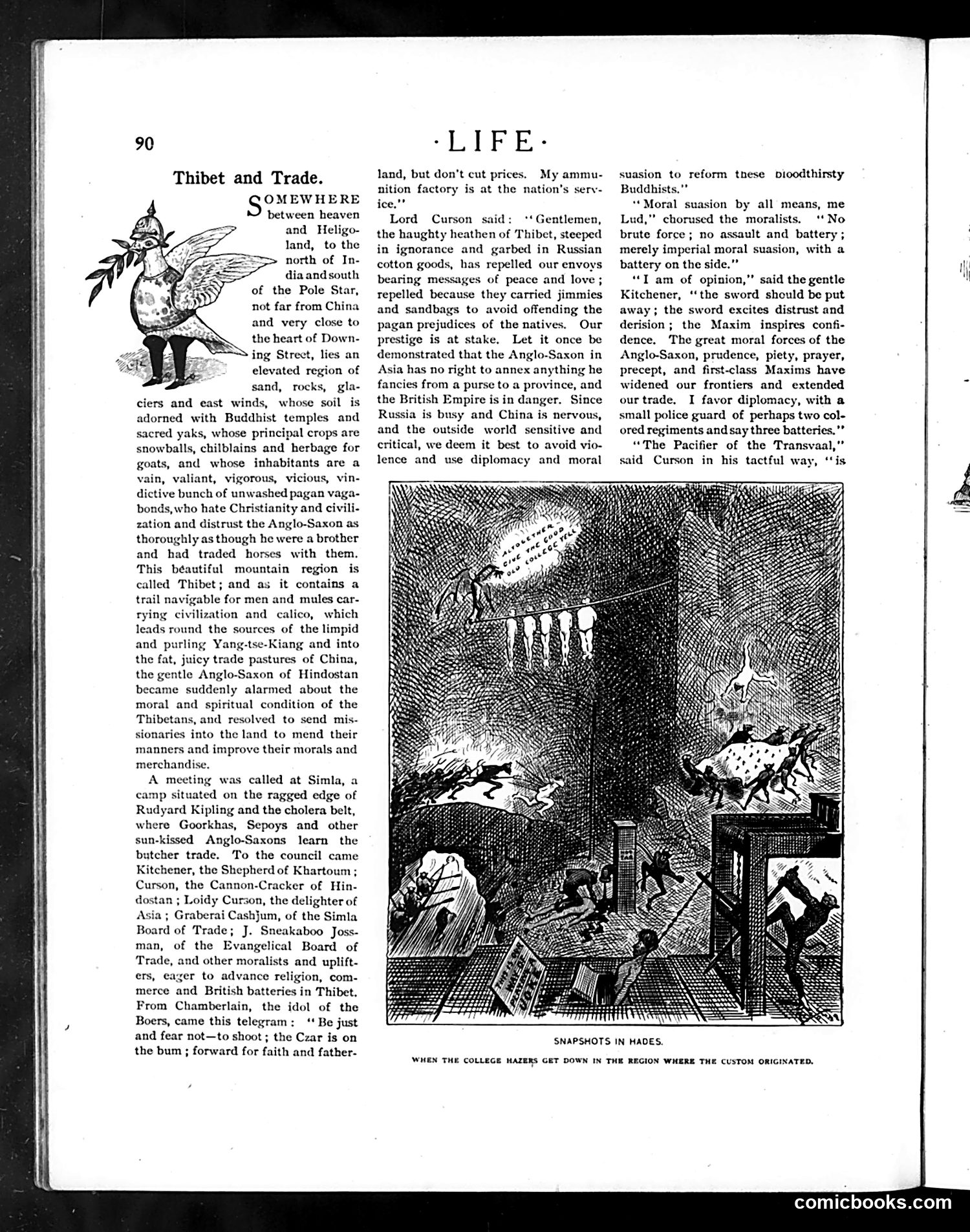
This page satirizes British imperial expansion into Tibet under the guise of missionary and commercial "civilization." The article criticizes Lord Curson (the Viceroy of India, identifiable from context) and other British officials who justify military intervention in Tibet by claiming moral and spiritual superiority over "haughty heathen" Tibetans. The accompanying illustration, titled "Snapshots in Hades," depicts the moral consequences of this imperial aggression—showing figures descending into hell, suggesting the satirist views Britain's military actions as morally corrupt despite their civilizing rhetoric. The satire mocks the disconnect between Britain's claimed peaceful intentions and its actual use of military force to impose trade and Christian values on resistant populations.
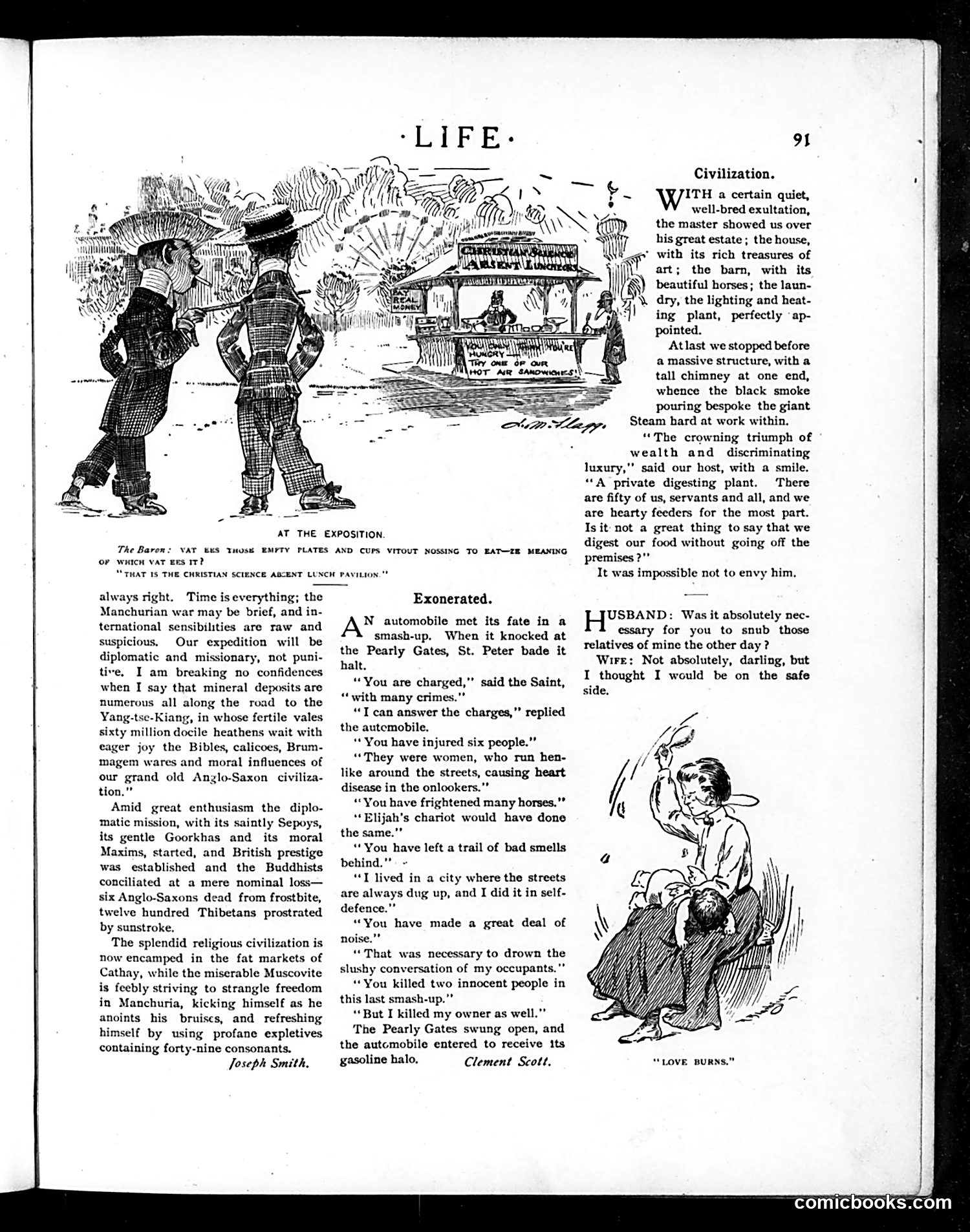
**Top Cartoon ("At the Exposition"):** Two bewildered European figures (likely a German baron, indicated by "vat" dialect) examine empty plates at a "Christian Science Ascent Lunch Pavilion." The joke satirizes Christian Science's emphasis on mind-over-matter healing—the pavilion offers no actual food, only spiritual nourishment. The baron's confusion mocks both the religious sect and European visitors' incomprehension of American eccentricities. **"Exonerated" (by Clement Scott):** An automobile argues its case at heaven's gates, blaming victims for their own injuries (women caused heart disease by running recklessly; noise drowned out bad conversation). St. Peter admits the car to heaven anyway—a sharp satire on automobiles' new danger to urban life and how manufacturers/drivers deflect responsibility onto pedestrians. **"Civilization":** A wealthy industrialist proudly shows his private sewage plant, treating it as a luxury symbol. The satire mocks nouveau-riche materialism and the era's sanitation obsession as markers of status rather than genuine civilization. **Bottom right dialogue:** A minor joke about marital conflict and strategic rudeness.
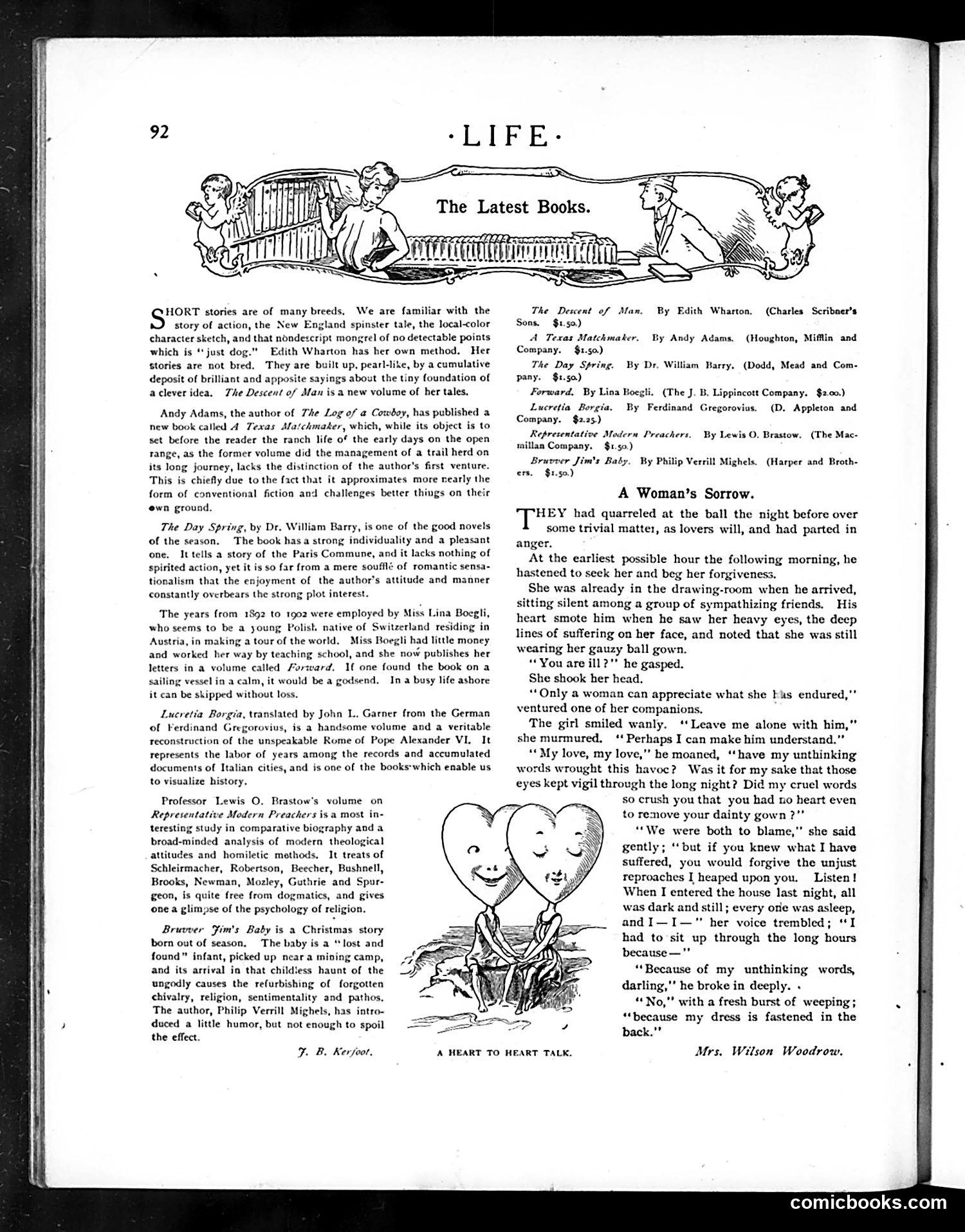
This page is primarily a **book review section** from *Life* magazine, but includes a short story excerpt titled "A Woman's Sorrow" by Mrs. Wilson Woodrow. The accompanying illustration—two anthropomorphized hearts with faces—is a sentimental visual accompaniment to the story's romantic plot. The excerpt depicts a woman's emotional distress after a lovers' quarrel at a ball. She confronts her partner about their dispute, accusing him of cruelty and blaming him for her suffering ("because of my unthinking words...my dress is fastened in the back"). **For modern readers:** This represents **Victorian-era sentimental fiction**—melodramatic, emotionally heightened romantic narratives popular in early 1900s magazines. The "heart to heart talk" framing emphasizes emotional vulnerability and reconciliation as central dramatic elements. The cute, cartoonish hearts underscore the period's romanticized treatment of courtship and domestic conflict as genteel entertainment rather than serious social commentary.
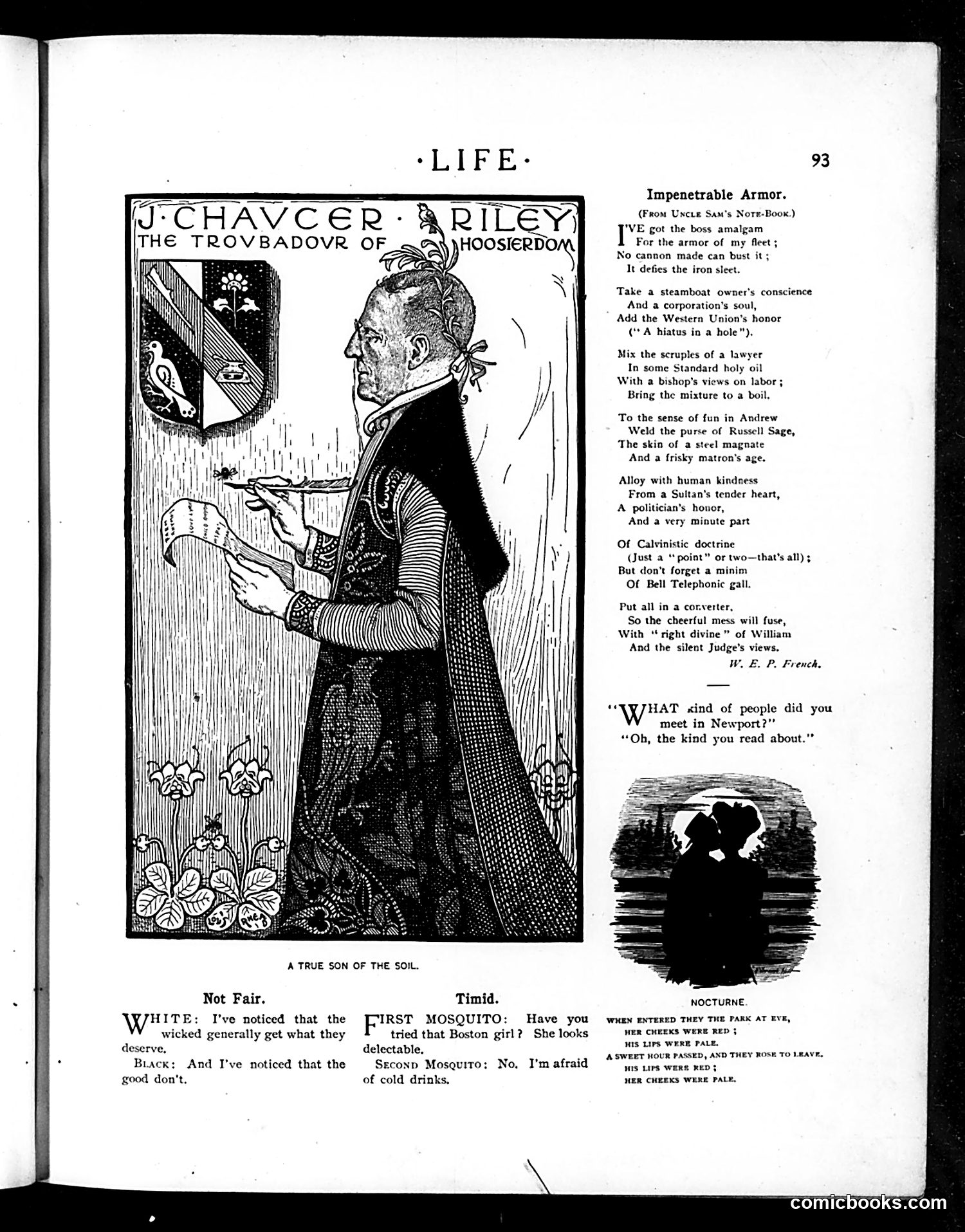
This page contains multiple satirical pieces from early Life magazine (likely 1880s-1890s based on style). **Main portrait:** J. Chaucer Riley, "The Troubadour of Hoosierdom"—a caricature of James Whitcomb Riley, the Indiana poet known for folksy, sentimental verse about rural life. **"Impenetrable Armor":** A poem satirizing corporate corruption by listing cynically what comprises American business ethics—combining the conscience of steamboat owners, railroad magnates' honor, lawyers' scruples, and Standard Oil's methods. It mocks how "armor" against criticism is built from hypocrisy and moral emptiness. **"Not Fair":** A brief joke contrasting racial fortunes: white people get rewarded for wickedness; Black people don't benefit from goodness—dark social commentary on systemic injustice. **"Timid":** A joke about mosquitoes avoiding Boston girls due to their consumption of "cold drinks"—likely soda or temperance beverages, making their blood unpalatable. **"Nocturne":** A poem about romantic role-reversal in a park encounter.
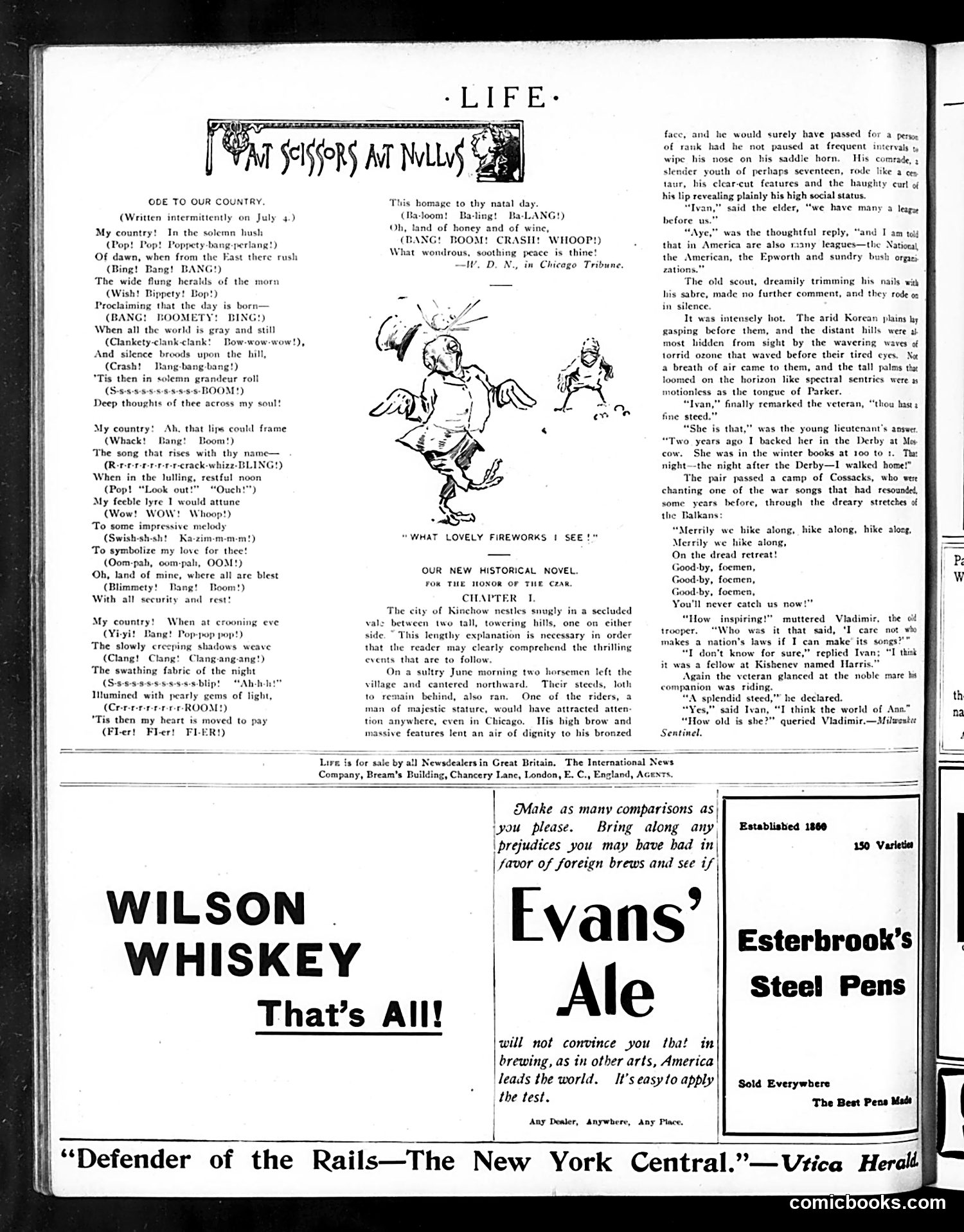
This page satirizes American Independence Day celebrations through two main pieces: **"Ode to Our Country"** (top) is a comic poem mocking July 4th patriotic fervor. The humor lies in the contrast between solemn, reverent language about the nation and the interruptions of *actual* Independence Day sounds—fireworks explosions rendered as onomatopoeia (BANG! CRASH! WHOOP!). The joke: real Americans can't contemplate their country meaningfully because fireworks constantly interrupt with loud noise. It's gentle satire on how commercialized and cacophonous the holiday has become. **"Our New Historical Novel"** (bottom) parodies overwrought historical fiction popular at the time. It opens in "Kinchow" with melodramatic prose introducing Russian/Eastern European characters, then undermines itself with absurd details (a dignified officer wiping his nose on his saddle horn; references to American baseball leagues inserted into a Russian steppe narrative). The satire mocks both the pretentiousness of historical novels and their careless, anachronistic writing—mixing incompatible settings and details for comic effect. Both pieces represent Life's typical sophisticated humor targeting American cultural pretensions.
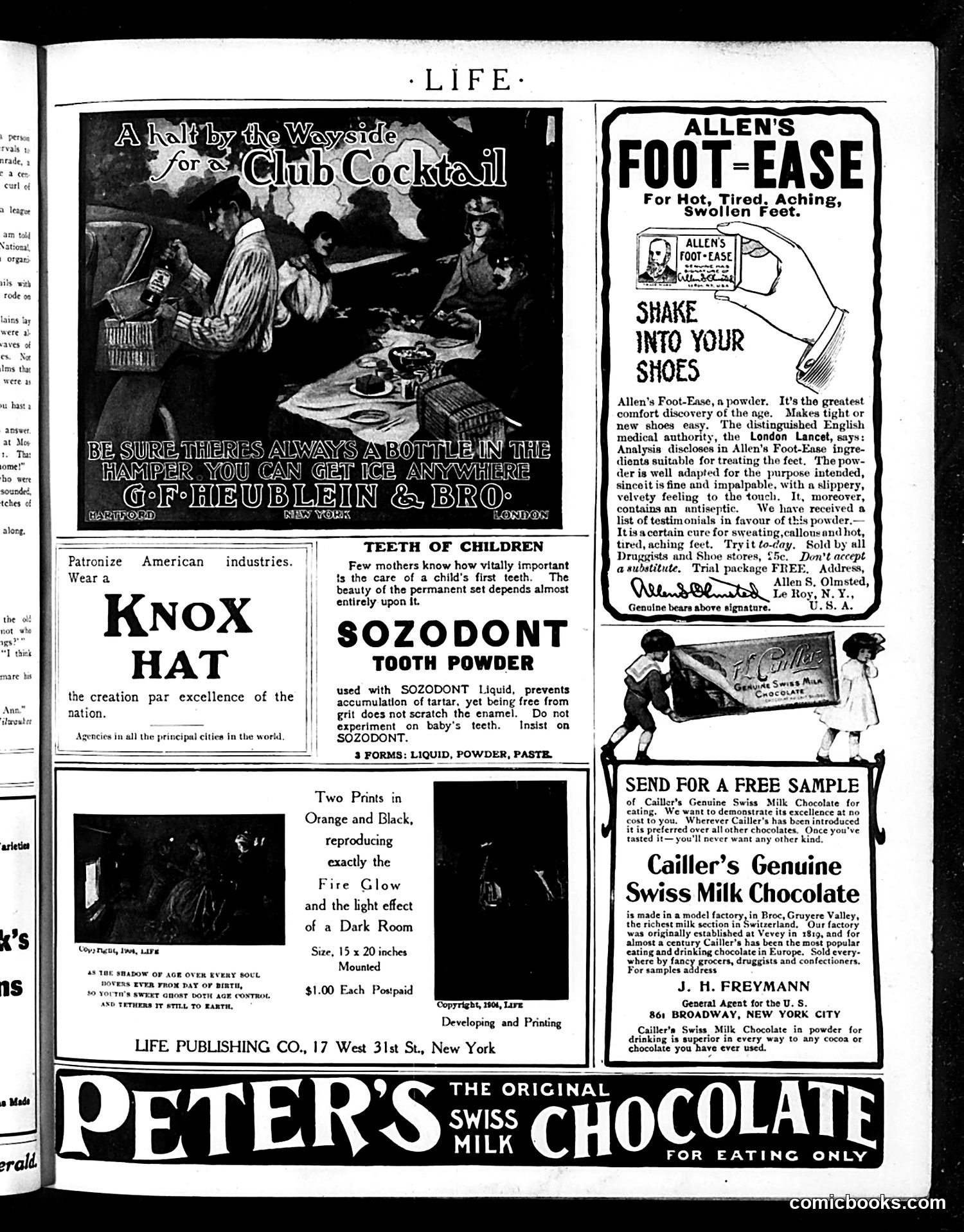
This page is primarily **advertising**, not political satire. It contains vintage product advertisements typical of early 1900s American magazines: **Key Ads:** - **Allen's Foot-Ease**: A medicinal powder for foot pain, citing endorsements from the London medical journal *Lancet* - **Knox Hat**: Appeals to nationalism ("Patronize American industries") - **Sozodont Tooth Powder**: Baby dental care product - **Cailler's Swiss Milk Chocolate**: Premium imported chocolate with free samples offered - **Peter's Swiss Milk Chocolate**: Competing chocolate brand **Social Context for Modern Readers:** These ads reflect early 20th-century consumer culture emphasizing: - Medical authority (referencing prestigious European sources) - American patriotism (Knox Hat) - Premium imported goods as status symbols (Swiss chocolates) - Direct mail marketing (free samples) - Detailed product testimonials as persuasion The page demonstrates how Life functioned as both satirical publication and advertising vehicle, with ads dominating editorial space.
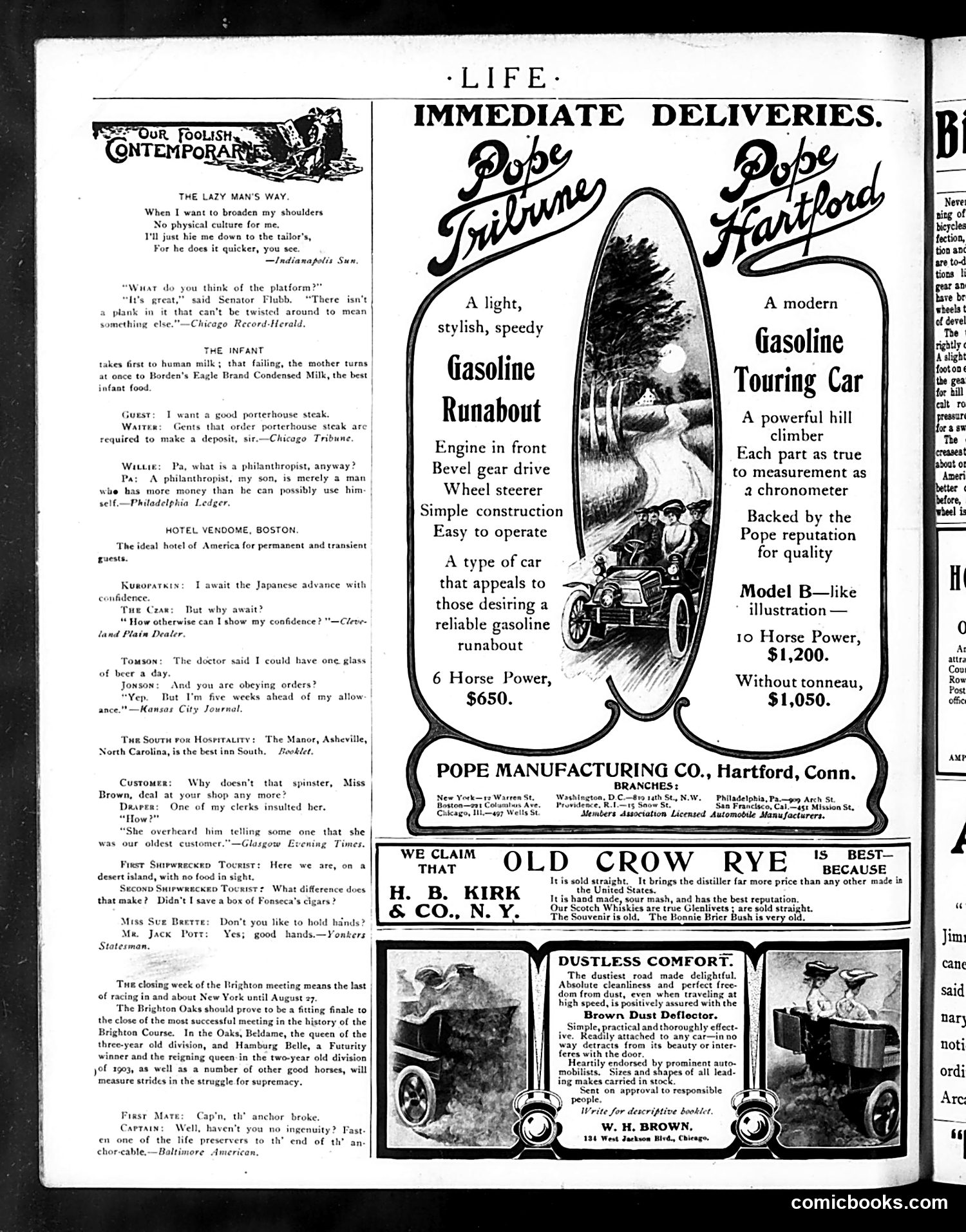
This page is primarily **advertising**, with small satirical jokes in the left column serving as filler content. The main advertisements promote: 1. **Pope automobiles** (center) — Two models: the "Tribune" ($650, 6 HP runabout) and "Fairford" ($1,200-$1,050, touring car). These are early automobiles with gasoline engines, targeting buyers seeking reliable, simple vehicles. 2. **Old Crow Rye whiskey** and **H.B. Kirk & Co.** spirits 3. **Brown Dust Deflector** — an automotive accessory The left-column humor consists of brief jokes about lazy tailors, political double-talk, infant formula, restaurant deposits, and philanthropists. These are generic period humor with no specific political targets — the satire is gentle social commentary on everyday American life (wealth, pretension, business practices). The page reflects early 1900s consumer culture: automobiles were still novel luxury goods requiring explanation of their practical benefits.
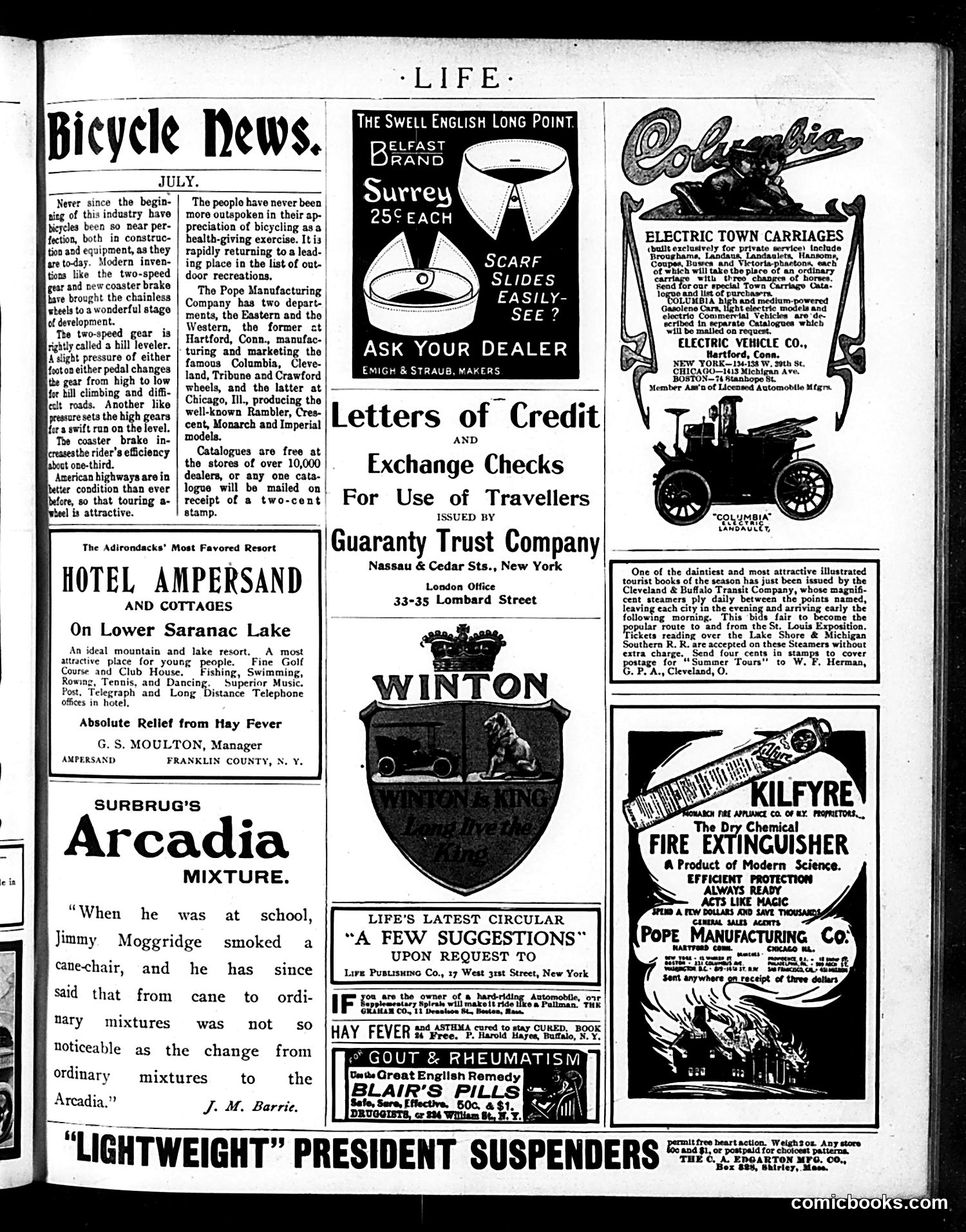
This page is primarily **advertising and announcements**, not satirical content. It's a July issue of *Life* magazine featuring: **Main content:** Product advertisements and travel promotions—bicycles (Columbia, Rambler), hotels (Hotel Ampersand in the Adirondacks), a bank service (Guaranty Trust Company), electric vehicles and carriages, and patent medicines (Arcadia Mixture, Blair's Pills for hay fever and gout). **No political cartoons are present.** The only notable non-advertisement element is a brief quote attributed to "J. M. Barrie" endorsing Surburg's Arcadia Mixture, likely referencing the famous Scottish author to lend prestige to the product. The page reflects early 20th-century consumer culture, with bicycles, electric cars, and travel gaining popularity. The patent medicine advertisements are typical of the era, before modern FDA regulations.
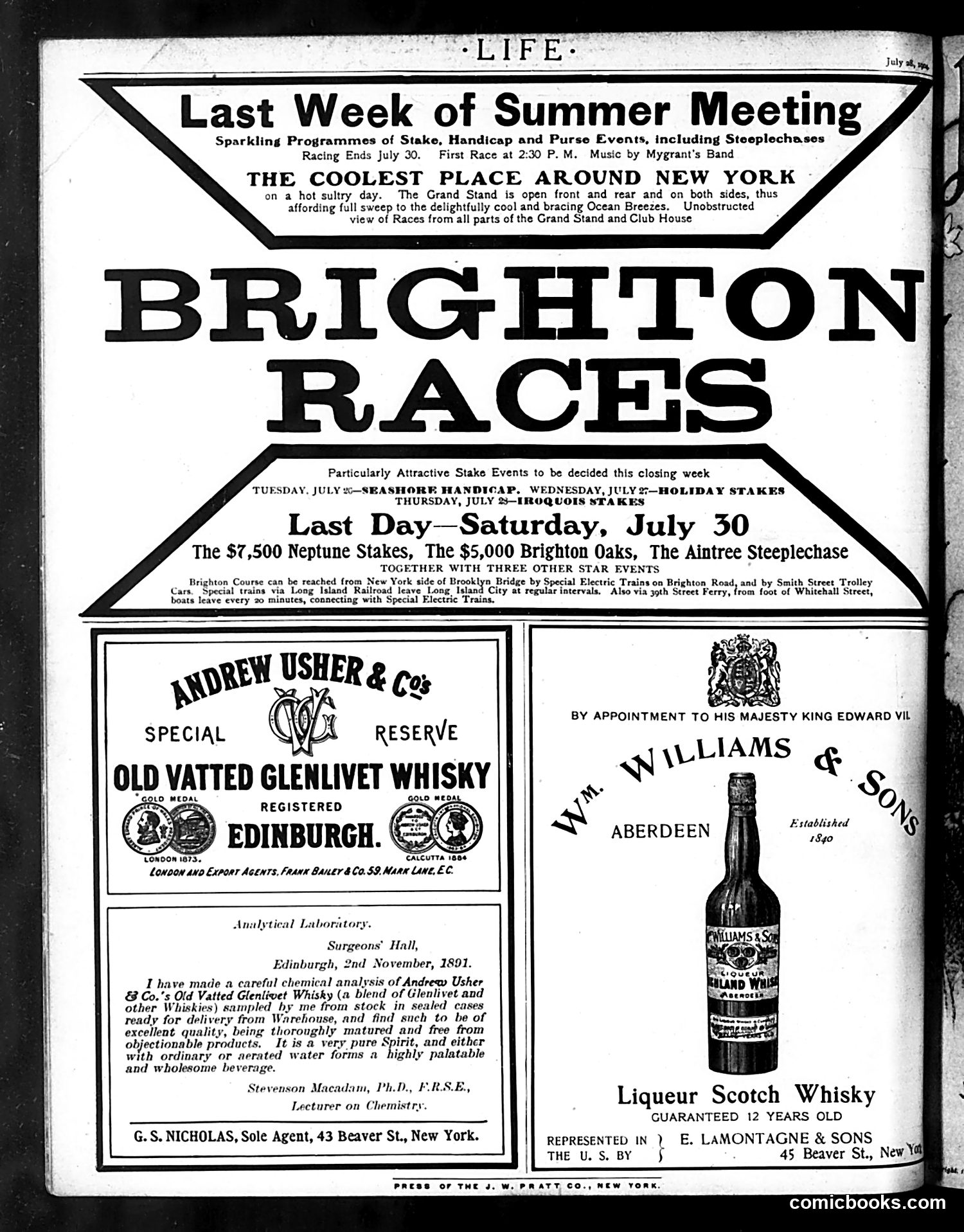
This is primarily an **advertisement and announcements page**, not a satirical cartoon. The page promotes Brighton Beach Racecourse's final week of summer racing (ending July 30), describing it as "the coolest place around New York" on hot days due to ocean breezes. The page includes practical transit information for New York readers and highlights major stakes races (the Neptune Stakes, Brighton Oaks, Aintree Steeplechase). Two liquor advertisements occupy the lower half: Andrew Usher & Co.'s Old Vatted Glenlivet Whisky (with a scientific endorsement from an 1891 Edinburgh chemist) and Williams & Sons' Highland Whisky, both marketed to Americans via New York agents. **No cartoon or satire is present**—this reflects Life magazine's dual role as satirical periodical and advertising vehicle in the 1910s era.