
Life, 1904-07-28 · page 14 of 20
Life — July 28, 1904 — page 14: what you’re looking at
What you’re looking at
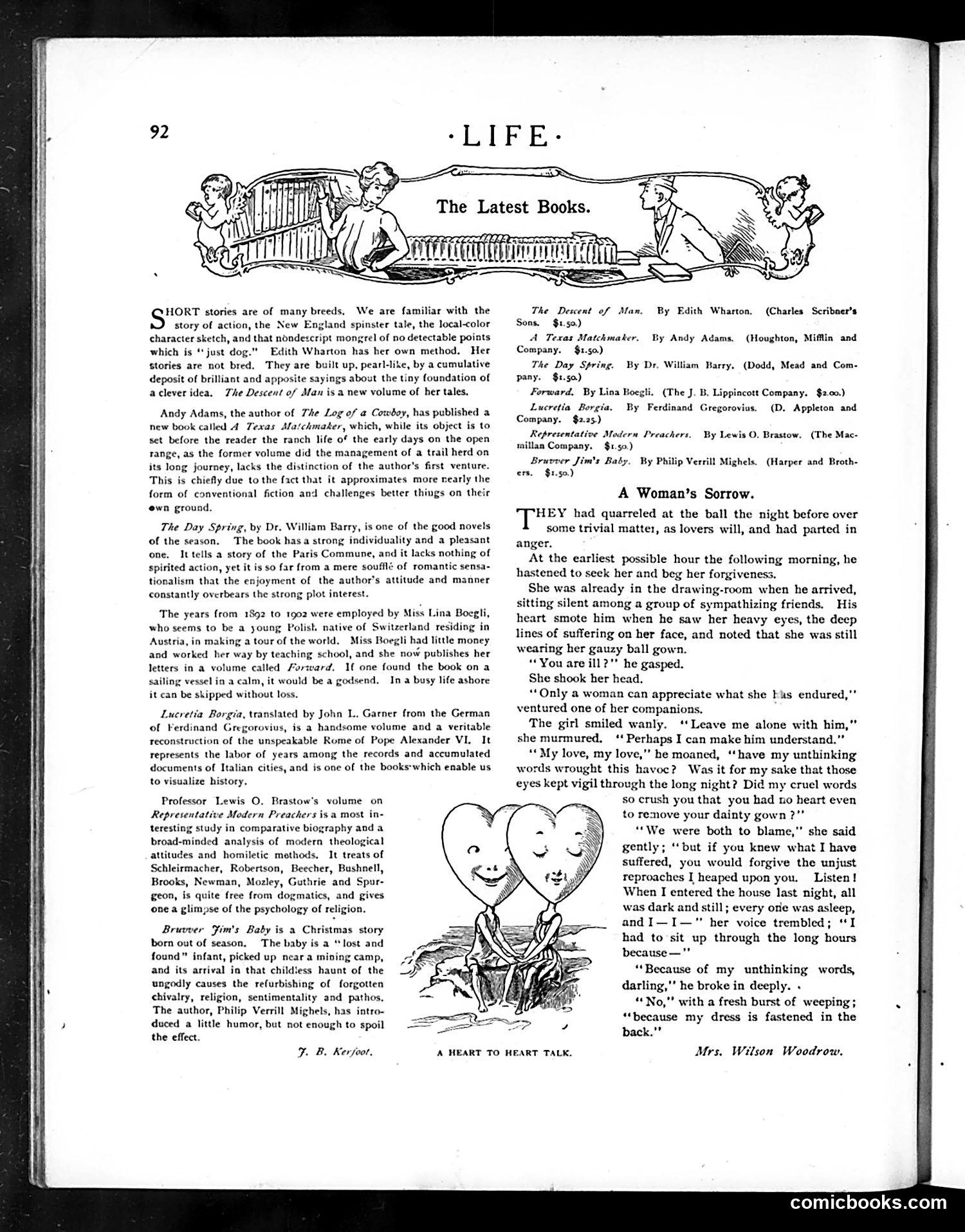
This page is primarily a **book review section** from *Life* magazine, but includes a short story excerpt titled "A Woman's Sorrow" by Mrs. Wilson Woodrow. The accompanying illustration—two anthropomorphized hearts with faces—is a sentimental visual accompaniment to the story's romantic plot. The excerpt depicts a woman's emotional distress after a lovers' quarrel at a ball. She confronts her partner about their dispute, accusing him of cruelty and blaming him for her suffering ("because of my unthinking words...my dress is fastened in the back"). **For modern readers:** This represents **Victorian-era sentimental fiction**—melodramatic, emotionally heightened romantic narratives popular in early 1900s magazines. The "heart to heart talk" framing emphasizes emotional vulnerability and reconciliation as central dramatic elements. The cute, cartoonish hearts underscore the period's romanticized treatment of courtship and domestic conflict as genteel entertainment rather than serious social commentary.
📄 Transcribed text from this page (OCR, searchable)
Machine-transcribed from the original scan — historical spelling and the odd misread are preserved.
HORT stories are of many breeds, We are familiar with the NS) story of action, the New England spinster tale, the local-color character sketch, and that nondescript mongrel of no detectable points which is “just dog." Edith Wharton has her own method. Her stories are not bred. They are built up, pearl-like, by a cumulative deposit of brilliant and apposite sayings about the tiny foundation of aclever idea. The Descent of Man isa new volume of her tales. Andy Adams, the author of Tie Log of a Cowboy, has published a new book called 4 Texas Ma/chmaker, which, while its object is to set before the reader the ranch life of the early days on the open range, as the former volume did the management of a trail herd on its long journey, lacks the distinction of the author's first venture. This is chiefly due to the fact that it approximates more nearly the form of conventional fiction and challenges better thivgs on their ewn ground. The Day Spring, by Dr. William Barry, is one of the good novels of the season. The book has.a strong individuality and a pleasant one. It tells a story of the Paris Commune, and it lacks nothing of spirited action, yet it is so far from a mere soufflé of romantic sensa- tionalism that the enjoyment of the author's attitude and manner constantly overbears the strong plot interest. The years {rom 1892 to 1902 were employed by Miss Lina Boegli, who seems to be a young Polist. native of Switzerland residing in Austria, in making a tour of the world, Miss Boegli had little money and worked her way by teaching school, and she now publishes her letters in a volume called Forward. If one found the book on a sailing vessel in a calm, it would be a godsend, In a busy life ashore it can be skipped without loss. Lucretia Borgia, translated by John L. Garner from the German of Ferdinand Gregorovius, is a handsome volume and a veritable reconstruction of the unspeakable Rome of Pope Alexander VI. It represents the labor of years among the records and accumulated documents of Italian cities, and is one of the books-which enable us to visualize history. Professor Lewis O, Brastow’s volume on Representative Modern Preachers is a most in- teresting study in comparative biography and a broad-minded analysis of modern theological attitudes and homiletic methods. It treats of Schleirmacher, Robertson, Beecher, Bushnell, Brooks, Newman, Mozley, Guthrie and Spur- geon, is quite free from dogmatics, and gives one a glimpse of the psychology of religion. Bruvver Fim's Baby is a Christmas story born out of season, The baby is a “lost and found” infant, picked up near a mining camp, and its arrival in that childiess haunt of the ungodly causes the refurbishing of forgotten chivalry, religion, sentimentality and pathos, The author, Philip Verrill Mighels, has intro- duced a little humor, but not enough to spoil the effect. J. B. Kerfoot. A HEART TO HEART TALK. The Descent of Man. Sons. $1.50.) A Texas Matchmaker. Company. §t.50.) The Day Spring. pany. $1.50.) Forward. By Lina Boegli. (The J. B. Lippincott Company. $2.00.) Lucretia Borgia. (D. Appleton and Company. $2.25.) Representative Modern Preachers, millan Company. $1.50.) Bruvver Jim's Baby. By Philip Verrill Mighels. (Harper and Broth- ers. $1.50.) By Edith Wharton, (Charles Scribner's By Andy Adams. (Houghton, Mifflin and By Dr, William Barry, (Dodd, Mead and Com- By Ferdinand Gregorovius. By Lewis O. Brastow, (The Mac- A Woman’s Sorrow. HEY had quarreled at the ball the night before over some trivial matter, as lovers will, and had parted in anger. At the earliest possible hour the following morning, he hastened to seek her and beg her forgiveness. She was already in the drawing-room when he arrived, sitting silent among a group of sympathizing friends. His heart smote him when he saw her heavy eyes, the deep lines of suffering on her face, and noted that she was still wearing her gauzy ball gown. “You are ill?" he gasped. She shook her head. “Only a woman can appreciate what she bus endured," ventured one of her companions. The girl smiled wanly. ‘Leave me alone with him,” she murmured, ‘ Perhaps I can make him understand.” “My love, my love,” he moaned, “have my unthinking words wrought this havoc? Was it for my sake that those eyes kept vigil through the long night? Did my cruel words so crush you that you had no heart even to remove your dainty gown ?”” gently; ‘but if you knew what I have suffered, you would forgive the unjust reproaches I heaped upon you. Listen! When I entered the house last night, all was dark and still; every ole was asleep, and I—I—" her voice trembled; ‘I had to sit up through the long hours because—"" “Because of my unthinking words, darling," he broke in deeply. « “No,” with a fresh burst of weeping; “because my dress is fastened in the back.”” Mrs. Wilson Woodrow. comicbooks.com