
Life, 1904-07-28 · page 4 of 20
Life — July 28, 1904 — page 4: what you’re looking at
What you’re looking at
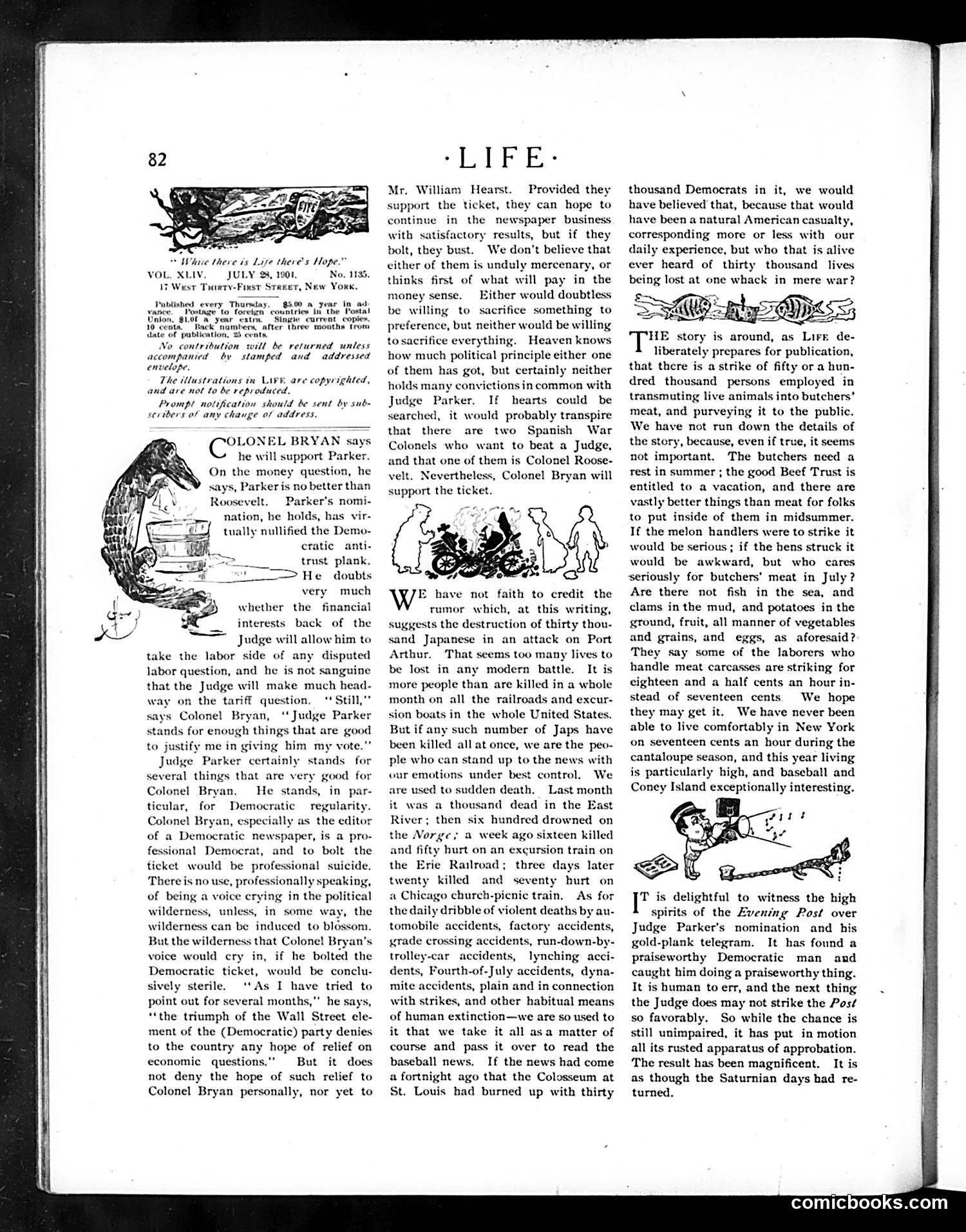
This page discusses the 1904 presidential election, specifically Judge Alton B. Parker's nomination as the Democratic candidate against incumbent Theodore Roosevelt. **Left cartoon**: Shows Colonel Bryan (William Jennings Bryan, three-time failed Democratic candidate) discussing Parker's nomination. The text reveals internal Democratic debate: Bryan prefers Parker to Roosevelt, though he questions whether Parker will actually challenge Roosevelt effectively on key issues like labor and tariffs. **Right section**: Addresses rumors of Japanese casualties in the Russo-Japanese War and various accident statistics, attempting to contextualize death tolls. It then pivots to praising Judge Parker's nomination as genuinely praiseworthy—a "Saturnian" moment (rare good news) for Democrats. The satire reflects Democratic anxiety about Parker as a viable challenger.
📄 Transcribed text from this page (OCR, searchable)
Machine-transcribed from the original scan — historical spelling and the odd misread are preserved.
White there is Lise there's Hope.” L XLIV. JULY 28, 1901. No. 1135. West Tuiety-Fiest Stener, New Yorx. Punished every Thurs 3.00 a year in ad Pout to fore equ i the Postal ators your ‘crue Bag current copies, ta. Bac Sone after three mouths trom 1 publication, 25 cents No contribution accompanied by envelope. The illustrations in Live. are copyrighted, and are not to be reproduced, Prompt notification should be sent by sub- seribers of any change of address. will be returned unless stamped and addressed OLONEL BRYAN say: he will support Parker. On the money question, he says, Parkeris no better than Roosevelt. Parker's nomi- nation, he holds, has_ vir- tually nullified the Demo- cratic anti- trust plank. “! > He doubts very much whether the financial interests back of the Judge will allow him to take the labor side of any disputed labor question, and he is not sanguine that the Judge will make much head- way on the tariff question, Still," says Colonel Bryan, “Judge Parker stands for enough things that are good to justify me in giving him my vote.” Judge Parker certainly stands for several things that are very good for Colonel Brya He stands, in par- ticular, for Democratic regularity. Colonel Bryan, especially the editor of a Democratic newspaper, is a pro- fessional Democrat, and to bolt the ticket would be professional suicide. There is no use, professionally speaking, of being a voice crying in the political wilderness, unless, in some way, the wilderness can be induced to blossom. But the wilderness that Colonel Bryan’s voice would cry in, if he bolted the Democratic ticket, would be conclu- sively sterile. ‘As I have: tried to point out for several months,”” hi “the triumph of the Wall Street cle- ment of the (Democratic) party denies to the country any hope of relief on economic questions.” But it does not deny the hope of such relief to Colonel Bryan personally, nor yet to LIFE Mr. William Hearst. Provided they support the ticket, they can hope to continue in the newspaper business with satisfactory results, but if they bolt, they bust. We don't believe that either of them is unduly mercenary, or thinks first of what will pay in the money sense. Either would doubtless be willing to sacrifice something to preference, but neither would be willing to sacrifice everything. Heaven knows how much political principle either one of them has got, but certainly neither holds many convictions in common with Judge Parker. If hearts could be searched, it would probably transpire that there are two Spanish War Colonels who want to beat a Judge, and that one of them is Colonel Roose- , Colonel Bryan will velt. Neverthele: support the tic! G E have rumor whi faith to credit the h, at this writing, suggests the destruction of thirty thou- sand Japanese in an attack on Port Arthur. That scems too many lives to be lost in any modern battle. It is more people than are killed in a whole month on all the railroads and excur- sion boats in the whole United States. But if any such number of Japs have been killed all at once, we are the peo- ple who can stand up to the news with our emotions under best control. We are used to sudden death, Last month it was a thousand dead in the East River; then six hundred drowned on the Norge; a week ago sixteen killed and fifty hurt on an excursion train on the Erie Railroad; three days later twenty killed and seventy hurt on a Chicago chureh-picnic train. As for the daily dribble of violent deaths by au- tomobile accidents, factory accidents, grade crossing accidents, run-down-b trolley-car accidents, lynching ac dents, Fourth-of-July accidents, dyna- mite accidents, plain and in connection with strikes, and other habitual means of human extinction—we are so used to it that we take it all asa matter of course and pass it over to read the baseball news. If the news had come a fortnight ago that the Colosseum at St. Louis had burned up with thirty not thousand Democrats in it, we would have believed that, because that would have been a natural American corresponding more or less y daily experience, but who that is alive ever heard of thirty thousand lives being lost at one whack in mere war? THe story is around, as Lirk de- liberately prepares for publication, that there is a strike of fifty or a hun- dred thousand persons employed in transmuting live animals into butchers’ meat, and purveying it to the public. We have not run down the details of the story, because, even if true, it seems not important. The butchers need a rest in summer ; the good Beef Trust is entitled to a vacation, and there are vastly better things than meat for folks to put inside of them in midsummer. If the melon handlers were to strike it would be serious ; if the hens struck it would be awkward, but who cares seriously for butchers’ meat in July ? Are there not fish in the sea, and clams in the mud, and potatoes in the ground, fruit, all manner of vegetables and grains, and eggs, as aforesaid? They say some of the laborers who handle meat carcasses are striking for eighteen and a half cents an hour in- stead of seventeen cents. We hope they may get it. We have never been able to live comfortably in New York on seventeen cents an hour during the cantaloupe season, and this year living is particularly high, and baseball and Coney Island exceptionally interesting. i is delightful to witness the high spirits of the Evening Post over Judge Parker's nomination and his gold-plank telegram. It has found a praiseworthy Democratic man and caught him doing a praiseworthy thing. It is human to err, and the next thing the Judge does may not strike the Post so favorably. So while the chance is still unimpaired, it has put in motion all its rusted apparatus of approbation. The result has been magnificent. It is as though the Saturnian days had re- turned. comicbooks.com