
A complete issue · 20 pages · 1904
Life — March 31, 1904
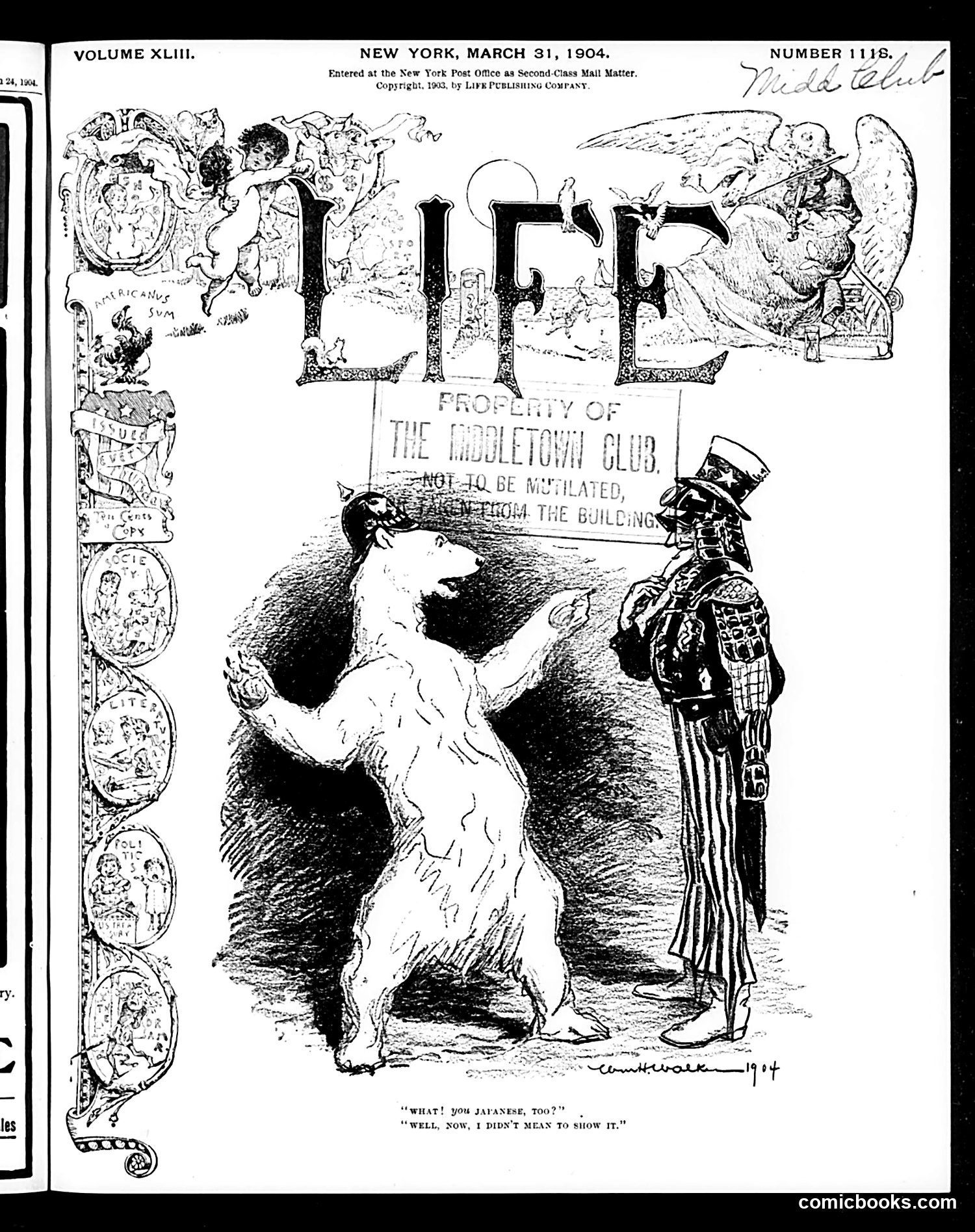
This satirical cover depicts a confrontation between a large bear and a formally dressed gentleman in top hat. The bear appears to represent Russia, while the man likely represents Japan, reflecting the Russo-Japanese War (1904-1905). The caption reads: "What! you Japanese, too?" / "Well, now, I didn't mean to show it." The joke plays on diplomatic pretense. The gentleman (Japan) is caught displaying aggression despite claiming peaceful intentions. The bear (Russia) expresses mock surprise at Japanese hostility. This satirizes Japan's attack on Port Arthur in February 1904, which initiated the war. Japan had concealed its military preparations while maintaining diplomatic relations with Russia. The cartoon mocks the gap between Japan's public diplomatic courtesy and its actual aggressive actions—a breach of accepted international etiquette.
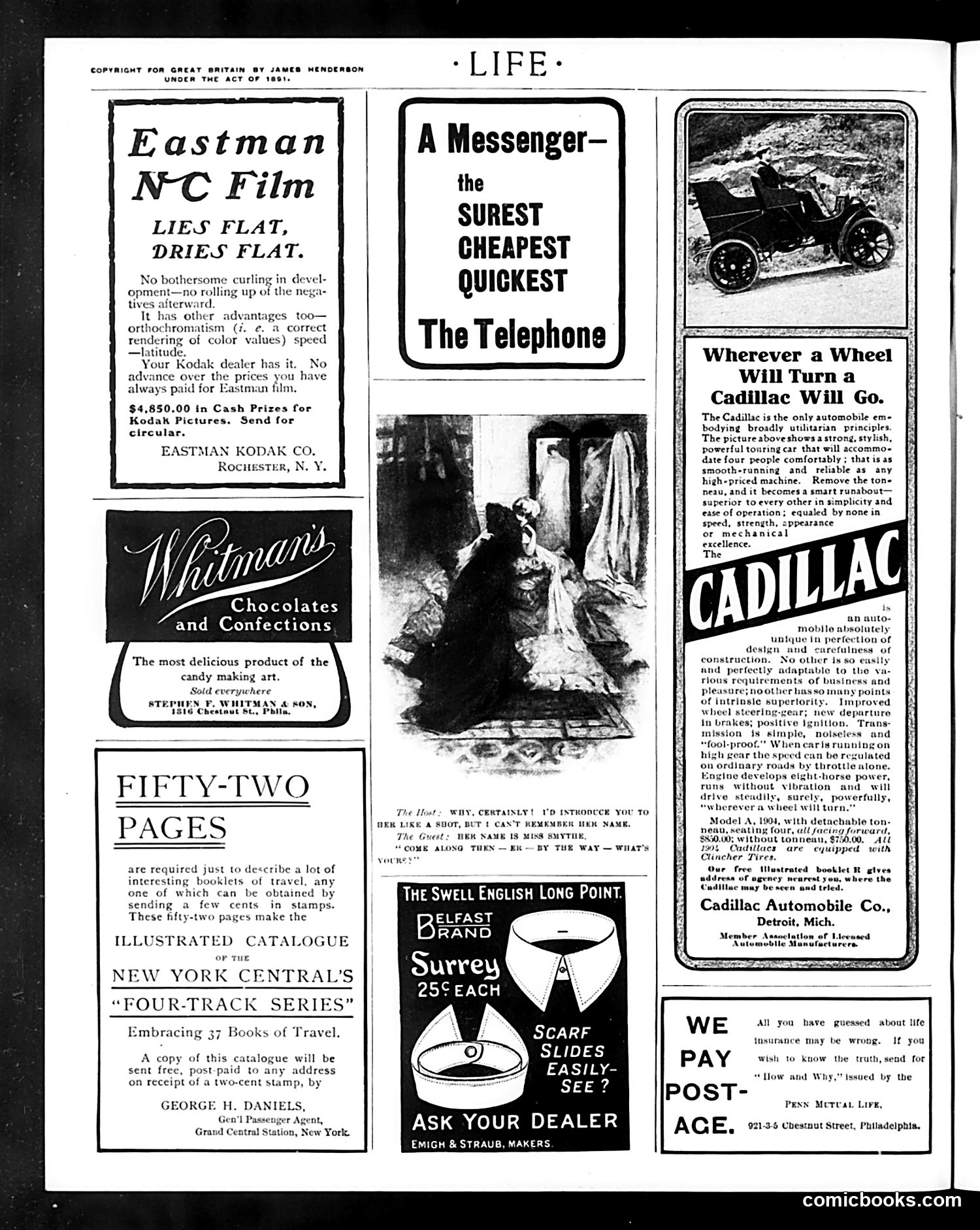
This page is primarily **advertising**, not political satire. It contains commercial notices for products and services typical of the early 1900s: - **Eastman Kodak film** (photography) - **Whitman's Chocolates** - **Central Railroad's travel catalogue** - **The Telephone** (promoted as efficient communication) - **Cadillac automobiles** (luxury vehicles) - **English scarf slides** (haberdashery) - **Life Insurance** (financial services) The central image appears to be a theatrical scene—possibly illustrating a story or joke related to "The Telephone" advertisement, showing figures in what looks like a dramatic domestic moment. These ads reflect early-20th-century consumer culture and technological advancement, but contain no discernible political cartoons or social satire on this particular page.
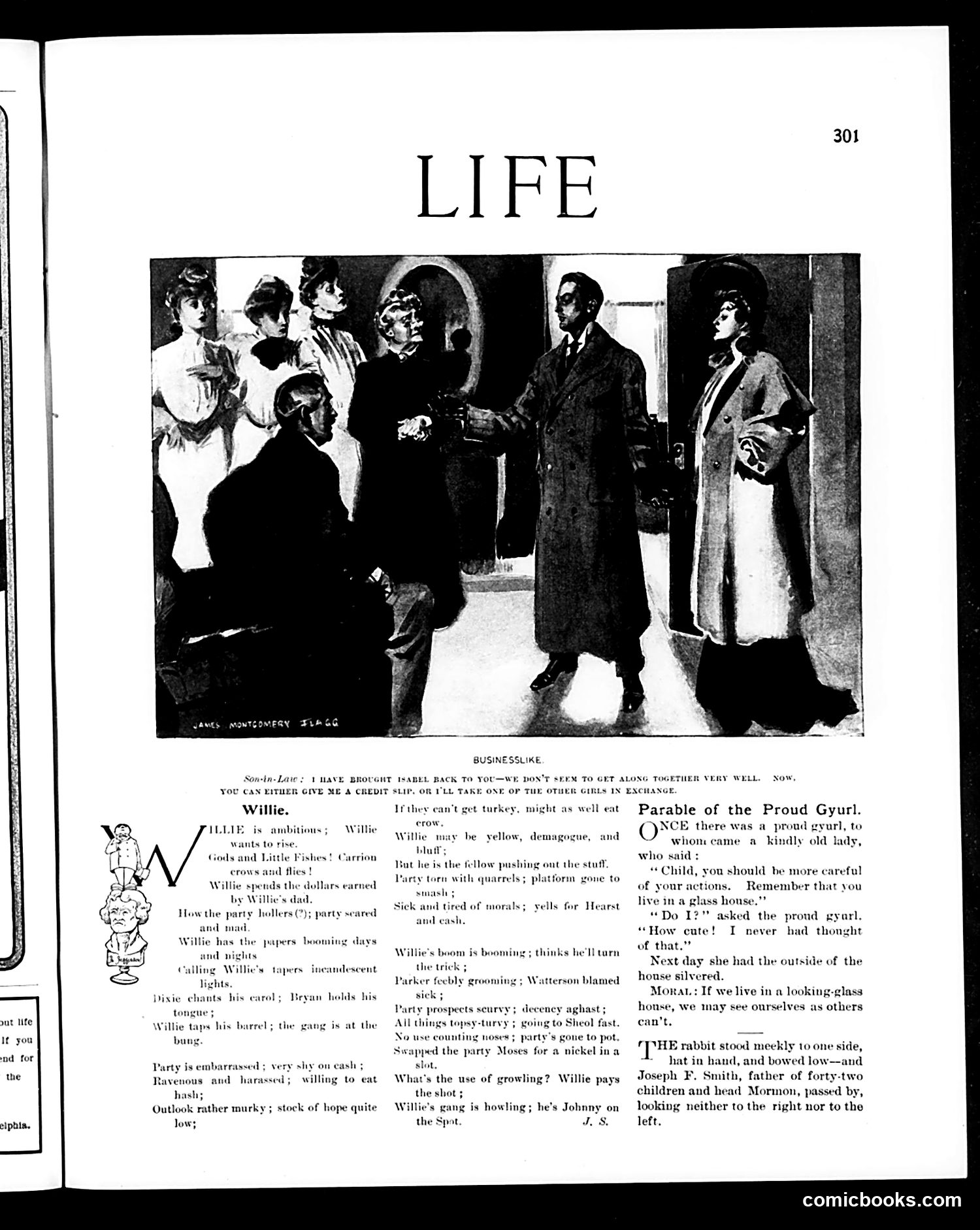
**Main Content:** This page contains three distinct pieces: 1. **"Businesslike"** - An illustration showing a social scene where a man negotiates with a woman about exchanging girls as romantic partners, framed as a casual business transaction. The satire mocks how wealthy men treat courtship as commercial negotiation rather than genuine emotional connection. 2. **"Willie"** - A humorous poem about a mischievous boy named Willie who causes chaos (stealing turkeys, disrupting parties, gang fights). It's slapstick comedy typical of early 20th-century children's humor. 3. **"Parable of the Proud Gyurl"** - A moral tale warning against vanity and superficiality, suggesting that those who judge others harshly may face similar judgment themselves—a commentary on hypocrisy and social pretension. The page targets upper-class social behavior and moral character through satire and cautionary tales.
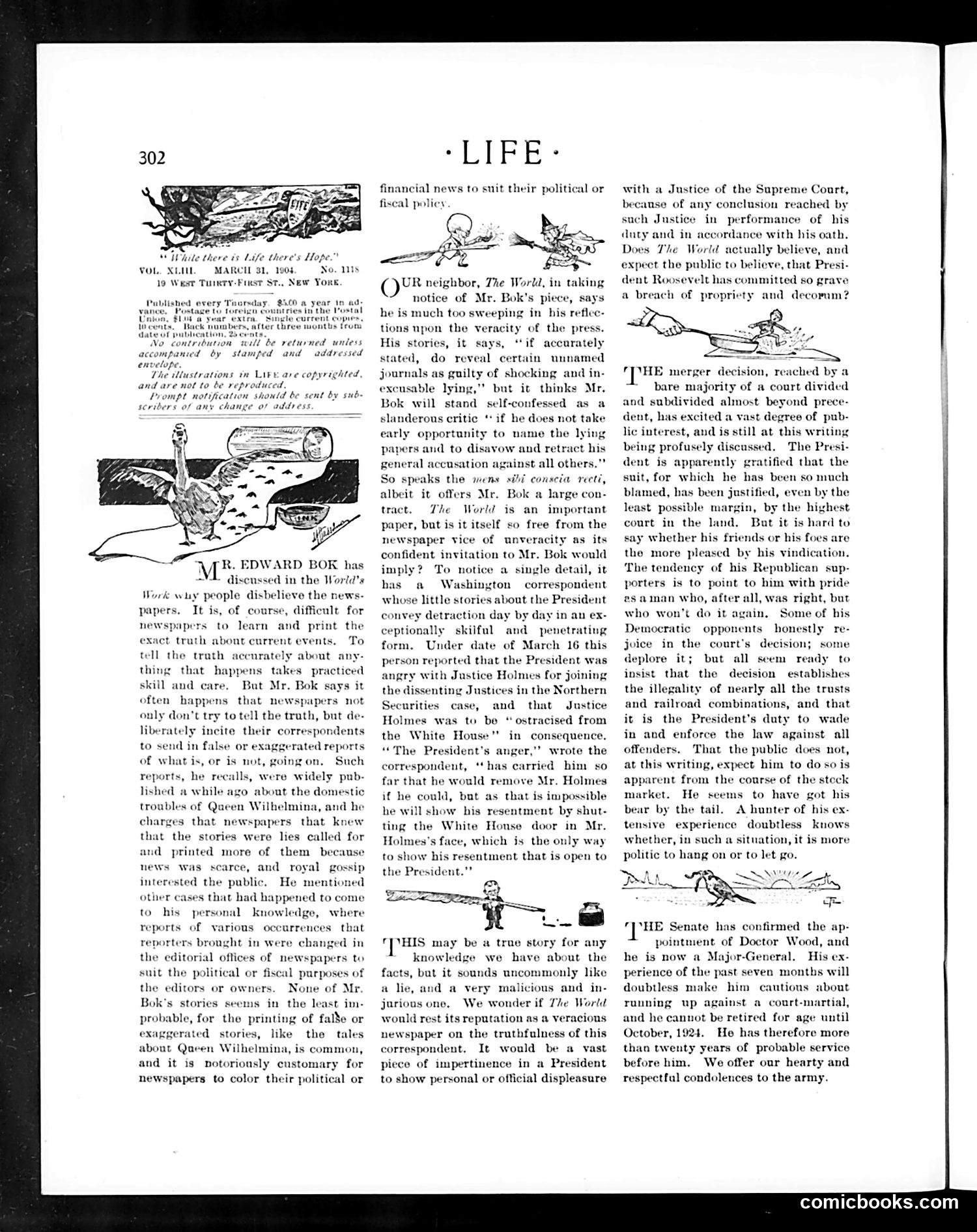
This page discusses newspaper credibility, particularly criticizing *The World* newspaper's coverage. The text charges that *The World* publishes unverified stories and allows its correspondents to send false reports to advance political agendas. The main cartoon shows a figure (appears to be Edward Bok, Life's editor) examining newspaper content with a magnifying glass, suggesting scrutiny of journalistic accuracy. The satire targets newspapers that color coverage for political purposes. The article references President Roosevelt allegedly being angry with Justice Holmes and suggests *The World* spreads such stories without verification to embarrass the administration. The page concludes with notice of Doctor Wood's appointment as Major-General, offering "hearty and respectful condolences to the army"—a tongue-in-cheek jab. The overarching point: Life exposes how newspapers weaponize reporting for partisan advantage.
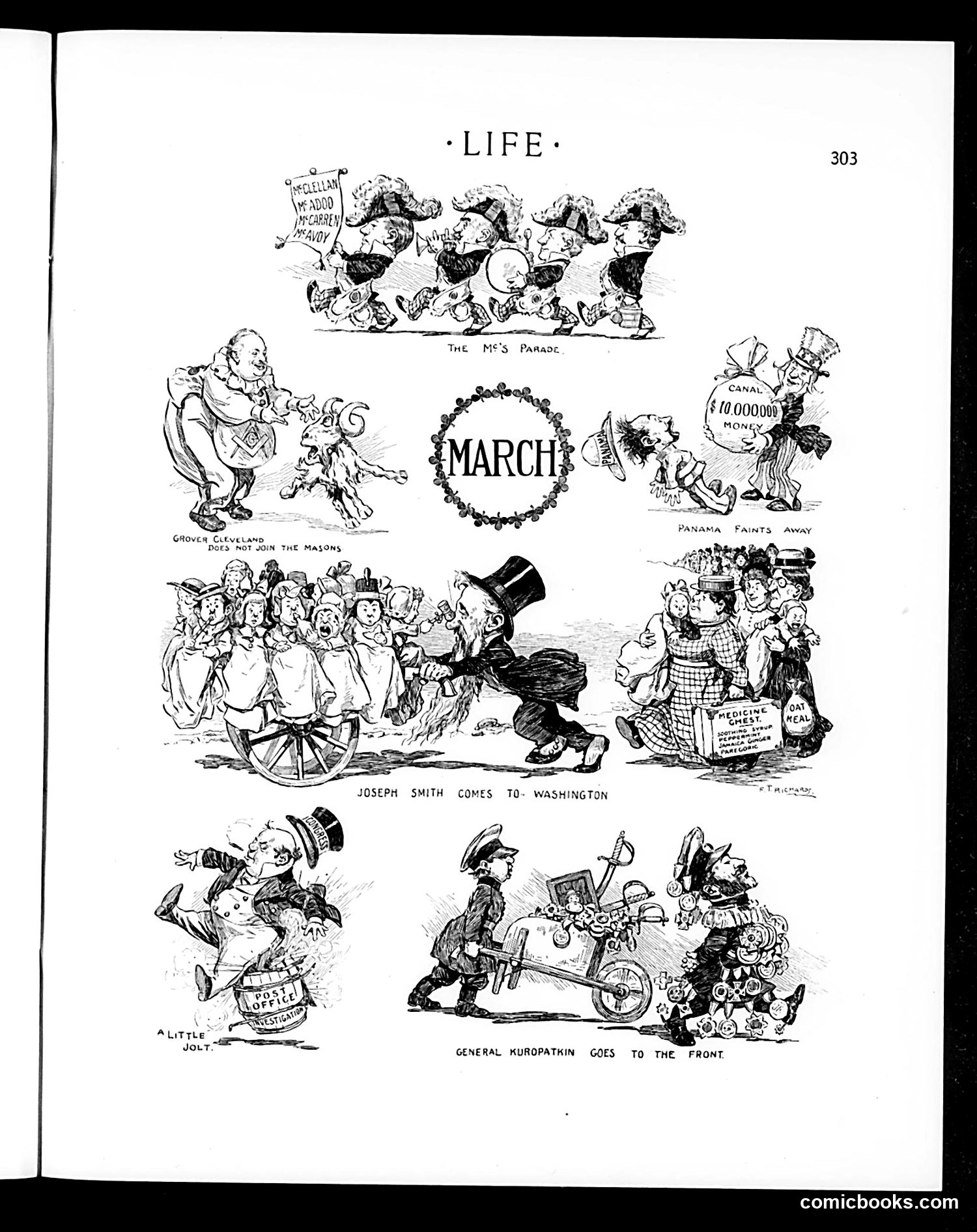
This is a political satire page from Life magazine's March issue (year unclear from image). The cartoons mock several contemporary political figures and events: **"The M's Parade"** appears to reference political figures whose names begin with M, likely including McKinley or other prominent politicians of the era. **"Grover Cleveland Does Not Join the Masons"** satirizes former President Cleveland's absence from Masonic activities. **"Joseph Smith Comes to Washington"** likely references the Mormon founder in a political context. **"General Kuropatkin Goes to the Front"** references the Russian general, suggesting international political commentary, possibly related to the Russo-Japanese War period. The cartoons employ exaggerated caricatures typical of early 20th-century American political satire, though specific identifications require additional historical context for certainty.
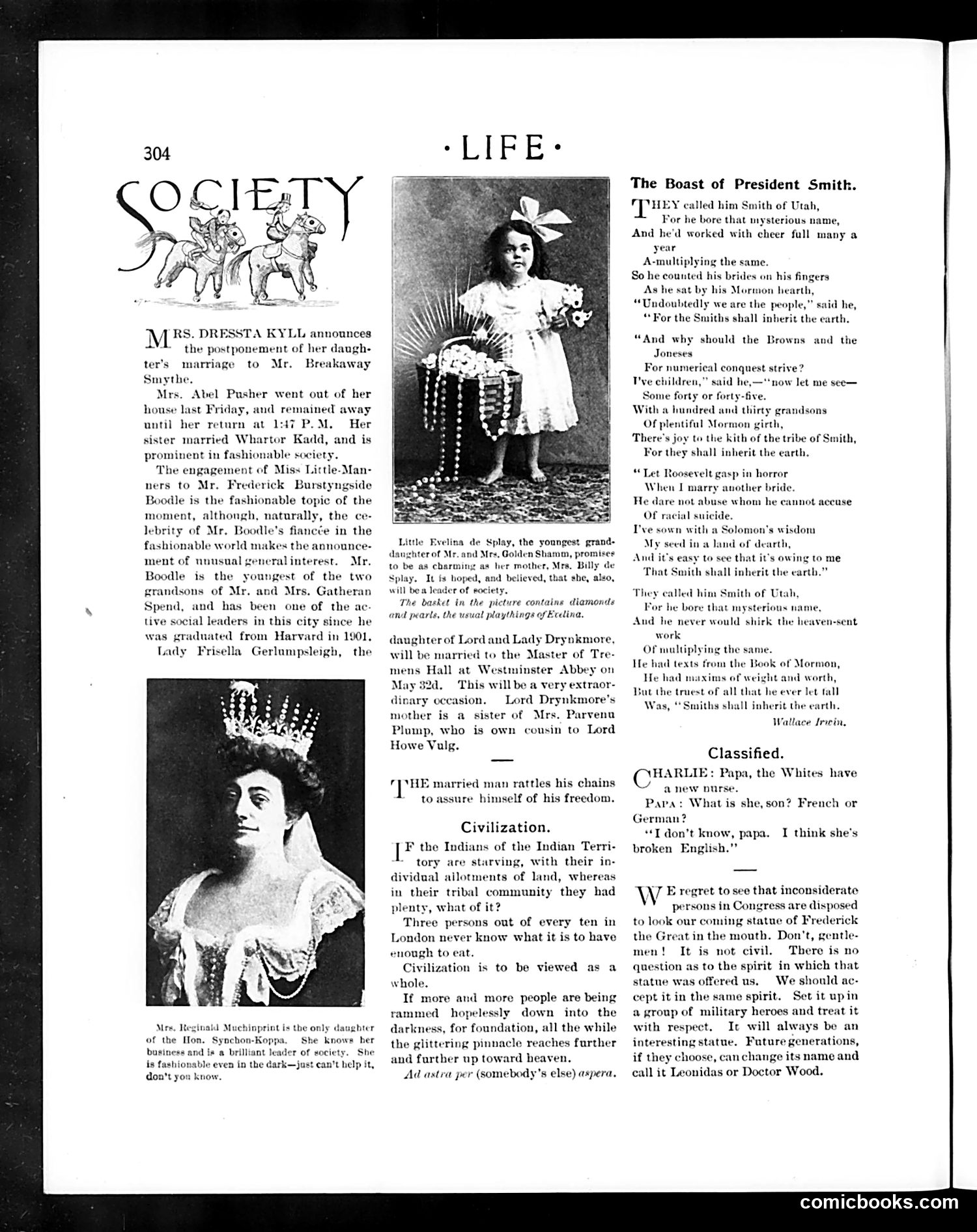
This page combines society announcements with satirical commentary. The **"Society" section** reports engagements and social events among the wealthy elite, including marriages and family connections. The **central satire** targets Mormonism through "The Boast of President Smith," a poem mocking Joseph Smith's polygamy. The text ridicules Mormon doctrine about inheriting the earth while satirizing the practice of multiple wives through repetitive, mocking verses. The **"Civilization" section** critiques both American indifference to Native American suffering and Congressional rudeness toward visiting dignitaries. It sarcastically suggests renaming any future monument after a contemporary figure rather than properly honoring indigenous dispossession. The photographs show prominent society women of the era, functioning as celebrity coverage typical of Life's format.
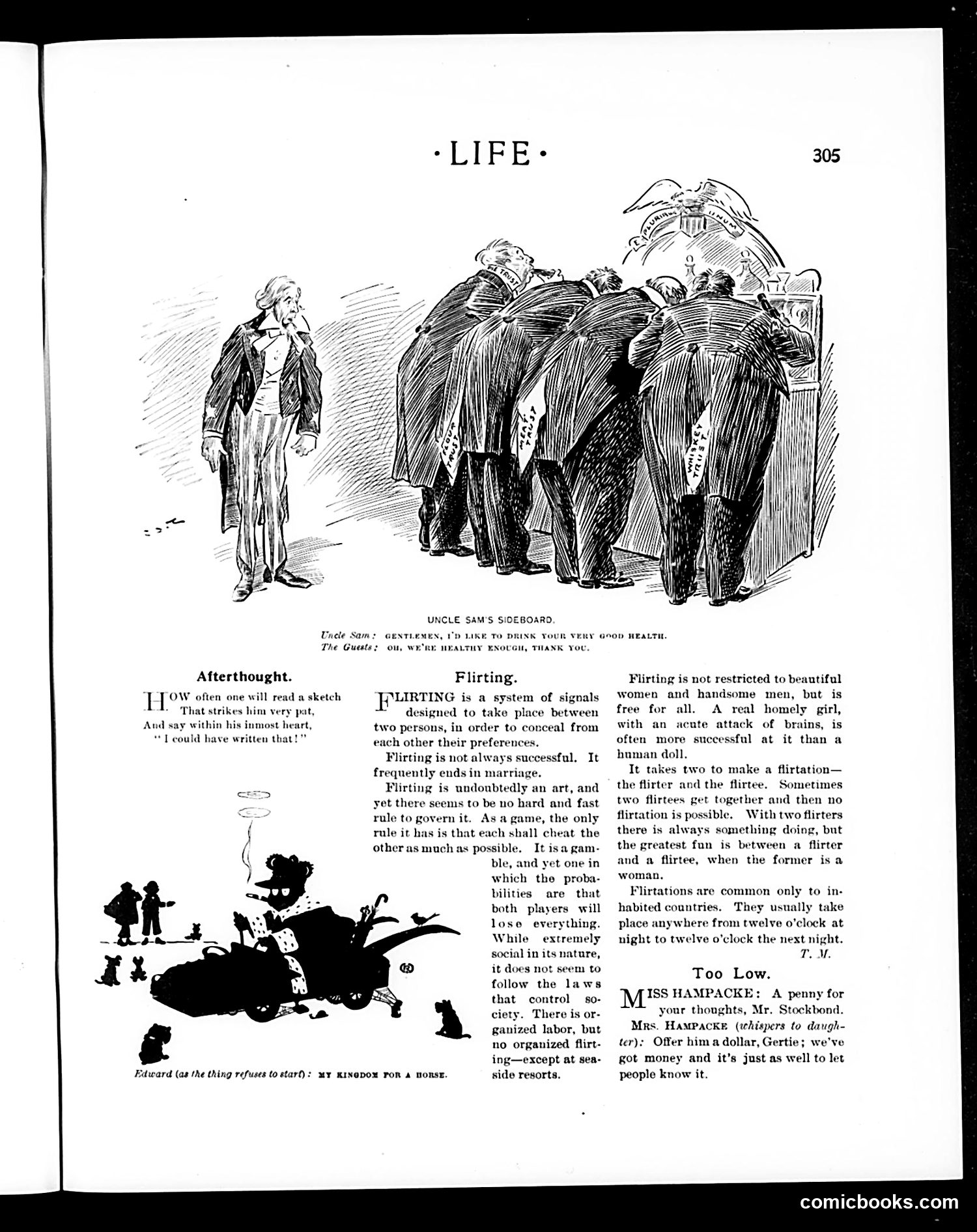
**Top Cartoon:** Shows Uncle Sam at a sideboard with well-dressed gentlemen gathered around, toasting. The caption reads "GENTLEMEN, I'D LIKE TO DRINK TO YOUR VERY GOOD HEALTH" with guests responding "OH, WE'RE HEALTHY ENOUGH, THANK YOU." This appears to satirize diplomatic relations or foreign policy, depicting Uncle Sam (America) offering hospitality that's being politely rebuffed—likely commentary on international tensions or failed diplomatic gestures of the era. **"Afterthought" Section:** A silhouetted cartoon showing a figure surrounded by toys/figures, captioned "EDWARD (AS HIS THING REFUSES TO START): MY KINDNESS FOR A HORSE." This mocks someone named Edward whose mechanical device has broken down. **"Flirting" Section:** Defines flirtation as a social signaling system between two people, noting it's "undoubtedly an art" but unregulated except at seaside resorts. Humorous domestic dialogue follows about penny thoughts versus dollars.
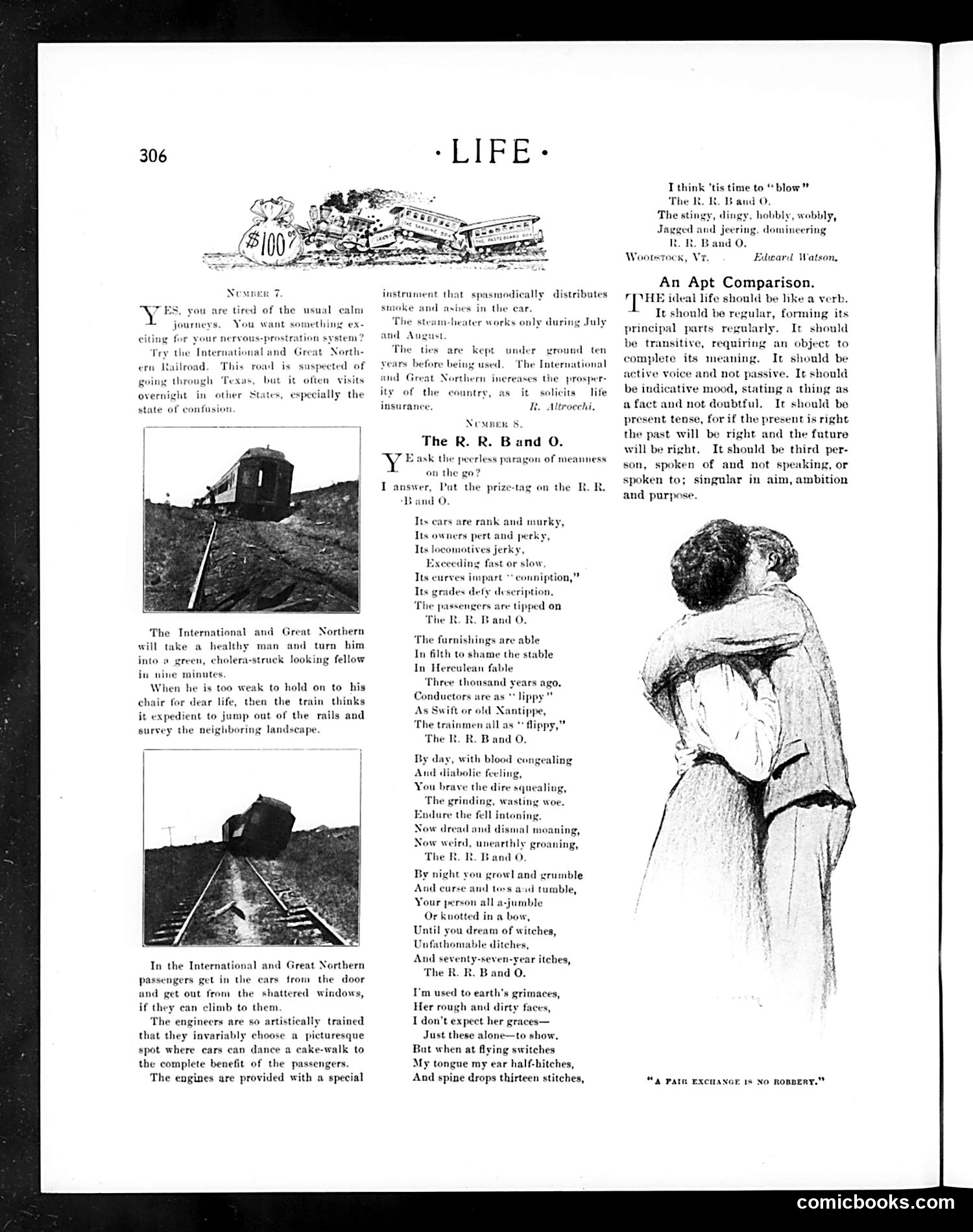
This page contains **railroad humor and social commentary**, not political cartoons. The content mocks the International and Great Northern Railroad through two photographs and accompanying text. The humor centers on the railroad's notorious reputation: it's described as so unreliable and uncomfortable that it would transform a healthy man into a "green, cholera-stricken looking fellow" in nine minutes. The detailed poem "The R.R. B and O." catalogs passengers' physical sufferings—jolting, grinding sounds, bizarre sleeping positions—presented as inevitable hardships of rail travel. The separate section "An Apt Comparison" uses a sketch showing two figures embracing, suggesting the life-as-verb metaphor applies to railroads: both should be "regular, transitive, and indicative." The satire targets real passenger complaints about this specific railroad line's poor conditions and service.
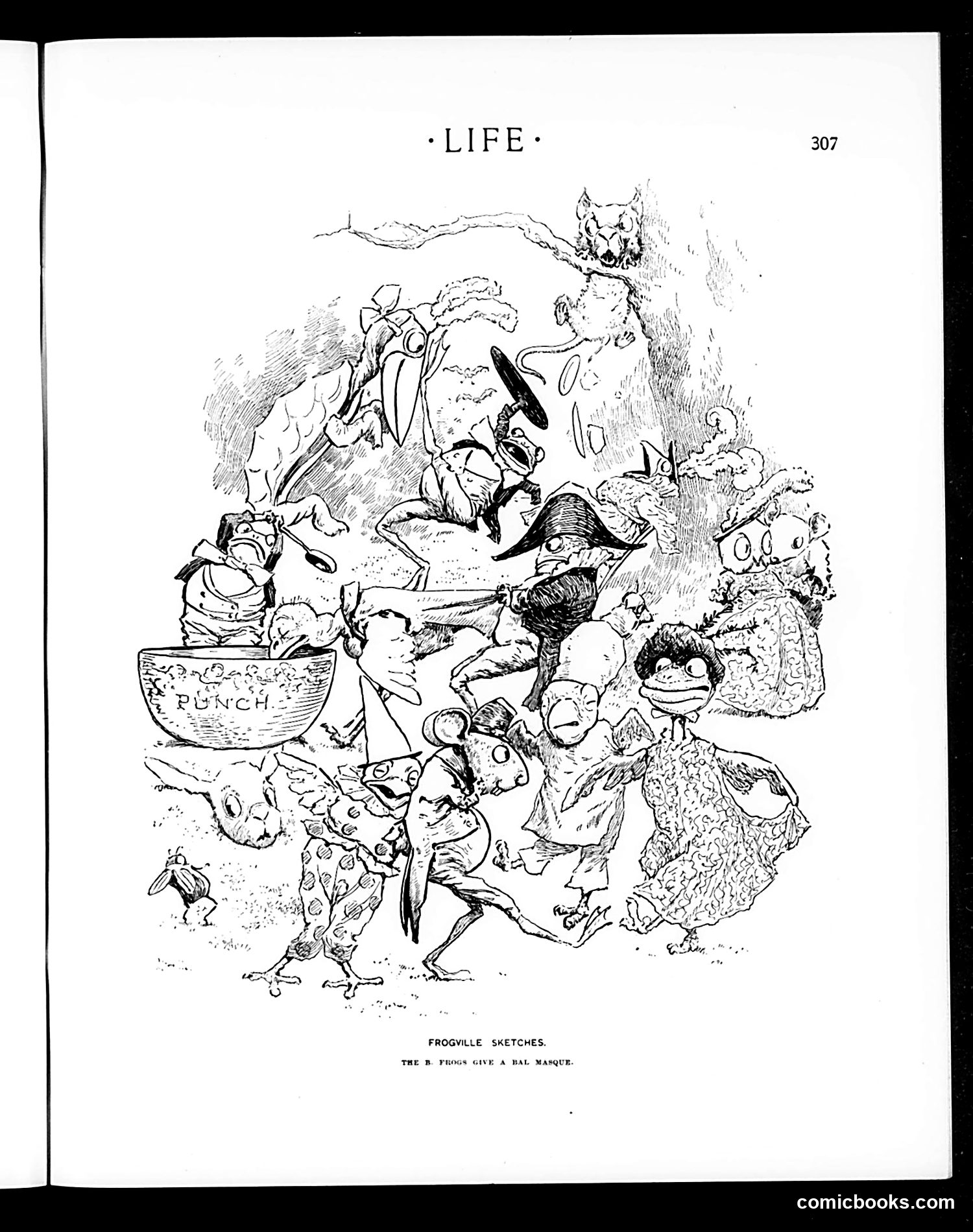
This is a whimsical illustration titled "Frogville Sketches," depicting anthropomorphic frogs attending a masquerade ball. The frogs are drawn in Victorian dress and costume, with one wearing a pirate outfit, others in patterned clothing, and various fancy attire typical of masquerade balls. A large punch bowl labeled "PUNCH" sits prominently on the left. The satire appears gentle rather than pointed—it's a playful anthropomorphic fantasy rather than direct political commentary. The "bal masque" (masked ball) setting suggests mockery of high society's formal, costume-wearing pretensions. The exaggerated frog features and crude manners create comic contrast with their formal dress, typical of Life magazine's humorous social observation during this era.
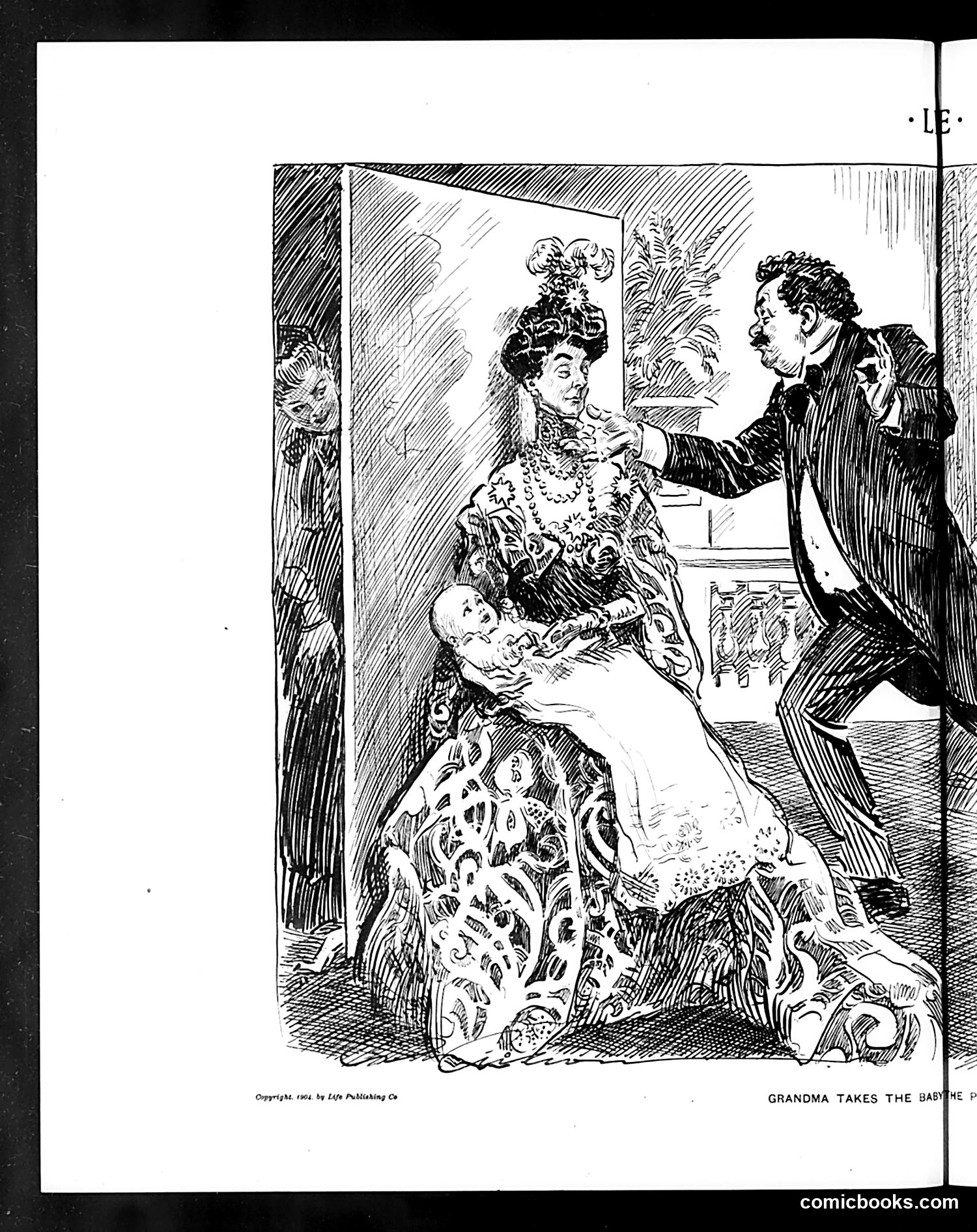
This is a satirical domestic scene titled "Grandma Takes the Baby." The cartoon depicts a well-dressed woman holding an infant while a man gestures animatedly toward her. A third figure peers from behind a doorway on the left. The satire likely comments on **gender roles and parenting responsibilities** in early 20th-century society. The man's exaggerated posture and expression suggest he's either reluctantly handing off childcare duties or awkwardly attempting to manage the situation. The grandmother's composed demeanor contrasts with his apparent distress. The elaborate clothing and domestic interior setting indicate this satirizes **middle or upper-class family dynamics**—possibly mocking fathers' unfamiliarity with childcare, or critiquing the expectation that grandmothers routinely assume parenting roles. The humor derives from the man's discomfort with what would have been considered "women's work."
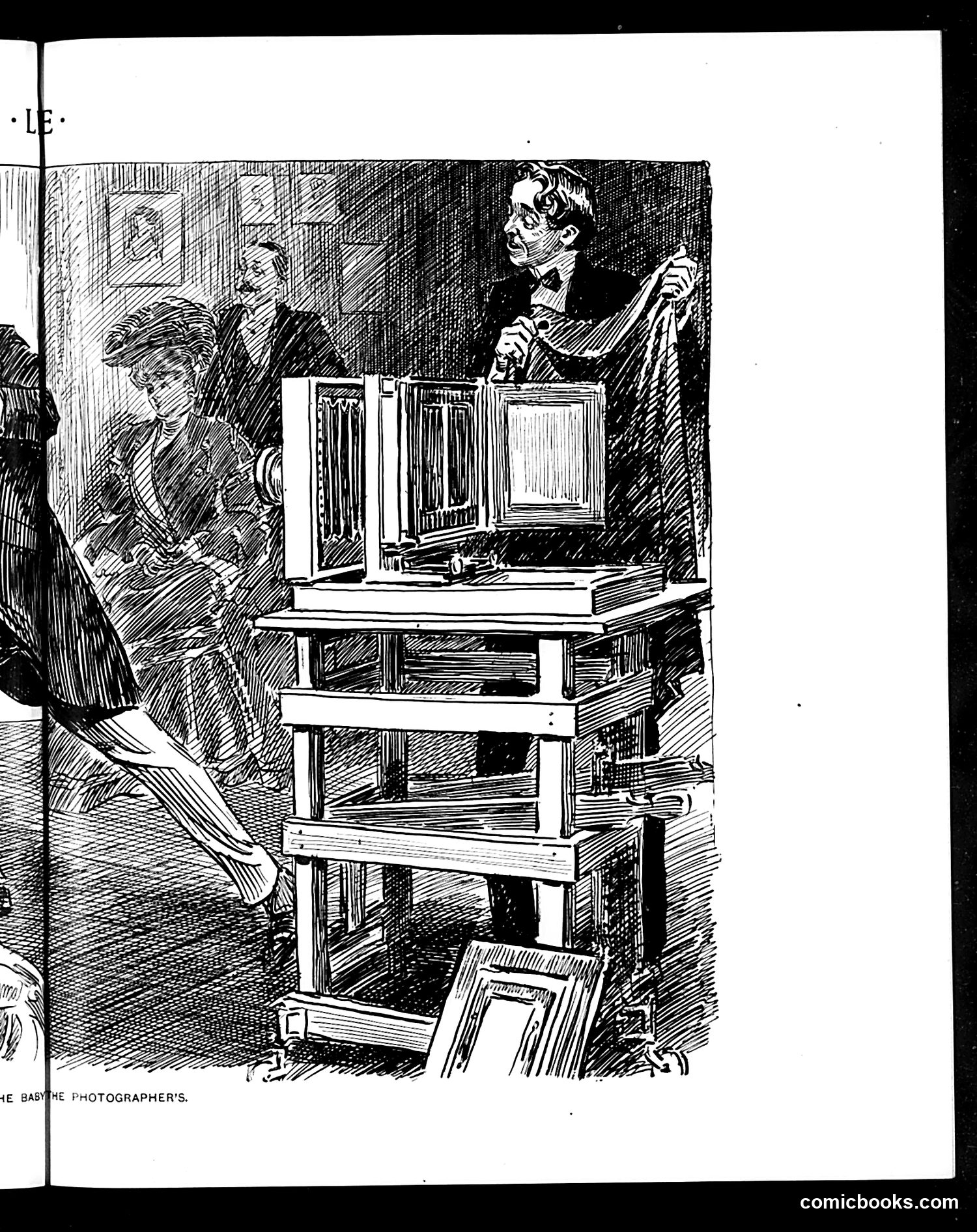
This satirical illustration depicts an early cinema or photography demonstration. A man operates what appears to be a large camera or projector on an elevated stand, displaying an image on a screen to an audience. The caption reads "THE BABY THE PHOTOGRAPHER'S" (text appears incomplete or unclear). The satire likely mocks either: 1. Early film/photography technology and its awkward, cumbersome nature 2. The novelty and spectacle-driven entertainment of early cinema 3. Possibly fraudulent or exaggerated claims by photographers The towering apparatus, formal presentation setup, and audience's apparent bemusement suggest this is ridiculing the pretentiousness or impracticality of early photographic demonstration culture. Without the complete caption, the specific target remains somewhat unclear.
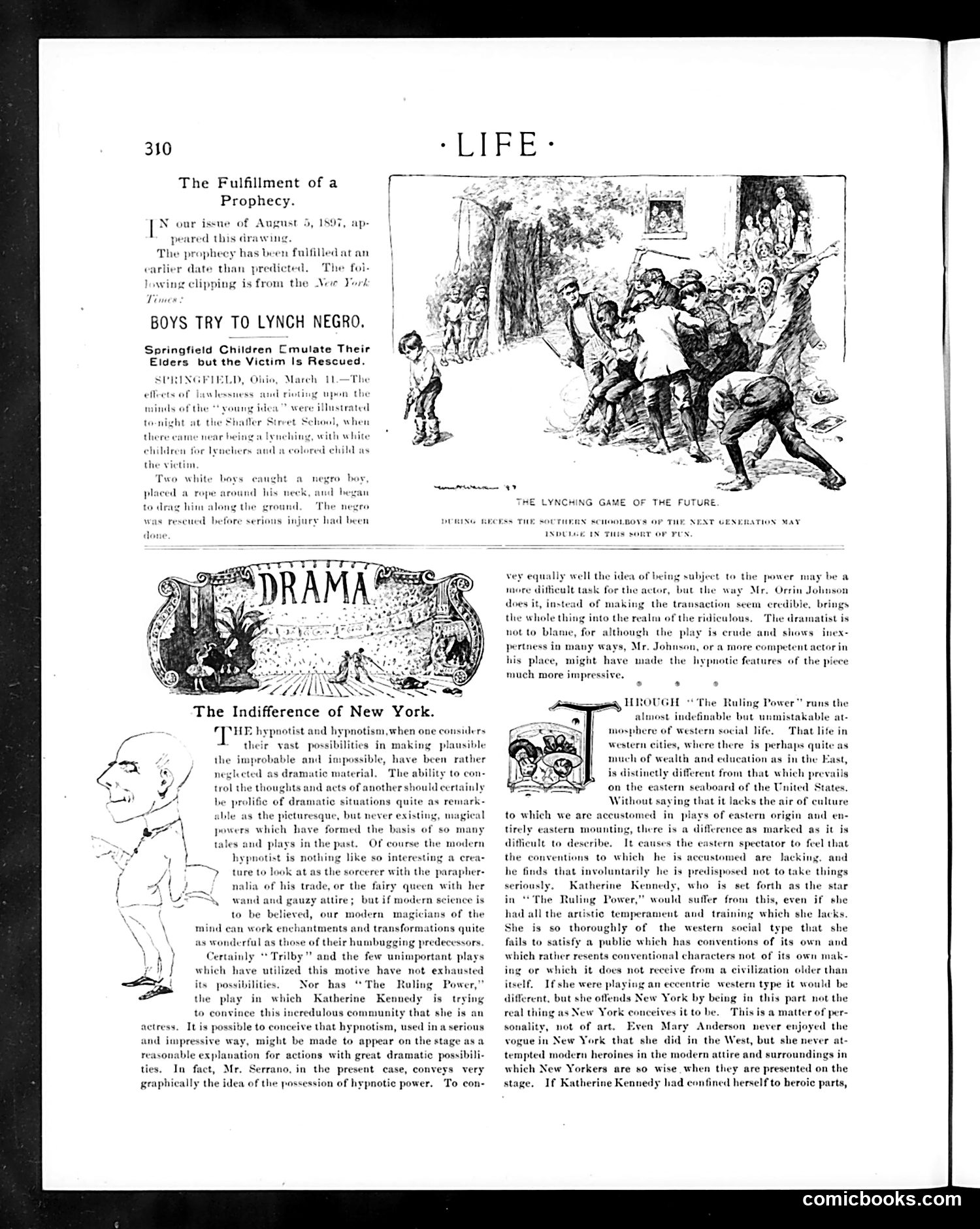
This page contains three distinct sections: 1. **"Boys Try to Lynch Negro"** — A news item reporting an incident in Springfield, Ohio where white boys attempted to lynch a Black child, but the victim escaped. 2. **"The Lynching Game of the Future"** — A satirical cartoon depicting children at play reenacting a lynching, with white children pursuing a Black child. The caption suggests this reflects how normalized racial violence had become—children were casually playing out lynchings as entertainment. 3. **"The Indifference of New York"** and **"The Ruling Power"** — Drama reviews discussing theatrical performances, including commentary on how New York audiences respond differently to western versus eastern settings in plays. The lynching content reflects Life's documented role documenting racial violence during this period of American history.
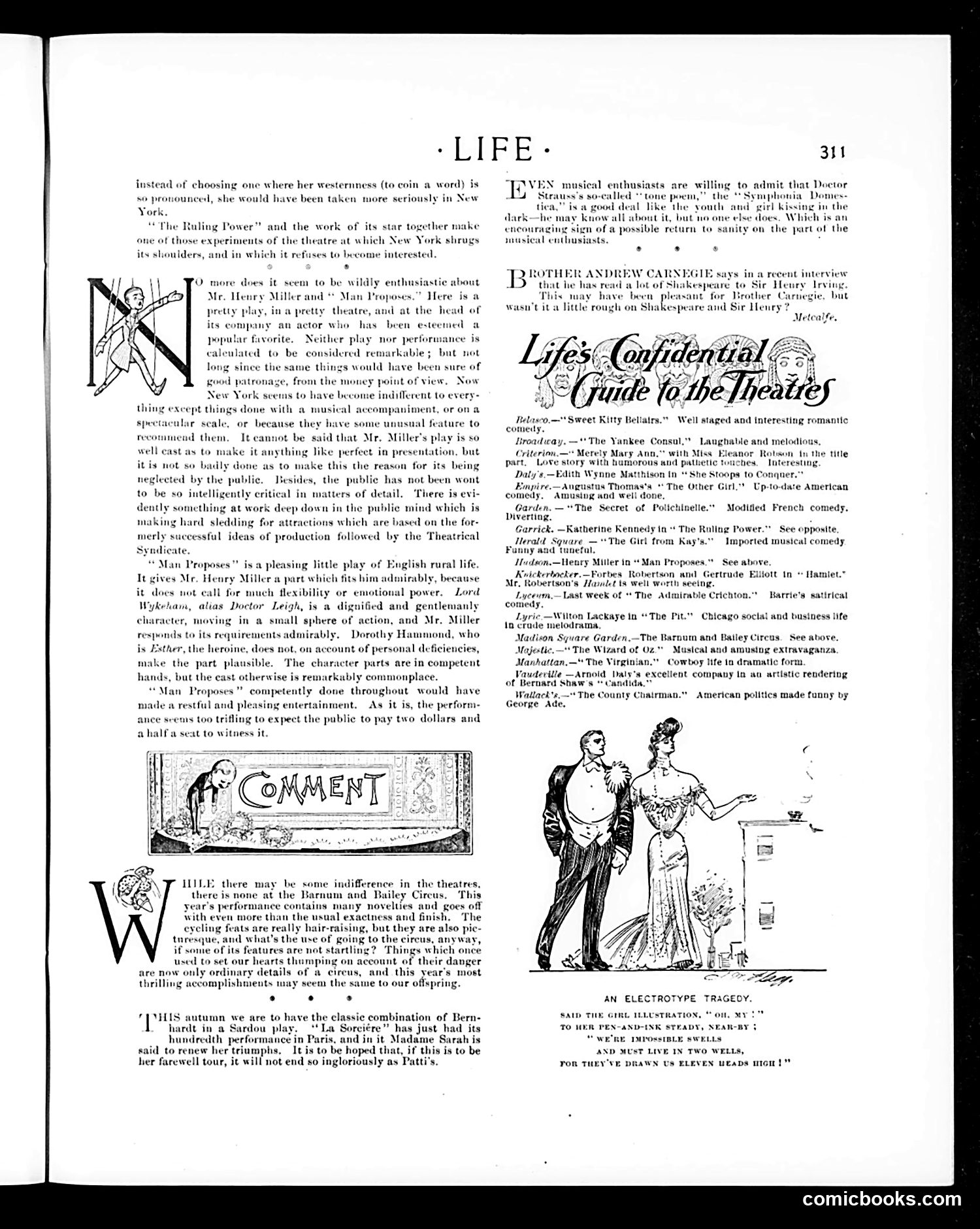
This page contains theater criticism and satirical commentary typical of Life magazine's cultural coverage. **Main Content:** The page critiques New York theater audiences' changing tastes. It reviews "Man Proposes," starring popular actor Henry Miller—a competent but unremarkable play that fails to draw crowds. The critic argues audiences now demand spectacle or musical accompaniment rather than quality dramatic acting, representing a decline in theatrical standards. **The Cartoon:** The illustration captioned "An Electrotype Tragedy" depicts a couple in formal dress surrounded by printing blocks/type. The dialogue suggests frustration with technical/printing production difficulties—likely satirizing the challenges of reproducing artwork or advertisements in publications. **Other References:** Brief mentions of Barnum and Bailey Circus (praised for exactness), Sarah Bernhardt's upcoming "La Sorcière," and Andrew Carnegie's Shakespeare readings with actor Henry Irving. The overall tone mocks public taste deterioration and theatrical mediocrity.
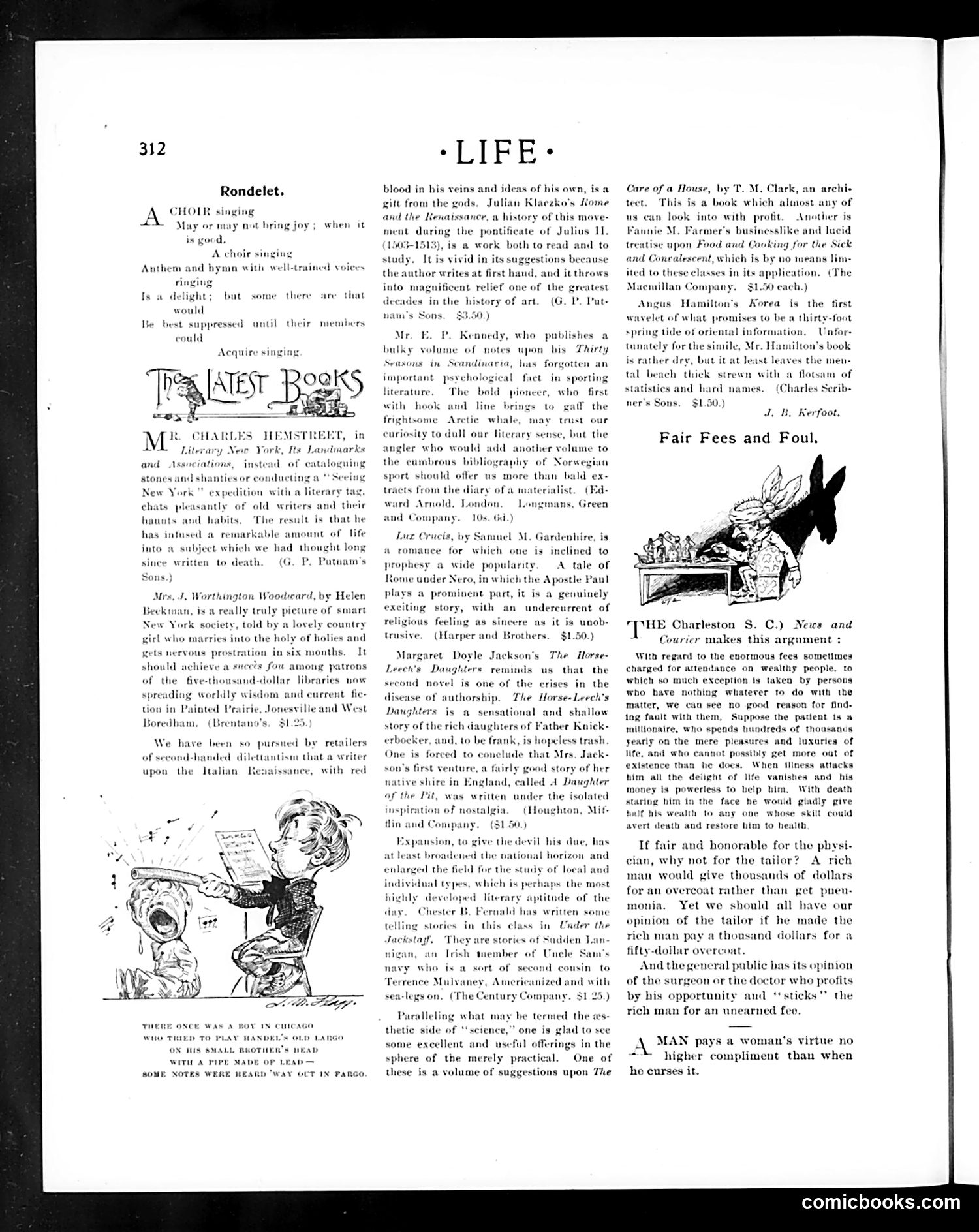
This page contains book reviews rather than political cartoons. The small illustration at the bottom depicts a child playing with what appears to be a toy or doll, with the caption "There once was a boy in Chicago / Who tried to play Handel's old largo / On his small brother's head— / Some notes were heard 'way out in Fargo," a humorous verse about a child misusing an instrument. The page reviews contemporary literary works, including books on the Italian Renaissance, Scandinavian travel, and a novel called *Luz Crucis* set in Rome. The reviews discuss various authors' contributions to literature, with critical commentary on their merit and originality. The cartoon's joke plays on the absurdity of a child attempting serious classical music on an unsuitable "instrument"—a satirical comment on cultural pretension or misguided artistic efforts, typical of Life magazine's humor during this era.
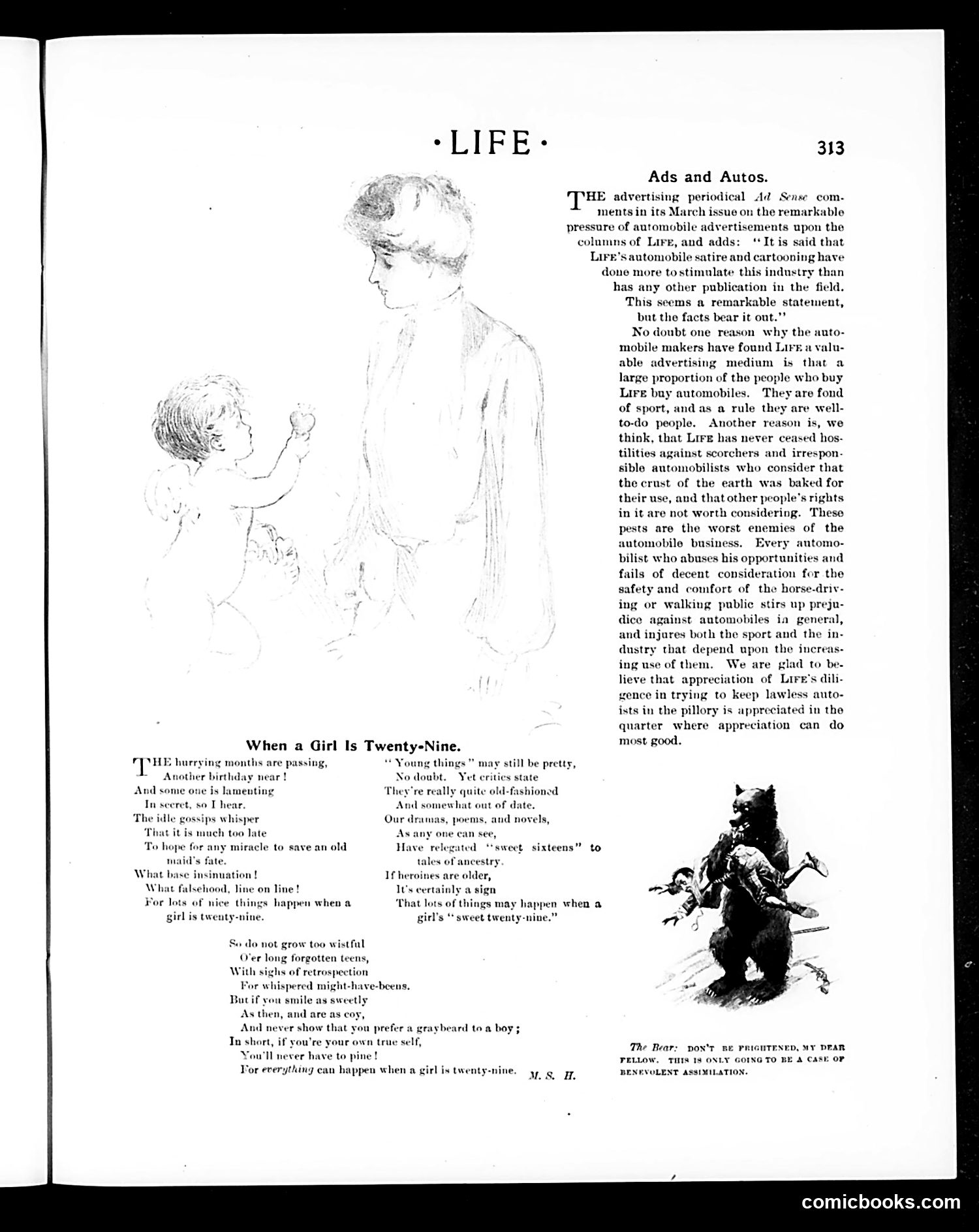
This page contains two distinct pieces: **"Ads and Autos" (Editorial Commentary):** Life magazine defends its extensive automobile advertising and satire, noting that Ad Sense magazine credited Life with stimulating the auto industry more than any other publication. The piece explains that Life's wealthy, sport-loving readership buys automobiles, and that Life has consistently criticized reckless drivers ("scorchers") and irresponsible automobilists—positioning this moral stance as actually *beneficial* to the legitimate automobile business by policing its worst practitioners. **"When a Girl Is Twenty-Nine" (Poem + Cartoon):** A humorous poem encouraging women approaching thirty not to despair, suggesting that "everything can happen when a girl is twenty-nine." The accompanying cartoon shows a bear assuring a smaller animal that it will undergo "benevolent assimilation"—a darkly ironic reference to American imperialism rhetoric of that era, here applied absurdly to wildlife to mock the poem's forced optimism. The page juxtaposes industrial advocacy with social satire typical of Life's editorial approach.
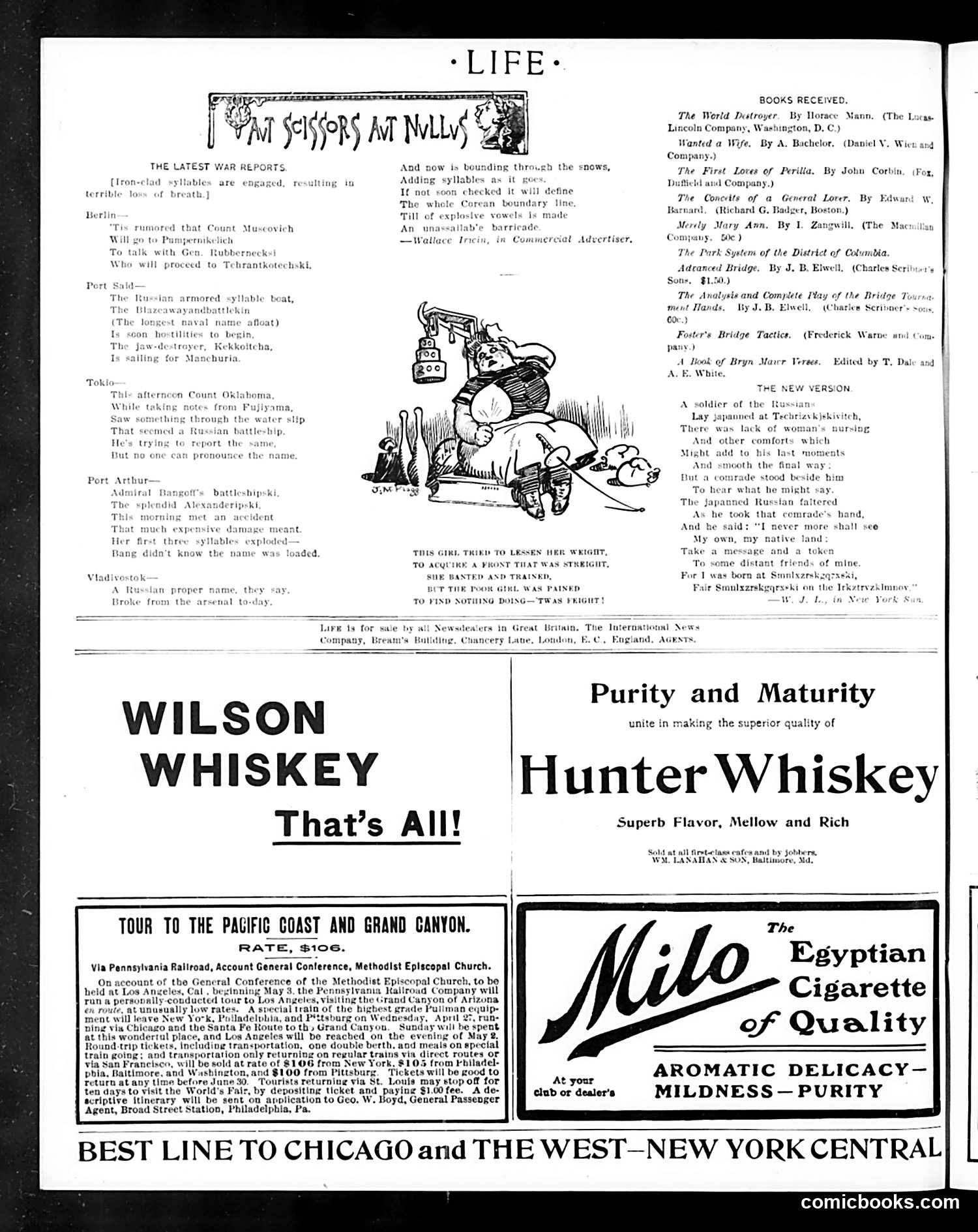
This page satirizes the **Russo-Japanese War** (1904-1905) through a mock "war report" using deliberately unpronounceable Russian place names and ship names—a comedy device mocking both the conflict's incomprehensibility to American readers and Russian naming conventions. The cartoon "This Girl Tried to Lessen Her Weight" appears unrelated to the war section; it's a separate domestic humor piece about a woman's dieting efforts with ironic results. The bulk of the page consists of **period advertisements** (Wilson Whiskey, Hunter Whiskey, Milo Egyptian Cigarettes) and travel promotions (a Methodist church tour to the Pacific Coast via Pennsylvania Railroad). The satire's humor relies on readers finding Russian names absurdly difficult—a common American attitude toward Russia at the time. The "Latest War Reports" section mocks both journalistic coverage of the distant conflict and the inherent strangeness of Russian culture to contemporary American audiences.
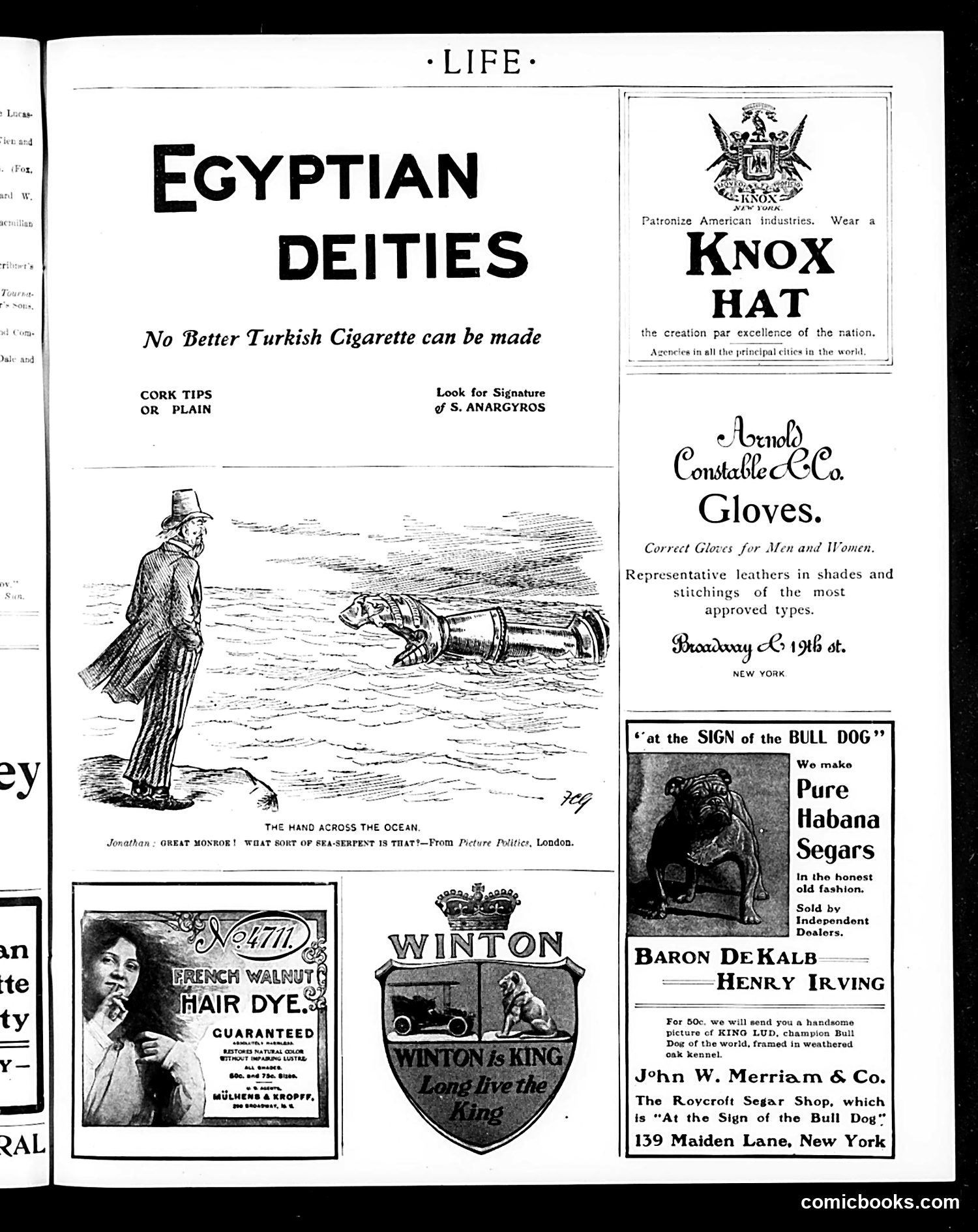
The main cartoon depicts a British figure (Jonathan, representing Britain) standing on one shore observing what appears to be a sea serpent in the water—actually the arm of another figure reaching across the Atlantic Ocean. This is political satire about Anglo-American relations, likely referencing diplomatic or military cooperation between Britain and the United States during World War I (the magazine dates to this era based on the "Patronize American Industries" messaging). The joke plays on the phrase "hand across the ocean"—a contemporary expression for Anglo-American alliance—by literally visualizing it as something monstrous or bizarre emerging from the sea. The British observer's confused reaction ("What sort of sea-serpent is that?") mocks either the unusual nature of the alliance or anxieties about American involvement. The page is otherwise filled with period advertisements (cigarettes, hats, gloves, hair dye, cigars) typical of *Life* magazine's commercial content.
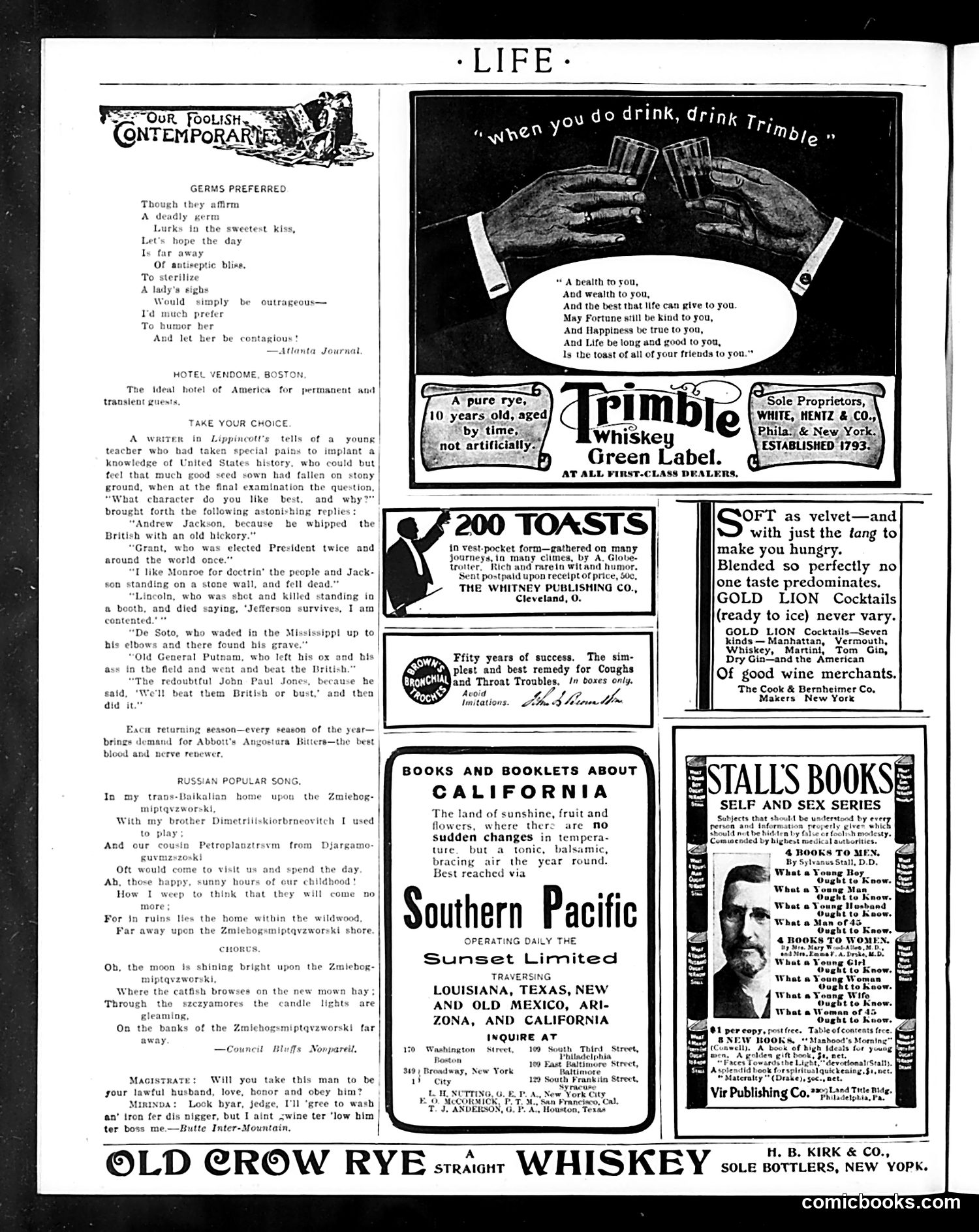
This page contains **mostly advertisements and light satirical humor** rather than political cartoons. The top-left section features "Germ's Preferred," a humorous poem mocking antiseptic zealotry—poking fun at the growing obsession with sterilization and germ theory in this era. Below that, "Take Your Choice" satirizes American history education, presenting absurd student answers about which historical figure they prefer. The humor targets poor educational outcomes; students cite violent actions (Jackson "whipping" the British, killing) as their reasons for admiration, suggesting both flawed teaching and students' misguided values. The page is otherwise dominated by **period advertisements**: Trimble Whiskey, Gold Lion Cocktails, Southern Pacific Railroad, Abbott's Angostura Bitters, and Stalls Books (a self-help series). A Russian-themed poem fills space with intentionally unpronounceable place-names, appearing to be absurdist humor or parody of ethnic comedy popular at the time. Overall, this is a typical **early-20th-century magazine page blending light satirical content with commercial advertisements**.
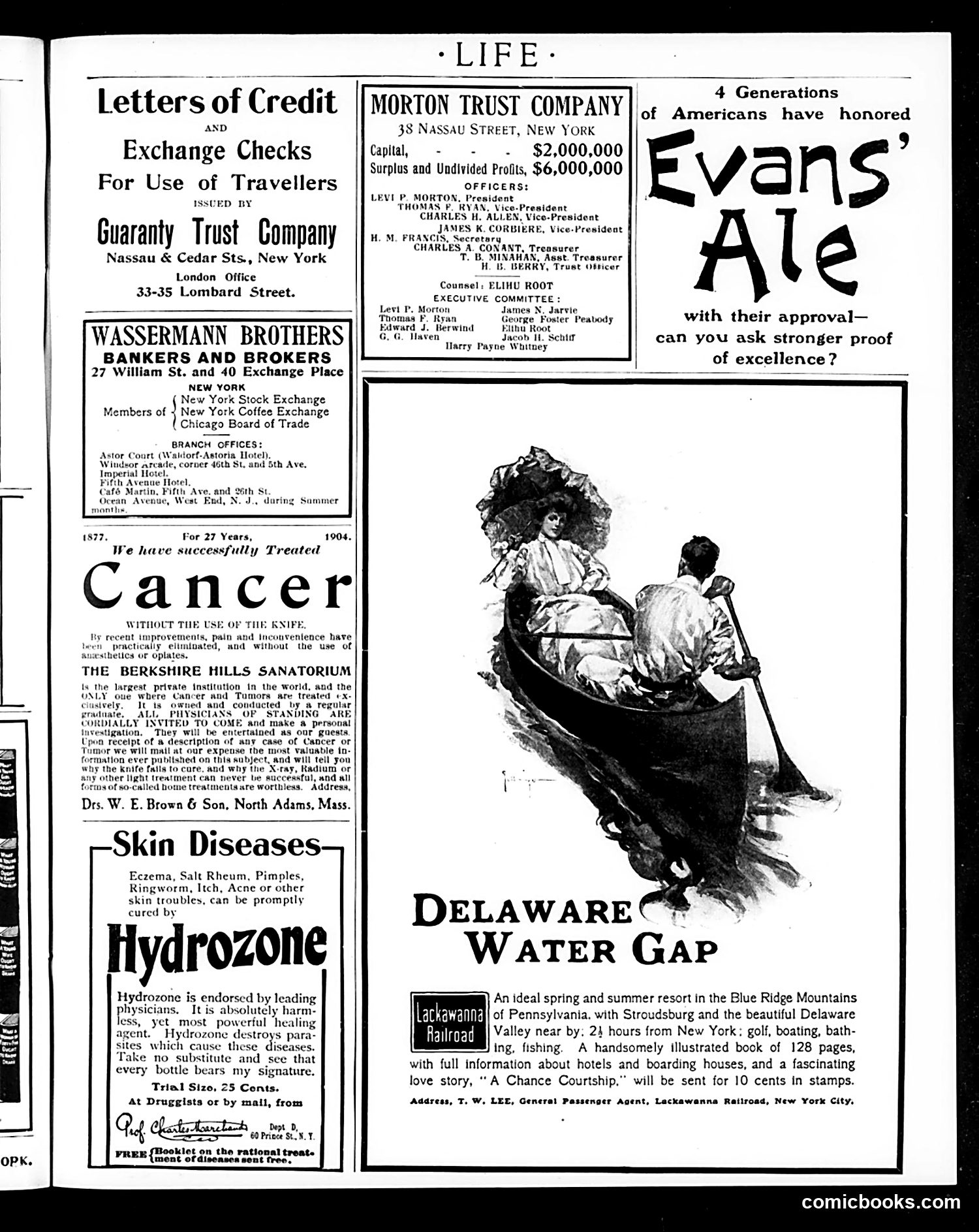
This is primarily an **advertising page** rather than satirical content. It features various turn-of-the-century advertisements: **Notable ads include:** - Financial services (Guaranty Trust Company, Morton Trust Company, Wassermann Brothers bankers) - A **cancer treatment sanatorium** claiming to cure cancer without surgery or opiates—representing the era's prevalent medical quackery - **Hydrozone**, a patent medicine for skin diseases endorsed by physicians, another common dubious remedy - **Evans Ale**, appealing to four generations of Americans (a marketing strategy emphasizing tradition and reliability) - **Delaware Water Gap** resort promotion via the Lackawanna Railroad The illustration accompanying Delaware Water Gap shows a couple enjoying leisure activities, typical period travel marketing. The page reflects early 1900s advertising practices: unregulated medical claims, nostalgic appeals, and luxury travel promotion aimed at affluent readers. There is no political satire present—this is straight commercial content from Life's advertising section.
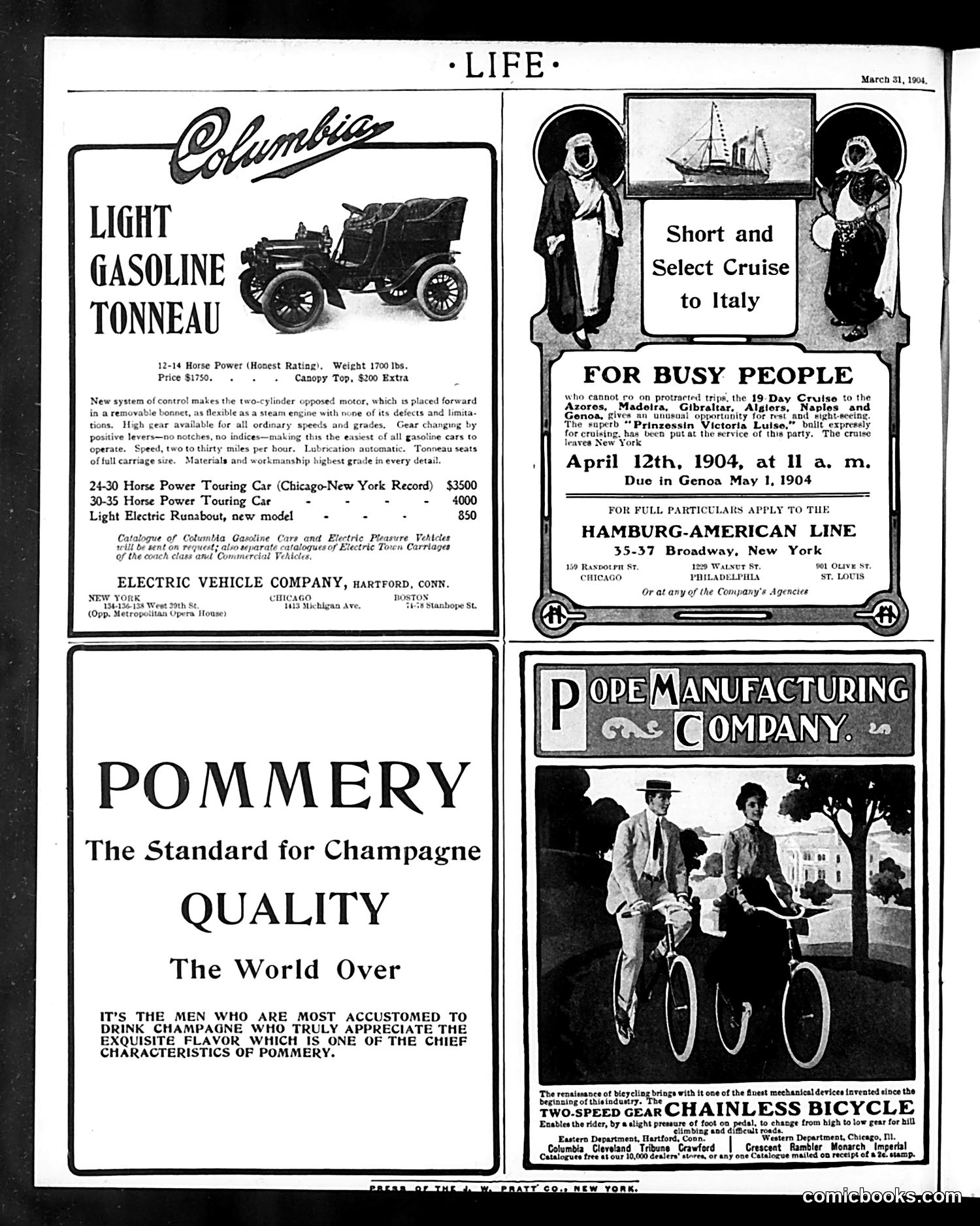
This is primarily an **advertising page**, not a satirical cartoon. It showcases four luxury products targeting wealthy Americans: 1. **Columbia automobiles** — Early gasoline-powered cars ranging from $850-$4,000, marketed as modern transportation innovations. 2. **Pommery Champagne** — French luxury beverage positioned for sophisticated drinkers. 3. **Hamburg-American cruise line** — A 19-day Mediterranean voyage departing April 12, 1904, aboard the *Prinzessin Victoria Luise*, marketed to "busy people" who want leisure travel. 4. **Pope Manufacturing chainless bicycles** — Two-speed mechanical bicycles featuring innovative gear-shifting technology. The page reflects **Gilded Age consumerism**: these ads target affluent Americans with disposable income for automobiles, foreign travel, imported beverages, and recreational cycling. The advertisements emphasize novelty, mechanical innovation, and aspirational lifestyles typical of early 1900s marketing.