
Life, 1904-03-31 · page 4 of 20
Life — March 31, 1904 — page 4: what you’re looking at
What you’re looking at
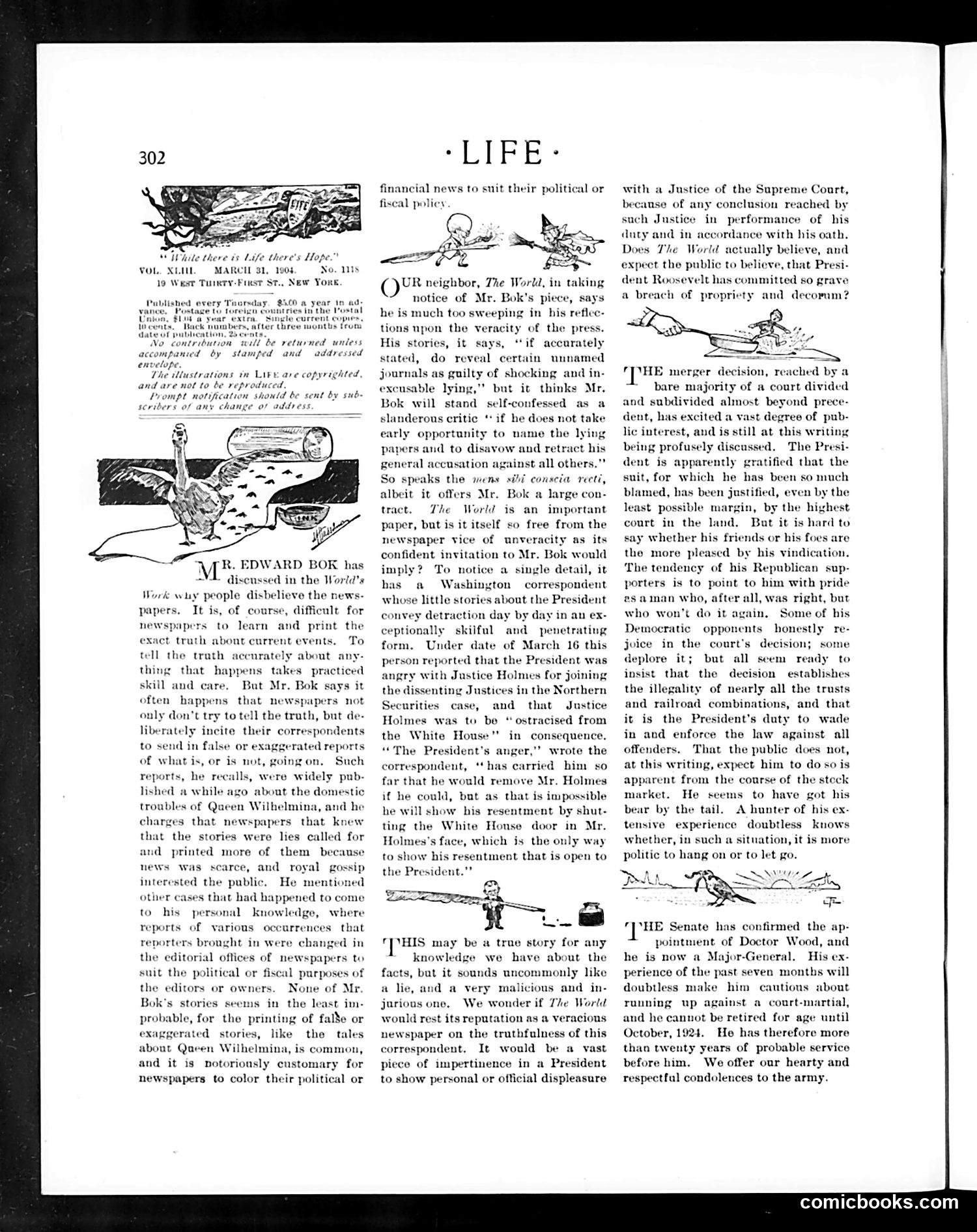
This page discusses newspaper credibility, particularly criticizing *The World* newspaper's coverage. The text charges that *The World* publishes unverified stories and allows its correspondents to send false reports to advance political agendas. The main cartoon shows a figure (appears to be Edward Bok, Life's editor) examining newspaper content with a magnifying glass, suggesting scrutiny of journalistic accuracy. The satire targets newspapers that color coverage for political purposes. The article references President Roosevelt allegedly being angry with Justice Holmes and suggests *The World* spreads such stories without verification to embarrass the administration. The page concludes with notice of Doctor Wood's appointment as Major-General, offering "hearty and respectful condolences to the army"—a tongue-in-cheek jab. The overarching point: Life exposes how newspapers weaponize reporting for partisan advantage.
📄 Transcribed text from this page (OCR, searchable)
Machine-transcribed from the original scan — historical spelling and the odd misread are preserved.
there és Life t VOL. XLUIL MARCIE 31, 19 West Tuiety-Finst St., New Yous. cs will be stamped No contribution accompanied by envelope. The illustrations in Lave and are not to be reproduce Prompt notification scribers of any ch and addressed M. R. EDWARD BOK has ~Y discussed in the World’s Work why people disbelieve the news- papers, It is, of course, difficult for newspapers to learn and print the exact truth abont current events. To tell the truth accurately about any- thing that happens takes practiced skill and care, But Mr. Bok says it often happens that newspapers not don't try to tell the truth, but de- liberately incite their correspondents to send in false or exaggerated reports of what is, or is not, going on, Such reports, he recalls, were widely pub- lished a whi > about the domestic troubles of Queen Wilhelmina, and he charges that newspapers that knew that the stories were lies called for and printed more of them bec news was scarce, and royal gossip interested the public. He mentioned other cases that had happened to come to his personal knowledge, where reports of various occurrences that rep rs brought in were changed in the editorial offices of newspapers to. suit the political or fiscal purposes of one of Mr. the least im- probable, for the printing of fale or aggerated like the tales about Queen Wilhelmina, is common, and it is notoriously customary for newspapers to color their political or the editors or owners. Bok’s stories seems in stories, “LIFE * financial news to suit their political or fiscal policy Ove neighbor, The World, in taking notice of Mr. Bok's piece, sa he is much too sweeping in his reflec- tions upon the veracity of the press. His stories, it says, ‘if accurately stated, do reveal certain unnamed journals as guilty of shocking and in- excusable lying,” but it thinks Mr. Bok will stand self-confessed as a slanderous critic ‘* if he does not take early opportunity to name the lying papers and to disavow and retract his general accusation against all others."* So speaks the mens si albeit it offers Mr. Bok a large con- trac The World is an important aper, but is it itself so free from the newspaper vice of unveracity as its confident invitation to Mr. Bok would imply ? » notice a single detail, it has a Washington correspondent whose little stories about the President convey detraction day by day in an ex- ceptionally skilful and penetrating form. Under date of March 16 this person reported that the President was angry with Justice Holmes for joining the dissenting Justices in the Northern Securities case, and that Justice Holmes was to be * ostracised from the White House" in consequence. “The President's anger,’’ wrote the correspondent, ‘has carried him so far that he would remove Mr. Holmes if he could, but as t is impossible he will show his resentment by shut- ting the White House door in Mr. Holmes’s fa which js the only way to show his resentment that is open to the President.”” conscia recti, os en | (PHIS may be a troe story for any knowledge we have about the facts, but it sounds uncommonly like a lie, and a very malicious and in- jurious one, We wonder if The World would rest its reputation as a veracious newspaper on the truthfulness of this correspondent. It would be a vast piece of impertinence in a President to show personal or official displeasure with a Justice of the Supreme Conrt, because of any conclusion reached b such Justice in performance of his duty and in accordance with his oath. Does The World actually believe, and expect the public to believe, that Presi- dent Roosevelt has committed so grav a breach of propriety and decorum? ed [ss merger decision, reach bare majority of a court divided and subdivided almost beyond prece- dent, has excited a vast degree of pub- lic interest, and is still at this writir being profusely discussed. The Pres dent is apparently gratified that the uit, for which he has been so much blamed, has been justified, even by the least possible margin, by the highest court in the land, But it is hard to say whether his friends or his foes are the more pleased by his vindication. y of his Republican sup- porters is to point to him with pride es aman who, after all, was right, but who won't do it n. Some of his Democratic opponents honestly re- joice in the court's decision; some deplore it; but all seem ready to insist that the decision establishes the illegality of nearly all the trusts and railroad combinations, and that it is the President’s duty to wade in and enforce the law against all offenders. That the public does not, at this writing, expect him to do so is apparent from the course of the steck market. He seems to have got his bear by the tail. A hunter of his ex- tensive experience doubtless knows whether, in such a situation, it is more politic to hang on or to let go. ‘] SHE Senate has confirmed the ap- pointment of Doctor Wood, and he is now a Major-General. His ex- perience of the past seven months will doubtless make him cautious about running up against a court-martial, and he cannot be retired for age until October, 1924. He has therefore more than twenty years of probable service before him. We offer our hearty and respectful condolences to the army. comicbooks.com