
Life, 1904-03-31 · page 12 of 20
Life — March 31, 1904 — page 12: what you’re looking at
What you’re looking at
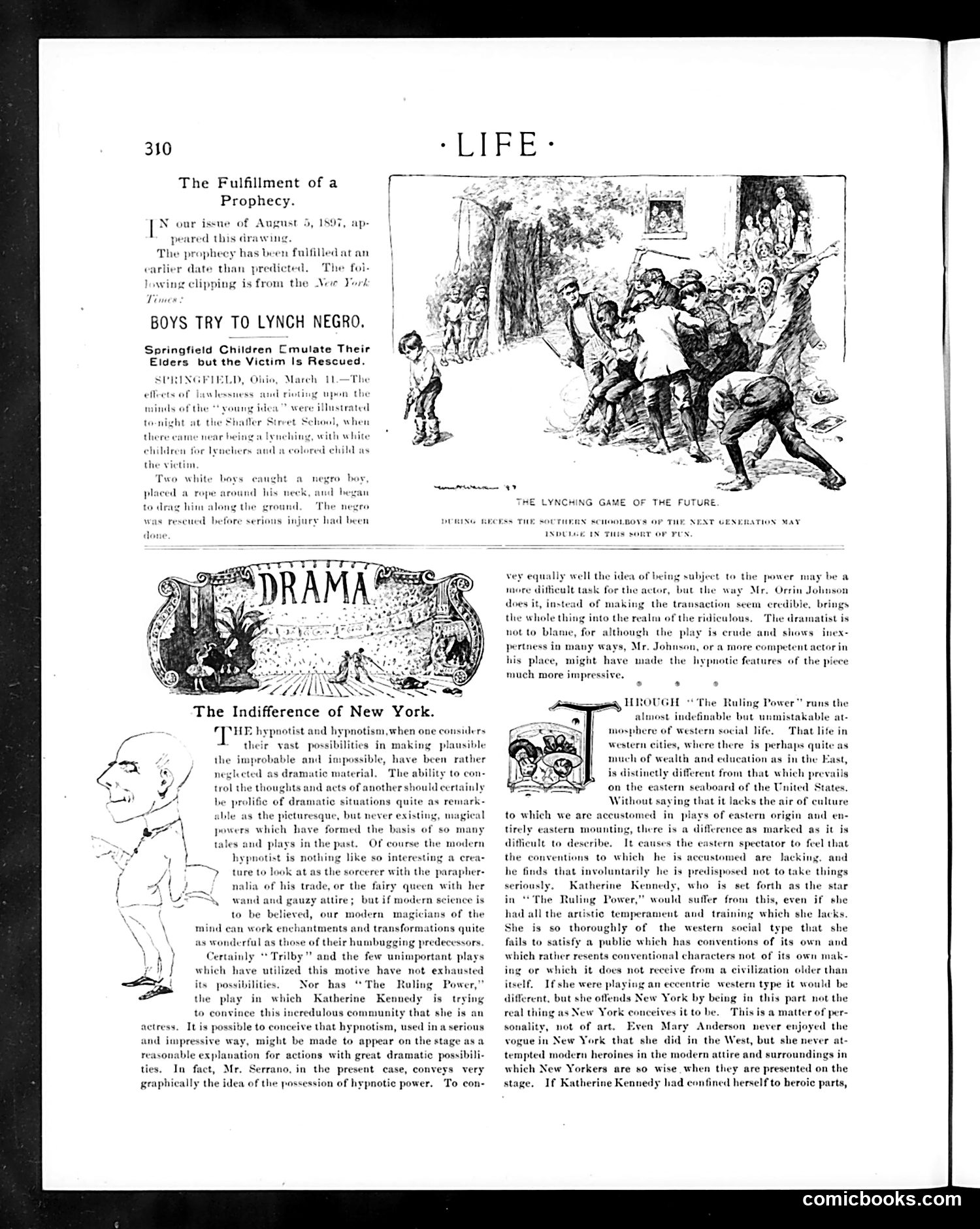
This page contains three distinct sections: 1. **"Boys Try to Lynch Negro"** — A news item reporting an incident in Springfield, Ohio where white boys attempted to lynch a Black child, but the victim escaped. 2. **"The Lynching Game of the Future"** — A satirical cartoon depicting children at play reenacting a lynching, with white children pursuing a Black child. The caption suggests this reflects how normalized racial violence had become—children were casually playing out lynchings as entertainment. 3. **"The Indifference of New York"** and **"The Ruling Power"** — Drama reviews discussing theatrical performances, including commentary on how New York audiences respond differently to western versus eastern settings in plays. The lynching content reflects Life's documented role documenting racial violence during this period of American history.
📄 Transcribed text from this page (OCR, searchable)
Machine-transcribed from the original scan — historical spelling and the odd misread are preserved.
310 The Fulfillment of a Prophecy. of A ared this drawn our iss ist 5, 1897, ap- The prophecy has been fulfilled at an rier date than predicted. The foi- dipping is from the ewe York BOYS TRY TO LYNCH NEGRO. Springfield Children Cmulate Their Elders but the Victim Is Rescued. SURINGFIELD, Ohio, March 11.—The effvets of Lawl Trioting upon the minds of the “ young idea” were illustrated ht at the Shaffer Street s , Whew there came near be Ivnehing, with white ehildr child as the victim, Two white 1 for Iynehers and ae DURING RECESS THE SOCTHERS Seno The Indifference of New York. CLE hypnotist and hypnotism, when one consi their vast possibilities in making pl the improbable and impossible, have been rather negleted as dramatic material. The ability to con- trol the thoughts and acts of another should certainly be prolific of dramatic situations quite as remark- able as the picturesque, but never existin, al powers which have f tales and plays in the past. Of notist is nothing like so interesting a crea- ture to look at as the sorcerer with the parapher- nalia of his trade, or the fairy queen with her \ wand and gauzy a but if modern science is ed, our modern mag mind can work enchantments and transformations quite as wonderful as those of their hambugging predecessors *Trilby” and the few unimportant plays atilized this motive have not exhausted its possibilities, Nor has “The Ruling the play in which Katherine Kennedy is trying nee this incredulous community that she is an actress. It is possible to conceive that hypnotism, used in a serious and impressive way, might be made to appear on the stage asa reasonable explanation for actions with great dramatic possibili- In fact, Mr. Serrano, in the present case, conveys very iphically the idea of the possession of hypnotic power. ‘To con- med the basis of so many irse the modern to be be ans of the Certain) which have to con ties. LYNCHING GAME OF THE FUTURE BOYS OF THY NEAT GENERATION MAY INDULGE IN THIS SORT OF FEN vey equally well the idea of being subject to the power may be a tnore difficult task for the actor, but the way Mr. Orrin Johnson does it, in making the transactio . brings real of the ridiculous, ‘The dramatist is igh the play is crude and shows inex- . Mr. Johnson, or a mo nt actor in ave made the hypnotic features of the piece seem er the whole thing into not to blame, for pertness in many w his pla compe much more impressive, . 6 »* HROUGH “The Ruling Power” runs the almost indefinable but unmistakabl mosphere of western social life. That li western cities, where there is perhaps quite much of we: is distin on the ates. Without saying that it lacks the air of culture to which we are accustomed inp gin a i stern mounting, there is a difference as marked as it is It causes the eastern spectator to feel that ventions to which he is accustomed are lacking, aud sed not to take things ith and education as in the y different from that which pri stern seaboard of the United ays of eastern o 1 en- t to describe, he finds that involuntarily he is predis Katherine Kennedy, who is. set forth as the star ng Power,” would sutfer from this, even if she in had all the artistic temperament and training She is so thoroughly of the western fails to satisfy a public which has conventions of its own and which rather resents con ing or which it does not receive from a civilization itself, If she were playing an eccentric western type it would be different, but she of x by being in this part not the real thing as New York conceives it to be. This is a matter of per- sonality, not of art, Even Mary Anderson never enjoyed the vogue in New York that she did in the West, but she never at- tempted modern heroines in the modern attire and surroundings in h New Yorkers are so wise when they are presented on the If Katherine Kennedy had confined herself to heroic parts, entional characters not of its der than stage. comicbooks.com