
Life, 1904-03-31 · page 14 of 20
Life — March 31, 1904 — page 14: what you’re looking at
What you’re looking at
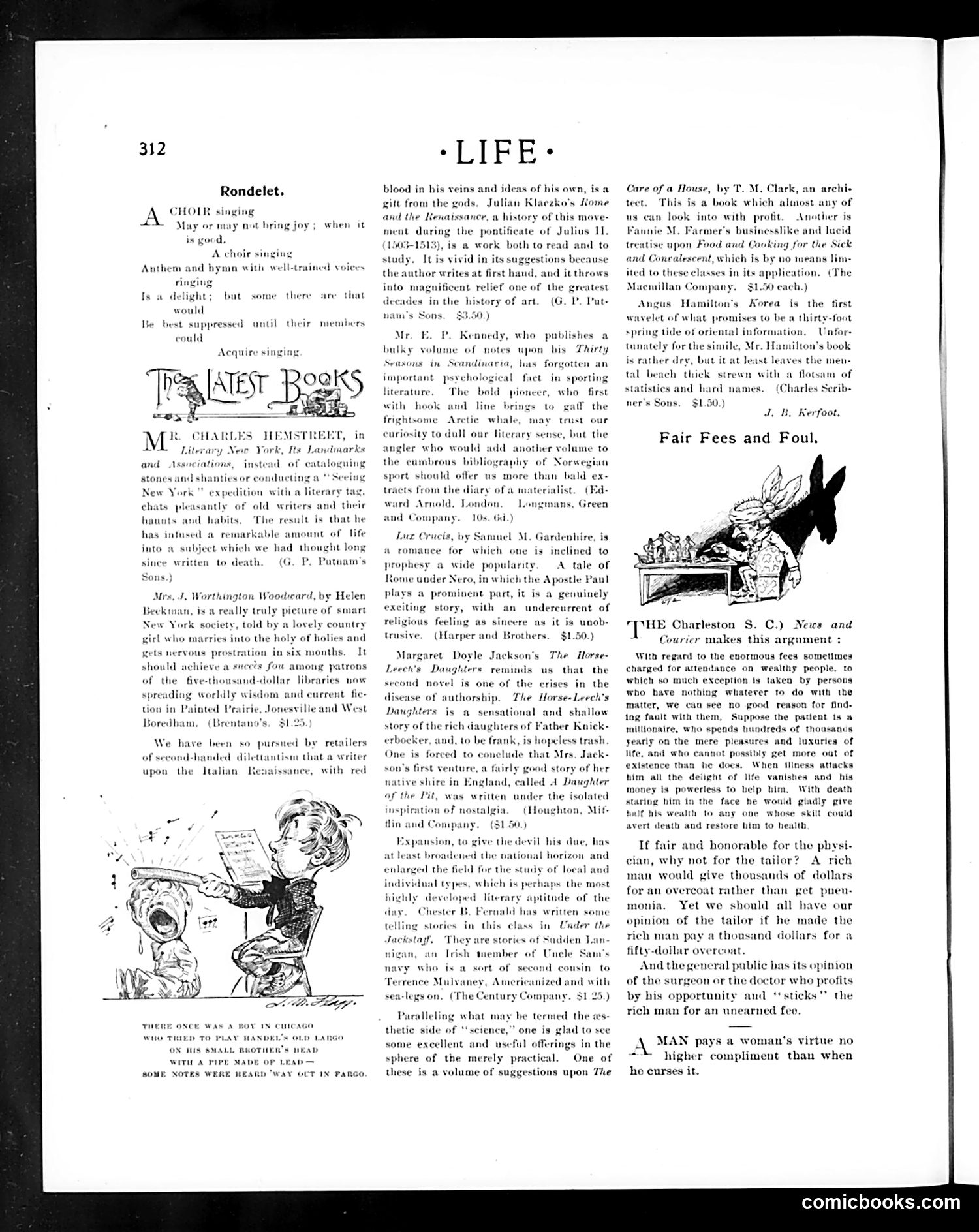
This page contains book reviews rather than political cartoons. The small illustration at the bottom depicts a child playing with what appears to be a toy or doll, with the caption "There once was a boy in Chicago / Who tried to play Handel's old largo / On his small brother's head— / Some notes were heard 'way out in Fargo," a humorous verse about a child misusing an instrument. The page reviews contemporary literary works, including books on the Italian Renaissance, Scandinavian travel, and a novel called *Luz Crucis* set in Rome. The reviews discuss various authors' contributions to literature, with critical commentary on their merit and originality. The cartoon's joke plays on the absurdity of a child attempting serious classical music on an unsuitable "instrument"—a satirical comment on cultural pretension or misguided artistic efforts, typical of Life magazine's humor during this era.
📄 Transcribed text from this page (OCR, searchable)
Machine-transcribed from the original scan — historical spelling and the odd misread are preserved.
312 Rondelet. CHOIR singing May or may not bring joy ; A when it is good, A choir singing Anthem and hymn with well-trained voices ringing Is a delight; but’ some there are that would Hie best suppressed until their members could Acquire singing ME, CHARLES HEMSTREET, ANE Ld y New York, Its Lawtaarks and ns, instead of catal stones hanties or conducting New York" expedition with a lite old writers and th The result is that he s pleasantly of haunts and habits. has infused a remarkable amount of fi swe had thought | Pats © subject whi written to death. (G. P. Sons.) Mrs. J. Wi y Helen Becktnan, is a really truly picture of smart gicl who marries into the holy of holies anc 1 in six months. It nong patrons hington Woodard, ety, told by # lovely country Kets nervous prostra should achieve a # of the spreadis ve-thousand-dollar 1 worldly raries now ad current fi nd West wisdom tiow in Painted Pra Jonesvill Boredham, ( 8. $1.25, We have of second-h 1 so pursed by retailers ta writer with red nded dilettantisn th upon the Italian Renaissance, LaRGo < Heap y LEAD — WAY OUT IN PARGO, with ar somn NOTES W *LIFE* blood in his veins and ideas of his own, isa Julian Klaczko's Kome and the Renaissance, a history of this move ment during the pontificate of Julius I. 1903-151 k both to read and to study. It is vivid in its su the author writes at first hy gift from the gods. is a tions because ud, and itthrows the greatest VP. Pate into magnificent relief on decades in the history of art. (G nam’s Sons. $3.50.) Mr EL P. bulky volume of notes upon bis Kennedy, who publishes a Thirty Seasons in Scandinavia, has forgotten an important literature. with h psvehe faet in sporti The bold 4 first and line brings to gail the Aretie curiosity to dull our literary s meer, who frightsome whale, may trust our . but the other volume to Norw angler who would add the cumbrous bibliography of sport should offer us more t teacts from the dia ad Arnold, and Company. yofan London, — Longmans, Gree 10s. Gd.) Luz Crucis, by Samuel M. Gardenhire, is which one is inclined to A tale of Apostle Paul Prominent part, it is a genuinely story, with an undercurrent of jous feeling sit is unob- $1.50.) The Horse- that the e of the crises in the he Horse-Leech’s a romance for prophesy a wide popularity Rome under Nero, in wh plays xciting sincer trusive. (Harper and Brothers Margaret Leech’s Doyle Jackson's Daughters reminds us second novel ison disease of authorst Daughters is as nd shallow ther Knick- erbocker, and, to be frank, is hopeless trash Mrs. J son’s first venture, a fairly good story of her led A Daughter story of the rich daughters of F One is forced to conelude th native shire in England, n under the isolated Mif- of the Pit, was writt inspiration of nostalgia, (Houghton lin and Company. 30.) to give the devil his due, ithe n ed for th ual types, whiel Expansion at least broade the fi tional horize eolary sturdy ivi ly ¢ Chester B. Fernald has written ler the Sudden Lan- siny stories in this class in Ui kxtayf. ‘Tl nt, » Sam's navy who is a sort of s rousin to Ter Mulvaney and with (The Century Company. $125.) Amer ed searlegs on Paralleling what may be termed th thetic side of “science,” one is glad to see cllent 1 offerings in the sphere of the merely practical. One of these is a volume of suggestions upon The some ex A usefi Care of a House, by T. M. Clark, an archi- tect. This is a book which almost any of us can look into with Faunie M. Farmer's busi treatise upon Food and Cooking for the Sick and Concalescent, which is by no means lime ited to these classes in its application. (The Macmillan Company, $1.50 Angus wavelet ach.) Hamilton's Korea is the first f what promises to be a thirty-foot tide of oriental information. Unfor- for the simile, Me. Hamilton's book is rather dry, but it at le tal be thick strewn with a flotss statisties and hard names. (CI $1.50.) st leaves the m arles Set ner's Sons. J.B. Kerfoot. Fair Fees and Foul, S.C.) News and s this argument : With regard to the enormous fees sometimes charged for attendance on wealthy people, to which so much exception Is taken by persons who have nothing whatever to do with the matter, we can see no good reason for find- tng fault with them. Suppose the patient ts s millfonaire, who spends tundreds of thousanes yearly on the mere pleasures and luxuries of ot possibly get more out of he docs, When tliness attacks delight of Ife vantstes Tee Charleston = Courter mak If fair and honorable for the ph cian, why not for the tailor? A rich man would give thousands of dollars for an overcoat rather than get pnen- monia. Yet we should all have our opinion of the tailor if he made the rich man pay a thousand rs for a fifty-dollar overc a And the general public bas its opinion of the surgeon or the doctor who profits by his opportunity and ‘sticks’ the rich man for an unearned fee. MAN pays a woman's virtue no higher compliment than when he curses it. comicbooks.com