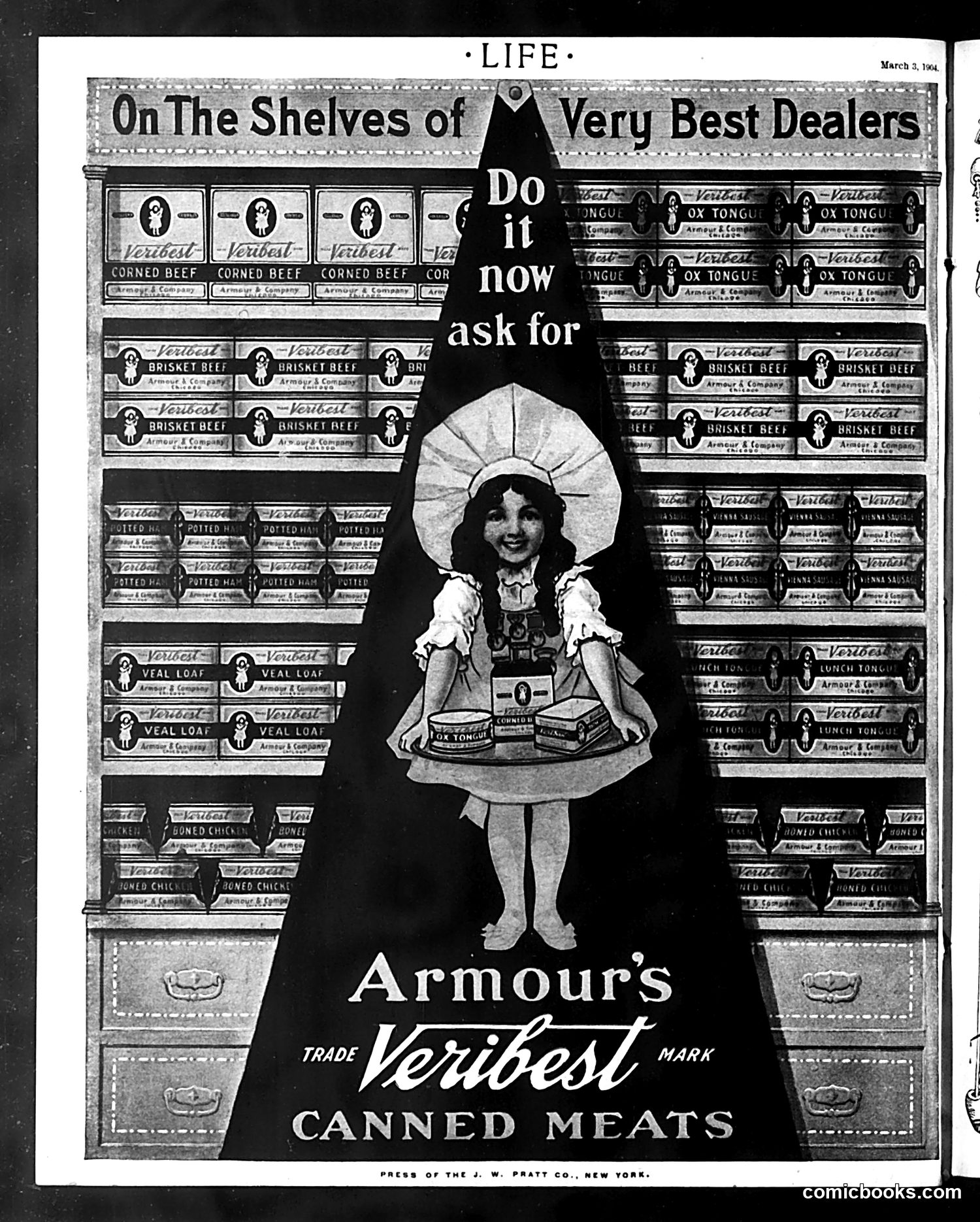
A complete issue · 38 pages · 1904
Life — March 3, 1904
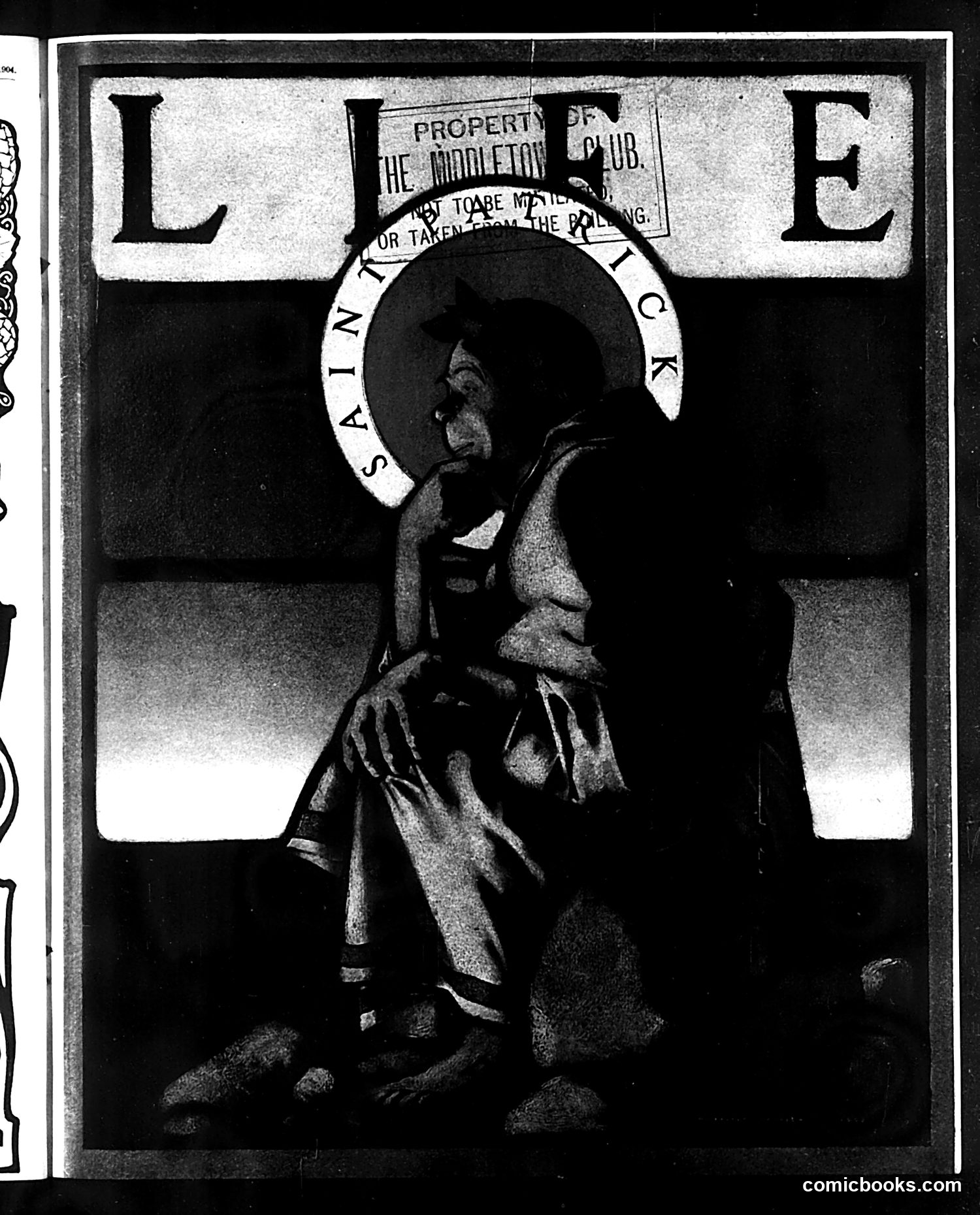
This appears to be a Life magazine cover featuring a figure wearing a large halo marked "SAINT DICK" (the text curves around the halo). The figure is depicted in profile against a dark background, with large letters "L" and "E" visible at top (likely part of "LIFE"). A stamp reading "PROPERTY OF THE MIDDLETON CLUB" is visible, suggesting this was library property. The satire seems to mock someone nicknamed or referred to as "Dick" by ironically canonizing them as a saint—a common technique in satirical magazines to criticize public figures through exaggerated praise. However, **without the magazine's date or additional context, I cannot definitively identify which "Dick" is being satirized** or what specific event prompted this cover. The artwork style suggests early-to-mid 20th century.
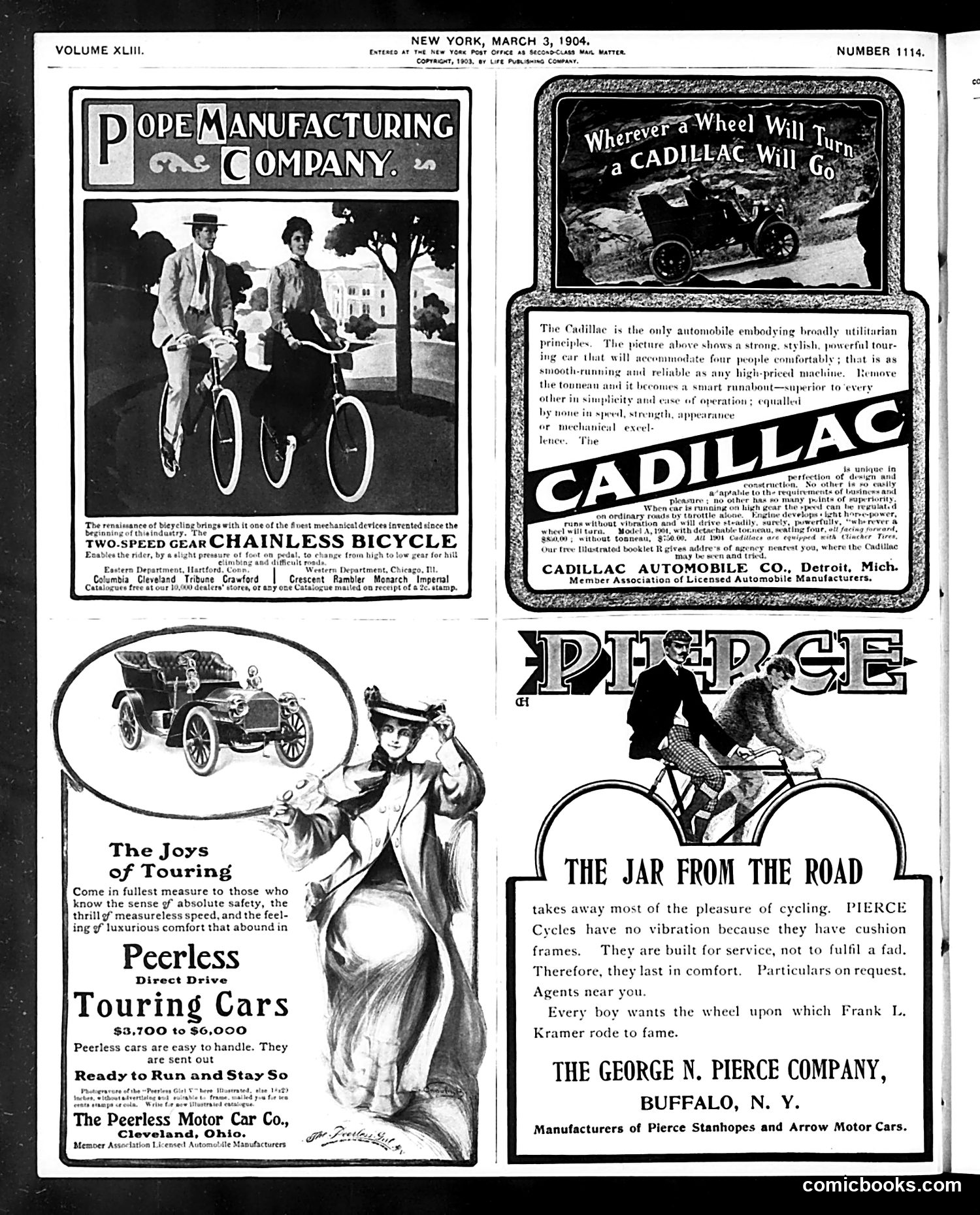
This page is primarily **advertising**, not satire or political commentary. It contains four vehicle advertisements from 1904: 1. **Pope Manufacturing Company** - promotes a chainless bicycle with two-speed gear 2. **Cadillac Automobile** - emphasizes utilitarian principles and reliability 3. **Peerless Motor Car** - highlights safety, speed, and comfort for touring 4. **Pierce Cycle** - advertises cushion-frame bicycles, contrasting them with jarring automobiles The page reflects the **early automotive era** when bicycles and cars competed for consumers. The Pierce ad's claim that cars create "jar from the road" suggests bicycles were marketed as smoother alternatives. The advertisements collectively show how manufacturers positioned different transportation technologies to appeal to affluent early-1900s consumers valuing safety, comfort, and mechanical innovation.
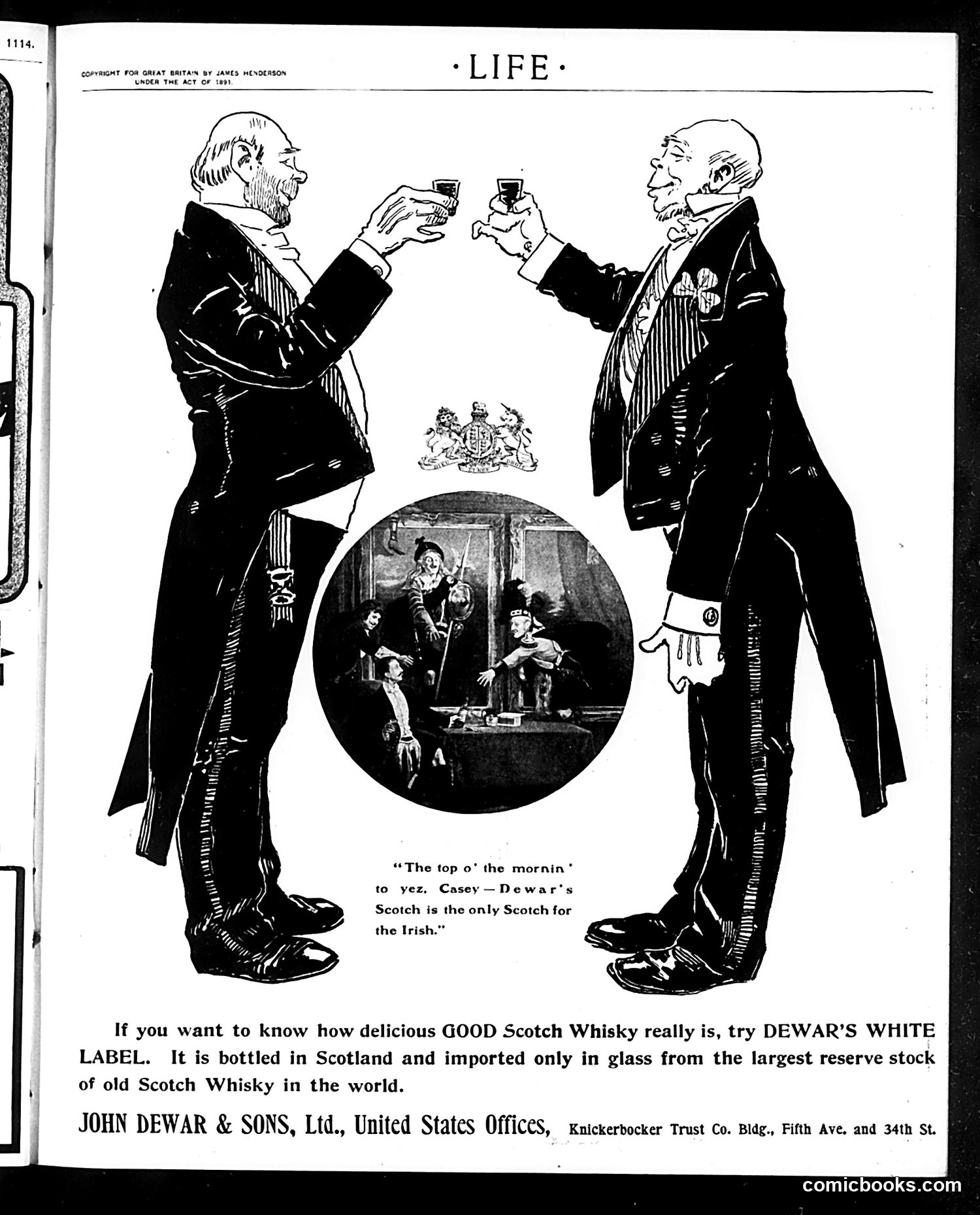
This is primarily a **Dewar's Whisky advertisement** rather than political satire. Two well-dressed gentlemen in formal attire toast each other while holding glasses. The circular inset shows what appears to be a domestic scene with a woman and children. The caption quotes one figure saying "the top o' the mornin' to yez, Casey — D'yez know, Scotch is the only Scotch for the Irish." This is a **stereotypical Irish joke** playing on the names "Casey" (Irish) and accent ("top o' the mornin'"), ironically promoting Scottish whisky to an Irishman. The humor relies on crude ethnic stereotypes common in early 20th-century advertising. The ad emphasizes Dewar's as imported, premium product from Scotland's "largest reserve stock."
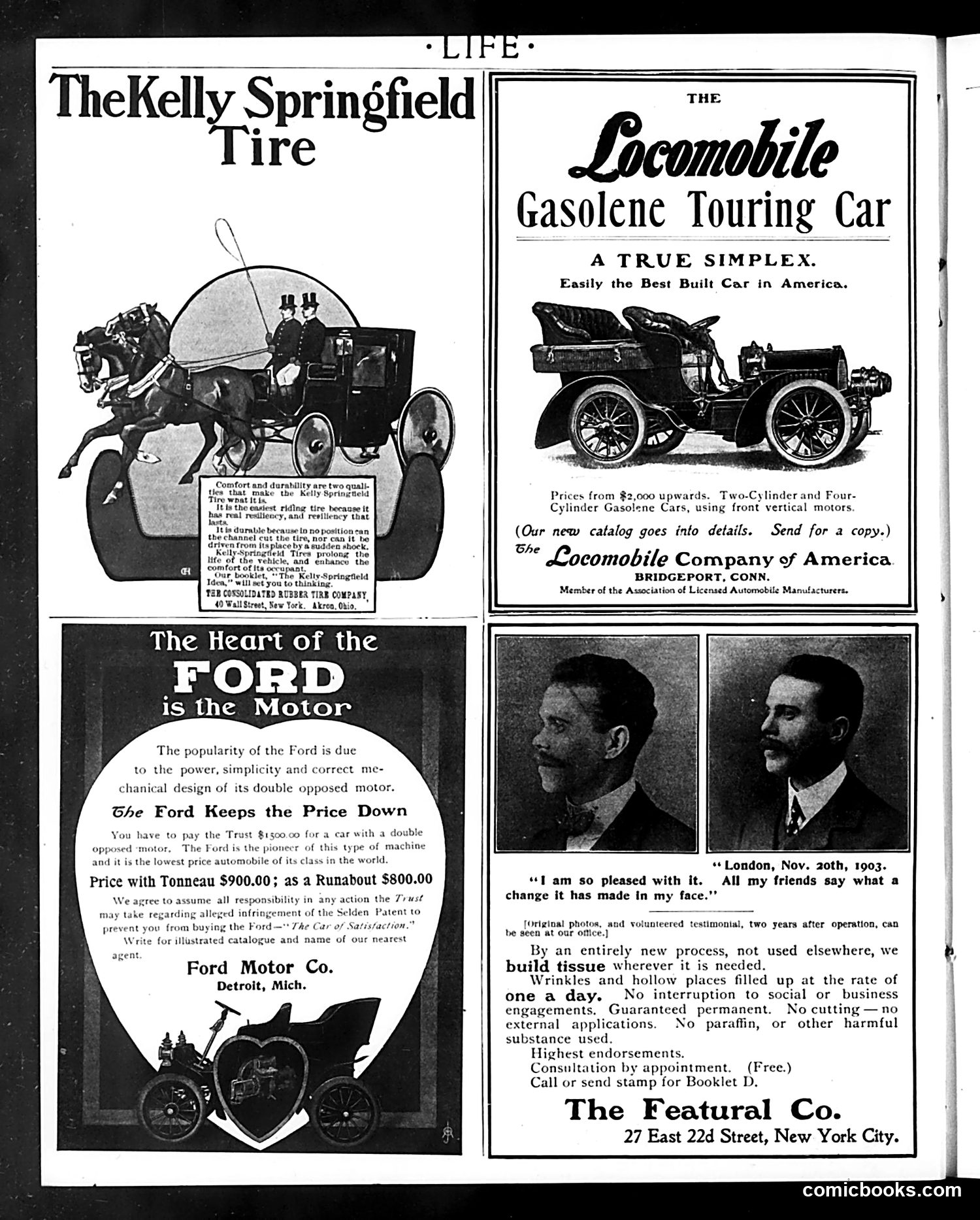
This page contains **no political cartoons or satire**—it's primarily **early automobile advertising** from Life magazine, circa 1903. The four advertisements promote competing vehicles: 1. **Kelly Springfield Tire**: emphasizes comfort and durability for horse-drawn carriages 2. **Locomotile Gasolene Touring Car**: claims to be "the Best Built Car in America," priced from $2,000 3. **Ford Motor Company**: highlights their affordable double-opposed motor engine, with prices around $800-$900 4. **The Featural Co.**: advertises a tissue-building treatment with testimonials The page reflects the early automotive era's competition between established carriage makers, new gasoline car manufacturers, and unrelated health products. There is no satirical commentary—these are straightforward commercial pitches to consumers considering emerging transportation technology.
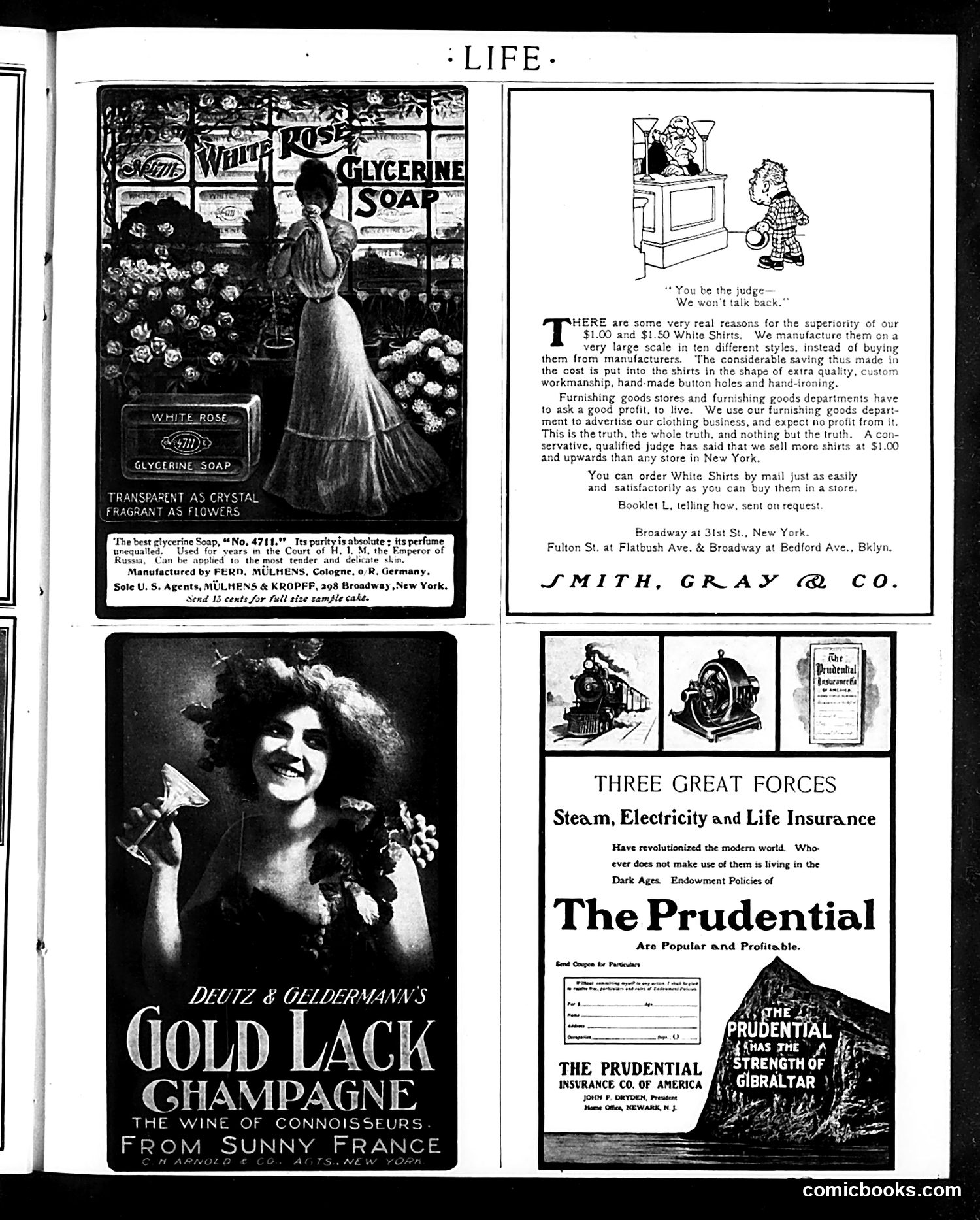
This page is primarily **advertising**, not political satire. It contains four advertisements: 1. **White Rose Glycerine Soap** – appeals to quality-conscious consumers with imagery of a woman examining store displays 2. **Smith, Gray & Co. White Shirts** – text-based ad explaining their direct-to-consumer mail-order business model and price positioning at $1.00+ 3. **Deutz & Geldermann's Gold Lack Champagne** – features a glamorous woman, marketed as "the wine of connoisseurs from Sunny France" 4. **The Prudential Insurance** – promotes life insurance by comparing it to transformative modern forces (steam, electricity) There is **no political cartoon** on this page. The content reflects early-to-mid 20th century consumer culture and marketing approaches targeting middle and upper-class American readers.
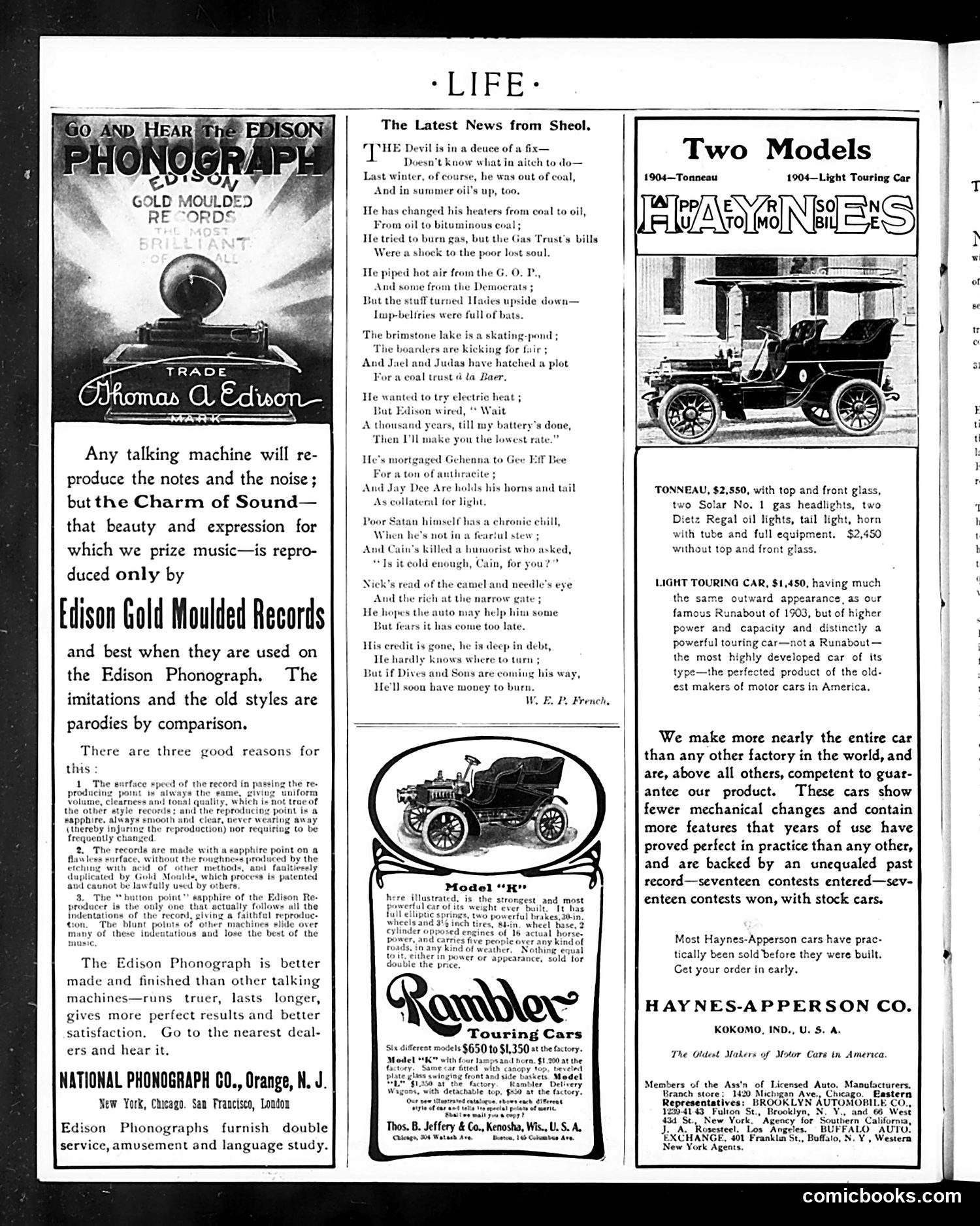
This page is primarily **advertising**, not political satire. It contains three distinct advertisements: 1. **Edison Phonograph** (left): Promotes Edison Gold Moulded Records, emphasizing superior sound quality compared to competitors' products. 2. **Haynes-Apperson Automobiles** (right): Showcases two 1904 car models—the Tonneau and Light Touring Car—highlighting manufacturing quality and competitive racing victories ("seventeen contests won"). 3. **Rambler Touring Cars** (center-bottom): Another automobile advertisement listing six different models and prices. The middle section contains a poem titled "The Latest News from Shoel" [sic], likely satirizing current events or social commentary, but without clearer context, its specific targets remain unclear. The page reflects early-1900s consumer culture dominated by new technologies: phonographs and automobiles.
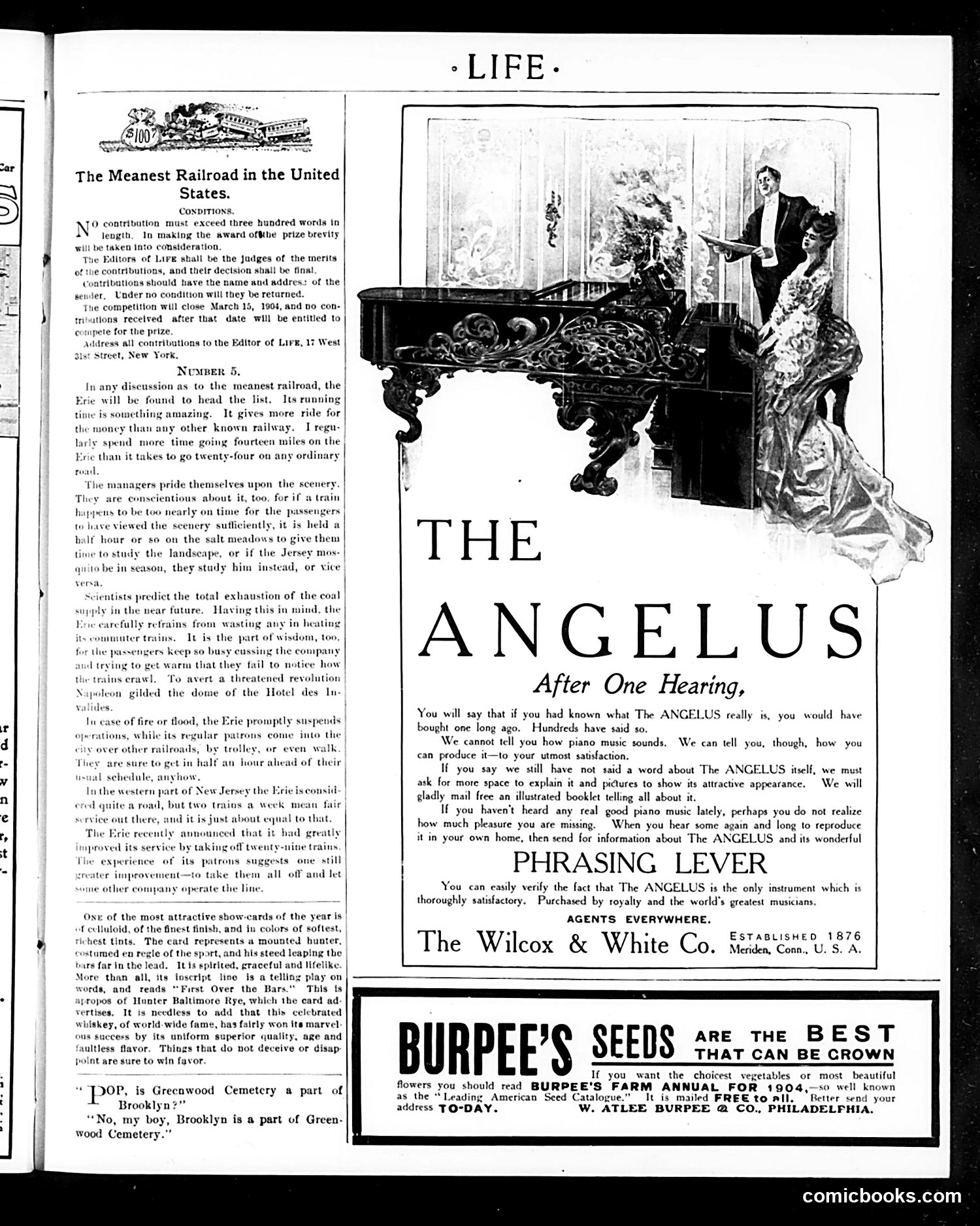
This page is primarily **advertising and editorial content**, not political satire. The left column discusses the Erie Railroad—apparently claiming it's "the meanest railroad in the United States" due to poor service, though the text humorously notes its speed and scenic merit. The main illustration shows a well-dressed couple at a piano, advertising **"The Angelus"** piano by Wilcox & White Co. (established 1876). The ad promises satisfaction and notes the instrument is "purchased by loyalty and the world's greatest musicians." Below is an advertisement for **Burpee's Seeds**, marketing their farm catalog as the "leading American seed catalogue." The page contains no political commentary or caricature—it's a typical Life magazine mix of light commentary and commercial advertising from the early 1900s.
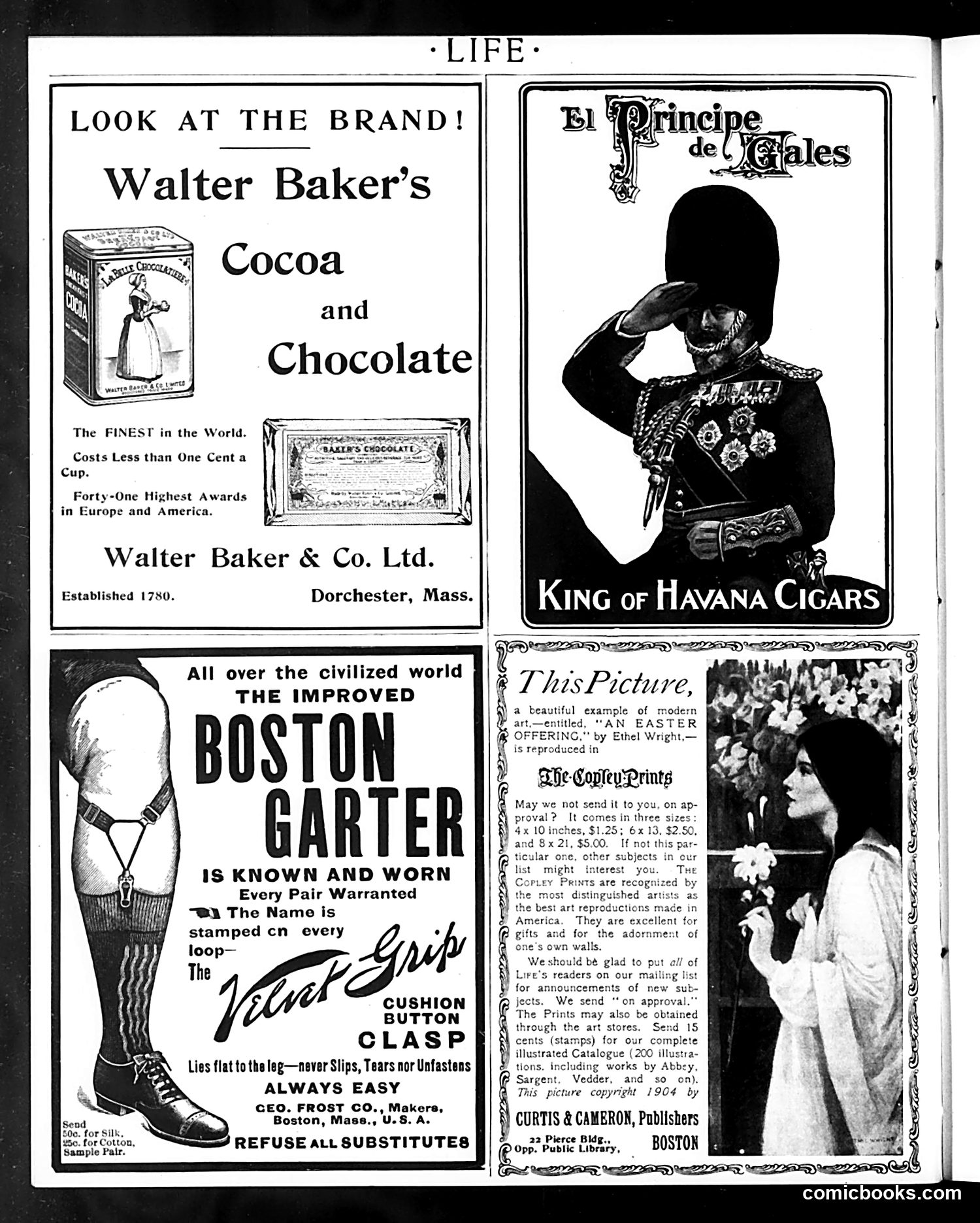
This page is primarily **advertising**, not political satire. It contains four commercial ads: 1. **Walter Baker's Cocoa and Chocolate** — emphasizes quality ("finest in the world") and affordability (less than one cent per cup), established 1780. 2. **El Príncipe de Gales Cigars** — features a silhouetted military figure in ornate uniform tipping his hat, marketing Cuban cigars as prestigious. 3. **Boston Garter** — shows a man's leg with garter, promoting the product as reliable ("never slips, tears nor unfastens"). 4. **Copley Prints** — advertises art reproductions by Ethel Wright, offering prints in multiple sizes. These are straightforward period advertisements with no apparent satire or political commentary. The page demonstrates Life magazine's primary revenue source at this time.
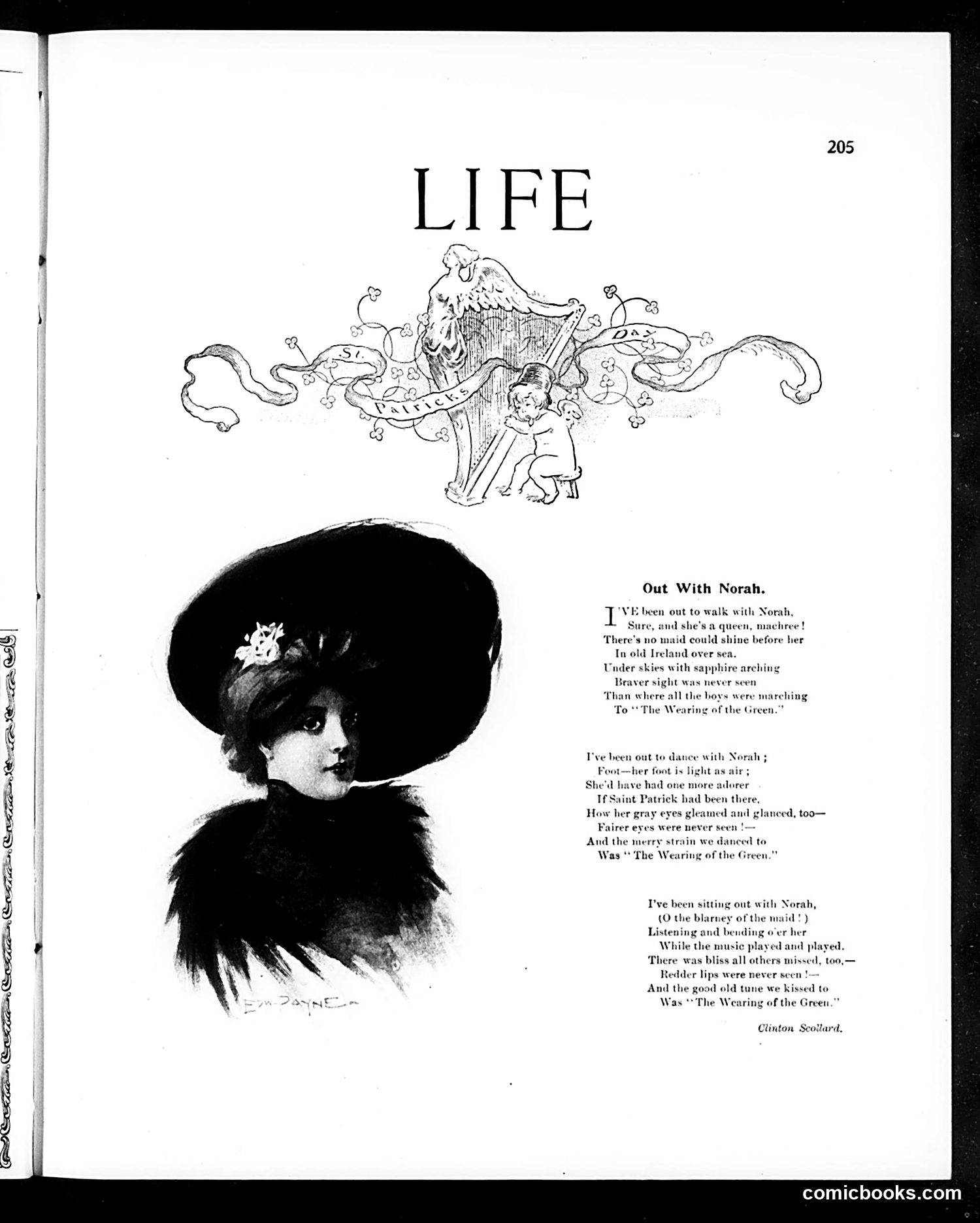
This page features a poem titled "Out With Norah" by Clinton Scollard, accompanied by a portrait of a woman wearing an elaborate wide-brimmed hat and feathered boa—fashionable attire of the early 1900s. The poem celebrates an Irish woman named Norah, referencing "The Wearing of the Green" (an Irish nationalist song) and Saint Patrick. The verses romantically describe dancing, walking, and sitting with Norah, praising her appearance and charm. The satirical point appears to target sentimental Irish-American nostalgia and romanticization of Irish identity, particularly around Saint Patrick's Day themes. The fashionable portrait contrasts with the poem's idealized, somewhat saccharine treatment of Irish romance and cultural pride.
This page contains political commentary rather than formal cartoons. The text discusses **Senator Hanna**, praising his virtues—ability, shrewdness, kindness—while noting his political influence and skill at acquiring voters through "business methods." The article suggests he's considering whether to enter the 1896 presidential race, positioning him as a stronger Republican candidate than Colonel Roosevelt, though less popular than Cleveland among Democrats. A second item criticizes the **Mayor** for vetoing a street railroad franchise, calling it an attempt to appease the public. The author sarcastically notes the Mayor demonstrated "unfitness" by causing a board to fence the new Public Library with advertising signs. The page uses written satire rather than visual caricature to critique political figures and their methods.
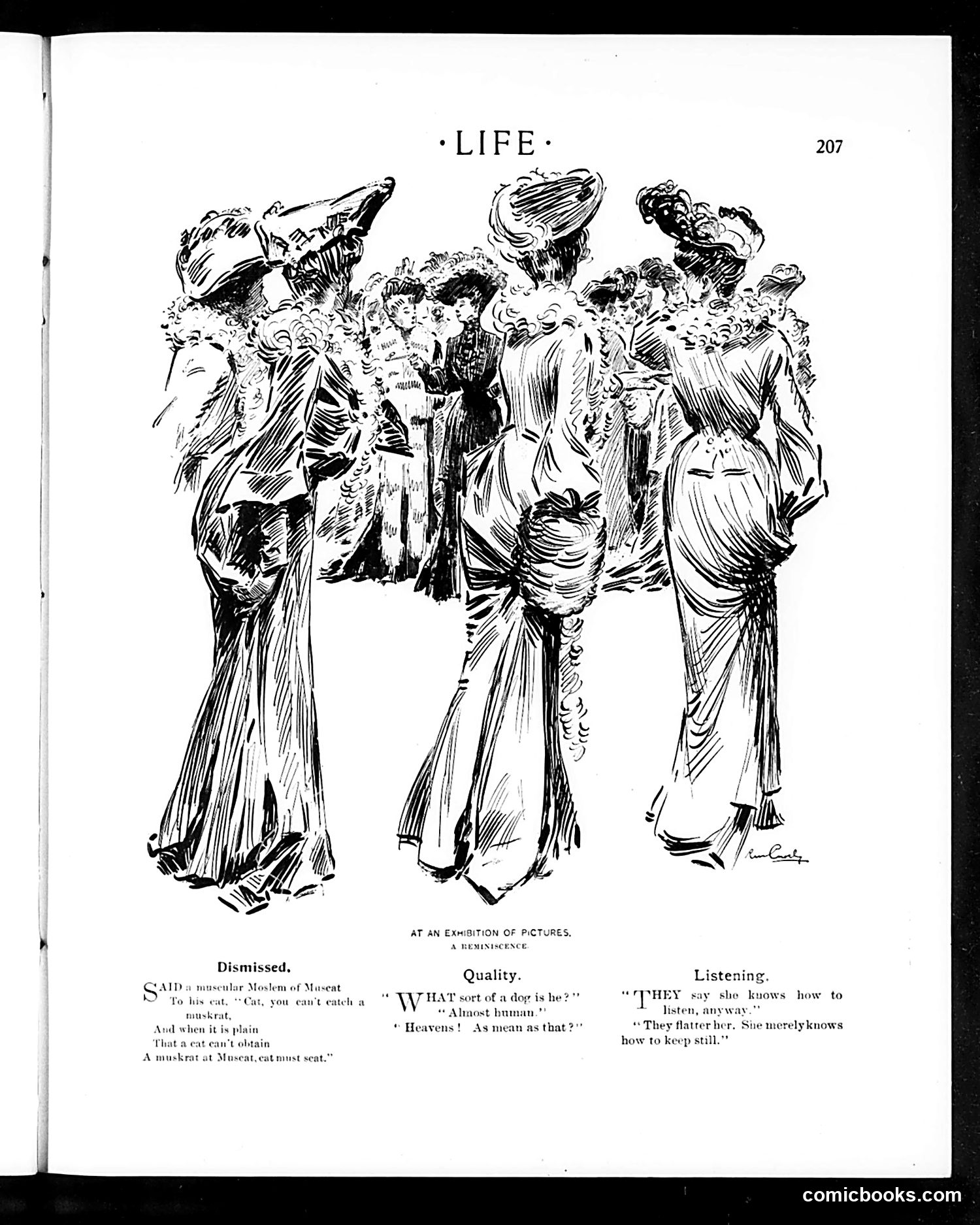
This page from *Life* magazine presents three satirical captions about fashionable women at an art exhibition. The cartoon depicts elegantly dressed women in early 20th-century attire, viewing pictures. The satire mocks three stereotypes of society women: 1. **"Dismissed"**: A woman dismisses modern art ("You can't catch a muskrat"), revealing her ignorance while pretending expertise. 2. **"Quality"**: Women debate what constitutes "almost human" art, suggesting shallow aesthetic judgment. 3. **"Listening"**: A woman is praised for merely staying silent, implying women at exhibitions are typically vapid chatterboxes. The humor targets upper-class women's pretensions to cultural sophistication while suggesting they lack genuine understanding or meaningful participation in artistic discourse.
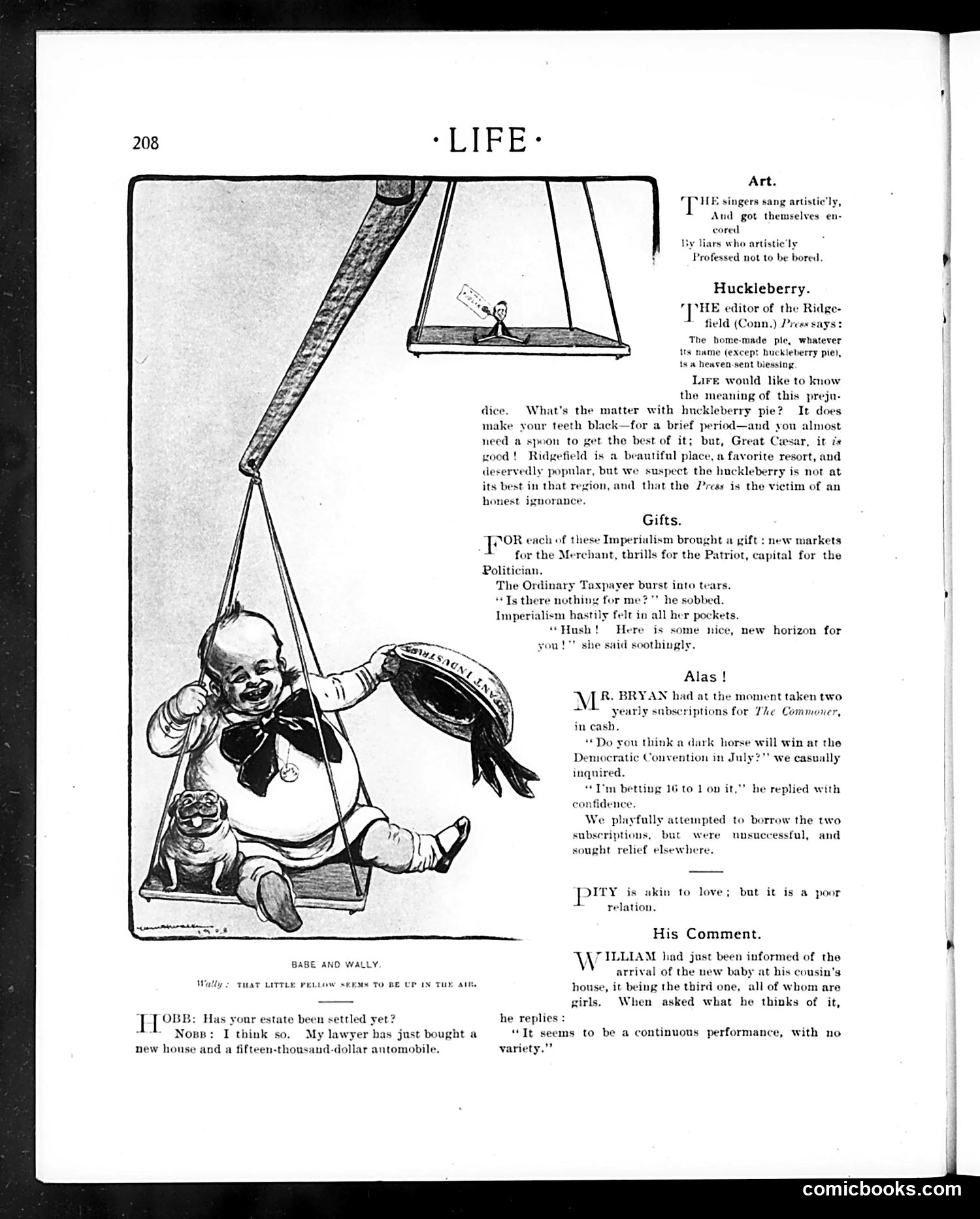
This satirical cartoon depicts a cherubic baby in a swing labeled "Babe and Wally." The accompanying dialogue between "Hobb" and "Nobb" concerns a lawyer who has purchased a new house and a "fifteen-thousand-dollar automobile." The satire appears to criticize wealth accumulation and legal professionals' financial success, likely during the Progressive Era when such displays of affluence drew public scrutiny. The "continuous performance with no variety" comment about babies suggests commentary on repetitive domestic life or perhaps political cycles. The cartoon's exact political target remains unclear without additional historical context, but it appears to mock materialistic values and the gap between ordinary citizens and prospering professionals during this period.
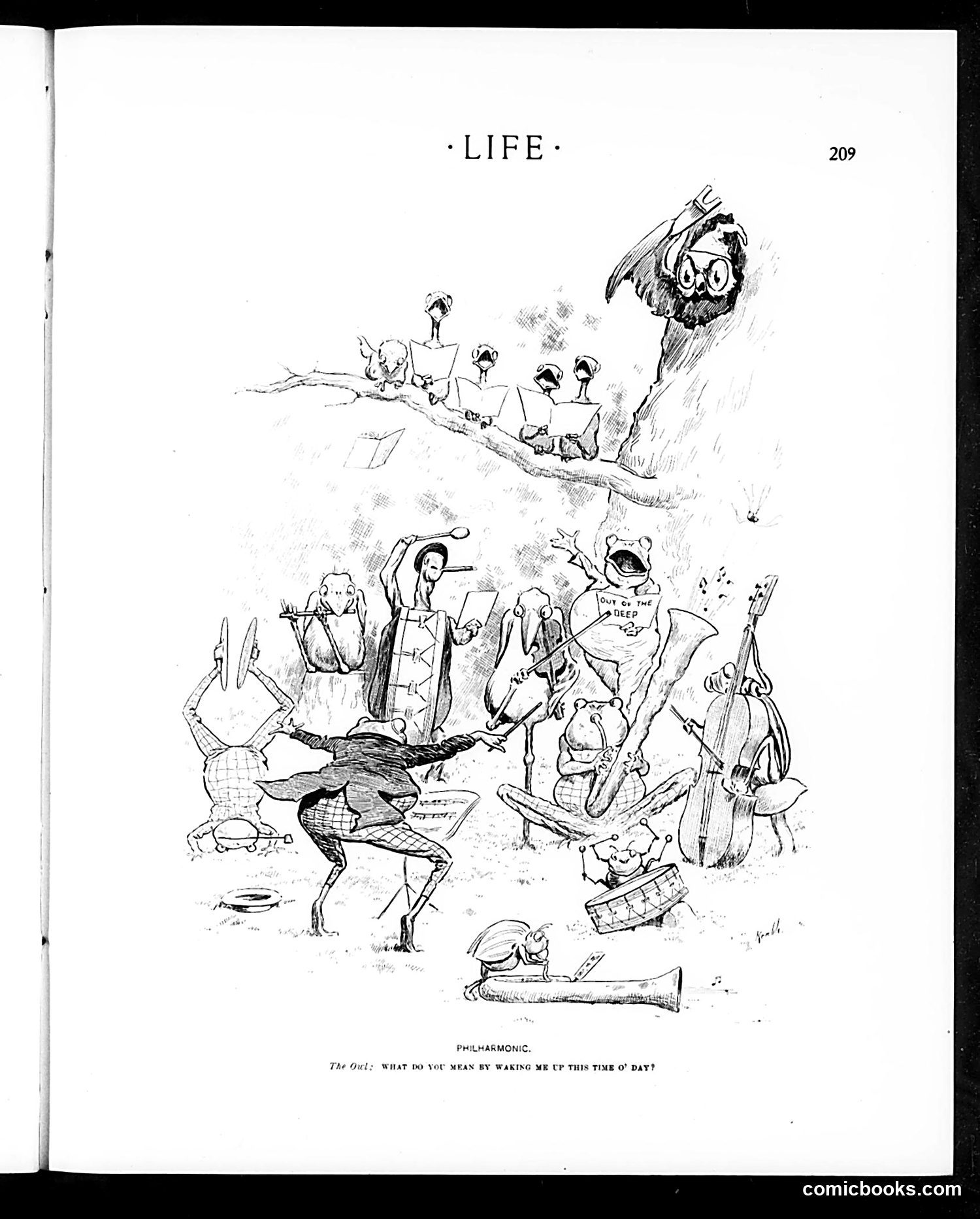
This is a single-panel cartoon satirizing a classical music orchestra. An owl (traditionally a symbol of wisdom, here representing refined taste) is rudely awakened by a chaotic "philharmonic" performance. The musicians are depicted as absurdly incompetent—playing violins, drums, and other instruments in disarray, with exaggerated, clownish expressions. The satire targets pretentious classical music culture: the joke is that this supposedly "high art" orchestra is actually producing such dreadful noise it disturbs even an owl in daytime. It mocks both the musicians' apparent lack of skill and, implicitly, audiences who pretend to appreciate such "serious" music. The humor relies on the contrast between philharmonic music's elite reputation and this ridiculous, cacophonous reality.
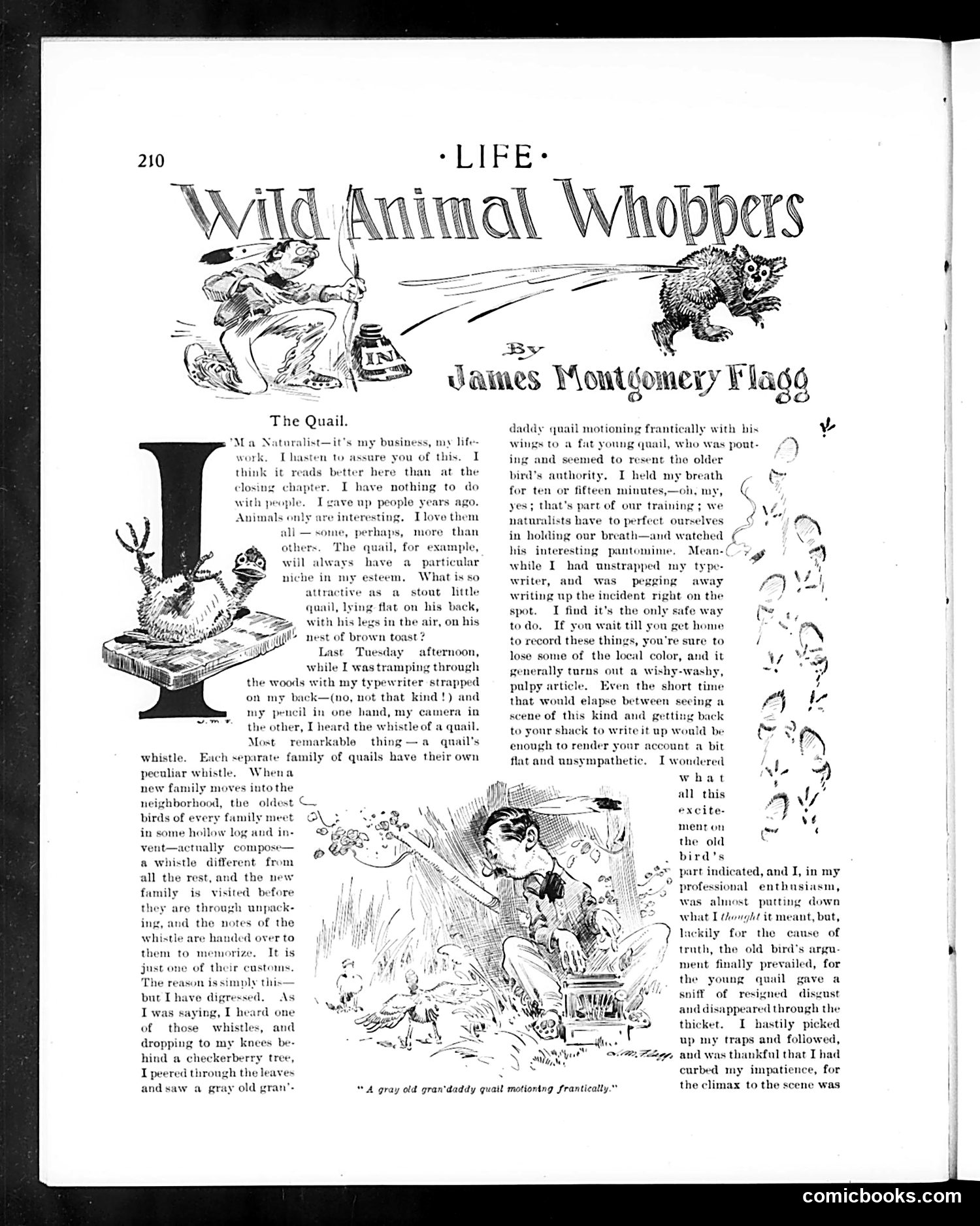
This is a humorous essay by James Montgomery Flagg about observing quails in nature. The "satire" here targets not politics but the author himself—a self-proclaimed naturalist who works as a writer/journalist. The joke: Flagg describes himself as a dedicated scientist studying animal behavior, yet he's comically unprepared (typewriter strapped to his back, camera in hand). When observing a father quail disciplining a young quail, Flagg nearly abandons scientific objectivity to write up the scene on the spot, prioritizing a publishable "story" over accurate documentation. The cartoon illustrates the central tension: Flagg sprawled in the bushes with his typewriter, frantically documenting nature while the quails go about their business. The humor lies in exposing how journalists/naturalists compromise their work through deadline pressure and the need for colorful copy rather than honest observation. The "whopper" (exaggeration) is Flagg's own pretense to serious naturalism.
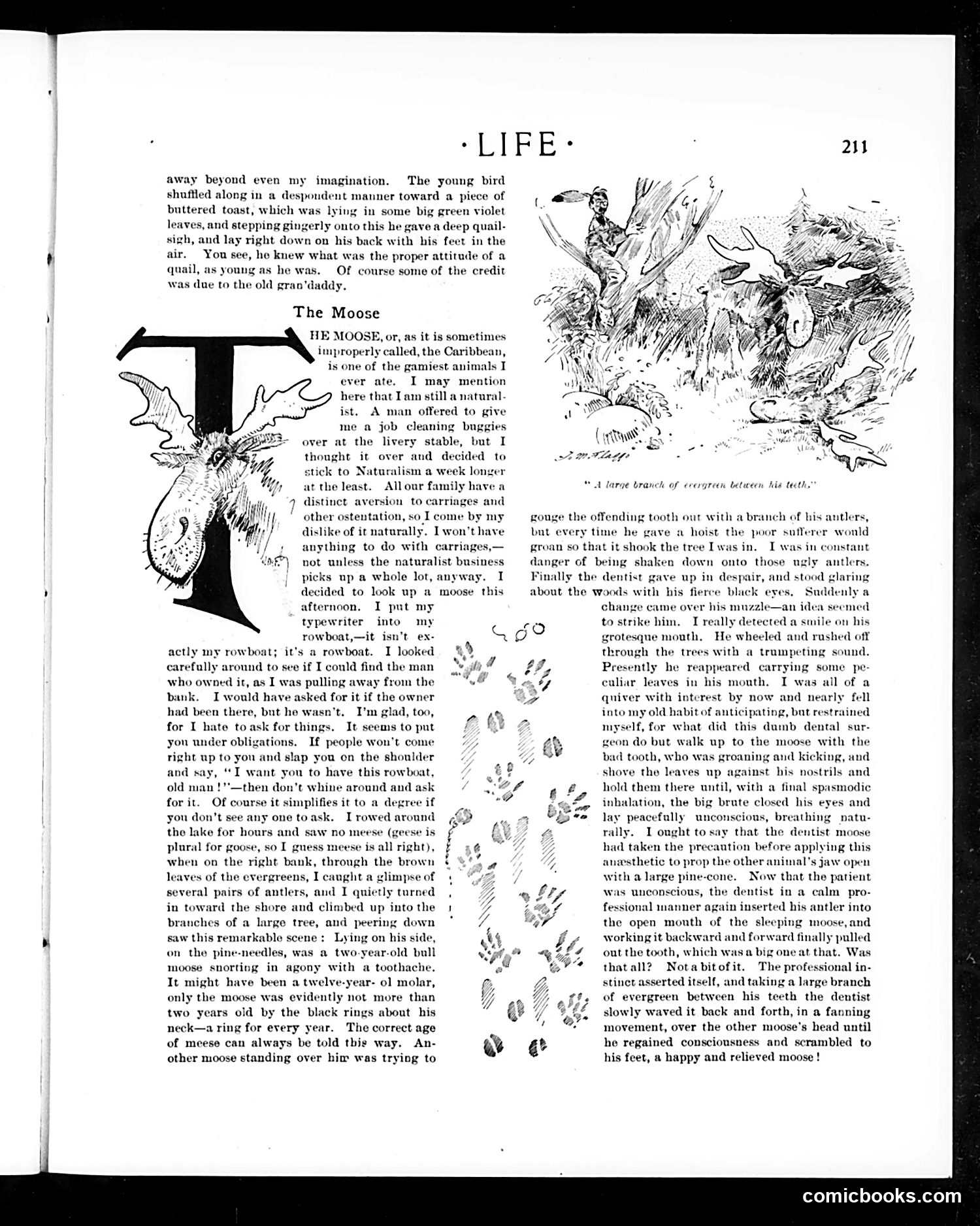
This page contains a humorous naturalist's essay describing an encounter with two moose, one suffering from a toothache. The narrative is satirical in tone—the author presents himself as a "naturalist" who actually borrowed someone's rowboat without permission and steals observations while hiding in trees. The central joke mocks both pseudo-intellectuals claiming naturalist credentials and the sentimental anthropomorphizing of animals. The author claims to still be a "naturalist" despite having no actual job, and the moose narrative becomes increasingly absurd: one moose dentist somehow recognizes the other needs anesthesia and produces medicinal leaves—a scenario clearly invented for comic effect. The illustrations show the moose in distress and relief, supporting the tall-tale nature of the account. Life magazine's satire targets pretentious amateur naturalists and readers' gullibility about such fanciful animal stories, which were apparently common enough to warrant mockery.
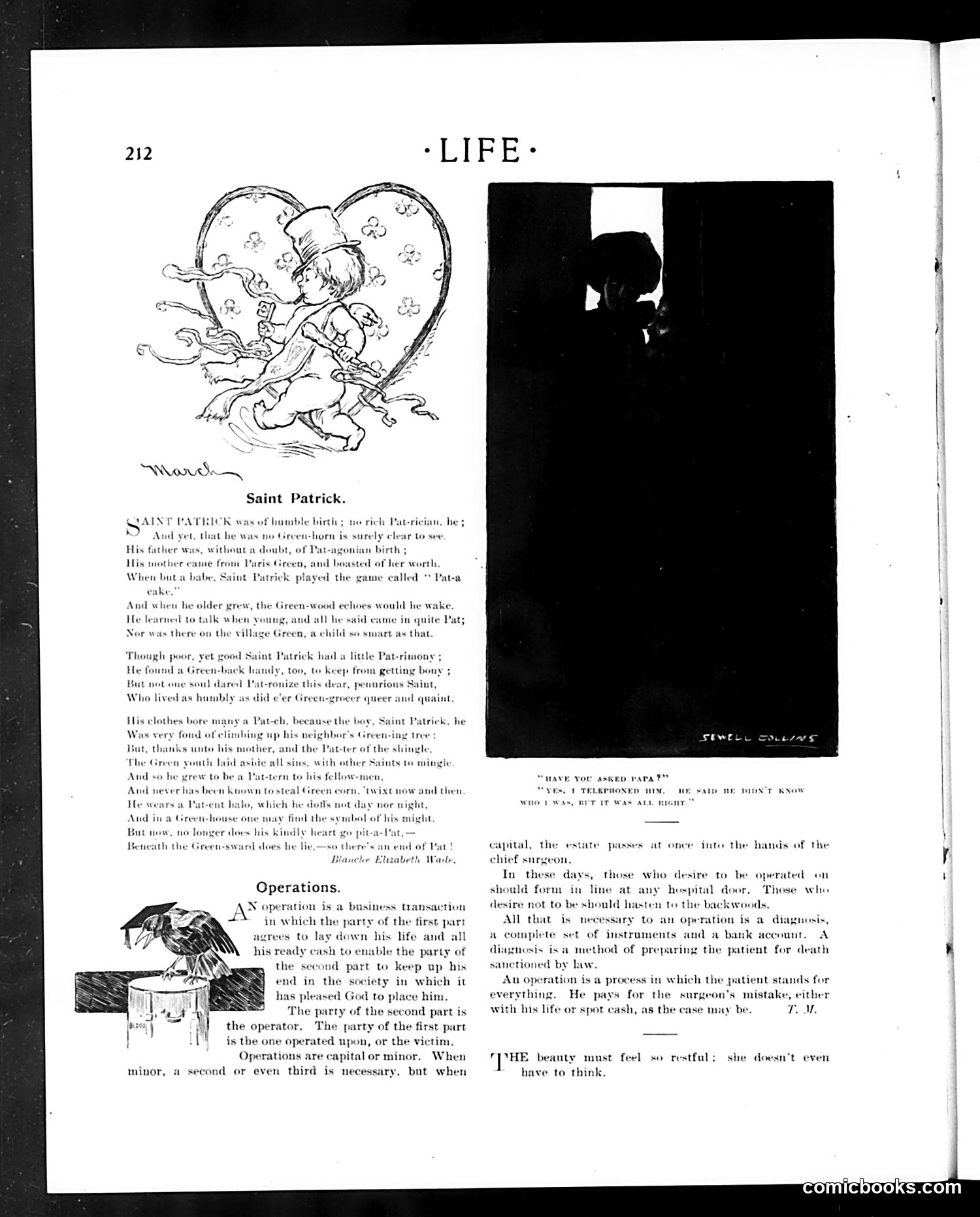
This page contains satirical humor typical of Life magazine's style. **"Saint Patrick"** is a lengthy humorous poem that plays on Irish stereotypes and puns. It presents Saint Patrick as a humble "Green-horn" (Irish immigrant) whose entire biography is riddled with forced puns on his name: "Pat-rimony," "Pat-ronize," "Pat-ch," "Pat-tern," etc. The satire mocks both overly sentimental Irish immigrant narratives and the groan-worthy wordplay itself. **"Operations"** is a cynical prose piece satirizing surgical practices and medical ethics of the era. It defines an "operation" as a transaction where a patient pays a surgeon (the "operator") or risks death for the surgeon's mistakes. The brief dialogue and final quote mock patients' passivity—particularly women's supposed lack of agency in medical decisions ("she doesn't even have to think"). This reflects Progressive-era skepticism about unregulated surgery and medical profiteering, while also perpetuating gendered assumptions about female helplessness.
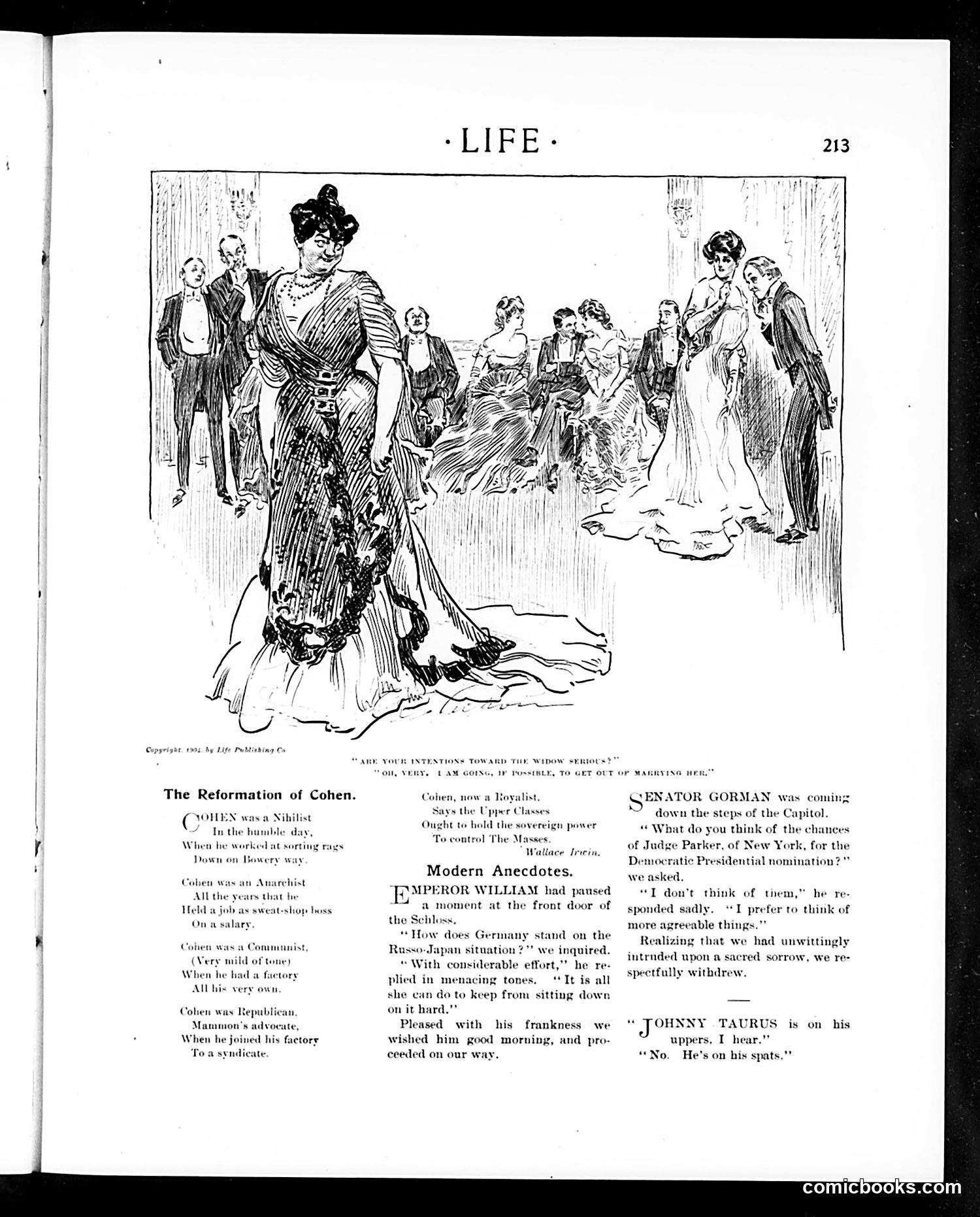
This page contains two distinct pieces of early 20th-century American political satire: **"The Reformation of Cohen"** is a poem mocking immigrant political volatility. It traces one Cohen through successive ideological phases—Nihilist, Communist, Republican—suggesting immigrants carelessly adopted whatever political ideology suited their economic circumstances. The satire targets both the immigrants' perceived instability and the wealthy interests ("Mammon's advocate") they eventually served. **"Modern Anecdotes"** contains two brief jokes: one mocking Emperor William II's diplomatic evasiveness about the Russo-Japanese War, and another about Senator Gorman's pessimism regarding Judge Alton Parker's Democratic presidential chances. The final joke appears to be wordplay about someone's financial status ("on his uppers" vs. "on his spats"). The main illustration shows a society gathering, likely depicting the Cohen narrative or contemporary social climbing.
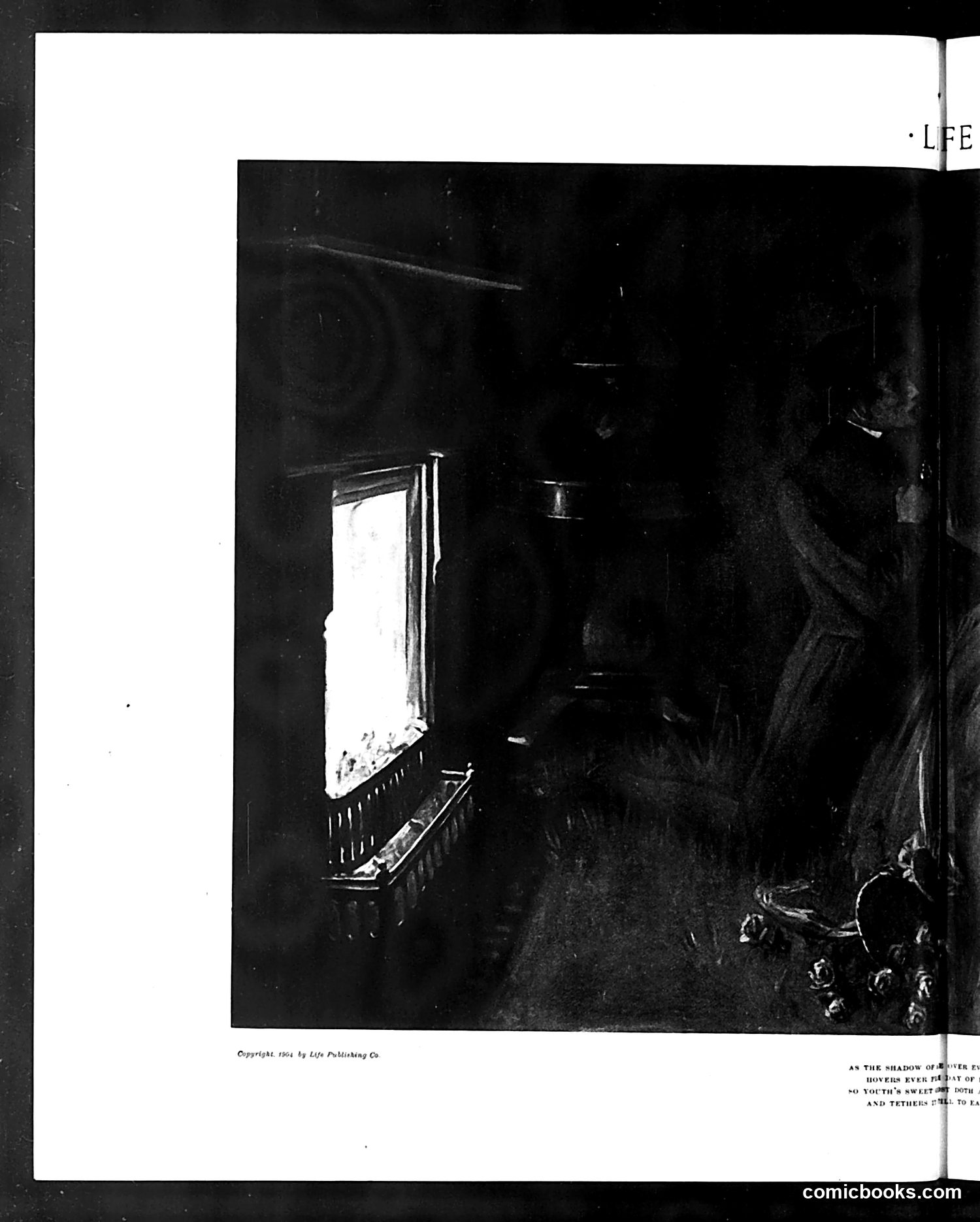
This is a dark, atmospheric black and white image from Life magazine (copyright 1864) showing an interior scene. A window with light streaming through dominates the composition, illuminating what appears to be a sparse, shadowy room. The photograph has a gothic or mysterious quality typical of late 19th-century illustration. However, the OCR text is incomplete and illegible at the bottom of the page, making it impossible to identify the specific cartoon's subject, political references, or satirical intent. Without the accompanying caption or text explaining the image's meaning, I cannot reliably determine what social or political commentary this piece intended to convey to contemporary readers. More complete source material would be needed for accurate interpretation.
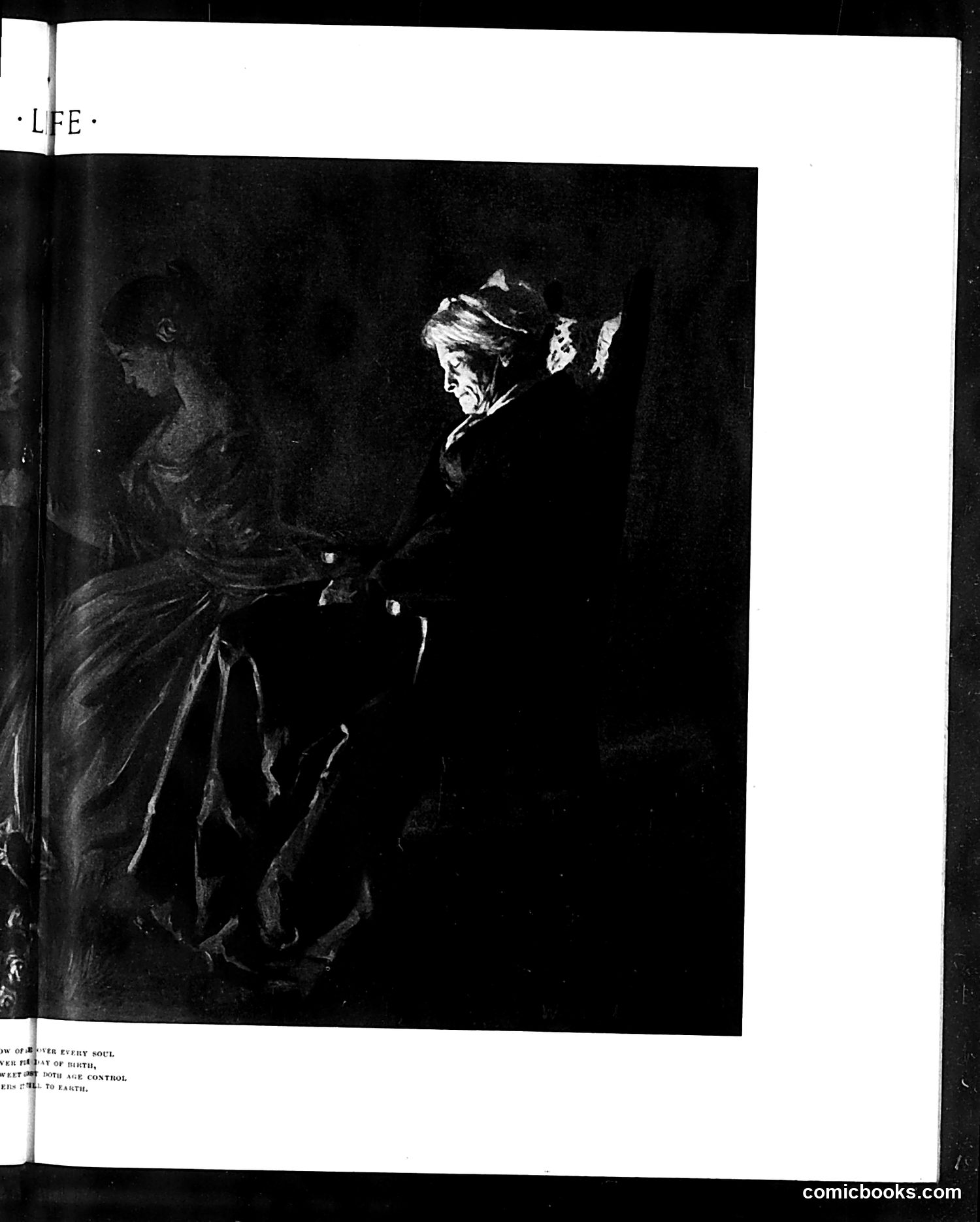
This appears to be a darkly dramatic illustration from *Life* magazine showing two figures in an interior scene. The central figure is an elderly person wearing a head covering, depicted in profile with distinctive facial features, turning to look at another figure visible on the left side of the composition. The illustration uses stark black-and-white contrast and shadowy technique typical of early-to-mid 20th century satirical artwork. However, without clearer text or caption visible in the image, I cannot definitively identify the specific figures, the political/social commentary intended, or the historical event being referenced. The style suggests social or political satire, but the specific meaning requires accompanying text that isn't legible in this reproduction.
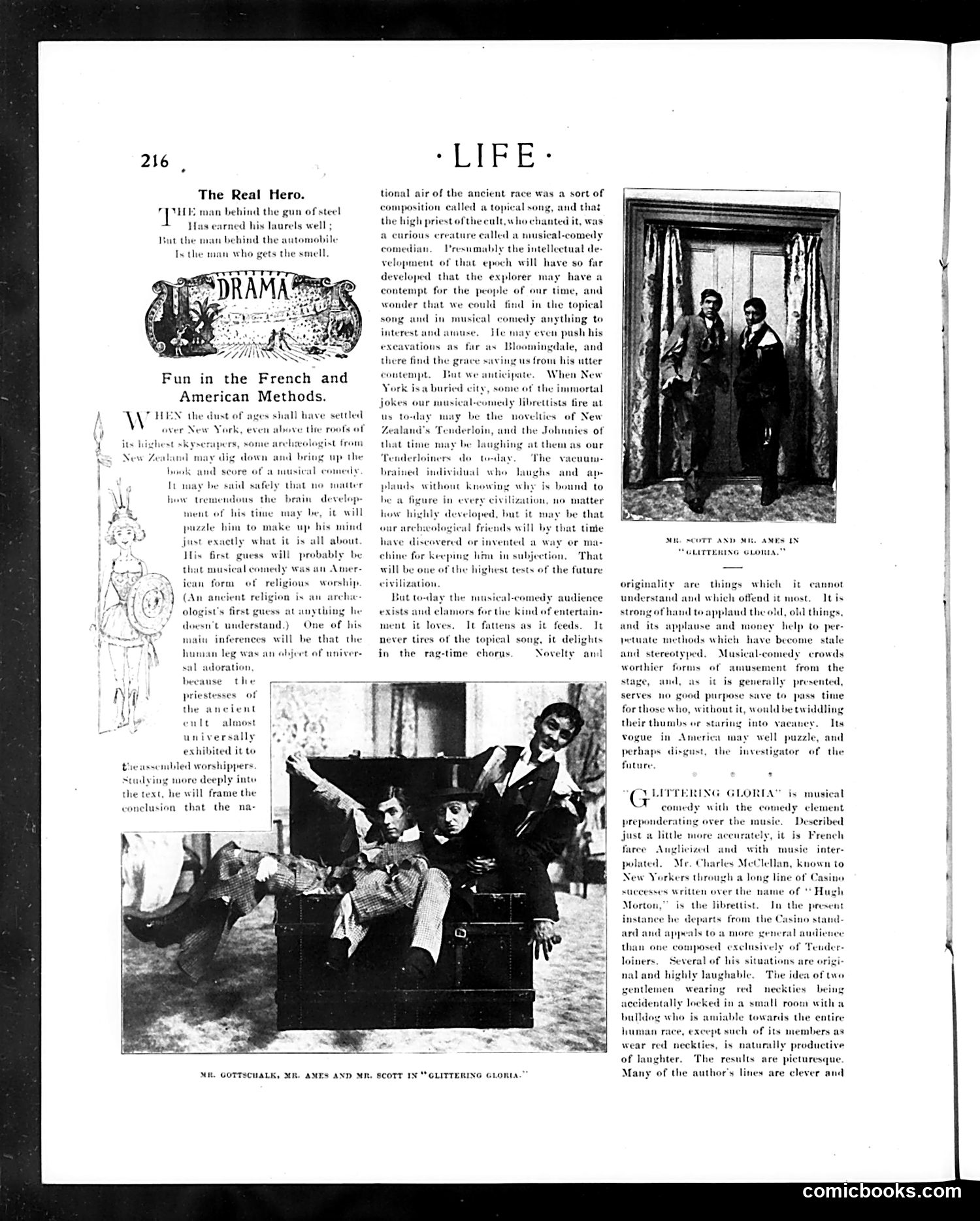
This page from *Life* magazine critiques musical comedy as intellectually hollow entertainment. **"The Real Hero"** sarcastically praises the man behind the gun rather than the soldier firing it—a jab at those who profit from war while others fight. **"Fun in the French and American Methods"** imagines a future archaeologist discovering New York as a buried city, finding musical-comedy theaters and puzzling over this "curious creature called a musical-comedy man." The satire suggests that future scholars will be baffled that a civilization spent time on such trivial entertainment. The piece dismisses musical comedy as mindless spectacle that crowds enjoy merely because it's novel and requires no thought—"stale and stereotyped" yet profitable. **"Glittering Gloria"** (photos shown) is a French farce adapted for American audiences, featuring absurdist humor (gentlemen accidentally locked in a room with a bulldog). The review acknowledges it's "clever" but notes it serves no purpose except idle distraction for audiences who might otherwise be bored. The underlying message: American popular entertainment is vapid and culturally worthless, valued only for commercial profit and audience numbness.
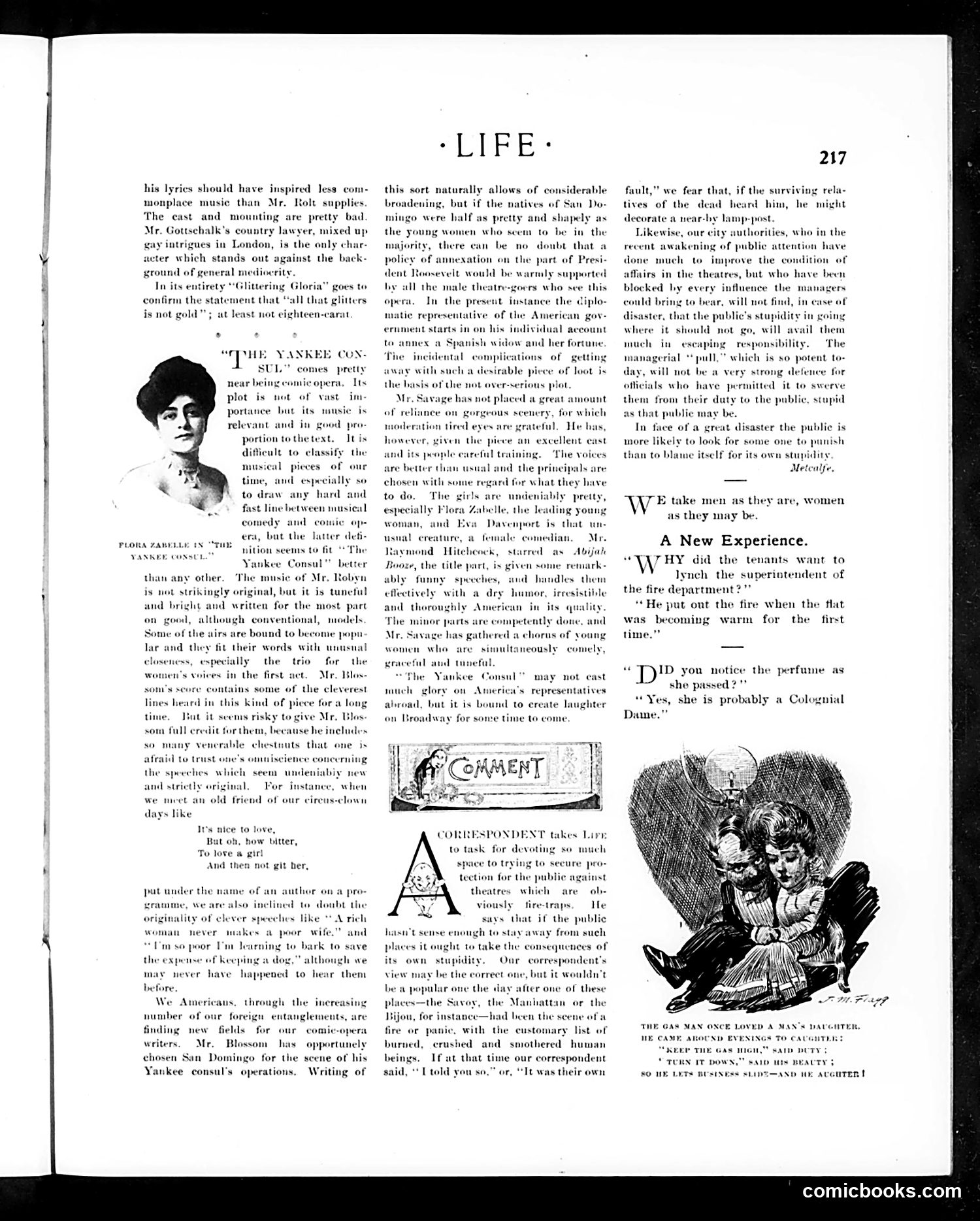
This page reviews "The Yankee Consul," a musical comedy set in San Domingo (Haiti). The satire operates on multiple levels: **The Main Cartoon:** The illustration depicts "The Gas Man Once Loved a Man's Daughter"—a theatrical scene showing a man pursuing a woman while she holds a gas lamp. The caption's crude humor about "gas" and romantic pursuit reflects period vaudeville comedy sensibilities. **The Political Context:** The review references American imperial ambitions, noting that President Roosevelt's annexation policy would be "warmly supported by all the male theatre-goers" if San Domingo's women were as attractive as those in the show. This satirizes American expansionism and the reduction of foreign policy to sexual fantasy. **The Theatrical Critique:** The reviewer mocks the show's thin plot (essentially acquiring "a desirable piece of loot") while praising Flora Zabelle's performance and Raymond Hitchcock's comedic timing, despite the conventional material. The commentary suggests Life used theater reviews to gently mock American imperialist attitudes of the Progressive Era.
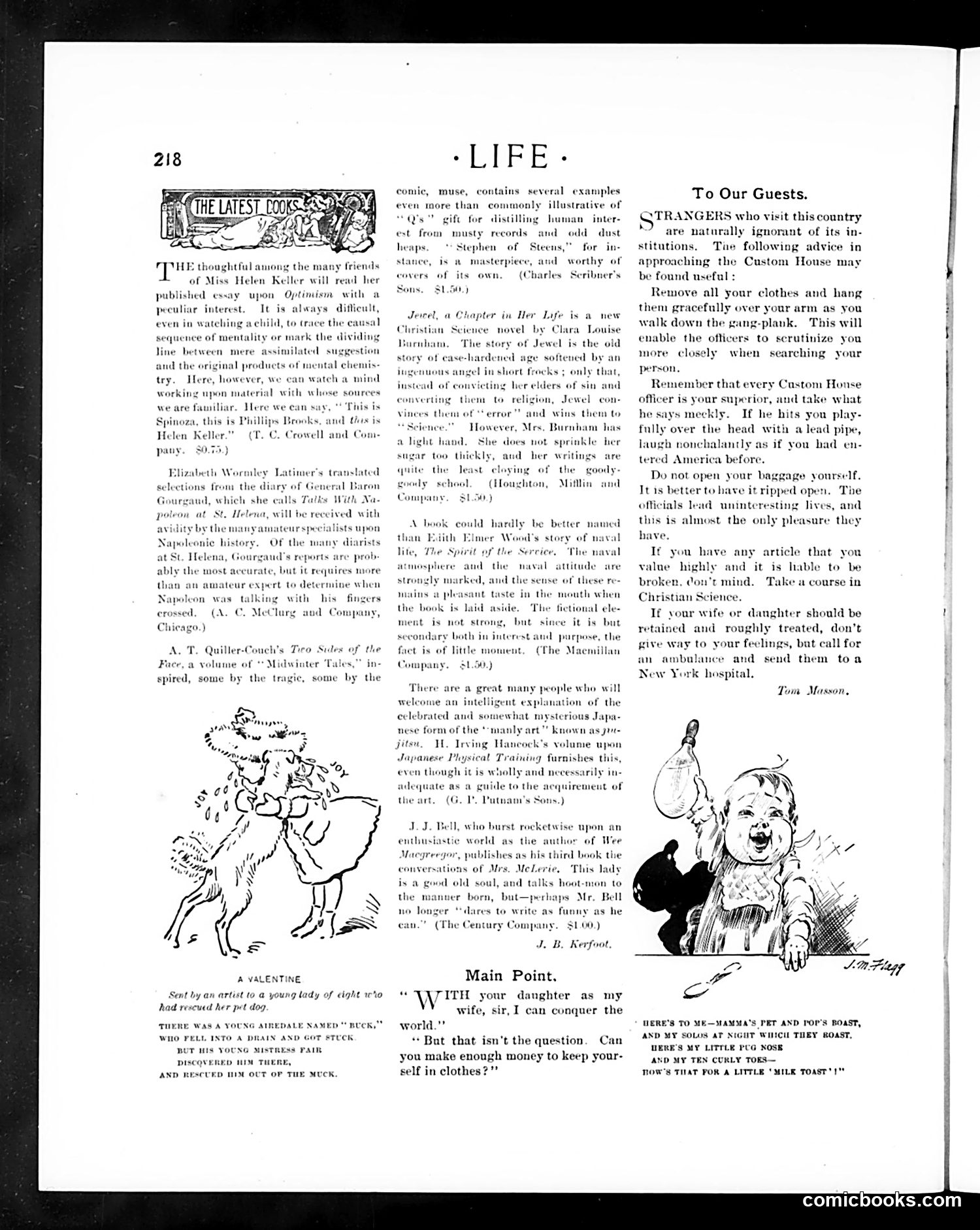
This page from *Life* magazine consists primarily of book reviews and satirical commentary, not political cartoons. **Content:** The main section reviews recent publications, including works on optimism by Helen Keller, a Christian Science novel, and a book on Japanese jujitsu. The reviews are brief and somewhat dismissive in tone—characteristic of *Life*'s sardonic literary criticism. **The Cartoons:** Two small illustrated pieces appear: 1. A "Valentine" joke about a young girl rescuing her dog "Buck" from a drain 2. "Main Point"—a dialogue joke where a suitor declares he'll "conquer the world" with the daughter as his wife, but her father pragmatically asks if he can afford to keep himself in clothes **The Satire:** The "To Our Guests" section mocks foreign travelers' ignorance of American customs, ironically suggesting they remove their clothes at customs—absurd advice playing on travelers' anxiety about inspections. These are gentle, domestic humor pieces typical of *Life*'s satirical style, not engaged political commentary.
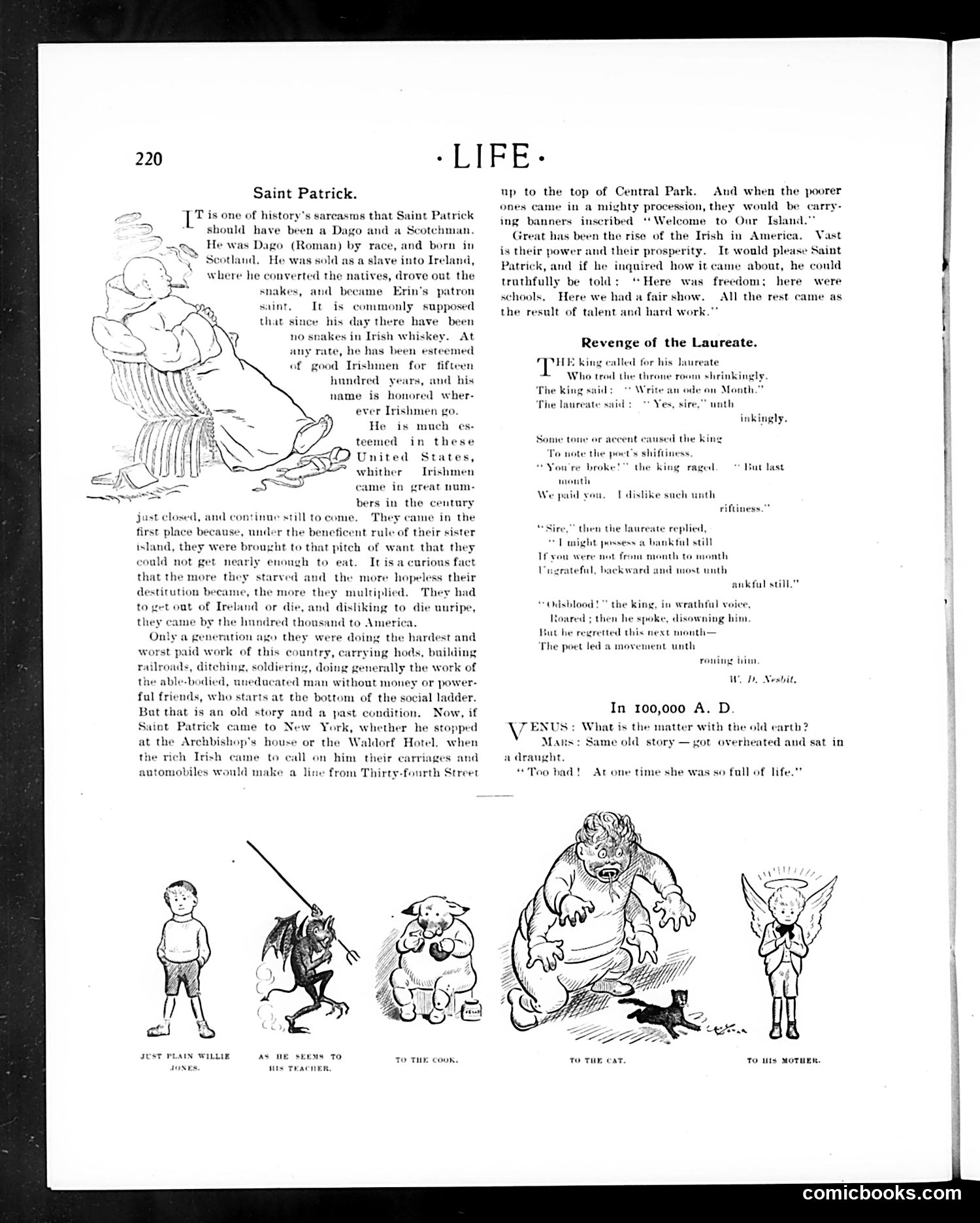
This page contains three satirical pieces: **"Saint Patrick"** (top): A historical essay celebrating Irish immigration to America. The text describes Patrick as ironically not actually Irish, then traces how Irish immigrants—initially impoverished and doing backbreaking labor—have risen through "freedom" and "schools" to prosperity and social prominence. The satire appears gentle: it celebrates Irish-American success while noting the contrast between their earlier desperation and current wealth. **"Revenge of the Laureate"** (middle): A dialogue poem where a king criticizes his court poet for financial irresponsibility. The poet responds with cutting wit, ultimately starting a movement that ousts the king. The satire mocks royal arrogance and suggests intellectual/artistic superiority over aristocratic authority. **"In 100,000 A.D"** (bottom): A brief comedic exchange where Venus asks Mars why Earth is troubled. Mars replies Earth "got overheated and sat in a draught"—a playful personification treating the planet like an overheated person catching cold. The final line's nostalgia ("so full of life") suggests dark humor about Earth's future decline. The bottom illustrations appear decorative, showing various character types.
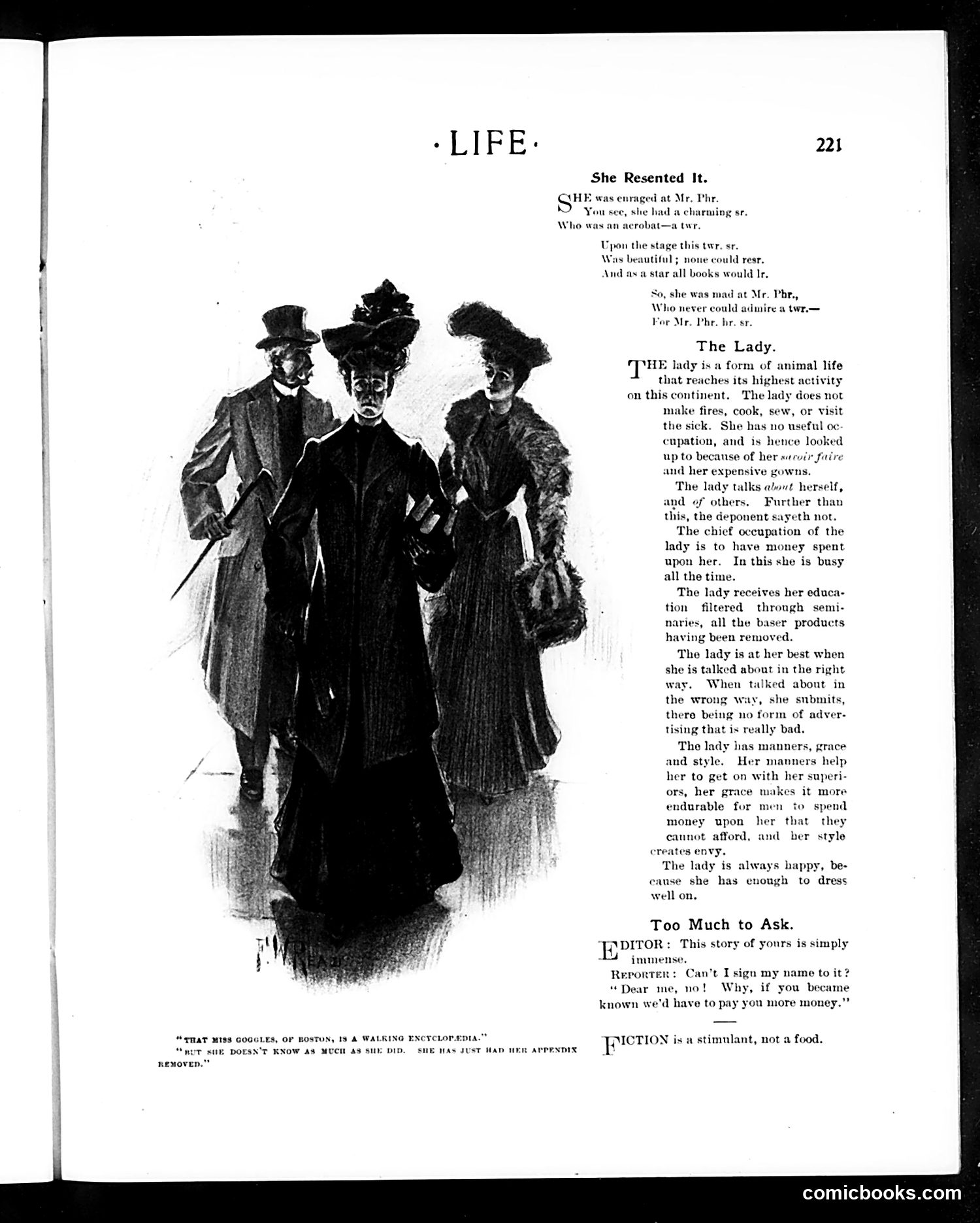
This page contains two satirical pieces mocking upper-class women and journalism practices. **"She Resented It"** (top): A woman is angry at Mr. Phelps because, though she was a beautiful stage performer (an "acrobat"), he never admired her. The joke satirizes both her vanity and his apparent indifference—suggesting she expected automatic admiration based on her looks and profession. **"The Lady"** (main text): A mock-scientific definition ridiculing idle wealthy women. It claims they have "no useful occupation" yet are "looked up to" for their expensive clothes and social graces. Their only job is having money spent on them. The satire targets the purposelessness of privileged women in society, their education filtered to remove "baser products," and their obsession with being talked about—any publicity, even negative, is acceptable. **"Too Much to Ask"** (bottom): An editor refuses to let a reporter sign their work, arguing that public recognition would require paying them more. This satirizes exploitative journalism practices and employers' resistance to employee visibility.
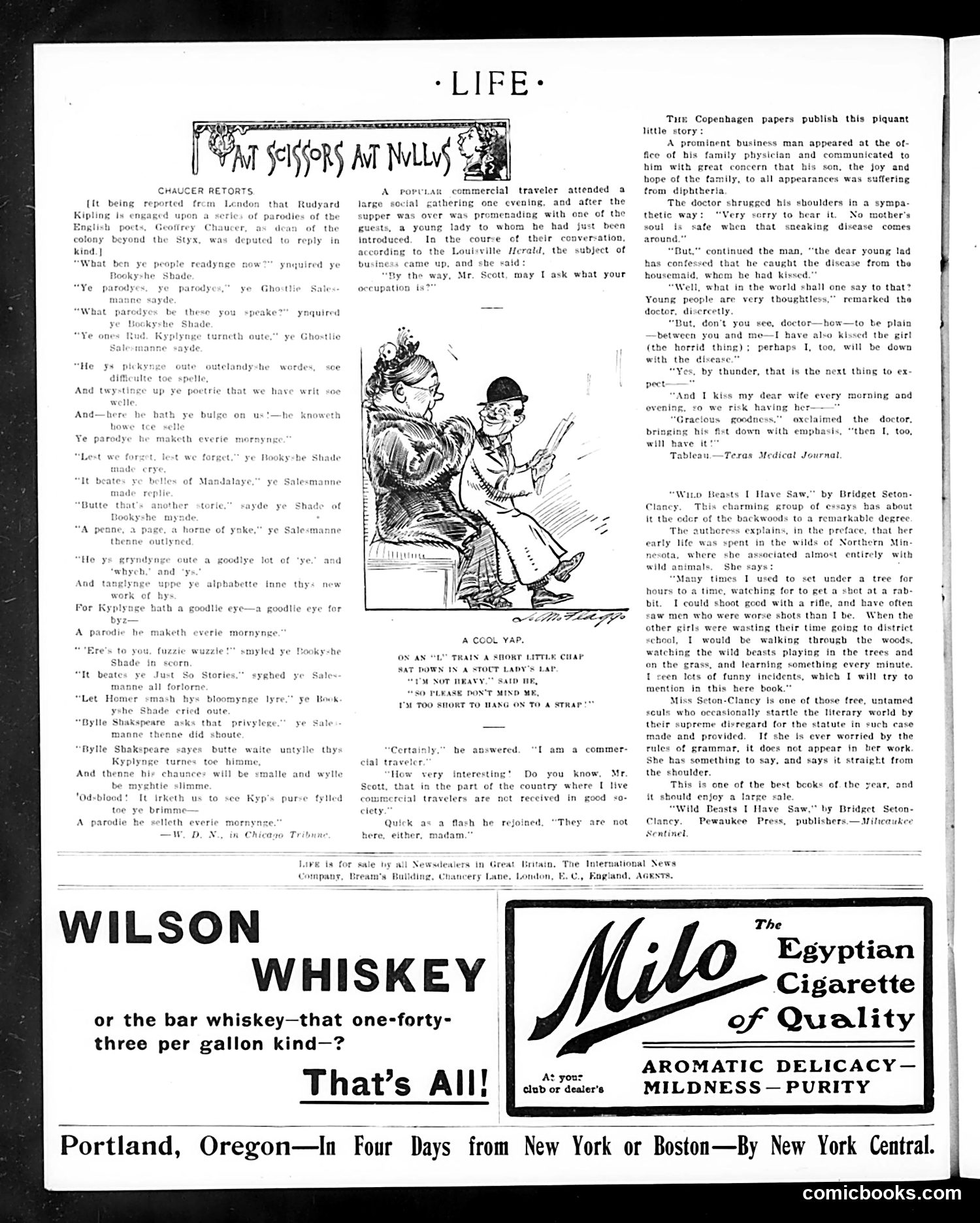
This page contains **Chaucer parodies** mocking Rudyard Kipling's literary output. The left column presents mock-Medieval English verse ribbing Kipling for churning out endless parodies and "Just So Stories"—his popular children's tales. The satire suggests Kipling has become formulaic and repetitive, with references to "ye parodye maketh everie mornynge" (he produces parodies every morning). This targets the prolific author's perceived artistic decline through comic exaggeration. The right side includes two unrelated stories: one about a naive businessman and disease transmission (a morality tale about kissing servants), and a book review of *Wild Beasts I Have Saw* by someone claiming backwoods experience. The advertisements (Wilson Whiskey, Milo Cigarettes) and travel notice are standard period marketing. The page's main humor relies on readers' familiarity with Kipling's works and contemporary literary criticism of his productivity over quality.
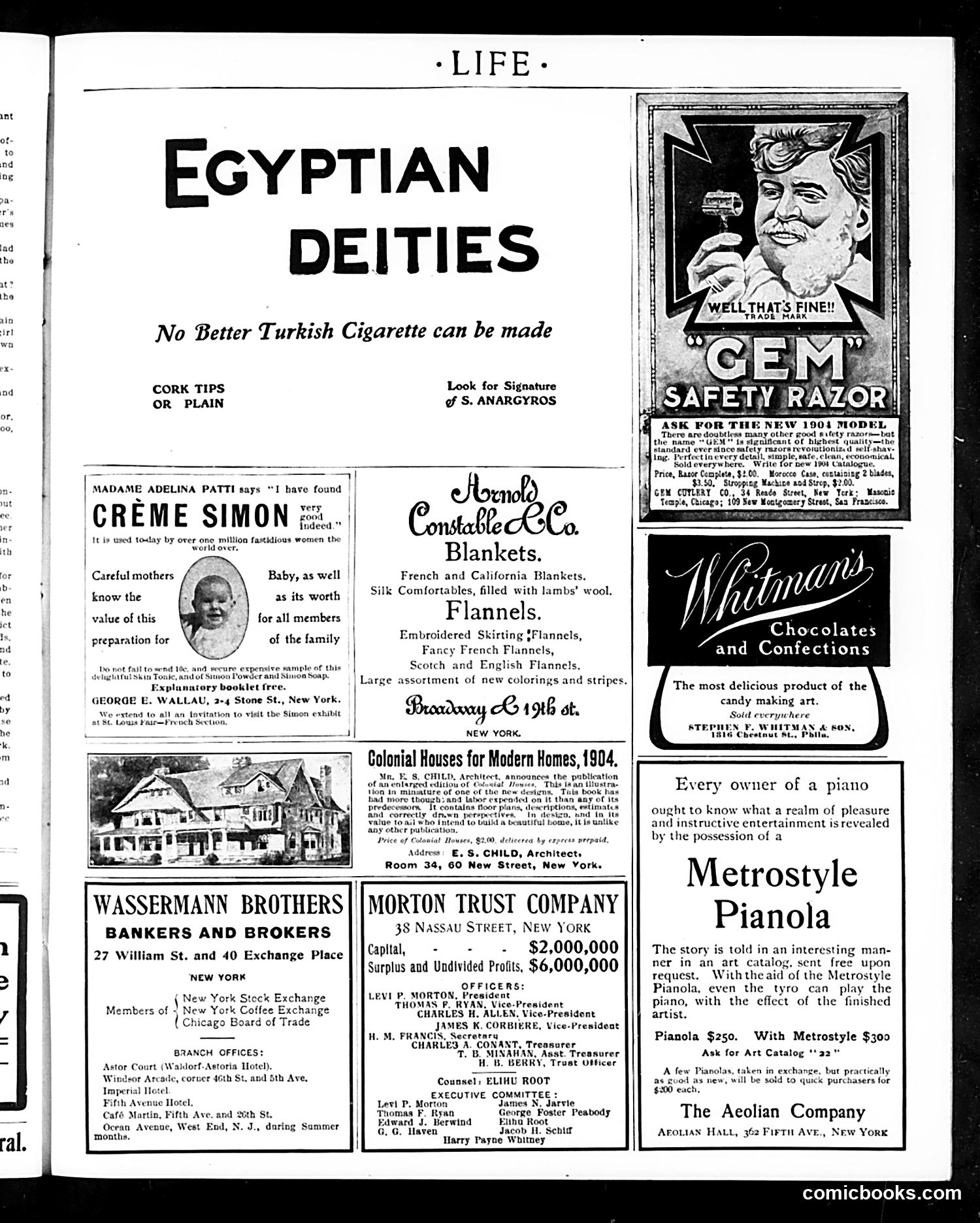
This is primarily an **advertising page** from Life magazine (circa 1904), not a political cartoon. The page contains multiple commercial advertisements with minimal satirical content. The main visual element is the **"Egyptian Deities" cigarette ad** at top, which uses orientalist imagery (then fashionable) to market Turkish cigarettes—the "Egyptian" reference being a marketing appeal to exotic appeal rather than historical accuracy. The only potential satire appears subtle: the page juxtaposes high-culture endorsements (opera singer Adelina Patti promoting face cream) with financial institutions and luxury goods, reflecting the era's conspicuous consumption among the wealthy. Most content serves straightforward commercial purposes: beauty products, real estate, banking services, candy, pianos, and razors. The **"Gem Safety Razor"** advertisement notably promotes the 1904 model, reflecting the recent innovation of safety razors versus dangerous straight razors. The page reflects early 1900s American consumer culture and advertising practices rather than political commentary.
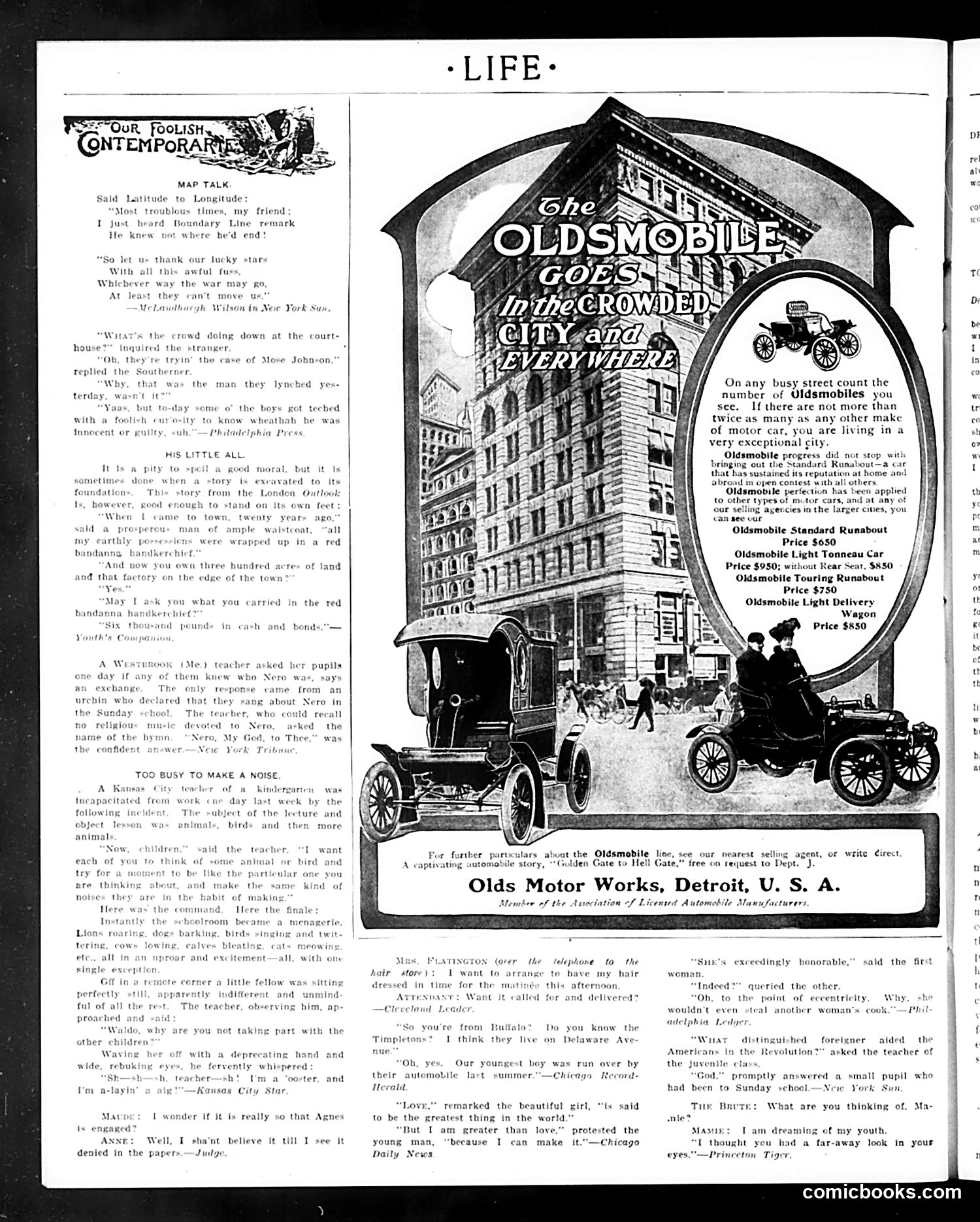
This page from *Life* magazine combines satirical anecdotes with automobile advertising, typical of early 1900s publishing. **The Satire:** The left column presents short humorous stories mocking American society. "Map Talk" jokes about geographical ignorance; "His Little All" tells of a poor man's rise to wealth; and "Too Busy to Make a Noise" ridicules a kindergarten teacher's failed classroom management. These vignettes satirize common social types—the ignorant, the ambitious, the ineffectual authority figure. Most notably, one anecdote references a lynching ("they're trying the case of Moxe Johnson"), a grim reminder that *Life*'s satire operated within a context of normalized racial violence, treating even murder as fodder for comedic bits. **The Advertising:** The right side features a full Oldsmobile automobile advertisement, showing the car as the modern marvel transforming crowded urban streets. This reflects the era's celebration of automotive progress and corporate marketing's growing prominence in magazines. The juxtaposition reveals *Life*'s dual purpose: satirizing society while promoting consumer culture.
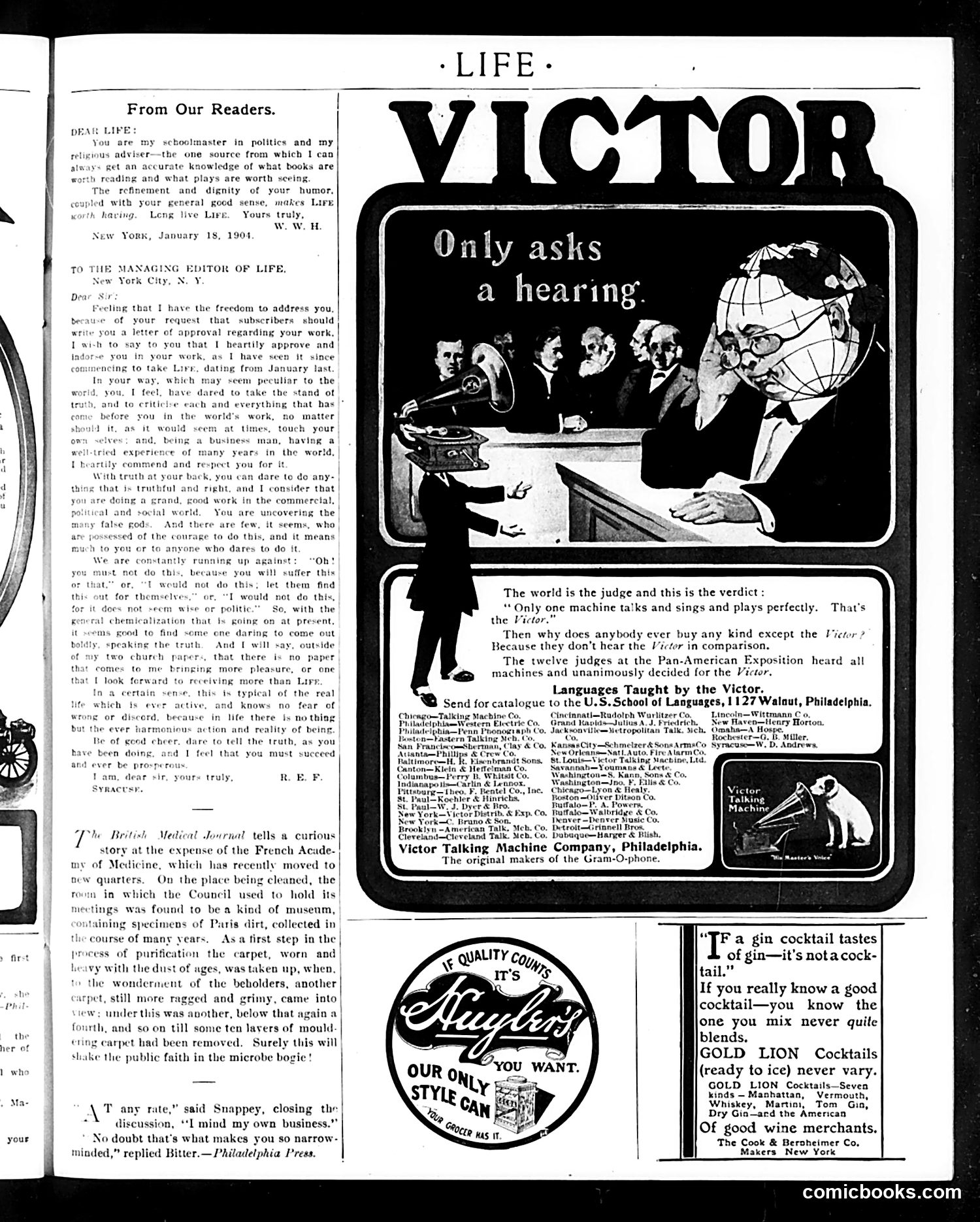
This page combines reader letters praising Life's editorial independence with a major Victor Talking Machine Company advertisement. The **main cartoon** shows a phonograph labeled "Victor" at a hearing, with the caption "Only asks a hearing." The image depicts the machine as a defendant before judges, emphasizing that it merely needs to be heard to prove superior to competitors. The advertisement's central claim states that twelve judges at the Pan-American Exposition unanimously chose the Victor over all other talking machines. This references an actual 1901 exposition competition, positioning the Victor as scientifically superior. The satire is subtle but present: the ad presents the machine's selection as objective proof ("the world is the judge"), yet the real message is that consumers don't buy Victors because they haven't heard them compared directly to competitors—implying marketing, not actual superiority, drives purchasing. The page also contains reader testimonials praising Life's truth-telling and editorial courage, which contextualizes the Victor ad as itself an example of Life's trusted judgment and advertising standards.
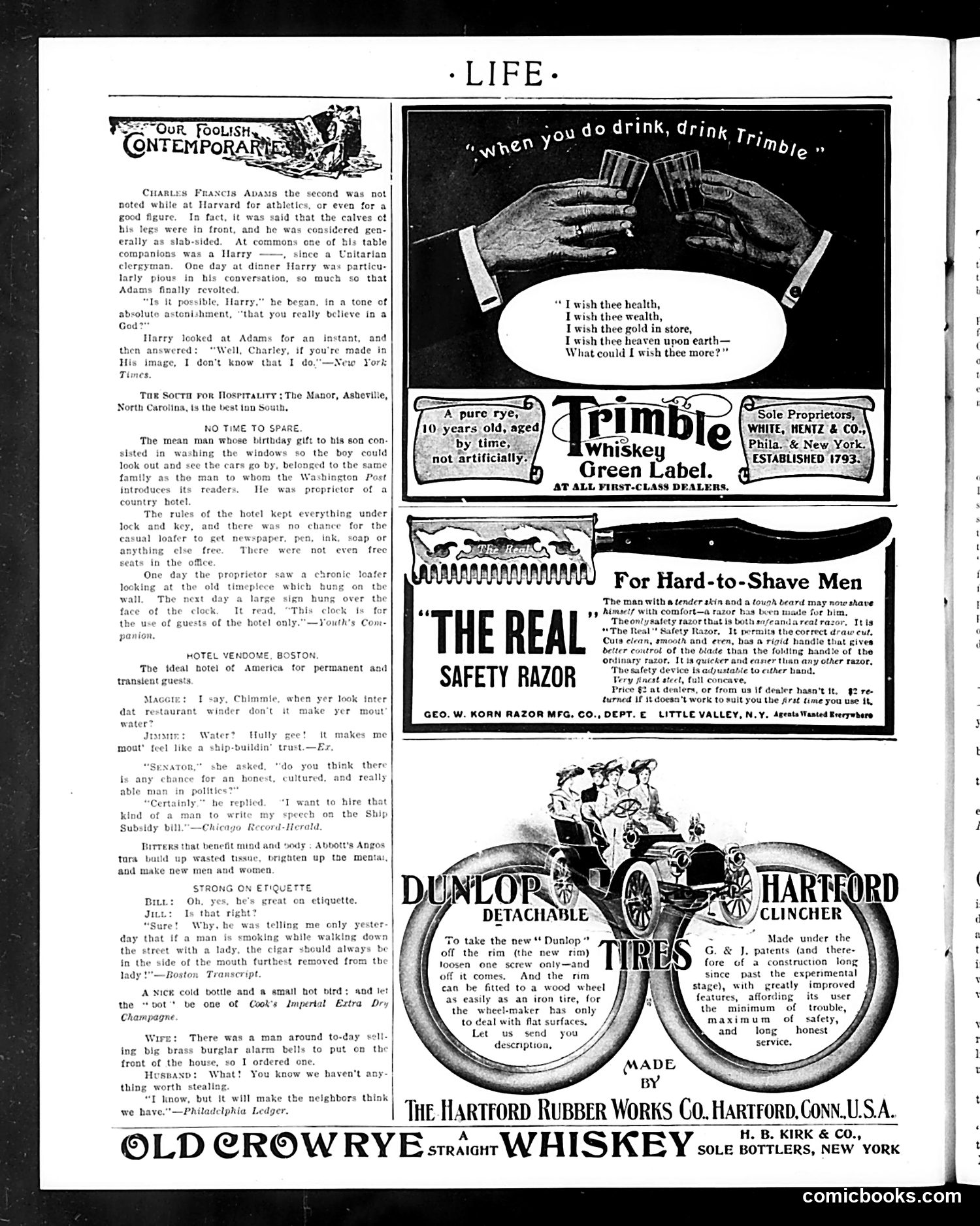
This page is primarily **advertising with some humorous short anecdotes**. The advertisements dominate—for Trimble Whiskey, "The Real" Safety Razor, Dunlop Detachable Tires, Hartford Rubber Works, and Old Crow Rye Whiskey. The left column contains brief satirical vignettes about human foibles: Charles Francis Adams's skeptical questioning of God while at Harvard; a stingy father making his son wash windows as a birthday gift; a miserly hotel proprietor obsessed with preventing theft; and domestic disputes over trivial matters (etiquette, noise). These anecdotes mock **everyday hypocrisy and penny-pinching behavior** among the middle and upper classes. They're presented as amusing observations of foolishness in "contemporary" American society—the magazine's stated purpose. The page reflects early 1900s advertising and humor conventions: brief jokes, product endorsements, and light social commentary rather than pointed political satire. The overall effect is lighthearted mockery of bourgeois pretension and stinginess.
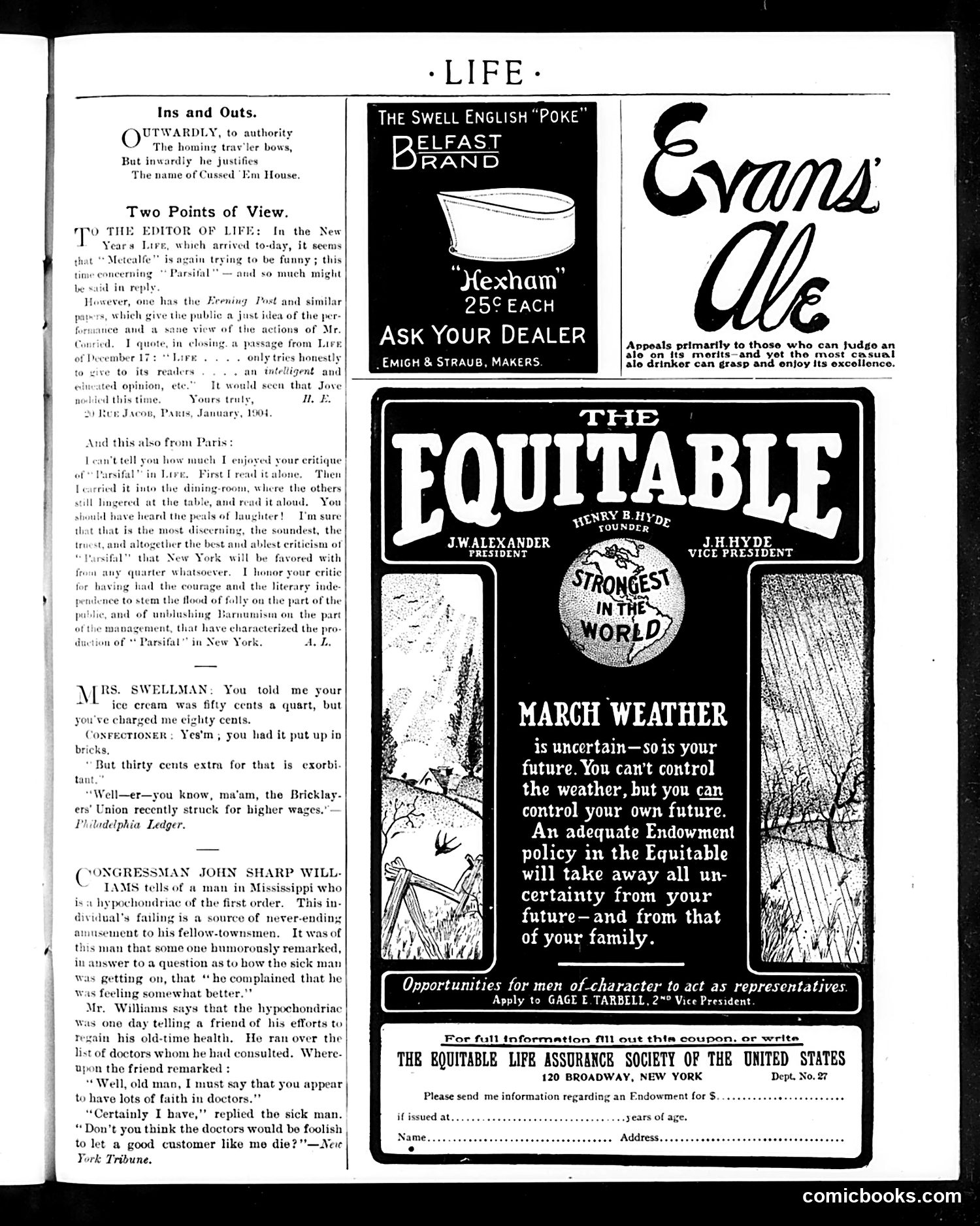
This page is primarily **advertising and reader letters**, not political satire. The content includes: **Letters Section ("Ins and Outs"):** Readers debate a recent *Life* article about Wagner's *Parsifal* opera and Metcalfe's review. One correspondent praises the critique; another defends it. There's also a humorous anecdote about a hypochondriac congressman who patronizes many doctors, and a joke about an ice cream vendor charging extra due to bricklayers' union wage increases. **Advertisements:** The page features three ads—for "Hexham" English beer, Evans Ale, and The Equitable Life Assurance Society endowment policies. The insurance ad uses March weather uncertainty as a metaphor for life's unpredictability, positioning insurance as security. **Historical Context:** The references to *Parsifal* (Wagner's controversial opera) and union wage strikes reflect early 1900s cultural and labor debates, but there are no cartoons or caricatures here—just period advertisements and correspondence.
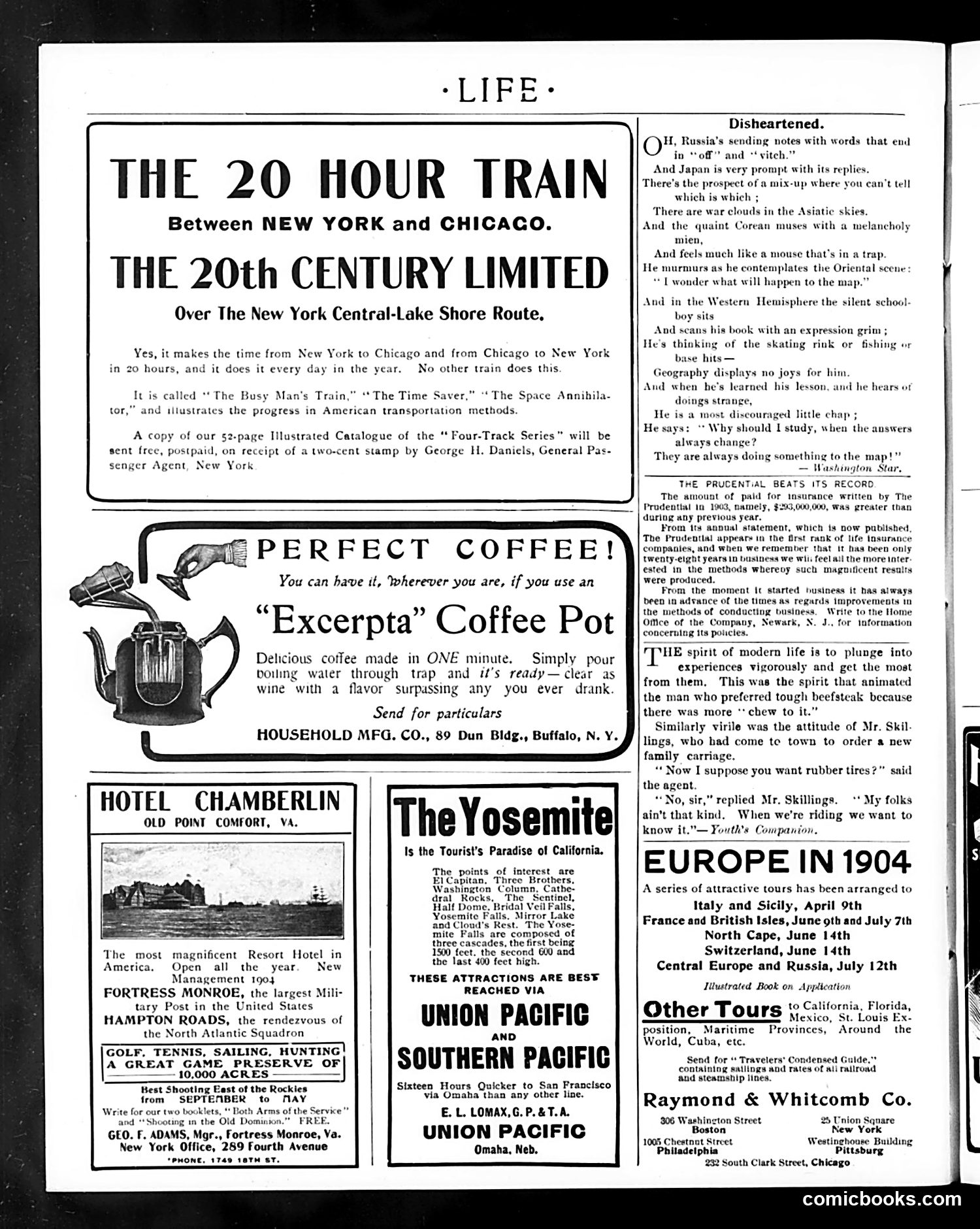
This is primarily an **advertising page** with one satirical poem. The advertisements showcase early 1900s American progress: the "20th Century Limited" train (New York to Chicago in 20 hours—then revolutionary), "Excerpta" coffee makers, luxury hotels, and tourist destinations. The satire appears in the poem **"Disheartened,"** attributed to the Washington Star. It mocks a schoolboy frustrated by geography lessons because maps constantly change due to geopolitical upheaval. The poem references the **Russo-Japanese War** (1904-1905) and territorial disputes in East Asia and Korea, suggesting that traditional education becomes obsolete when international borders shift unpredictably. The boy sarcastically asks: "Why should I study, when the answers always change?" The joke critiques both modern instability and the inadequacy of static textbooks to keep pace with real-world events—a commentary on early 20th-century imperial competition redrawing the world map.
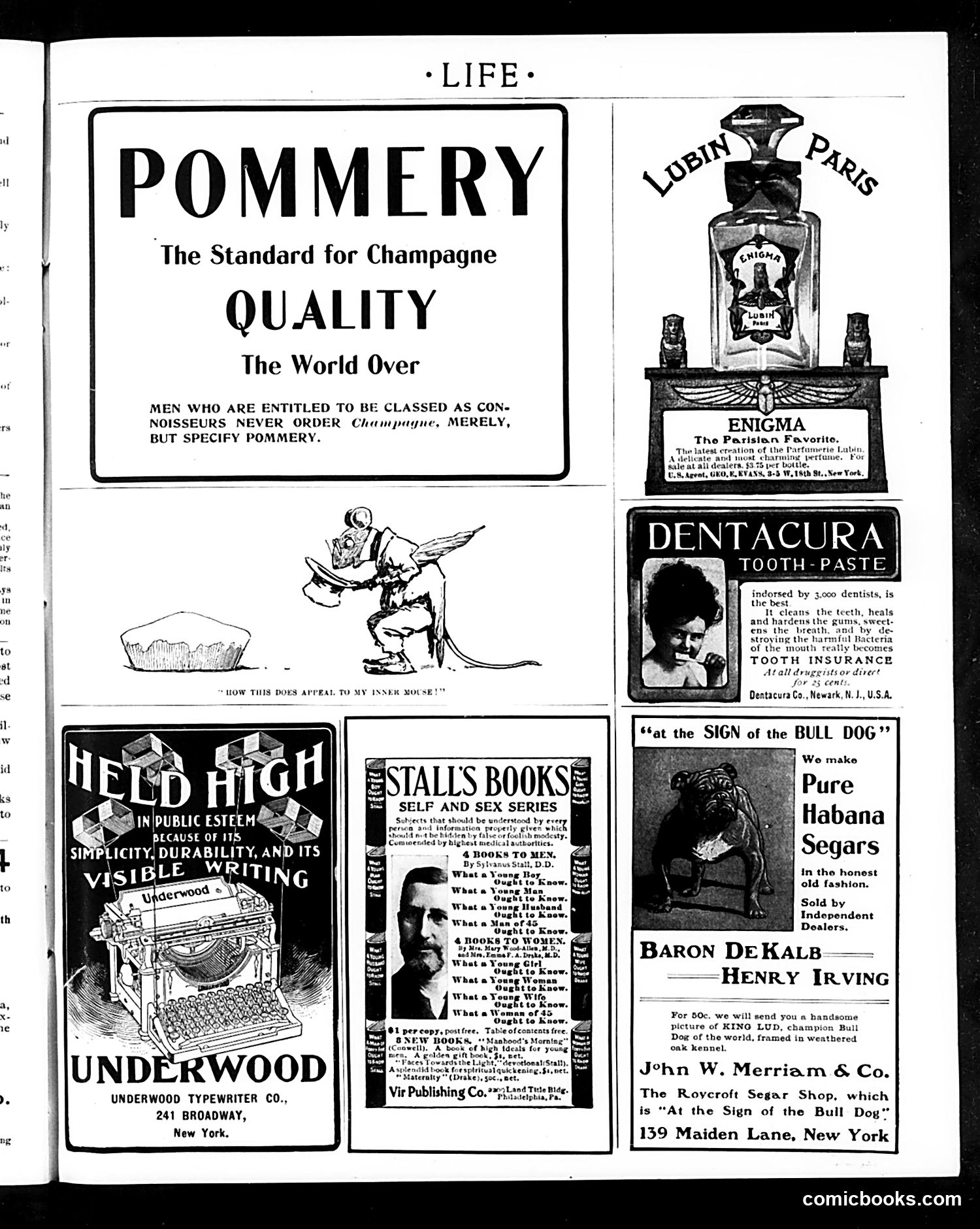
This is primarily an **advertising page** from Life magazine, not a satirical cartoon page. The layout contains six distinct advertisements for various products: 1. **Pommery Champagne** — Appeals to wealthy "connoisseurs" by emphasizing brand specificity over generic champagne purchases 2. **Enigma Perfume** — A Parisian fragrance marketed as "The Parisian Favorite" 3. **Dentacura Tooth Paste** — Claims endorsement by 3,000 dentists and promises dental health 4. **Held High Underwood Typewriter** — Emphasizes durability and visible writing mechanism 5. **Stall's Books** — Educational self-help series on various subjects for men and women 6. **Baron de Kalb/Henry Irving Cigars** — Features a bulldog mascot, sold at the Roycroft Cigar Shop The small cartoon showing a woman and cherub ("How this does appeal to my inner house") likely accompanies the Pommery ad. The page reflects early 20th-century consumer culture targeting middle to upper-class readers, with products emphasizing refinement, self-improvement, and respectability.
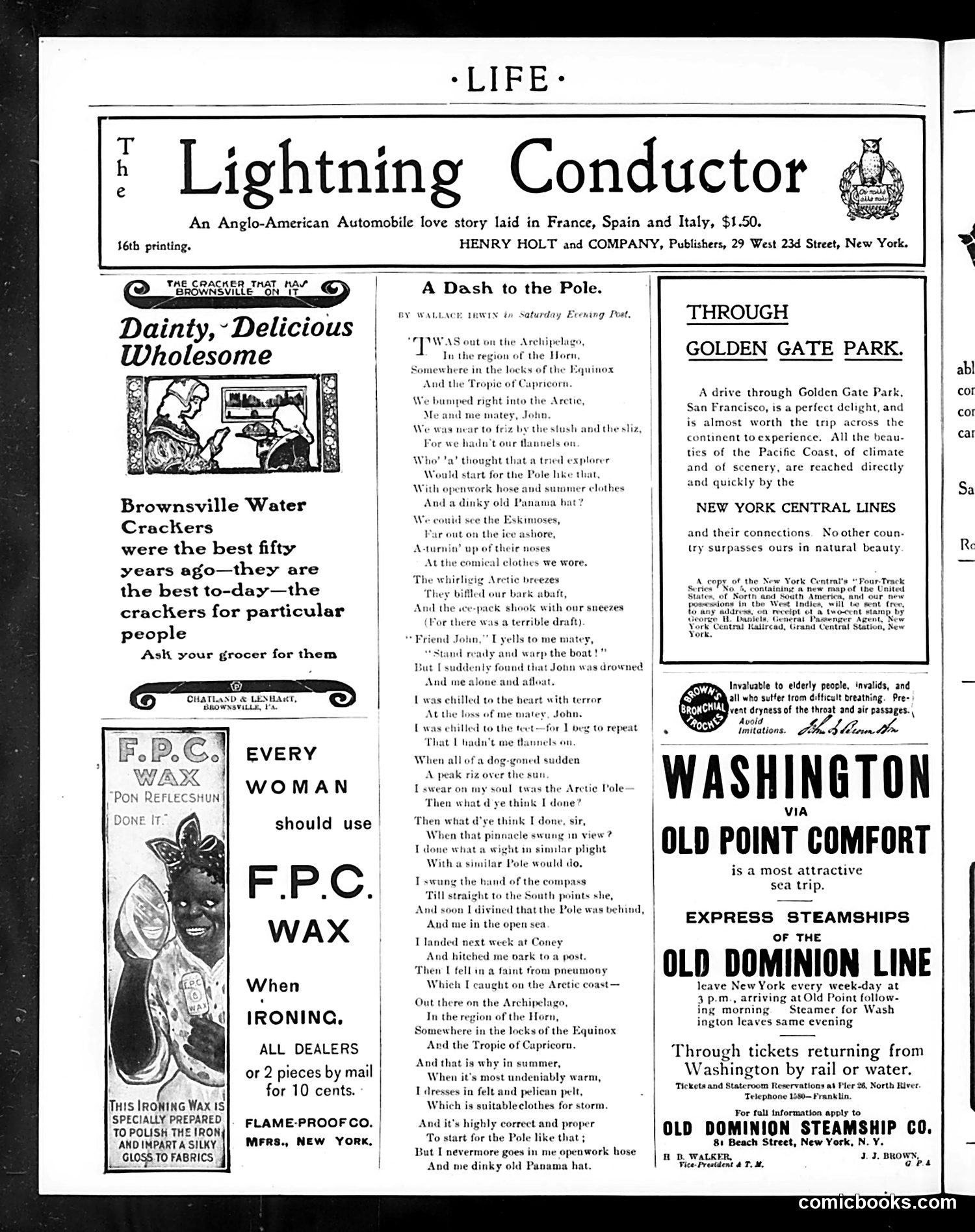
This page is primarily **advertising** with a humorous poem as filler content. The poem "A Dash to the Pole" by Wallace Irwin (from *Saturday Evening Post*) is a comedic narrative about a sailor who, unprepared for Arctic conditions, ventures toward the North Pole wearing summer clothes and a Panama hat instead of proper winter gear. The joke is situational irony: the narrator initially mocks an "tried explorer" for similar foolishness, then does the exact same thing himself, nearly freezes, loses his companion "John," and learns his lesson. The satire is gentle — poking fun at human folly and lack of preparedness rather than targeting specific figures or events. It's a cautionary tale wrapped in comic verse, reflecting early 20th-century attitudes about adventure and masculine bravado. The surrounding ads (F.P.C. Wax, Brownsville Water Crackers, Old Dominion Line steamships) are unrelated commercial content typical of *Life* magazine's layout from this era.
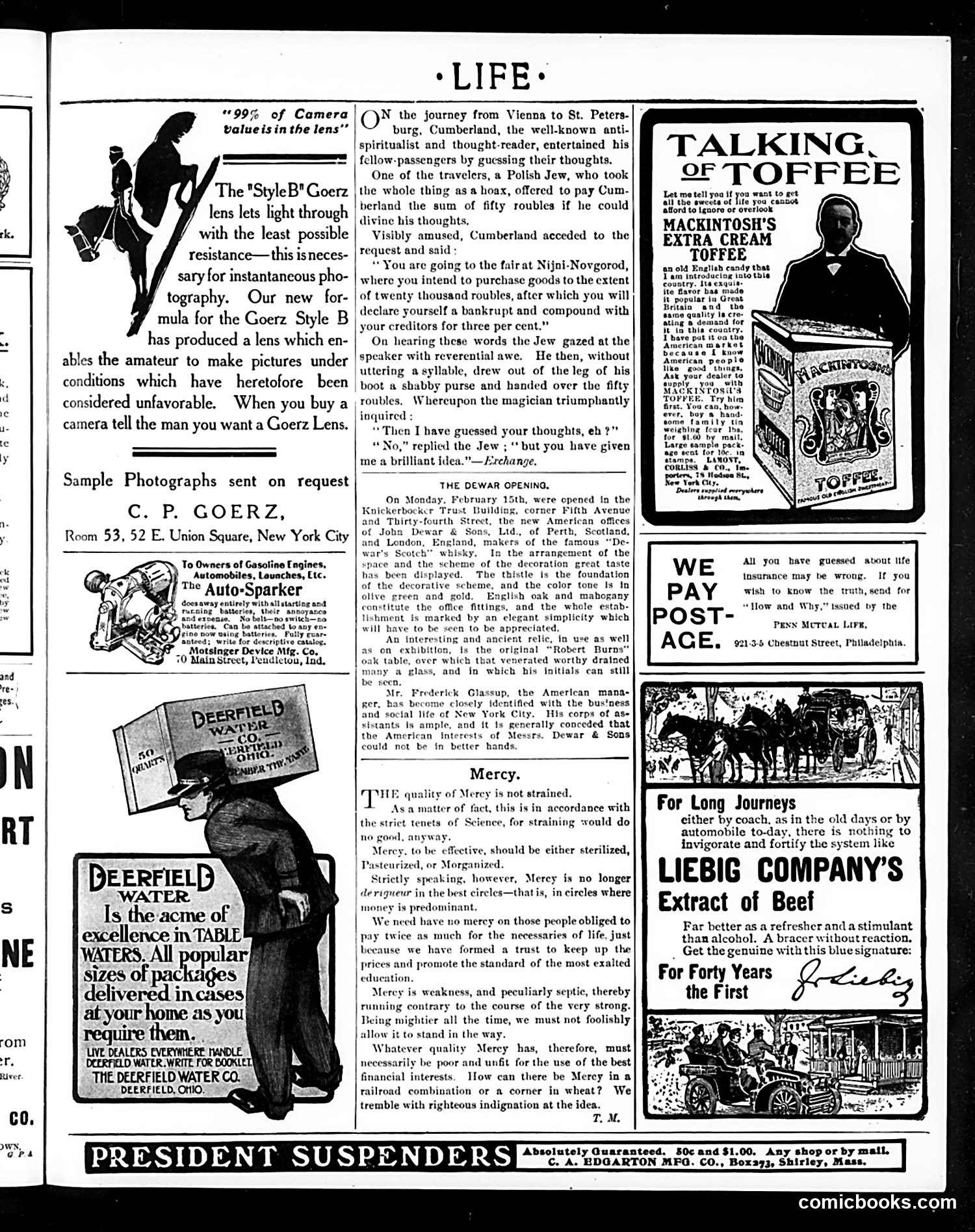
This page is primarily **advertising with satirical commentary**, typical of Life magazine's format. The main editorial content is a humorous anecdote about a thought-reader named Cumberland who impresses a Polish Jewish traveler by accurately predicting his fraudulent business scheme (planning to buy goods, then declare bankruptcy and settle with creditors for 3%). The joke: the traveler pays Cumberland the bet not because his thoughts were read, but because Cumberland unwittingly gave him a "brilliant idea"—satirizing both the traveler's dishonesty and the charlatan nature of spiritualist performers. The essay "Mercy" is sardonic social criticism attacking wealthy industrialists who exploit workers while claiming moral superiority. It argues that their "mercy" is merely self-interested preservation of profit-generating systems, not genuine compassion. The advertisements include camera lenses, automobile parts, water, coffee, and beef extract—representative products of the era. The page reflects early 20th-century American skepticism toward spiritualism and sharp critique of industrial-age inequality.
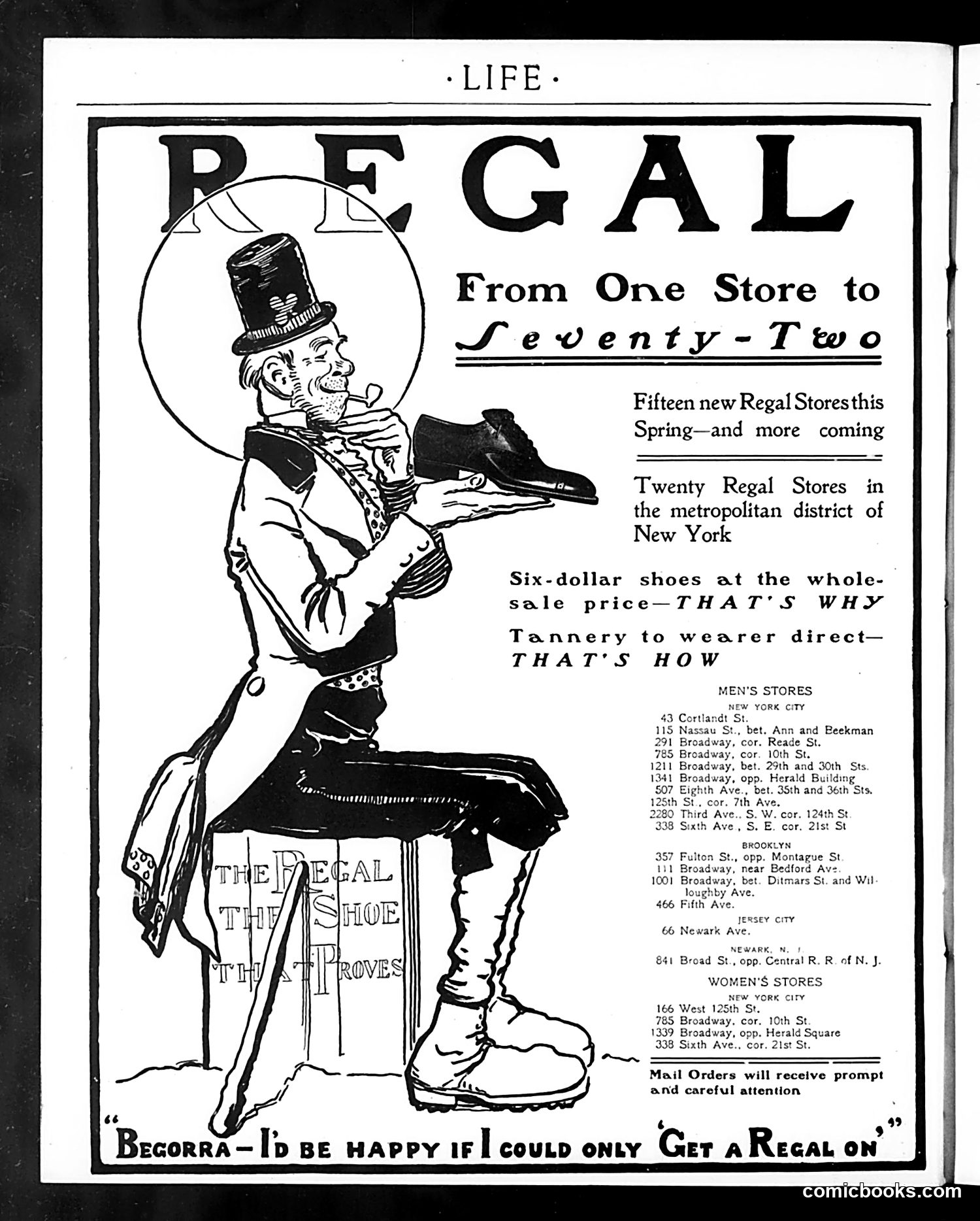
This is primarily a **shoe company advertisement**, not political satire. The page promotes Regal Shoes' rapid expansion from one store to 72 locations. The illustrated figure is a well-dressed dandy or gentleman in top hat and formal wear, striking a theatrical pose on a pedestal labeled "THE REGAL—THE SHOE THAT PROVES." The character embodies the aspirational fashion message: that affordable quality shoes (sold at wholesale prices, "tannery to wearer direct") allow working-class men to dress like gentlemen. The satire is gentle commercial humor: the exaggerated, self-satisfied pose mocks the pretension of fashion while selling it. The caption's pun—"Begorra—I'd be happy if I could only get a Regal on"—uses an Irish accent stereotype for comedic effect, targeting working-class immigrants as the intended customer base. This reflects early 20th-century direct-to-consumer retail marketing and the democratization of fashionable dress through chain stores.
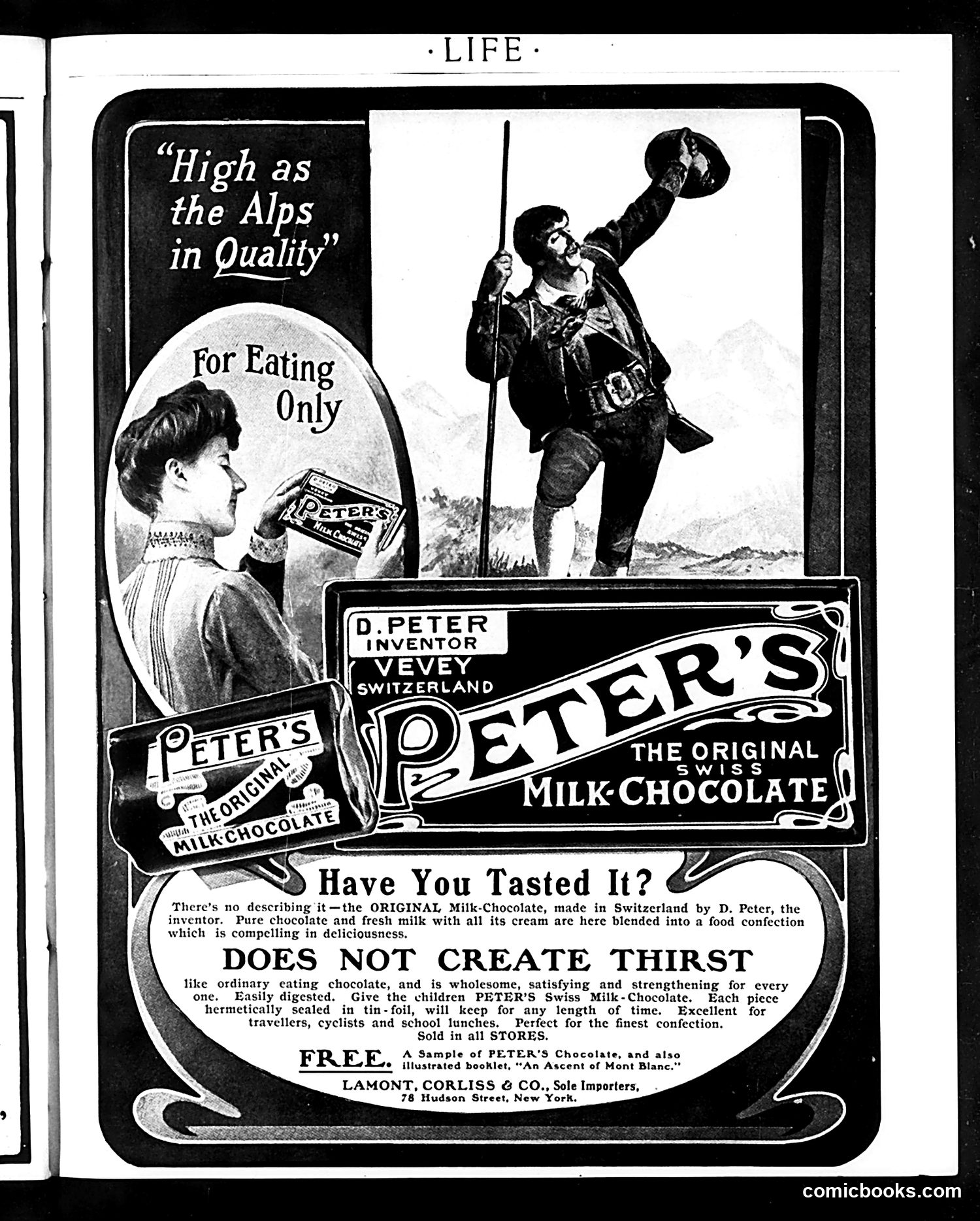
This is a full-page advertisement, not political satire. It promotes Peter's milk chocolate, a Swiss product invented by D. Peter of Vevey. The imagery uses mountaineering to reinforce the "high quality" claim: a woman on the left examines the product while a Swiss mountaineer on the right scales an Alpine peak. The visual metaphor equates chocolate quality with Alpine heights—"High as the Alps in Quality." The ad emphasizes that this chocolate is "for eating only" (doesn't create thirst like other chocolates), is wholesome and easily digested, and comes hermetically sealed for long shelf life. It targets travelers, cyclists, schoolchildren, and anyone wanting quality confection. The distributor, Lamont, Corliss & Co. in New York, offers free samples and a promotional booklet titled "An Ascent of Mont Blanc"—extending the Alpine marketing theme. This represents typical early-20th-century advertising using adventure and national reputation (Swiss chocolate) to sell products.