
Life, 1904-03-03 · page 24 of 38
Life — March 3, 1904 — page 24: what you’re looking at
What you’re looking at
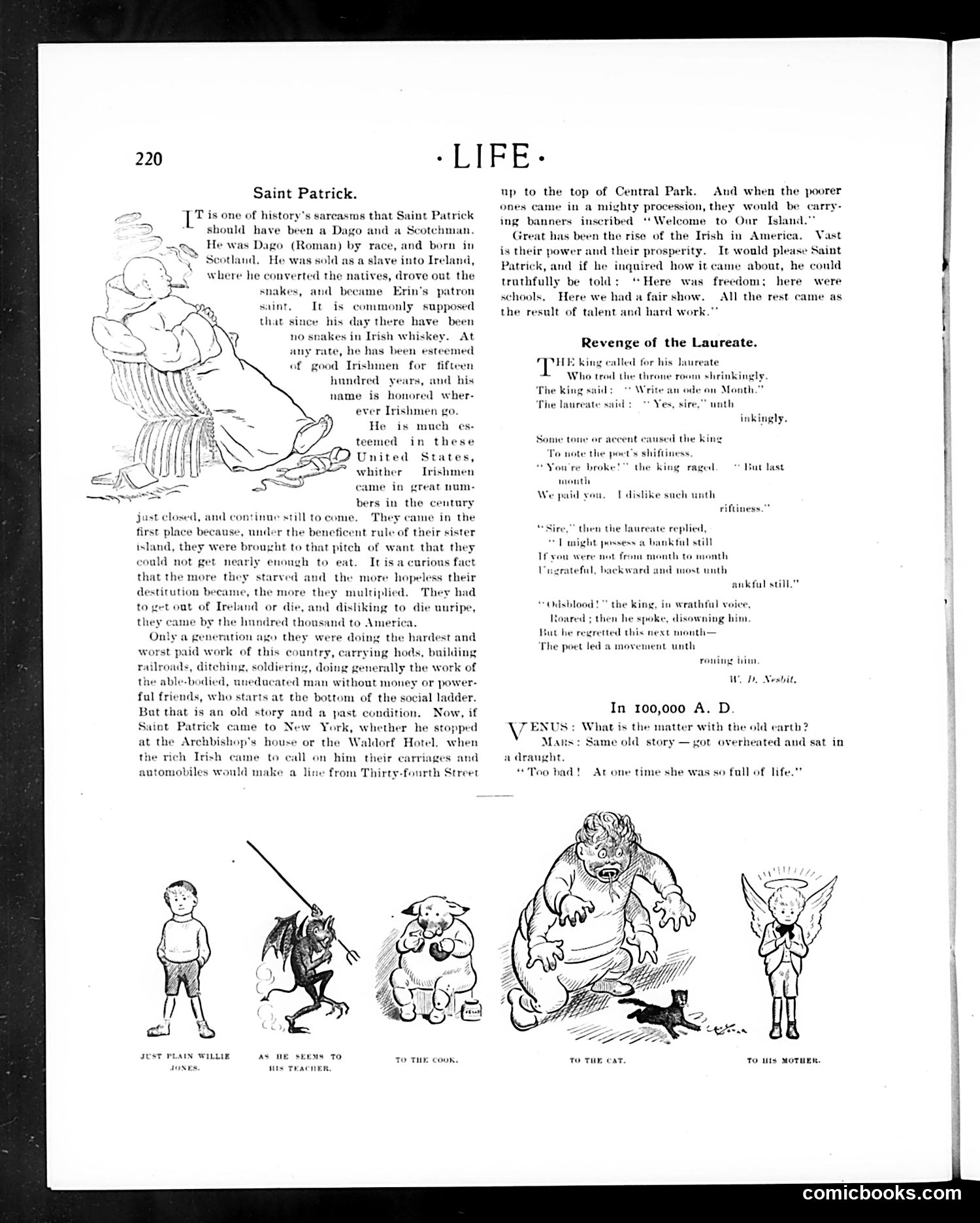
This page contains three satirical pieces: **"Saint Patrick"** (top): A historical essay celebrating Irish immigration to America. The text describes Patrick as ironically not actually Irish, then traces how Irish immigrants—initially impoverished and doing backbreaking labor—have risen through "freedom" and "schools" to prosperity and social prominence. The satire appears gentle: it celebrates Irish-American success while noting the contrast between their earlier desperation and current wealth. **"Revenge of the Laureate"** (middle): A dialogue poem where a king criticizes his court poet for financial irresponsibility. The poet responds with cutting wit, ultimately starting a movement that ousts the king. The satire mocks royal arrogance and suggests intellectual/artistic superiority over aristocratic authority. **"In 100,000 A.D"** (bottom): A brief comedic exchange where Venus asks Mars why Earth is troubled. Mars replies Earth "got overheated and sat in a draught"—a playful personification treating the planet like an overheated person catching cold. The final line's nostalgia ("so full of life") suggests dark humor about Earth's future decline. The bottom illustrations appear decorative, showing various character types.
📄 Transcribed text from this page (OCR, searchable)
Machine-transcribed from the original scan — historical spelling and the odd misread are preserved.
Saint Patrick. s one of history's sarcasms that Saint Patrick should have been a Dago and a Scotchman. He was Dago (Roman) by race, and born in Scotland, He was sold asa slave into Ireland, onverted the natives, drove out the snakes, and became Erin's patron It is commonly supposed his day there have been akes in Irish whisk any rate, he has been este of good Irishmen for fifteen hundred years, and his name is honored wher- ever Irishmen go. He is much es- teemed in these <1) United States, ZF whither — Irishmen —_ came in great num- where he bers in the century ntinue stilltocome. The me in the just closed, and c first place because, under the beneficent rule of their sister could not get nearly enough to eat. Itisa curious that the more they starved and the more hopeless their destitution became, the more they multiplied. They had tout of Ireland or die, and disliking to die unripe, ume by the hundred thousand to America. were doing the hardest and k of this country, carrying hods, building ditching, soldiering, doing generally the work of lied, uneducated man without money or power- ful friends, who starts at the bottom of the social ladder. But that is an old story and a past condition, Now, if Saint Patrick came to New York, whether he stopped at the Archbishop's house or the Waldorf Hotel, when the rich Irish came to call on him their carriages and automobiles would make a line from Thirty-fonrth Street ion age th JUST PLAIN WILLIE JONES. SEEMS TO PACKER. To THE CouK. -LIFE: up to the top of Central Park. And when the poorer oes came in a mighty procession, they would be carry- ing banners inscribed ‘*Welcome to Onur Island.” Great has been the rise of the Irish in Amer: is their power and their prosperity. It would please $ Patrick, and if he inquired how it came about, he could truthfully be told: ‘Here was freedom; here were schools, Here we had a fair she All the rest came as the result of talent and hard work." Revenge of the Laureate. Hed for his Iuureate Who trod the throne room sheinkin The ig said: Month, ‘The laureate said : h inkingly. Som used the king To note the poet's shiftiness. “Youre b mouth We paid y “the king rage Tut last I dislike such unth riftiness.” “Sire,” then the | se If vou were not from nn replied, ktul still ath to month It possess a Vagrateful, backward and most unth ankful still.” Ohdsh wrathful voic . disowning him. ext month— the king, i Roared Hue The poet led a movement unth rening bin WL, Nesbit. In 100,000 A. D VENUS : What is the matter with the old earth? Mans: Same old story — got overheated and sat in aight, “Too bad! At one time she was so full of life.” To TUE CAT. To ts MoTUER. comicbooks.com