
Life, 1904-03-03 · page 20 of 38
Life — March 3, 1904 — page 20: what you’re looking at
What you’re looking at
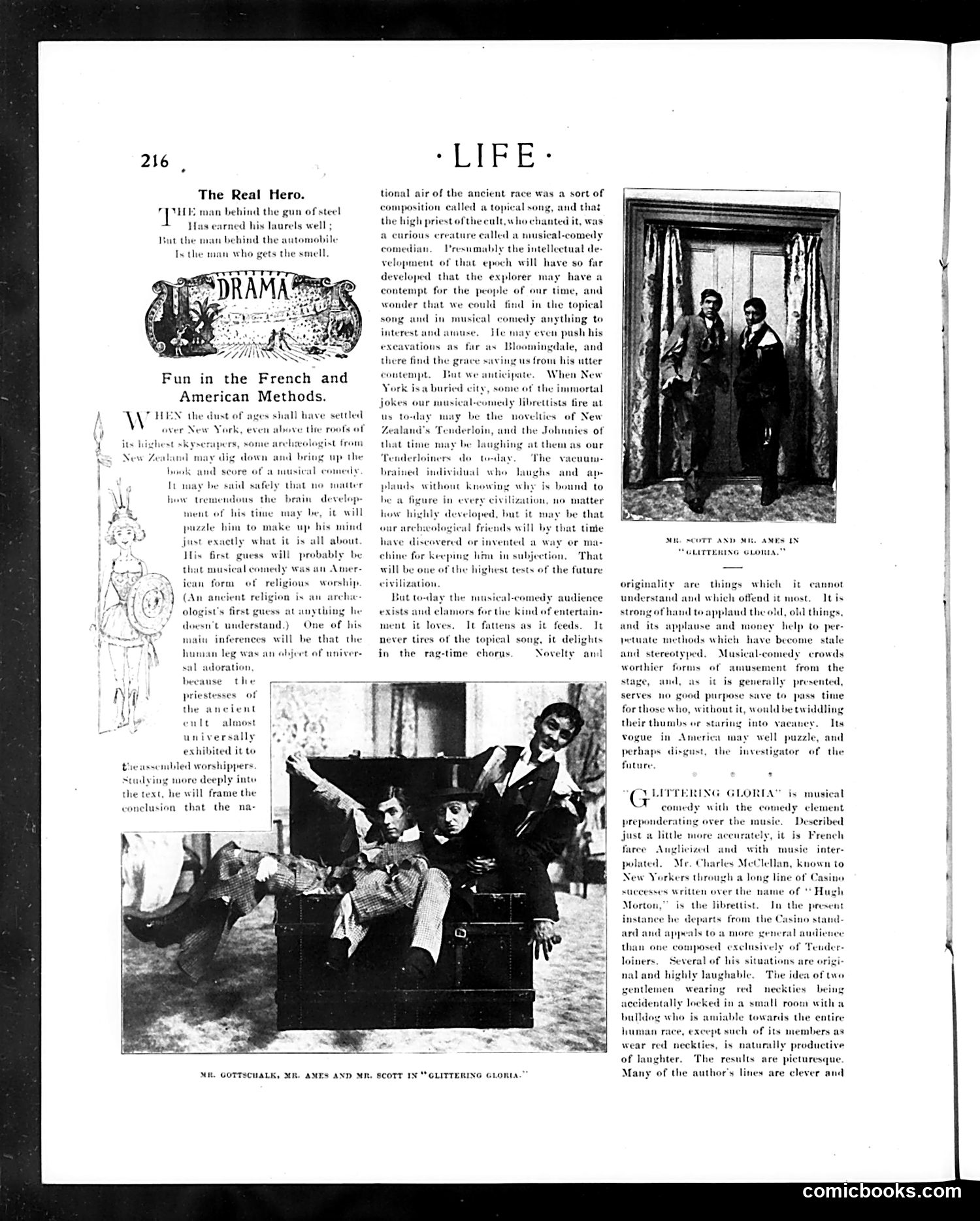
This page from *Life* magazine critiques musical comedy as intellectually hollow entertainment. **"The Real Hero"** sarcastically praises the man behind the gun rather than the soldier firing it—a jab at those who profit from war while others fight. **"Fun in the French and American Methods"** imagines a future archaeologist discovering New York as a buried city, finding musical-comedy theaters and puzzling over this "curious creature called a musical-comedy man." The satire suggests that future scholars will be baffled that a civilization spent time on such trivial entertainment. The piece dismisses musical comedy as mindless spectacle that crowds enjoy merely because it's novel and requires no thought—"stale and stereotyped" yet profitable. **"Glittering Gloria"** (photos shown) is a French farce adapted for American audiences, featuring absurdist humor (gentlemen accidentally locked in a room with a bulldog). The review acknowledges it's "clever" but notes it serves no purpose except idle distraction for audiences who might otherwise be bored. The underlying message: American popular entertainment is vapid and culturally worthless, valued only for commercial profit and audience numbness.
📄 Transcribed text from this page (OCR, searchable)
Machine-transcribed from the original scan — historical spelling and the odd misread are preserved.
216 The Real Hero. pues 1 behind the gun of steel Hus carned his laurels well ; behind thi an who gets the smell 1 the automobile Fun in the French and American Methods. JA EN the dust of rk, ever ges shall have settled rove thre roots of {its highest *kyseray fe New Zealand may dig dows k and score of Lg It way be anid safely that 10 1m teen s the brain develop: ment of his time may be, it will puzzle him to make up his anind just exactly what it is all probably His first guess will that musical ican form of wnedy was an Amer: ligious worship. arehw nis a Us first guess at anything he t understand.) One of his ill be that the tof univer: infer leg was an oration cause estesses of ancient ult universally exhibited it to | ssembled worshipp Studying more deeply int the text, he will frame the a that the conelusi« the - — ‘LIPE« air of the ancient race was a sort of and thag tiona composition called a topic the high priest ofthe cult, wh a curious | comedian, Presumably the intellectual de- velopment of that epoch will have so far devele that the explorer may contempt for the people of wonder that we ld find song and in musical come interest excavations as fir as ir time, 1 the top nything to He may even push his Blo there find the grace saving us from his utter When New the immortal pd aiause, ningdale, and contempt York isa buried city, some Tut we anticipate jokes our musical-comedy librettists fire the novelties of New innies of it them as our The and the J rloiners dot el individual whe I ds without knowing why vacuum and is bound to ap. he a figure in every civilization, no matter may be that tine ly developed, but ol ‘evered or invented 1 friends will 1 way orm That ine for keepi ¢ him in subj ion, will be one of the highest test the fature civilization But to-day the musical-comedy audience kind of entertain- tens as it feeds. It exists and clamors for tin ment it loves. It f never tires of the to in the rag-time al song, it del Novelty a chorus. MR. GOTTSCUALK, 31. AMES AND MR. SCOTT IN “GLITTERING GLonta. AMES IN UrTERING GLOnIA.” originality are nit understand and which offend it most strong of hand to applaud th and its a things w cannot Itis old things, lause and money help to per= Vetuate methods which have become. stale and stereotyped. Musical-comedy crowds worthier forms of amusement from the st . as it is generally pres rves no vod purpose save to pass for those who, without it, would be twiddling their thumbs or staring into. vaca Its vogue in America may well puzzle, and perhaps disgust, the investigator of the future VLITTE NG GLOR comedy with the is musical ly clement Described y, it is Freneh ‘lL oand with harles Me orkers thro preponderating over the music just @ little more acew music inter- ‘leHan, known to ha long lin of Casino written over the name of Hugh Morton, librettist. In the pre instance he departs from the Casino ard and appeals toa more general than on lo naland | composed exclusively of everal of his situations are ily laughable. The ic gentlemen wearing red nec accidentally locked in asm bulldog who i of two being én U room with a able tor js the ent human race, except such of its members as wear red ne of Jau Many . is naturally productive re picturesque. + are clever a hter, The results the author's comicbooks.com