
A complete issue · 24 pages · 1903
Life — October 15, 1903
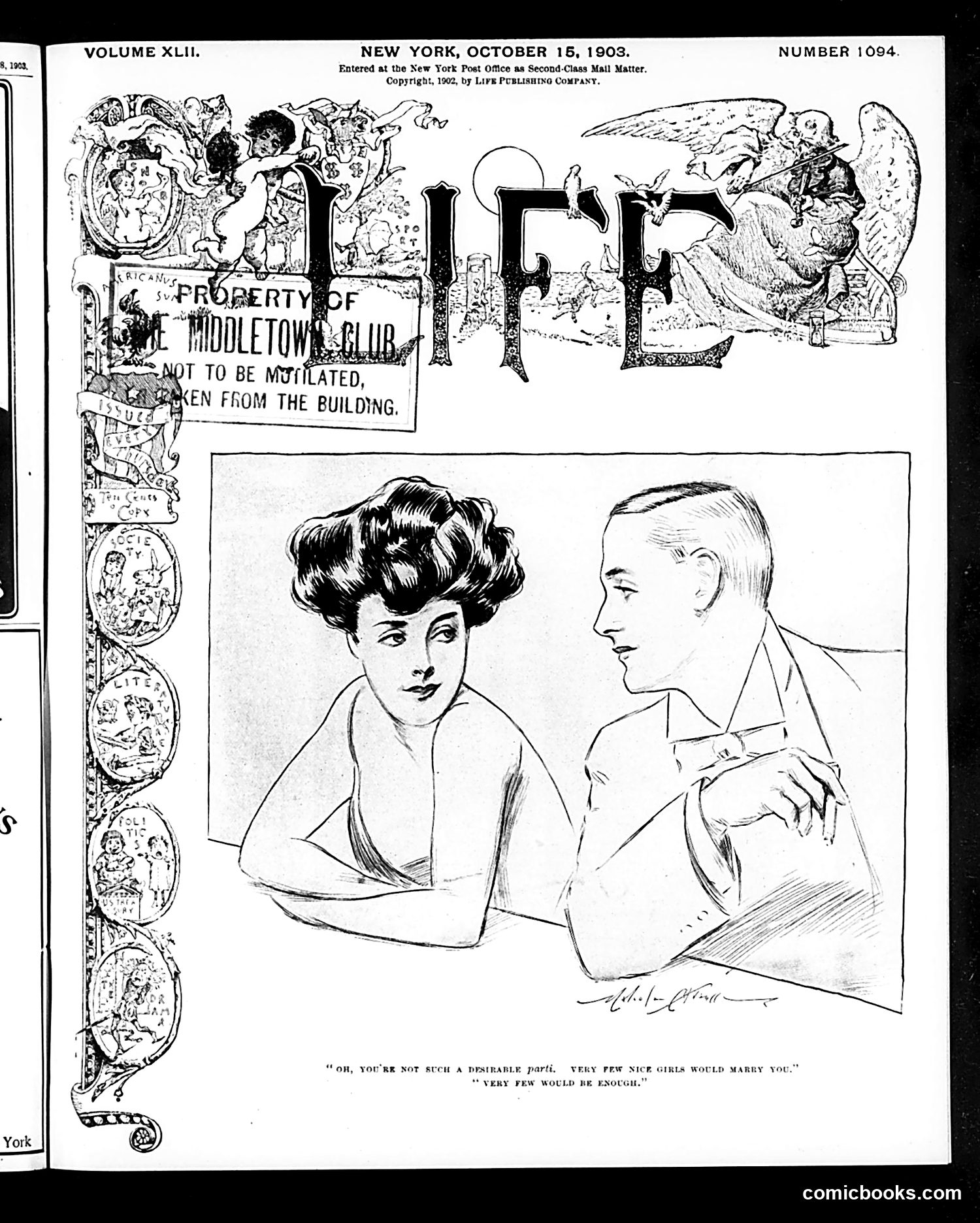
This page features a romantic illustration with satirical dialogue. A woman with the fashionable Gibson Girl hairstyle of the era sits with a man in conversation. The caption reads: "Oh, you're not such a desirable parti. Very few nice girls would marry you." / "Very few would be enough." The humor mocks early 1900s courtship rituals and marriage expectations. The man's response—suggesting he needs only a few options rather than universal desirability—is presented as charmingly pragmatic rather than romantic. This reflects contemporary anxieties about bachelor eligibility and the marriage market among upper-class Americans. The elaborate decorative header marks this as premium editorial content in Life's satirical commentary on social customs.
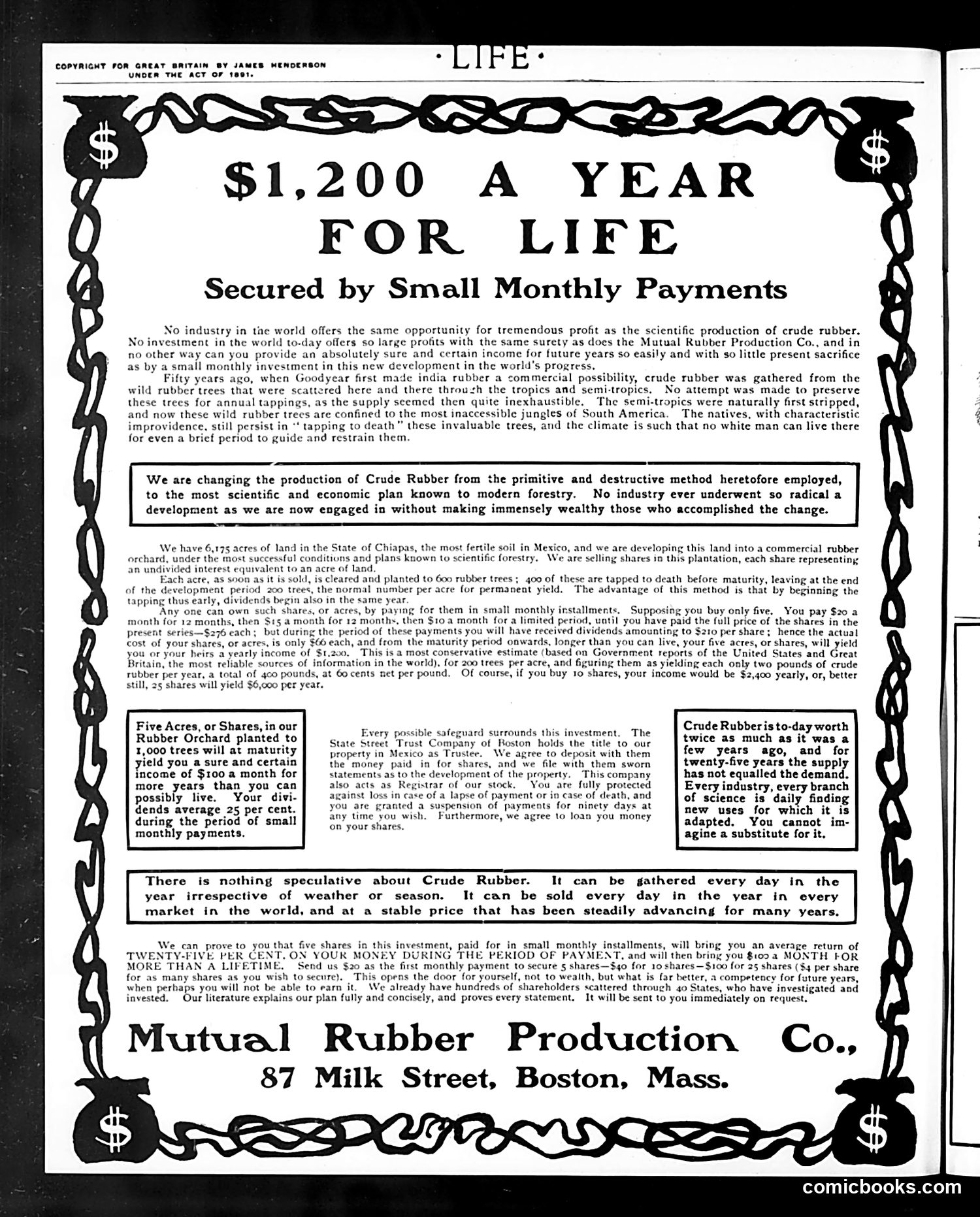
This page is **primarily an advertisement**, not editorial satire. It's a financial investment pitch from the Mutual Rubber Production Co. (Boston, Mass.) promoting shares in a rubber plantation in Chiapas, Mexico. The ad promises "$1,200 a year for life" through small monthly payments, claiming rubber production offers exceptional profits. It emphasizes the shift from "primitive" harvesting to "modern forestry" and guarantees 25% annual returns during the payment period, followed by monthly dividends. The decorative border featuring dollar signs and chain links is purely ornamental. While the language reflects early-20th-century investment marketing optimism, there's no political cartoon or satire present—this is a straightforward (if heavily promotional) securities advertisement typical of Life magazine's revenue model.
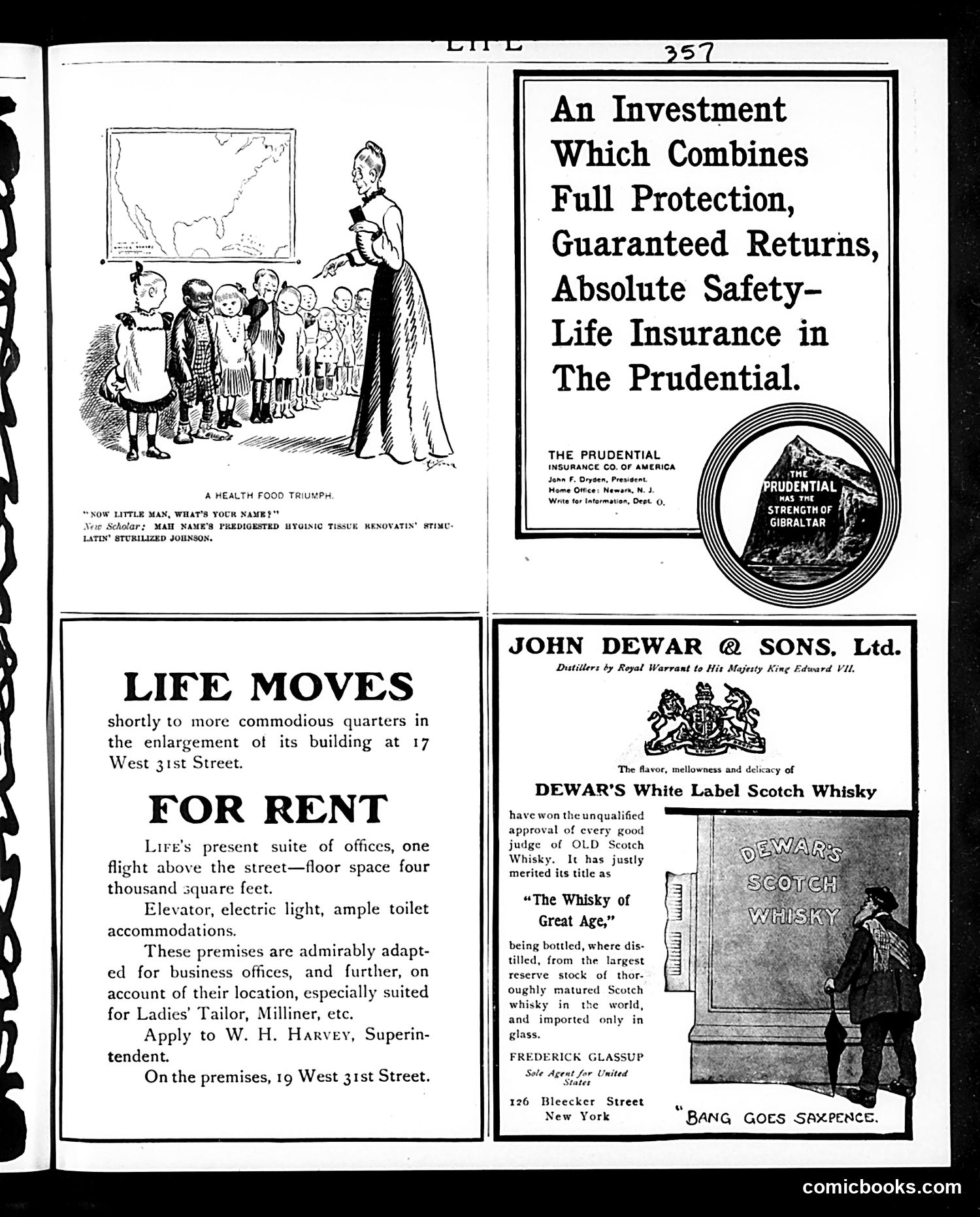
This page is primarily **advertising** with one cartoon. The cartoon "A Health Food Triumph" shows a schoolteacher with children, captioned about a "Man Named Uvding Tissue Renovatin" and "Sterilized Johnson." The joke appears to reference **health food marketing claims** of the early 20th century—a period of intense promotion of "scientific" dietary products promising physical transformation. The humor lies in the absurd notion that a teacher would name a child after a trendy health product, satirizing how enthusiastically the public embraced these commercial health claims. The remaining content consists of advertisements for **Life magazine office space**, **Prudential Life Insurance**, and **Dewar's Scotch Whisky**—representative of typical magazine advertising from this era.
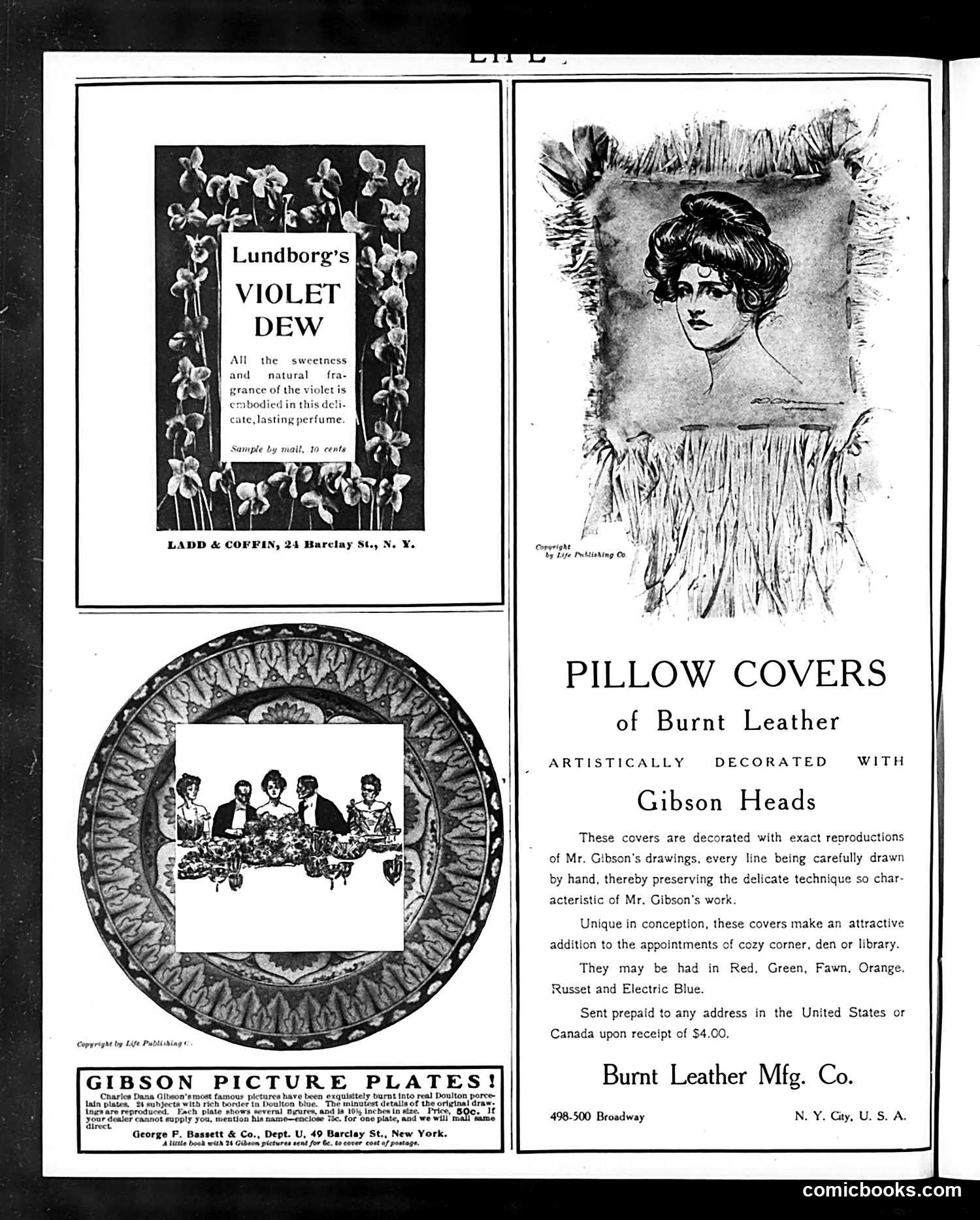
This page is **primarily advertising**, not satire or political commentary. It contains three separate product advertisements: 1. **Lundborg's Violet Dew** perfume (top left) — a fragrance product from a New York vendor 2. **Gibson Picture Plates** (bottom left) — decorative plates featuring Gibson Girl illustrations, a popular early-20th-century aesthetic 3. **Pillow Covers of Burnt Leather** (right) — decorative home goods featuring Gibson Head designs, available in multiple colors The Gibson Girl imagery reflects the era's popular illustration style. The page demonstrates Life magazine's dual function as both satirical publication and advertising vehicle. No political meaning or satire is evident—this is straightforward period commercial content aimed at affluent readers interested in decorative arts and beauty products.
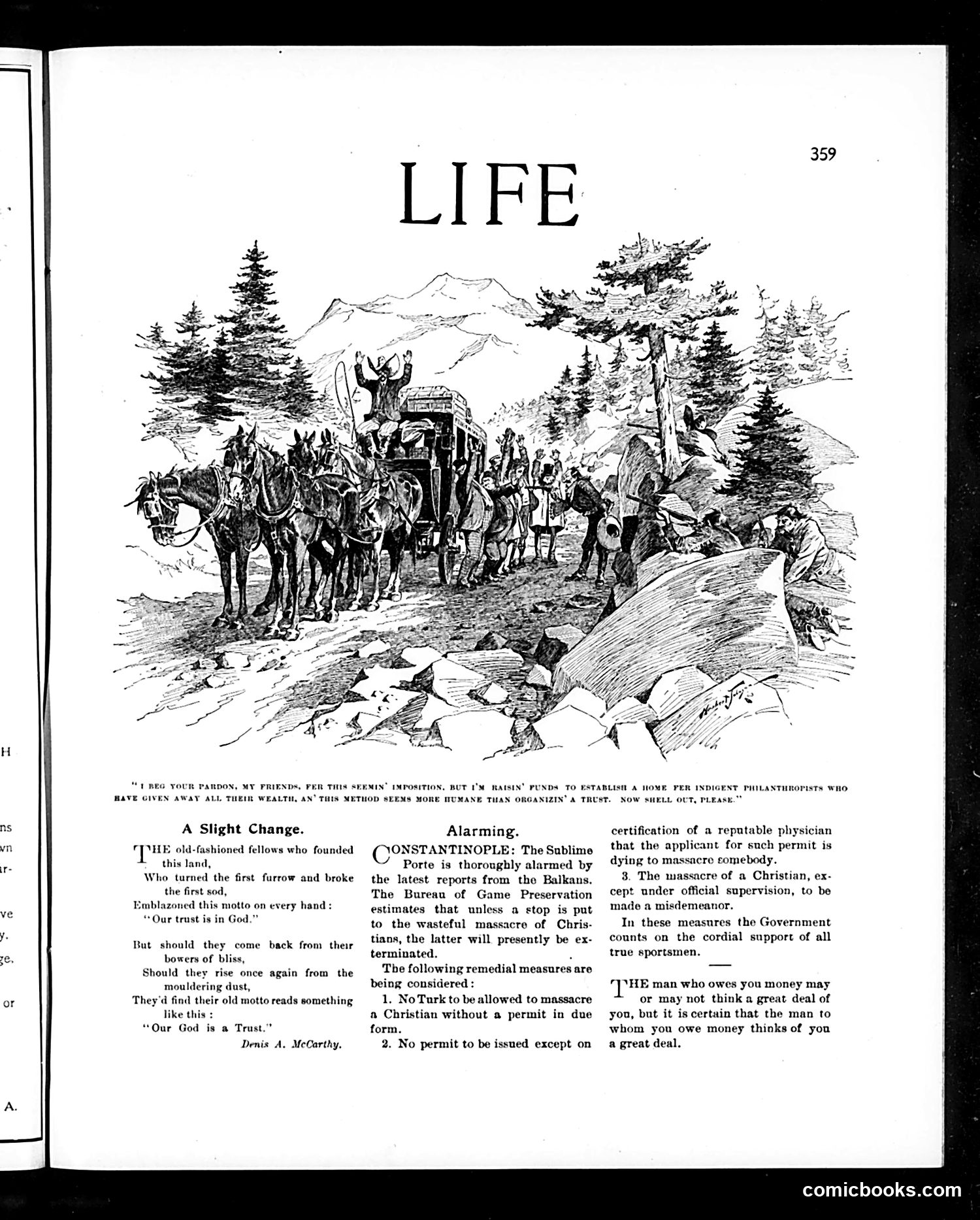
This page from *Life* magazine features a satirical illustration titled "A Slight Change" paired with commentary on two contemporary issues. The main illustration depicts a frontier/colonial-era wagon train with horses and settlers moving through mountainous terrain—likely referencing westward expansion and manifest destiny themes. The text below satirizes two concerns: First, "A Slight Change" mocks old-fashioned pioneers' trust in God, suggesting modern times require different values. Second, under "Alarming," the piece critiques Ottoman Empire policies regarding Christian persecution in the Balkans, proposing bureaucratic solutions like permit systems—satirizing both Ottoman governance and Western governmental responses to humanitarian crises. The final section uses humor about debt to transition topics. The overall tone suggests *Life* was commenting on both American historical identity and contemporary international religious conflict, likely dating to the late 19th or early 20th century.
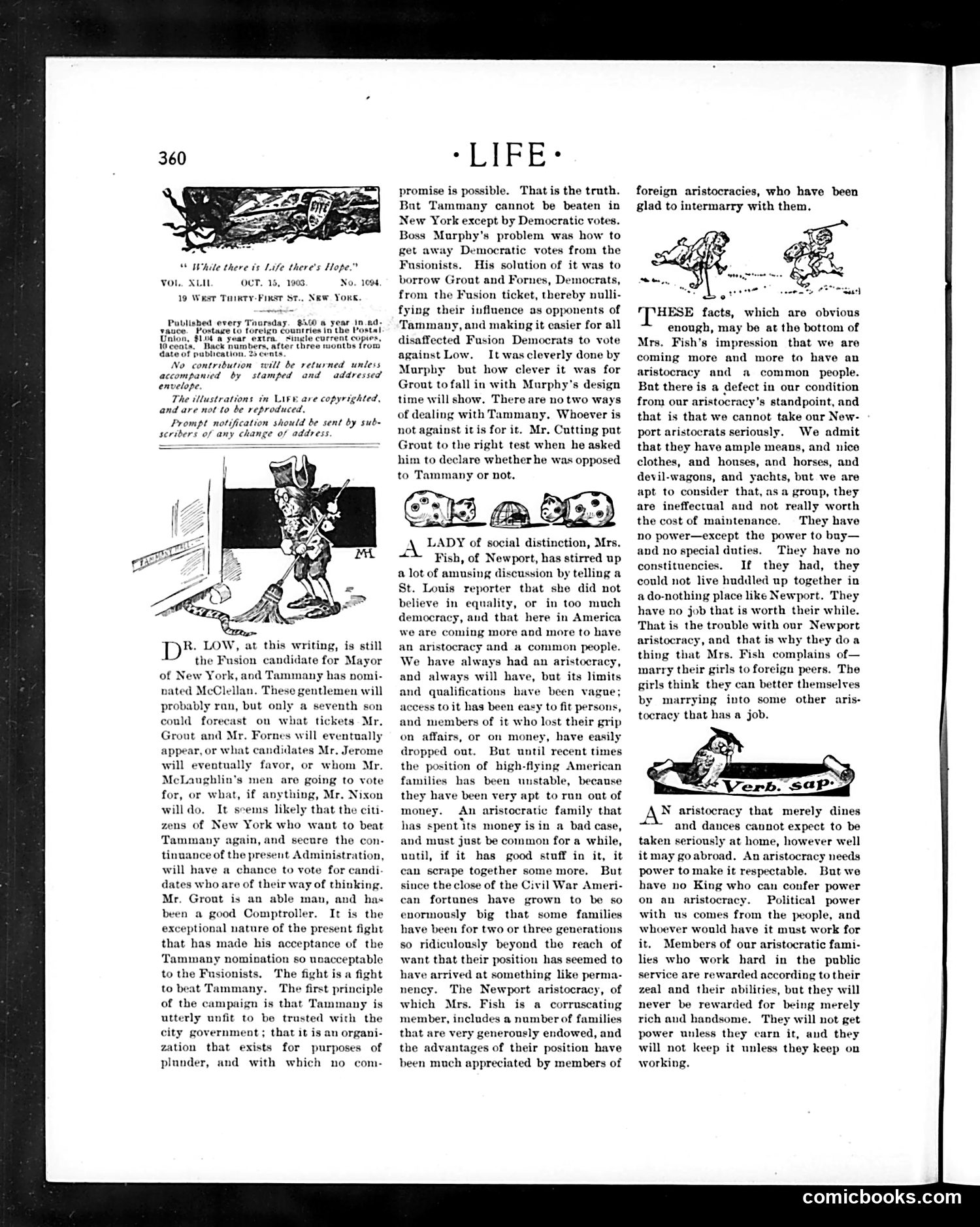
This October 1903 *Life* magazine page satirizes New York City politics, specifically Boss Murphy's control of Democratic voters and the Tammany Hall machine. The text discusses how Murphy manipulated Fusion Democrats to oppose Judge Tammany while maintaining Tammany's political power. The cartoons mock Mrs. Fish, a Newport society woman, for claiming America lacks aristocracy while maintaining aristocratic pretensions. The satire suggests that wealthy New Yorkers like the Fishes perpetuate class hierarchies through inherited privilege, contradicting democratic ideals. The underlying critique: New York's political establishment—both Tammany bosses and wealthy elites—operates as an undemocratic oligarchy despite America's egalitarian promises. The magazine attacks both corrupt political machines and the privileged classes that support them.
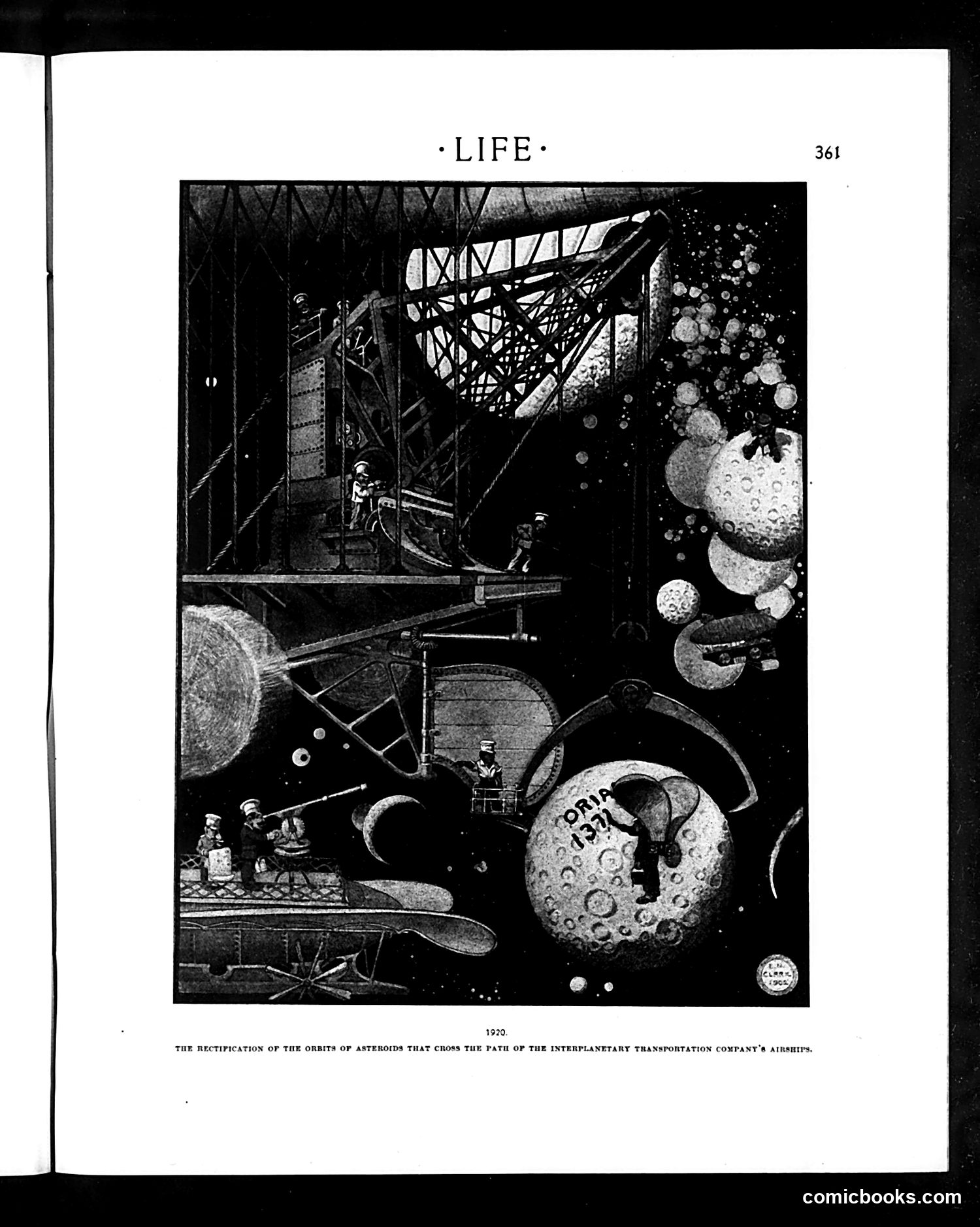
This 1929 illustration from *Life* magazine is science fiction satire. The caption describes "the rectification of the orbits of asteroids that cross the path of the interplanetary transportation company's airships." The image depicts a futuristic space scene with small human figures operating giant machinery and astronomical equipment to manipulate asteroid trajectories. The satire mocks corporate expansion and bureaucratic solutions: it imagines a future transportation company so dominant that it literally alters celestial bodies to clear shipping lanes for its spacecraft. This reflects 1920s anxieties about corporate monopolies and unchecked technological ambition. The joke suggests that if business growth continues unchecked, companies might eventually reshape nature itself for profit—an absurdist extrapolation of contemporary industrial power.
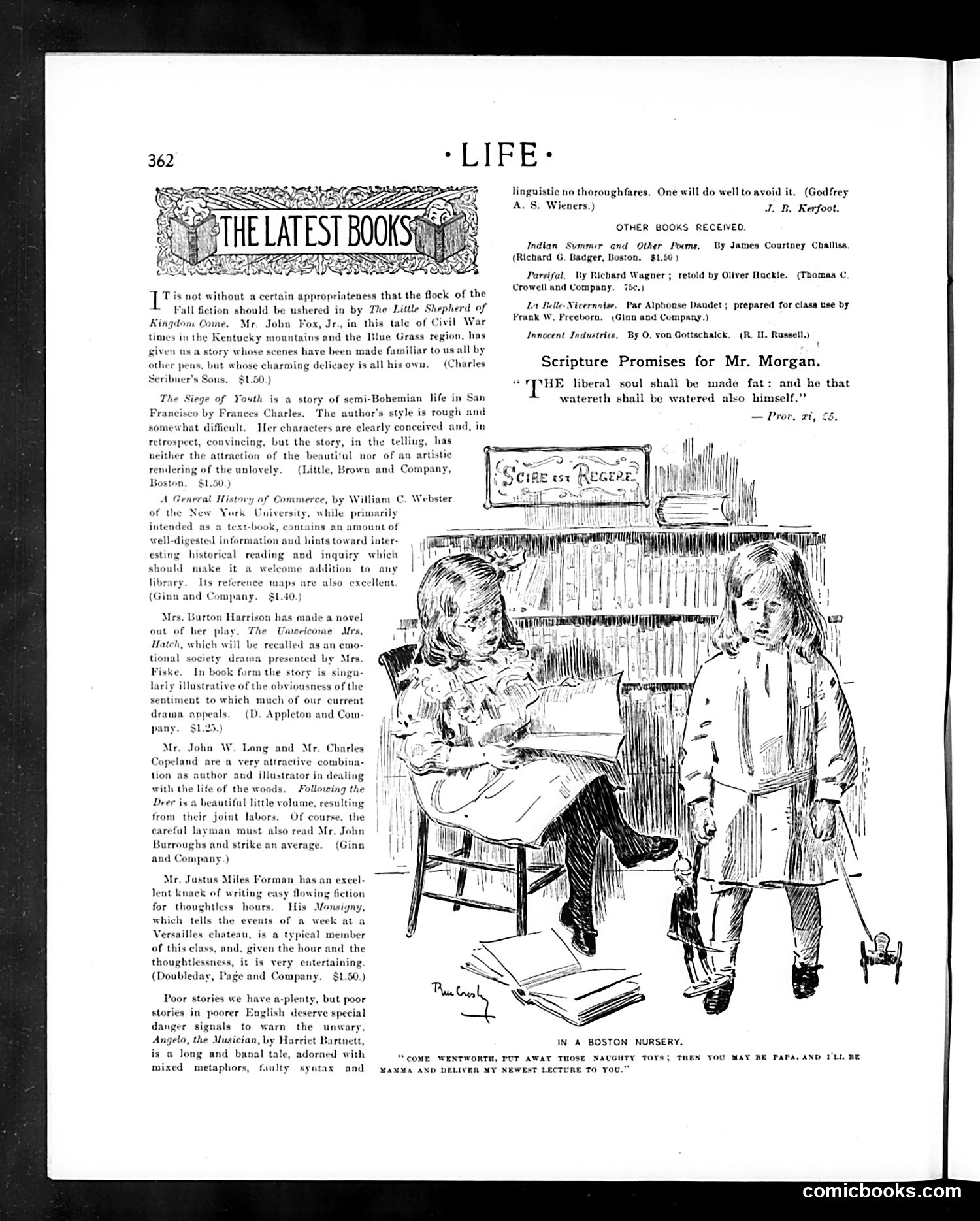
This illustration depicts a domestic scene showing an adult (likely a parent or nanny) reading to children in what appears to be a Victorian-era nursery. The caption reads: "Come Wentworth, put away those naughty toys; then you may be papa, and I'll be mamma and deliver my newest lecture to you." The satire critiques parental authority and child-rearing practices of the era. The joke appears to mock how children imitate adult behavior—specifically, the parent is promising to let the child "play papa" only after obedience is achieved. This reflects period anxieties about parenting methods, discipline, and the transmission of authority. The phrase "newest lecture" suggests commentary on verbose, lecture-based parenting styles common to educated middle-class households of that time.
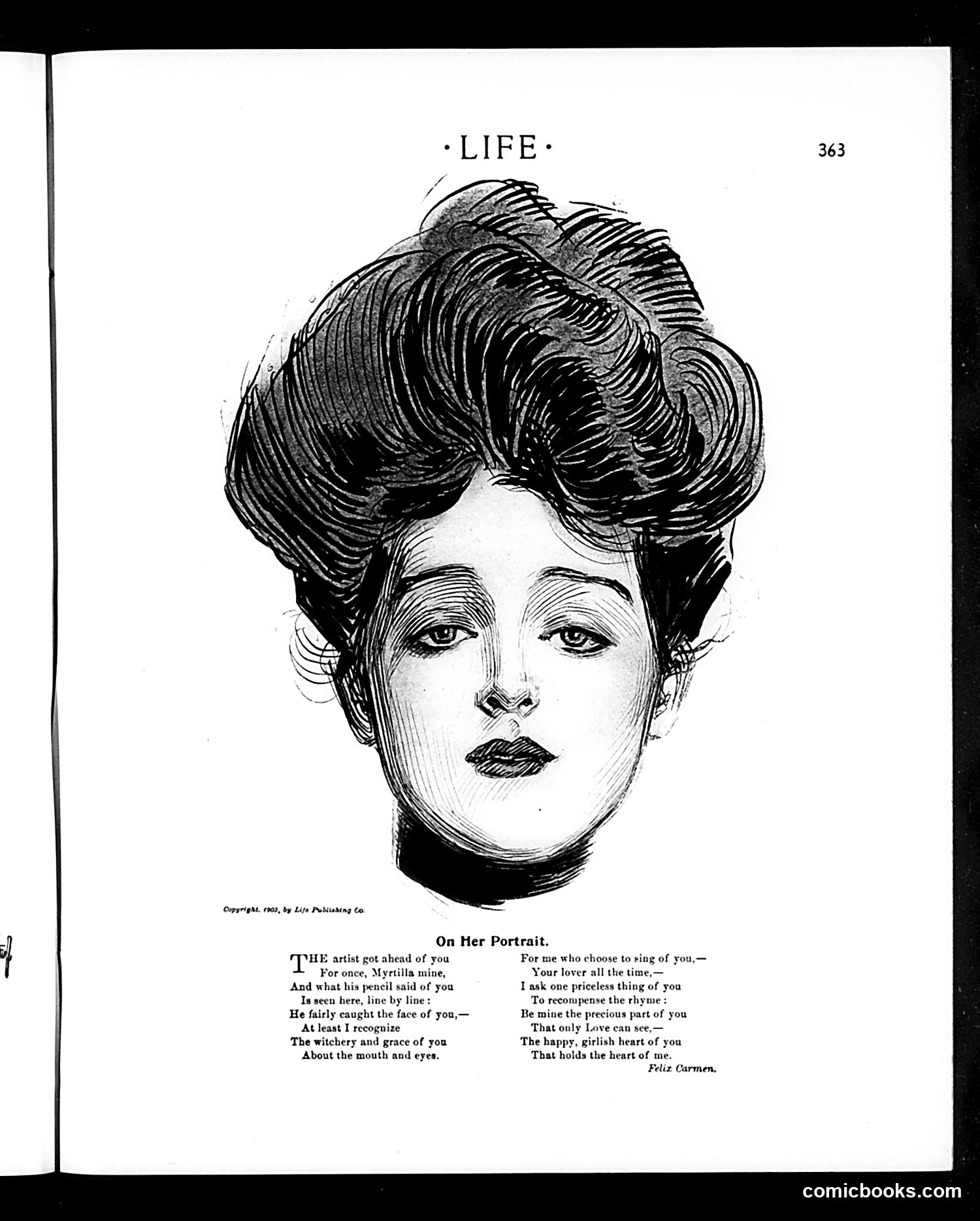
This page features a portrait drawing of a woman with early 1900s styling (upswept hair, defined features) accompanied by a poem titled "On Her Portrait" by Felix Carmen. The poem contrasts two perspectives: an artist who captured the subject's physical beauty through line and sketch, versus a lover who claims to possess her "precious part"—her heart. The verse humorously argues that while the artist achieved technical success in depicting "the witchcraft and grace" of her face, only love can truly know "the happy, girlish heart." This appears to be a light satirical commentary on artistic rivalry and romantic devotion—suggesting that physical representation, however skillful, cannot match emotional intimacy. The tone is genteel rather than sharply satirical, typical of Life's early 1900s social humor.
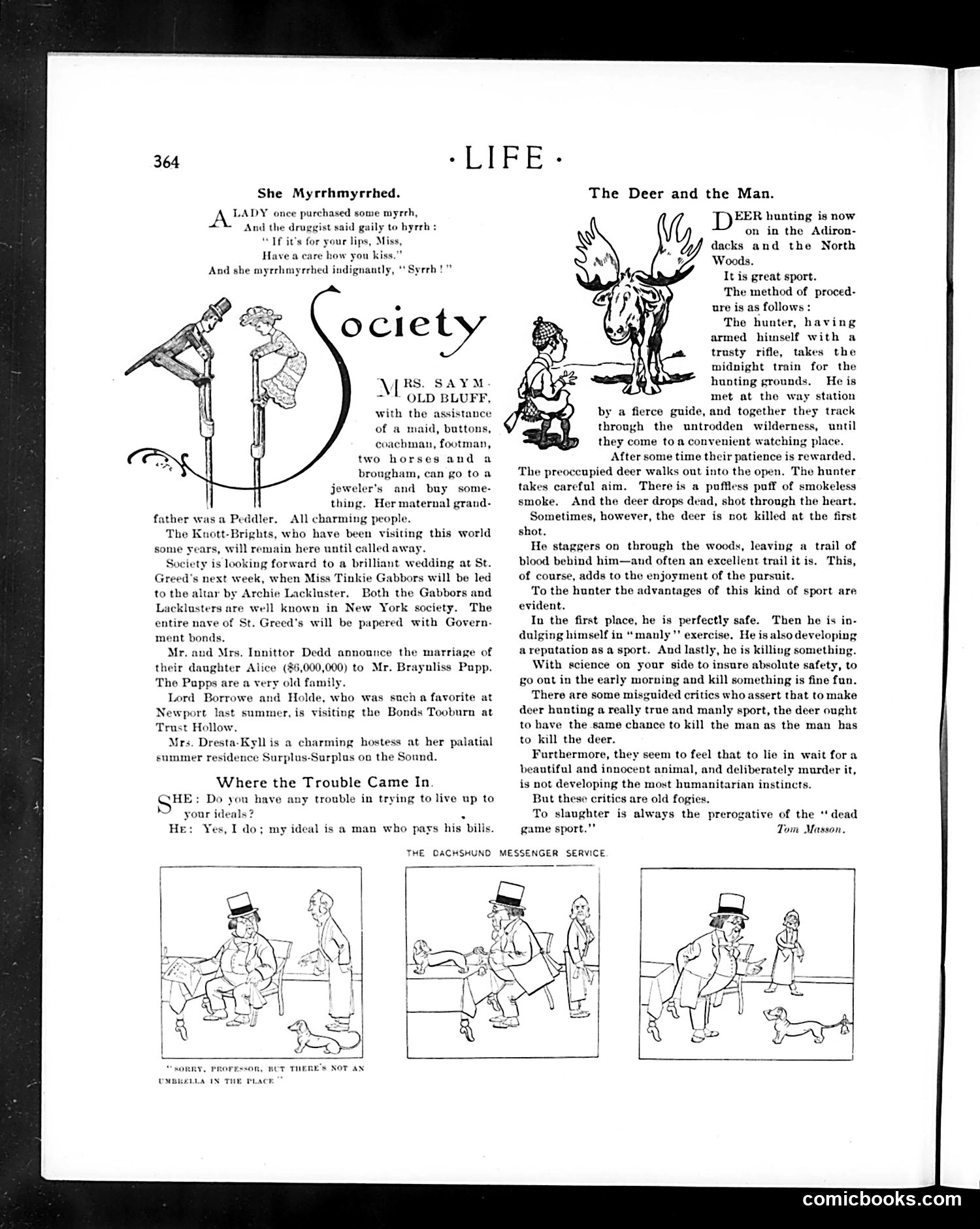
This three-panel comic satirizes a man's excuse for financial troubles. The sequence shows a well-dressed gentleman explaining to a woman that his ideal man "pays his bills," but he himself apparently does not. The joke's title references a "dachshund messenger service"—in the final panel, a small dog carries what appears to be a bill or debt notice. The humor derives from the man's hypocrisy: he advocates for financial responsibility while using a pet as a comedic device to avoid or deliver unwelcome debts. The cartoon satirizes middle-class attitudes about money and masculinity in the early 20th century, mocking men who speak of virtue while failing to practice it themselves. The dachshund functions as both literal messenger and visual punchline.
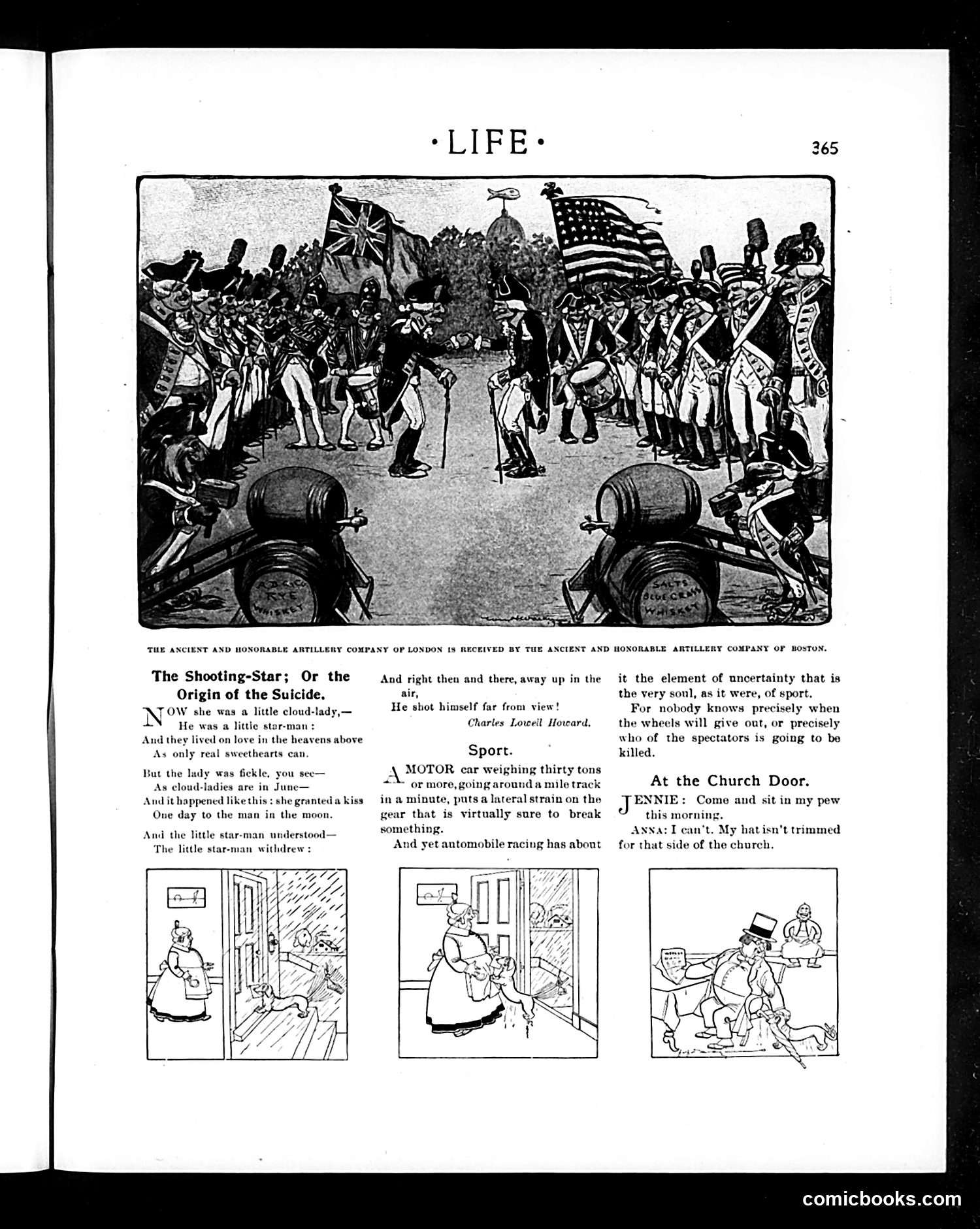
**Top Image:** Shows a military ceremony with uniformed soldiers, flags (including the American flag), and what appears to be a formal transfer or reception. The caption states "THE ANCIENT AND HONORABLE ARTILLERY COMPANY OF LONDON IS RECEIVED BY THE ANCIENT AND HONORABLE ARTILLERY COMPANY OF BOSTON," suggesting Anglo-American diplomatic or military goodwill. **Stories Below:** "The Shooting-Star" presents a romantic poem about a "little old-lady" and "little star-man" with whimsical illustrations. "Sport" discusses automobile racing dangers—a 30-ton motor car racing poses injury risks, yet racing continues due to spectacle's uncertainty. "At the Church Door" is a brief comic dialogue about hat trimming. The page mixes highbrow poetry, sports commentary, and domestic humor typical of early 20th-century Life magazine's satirical format.
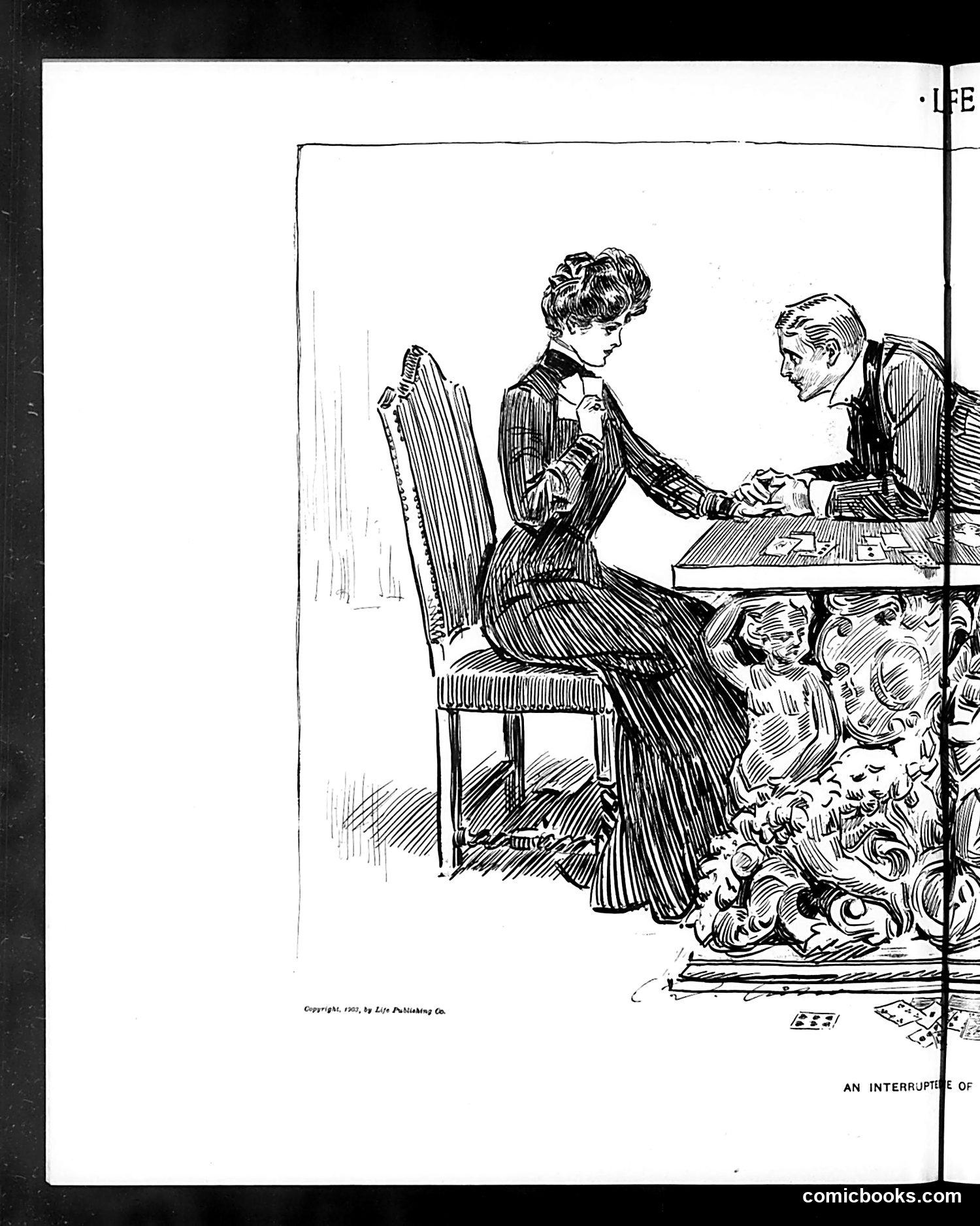
This page shows a sketch titled "AN INTERRUPTIE OF" (title appears cut off). The illustration depicts two figures at a desk: a woman seated, dressed in a business suit with short hair styled in a 1920s fashion, and a man leaning toward her across the desk in what appears to be a business or office setting. The satire likely concerns **gender dynamics in the workplace** during the early 20th century, when women's professional participation was still controversial. The woman's confident posture and business attire suggest she occupies a professional role, while the man's interaction—the "interruption" of the title—may be satirizing how women's authority or work was frequently interrupted or undermined by male colleagues. The copyright indicates Life Publishing Co., consistent with the magazine's social commentary focus of that era.
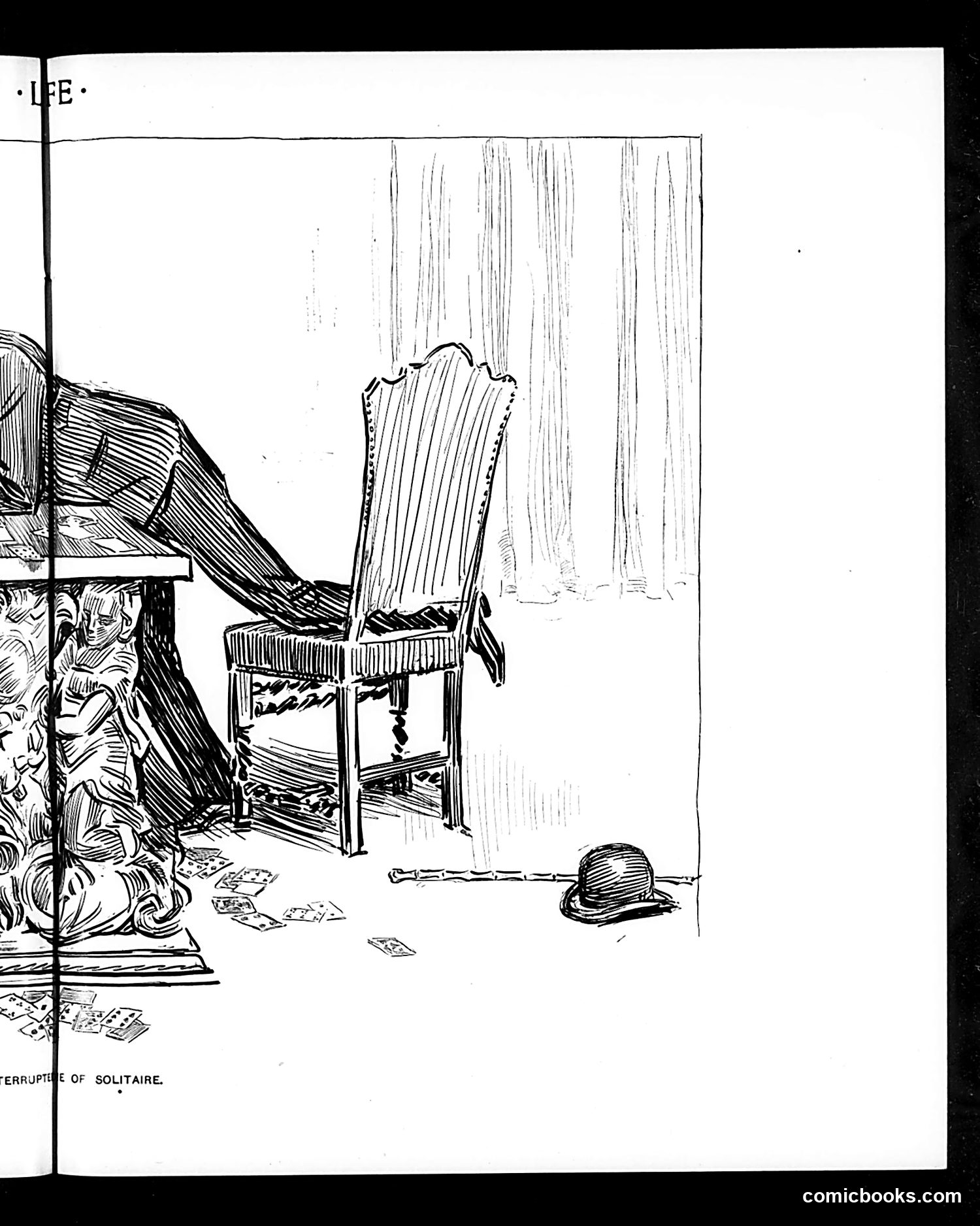
This ink sketch depicts a solitary figure playing cards at a chair, with scattered playing cards on the floor and a hat nearby. The composition suggests someone has been interrupted during a game of solitaire—a solitary pastime. Without additional context from the magazine issue, the specific satirical target is unclear. The title suggests commentary on disruption or intrusion into private leisure. Given Life magazine's focus on social satire, this likely mocks some contemporary figure or situation, but the image alone doesn't reveal who or what is being ridiculed. The careful crosshatching technique and compositional focus on abandoned cards and furniture conveys mood rather than explicit commentary.
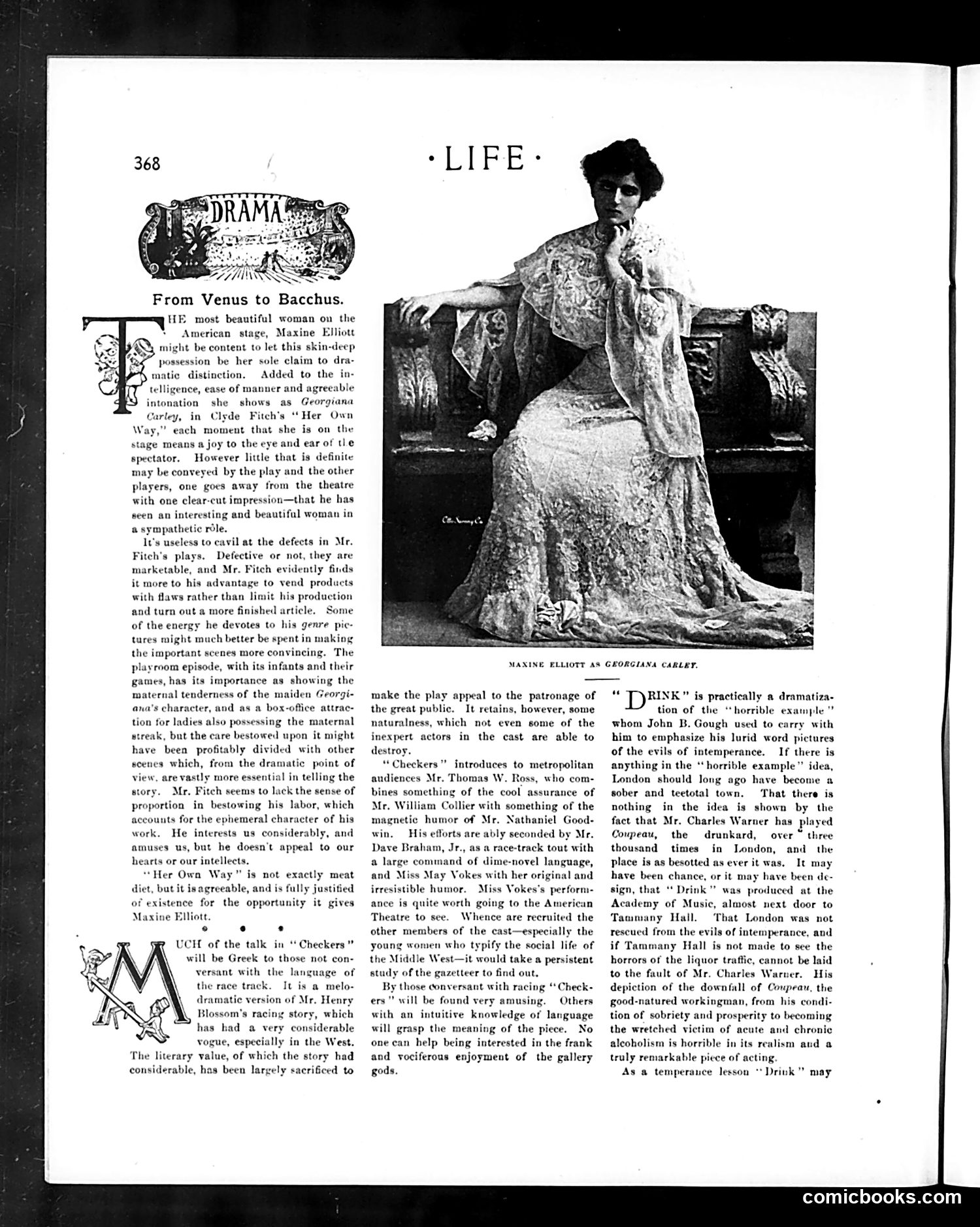
This page reviews three theatrical productions. The featured photograph shows **Maxine Elliott**, considered America's most beautiful actress, in Clyde Fitch's play "Her Own Way." The critic praises Elliott's intelligence and stage presence but criticizes Fitch for producing flawed, formulaic plays designed for commercial appeal rather than artistic merit. The review notes Fitch wastes effort on sentimental scenes (like a nursery sequence) that should serve the drama's core narrative. The page also discusses "Checkers," a melodrama based on racing-world subject matter, praising actor Thomas W. Ross and especially actress May Vokes, while acknowledging much of the dialogue relies on race-track jargon audiences won't understand. Finally, "Drink" is identified as a temperance morality play similar to John B. Gough's 19th-century anti-alcohol lectures, criticizing whether such "horrible examples" actually reform behavior.
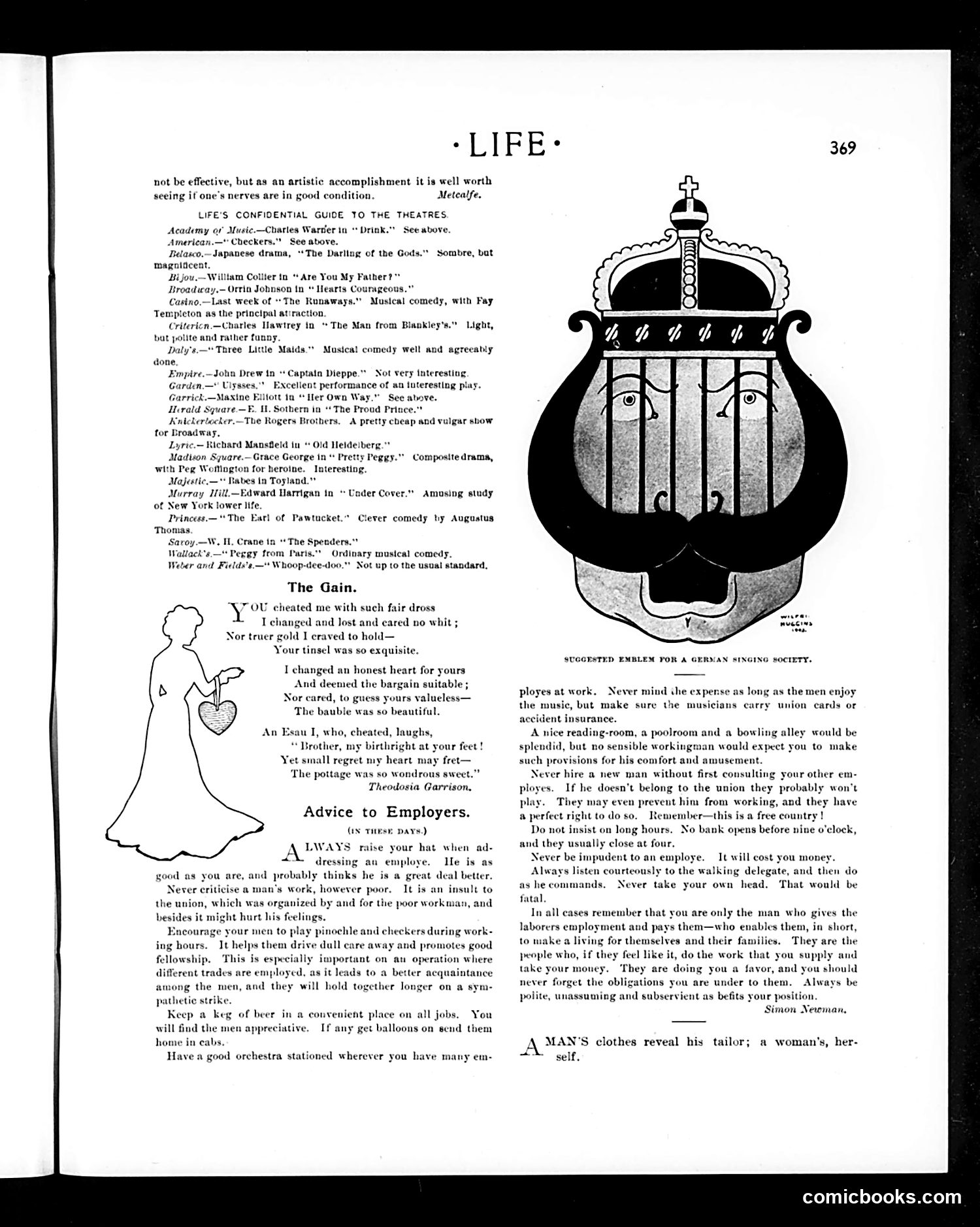
This page contains theatrical reviews and satirical advice to employers. The main satirical piece, "Advice to Employers," uses heavy irony to mock labor unions and their demands on business owners. The satire presents absurd "recommendations" that employers should: raise their hats to employees, never criticize work, encourage gambling during work hours, provide free beer, hire orchestras, and consult unions before hiring. Each suggestion is framed as obligatory deference to union power. The piece ridicules the growing labor movement's influence—particularly unions' ability to enforce closed shops, prevent non-union hiring, and organize strikes. The author sarcastically suggests workers now control employers, inverting the traditional hierarchy. The illustration (German singing society emblem) and accompanying poem "The Gain" appear unrelated to the labor satire. This reflects *Life*'s typical format mixing theatrical notices, poetry, and social commentary.
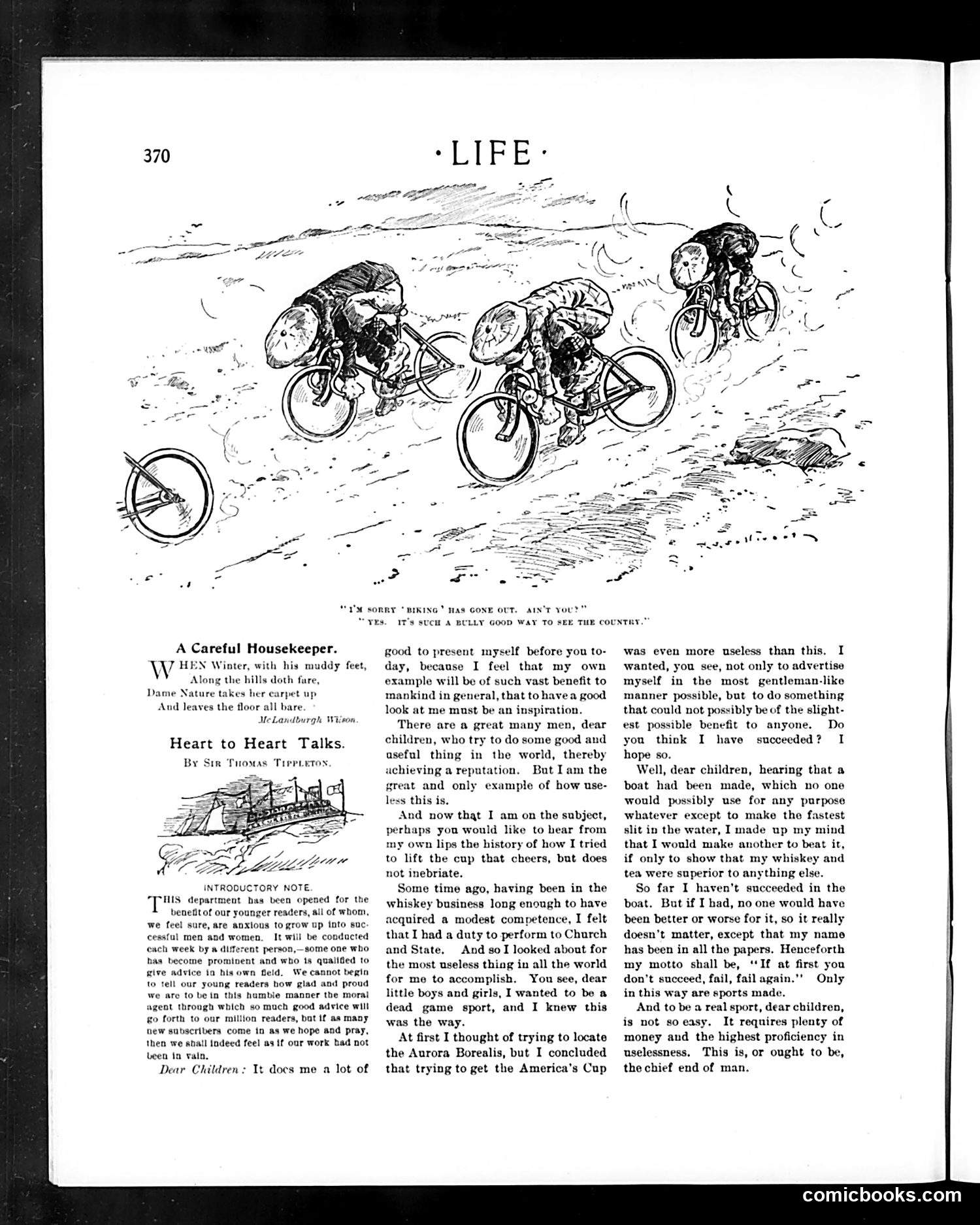
**The Cartoon:** The top illustration shows cyclists touring the countryside with camping gear, captioned with dialogue about "biking" being "gone out" but remaining "a bully good way to see the country." This appears to be gentle satire on the bicycle craze of the 1890s-1900s. **"Heart to Heart Talks":** Sir Thomas Tippleton's essay is savage self-parody. He boasts of his uselessness—having abandoned the whiskey business to pursue pointless endeavors like building a yacht to compete with another useless yacht, solely to advertise himself and get his name in papers. He explicitly celebrates accomplishing nothing of social benefit and frames this as moral instruction for children. The satire targets wealthy industrialists who pursue vanity projects while claiming gentlemanly virtue. Tippleton's motto—"If at first you don't succeed, fail, fail again"—inverts the inspirational cliché. His frank admission that his competitive boat-building has zero value except self-promotion mocks the era's wealthy sportsmen who disguised ego as achievement.
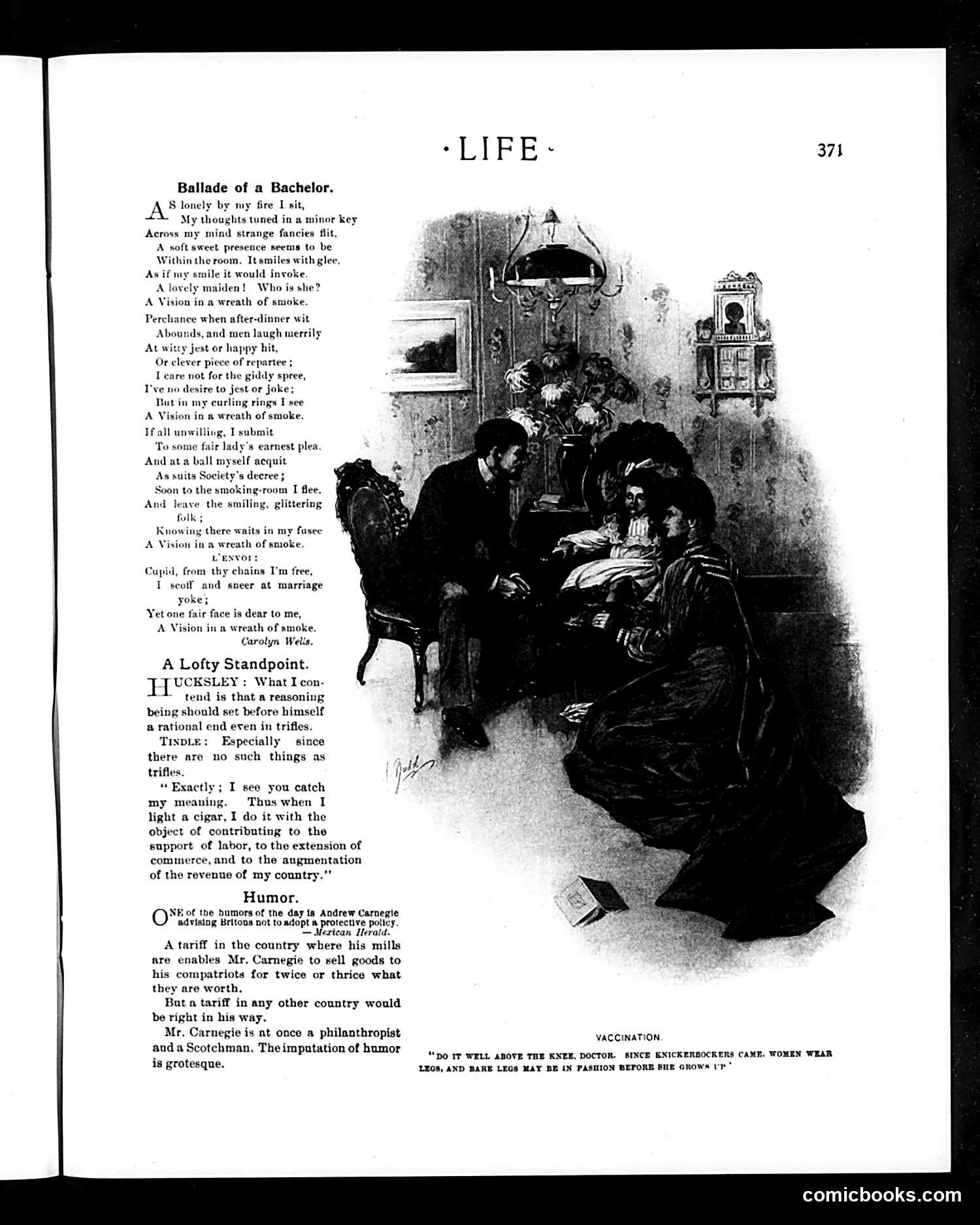
This page contains three separate pieces of satire: 1. **"Ballade of a Bachelor"** (poem by Carolyn Wells): A romantic poem about a solitary bachelor who fantasizes about an idealized woman while smoking cigars—his vision exists only "in a wreath of smoke." The humor lies in the gap between romantic longing and the bachelor's actual solitary reality. 2. **"A Lofty Standpoint"** (dialogue): Two characters debate rationality in trivial matters. One absurdly justifies lighting a cigar as contributing to "labor," "commerce," and "revenue"—mocking over-intellectualization of simple pleasures. 3. **"Humor" (brief editorial)**: Satirizes Andrew Carnegie's hypocrisy: he advocates *against* protective tariffs for Britain while his American mills benefit from *American* tariffs that inflate prices for consumers. The satire highlights the contradiction between his philanthropic reputation and self-interested business practices. 4. **"Vaccination"** (cartoon caption): A doctor is advised to vaccinate "above the knee" because women now wear knickerbockers (baggy pants), so bare legs may become fashionable—satirizing concern about preserving modesty.
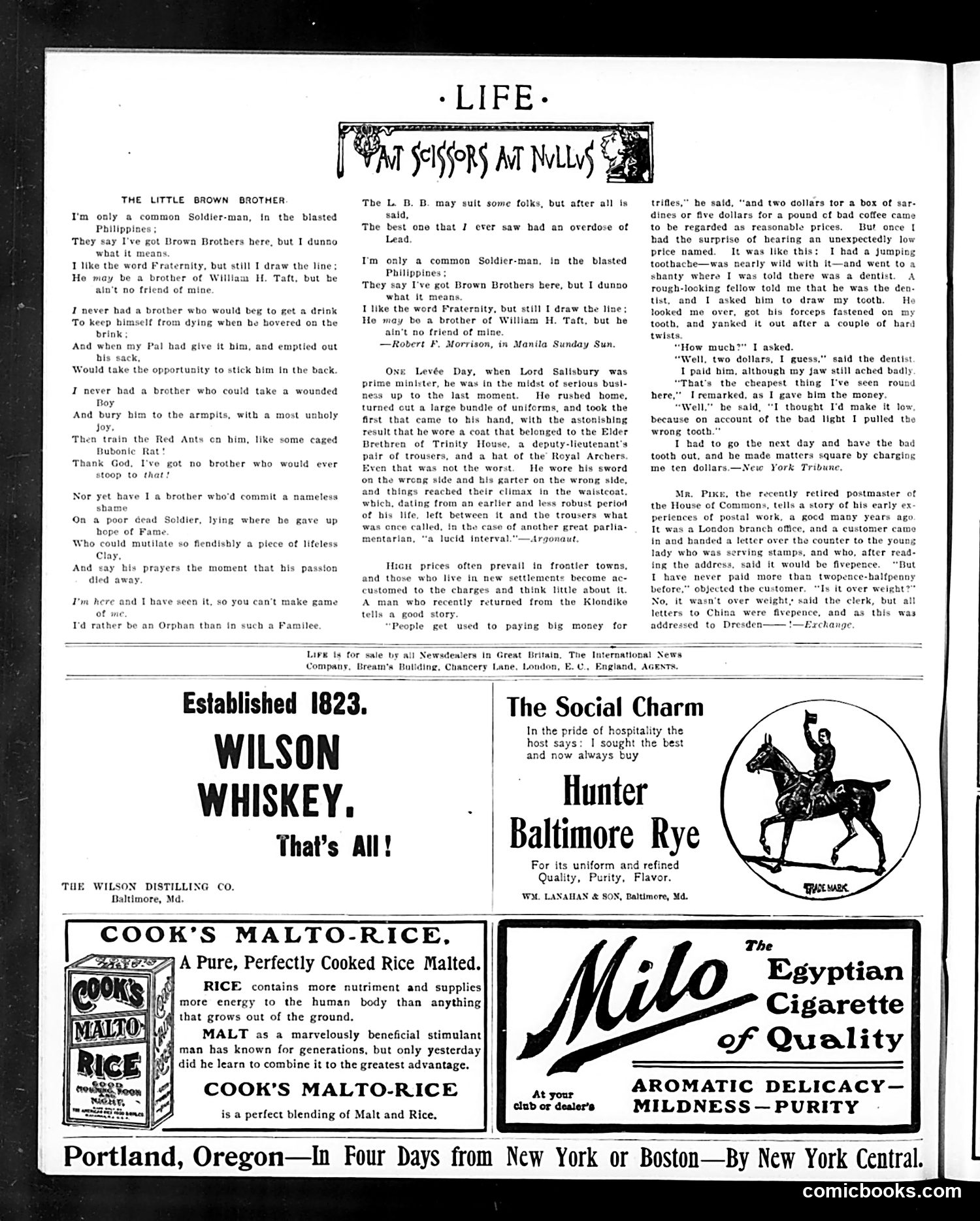
This page features a poem by Robert F. Morrison criticizing American military involvement in the Philippines. The "Little Brown Brother" refers to Filipinos, satirizing President William H. Taft's paternalistic justification for U.S. colonial occupation. The soldier-narrator rejects the fraternal language ("Brown Brothers"), describing Filipino fighters as treacherous and comparing them to disease vectors ("Bubonic Rat"). He expresses disgust at being expected to view violent colonial conflict through a lens of civilizing brotherhood. The satire targets Taft's imperial ideology—the notion that American occupation was benevolent "nation-building" rather than military conquest. The soldier's bitter firsthand account exposes this rhetoric as false, presenting the Philippines campaign as brutal, dehumanizing, and morally indefensible. The surrounding advertisements (Wilson Whiskey, Hunter Baltimore Rye, Cook's Malto-Rice, Milo Cigarettes) are incidental commercial content typical of Life magazine's format.
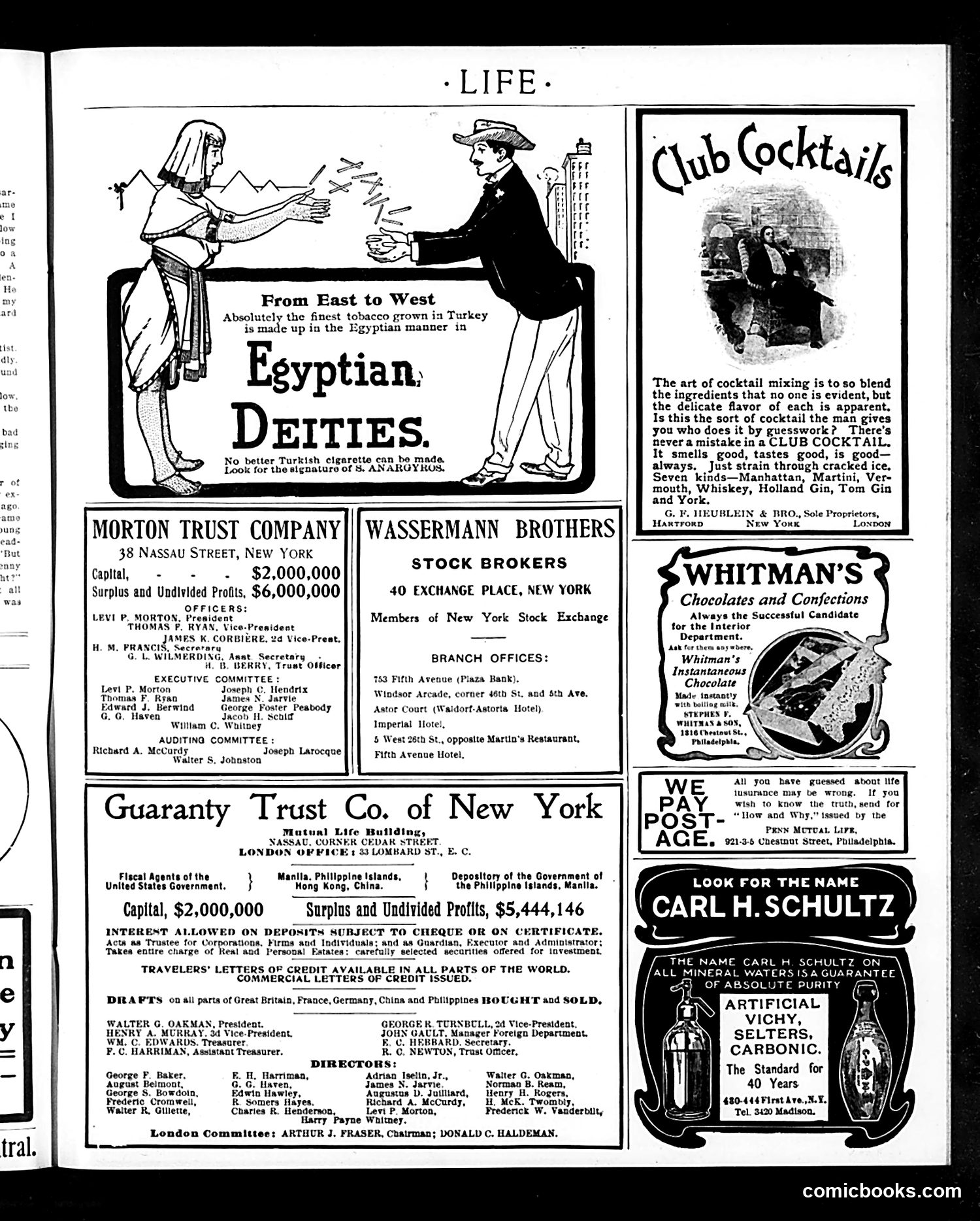
This page is primarily **advertising**, not satire or political commentary. However, the one cartoon present uses period stereotypes: **The Egyptian Deities Cigarette Ad** depicts a transaction between a Western businessman and an orientalized female figure in Egyptian dress. The "joke" relies on early 20th-century exoticism: Turkish tobacco processed in "Egyptian manner" is presented as exotic and desirable to Western consumers. The imagery trades on stereotyped representations of Middle Eastern/North African women and the romanticization of "Eastern" goods as luxurious imports. The remaining content consists of financial institution advertisements (Morton Trust Company, Guaranty Trust Co., Wassermann Brothers), food/beverage ads (Club Cocktails, Whitman's Chocolates, Carl H. Schultz mineral waters), and insurance advertising. These reflect contemporary business culture and consumer products aimed at wealthy readers. The page shows how *Life* supplemented satirical content with substantial advertising revenue—typical for American magazines of this era.
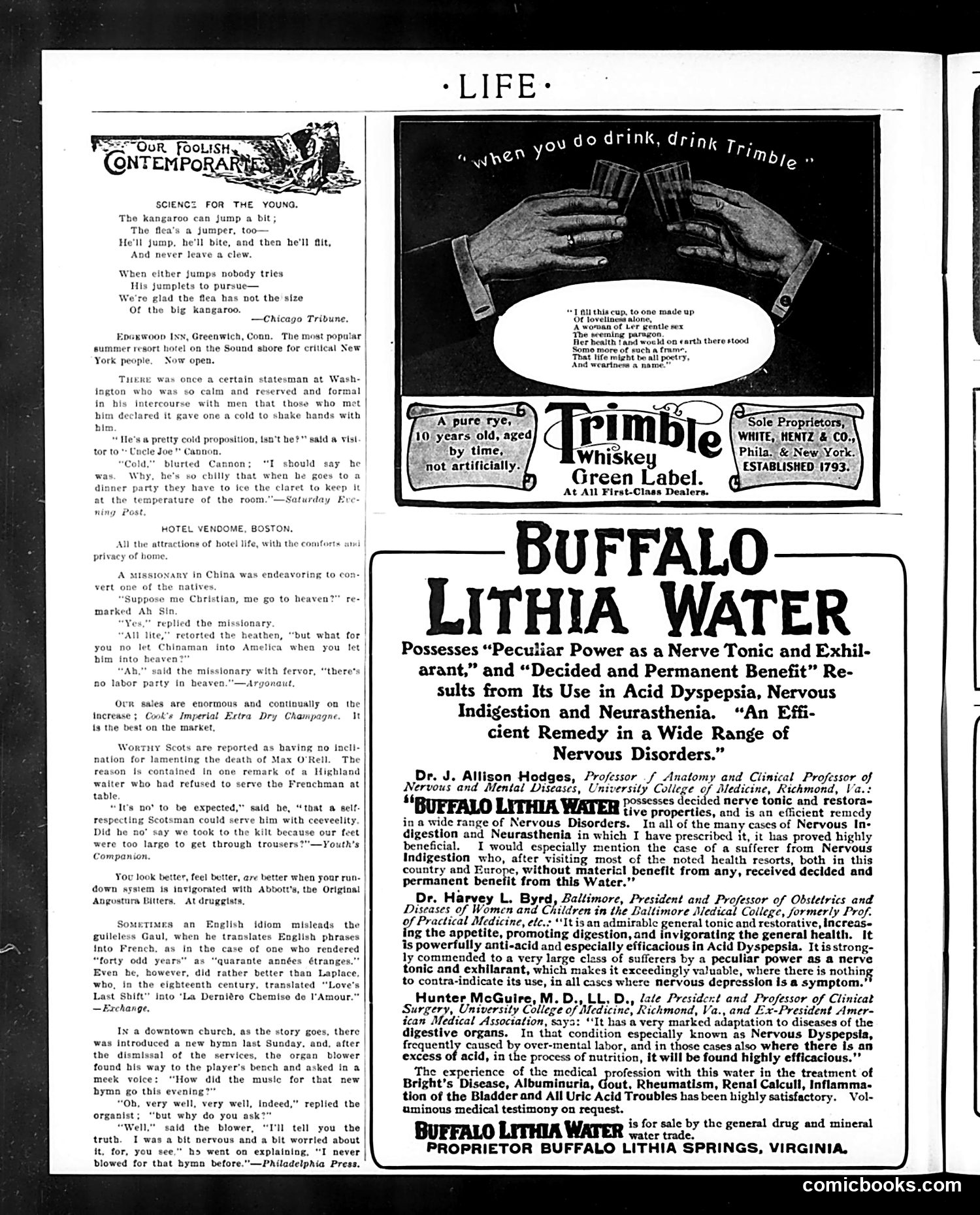
This page contains satirical anecdotes and period advertisements typical of early 1900s Life magazine. The humor pieces mock various subjects: **"Our Foolish Contemporaries"** section includes jokes about: - A statesman (likely Speaker Joe Cannon, mentioned by name) known for being so cold and aloof that shaking his hand feels frigid - A missionary in China debating whether Chinese people can enter heaven - Scots' reaction to a Frenchman's (Max O'Rell's) insulting comments about kilts - Translation mishaps between English and French The page is dominated by **product advertisements**: Trimble Whiskey (prominently featured with hands toasting), Buffalo Lithia Water (marketed as a nerve tonic for dyspepsia and neurasthenia), and various hotels and patent medicines. These ads reflect period obsessions with digestive ailments and "nervous disorders" treated with mineral waters and alcohol. The content reflects turn-of-century American satire targeting political figures, ethnic stereotypes, and language confusion—humor conventions that are now largely dated or offensive.
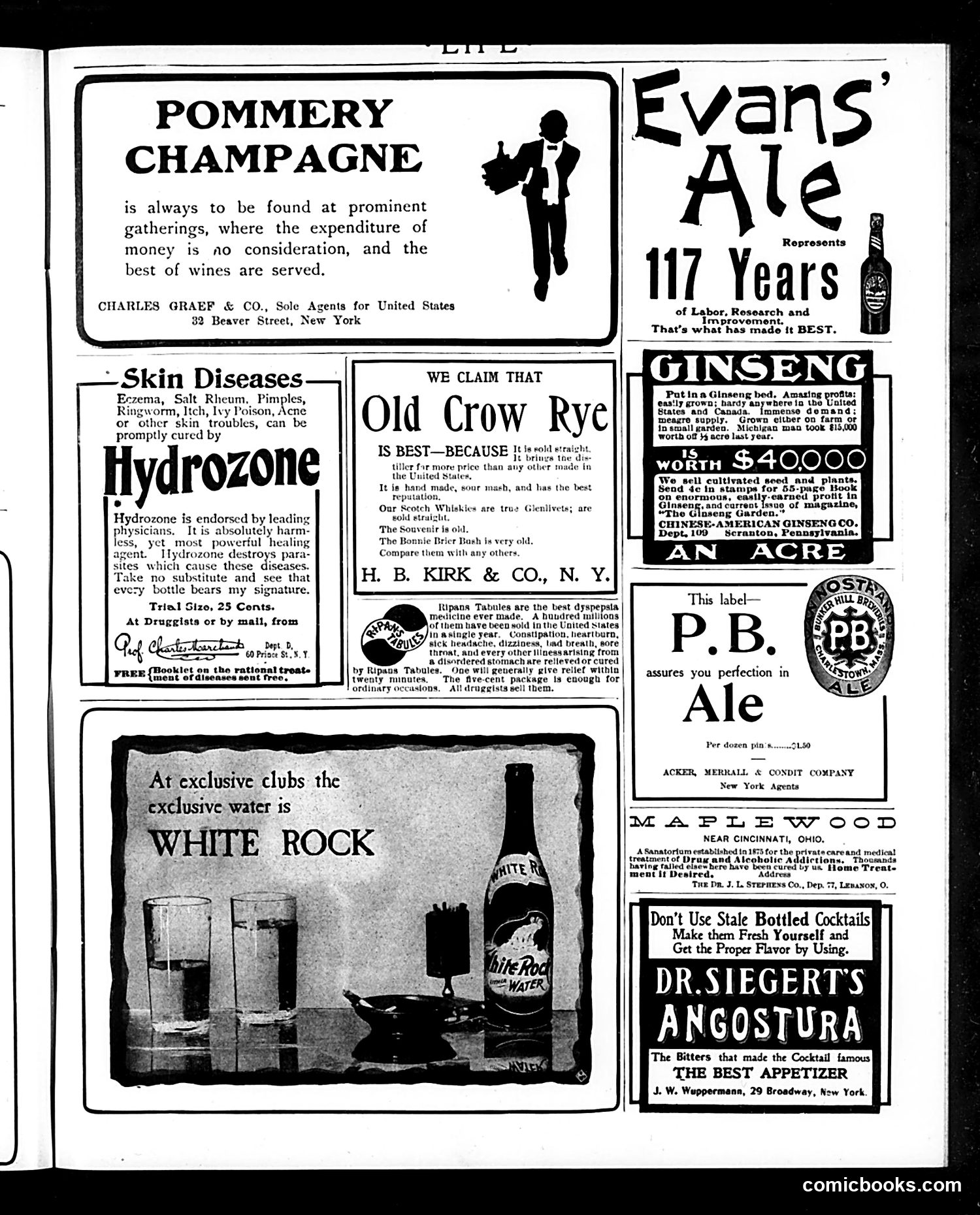
This page is **entirely advertisements**, not satirical content. It's a collection of period product promotions typical of early 20th-century American magazines. **Key advertised products include:** - **Pommery Champagne** — luxury wine for wealthy gatherings - **Old Crow Rye whiskey** — positioned as superior quality - **Hydrozone** — a patent medicine claiming to cure skin diseases (eczema, ringworm, etc.) - **Ginseng** — marketed as a health supplement with inflated value claims ($40,000) - **Ripans Tabules** — digestive remedy claiming to treat constipation and headaches - **White Rock water** — exclusive bottled water - **Evans' Ale** — beer emphasizing 117 years of production - **Dr. Siegert's Angostura bitters** — cocktail ingredient **Historical context**: These ads reflect the pre-FDA era when patent medicines made unregulated health claims, alcohol was freely advertised, and luxury products marketed to the wealthy. The repetitive claims of miraculous cures are now recognizable as fraudulent marketing.
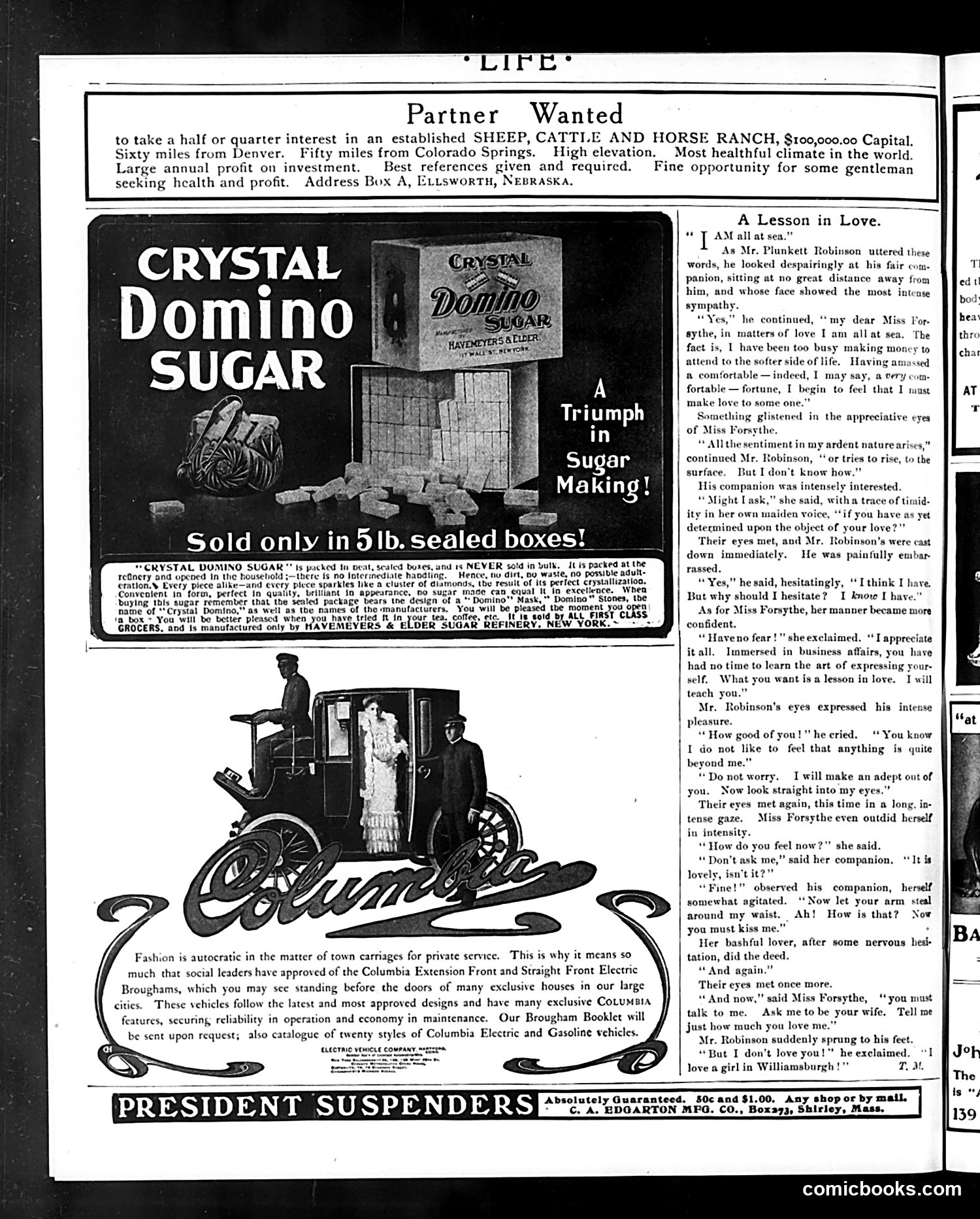
This page contains **advertisements and a serialized romantic story**, not political satire. The ads promote: - A ranch partnership opportunity in Nebraska - Crystal Domino Sugar (emphasizing purity and quality packaging) - Columbia Electric Broughams (luxury carriages for wealthy households) - President Suspenders The story "A Lesson in Love" depicts a wealthy businessman, Mr. Plunkett Robinson, who admits his single-minded focus on making money has left him emotionally inexperienced. He seeks romantic guidance from Miss Forsythe, a woman who offers to teach him "the art of expressing yourself" through intimate eye contact and physical closeness. The humor appears gentle and romantic rather than satirical—playing on the businessman's awkwardness and the woman's willingness to guide him toward an intimate moment. This reflects early 20th-century magazine storytelling conventions mixing courtship with mild innuendo acceptable for the era.
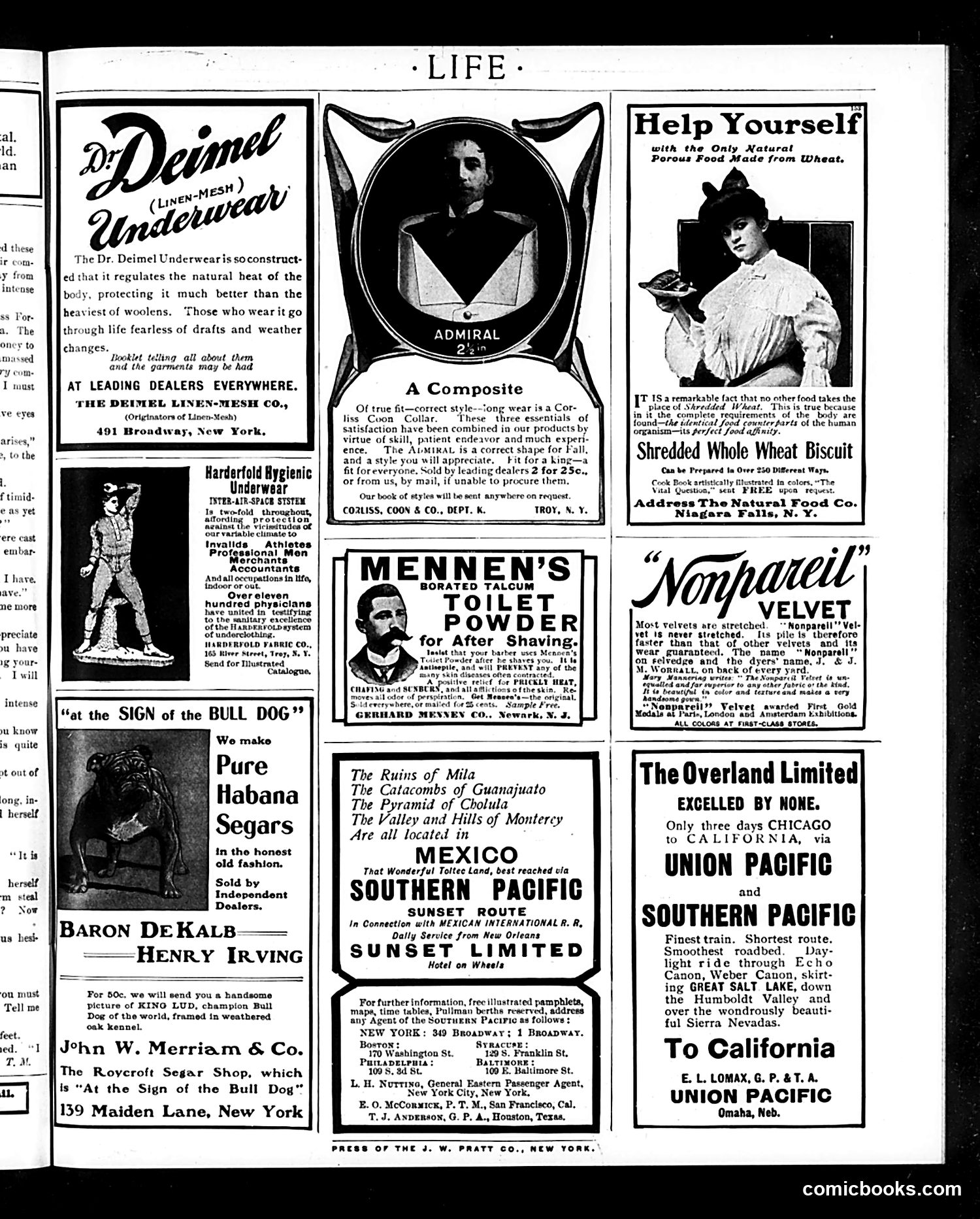
This is primarily a **advertisements page** from an early 1900s Life magazine, not a political cartoon. The content reflects period consumer goods and travel marketing. Key advertisements include: - **Dr. Deimel Underwear**: thermal regulation clothing marketed as superior to wool - **Mennen's Borated Talcum Powder**: men's aftershave product - **Corliss Coon Collars**: detachable shirt collars (a common grooming product then) - **Nonpareil Velvet fabric**: marketed as superior because unstretched - **Shredded Wheat Biscuit**: whole grain food product - **Baron de Kalb cigars**: "pure Habana" tobacco - **Southern Pacific Railway**: Mexico travel via the "Sunset Limited" train - **Union Pacific Railway**: Chicago-to-California service The page demonstrates early 20th-century advertising emphasizing **durability, scientific superiority, and status**. References to physicians endorsing products and claims of "natural" or "pure" ingredients reflect period marketing strategies. No political satire is evident.
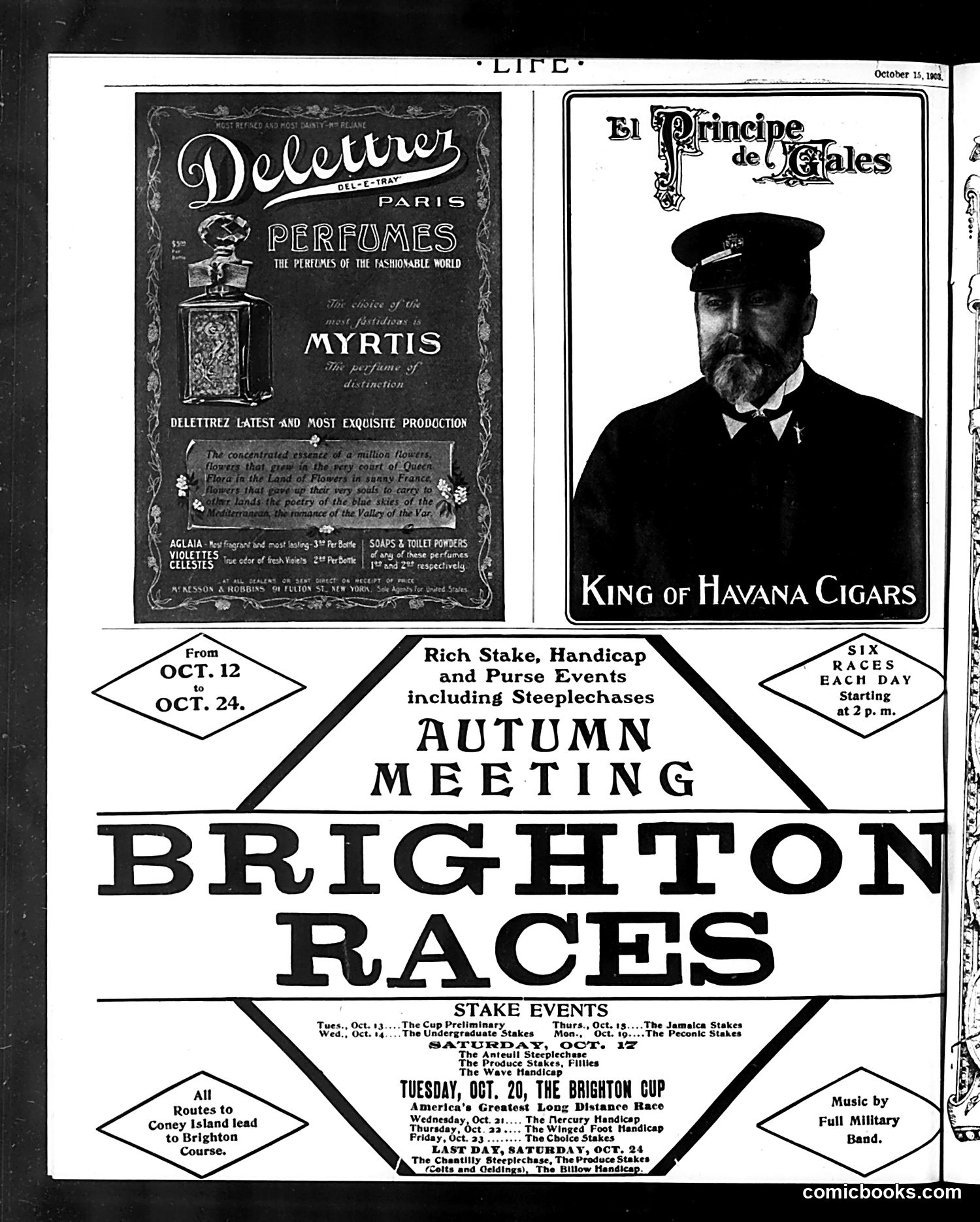
This is primarily an **advertising page**, not a satirical cartoon. The content includes: **Top left:** A Delettrez Paris perfume advertisement featuring the "Myrtis" fragrance, marketed as "the perfume of distinction" for fashionable society. **Top right:** An advertisement for "El Príncipe de Gales" (The Prince of Wales) brand Havana cigars, featuring a bearded man in formal attire with a captain's hat. **Main content:** A large advertisement for the **Brighton Races** autumn horse-racing meeting (October 12-24, 1903), listing stake events, steeplechases, and the prominent "Brighton Cup" race on October 20. Notes indicate "Six races each day" and music by a "Full Military Band." The page reflects early 1900s luxury consumer culture—perfume, cigars, and horse racing were entertainment and status symbols for wealthy readers. There is no evident political satire; this is straightforward period advertising.