
Life, 1903-10-15 · page 14 of 24
Life — October 15, 1903 — page 14: what you’re looking at
What you’re looking at
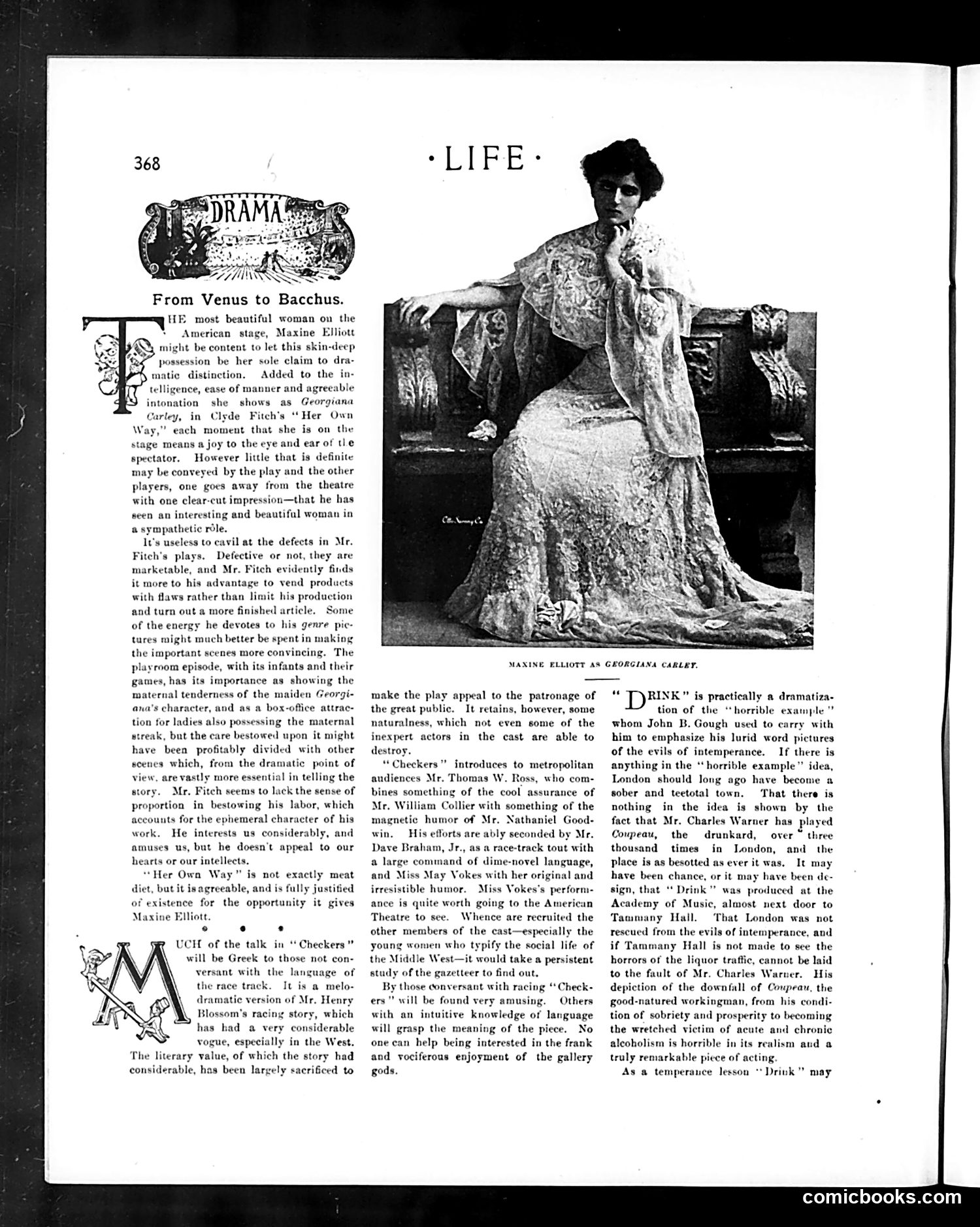
This page reviews three theatrical productions. The featured photograph shows **Maxine Elliott**, considered America's most beautiful actress, in Clyde Fitch's play "Her Own Way." The critic praises Elliott's intelligence and stage presence but criticizes Fitch for producing flawed, formulaic plays designed for commercial appeal rather than artistic merit. The review notes Fitch wastes effort on sentimental scenes (like a nursery sequence) that should serve the drama's core narrative. The page also discusses "Checkers," a melodrama based on racing-world subject matter, praising actor Thomas W. Ross and especially actress May Vokes, while acknowledging much of the dialogue relies on race-track jargon audiences won't understand. Finally, "Drink" is identified as a temperance morality play similar to John B. Gough's 19th-century anti-alcohol lectures, criticizing whether such "horrible examples" actually reform behavior.
📄 Transcribed text from this page (OCR, searchable)
Machine-transcribed from the original scan — historical spelling and the odd misread are preserved.
From Venus to Bacchus. HE most beautiful woman on the American stage, Maxine Elliott might be content to let this skin-deep possession be her sole claim to dra- distinction. Added to the in- telligence, ease of manner and agrecable intonation she as Georgiana Carley, in Clyde Fitch's “Her Own Way,” each moment that she is on the stage means a joy to the eye and ear of tle spectator. However little that is definite may be conveyed by the play and the other players, one goes away from the theatre with one clear-cut impression—that he has seen an interesting and beautiful woman in matic shows a sympathetic role. It’s useless to cavil at the defects in Mr. Fiteh's plays, Defective or not, they are marketable, and Mr. Fitch evidently finds it more to his advantage to vend products with flaws rather than limit his production and turn out a more finished article. Some of the energy he devotes to his genre pic- tures might much better be spent in making the important scenes more convincing. The playroom episode, with its infants and their games, has its importance as showing the ernal tenderness of the maiden Georgi- cter, and as a box-office attrac- tion for ladies also possessing the maternal , but the care bestowed upon it might been profitably divided with other scenes which, from the dramatic point of view, are vastly more essential in telling the story. Mr. Fitch seems to lack the sense of proportion in bestowing his labor, which accounts for the ephemeral character of his work. He interests us considerably, and amuses us, but he doesn’t appeal to our hearts or our intellects, “Her Owa W: is not exactly meat but it isagreeable, and is fully justified existence for the opportunity it gives Maxine Elliott. ° . ° UCH of the talk in “Checkers” will be Greek to those not con- versant with the la: of the race track. It is a melo- dramatic version of Mr. Henry Blossom’s racing story, which has had a ve vogue, especially in the West. The literary value, of which the story had considerable, has been largely sacrificed to considerable MANINE ELLIOTT AS GEORGIANA CaRLEY, make the play appeal to the patronage of the great public. It retains, however, some naturalness, which not even some of the inexpert actors in the cast are able to destroy. “Checkers” introduces to metropolitan audiences Mr. Thomas W. Ross, who com- bines something of the cool assurance of. Mr, William Collier with something of the magnetic humor of Mr. Nathaniel Good- win. ably seconded by Mr. Dave Braham, Jr., as a race-track tout with a large command of dime-novel language, and Miss May Vokes with her original and irresistible humor. Miss Vokes's perform- ance is quite worth going to the American Theatre to see. Whence are recruited the other members of the cast—especially the young women who typify the social life of the Middle West—it would take a persistent study of the gazetteer to find out, By those conversant with racing “ Check- ers" will be found very amusing. Others with an intuitive knowledge of language will grasp the meaning of the piece. No one can help being interested in the frank and vociferous enjoyment of the gallery gods. His efforts are “ T)RINK” is practically « dramatiza- tion of the “horrible e: ’ whom John B. Gough used to carry with him to emphasize his lurid word pictures of the evils of intemperance. If there is anything in the “horrible example” idea, London should Jong ago have become a sober and teetotal town. That there is nothing in the idea is shown by the fact that Mr. Charles Warner has played Coupeau, the drunkard, over “ three thousand times in London, and the place is as besotted as ever it was. It may have been chance, or it may have been de- sign, that “ Drink’ was produced at the Academy of Music, almost next door to Tammany Hall. That London was not rescued from the evils of intemperance, and if Tammany Hall is not made to see the horrors of the liquor traffic, cannot be laid to the fault of Mr. Charles Warner. His depiction of the downfall of Coupeau, the good-natured workingman, from his condi- tion of sobriety and prosperity to becoming the wretched victim of acute and chronic alcoholism is horrible in its realism and a truly remarkable piece of acting. As a temperance lesson“ Drivk may comicbooks.com