
Life, 1903-10-15 · page 15 of 24
Life — October 15, 1903 — page 15: what you’re looking at
What you’re looking at
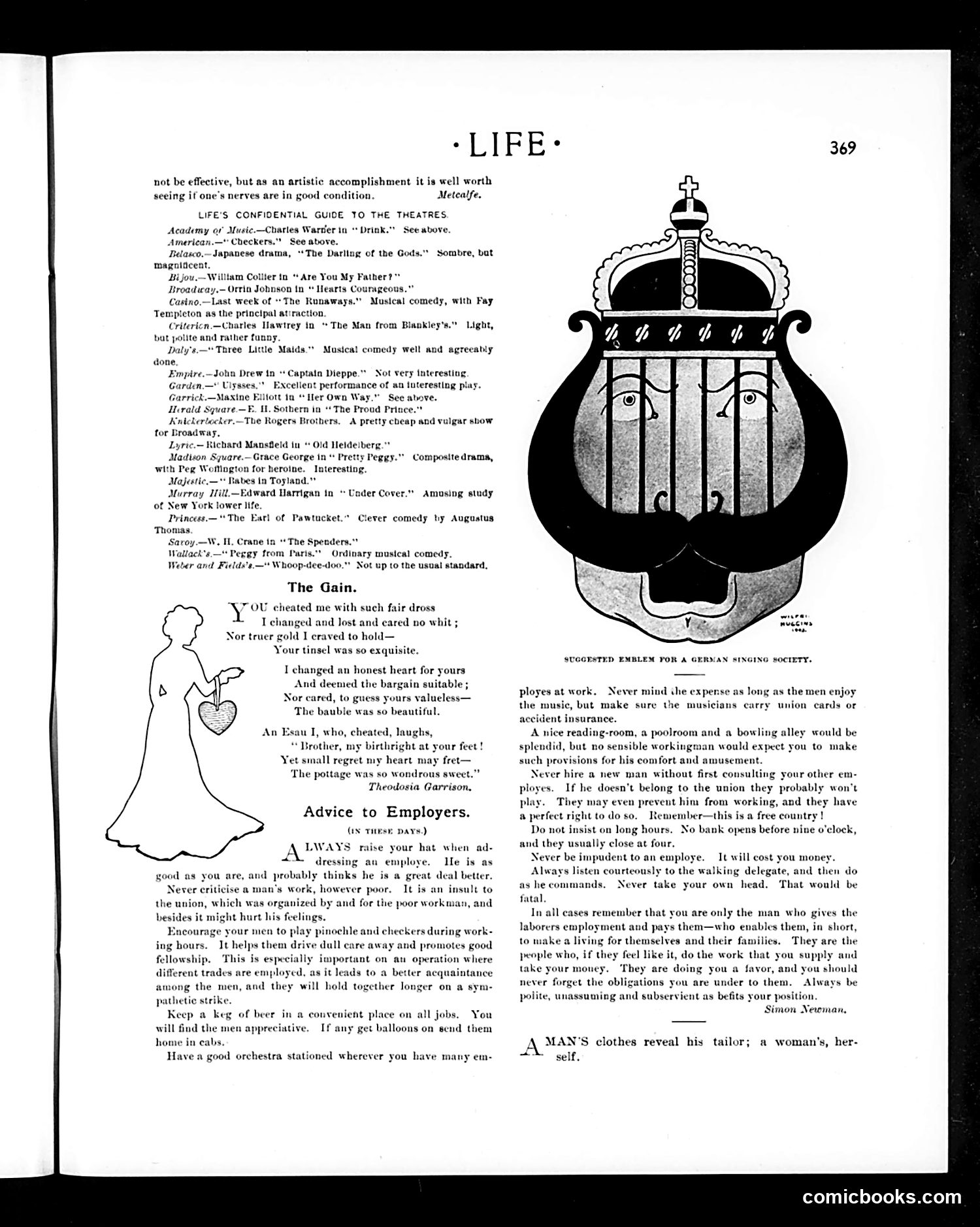
This page contains theatrical reviews and satirical advice to employers. The main satirical piece, "Advice to Employers," uses heavy irony to mock labor unions and their demands on business owners. The satire presents absurd "recommendations" that employers should: raise their hats to employees, never criticize work, encourage gambling during work hours, provide free beer, hire orchestras, and consult unions before hiring. Each suggestion is framed as obligatory deference to union power. The piece ridicules the growing labor movement's influence—particularly unions' ability to enforce closed shops, prevent non-union hiring, and organize strikes. The author sarcastically suggests workers now control employers, inverting the traditional hierarchy. The illustration (German singing society emblem) and accompanying poem "The Gain" appear unrelated to the labor satire. This reflects *Life*'s typical format mixing theatrical notices, poetry, and social commentary.
📄 Transcribed text from this page (OCR, searchable)
Machine-transcribed from the original scan — historical spelling and the odd misread are preserved.
“LIFE not be effective, but as an artistic accomplishment it is well worth seeing if one’s nerves are in good condition. Metcalfe. LIFE'S CONFIDENTIAL GUIDE TO THE THEATRES. Academy or Music.—Charles Wartier in “Drink.” See above. American.—" Checkers." See above. Belasco. Japanese drama, “The Darling of the God: Magnificent. Bijou.—Willtam Coliter tn * Are You My Father?" Broadway.— Orrin Jobnson tn “ Hearts Courtgeous.” Casino.—Last week of “The Runaways.” Musical comedy, with Fay Templeton as the principal atiraction. Critericn.—Charles Hawtrey in * The Man from Blankley's.” Light, bat polite and rather funny. Daty's.—" Three Little Maids." Musical comedy well and agreeably done. Empire.—Joun Drew in “ Captata Dieppe.” Not very interesting Garden. — Uisases,” Excellent performance of an tateresting pias, Garrick.—Maxine Flltott 1a“ Her Own Way.” See above. Herald Square —F. I. Sothern in “The Proud Prince." Knicherlocker.—The Rogers Brothers. A pretty cheap and vulgar show tor Broadway, Lyric.— Richard Mansfield iu “ Old Heidelberg.” Madison Square.— Grace George in“ Pretty Peggy." Composite drama, with Peg Wofington for heroine. Interesting. Majestic. —** Babes tn Toyland."* Murray Hil,—Eaward Harrigan in “Under Cover.” Amusing study of New York lower life. Princess.— "The Earl of Pawtucket.” Clever comedy ty Augustus ‘Thomas. Saroy.—W. I. Crane in “The Spenders.” Wallack"s.—" Peggy from Paris." Ordinary musical comedy. Weter and Fields’e.—* Whoop-dee-doo.”” Not up to the usual standard, Sombre, bat The Gain. Y OU cheated me with such fair dross T changed and lost and eared no whit ; Nor truer gold I craved to hold— Your tinsel was so exquisite. I changed an honest heart for yours And deemed the bargain suitable; Nor , to guess yours valueless— The bauble was so beautiful. An Esau I, who, cheated, laughs, “Brother, my birthright at your fe Yet sinall regret my heart may fret— The pottage was so wondrous sweet. Theodosia Garrison, Advice to Employers. (Gs Titesy: Days.) LWAYS raise your hat when ad- dressing an employe. He is as good as you are, and probably thinks he is a great deal better. Never criticise a man’s work, however poor. It is an insult to the union, which was organized by and for the poor workman, and besides it might hurt his feelings. Encourage your men to play pinochle and checkers during work- ing hours. It helps them drive dull care away and promotes good fellowship. This is especially important on au operation where different trades are employed, as it leads to a better acquaintance among the men, and they will hold together longer on a sym- pathetic strike. Keep a keg of beer in a convenient place on all jobs. You will find the men appreciative. If any get balloons on send them home in eabs. Have a good orchestra stationed wherever you have many em- PSTED EMBLEM YOR A GERMAN SINGING SOCIETY. ployes at work, Never mind che expense as long as the men enjoy the music, but make sure the musicians carry union cards or accident insurance. A nice reading-room, a poolroom and a bowling alley would be splendid, but no sensible workingman would expect you to make such provisions for his comfort and amusement. Never hire a new man without first consulting your other em- ployes. If he doesn’t belong to the union they probably won't play. They may even prevent him from working, and they have a perfect right to do so, Remember—this is a free country ! Do not insist on long hours. No bank opens before nine o'clock, and they usually close at four, Never be impudent to an emplo It will cost you money. Always listen courteously to the walking del and then do as he commands. Never take your own head. That would be fatal. In all cases remember that you are only the man who gives the laborers employment and pays them—who enables them, in short, to make a living for themselves and their families. They are the people who, if they feel like it, do the work that you supply and take your money, They are doing you a favor, and you should never forget the obligations y polite, unassuming and subservien > are under to then befits your position. Simon Newman, Always be MAN'S clothes reveal his tailor; a woman's, her- self. comicbooks.com