
Life, 1903-10-15 · page 10 of 24
Life — October 15, 1903 — page 10: what you’re looking at
What you’re looking at
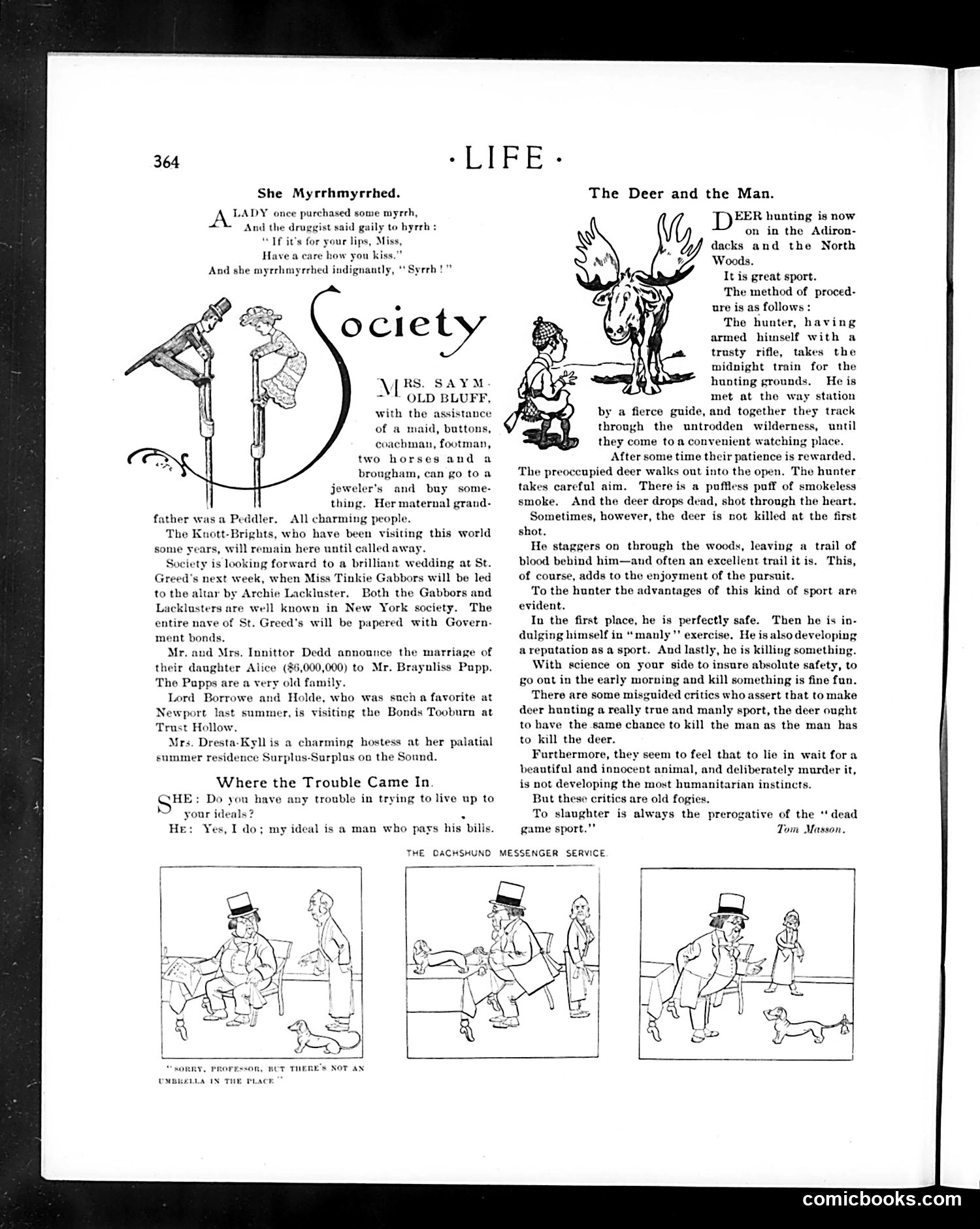
This three-panel comic satirizes a man's excuse for financial troubles. The sequence shows a well-dressed gentleman explaining to a woman that his ideal man "pays his bills," but he himself apparently does not. The joke's title references a "dachshund messenger service"—in the final panel, a small dog carries what appears to be a bill or debt notice. The humor derives from the man's hypocrisy: he advocates for financial responsibility while using a pet as a comedic device to avoid or deliver unwelcome debts. The cartoon satirizes middle-class attitudes about money and masculinity in the early 20th century, mocking men who speak of virtue while failing to practice it themselves. The dachshund functions as both literal messenger and visual punchline.
📄 Transcribed text from this page (OCR, searchable)
Machine-transcribed from the original scan — historical spelling and the odd misread are preserved.
She Myrrhmyrrhed. A LADY once purchased some myrrh, And the druggist said gaily to hyrrh : NI RS. SAYM - OLD BLUFF, with the assistance of a maid, buttons, coachman, footman, two horses and a brougham, can go to a jeweler’s and buy some- thing. Her maternal grand- father was a Peddler, All charming people. The Knott-Brights, who have been visiting this world some years, will remain here until called away. sciety is looking forward to a brilliant wedding at St. Greed’s next week, when Miss Tinkie Gabbors will be led to the altar by Archie Lackluster. Both the Gabbors and Lacklusters are well known in New York society. The entire nave of St. Greed’s will be papered with Govern. ment bonds. Mr. and Mrs. Innittor Dedd announce the marriage of their daughter Alice (36,000,000) to Mr. Braynliss Pupp. Tho Papps are a very old family Lord Borrowe and Holde, who was snch a favorite at Newport last summer, is visiting the Bonds Tooburn at Trust Hollow. Mrs. Dresta-K: ming hostess at her palatial summer residence Surplus-Surplus oo the Sound. Where the Trouble Came In GHE: Do you have any trouble in trying to live up to your ide: . Yes, I do; my ideal is a man who pays his bilis. lis ac Deer and the Man. DR hunting is now on in the Adiron- dacks and the North Woods. It is great sport. The method of proced- ure is as follows : The hunter, having armed himself with a trusty rifle, takes the midnight train for the hunting grounds. He is met at the way station by a fierce guide, and together they track through the untrodden wilderness, until they come toa convenient watching place. After some time their patience is rewarded. ‘The preoccupied deer walks out into the open. The hunter takes careful aim. There is a puffless puff of smokeless smoke. And the deer drops dead, shot through the heart. Sometimes, however, the deer is not killed at the first shot. He staggers on through the woods, leaving a trail of blood behind him—and often an excellent trail it is. This, of course, adds to the enjoyment of the pursuit. To the hunter the advantages of this kind of sport are evident. In the first place, he is perfectly safe. Then he is in- dulging himself in “ manly" exerc He is also developing areputation as a sport. And lastly, he is killing something. With science on your side to insure absolute safety, to go ont in the early morning and kill something is fine fun. There are some misguided critics who assert that tomake deer hunting a really true and manly sport, the deer ought to have the same chance to kill the man as the man has to kill the deer. Furthermore, they seem to feel that to lie in wait for a beautiful and innocent animal, and deliberately murder it, is not developing the most humanitarian instincts. But these critics are old fogies. To slaughter is always the prerogative of the ‘‘ dead game sport.”” Tom Masson. THE OACHSHUND MESSENGER SERVICE comicbooks.com