
Life, 1903-10-15 · page 6 of 24
Life — October 15, 1903 — page 6: what you’re looking at
What you’re looking at
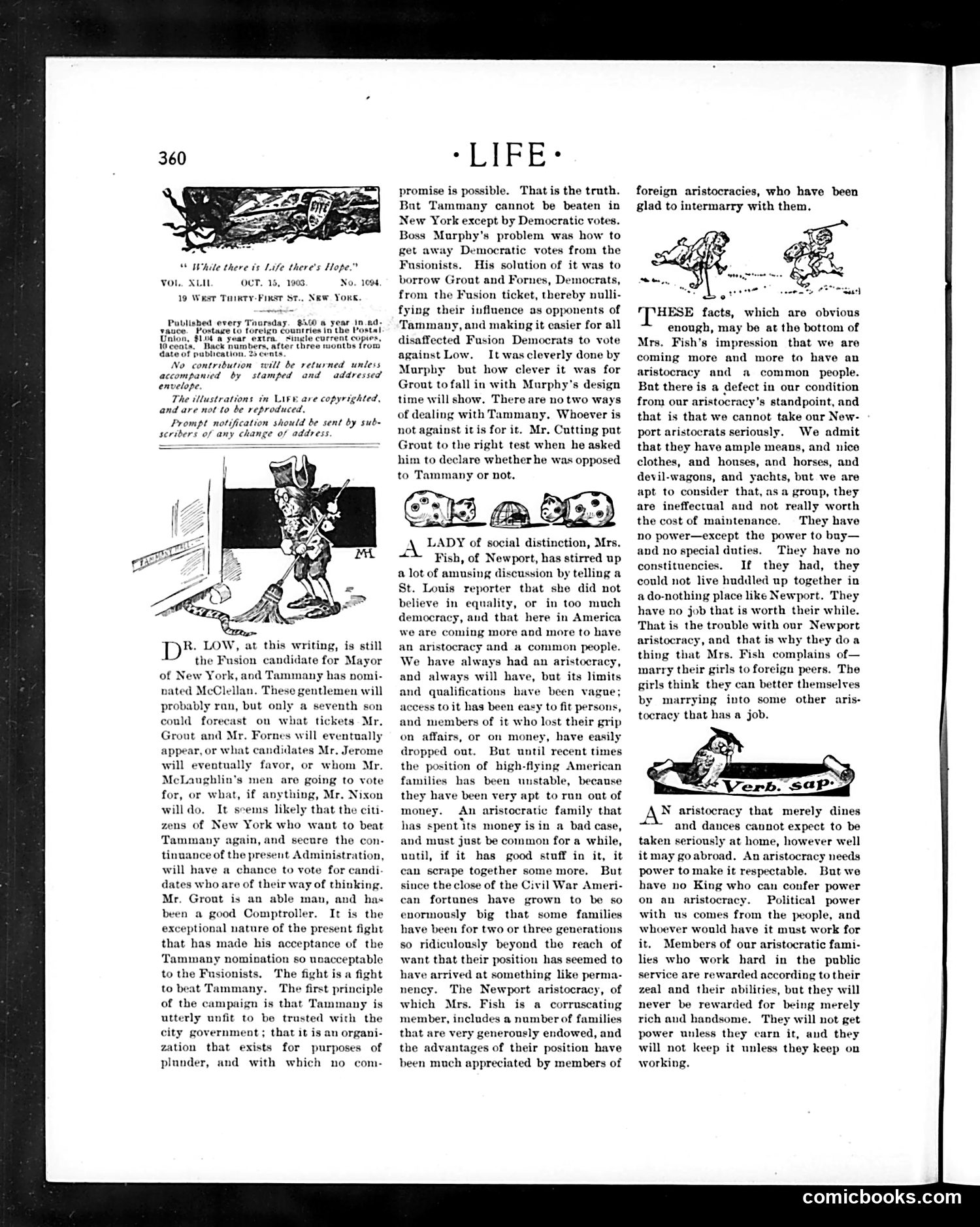
This October 1903 *Life* magazine page satirizes New York City politics, specifically Boss Murphy's control of Democratic voters and the Tammany Hall machine. The text discusses how Murphy manipulated Fusion Democrats to oppose Judge Tammany while maintaining Tammany's political power. The cartoons mock Mrs. Fish, a Newport society woman, for claiming America lacks aristocracy while maintaining aristocratic pretensions. The satire suggests that wealthy New Yorkers like the Fishes perpetuate class hierarchies through inherited privilege, contradicting democratic ideals. The underlying critique: New York's political establishment—both Tammany bosses and wealthy elites—operates as an undemocratic oligarchy despite America's egalitarian promises. The magazine attacks both corrupt political machines and the privileged classes that support them.
📄 Transcribed text from this page (OCR, searchable)
Machine-transcribed from the original scan — historical spelling and the odd misread are preserved.
“ While there is Life there's Hope.” vol. XL oct. No. 1094 19 West Taiety-Finst St. New Yore. plished every Tharsday. 800 @ year 1 Postawe (0 foreign countries in the I $100 a year extra, single current cu Back numbers, after three months abheation. 25 cents. No contribution will be returned unless accompanied by stamped and addressed envelope. The illustrations in Lite are copyrighted, and are not to be reproduced. Prompt notification should be sent by sub scribers of any change of address I at this writing, is still the Fusion candidate for Mayor of New York, and Tammany has nomi- nated McClellan. These gentlemen will bly ran, but only a seventh son could forecast on what tickets Mr, Grout and Mr. Fornes will eventually appear, or what candidates Mr. Jerome will eventually favor, or whom Mr. McLaughlin's men going to vote for, or what, if anything, Mr. Nixon will do, It seems likely that the citi- zens of New York who want to beat Tammany again, and secure the con- tinuance of the present Administration, will have a chance to vote for candi dates who are of their way of thinking. Mr. Grout is an able man, and has been a good Comptroller. It is the exceptional nature of the present fight that has made his acceptance of the Tammany nomination so unacceptable to the Fusionists. The fight isa fight to beat Tammany. The first principle of the campaign is that Tammany is utterly unfit to be trusted with the city government; that it is an organi- zation that exists for purposes of plunder, and with which no com- - LIFE: promise is possible. That is the truth. But Tammany cannot be beaten in New York except by Democratic votes. Boss Murphy's problem was how to get aw Democratic votes from the Fasionists. His solution of it was to borrow Gront and Fornes, Deme from the Fusion ticket, thereb; fying their influence as opponents of Tammany, and making it easier for all disaffected Fusion Democrats to vote against Low. It was cleverly done by Murphy but how clever it was for Gront tofall in with Murphy's design time will show. There are no two ways of dealing with Tammany, Whoever is not against itis for it. Mr, Cutting put Grout to the right test when he asked him to declare whether he was opposed to Tammany or not. Cis @& 823) LADY of social distinction, Mrs. Fish, of Newport, has stirred up a lot of amusing discussion by telling a St. Louis reporter that she did not wa believe in equality, or in too much democracy, and that here in America we are coming more and more to have an aristocracy and a common people. We have always had an aristocracy, and always will have, but its limits and qualifications have been vague; a $s toit has been easy to fit persons, and members of it who lost their grip on affairs, or on money, have easily dropped out. But until recent times the position of high-flying American families has been unstable, because they have been very apt to run ont of money. An aristocratic family that has spent its money is in a bad case, and must just be common for a whil until, if it has good stuff in it, it can scrape together some more. But since the close of the Civil War Ameri- can fortunes have grown to be so enormously big that some families have been for two or three generations so ridiculously beyond the reach of want that their position has seemed to have arrived at something like perma- nency. The Newport aristocracy, of which Mrs. Fish is a corruscating member, includes a number of families that are very generously endowed, and the advantages of their position have been much appreciated by members of foreign aristocracies, who have been glad to intermarry with them. de [THESE facts, which are obvious enough, may be at the bottom of Mrs. Fish’s impression that we aro coming more and more to have an aristocracy and a common people. Bat there is a defect in our condition from our aristocracy’s standpoint, and that is that we cannot take our New- port aristocrats seriously. We admit that they have ample means, and nice clothes, and houses, and horses, and devil-wagons, and yachts, but we are apt to consider that, as a group, they are ineffectual and not really worth the cost of maintenance. They have no power—except the power to bay— and no special duties. They have no constituencies. If they had, they could not live huddled up together in a do-nothing place like Newport. They have no job that is worth their while. That is the trouble with our Newport aristocracy, and that is why they doa thing that Mrs. Fish complains of— marry their girls to foreign peers. The girls think they can better themselves. by marrying into some other aris- tocracy that has a job. AN aristocracy that merely dines ~ and dances cannot expect to be taken seriously at home, however well it may goabroad. An aristocracy needs power to make it respectable. But we have no King who can confer power on an aristocracy. Political power with us comes from the people, and whoever would have it must work for it. Members of our aristocratic fami- lies who work hard in the public service are rewarded according to their zeal and their abilities, but they will never be rewarded for being merely rich and handsome. They will not get power unless they carn it, and they will not keep it unless they keep on working. comicbooks.com