
A complete issue · 20 pages · 1903
Life — September 17, 1903
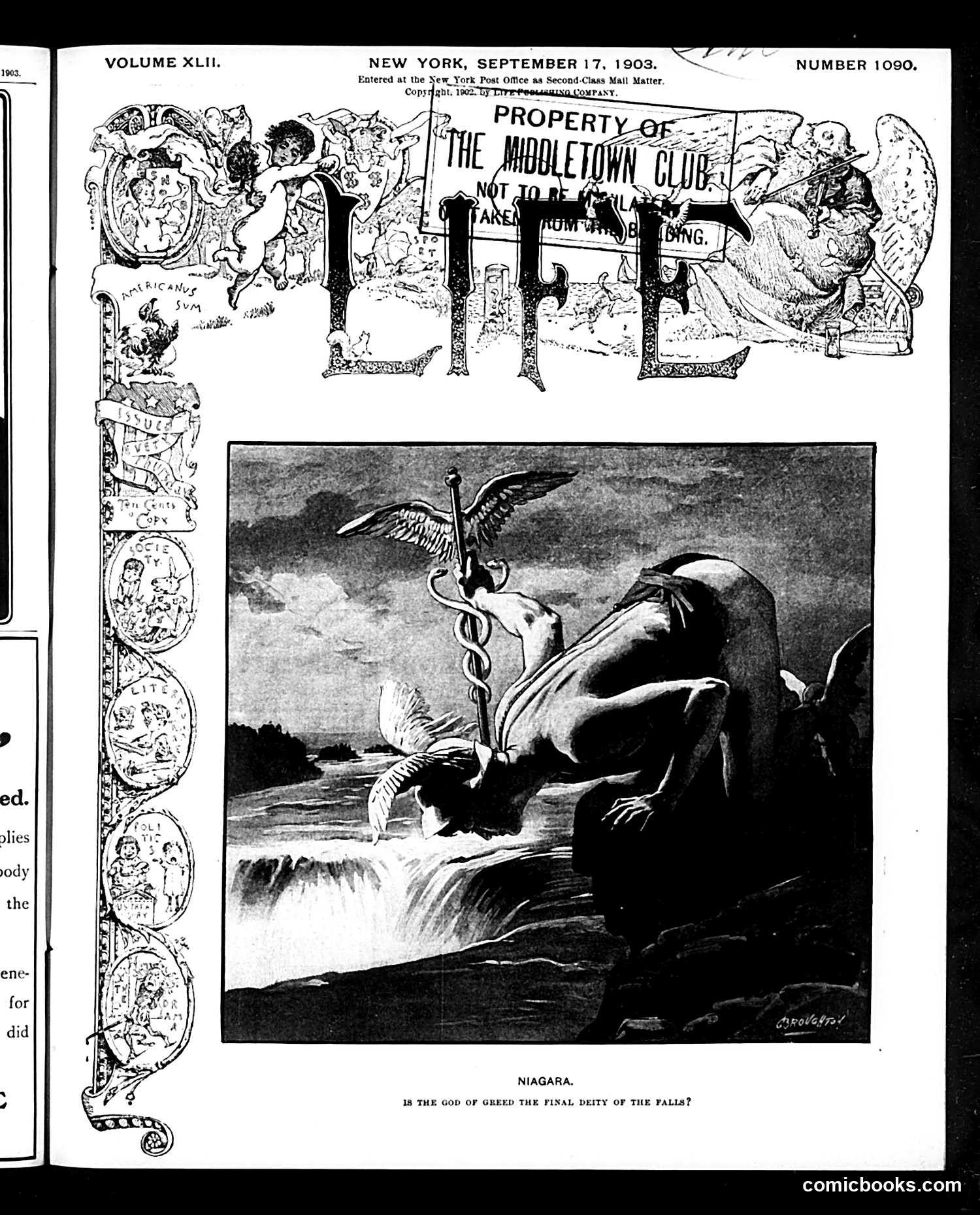
This page features a satirical illustration titled "NIAGARA" with the caption: "IS THE GOD OF GREED THE FINAL DEITY OF THE FALLS?" The image depicts a figure embodying greed or commercialism—shown as a dark, demonic or corpulent entity—presiding over Niagara Falls with a caduceus (Mercury's staff, symbol of commerce). The composition suggests anxiety about capitalist exploitation of natural landmarks. The ornamental left border contains zodiac-like circular medallions, reinforcing themes of fate and inevitability. The satirical point appears to critique how commercial interests and greed were dominating and exploiting iconic American natural resources during the Gilded Age—a common concern in early 1900s American satire about industrialization's environmental and spiritual costs.
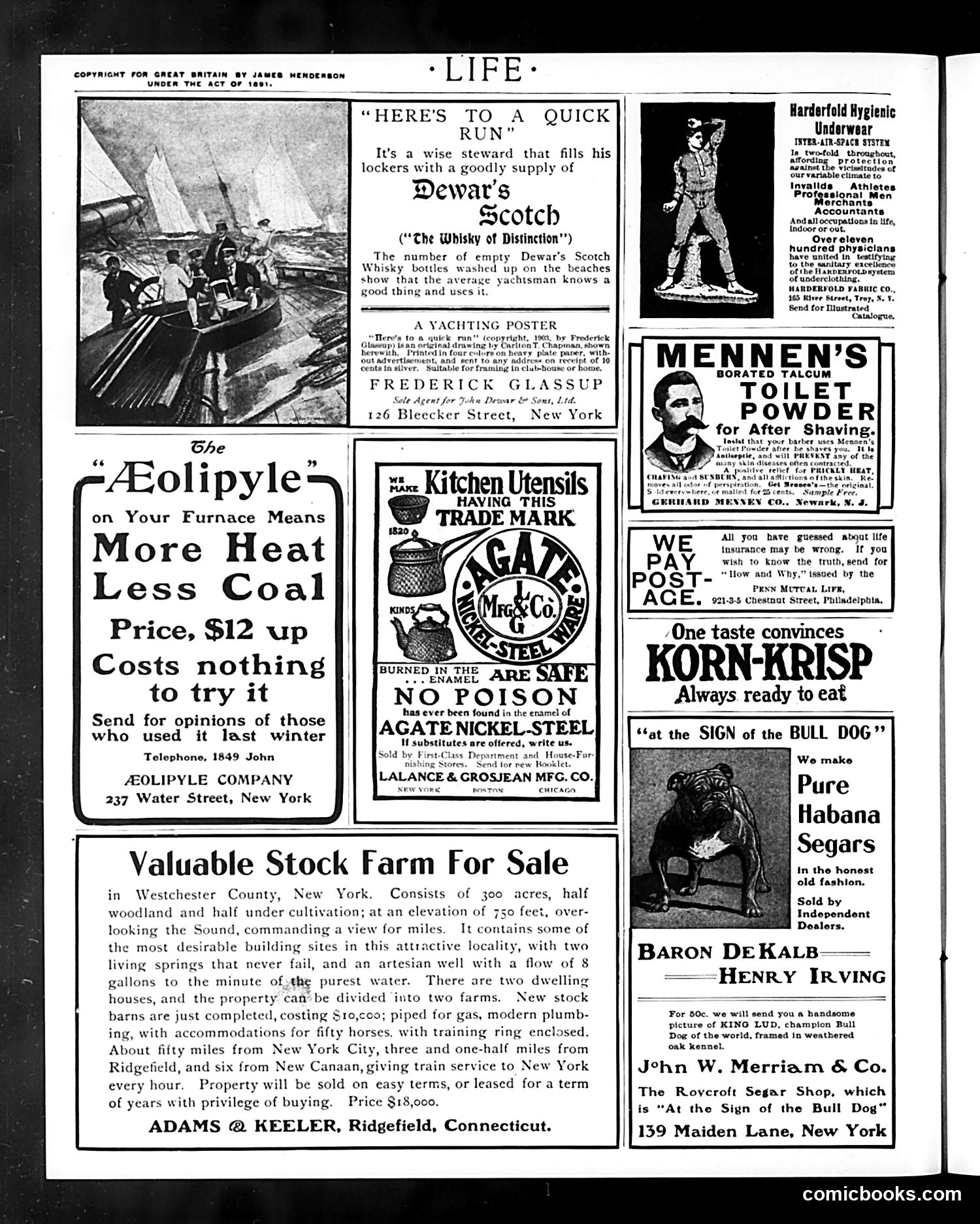
This page is **primarily advertising** rather than political satire. It contains commercial advertisements for various products including: - Dewar's Scotch whisky - Aeolipyle furnaces - Agate brand kitchen utensils - Mennen's toilet powder - Korn-Krisp cereal - Baron DeKalb Henry Irving cigars - A stock farm for sale in Connecticut The only illustration with potential satirical content is **"A Yachting Poster"** by Frederick Glasup—a nautical scene depicted as a framed artwork advertisement. The page reflects **early 20th-century consumer culture**, showcasing how Life magazine supported itself through advertising while maintaining its satirical brand through product endorsements presented with tongue-in-cheek humor. No specific political figures or events appear to be referenced.
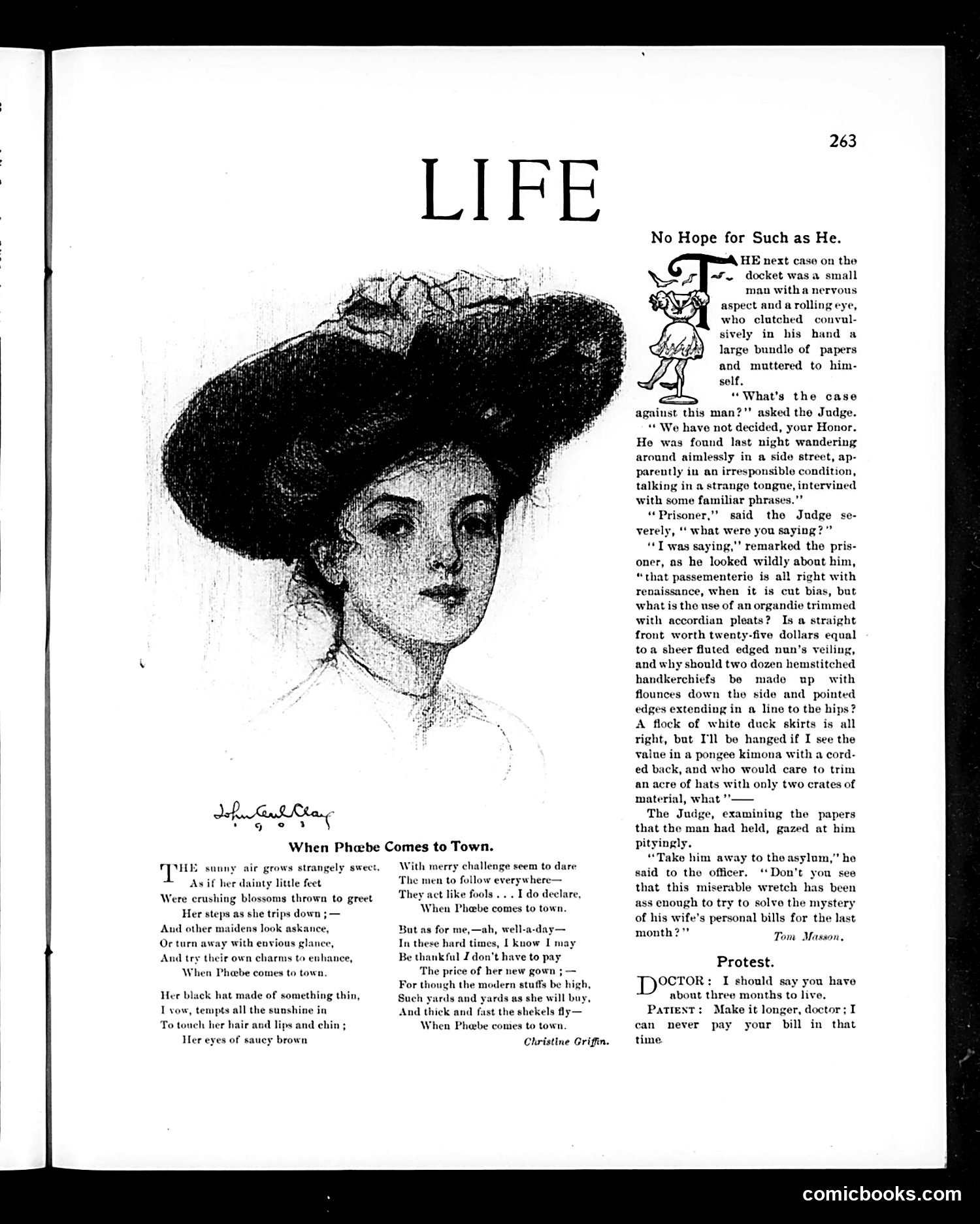
This page contains two distinct pieces: **"When Phoebe Comes to Town"** (left) is a poem by Christine Griffin celebrating a woman's arrival, praising her beauty and charm. The accompanying sketch shows a fashionable woman with an elaborate Edwardian-era hat—typical of early 1900s women's fashion. **"No Hope for Such as He"** (right) is a satirical courtroom scene mocking a defendant whose eccentric speech and behavior perplex the judge. The prisoner speaks in incomprehensible jargon (mixing "passementerie," "organdies," and fashion terminology), and the judge dismisses him to an asylum. The satire appears to ridicule either pretentious fashion-obsessed individuals or perhaps specific social eccentrics of the era. The joke relies on the absurdity of his rambling defense.
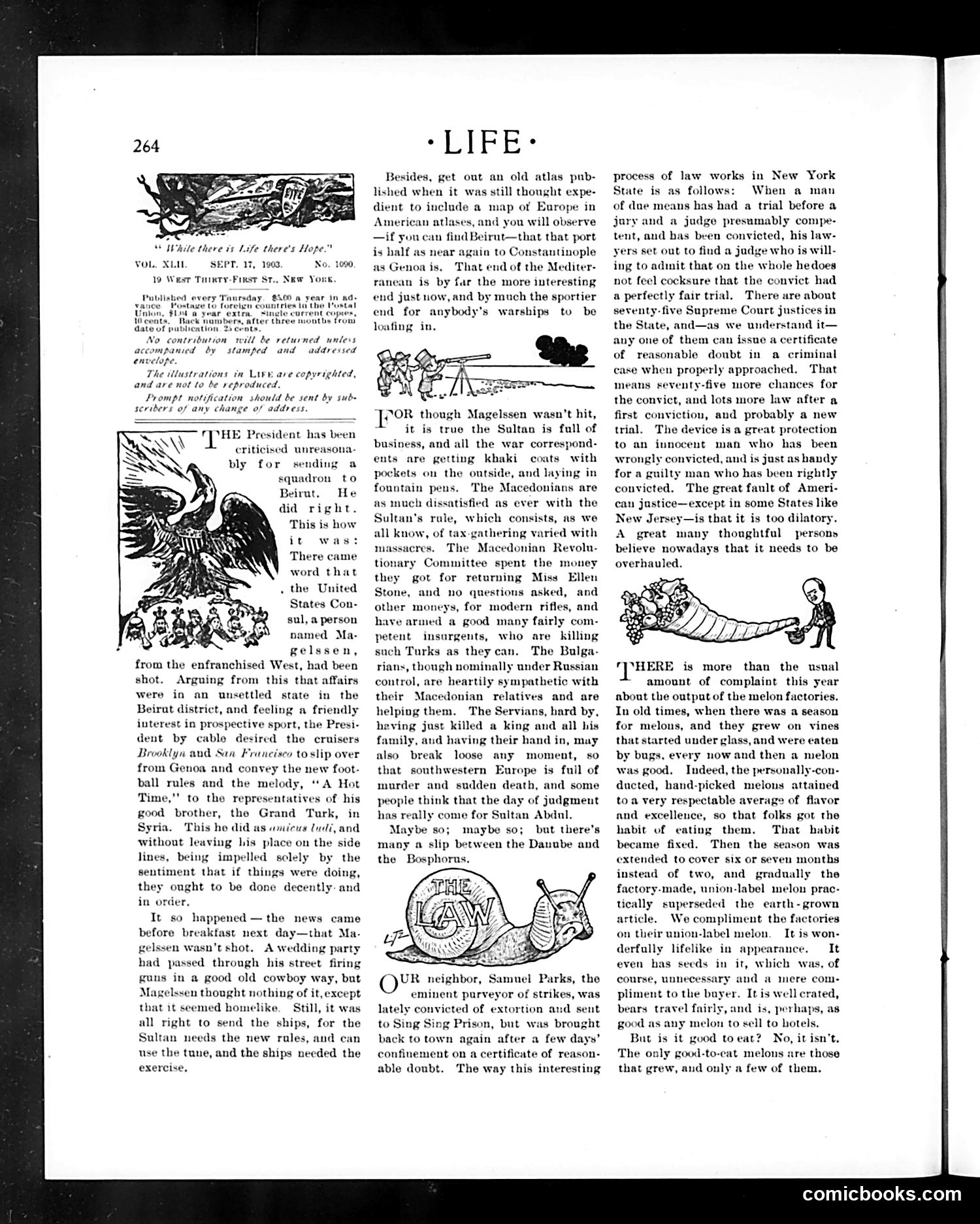
This page contains **editorial commentary** rather than explicit political cartoons. The illustrated vignettes appear to support written critiques of contemporary events: 1. **Upper left image**: An eagle with what appears to be a military figure, likely referencing President Theodore Roosevelt's military policy decisions—the text mentions criticism of "sending a squadron to Beirut." 2. **Middle illustration**: A snail, accompanying discussion of melon season and factory-made union-label melons replacing naturally grown ones—satirizing industrial food production and labor practices. 3. **Lower illustration**: Samuel Parks, a labor agitator recently convicted of extortion, being released from Sing Sing Prison. The text treats this as absurd—a corrupt strike organizer returning to town. The overall tone criticizes both political military adventurism and labor corruption.
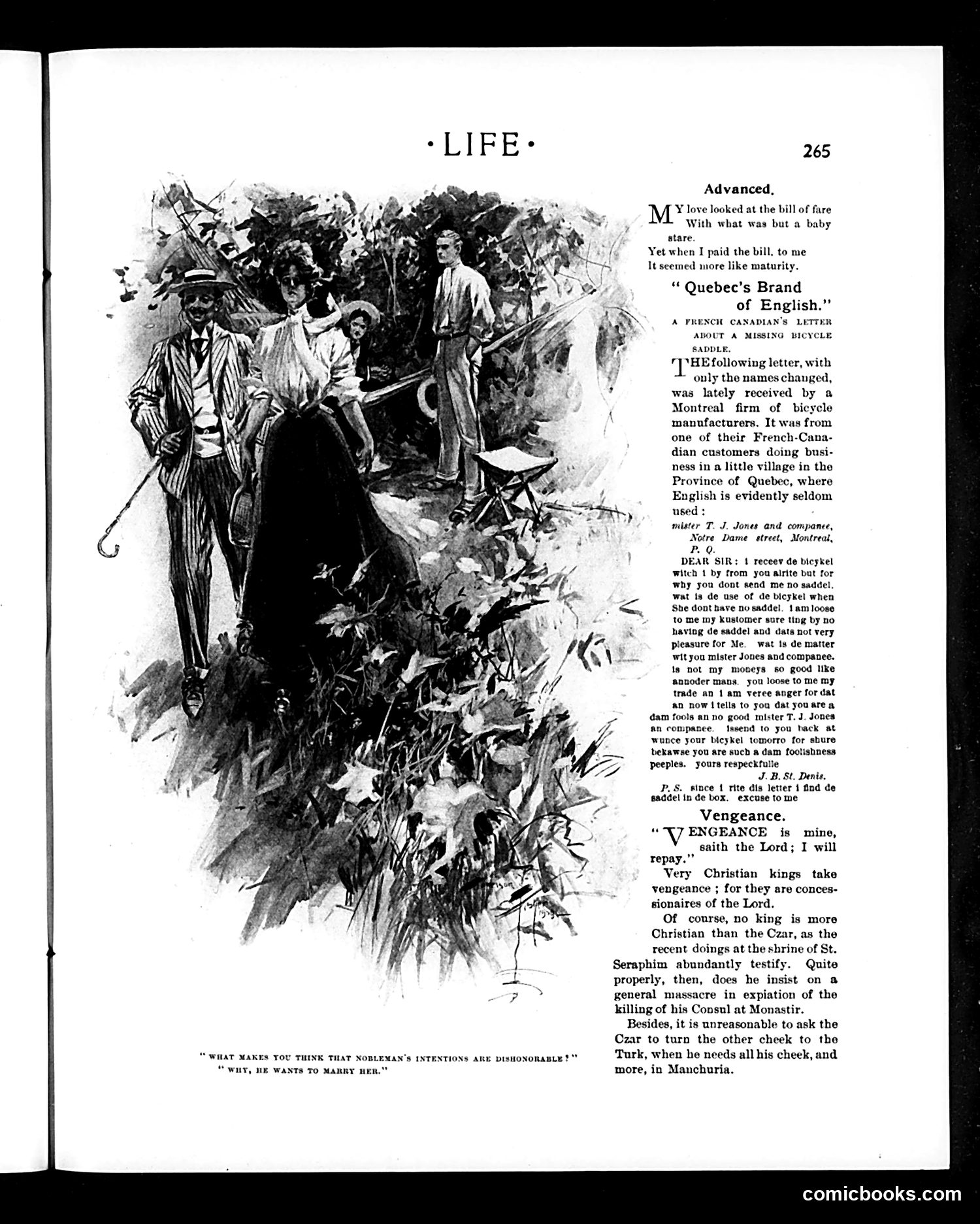
The main illustration depicts a chaotic scene of what appears to be a social gathering or confrontation, with multiple figures in period dress engaged in dramatic interaction. The caption below reads: "WHAT MAKES YOU THINK THAT NOBLEMAN'S INTENTIONS ARE DISHONORABLE?" / "WHY, HE WANTS TO MARRY HER." This is satirical commentary on class and marriage conventions. The joke suggests that a nobleman's desire to *marry* a woman of lower status is itself suspicious or dishonorable—implying that such cross-class unions were considered scandalous or improper. The satire mocks rigid social hierarchies where marrying "down" was viewed as more threatening than seduction. The accompanying text pieces ("Advanced," "Quebec's Brand of English," and "Vengeance") appear to be separate editorial or humorous content unrelated to the main cartoon.
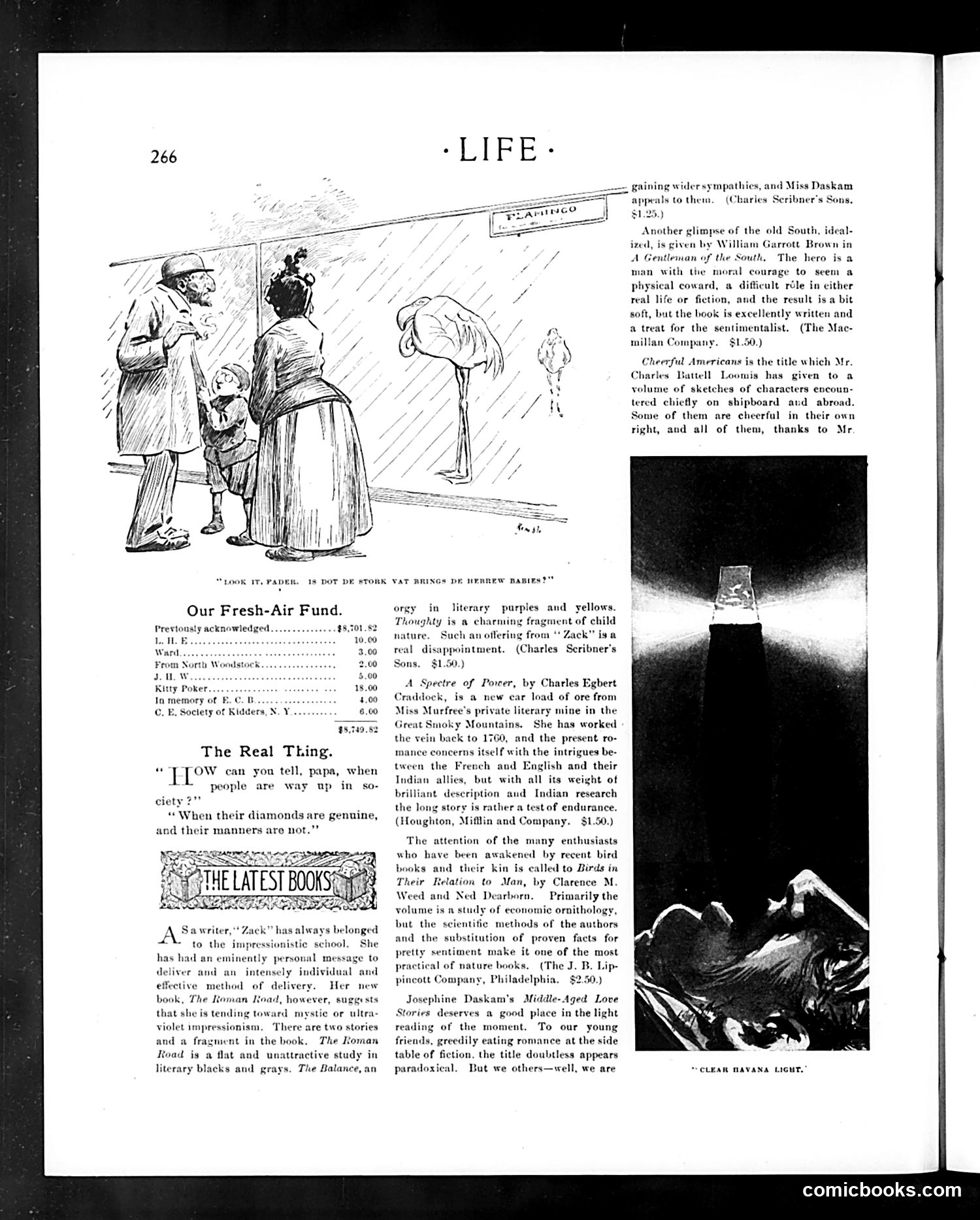
This page consists primarily of **book reviews** rather than political satire. "The Real Thing" cartoon at bottom-left is a light social commentary showing a conversation between a parent and child about recognizing genuine wealth—when "diamonds are genuine, and their manners are not." This reflects *Life*'s typical satirical commentary on American social pretension and class display. The bulk of the page reviews recent literary works, including titles by Charles Scribner's Sons and other publishers. The "Fresh-Air Fund" donation list suggests this issue dates to the early 20th century. The two illustrated images accompanying book reviews appear to be cover art or promotional illustrations rather than satirical commentary on current events.
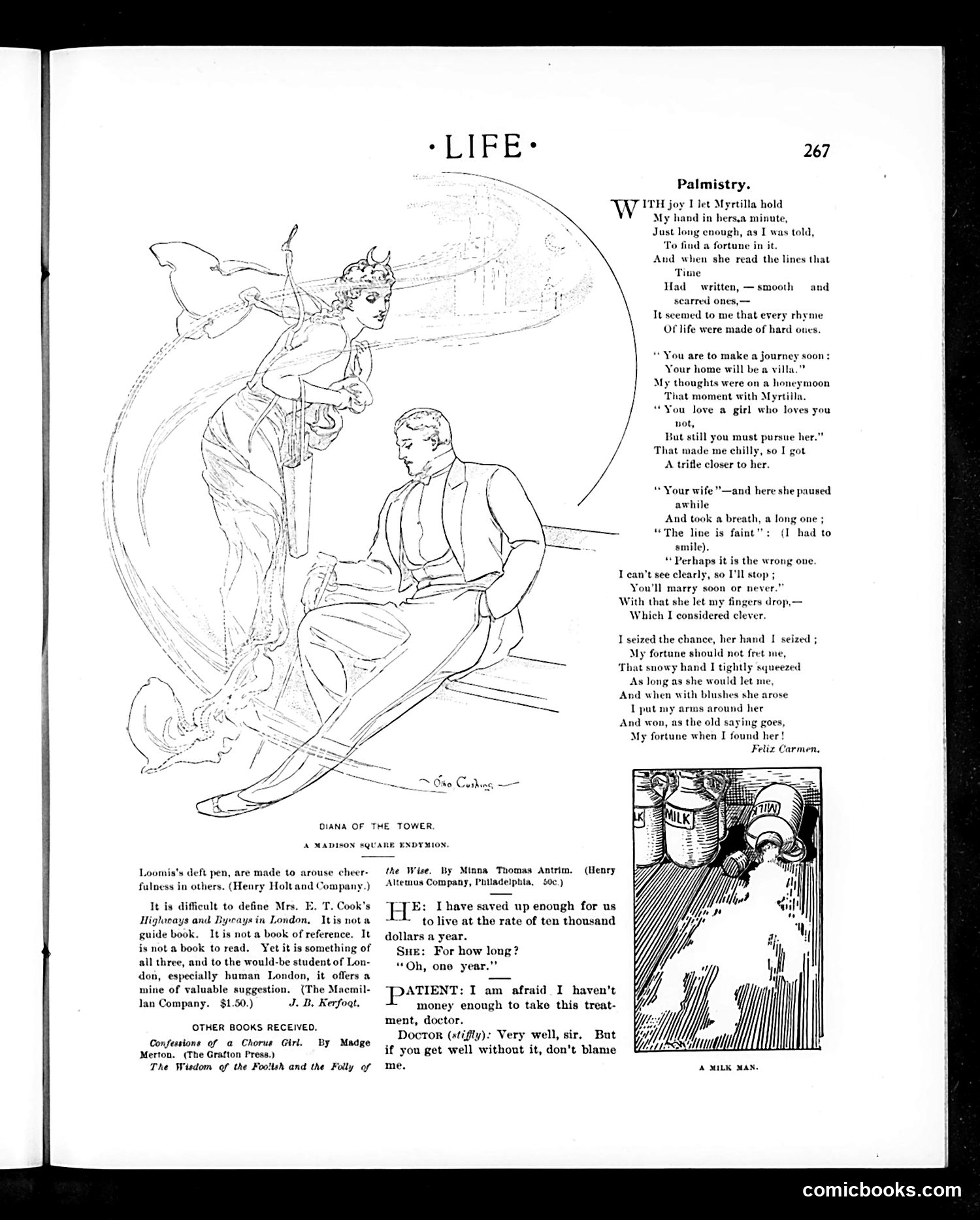
This page contains a poem titled "Palmistry" by Felix Cornman, paired with an illustration labeled "Diana of the Tower" (credited to San Cordova). The artwork depicts a fortune teller reading a man's palm. The satire mocks the popular Edwardian-era belief in palmistry—reading fortunes from hand lines. The poem humorously recounts how a fortune teller predicted the narrator would marry soon and find love, only for her to declare his palm's lines are "faint" or unclear, ultimately concluding "You'll marry soon or never." The joke targets both fortune tellers' vagueness and the foolishness of clients who believe such predictions. The accompanying sketches and text ("The Wise," "A Milk Man") appear to be separate humorous pieces about everyday life and social observations typical of Life magazine's satirical content.
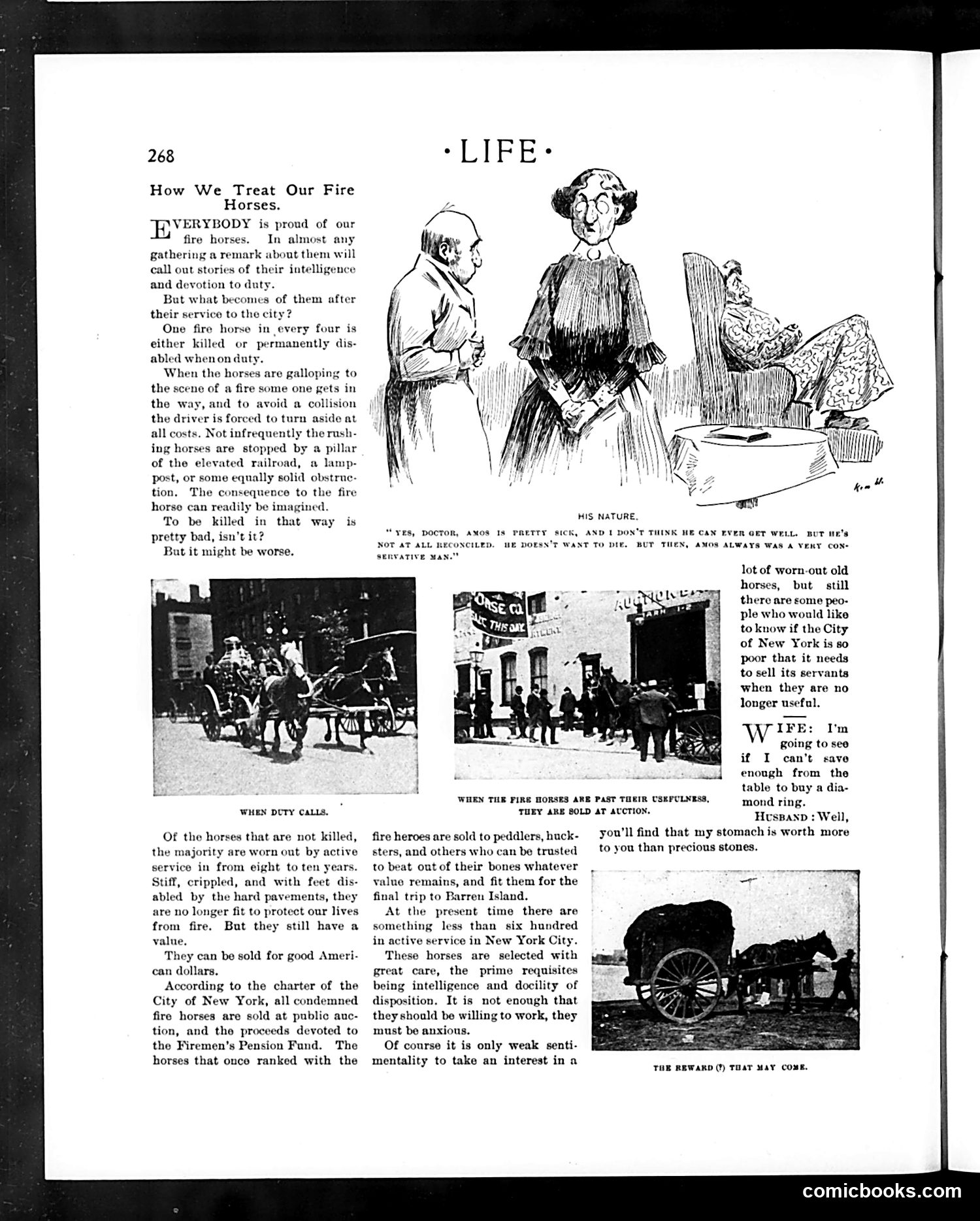
This page discusses the fate of New York City's fire department horses. The article explains that retired fire horses—once vital to the city's emergency services—faced grim outcomes: one in four was killed or permanently disabled during service. When no longer useful, these horses were sold at auction to knackers and peddlers who would beat them to extract remaining value before sending them to Farren Island (likely a rendering facility). The accompanying cartoon satirizes this callousness through a domestic scene where a wife suggests selling her husband to buy jewelry, mirroring how the city discards its worn-out servants. The photographs show fire horses in active service and at auction. The piece critiques New York's disposable treatment of animals that once served the public faithfully.
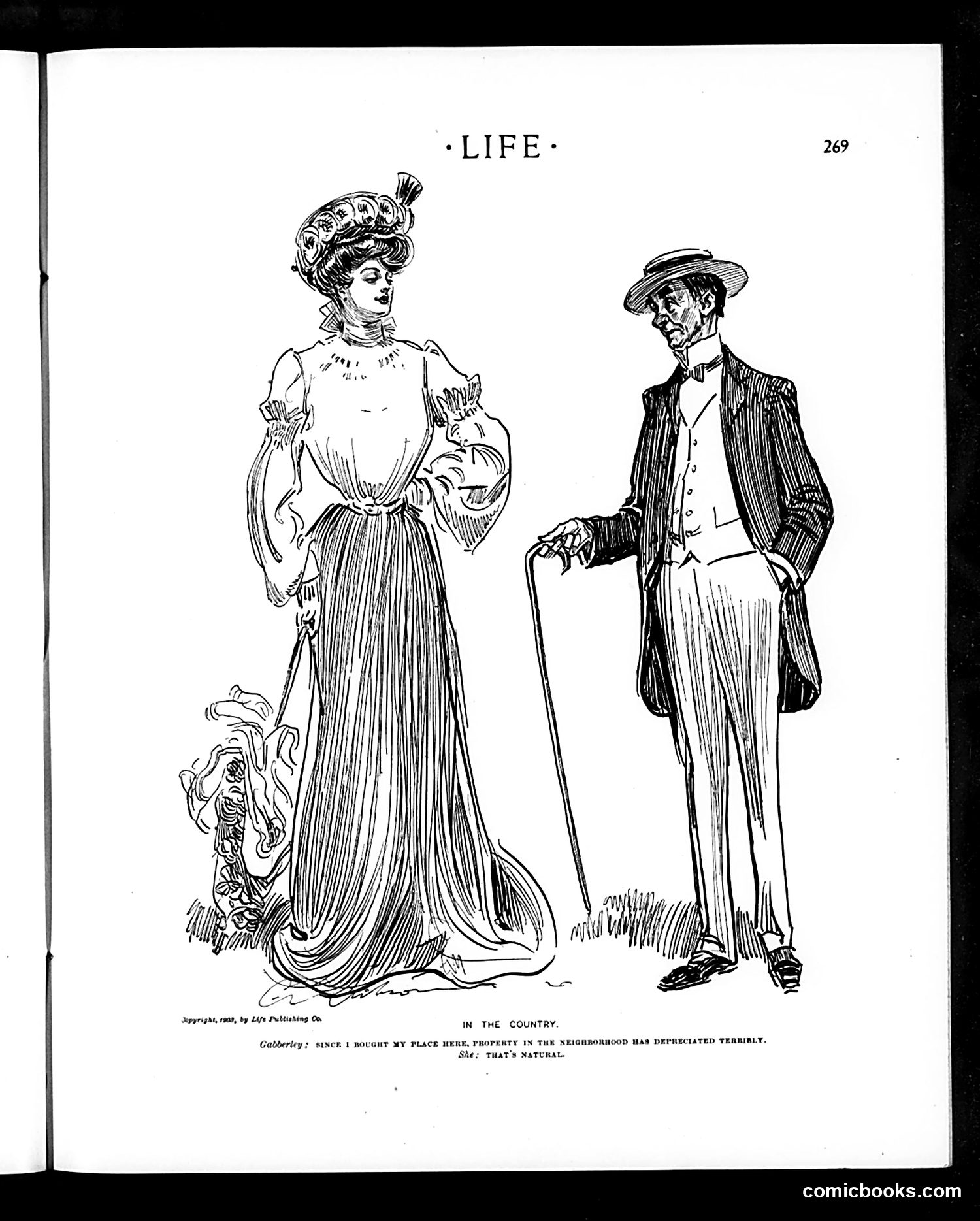
This cartoon satirizes rural property ownership and neighborhood deterioration. A well-dressed woman complains to a gentleman that since she bought her country property, the neighborhood has "depreciated terribly." The gentleman's implied response ("That's natural") suggests her presence—or her class status—is itself causing the decline. The satire likely targets wealthy urbanites who purchase rural estates expecting genteel surroundings, only to find their own arrival paradoxically degrades property values or community character. It's a commentary on snobbery and the ironic consequences of the wealthy attempting to escape to pristine countryside: their very arrival corrupts what they sought. The elaborate Edwardian fashion suggests early 1900s dating.
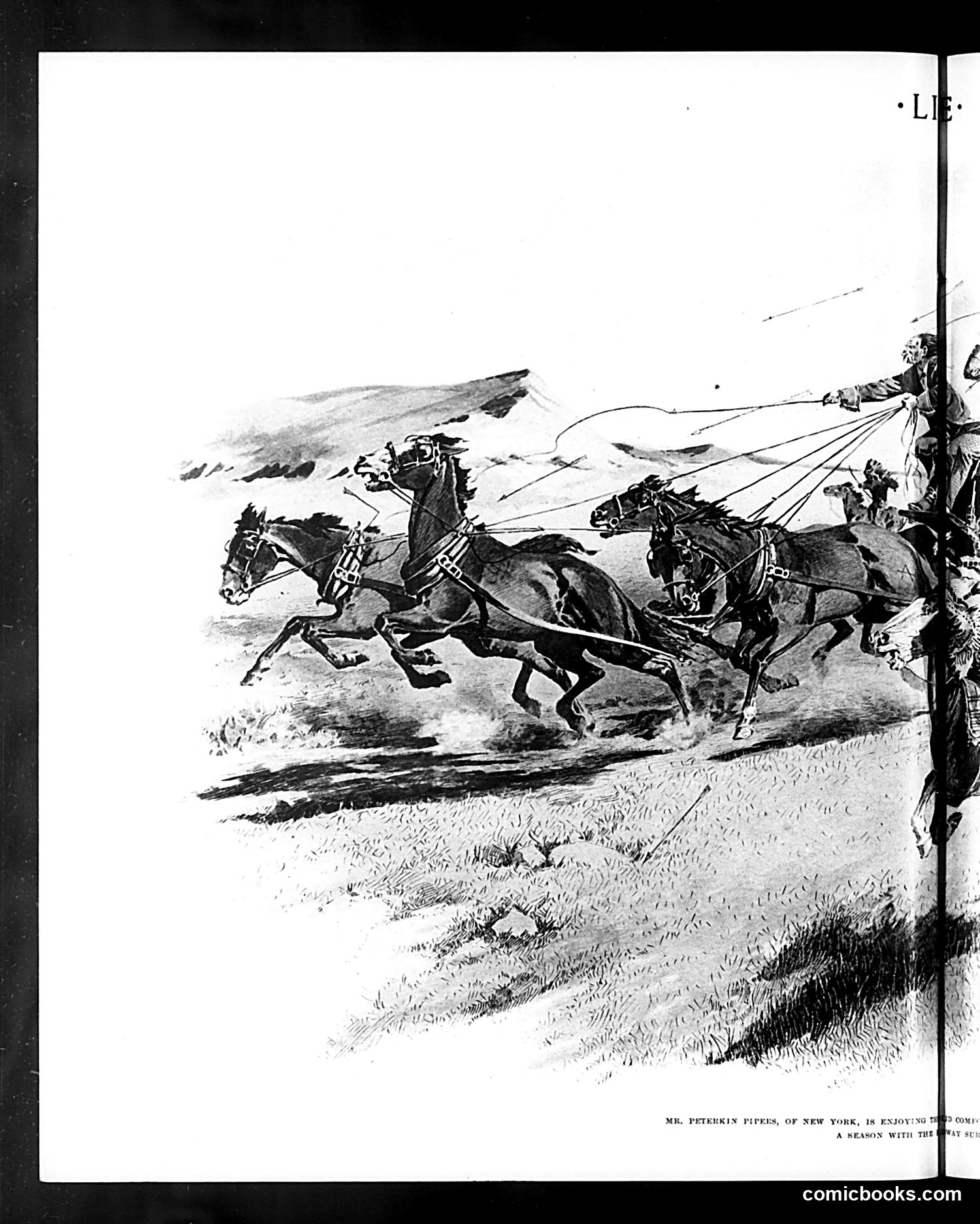
This illustration depicts **Mr. Pettekin Pipes of New York** enjoying a season with **the [Pony Club]** (text is partially cut off). The image shows a man in formal dress on the right, holding reins attached to a team of horses pulling what appears to be a sleigh or carriage across a snowy landscape. The satire likely mocks wealthy New York society's leisure pursuits—specifically the fashionable practice of winter sports and exclusive club memberships among the upper class. Pettekin Pipes appears to be a satirical character name itself (suggesting pretension and affectation). The exaggerated scene of him commanding multiple horses suggests both his wealth and perhaps the absurdity of such extravagant pastimes, typical of *Life* magazine's social commentary on the privileged classes.
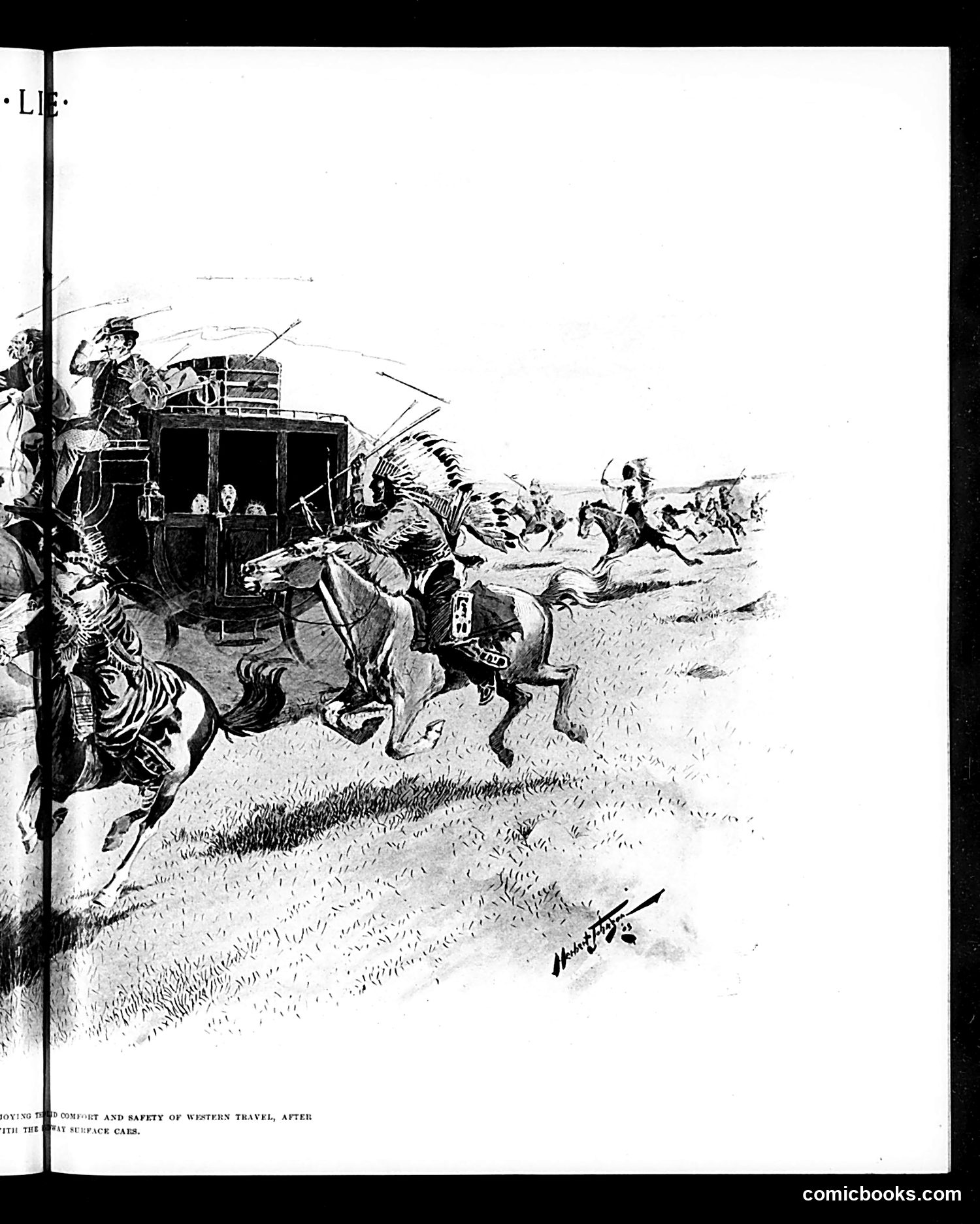
This illustration depicts a scene of Western travel, specifically showing the safety improvements of surface cars (likely referring to stagecoaches or early transportation vehicles). The image shows mounted cavalry or armed escorts protecting a coach traveling across open prairie or frontier landscape. The caption references "IMPROVING THE COMFORT AND SAFETY OF WESTERN TRAVEL, AFTER WITH THE SURFACE CARS" (text partially obscured). The satire appears to critique the contrast between *promised* safety of Western travel via new surface transportation versus the *reality* of the still-dangerous frontier requiring armed military protection. The multiple armed riders suggest that despite modern conveyances, travelers still needed substantial security, undermining claims of improved safety. This likely comments on 19th-century expansion and the gap between promotional rhetoric and actual frontier conditions.
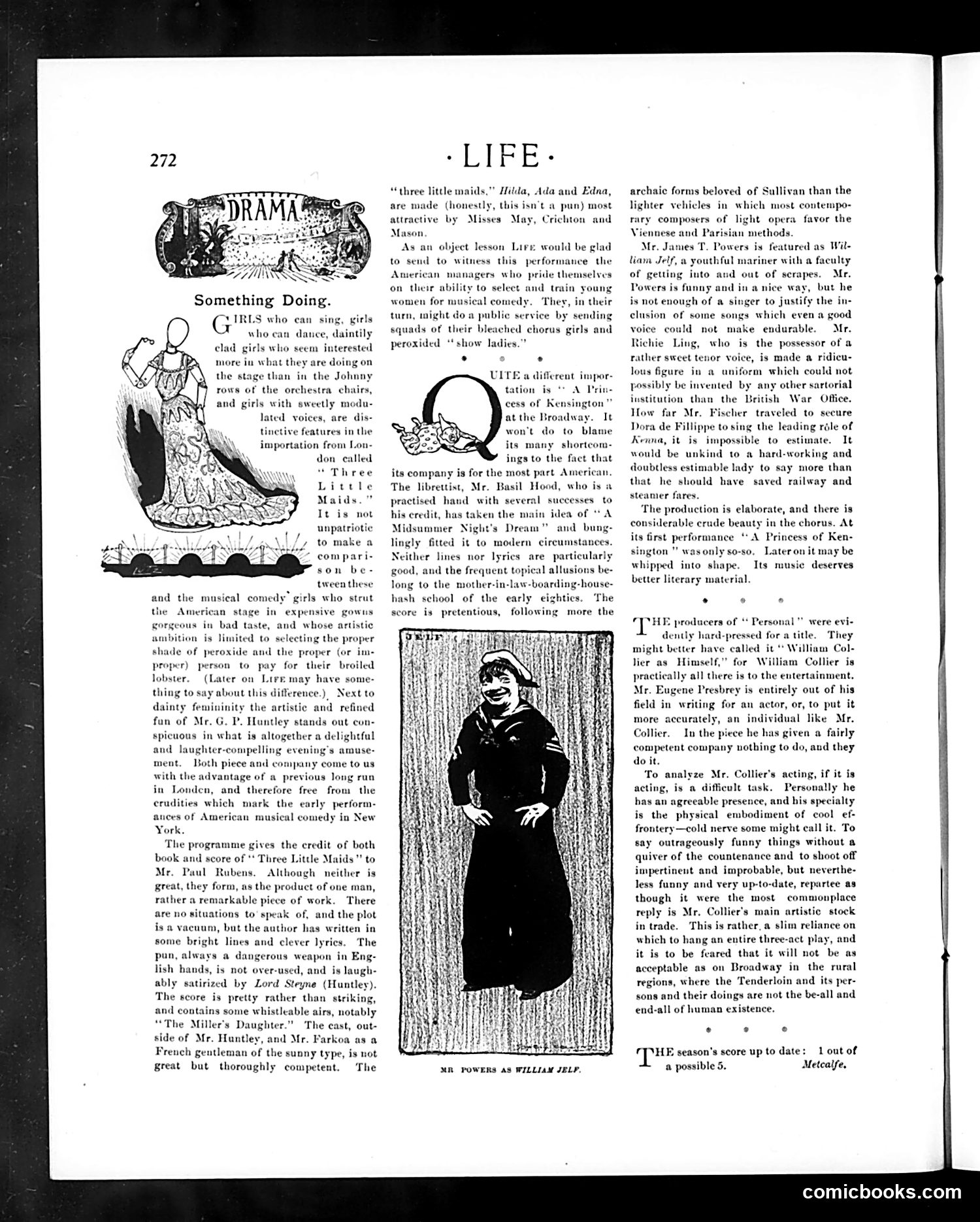
This page reviews theatrical productions, particularly "Something Doing," a musical comedy featuring young female performers in a chorus. The text criticizes how American theaters exploit attractive young women in minimal costumes, praising this production for avoiding such excess. The illustration shows **Mr. James T. Powers as William Jelf**, a character described as "a youthful mariner." The accompanying review praises Powers's performance, noting his ability to deliver funny lines with natural timing and his agreeable stage presence. The satire targets the entertainment industry's tendency to prioritize visual spectacle over genuine talent, while commending productions that emphasize artistic merit and refined comedy instead. The review concludes that the production deserves better literary material.
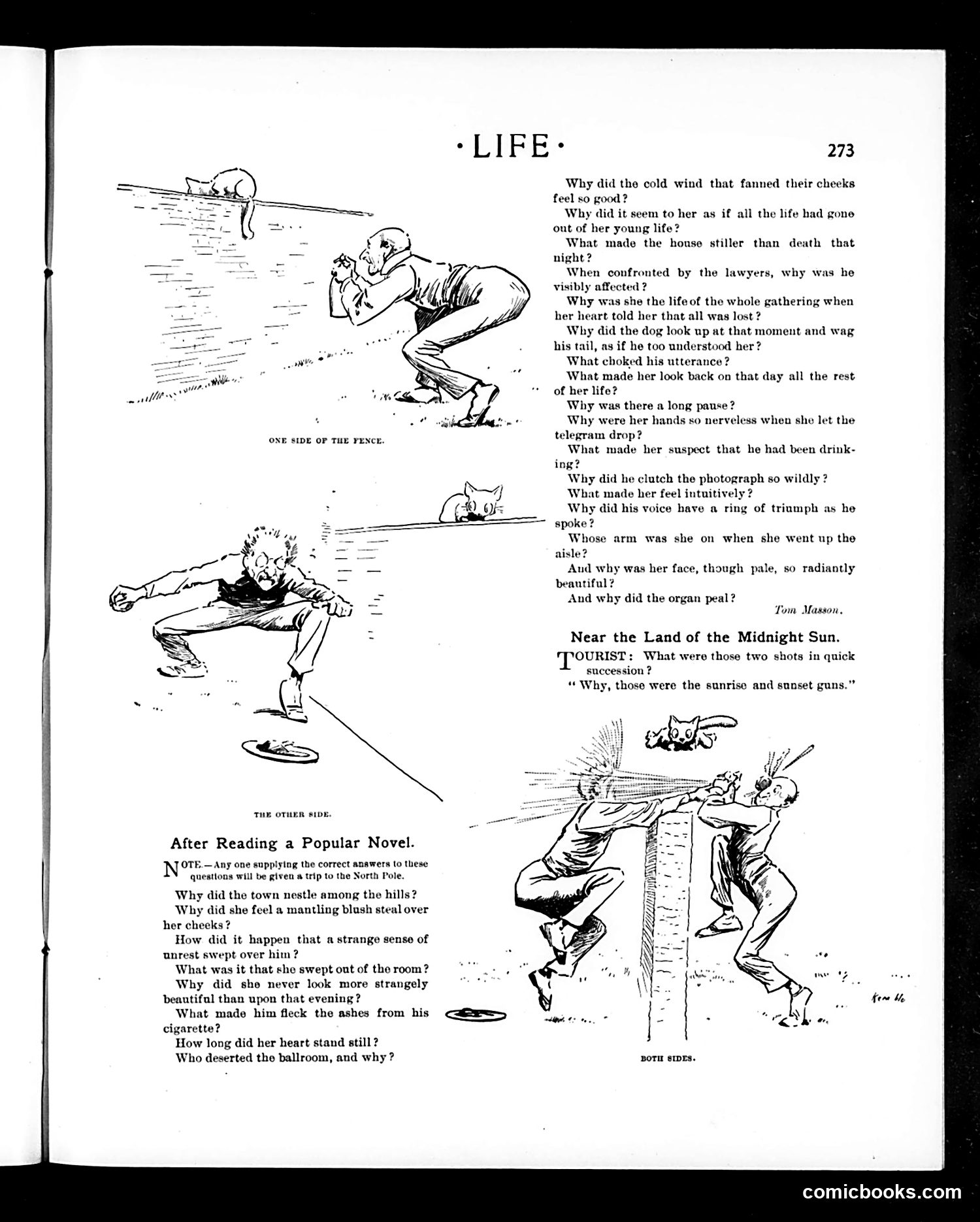
This page mocks the overwrought melodrama of popular romance novels of the early 20th century. The cartoons show people acting out absurdly exaggerated emotional reactions—a man contorted by passion, figures leaping and gesturing wildly. The text lists dozens of breathlessly rhetorical questions ("Why did the cold wind that fanned their cheeks feel so good?") mimicking the purple prose and manufactured emotional intensity of sentimental fiction. Each question treats trivial details with false profundity typical of mass-market romance. The joke's punchline: a note promises readers who answer correctly will receive "a trip to the North Pole"—implying only by escaping to an impossibly remote location could one avoid being subjected to more such melodramatic fiction. The brief joke about "sunrise and sunset guns" appears unrelated to the main satire.
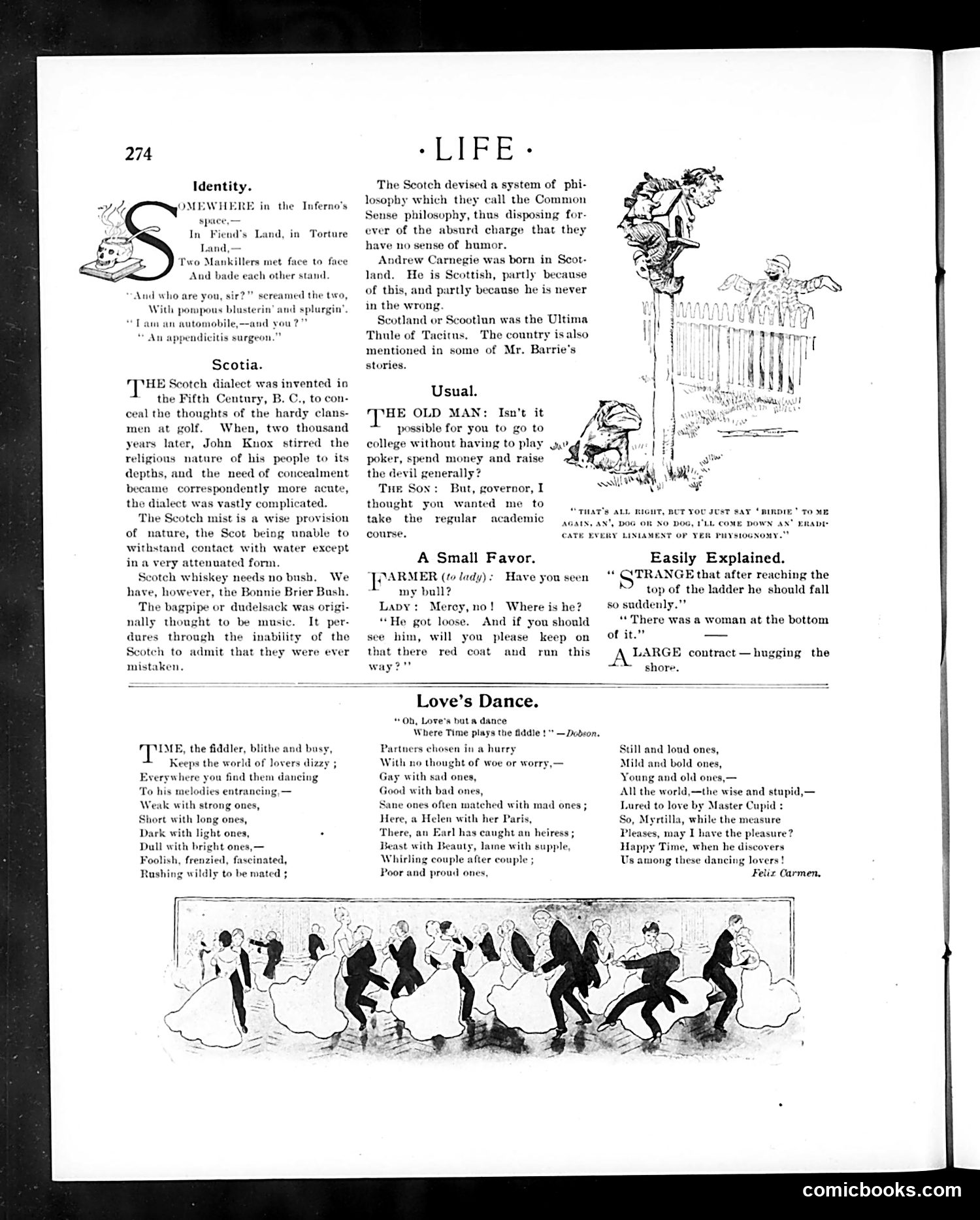
This page from *Life* magazine (appears early 20th century) contains several satirical pieces: **"Scotia"** mocks Scottish character stereotypes—the impenetrable dialect, their relationship to golf and whiskey, the bagpipe as "music," and Andrew Carnegie as a Scottish success story. The humor relies on ethnic caricature, portraying Scots as humorless, stubborn, and unable to admit error. **"Identity"** shows two men in WWI ("No Man's Land") identifying themselves—one claims to be an "appendicitis surgeon," a joke about medical officers' dubious battlefield utility. **"Usual"** depicts a father-son conversation where the son wants college without sports/drinking, but the father insists on "regular academic course"—satirizing how higher education supposedly requires dissipation. The remaining pieces—"A Small Favor," "Easily Explained," and "Love's Dance"—are lighter domestic/romantic vignettes with accompanying illustrations showing typical early-20th-century courtship and social scenarios. The overall tone is genteel, class-conscious humor aimed at educated readers.
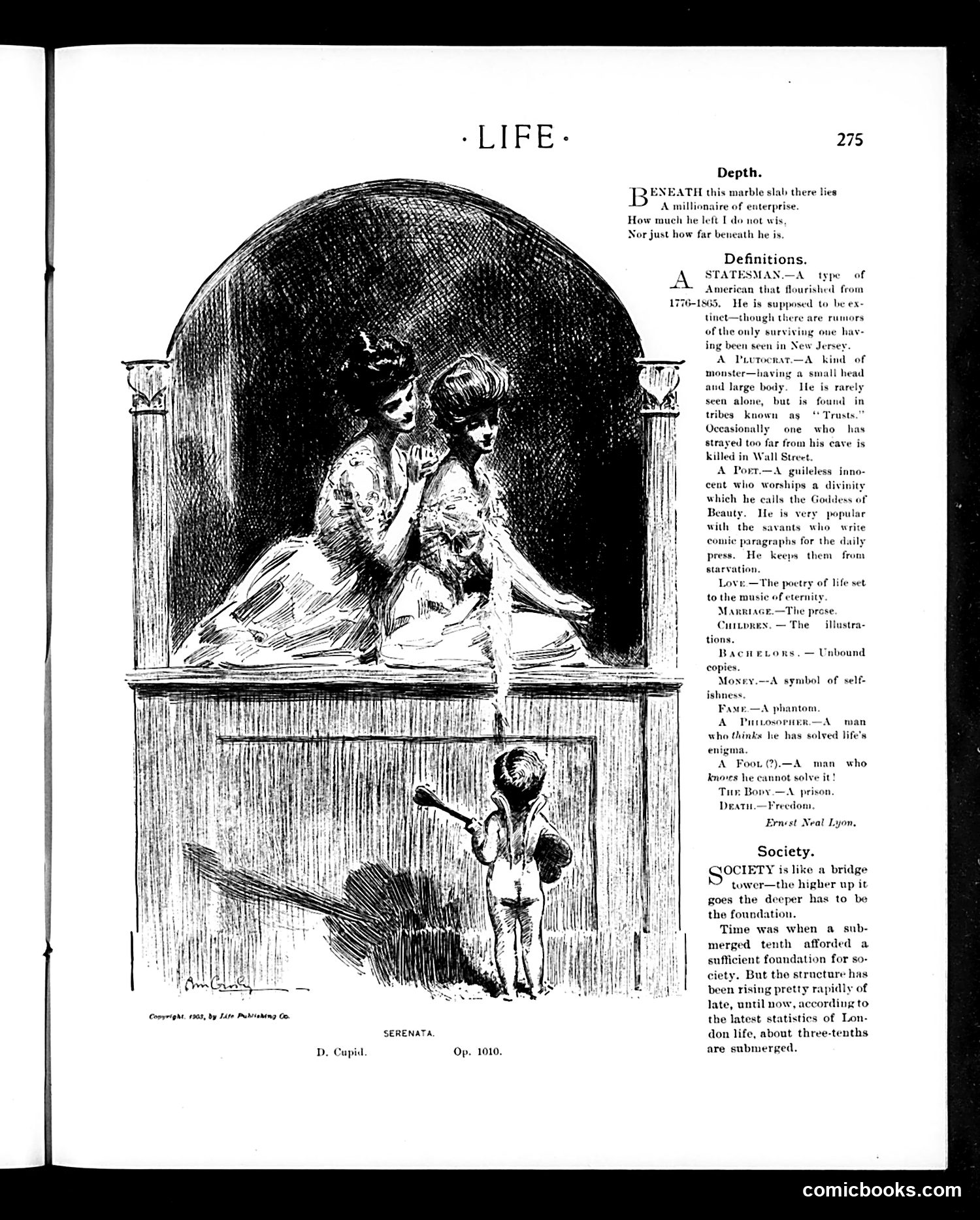
This 1903 *Life* page contains satirical social commentary through a two-part structure: **The Cartoon ("Serenata"):** D. Cupid's illustration depicts a cherub observing a romantic couple in an alcove above while a figure below (appearing to dig or labor) works beneath them. The epitaph "Depth" mocks shallow romanticism—suggesting love exists only on life's surface while labor and hardship support society invisibly below. **The Definitions Section:** This satirizes American types through mock-dictionary entries. "Statesman" is extinct (post-1865, suggesting Reconstruction-era decline). "Plutocrat" is a monster confined to "Trusts"—referencing the monopolistic corporations dominating early 1900s America. "Poet" is a delusional fantasist; "Philosopher" a pretentious fool. **The Society Essay:** Closing commentary on class structure uses bridge metaphor: upper-class society requires an exploited underclass ("submerged tenth") as foundation, now worsening—three-tenths are submerged. This critiques industrial inequality. The overall message: American society rests on invisible suffering while celebrating romantic and commercial illusions.
This page features a humorous poem satirizing marital conflict and gender expectations in early 20th-century America. The narrative follows a husband and wife whose vacation plans clash: he wants to fish and hunt in solitude; she desires a fashionable resort to display her wardrobe and social status. The joke's irony: after she forces him to the resort, he becomes distracted by an attractive woman, prompting his wife to suddenly prefer fishing. Now at the fishing trip he wanted, he's miserable—thinking of the resort's social scene. The poem's moral: men are perpetually dissatisfied, always wanting what they cannot have. The satire targets both spouses—her materialism and vanity, his easily-distracted nature—while poking fun at marriage as a constant negotiation where neither party gets their way. The accompanying anecdotes mock druggists' unnecessary delays and a Scottish minister's confusion, using similar comedic structures of verbal irony and social observation typical of *Life*'s satirical approach.
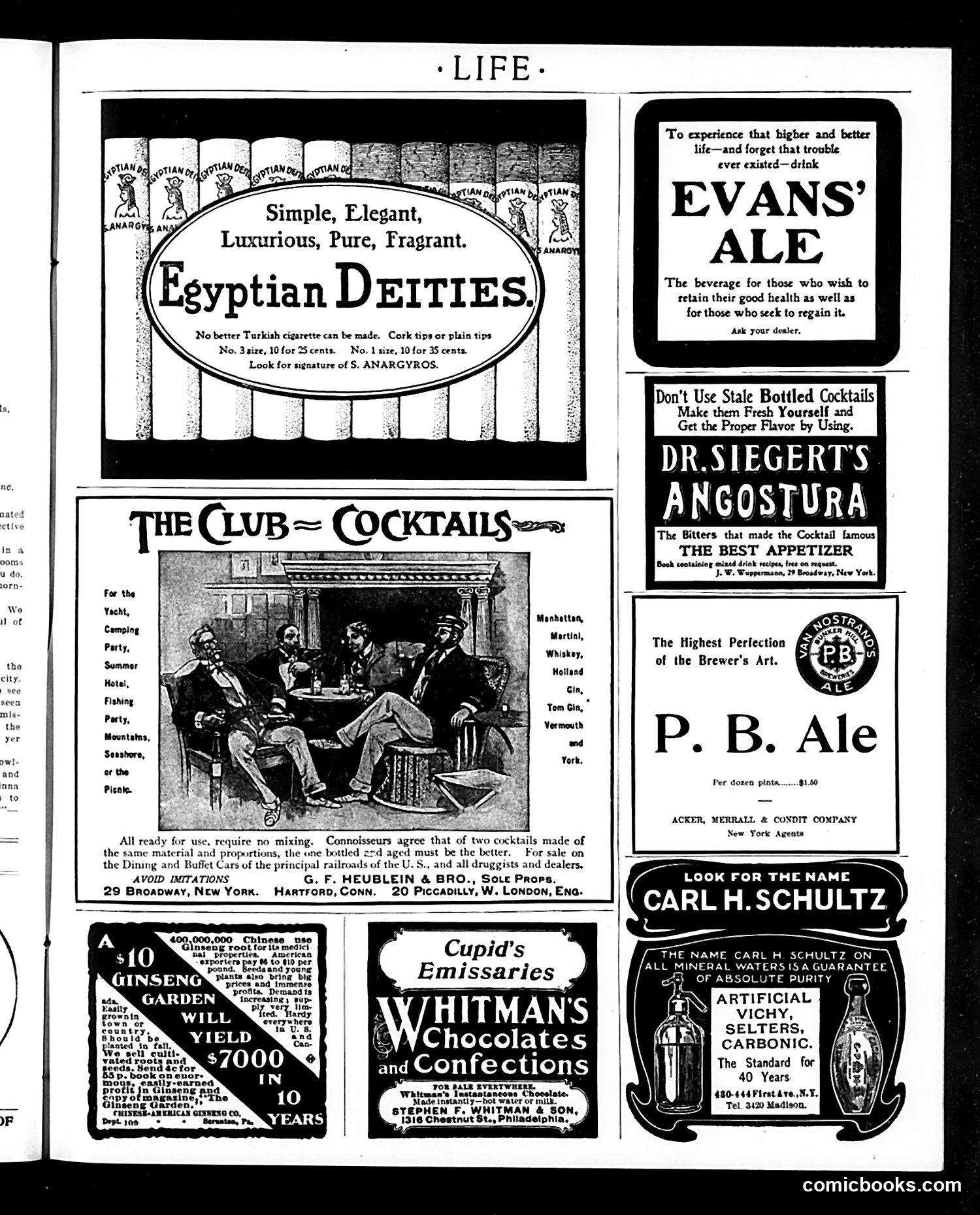
This is primarily an **advertisement page**, not a satirical cartoon. It showcases early 20th-century luxury consumer products aimed at affluent Americans. **Key products advertised:** - **Egyptian Deities** cigarettes (Turkish, premium quality) - **The Club Cocktails** (pre-mixed drinks for travel/recreation) - **Evans' Ale** and **P.B. Ale** (beers marketed for health) - **Dr. Siegert's Angostura** (cocktail bitters) - **Whitman's Chocolates** (confections) - **Ginseng** (Chinese medicinal root) - **Carl H. Schultz** mineral waters **Notable context:** The ads reflect pre-Prohibition attitudes toward alcohol as respectable—even healthful. Products are positioned for wealthy leisure activities (yachting, camping, hotels). The repeated health claims ("retain good health," "regain it") suggest early marketing of lifestyle products as wellness solutions. The cigarette ad's "Turkish" positioning reflects Western fascination with exoticism common to this era.
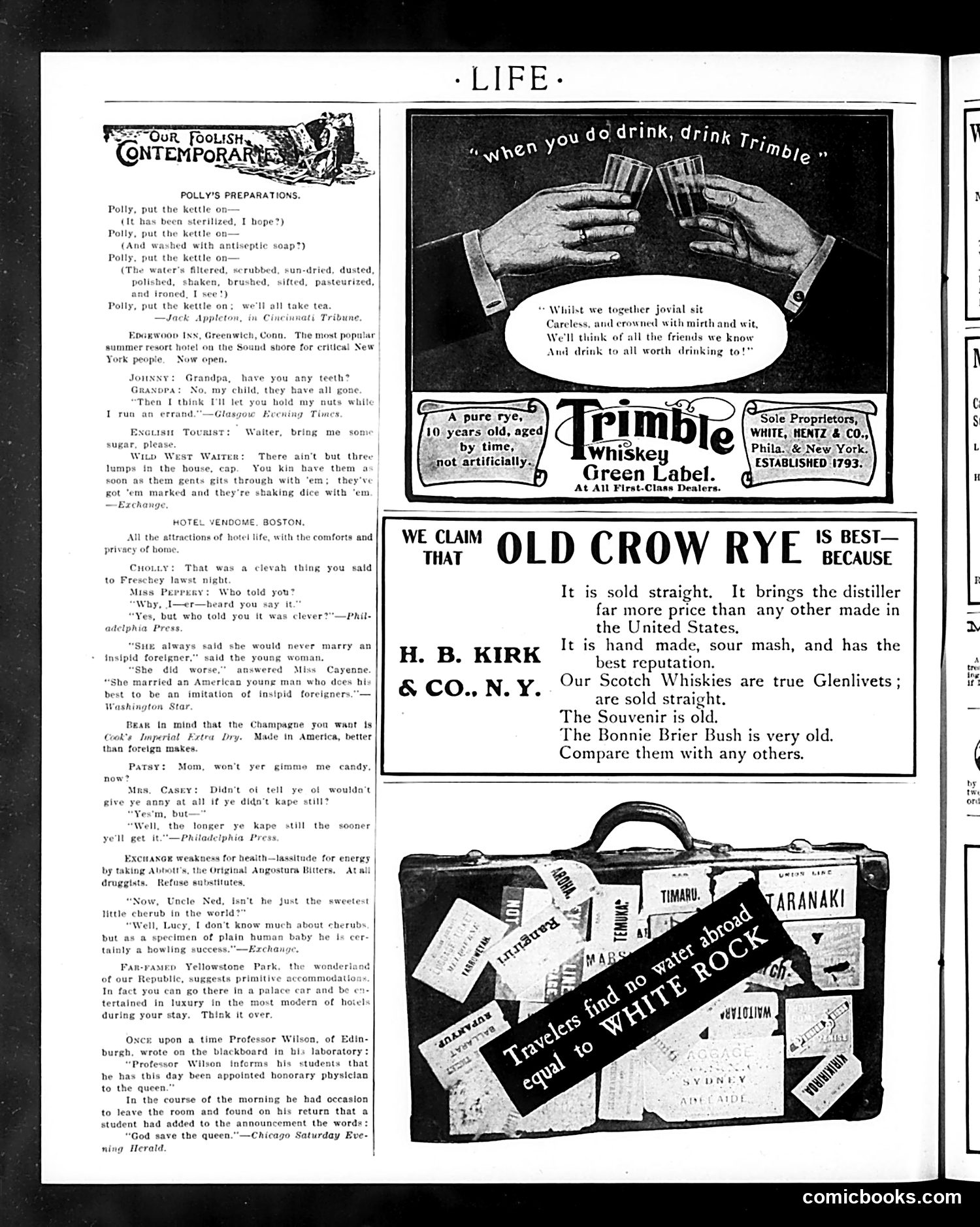
This page is primarily **advertising**, not political satire. It contains humorous short jokes under the "Our Foolish Contemporaries" header, interspersed with liquor and hotel advertisements typical of early 20th-century Life magazine. The jokes mock everyday social situations: overly-cautious kettle sterilization, absent-minded elderly people, misheard compliments, and class pretension. These are gentle, observational humor rather than pointed satire. The advertisements promote whiskey brands (Trimble, Old Crow Rye), Scotch whisky, and resort hotels—reflecting the magazine's affluent readership. The liquor ads emphasize quality and American manufacturing, likely targeting the pre-Prohibition era when such advertising was common in mainstream publications. The suitcase illustration advertises travel to White Rock, a tourist destination. Overall, the page reflects early 1900s consumer culture and middle/upper-class social anxieties about propriety and authenticity.
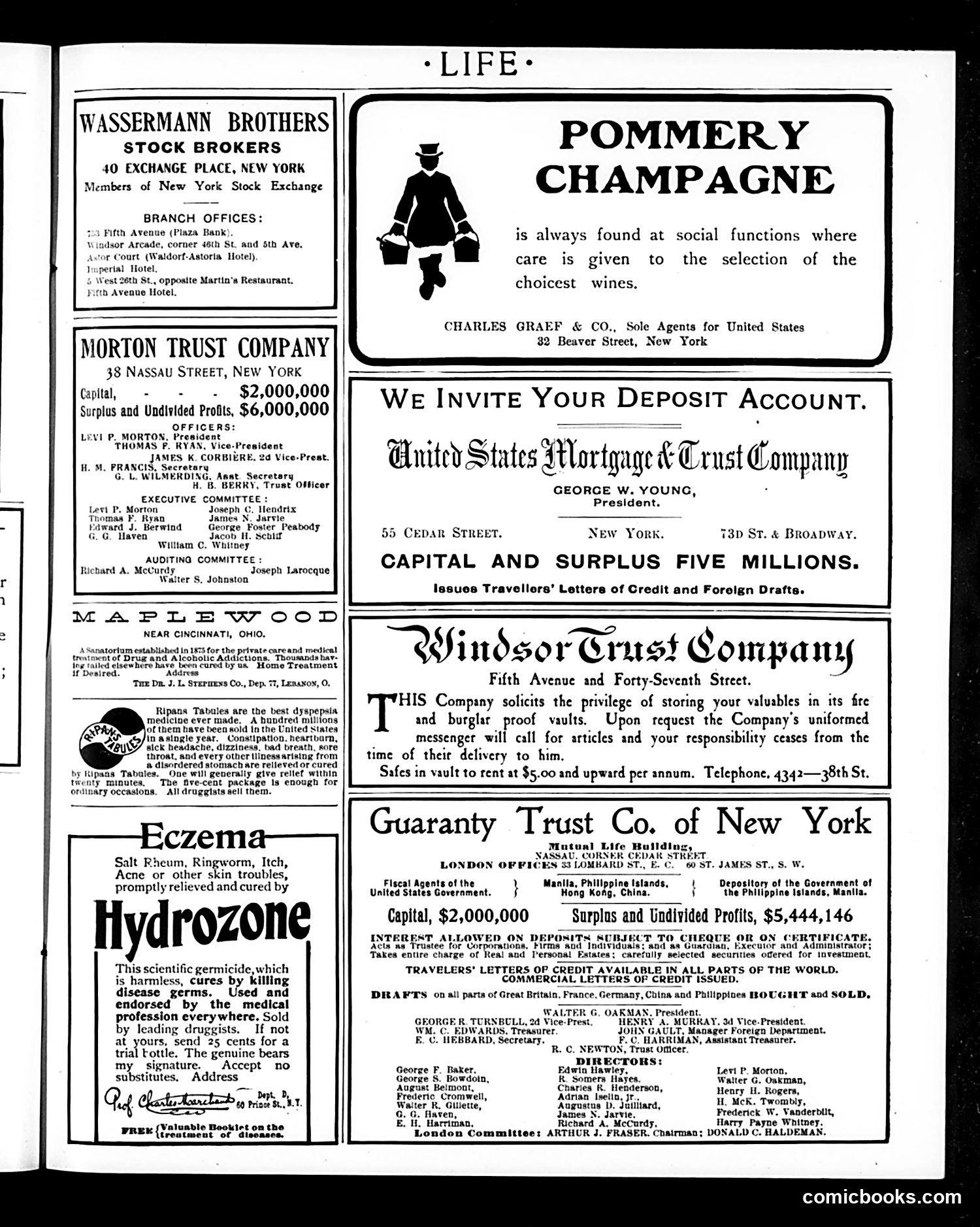
This page is primarily **financial and commercial advertising**, not political satire. It features ads from New York banks, trust companies, and investment firms from the early 1900s, including: - Stock brokers and trust companies (Wassermann Brothers, Morton Trust Company) - The United States Mortgage & Trust Company - Wine merchants (Pommery Champagne) - Guaranty Trust Co. of New York One notable element is the **Hydrozone skin remedy ad**, which advertises a "scientific germicide" claiming to cure eczema and various ailments—typical patent medicine marketing of the era, relying on vague scientific language and medical endorsements to sell unproven treatments. The page contains **no political cartoons or satirical imagery**—it appears to be a straightforward advertising page from *Life* magazine's business section, showcasing Manhattan's financial institutions and consumer products aimed at wealthy readers.
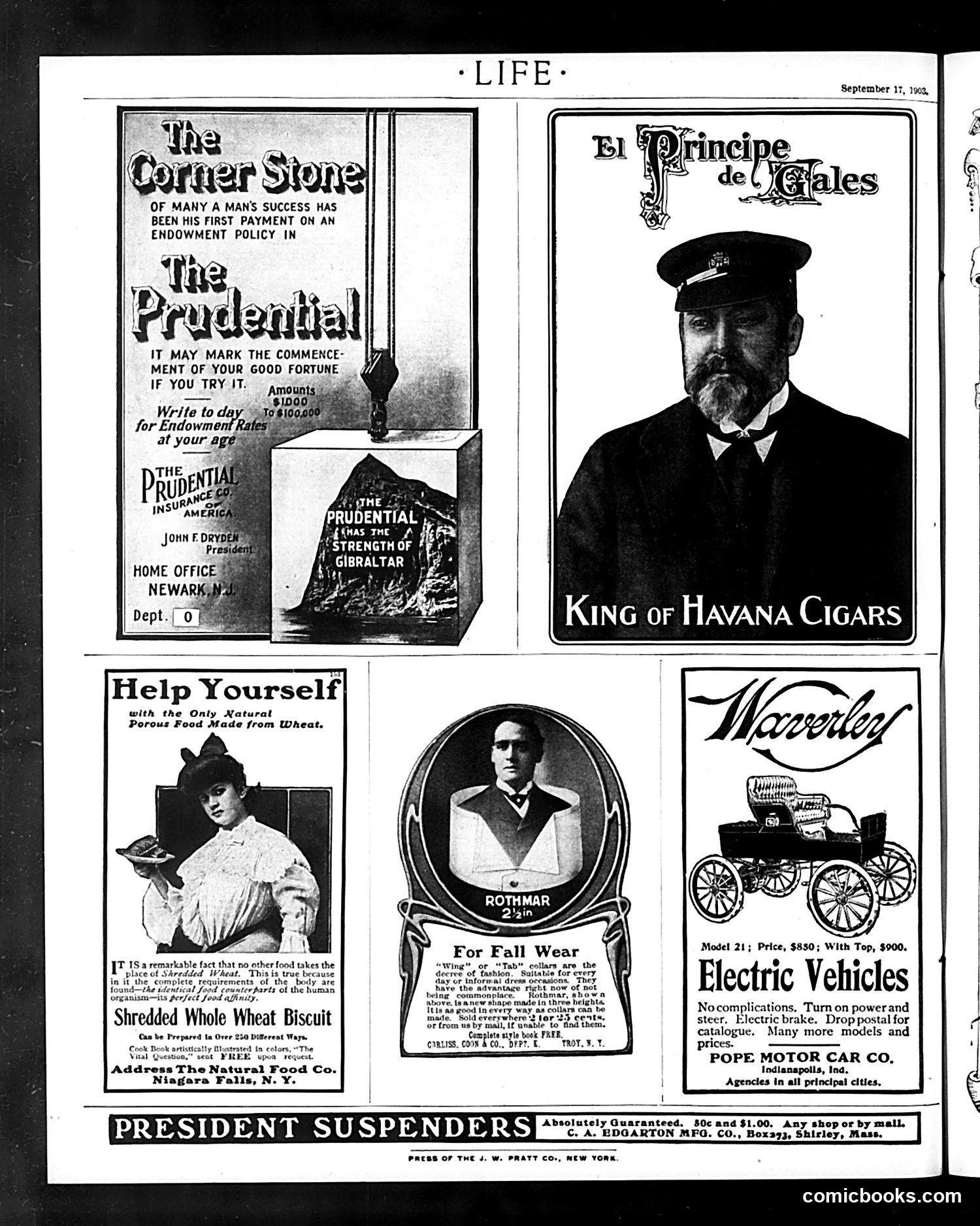
This is primarily an **advertising page** rather than satirical content. It contains five commercial advertisements typical of early 1900s American magazines: 1. **The Prudential Insurance** (top left): Promotes endowment life insurance policies, using the famous "Strength of Gibraltar" imagery as their corporate symbol. 2. **El Príncipe de Gales Cigars** (top right): Features a bearded man in captain's uniform marketing Havana cigars as a luxury product. 3. **Shredded Whole Wheat Biscuit** (bottom left): Promotes a breakfast cereal as complete nutrition, claiming it contains all bodily requirements. 4. **Rothmar** (center): An unspecified fashion or clothing advertisement. 5. **Waverly Electric Vehicles** (right): Markets electric automobiles as simple, uncomplicated transportation—a significant technology in 1903 before gasoline engines dominated. The page reflects period consumer culture: life insurance, luxury goods, processed foods marketed as scientific nutrition, and early automotive innovation.