
Life, 1903-09-17 · page 8 of 20
Life — September 17, 1903 — page 8: what you’re looking at
What you’re looking at
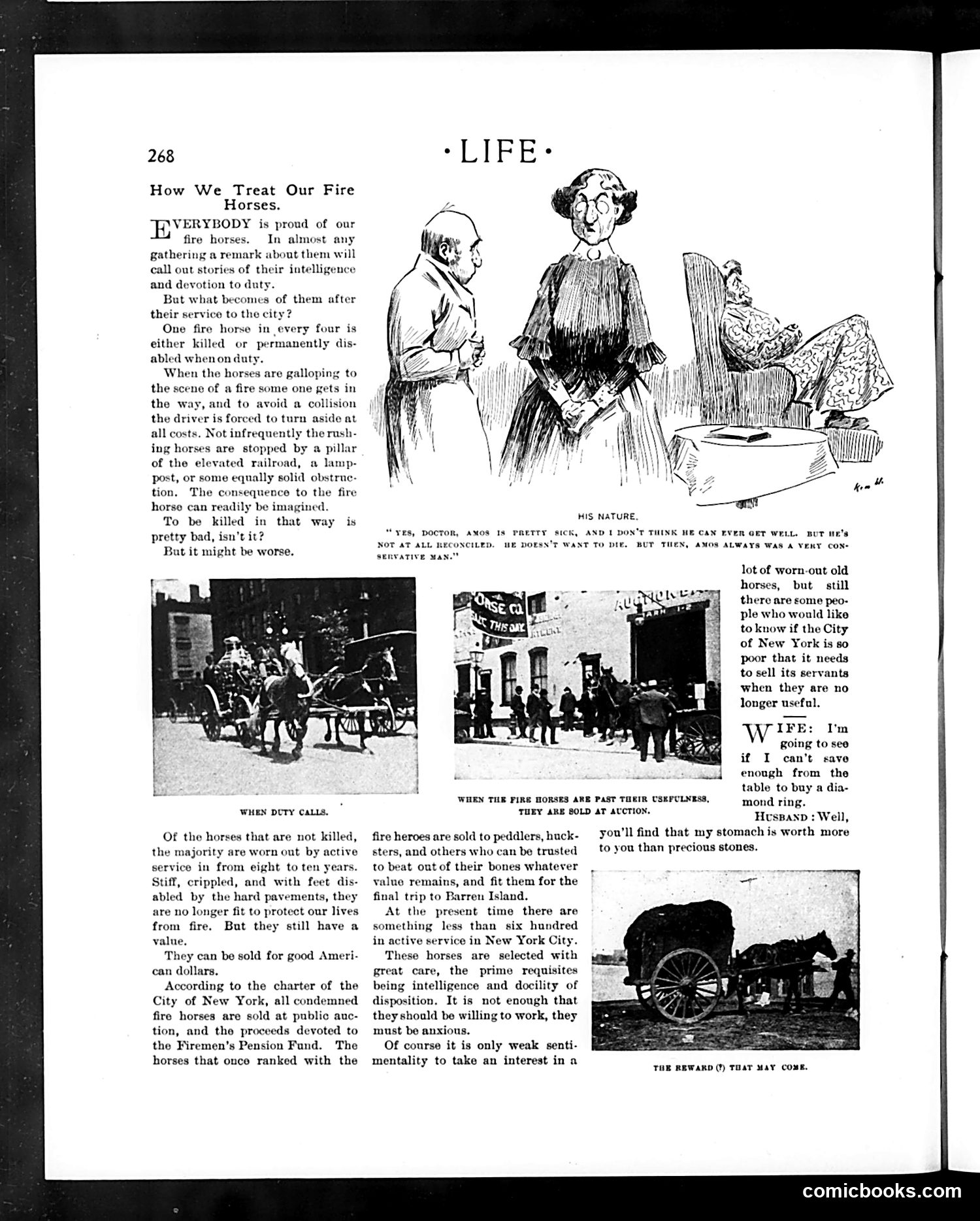
This page discusses the fate of New York City's fire department horses. The article explains that retired fire horses—once vital to the city's emergency services—faced grim outcomes: one in four was killed or permanently disabled during service. When no longer useful, these horses were sold at auction to knackers and peddlers who would beat them to extract remaining value before sending them to Farren Island (likely a rendering facility). The accompanying cartoon satirizes this callousness through a domestic scene where a wife suggests selling her husband to buy jewelry, mirroring how the city discards its worn-out servants. The photographs show fire horses in active service and at auction. The piece critiques New York's disposable treatment of animals that once served the public faithfully.
📄 Transcribed text from this page (OCR, searchable)
Machine-transcribed from the original scan — historical spelling and the odd misread are preserved.
268 How We Treat Our Fire Horses. Byer tsopy is proud of our fire horses. In almost any gathering a remark about them will call out stories of their intelligence and devotion to duty. But what becomes of them after their service to the city? One fire horse in every four is either killed or permanently dis- abled whenon duty. When the horses are galloping to the scene of a fire some one gets in the way, and to avoid a collision the dri is forced to turn aside at all costs. Not infrequently the rush- ing horses are stopped by a pillar of the elevated railroad, a lamp- post, or some equally solid obstrue- tion. The consequence to the fire horse can readily be imagined. To be killed in that wa pretty bad, isn’t it? But it might be worse. WHEN DUTY CALLS. Of the horses that are not killed, the majority are worn out by active service in from eight to ten years. Stiff, crippled, and with feet dis- abled by the hard pavements, they are no longer fit to protect our lives from fire. But they still have a value. They can be sold for good Ameri- can dollars, According to the charter of the City of New York, all condemned fire horses are sold at public auc- tion, and the proceeds devoted to the Firemen’s Pension Fund. The horses that once ranked with the HIS NATURE. “YES, DOCTOR, AMOS IS PRETTY SICK, AND I DON'T THINK HE CAN EVER GET WELL. BUT HR's NOT AT ALL RECONCILED. UE DOESN'T WANT To DIE, BUT THEN, AMOS ALWAYS WAS A VEKY CON- SeRvaTIVE lot of worn-out old horses, but still there are some peo- ple who would like to know if the City of New York is so poor that it needs to sell its servants when they are no longer useful. V IFE: I'm going to seo if I can't save enough from the table to buy a dia- WHEN THE FIRE HORSES ARE PAST THEIR USEFULNESS, mond ring. TUEY ARE SOLD AT AUCTION. Hussanp : Well, fire heroes are sold to peddlers, huck- You'll find that my stomach is worth more sters, and others who can be trusted to you than precious stones. to beat outof their bones whatever value remains, and fit them for the final trip to Barren Island. At the present time there are something less than six hundred in active service in New York City. These horses are selected with great care, the prime requisites being intelligence and docility of disposition. It is not enough that they should be willing to work, they must be anxious. Of course it is only weak senti- mentality to take an interest in a ee en comicbooks.com