
Life, 1903-09-17 · page 12 of 20
Life — September 17, 1903 — page 12: what you’re looking at
What you’re looking at
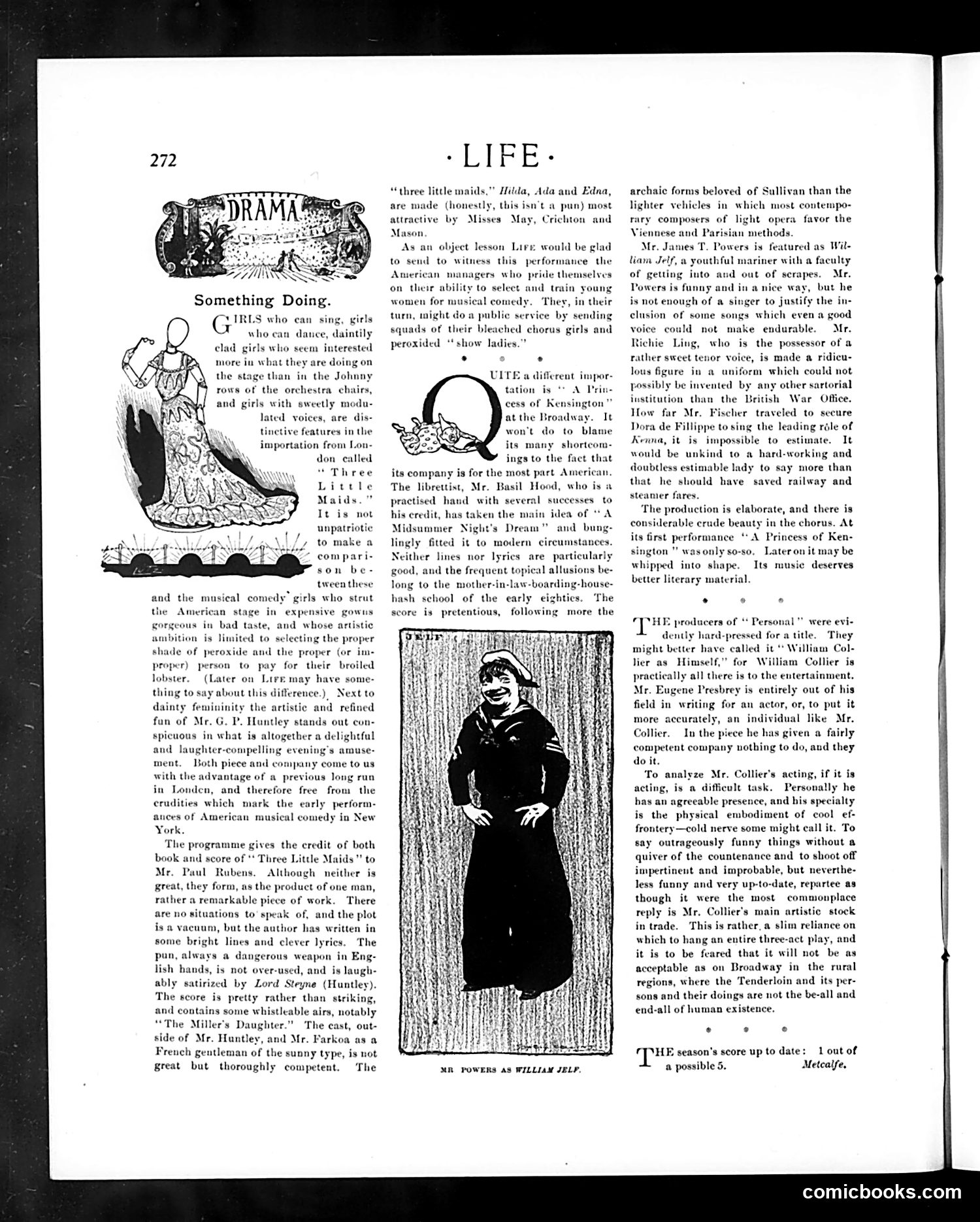
This page reviews theatrical productions, particularly "Something Doing," a musical comedy featuring young female performers in a chorus. The text criticizes how American theaters exploit attractive young women in minimal costumes, praising this production for avoiding such excess. The illustration shows **Mr. James T. Powers as William Jelf**, a character described as "a youthful mariner." The accompanying review praises Powers's performance, noting his ability to deliver funny lines with natural timing and his agreeable stage presence. The satire targets the entertainment industry's tendency to prioritize visual spectacle over genuine talent, while commending productions that emphasize artistic merit and refined comedy instead. The review concludes that the production deserves better literary material.
📄 Transcribed text from this page (OCR, searchable)
Machine-transcribed from the original scan — historical spelling and the odd misread are preserved.
Something Doing. TUIRLS who can sing, girls who can dance, daintily clad girls who seem interested more in what they are in the Jo hestra chairs, and girls with sweetly modu- the stage than rows of the o ated voices, are dis- ‘e features in the importation fe don called Lon- not unpatriotic to make a com pari- son tween these girls who strut expensive gowns and the musical con the American stage in gorgeous in bad taste, and whose artistic anbition is limited to selecting the proper shade of peroxide and the proper (or proper) person to pay for their broiled lobster. (Later on Lire may have some- y about this difference.) Next to thing to s: dainty femininity the artistic and refined fun of Mr. G. P. Huntley stands out con- spicuous in what is altogether a delightful and laughter-compelling evening's amuse- ment. oth piece a pany come to us with the advantage of a previous Jong run in Londen, and therefore free from the crudities which mark the early perforn auces of American musical comedy in } York. The programme gives the credit of both book and score of ** Three Little Maids" to Mr. Paul Rubens. Although neither is great, they form, as the product of one man, rather a remarkable piece of work. There are no situations to’ speak of, and the plot is a vacuum, but the author has written in some bright lines and clever lyrics. The pun, always a dangerous weapon in Eng- lish hands, is not over-u 1 co: , and is laugh- ably satirized by Lord Steyne (Huntley). The score is pretty rather than striking, and contains some whistleable airs, notably “The Miller's Daughter.” The cast, out- side of Mr. Huntley, and Mr. F French gentleman of the sunny ty Breat but thoroughly competent. The ‘LIFE: “three little maids,” Hilda, Ada and Edna, are made (honestly, this isn’t a pun) most attractive by Misses May, Crichton and Mason As an object lesson Lire: would be glad to send to witness this perf ce the American managers who pride themselves on their ability to select and train young women for musical comedy. ‘The turn, wight doa public service by squads of their bleached chorus giels and peroxided ‘show ladies.” . . UIT. in their sending a different impor- tation is‘ A Prit cess of Kensington ” atthe Broadway. It blame its many shortcom- ings to the fact that its company is for the most part Americar The librettist, Mr. Basil Hood, who is a practised hand with sever his credit, has taken the 1 won't do to sses_ to a of Midsummer Night's Dream" and bun, lingly fitted it to modern circumstan Neither lines nor lyrics are particular good, and the frequent topical allusions be- long to the mother-in-law-bo hash school of the early ¢ is pretentious, ain id following more the = Ger MR POWERS AS WILLIAM JELP. archaic forms beloved of Sullivan than the lighter vehicles in which most contempo- rary composers of light opera favor the Viennese and Parisian methods. Mr. James T. Powers iy featured as Wil liam Jelf, a youthful mariner with a faculty 1g into and out of scrapes. Mr. Powers is funny and in a nice way, but he hoof a singer to justify the in- clusion of some songs which even a good voice could not make endurable. Mr. Richie Ling, who is the possessor of a rather sweet tenor voice, is made a ridicu- lous figure in a uniform whieh could not y be invented by any other sartorial institution than the British War Office, How far Mr. traveled to secure Dora de Fillippe to sing the leading role of Kenna, it is impossible to estimate. It would be unkind to a hard-working and doubtless estimable lady to say more than that he should have saved railway and steamer fares. The production is elaborate, and there is considerable crude beauty in the chorus. At its first performance ‘A Princess of Ken- sington " wasonly so-so, Later on it may be whipped into shape. Its music deserves better literary material. is not enou Fischer . ° TT! producers of * were e dently hard-pressed for a title. They might better have called it William Col- lier as Himself,” for William Collier is practically all there is to the entertainment, Mr. Eugene Presbrey is entirely out of his field in writing for an actor, or, to put it more accurately, an individual like Mr. Collier. In the piece he has given a fairly competent company nothing to do, aud they do it. To analyze Mr. Collier's acting, if it is acting, is a difficult task. Personally he has an agreeable presence, and his specialty is the physical embodiment of cool ef- frontery—cold nerve some might call it. To say outrageously funny things without a quiver of the countenance and to shoot off impertinent and improbable, but neverthe- less funny and very up-to-date, repartee as though it were the most commonplace reply is Mr. Collier's main artistic stock in trade. This is rather, a slim reliance on which to hang an entire three-act play, and it is to be feared that it will not be as acceptable as on Broadway in the rural regions, where the Tenderloin and its per- sons and their doings are not the be-all and end-all of human existence. . ° ° lout of [HE season's score up to dat Metcalfe. a possible 5. comicbooks.com