
A complete issue · 24 pages · 1903
Life — August 13, 1903
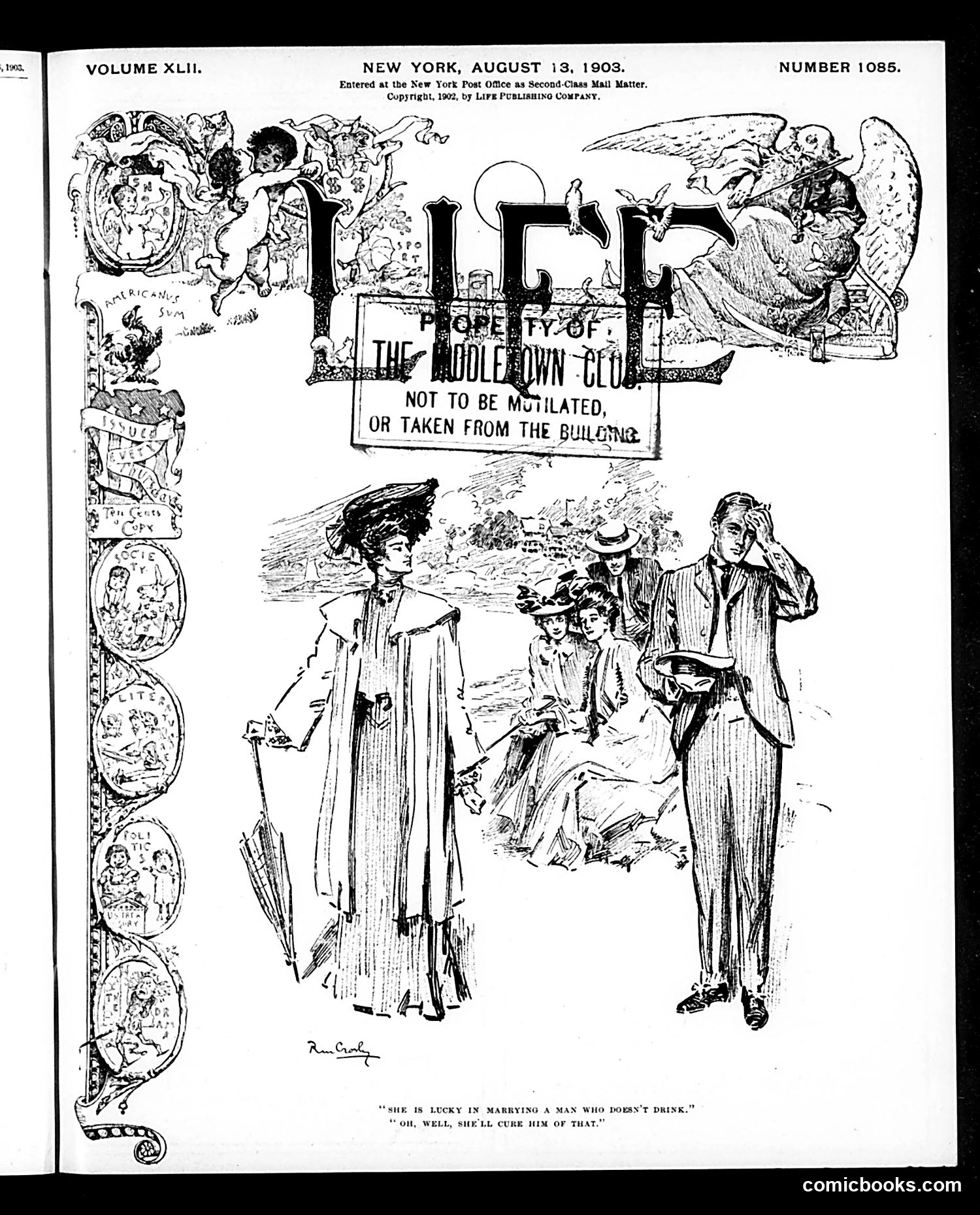
This page features "The Addle-Dwn Club" (likely "Addled-Down Club"), a satirical comic with decorative borders. The main illustration depicts fashionably dressed adults and children in what appears to be a leisure or social setting. The caption reads: "She is lucky in marrying a man who doesn't drink. Oh, well, she'll cure him of that." The satire targets gender dynamics and marriage—specifically the assumption that wives reform husbands' behavior. The joke inverts typical expectations: rather than a wife improving her husband by stopping his drinking, the cartoon suggests she'll corrupt him into drinking. This reflects early 20th-century anxieties about female influence in marriage and satirizes the period's temperance movement rhetoric. The ornate left border contains additional illustrated vignettes, typical of Life's decorative style.
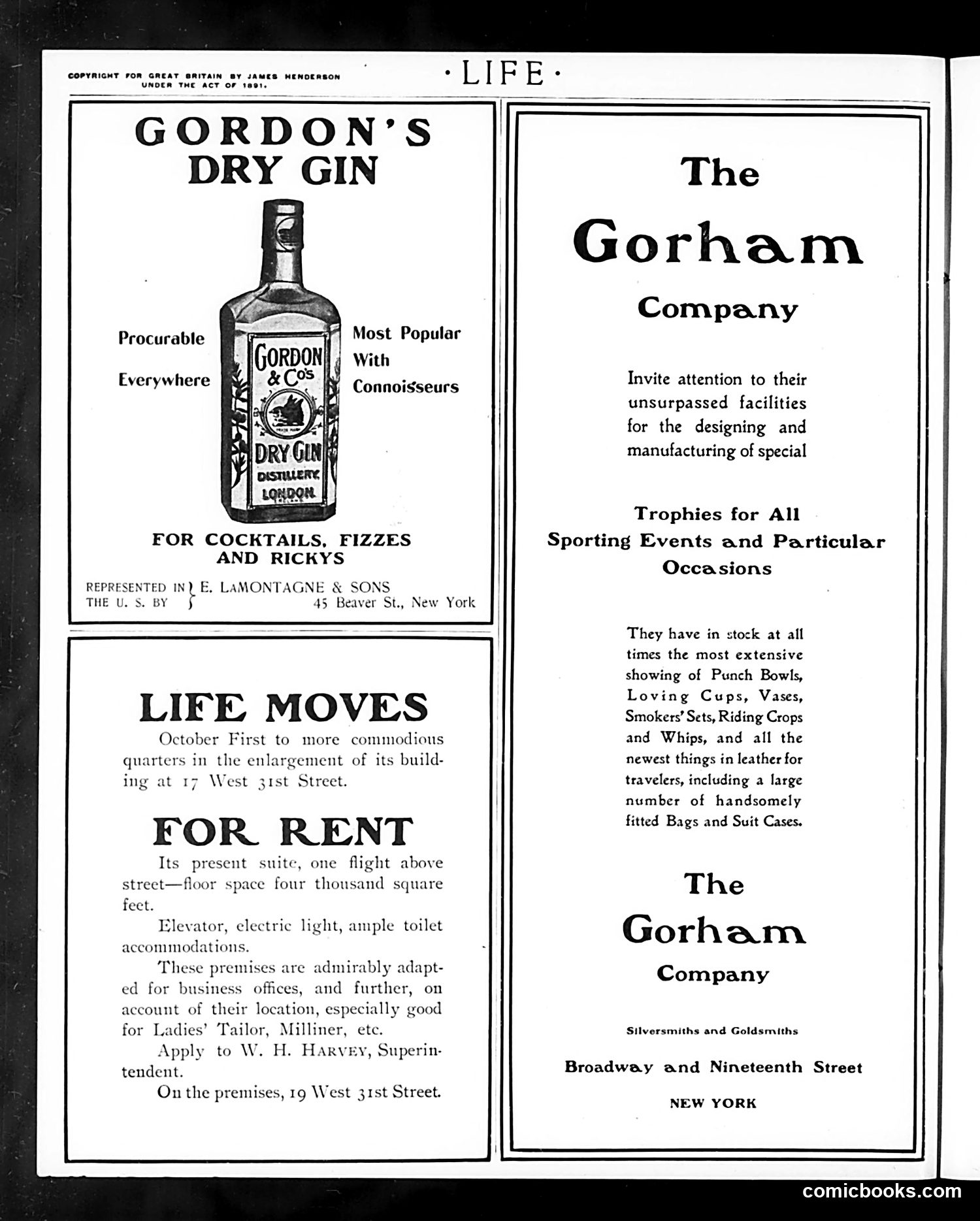
This page contains **no cartoons or satirical content**—it is entirely **advertising**. The page features three ads: 1. **Gordon's Dry Gin** (top left): A liquor advertisement emphasizing the product is "Procurable Everywhere" and "Most Popular With Connoisseurs," suitable for cocktails and mixed drinks. The U.S. representative is listed as E. LaMontagne & Sons in New York. 2. **Life Magazine Office Move** (bottom left): An announcement that *Life* is relocating to larger quarters at 17 West 31st Street in October, with office space available for rent. 3. **The Gorham Company** (right): An advertisement for a silversmith and goldsmith business located on Broadway and Nineteenth Street in New York, promoting trophies and sporting goods.
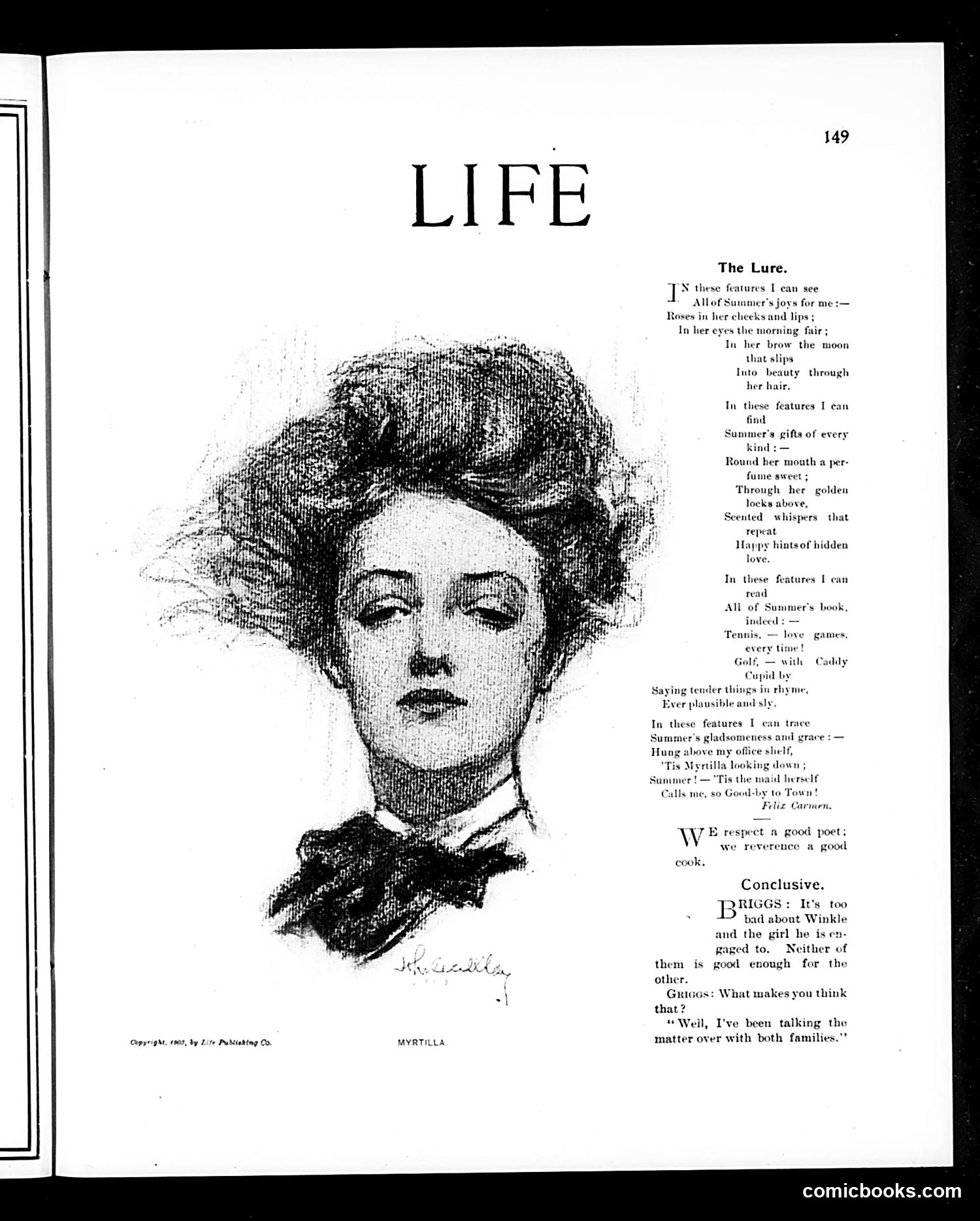
This page from *Life* magazine (page 149) features a portrait titled "Myrtilla" accompanied by a poem called "The Lure" and a short dialogue section titled "Conclusive." The portrait is a sketch of a woman's face with styled upswept hair typical of the early 1900s. The poem praises a woman named Summer for her beauty and charm, describing her physical features and appealing personality. The brief dialogue below involves characters named Briggs and Griggs discussing whether Winkle should marry "the girl he is engaged to," with Briggs declaring neither party "is good enough for the other"—a humorous commentary on mismatched relationships. The overall content appears to be light satirical commentary on courtship, beauty, and romantic compatibility rather than serious political satire.
This page contains two editorial cartoons addressing early 1900s financial and infrastructure debates. The **first cartoon** (top left) depicts a cauldron labeled "SOUP" with figures around it, satirizing stock market speculation. The text criticizes wealthy speculators who lost fortunes in market crashes, suggesting they operated on greed rather than legitimate business principles. The **second cartoon** (bottom) shows what appears to be industrial/commercial figures, accompanying discussion of two major canal projects: the **Panama Canal** and a proposed **Erie Canal** expansion. The text debates whether these are sound investments or financial schemes, questioning whether New York State should fund canal improvements versus the New York Central Railroad. The satire targets both reckless speculation and government infrastructure spending decisions of the era.
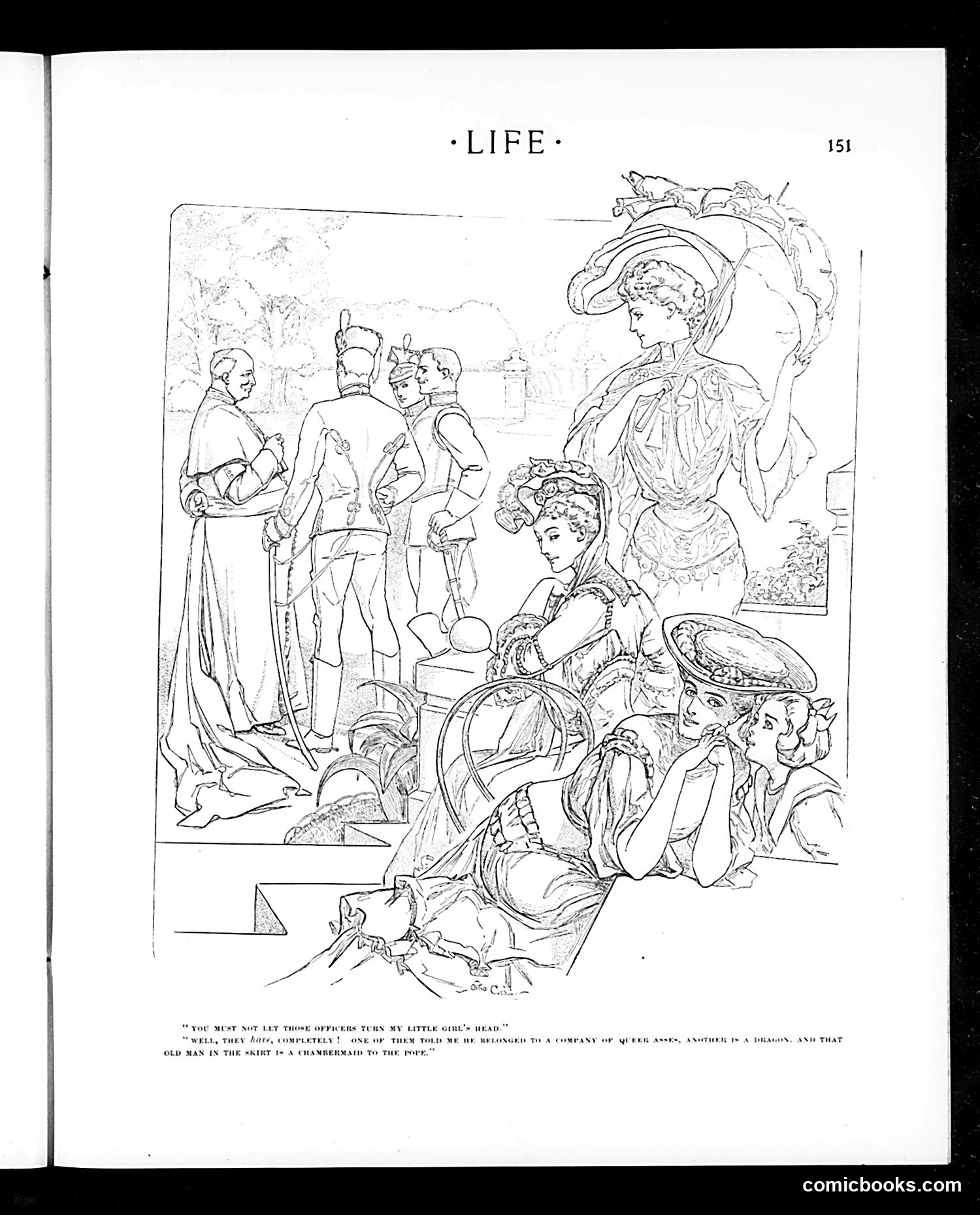
This illustration depicts a social scene involving military officers and women in elaborate Edwardian-era dress. The caption references an old man in the shirt as "a chambermaid to the pope," suggesting he's been demoted or humiliated. The dialogue indicates officers are discussing turning a young girl's head, with one claiming to belong to "a company of queen asses" and another claiming to be "a dragon." The satire appears to target military pretension and romantic entanglement—poking fun at officers' vanity and their tendency toward exaggeration about their importance and exploits. The "queen asses" and "dragon" comments seem deliberately absurd, mocking the grandiose self-descriptions soldiers might offer to impress women. The overall tone satirizes the intersection of military ego and courtship dynamics.
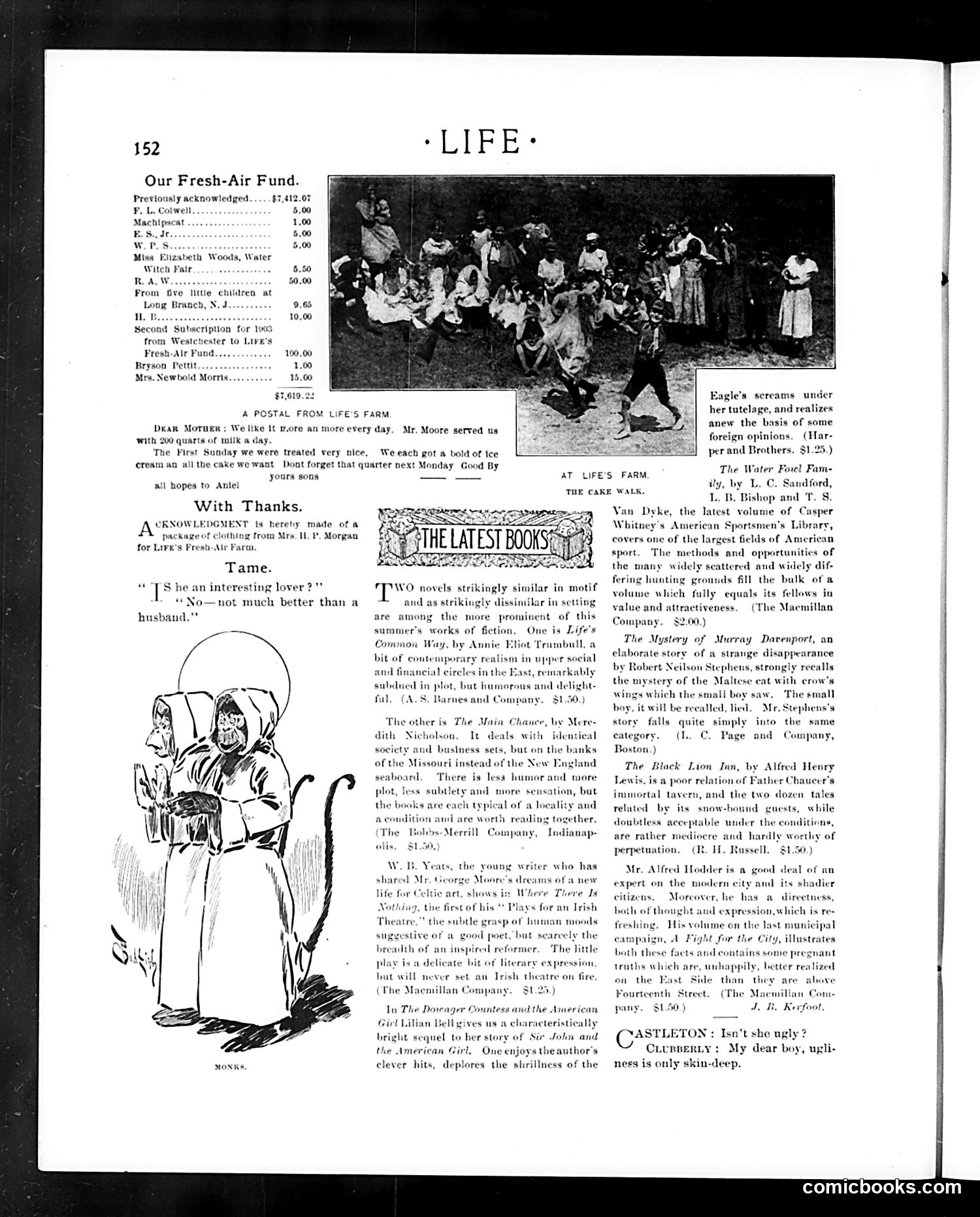
This page contains charitable fundraising notices, book reviews, and a single cartoon labeled "Tame." **The Cartoon:** The illustration shows a woman in a large dress carrying a child, rendered in a simple line-drawing style. The caption reads: "Is he an interesting lover?" "No—not much better than a husband." **The Joke:** This is a marital satire common to the era, suggesting that husbands are dull or unexciting as romantic partners—a cynical commentary on marriage. The woman's oversized dress and the child she carries emphasize domesticity and motherhood as her reality versus any romantic idealization. **Context:** The humor relies on early 20th-century assumptions about marriage being more practical than passionate, a recurring theme in Life's satirical content. The drawing style is deliberately crude, matching the joke's bluntness.
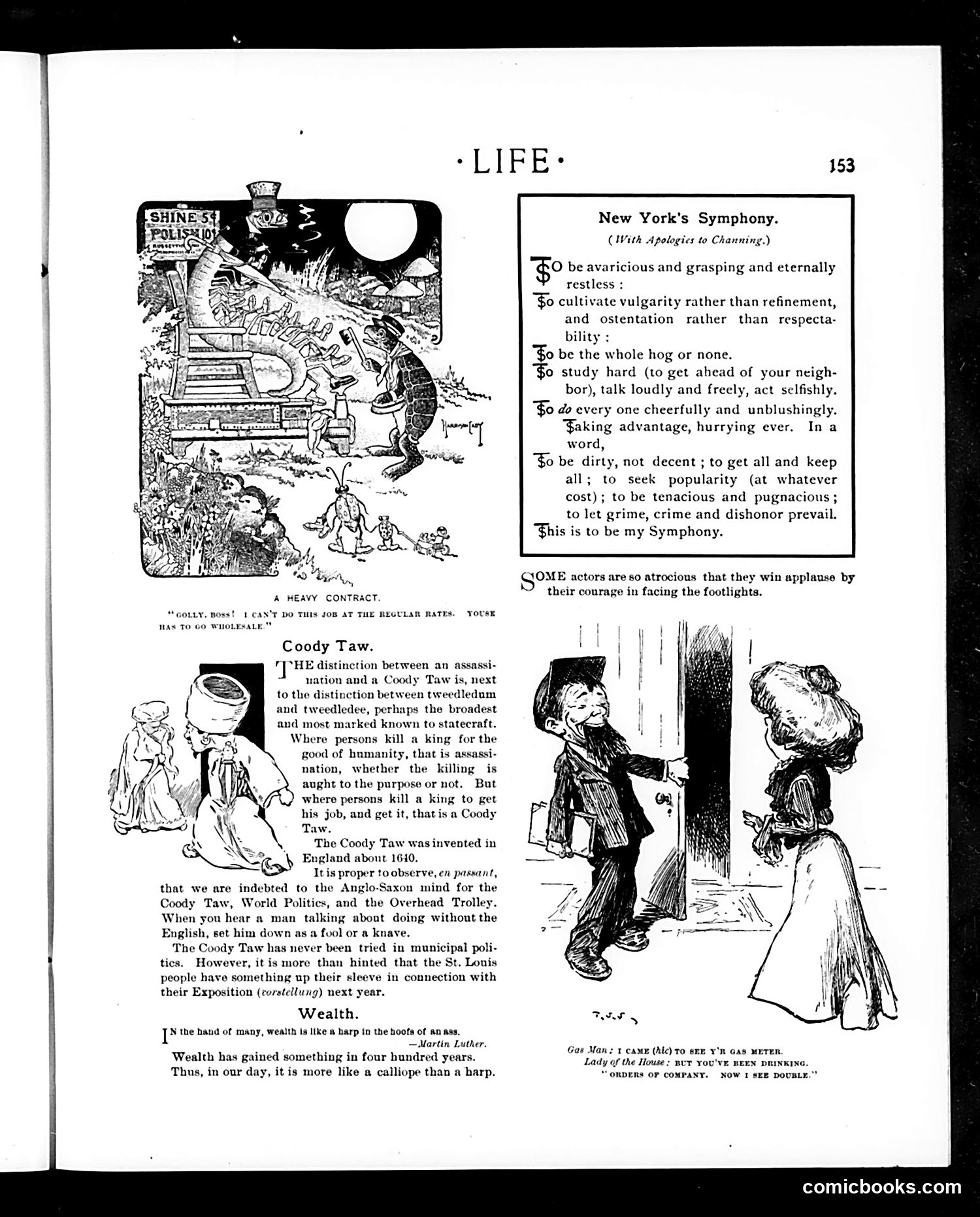
This page contains three satirical pieces from Life magazine: 1. **"A Heavy Contract"** (top left cartoon): Shows a messy, chaotic scene with the caption about "Colly, Boss! I can't do this job at the regular rates—you'll have to go wholesale." This appears to satirize labor disputes or contract negotiations, likely referencing Teddy Roosevelt-era labor conflicts. 2. **"New York's Symphony"** (right panel): A mock manifesto sarcastically describing corrupt behavior—being greedy, vulgar, selfish, and dishonest. This satirizes New York City's perceived moral decline and civic corruption during the Progressive Era. 3. **"Coody Taw"** and **"Wealth"** sections: These discuss morality and financial success, with accompanying sketch humor about social hypocrisy and class distinctions. The overall theme critiques American greed, corruption, and moral compromise of the period.
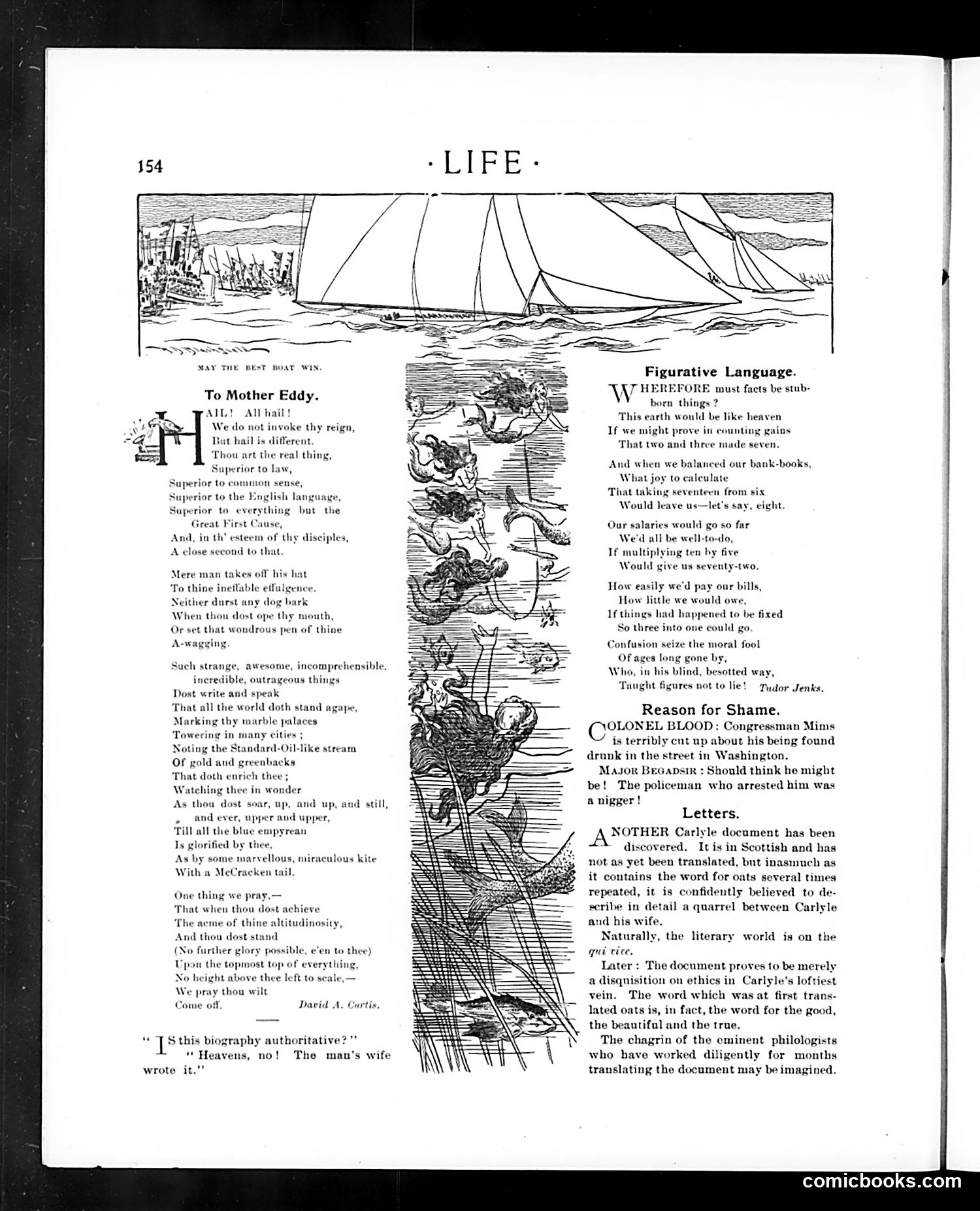
This page contains three distinct sections: a sailing poem ("May the Best Boat Win"), a poem "To Mother Eddy" (likely Mary Baker Eddy, founder of Christian Science), and satirical commentary pieces. The central illustration depicts tangled fishing lines with human figures caught in knots—a visual metaphor for confusion or entanglement. **"Reason for Shame"** mocks Colonel Blood and Congressman Mims, referencing an incident where Mims was found drunk in Washington streets. The satire criticizes both his intoxication and the arresting officer's racial prejudice (calling the officer "a nigger"). **"Letters"** discusses a newly discovered Carlyle document, joking about scholarly excitement over finding the word "oats" repeated multiple times—mocking both pretentious literary analysis and the trivial nature of the actual discovery. The humor relies on period-specific political and cultural references now requiring historical context.
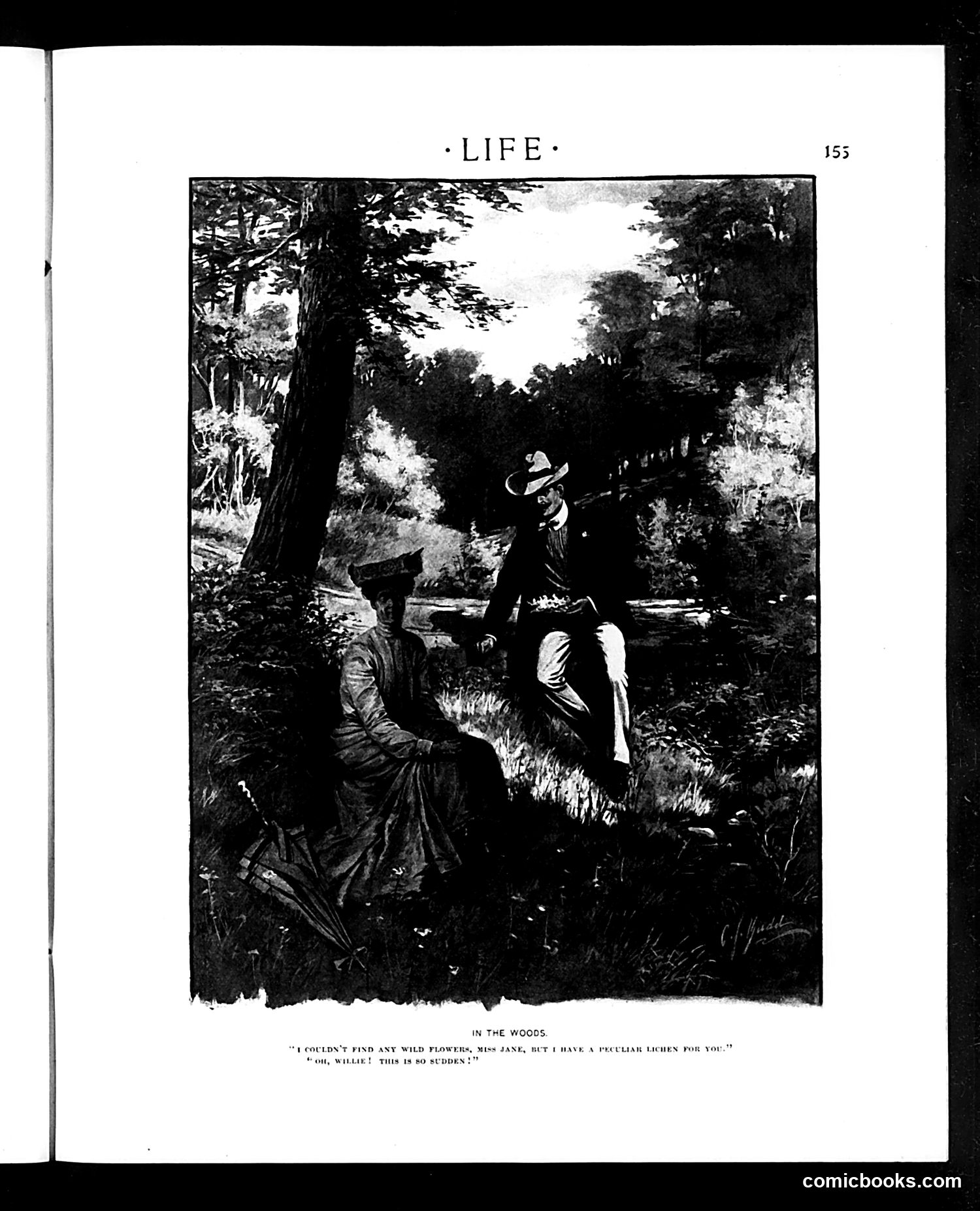
This illustration depicts a romantic woodland scene with two figures. The caption reads: "I COULDN'T FIND ANY WILD FLOWERS, MISS JANE, BUT I HAVE A PECULIAR LICHEN FOR YOU." / "OH, WILLIE! THIS IS SO SUDDEN!" The humor is a **pun-based joke**: "lichen" (a fungus-algae organism) sounds identical to "liking," creating a double entendre. Willie presents a botanical specimen as a romantic gesture, misusing the scientific term while attempting courtship. The woman's exaggerated response ("This is so sudden!") parodies melodramatic romantic reactions, treating the awkward botanical "compliment" as if it were a marriage proposal. This reflects early 20th-century Life magazine's characteristic style: gentle, wordplay-driven humor targeting educated middle-class audiences familiar with both science and Victorian romance conventions.
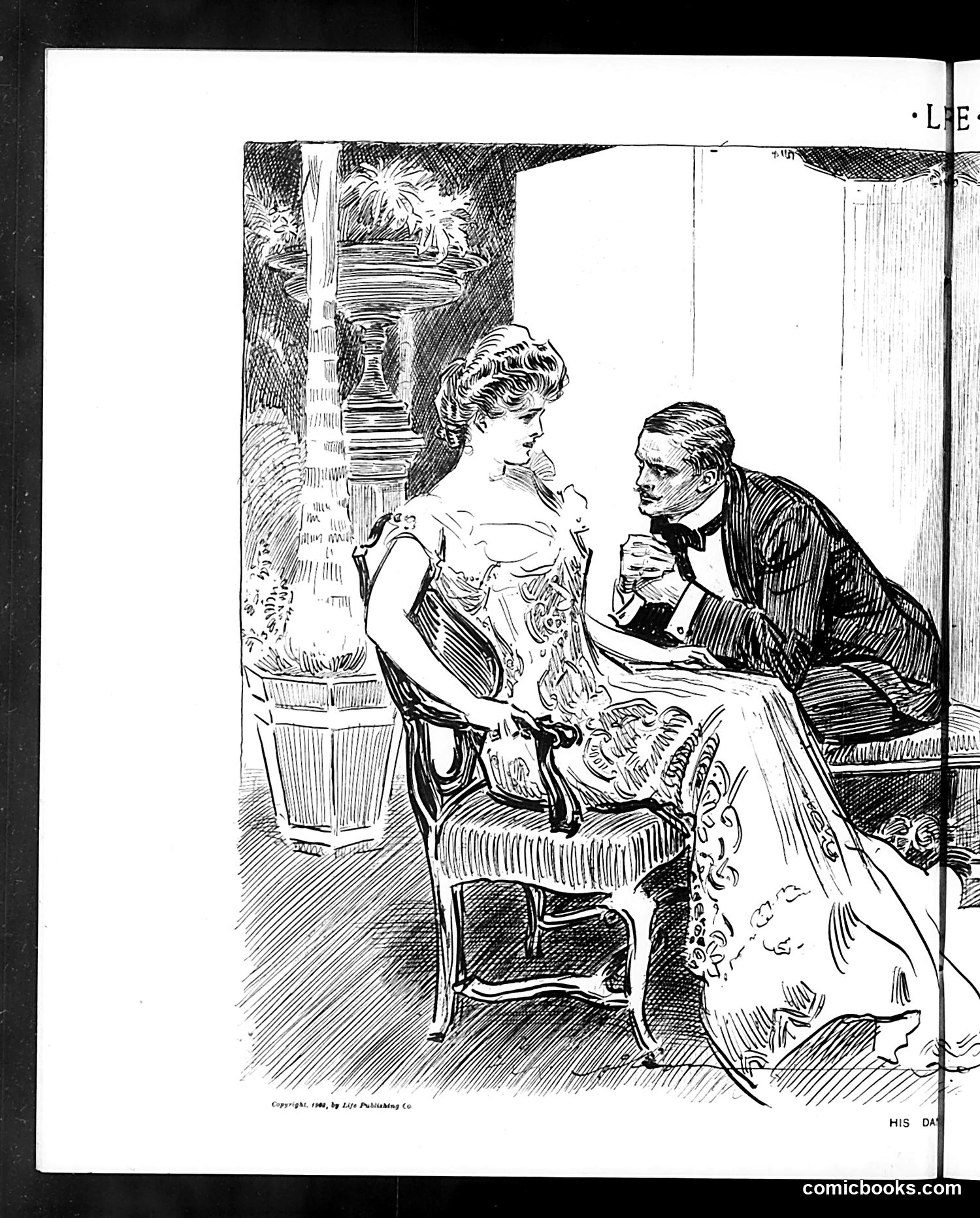
This is a black-and-white sketch showing two figures in an intimate interior setting. A woman in elegant dress sits while a man in formal attire (tuxedo and bow tie) leans toward her in conversation. Without visible caption text or clearer context from the OCR, the specific satirical target remains **unclear**. The composition suggests commentary on **courtship, seduction, or social interaction between classes or social types**—common Life magazine themes of the era (copyright visible: 1906, Life Publishing Co.). The formal dress and domestic setting imply this may satirize either **romantic pretense among the wealthy** or **social climbing dynamics**. However, without identifying captions or additional text visible in the image, I cannot definitively state which political or social figure is being caricatured or what specific event or behavior is being mocked.
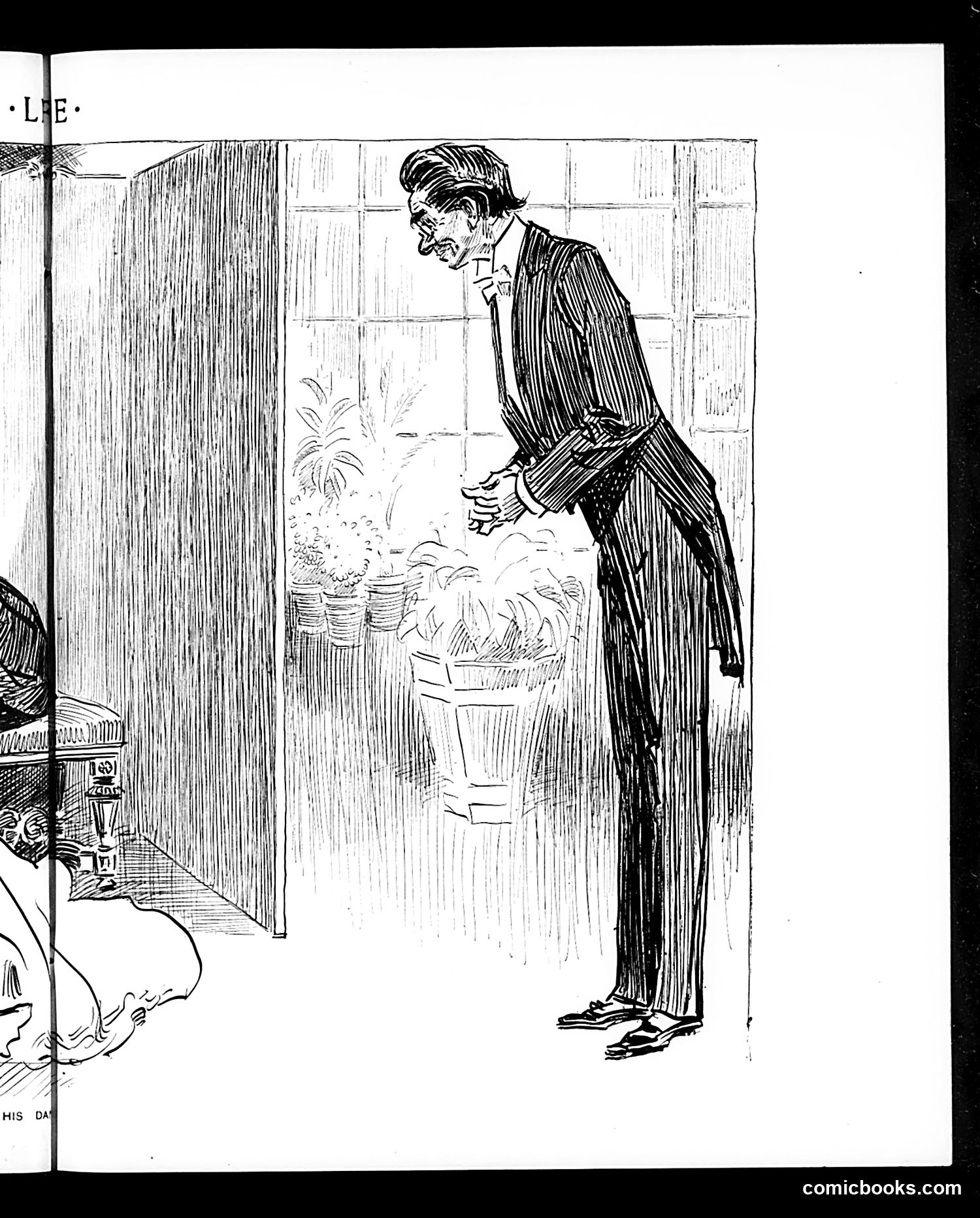
This appears to be a single-panel cartoon from *Life* magazine showing a well-dressed man in a pinstriped suit looking disapprovingly at potted plants on a windowsill. The man's posture and expression suggest complaint or displeasure. Without visible text or caption, the cartoon's specific meaning is unclear. However, the composition suggests social satire about domestic life—possibly mocking fastidious housekeeping standards, a husband's complaint about his wife's plant collection, or class-conscious concern with home decoration. The man's exaggerated profile and caricatured features are typical of *Life*'s satirical style. The exact reference or topical joke remains uncertain without accompanying caption text visible in this image.
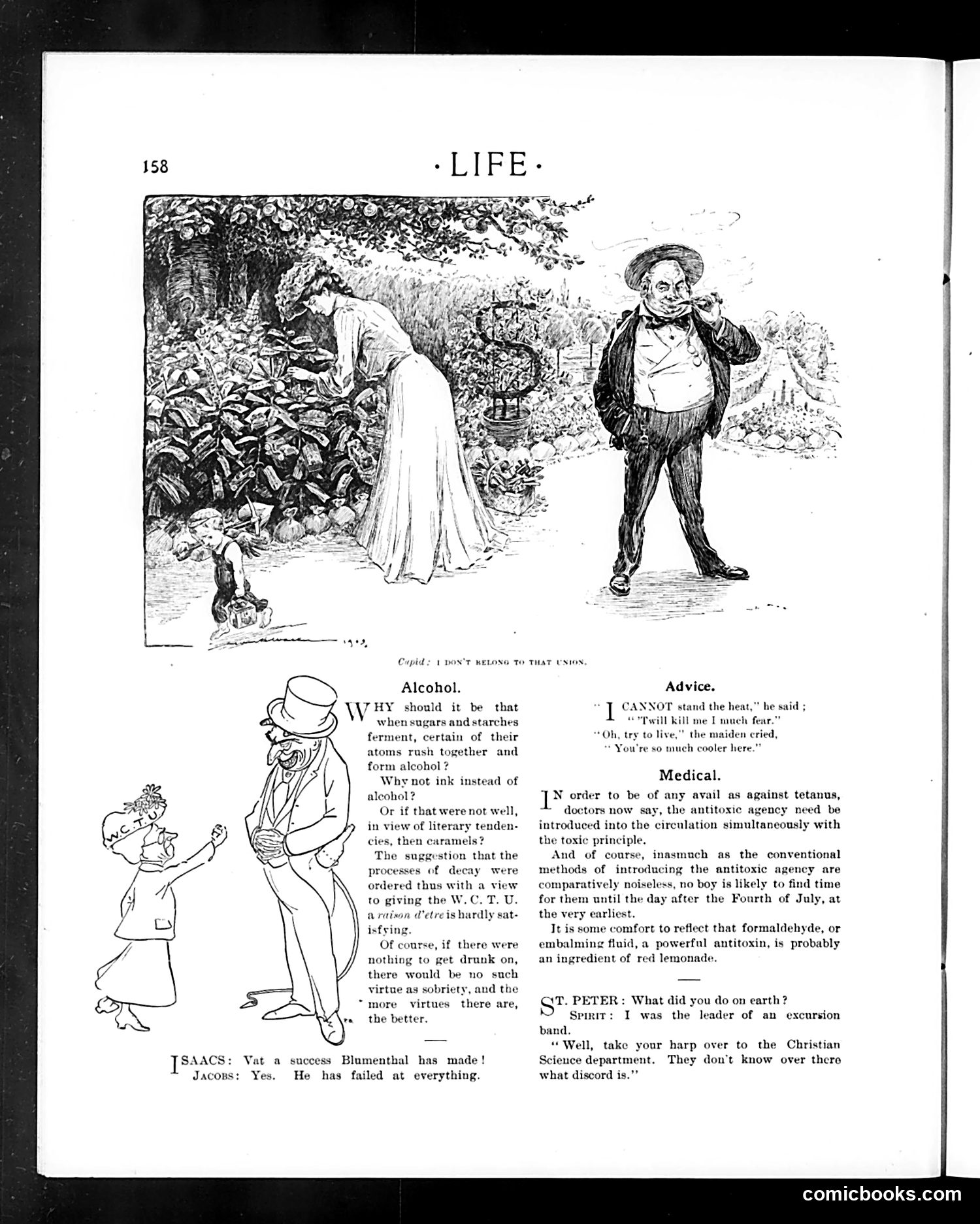
This page features satirical commentary on three topics: **"Alcohol"** (top): The cartoon depicts a well-dressed man rejecting a woman's advances in a garden, captioned "I don't belong to that union." The accompanying text humorously questions why society ferments sugars into alcohol rather than ink, suggesting fermentation processes could serve better purposes. A small sketch below shows two characters (Isaacs and Jacobs) discussing a "successful blumenthal" who "has failed at everything"—likely mocking a public figure or business failure. **"Advice"** and **"Medical"**: Brief satirical columns offering humorous guidance and commentary on medical practices, including references to tetanus treatment and formaldehyde. The overall tone reflects turn-of-century American satirical humor targeting contemporary social attitudes, scientific developments, and public figures.
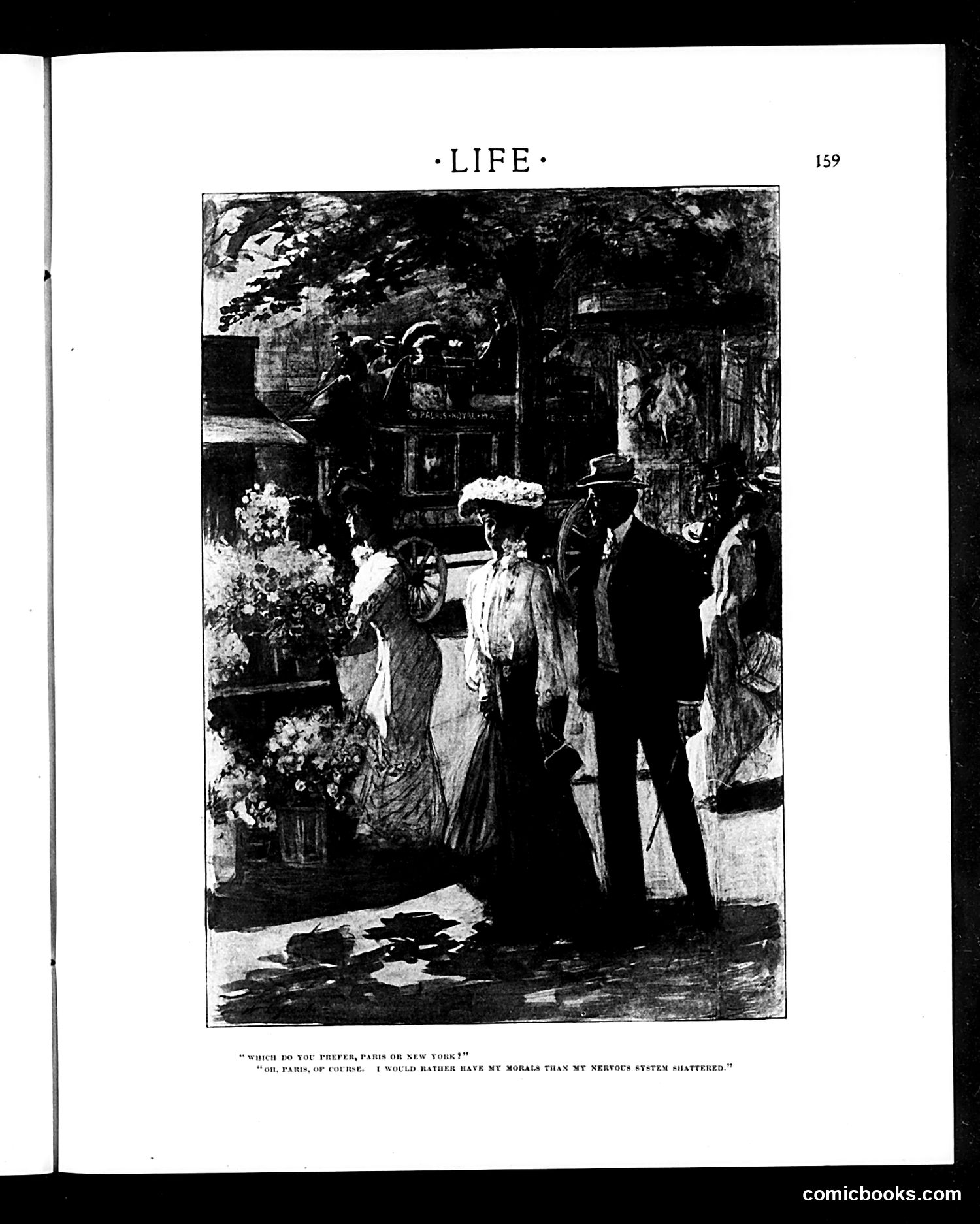
This single illustration depicts a sophisticated social scene, likely from the early 20th century based on the clothing and art style. The dialogue presents a conversation between two figures about preferring Paris or New York, with one character stating they'd "rather have my morals than my nervous system shattered." The satire contrasts Paris's reputation for moral permissiveness with New York's frenetic, stressful pace. The joke suggests that while Paris might compromise one's morals through its decadent lifestyle, New York's intensity damages one's nerves—implying both cities have their corrupting effects, just different ones. The cartoon mocks both European and American urban culture, playing on contemporary stereotypes about each city's social character and pace of life. The formal dress and garden setting suggest this targets upper-class concerns about how cosmopolitan living affects refinement.
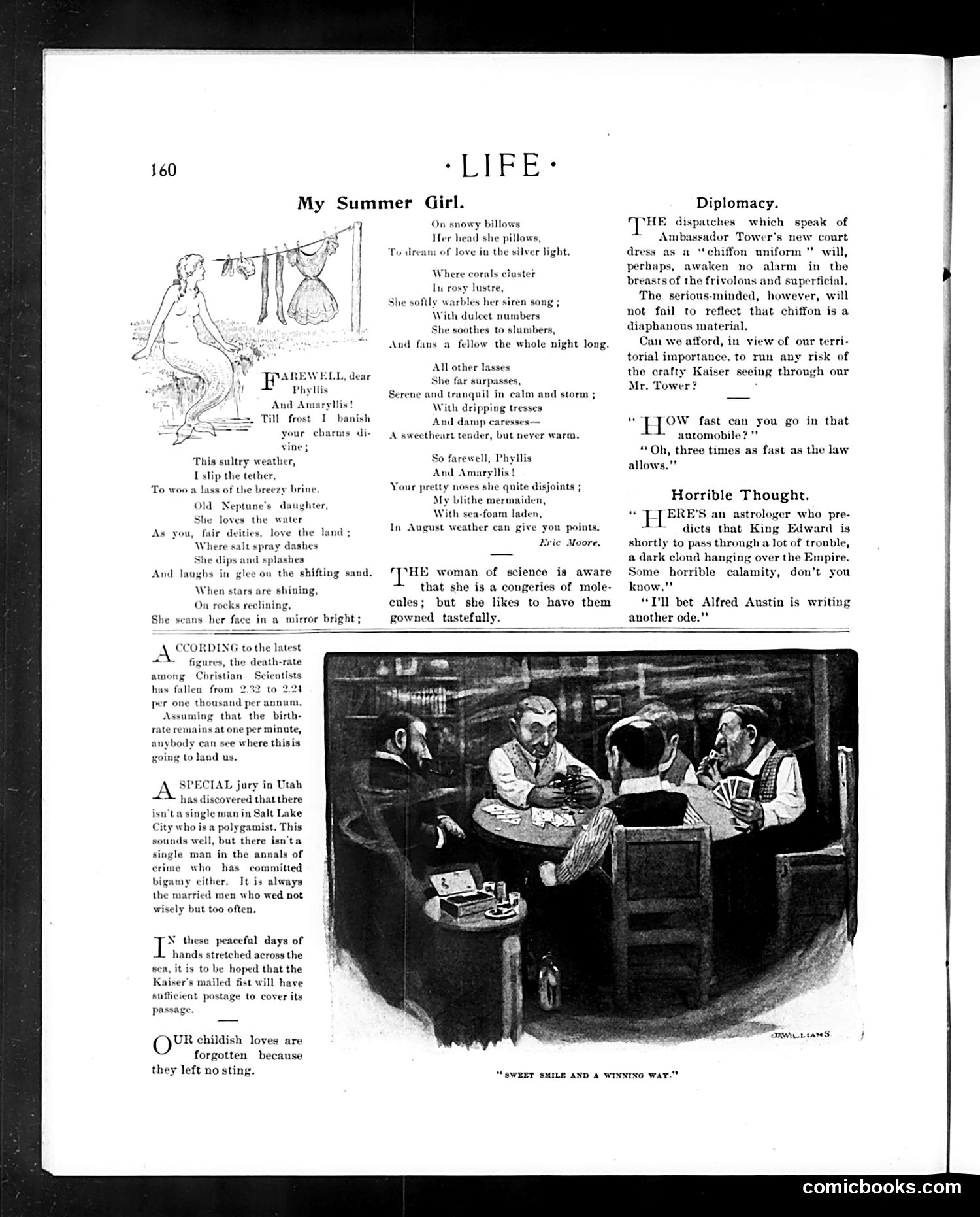
This page contains light satirical commentary typical of early 20th-century Life magazine. The main elements: **"My Summer Girl"** is a romantic poem about a man's infatuation with a mermaid-like woman who loves the sea—a playful fantasy piece with accompanying illustration. **"Diplomacy"** mocks Ambassador Tower's new court uniform described as "chiffon"—a delicate, transparent fabric. The satire suggests it's absurd for a diplomat representing America's territorial interests to wear such an insubstantial material, playing on anxieties about appearing weak internationally. **"Horrible Thought"** jokes that an astrologer predicting King Edward will face trouble must inspire poet Alfred Austin to write another ode—satirizing Austin as predictably dramatic and opportunistic. The remaining brief items offer social observations: Christian Scientists' low death rates, Utah's claim of no polygamists, the Kaiser's postage costs, and forgotten childhood loves. The central photograph captioned "Sweet Smile and a Winning Way" depicts what appears to be a business or social gathering, though its specific context isn't clear from the text.
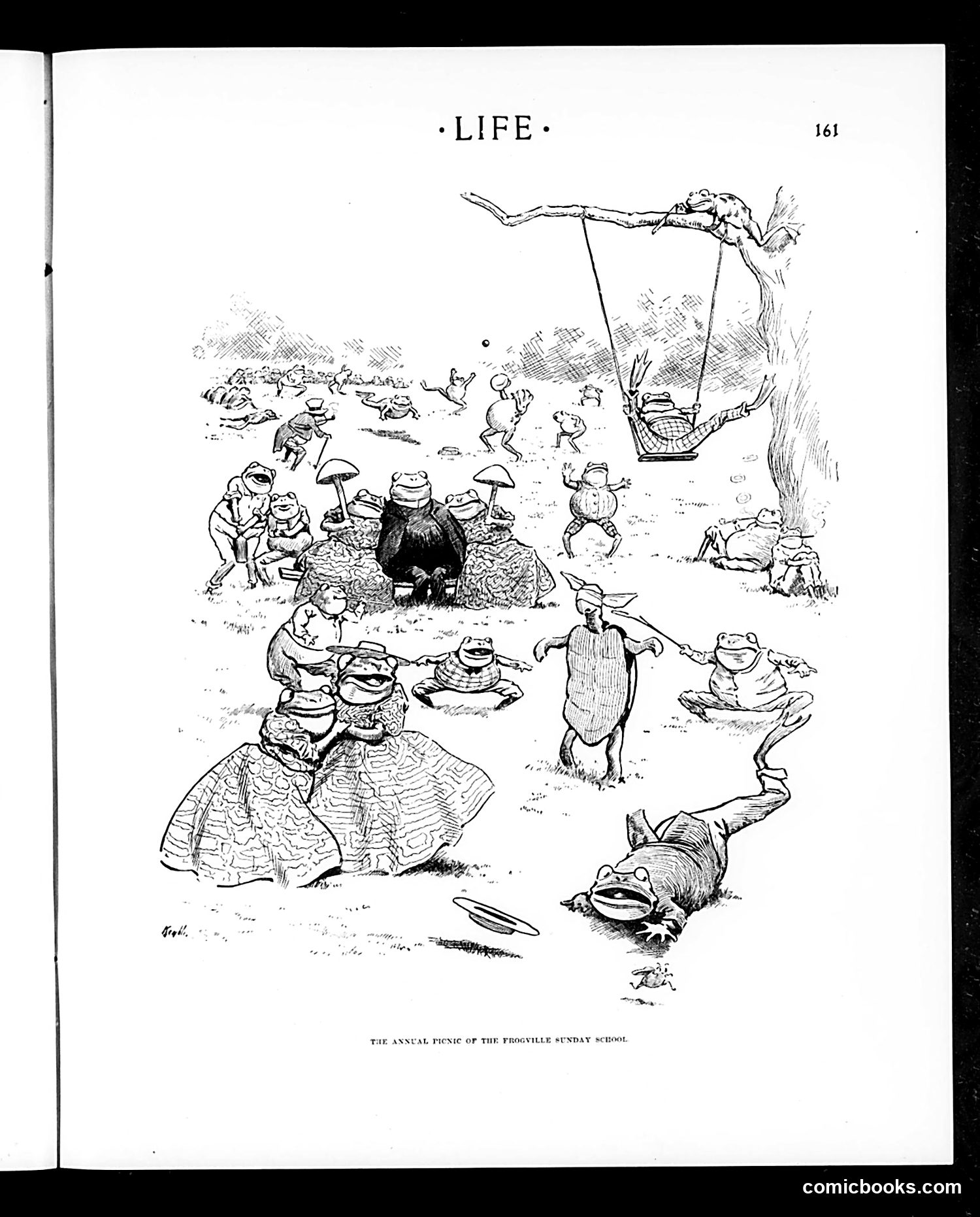
This is a humorous illustration depicting anthropomorphic frogs enjoying a picnic outing. The scene shows numerous frog characters engaged in typical leisure activities—some seated eating, others swinging on a rope swing, playing games, or resting under umbrellas for shade. The satire appears to be gentle social commentary: by portraying frogs conducting a "Sunday School" picnic with human social conventions and recreational pursuits, the cartoonist creates absurdist humor through the incongruity of animals mimicking civilized human behavior. The detailed rendering of frog anatomy alongside human-like activities and clothing produces a whimsical effect typical of early Life magazine's satirical approach to American social customs and leisure culture.
This page primarily contains **humorous short anecdotes** rather than political cartoons, presented as typical Life magazine satirical content. **"A Dry Land Mermaid"** mocks the Salt Lake Herald's report of a young woman with fish scales living in Salt Lake City—likely a tall tale or hoax the magazine treats with playful skepticism. **"The American Abroad"** satirizes a common stereotype: the boastful American tourist who exaggerates stories to impress English society. The story depicts an American man at a dinner party constantly "bluffing" and name-dropping ("I had a cousin in Virginia..."), then being literally kicked under the table by an English host to signal he should stop. **"The Substitute"** presents a publishing anecdote where an author's repeated mention that he revised his manuscript five times paradoxically convinces passengers to buy copies. The page is primarily **advertising** (Wilson Whiskey, Glen Springs, Carl H. Schultz minerals, Esterbrook pens), with these brief humorous sketches filling space between ads—typical Life magazine format of the era.
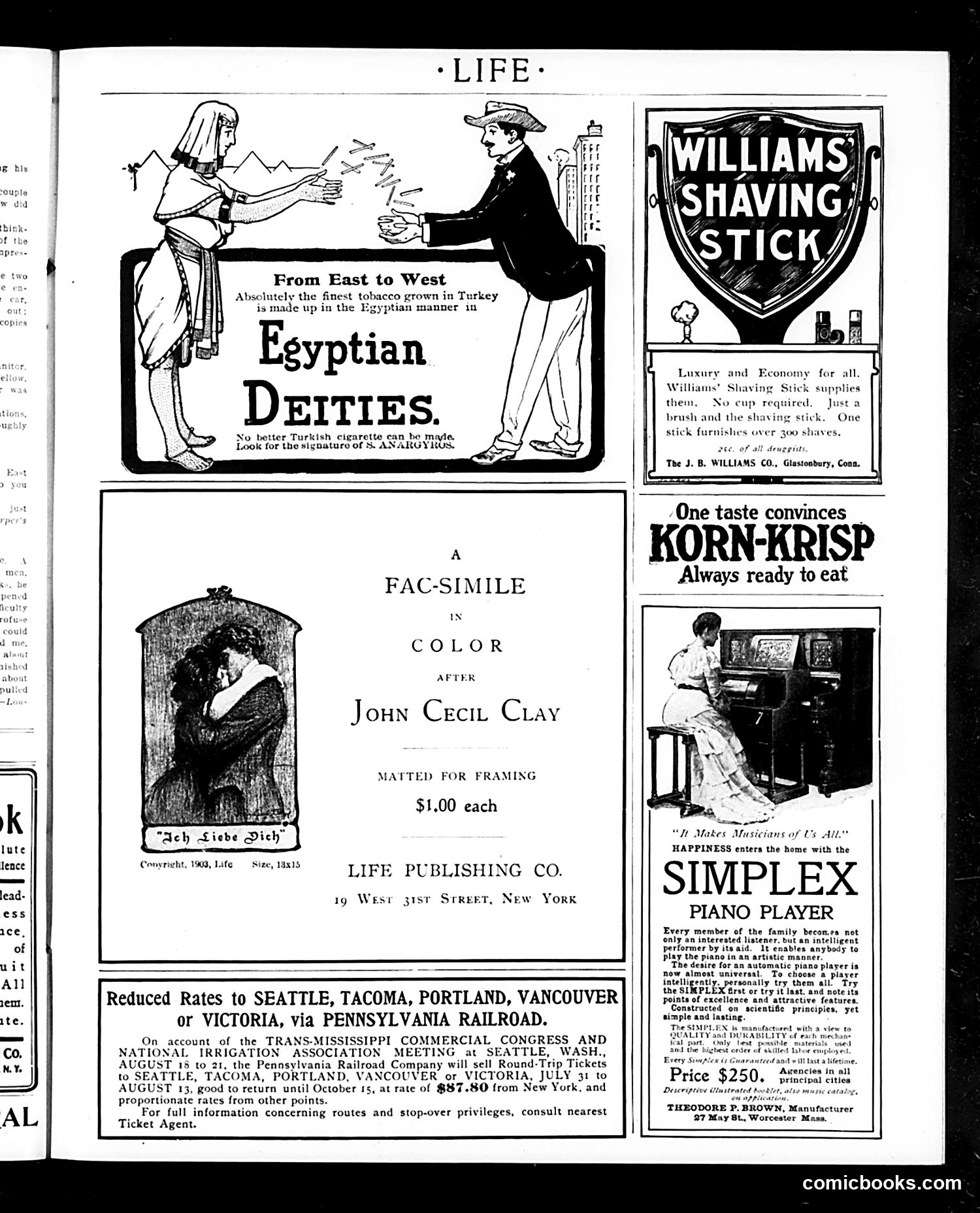
This page is primarily **advertising**, not political satire. It contains four distinct advertisements from early 1900s America: 1. **Egyptian Deities cigarettes**: Markets Turkish tobacco packaged in "Egyptian manner," appealing to exotic/Orientalist consumer tastes popular in that era. 2. **Williams Shaving Stick**: Promotes a convenience product requiring only a brush—no cup needed—with economical messaging (one stick = 300+ shaves). 3. **John Cecil Clay facsimile art print**: Offers color reproductions of artwork by the artist, matted and ready for framing at $1 each. 4. **Simplex Piano Player**: An automatic piano device allowing untrained family members to perform music "artistically." Marketing emphasizes democratizing musical performance. 5. **Pennsylvania Railroad**: Advertises reduced rates to Pacific Northwest cities for a commercial congress meeting. The page reflects early 20th-century consumer culture, emphasizing convenience, aspiration, and emerging mechanical/technological solutions to everyday activities. No political satire is evident.
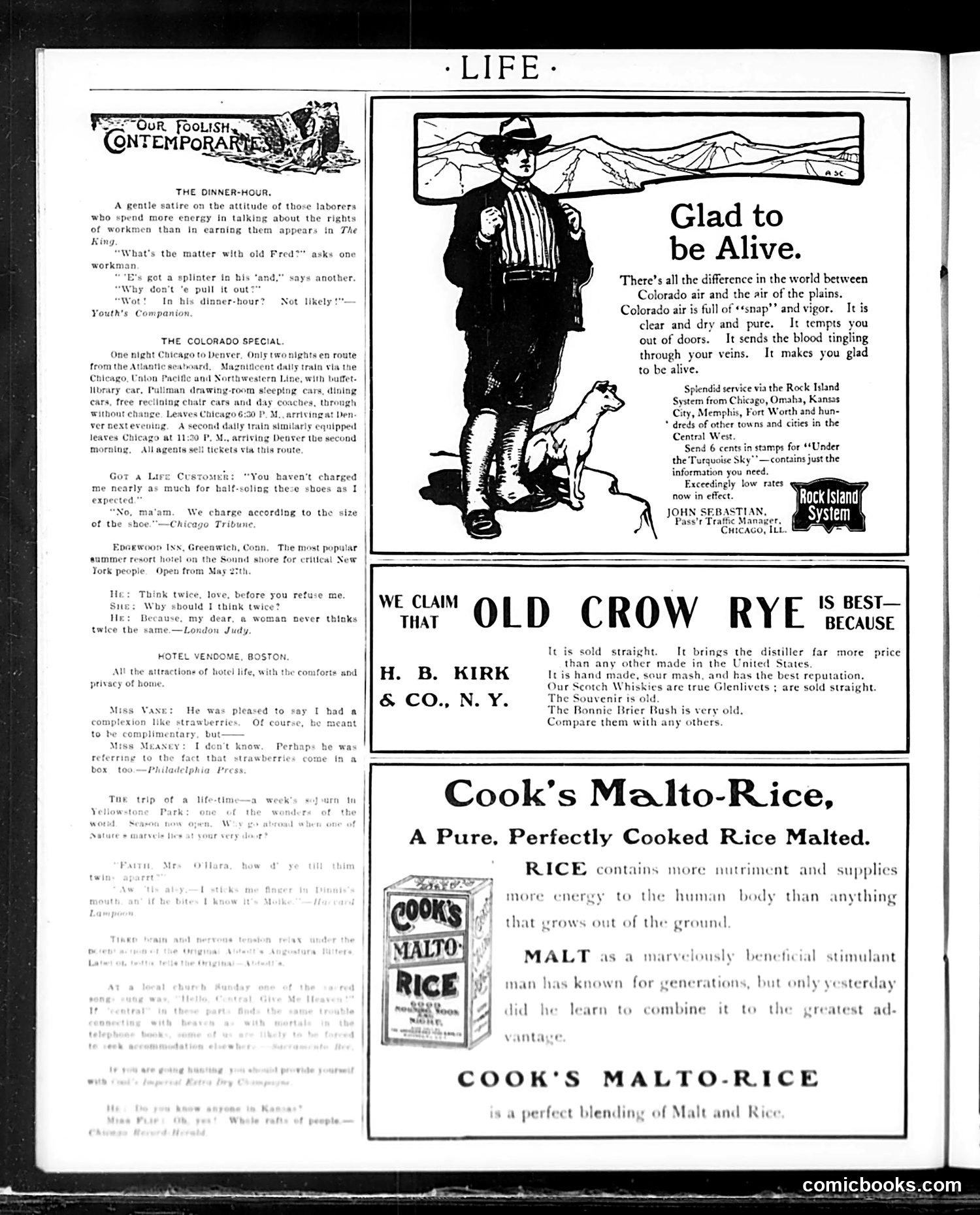
This page from *Life* magazine contains satirical sketches and period advertisements. The left column features three brief comedic vignettes mocking contemporary labor and social attitudes: 1. **"The Dinner-Hour"** satirizes workers who complain rather than work, suggesting they waste energy talking instead of earning wages. 2. **"The Colorado Special"** appears to joke about a train conductor overcharging a customer for shoe repairs, claiming the price varies "according to the size." 3. **"Hotel Vendome"** contains a brief romantic exchange mocking women's indecisiveness—a common period stereotype. The right side is dominated by advertisements: a *Rock Island System* railway ad promoting Colorado's health benefits, an *Old Crow Rye* whiskey advertisement, and a *Cook's Malto-Rice* product promotion claiming nutritional superiority. The overall tone reflects early 20th-century American attitudes toward labor, gender, and commercial consumption, with gentle humor aimed at middle-class readers.
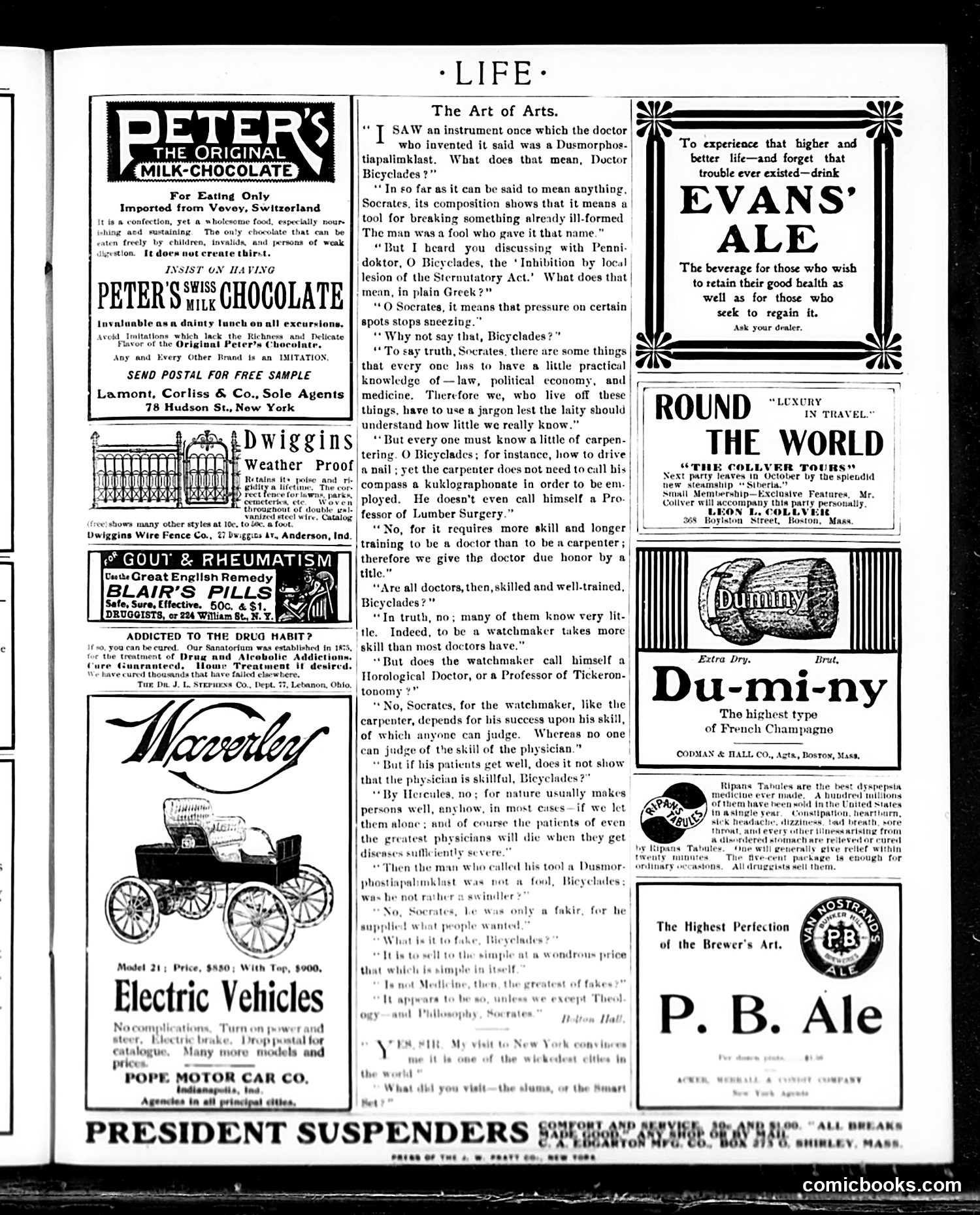
This page is primarily **advertisements**, not political satire. The main content is a philosophical dialogue titled "The Art of Arts," a Socratic-style conversation between Socrates and "Bicyclades" (a made-up name) satirizing professional jargon and pretension. The joke: Socrates repeatedly catches "Bicyclades" using unnecessarily complex terminology to describe simple things. A doctor invents a ridiculous machine called a "Dusmorphopalimklast" that means nothing; professionals use obscure language to seem important while actually knowing little. The satire mocks how doctors, watchmakers, and other skilled tradespeople use fancy titles and jargon to obscure their actual competence—suggesting that nature often heals patients regardless of medical intervention. The surrounding advertisements are genuine period products (chocolates, vehicles, ale, champagne), not part of the satire. The dialogue appears to be humorous commentary on professional pomposity rather than political critique.
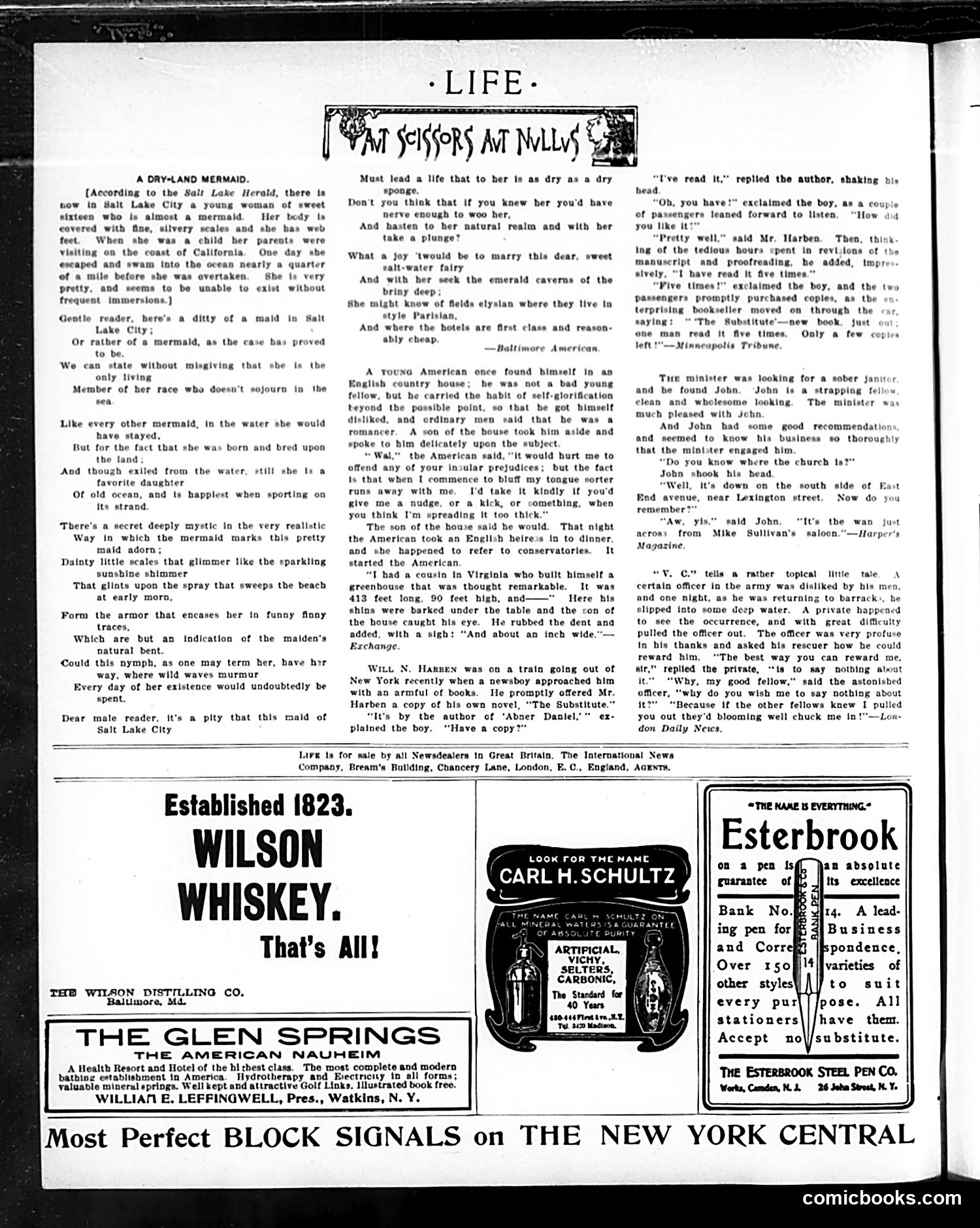
This page from *Life* magazine contains satirical verse and anecdotes typical of the period's humor. **"A Dry-Land Mermaid"** is a playful poem about a Salt Lake City girl supposedly covered in fish scales and webbed feet, allegedly from childhood ocean exposure. The satire gently mocks the implausibility of the story while humorously suggesting she'd be happier living underwater—it's lighthearted social commentary wrapped in whimsy. **The second anecdote** satirizes American braggadocio. An American visitor to an English country house constantly exaggerates ("bluffs"), so the host agrees to kick him under the table as a warning. When the American brags about a Virginia greenhouse that's "413 feet long, 90 feet high," he gets kicked and hastily adds "and about an inch wide"—undercutting his own lie. **The final story** humorously depicts a newsboy persistently trying to sell his own author's novel to someone who's already read it, emphasizing the boy's earnest but ineffective sales pitch. These pieces represent *Life*'s satirical approach to American social behavior and cultural pretensions.
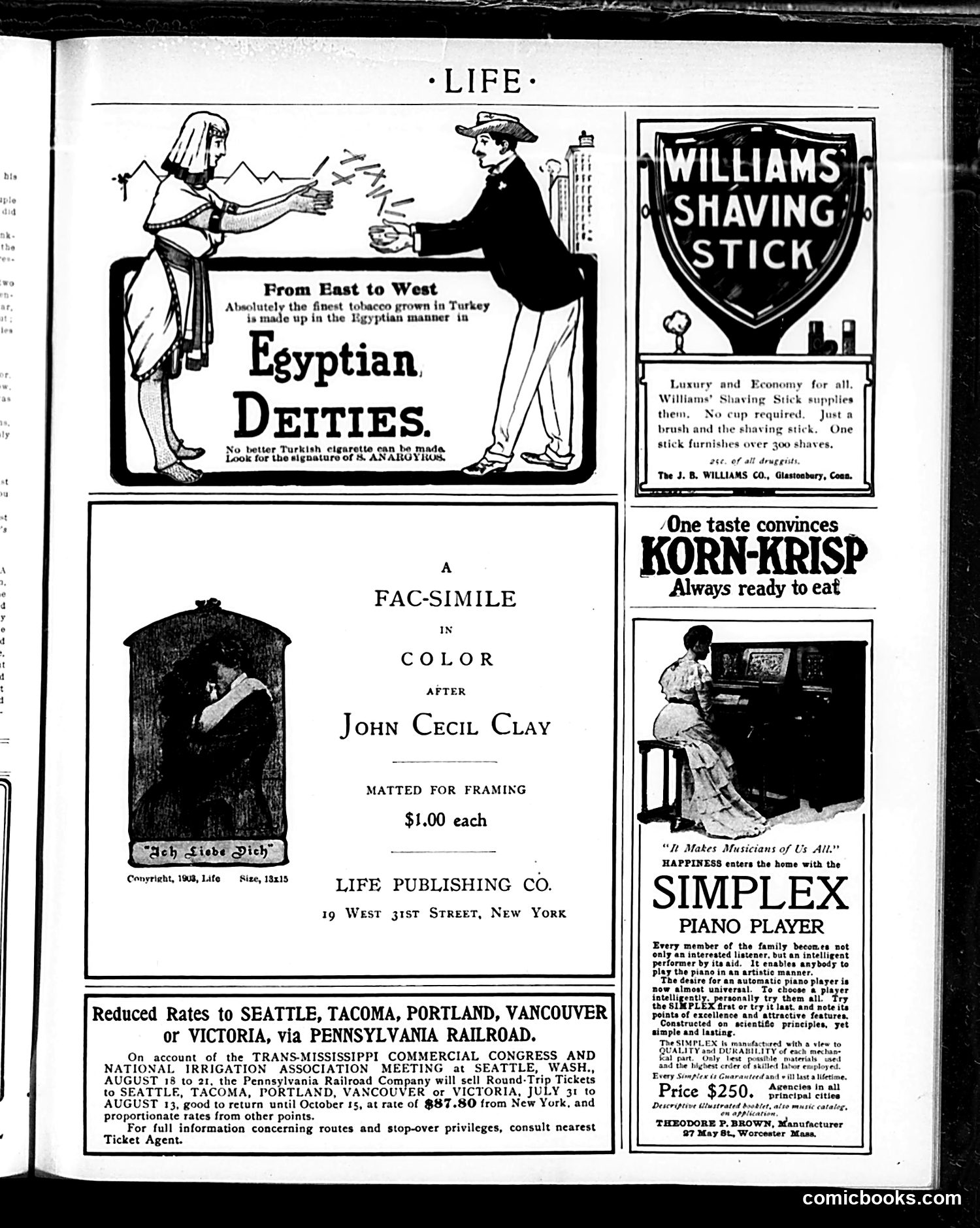
This page is primarily **advertising**, not satire or political commentary. The one cartoon present—the Egyptian Deities cigarette ad—uses Orientalist humor typical of the era: a Turkish tobacco merchant in exotic dress haggling with a Western businessman, with the joke being that even "Eastern" products must be made in "Egyptian manner" to be acceptable. The page features four period advertisements: 1. **Egyptian Deities cigarettes**—emphasizing Turkish tobacco quality with xenophobic marketing 2. **Williams Shaving Stick**—economical grooming product 3. **Korn-Krisp cereal**—ready-to-eat breakfast food 4. **Simplex Piano Player**—mechanical piano device allowing non-musicians to perform A railroad notice advertises reduced rates to Seattle for a commercial congress (August 1909, based on context). The advertisements reflect early 20th-century consumer culture and marketing strategies, including appeals to luxury, economy, family entertainment, and convenient modern living.
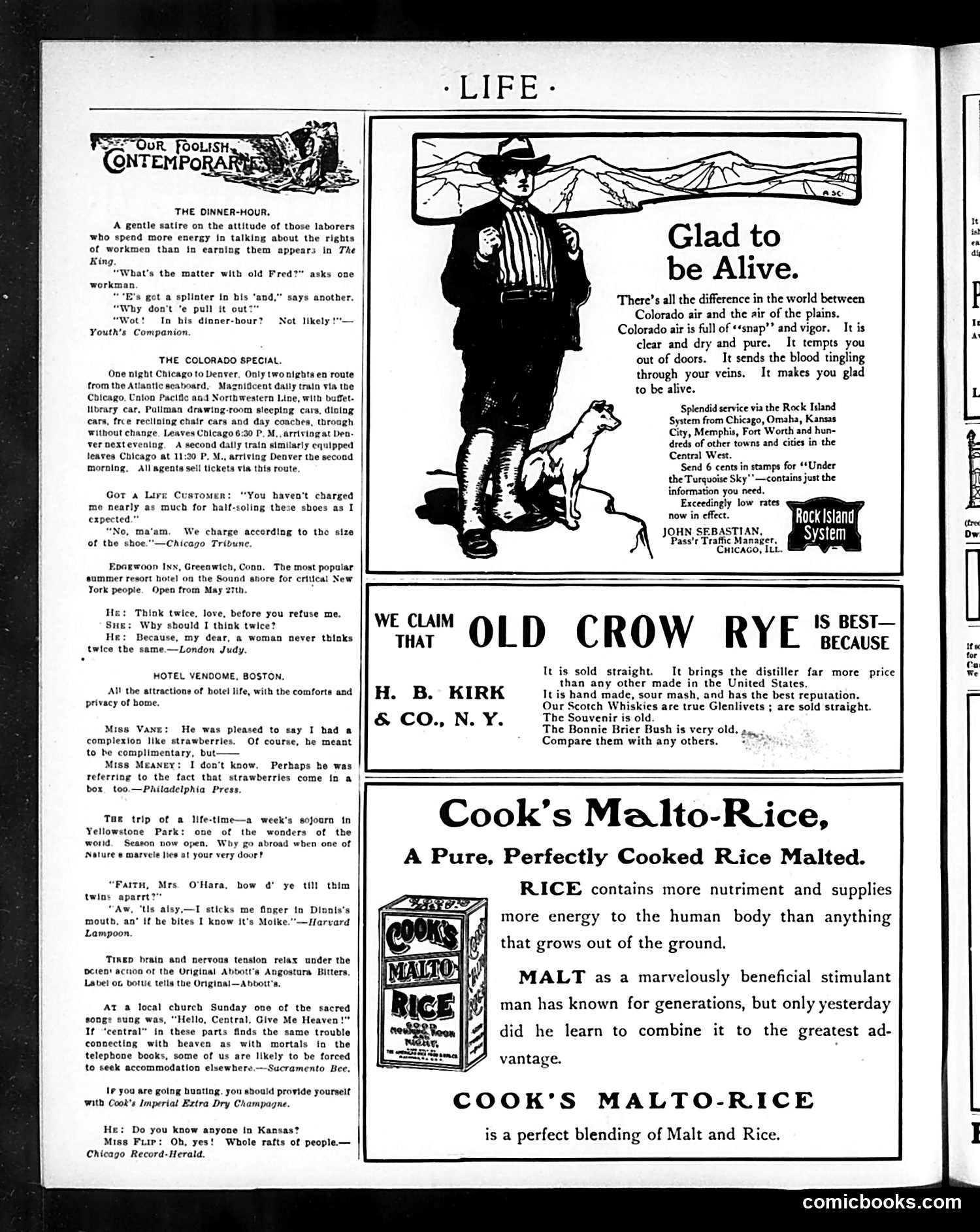
This page's main satirical cartoon mocks working-class laborers who prioritize workplace grievances over actual labor. Two workers discuss "old Fred," who won't remove a splinter from his hand during his dinner break—"not likely!" The joke: Fred would rather complain about workers' rights and conditions than attend to practical matters affecting his own productivity and comfort. The satire targets labor activists of the early 1900s, suggesting they spend more energy "talking about the rights of workmen than in earning them" (per the text). It's a conservative jab at union organizing and labor rhetoric—portraying advocates as hypocritical blowhards disconnected from honest work. The page also features period advertisements (Rock Island rail system, Old Crow whiskey, Cook's Malto-Rice) and humorous snippets from contemporary publications, typical of *Life* magazine's format.
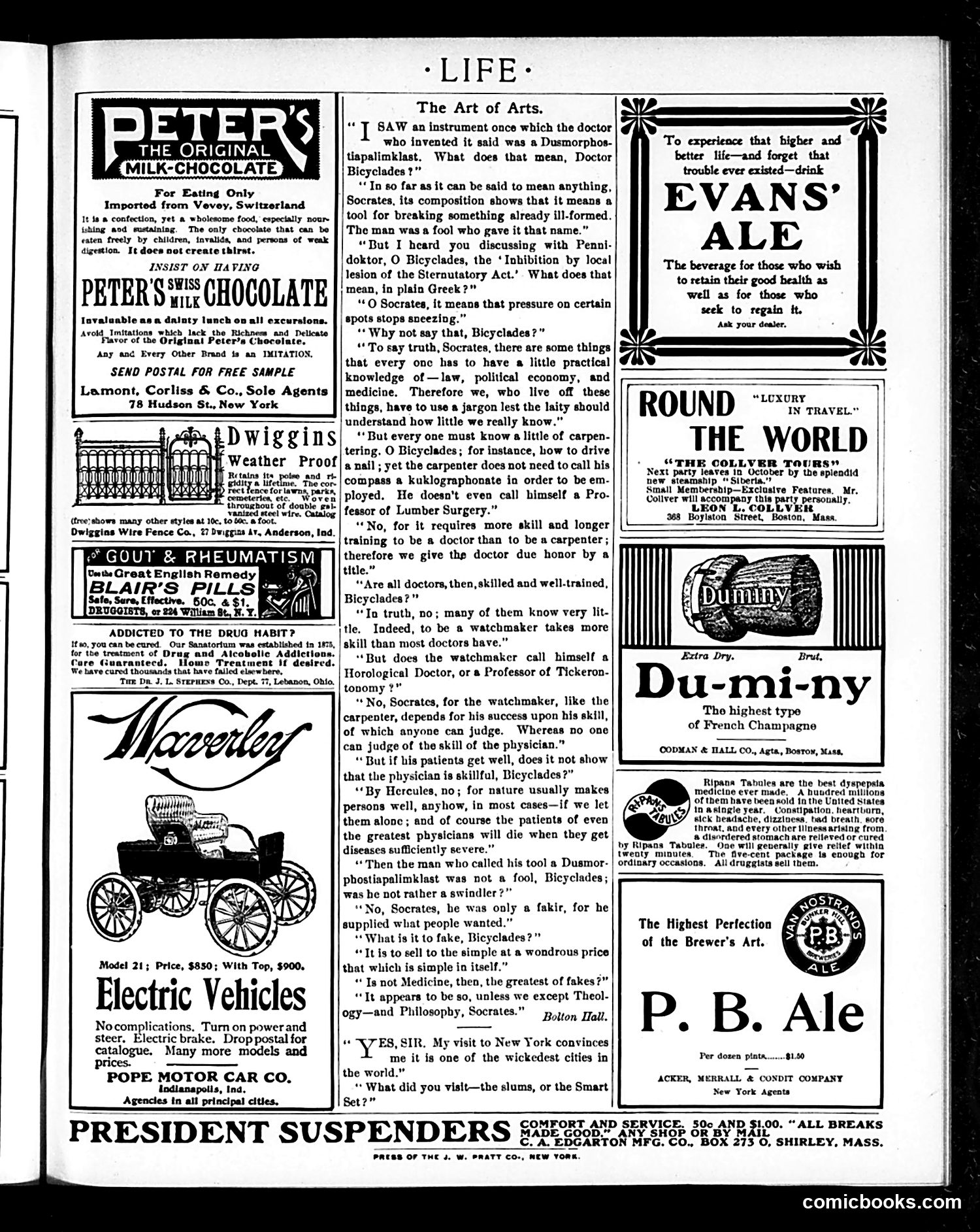
This page is primarily **advertising**, not political satire. The dominant content consists of product advertisements (Peter's chocolate, electric vehicles, drug addiction treatment, ale brands). The one substantial text piece—"The Art of Arts"—is a **Socratic dialogue** satirizing professional jargon and pretension. Using the classical dialogue format, it mocks doctors and other professions who use incomprehensible technical terms (like "Dusmorphostiapalimklast") to obscure simple concepts and inflate their expertise. The satire argues that such jargon allows practitioners to hide their actual lack of skill from laypeople who cannot judge competence. The dialogue concludes that these professionals are "fakirs"—charlatans supplying what people *want* (the appearance of expertise) rather than what they *need* (actual skill). This reflects early 20th-century skepticism toward credentialed professionals and their mystifying language as a form of social control.
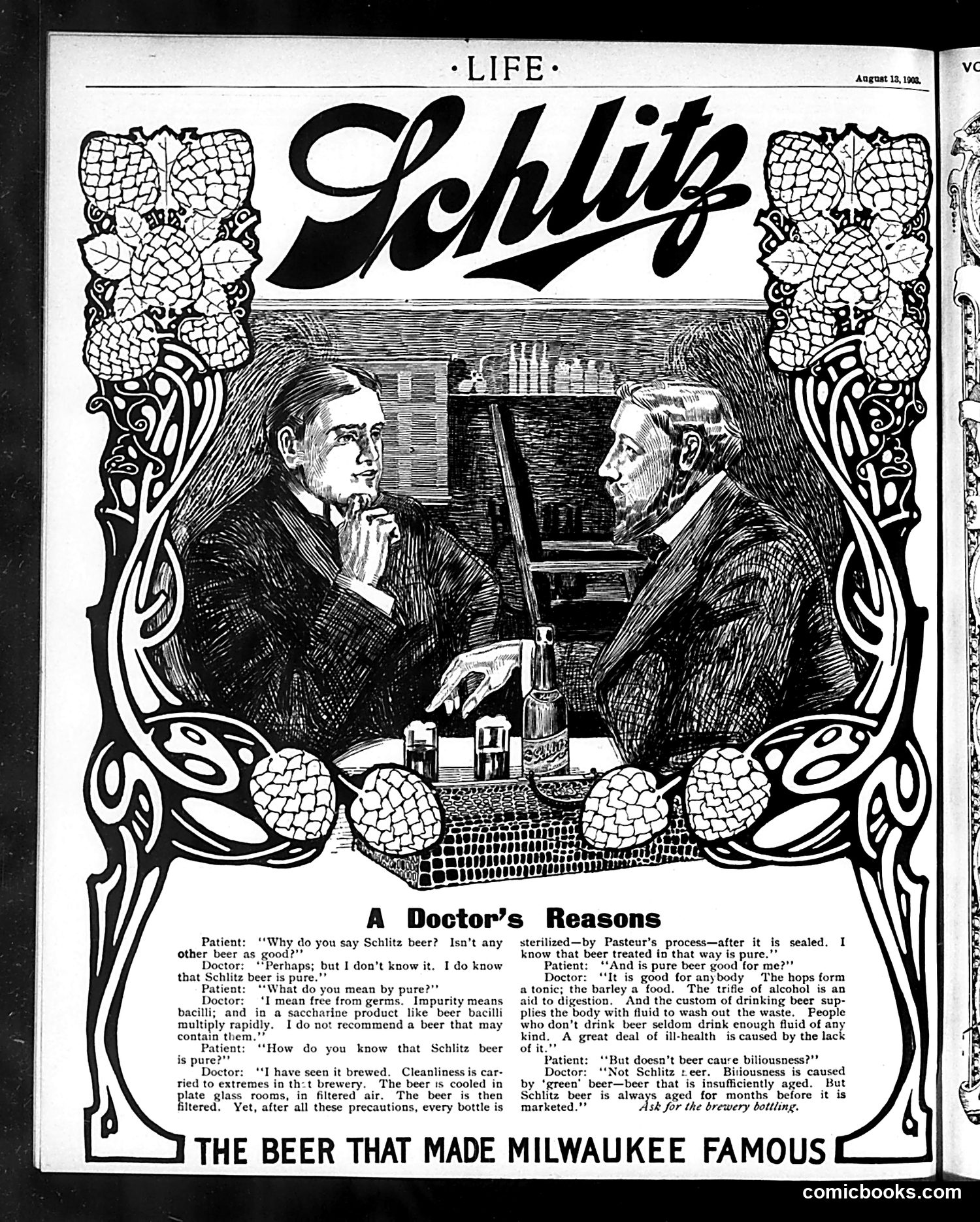
This is a **Schlitz beer advertisement** disguised as editorial content in Life magazine. The "cartoon" depicts a doctor and patient in conversation, with the doctor enthusiastically endorsing Schlitz as pure and healthful. The satirical angle—which Life's readers would recognize—is that this mimics the format of legitimate medical advice while actually being paid advertising. The doctor's arguments reflect **late-19th-century pseudoscience**: beer is promoted as medicinal, containing beneficial "tonics" (hops) and "food" (barley), and as necessary hydration. He dismisses concerns about alcohol and billiousness by claiming Schlitz's purity and aging process prevent such problems. The elaborate decorative border with hops emphasizes the brewing heritage. This represents how companies exploited medical authority to market products before modern advertising regulations. The tagline "The Beer That Made Milwaukee Famous" references Milwaukee's actual prominence in American beer production.