
Life, 1903-08-13 · page 4 of 24
Life — August 13, 1903 — page 4: what you’re looking at
What you’re looking at
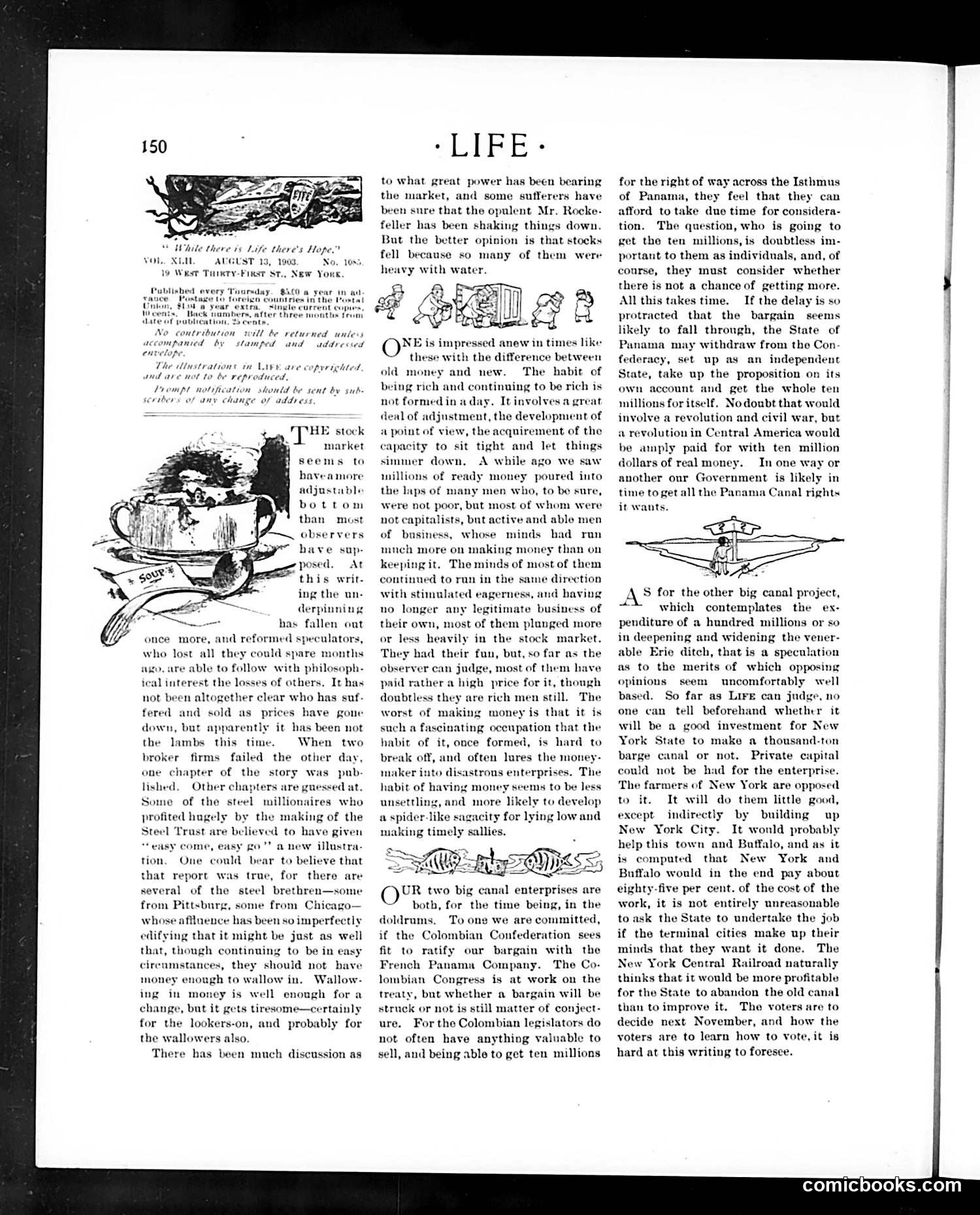
This page contains two editorial cartoons addressing early 1900s financial and infrastructure debates. The **first cartoon** (top left) depicts a cauldron labeled "SOUP" with figures around it, satirizing stock market speculation. The text criticizes wealthy speculators who lost fortunes in market crashes, suggesting they operated on greed rather than legitimate business principles. The **second cartoon** (bottom) shows what appears to be industrial/commercial figures, accompanying discussion of two major canal projects: the **Panama Canal** and a proposed **Erie Canal** expansion. The text debates whether these are sound investments or financial schemes, questioning whether New York State should fund canal improvements versus the New York Central Railroad. The satire targets both reckless speculation and government infrastructure spending decisions of the era.
📄 Transcribed text from this page (OCR, searchable)
Machine-transcribed from the original scan — historical spelling and the odd misread are preserved.
While there is Life VOL. NLM AUGUST 1 19 Wrst Tuiwty- Piast puptre 0 contribution will be returned untess accompanied by stamped and The Ulustrations in Lavy are copyrighted, Prompt notification should be sent by sub: rbers 0) . THE stock 7 market havea mor adjustabls bottom than most observers have sup- posed. At “this writ. ing the un- derpinning has fallen out once more, and reformed speculators, who lost all they could spare months ago, are able to follow with philosoph- ical interest the losses of others. It has not n altogether el who has suf- fered and sold as prices have gone down, but ay ntly it has been not the lambs this time. When two broker firms failed the other day, one chapter of the story was pub- lished, Other chapters are guessed at. me of the steel millionaires who profited hagely by the making of the Steel Trast ¢ ave given sy come, easy go"? a new illustra- tion. One could bear to believe that that report was true, for there are several of the steel brethren—some from Pittsburg, some from Chicago— whose affluence has been so imperfectly edifying that it might be just as well that, though continuing to be in easy circumstances, they should not have money enough to wallow in. Wallow. ing in money is well enough for a change, but it gets tiresome—certainly for the lookers-on, and probably for the wallowers also. There has been much discussion as e LIFE « to what great power has been bearing nd some sufferers have been sure that the opulent Mr. Rocke- feller has been shaking things down. But the better opinion is that stocks fell because so many of them were heavy with water. sed anew in times like with the difference between old money and new. The habit of being rich and continuing to be rich is not formed in aday. It involves a great deal of adjustment, the development of a point of view, the acquirement of the capacity to sit tight and let things simmer down, A while ago we saw millions of ready money poured into the laps of many men who, to be sure, Were not poor, but most of whom were not capitalists, bnt active and able men of business, whose minds bad ran munch more on making money than on keeping it, The minds of most of them continued to ran in the same direction with stimulated eagerness, and having no longer any legitimate business of their own, most of them plunged more or less heavily in the stock market. They had their fun, but, so far as the observer can judge, most of them have paid rather a high price for it, though doubtless they are rich men still, The worst of making money is that it is such a fascinating occupation that the habit of it, once formed, is hard to break off, and often lures the money- maker into disastrous enterprises. The habit of having money seems to be less unsettling, and more likely to develop a spider-like sa ing timely O UR two big ci both, for the time being, in the doldrums. To one we are committed, if the Colombian Confederation sees fit to ratify our bargain with the , nama Company. The Co- lombian Congress is at work on the treaty, but whether a bargain will be struck or not is still matter of conject- ure. For the Colombian legislators do not often have anything valuable to sell, and being able to get ten millions for the right of way across the Isthmus of Panama, they feel that they can afford to take due time for considera- tion. The question, who is going to get the ten millions, is doubtless im- portant to them as individuals, and, of course, they must consider whether there is not a chance of getting more. All this takes time. If the delay is so protracted that the bargain seems likely to fall through, the State of Panama may withdraw from the Con federacy, set up as an independent State, take up the proposition on its own account and get the whole ten millions foritself. Nodoubt that would involve a revolution and civil war, but a revolution in Central America would be amply paid for with ten million dollars of real money. In one way or another our Government is likely in time to get all the Panama Canal rights it wants. for the other big canal project, which contemplates the ex- penditure of a hundred millions or so in deepening and widening the vener- able Erie ditch, that is a speculati as to the merits of which opposing opinions seem uncomfortably well based. So far as Lire can judge, no one can tell beforehand whether it will be a good investment for New York State to make a thousand-ton barge canal or not. Private capital could not be had for the enterprise. The farmers of New York are opposed to it. It will do them little good, cept indirectly by building up New York City. It would probably help this town and Buffalo, and as it is computed that New York and Buffalo would in the end pay about eighty-five per cent. of the cost of the work, it is not entirely unreasonable to ask the State to undertake the job if the terminal cities make up their minds that they want it done. The New York Central Railroad naturally thinks that it would be more profitable for the State to abandon the old canal than to improve it. The voters are to decide next November, and how the voters are to learn how to vote, it is hard at this writing to foresee. we | j i | comicbooks.com