
Life, 1903-08-13 · page 8 of 24
Life — August 13, 1903 — page 8: what you’re looking at
What you’re looking at
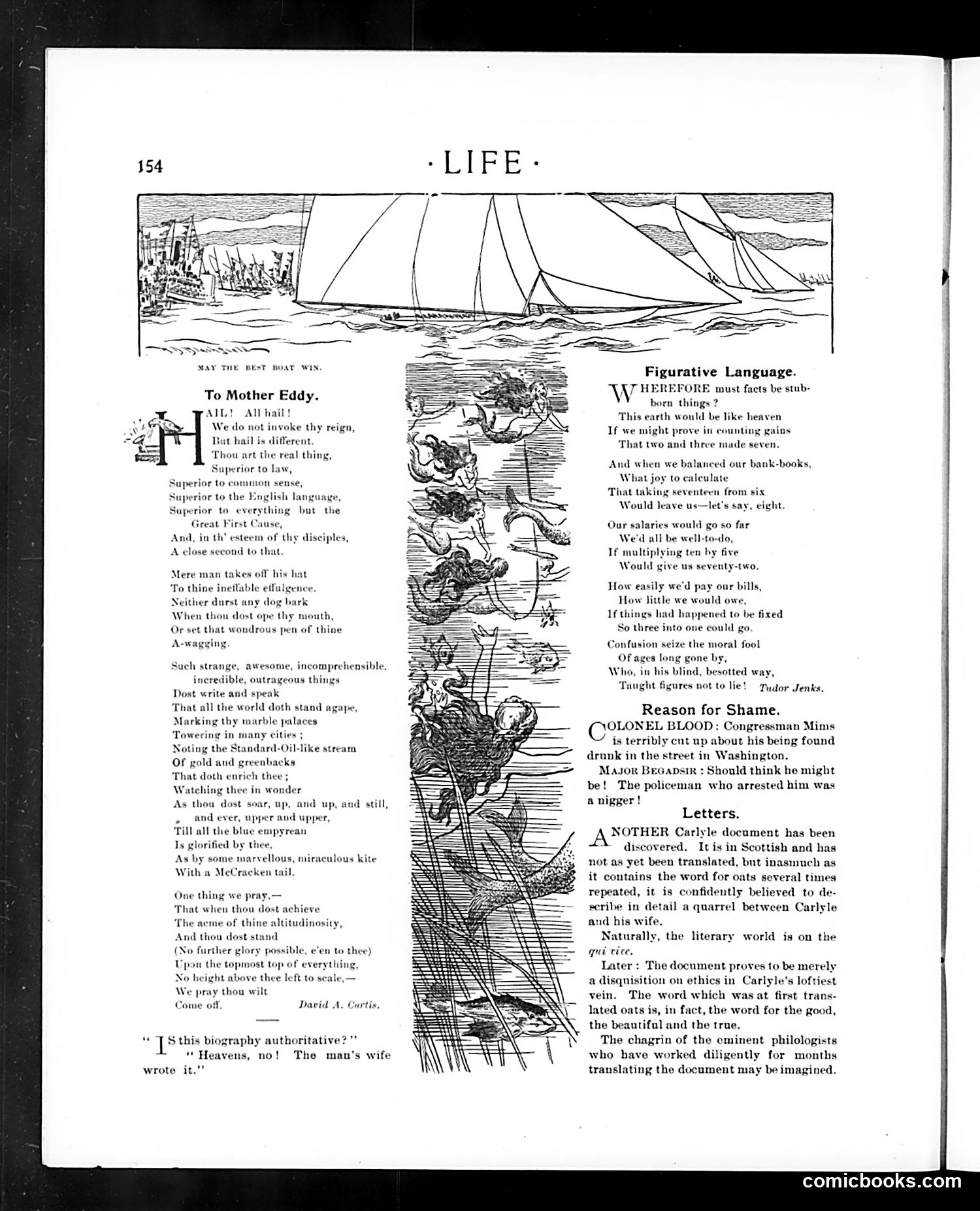
This page contains three distinct sections: a sailing poem ("May the Best Boat Win"), a poem "To Mother Eddy" (likely Mary Baker Eddy, founder of Christian Science), and satirical commentary pieces. The central illustration depicts tangled fishing lines with human figures caught in knots—a visual metaphor for confusion or entanglement. **"Reason for Shame"** mocks Colonel Blood and Congressman Mims, referencing an incident where Mims was found drunk in Washington streets. The satire criticizes both his intoxication and the arresting officer's racial prejudice (calling the officer "a nigger"). **"Letters"** discusses a newly discovered Carlyle document, joking about scholarly excitement over finding the word "oats" repeated multiple times—mocking both pretentious literary analysis and the trivial nature of the actual discovery. The humor relies on period-specific political and cultural references now requiring historical context.
📄 Transcribed text from this page (OCR, searchable)
Machine-transcribed from the original scan — historical spelling and the odd misread are preserved.
—__ SES MAY THE BEST BOAT WIN. To Mother Eddy. AIL! All hail! We do but ha ‘Thou art the rea Superior to law, Superior to common sense, Superior to the English language, Superior to everything but the Great First Cause, And, in th’ esteem of thy disciples, A close second to that. Mere man takes off his hat ‘To thine ineffable effulgence. Neither durst any dog bark When thou dost ope thy mouth, Or set that wondrous pen of thine Such strange, awesome, incomprehensible, incredible, outrageous things Dost write and speak That all the world doth stand agape, Marking thy marble palaces Towering in many citie Noting the Standard-Oil-like stream Of gold and greenbacks That doth enrich t 1 Watching thee in wonder As thou dost soar, up, and up, and still, and ever, upper and upper, Till all the blue empyrean fied by the riraculous kite One thing we pray,— That when thou dos ‘The acme of thine alt nd thou dost stand ‘6 further glory possible, e’en to thee) Upon the topmost top of everything, No height above thee left to seale,— We pray thou wilt Come off. David A, Curtis, “7S this biography authoritativ: “ Heavens, no! The man's wife wrote it.’” Figurative Language. WHEREFORE must facts be stub- born things ? This earth would be like heaven If we might prove in counting gai ‘That two and three made seven, And when we balanced our bank-books, What joy to calculate That taking seventeen from six Would leave us—let’s say, eight. alaries would go so far all be well-to-do, If multiplying ten hy five Would give us seventy-two. How easily we'd pay our bills, How little we would owe, If things had happened to be fixed So three into one could go. Confusion seize the moral fool Of ages long gone by, Who, in his blind, besotted way, Taught figures not to lie! Tudor Jenks. Reason for Shame. OLONEL BLOOD: Congressman Mims is terribly cut up about his being found drunk in the street in Washington. MaJsor BeGapsir : Should think he might be! The policeman who arrested him was a nigger! Letters. NOTHER Carlyle document has been discovered. It is in Scottish and has not as yet been translated, but inasmuch as it contains the word for oats several times repeated, it is confidently believed to de- scribe in detail a quarrel between Carlyle and his wife. Naturally, the literary world is on the qui vive, Later he document proves to be merely a disquisition on ethics in Carlyle’s loftiest vein. The word which was at first trans- lated oats is, in fact, the word for the good, the beautiful and the true. The chagrin of the eminent philologists who have worked diligently for months translating the document may be imagined. comicbooks.com