
A complete issue · 24 pages · 1903
Life — June 18, 1903
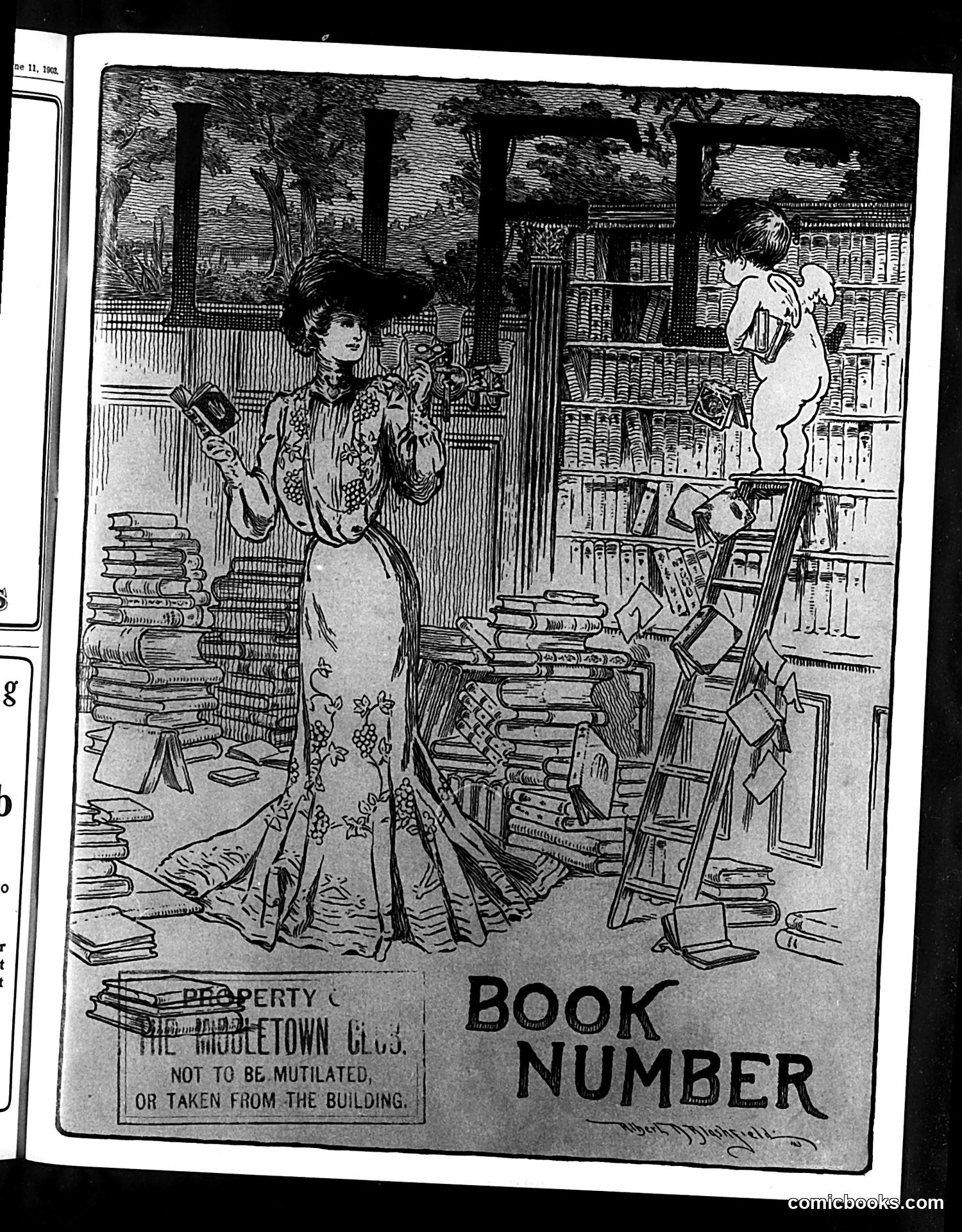
This is a **library-themed illustration** rather than political satire. The image depicts a well-dressed woman in an Edwardian-era library surrounded by books, with cherubic figures (putti) among the shelves. The text "BOOK NUMBER" appears prominently. The **property stamp** ("The Middletown Club / Not to be mutilated, or taken from the building") indicates this page itself is being catalogued as library property—a meta-joke where the magazine page becomes a "book number." The satire appears to target **pretentious library culture** of the early 1900s: the elegant woman and decorative cherubs suggest romanticized, elevated views of books and reading, while the haphazard stacks and library chaos humorously undercut that idealization. It's gentle social commentary on how libraries were perceived as refined cultural institutions.
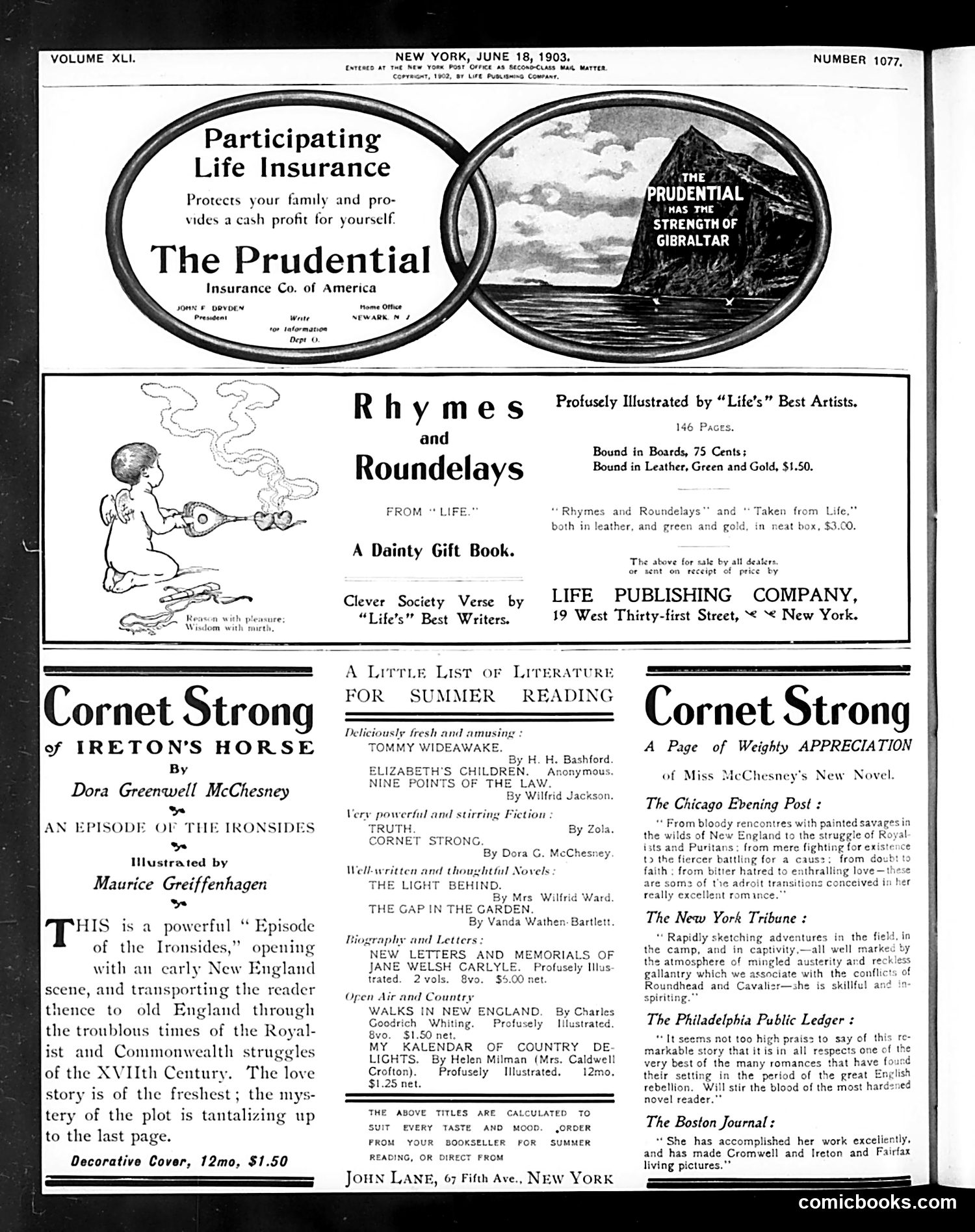
This page is primarily **advertising and book promotion** rather than satirical content or political cartoons. The top half features ads for Prudential Insurance (with Gibraltar imagery emphasizing strength) and a poetry collection called "Rhymes and Roundelays." The lower half advertises books for summer reading, including Dora Greenwell McCbesney's "Cornet Strong of Ireton's Horse"—described as a historical novel set in seventeenth-century England during the Civil War period. The Chicago Evening Post's review praises it as engaging adventure fiction. The page reflects **early 1900s commercial publishing practices**, where literary magazines like Life mixed editorial content with extensive advertising. There is no apparent political satire or caricature present—this is a straightforward advertising section.
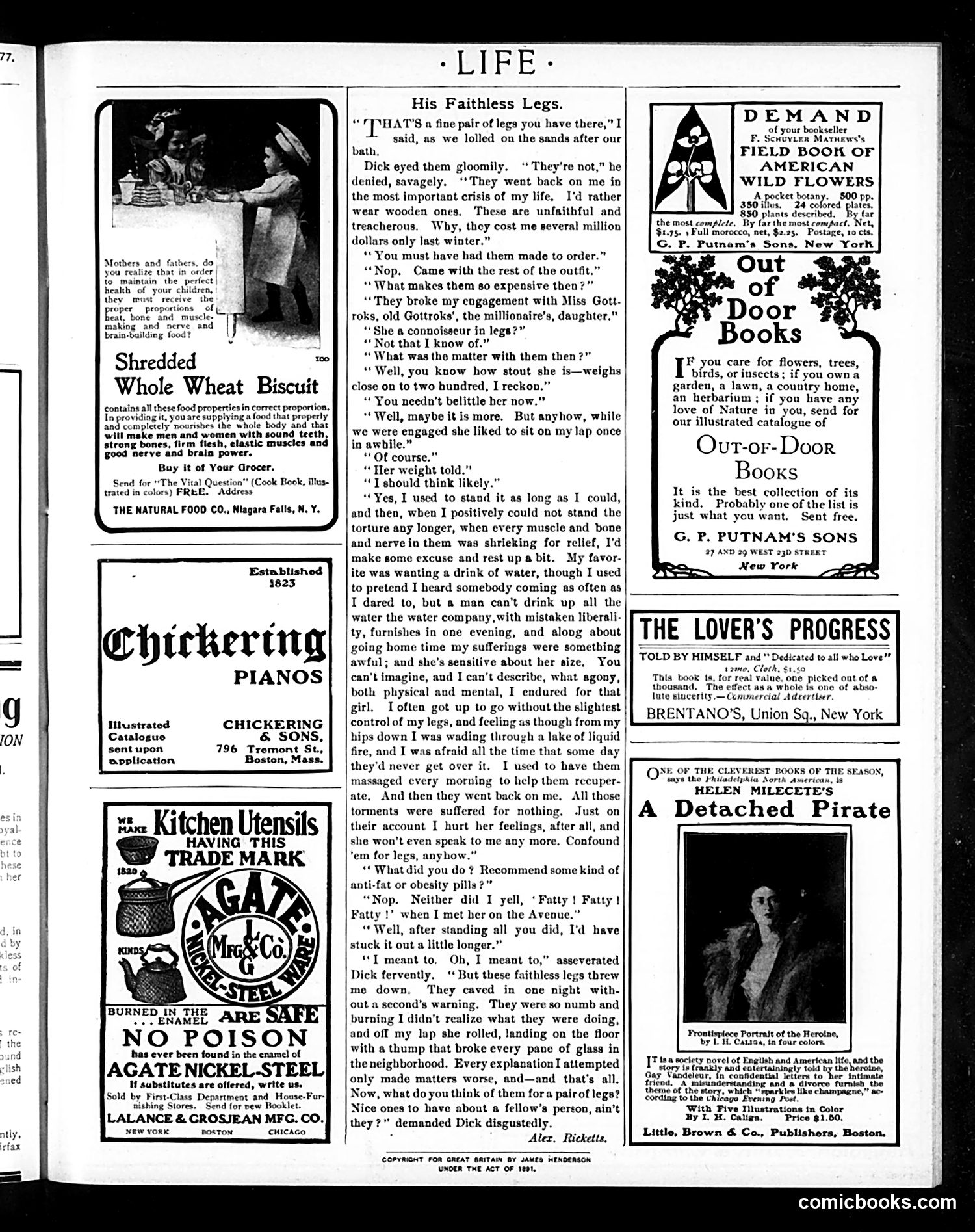
This page's main content is a humorous monologue by a character named Dick about his fiancée's expensive legs. The joke centers on a broken engagement: Dick's former fiancée, Miss Goldrocks (daughter of a millionaire), was so heavy that her legs—which he'd paid to have specially made or fitted—eventually gave out under her weight, causing her to collapse. The satire targets both wealthy excess (the millionaire's indulgent daughter) and the absurdity of romantic/financial commitments. Dick's complaints about her weight and the financial burden of maintaining her are presented comedically. The remainder of the page consists primarily of period advertisements for products like Shredded Wheat Biscuit, pianos, and kitchen utensils, with no additional satirical content visible.
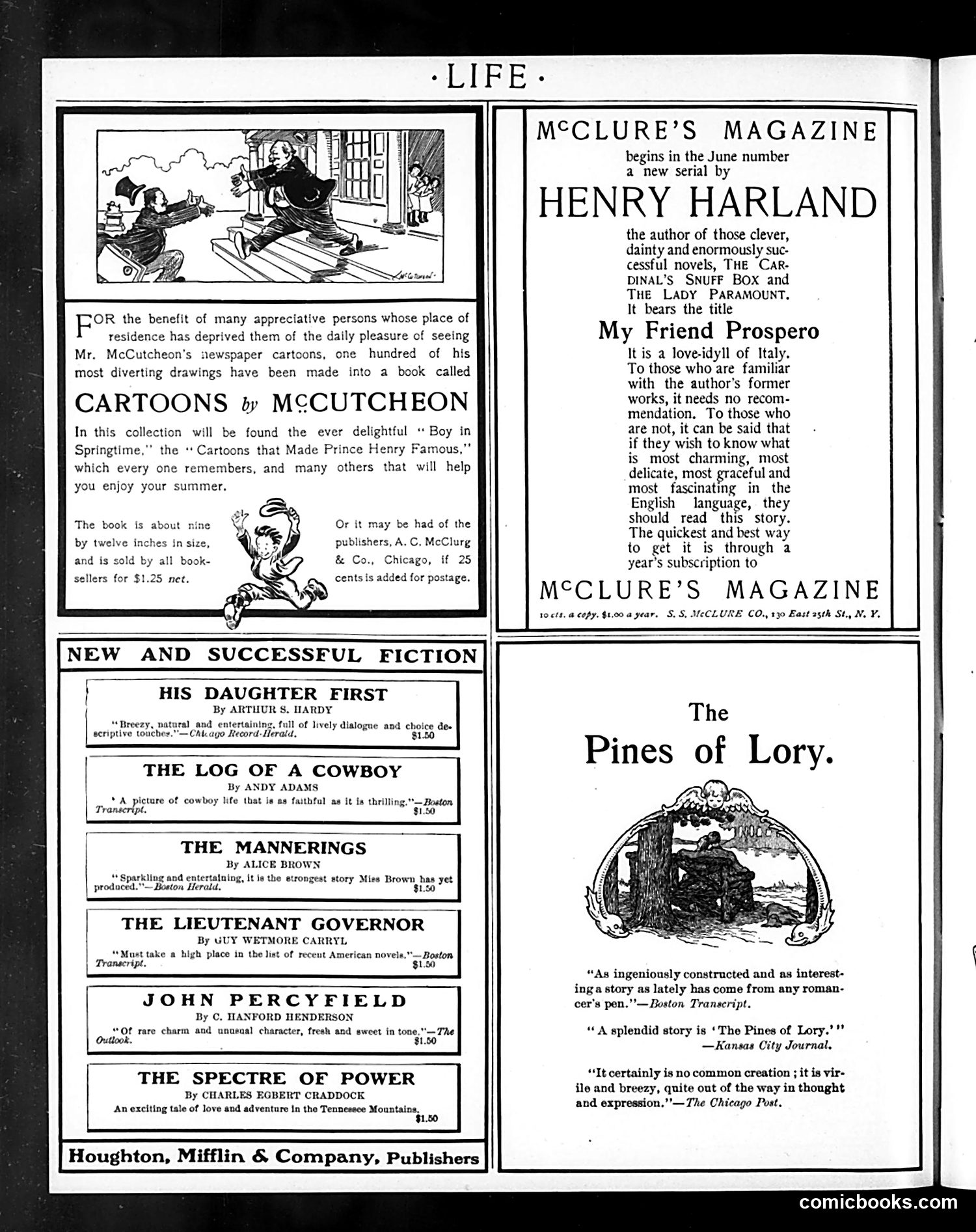
This page is primarily **advertising and literary promotion** rather than political satire. The top-left cartoon promotes "Cartoons by McCutcheon," a collection of drawings by Life's cartoonist. The small illustration shows figures in comedic interaction, typical of the magazine's humorous style. The right side advertises McClure's Magazine's serialization of Henry Harland's novel "My Friend Prospero," marketing it to readers unfamiliar with his previous works. The bottom section lists "New and Successful Fiction" from Houghton, Mifflin & Company—six novels priced at $1.50 each—and promotes "The Pines of Lory," another novel receiving positive critical reviews from Boston, Kansas City, and Chicago newspapers. This appears to be a **commercial/literary page** rather than political commentary.
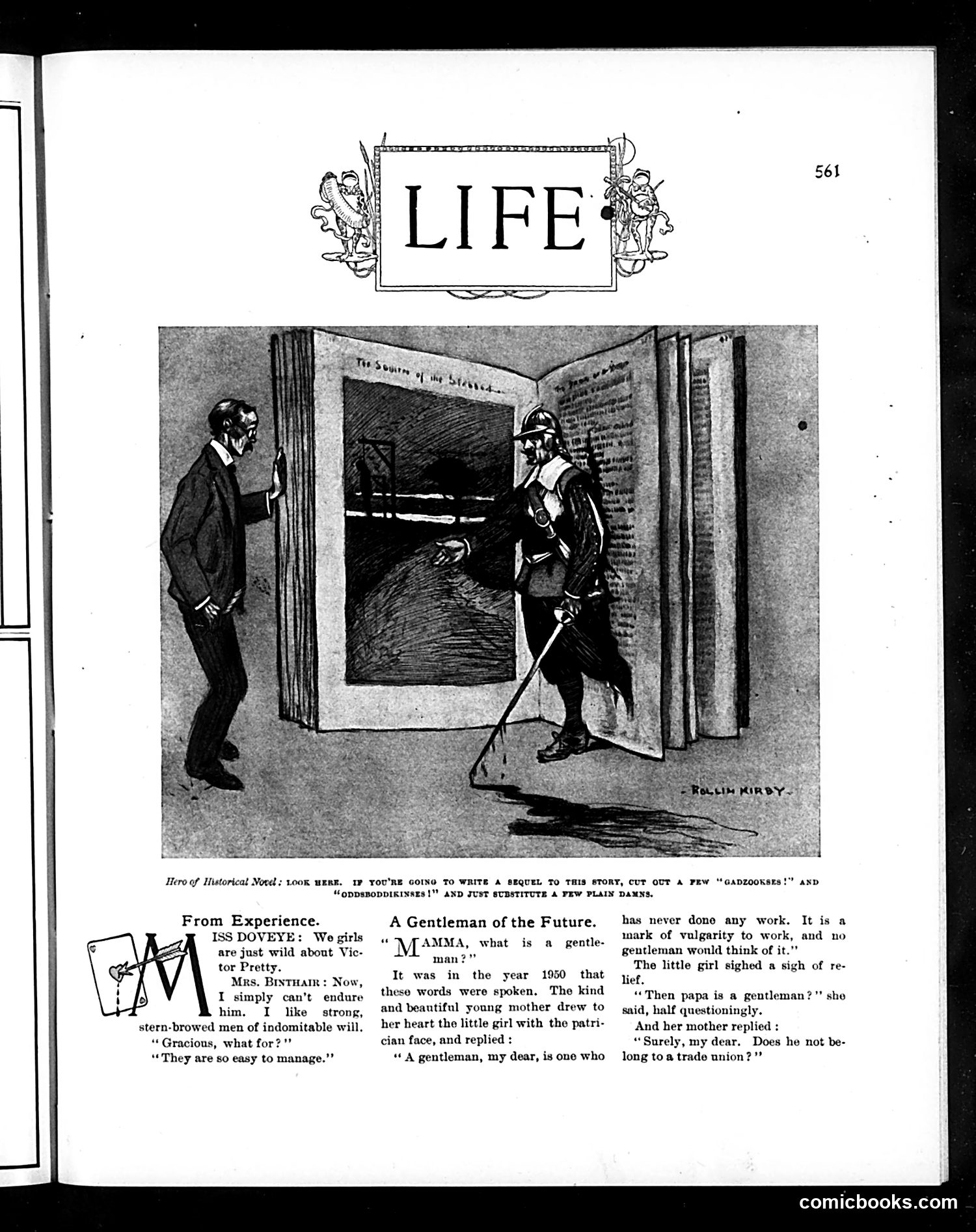
This page contains satirical commentary on gender and class expectations in early 20th-century America. The main cartoon shows a soldier or military figure confronting a well-dressed civilian man, likely satirizing debates about masculinity and military service. The caption references "daredevils" and "oddsbodkins," suggesting wordplay about courage and social propriety. The text below discusses what constitutes a "gentleman," featuring a mother defending her daughter's choice of a union man as a suitor. The satire critiques class prejudice—the implication being that working-class men (particularly union members) were unfairly stigmatized as unsuitable despite possessing gentlemanly qualities. The overall message appears to challenge conventional social hierarchies that equated gentility with upper-class status rather than character.
This editorial page critiques severe weather disruptions affecting America. The text references recent devastating floods and droughts spanning from the East to the Midwest, with particular mention of rain shortages lasting forty days and fires in Michigan. The cartoons appear to illustrate weather-related hardship, though specific figures are unclear from the image quality. The editorial names several prominent figures—Mr. Morgan, Mr. Carnegie, Mr. Rockefeller, and Mr. Gates—seemingly critiquing wealthy industrialists for their inadequate response to natural disaster victims, contrasting their prosperity with public suffering. The piece sarcastically suggests Providence and weather patterns, not human effort, determine outcomes, while implying wealthy philanthropists should do more to help affected communities endure environmental catastrophe.
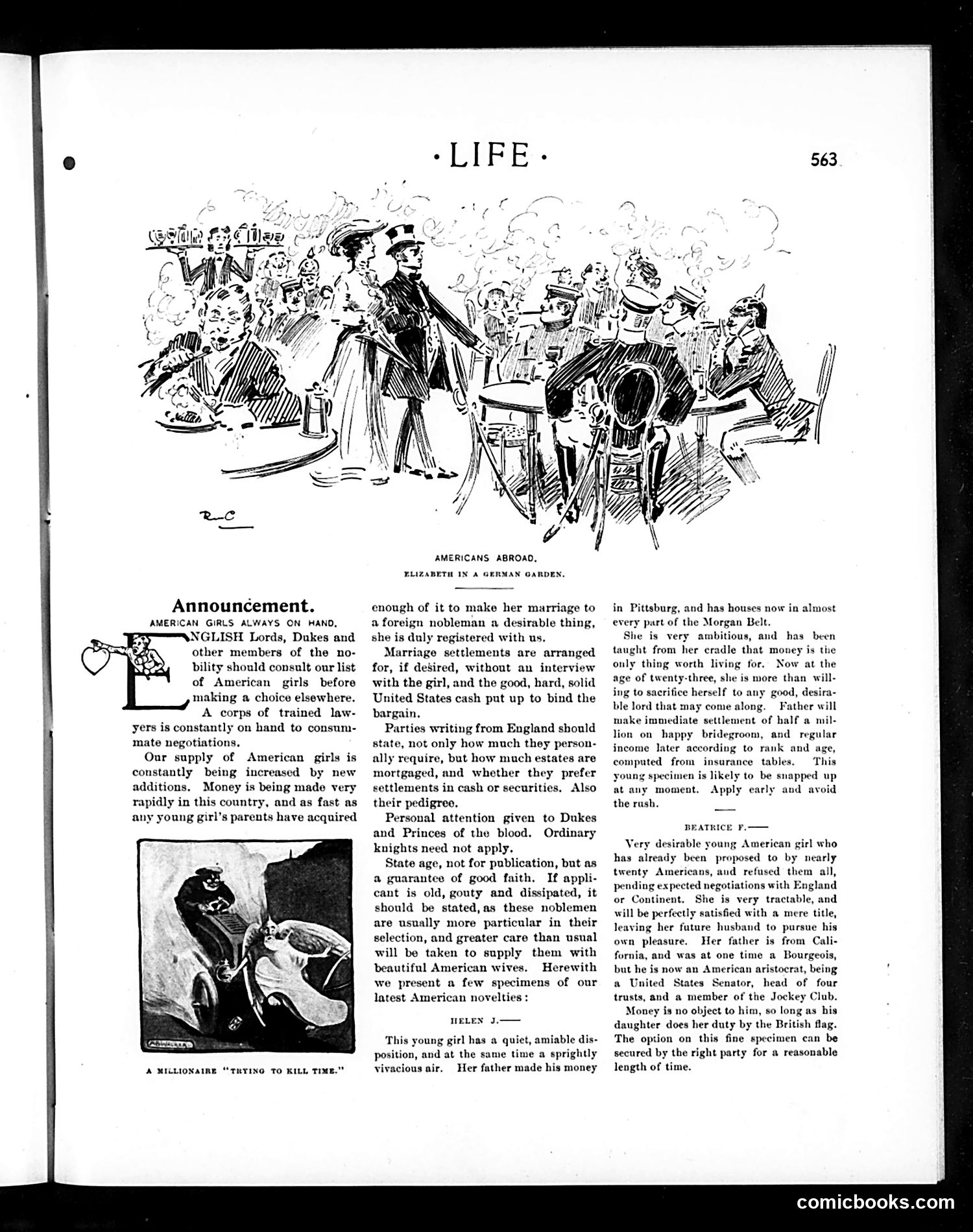
This satirical article mocks the marriage market for wealthy American heiresses in Europe. The top illustration shows American girls in a German garden surrounded by European nobility seeking advantageous marriages. The accompanying announcement advertises American girls as marriageable commodities, with explicit mention of arranging marriages to foreign noblemen in exchange for titles and social status. The text jokes that American fathers with money are eager to secure titles for their daughters through marriage settlements. Two specific cases are highlighted: "Helen J.," described as a millionaire's daughter with "a quiet, amiable disposition" seeking a titled husband; and "Beatrice F.," a very desirable American girl pursued by nearly twenty suitors who rejected them all to marry an Englishman. The satire critiques the gilded-age practice of wealthy American families purchasing European nobility through strategic marriages—a genuine historical phenomenon of the period.
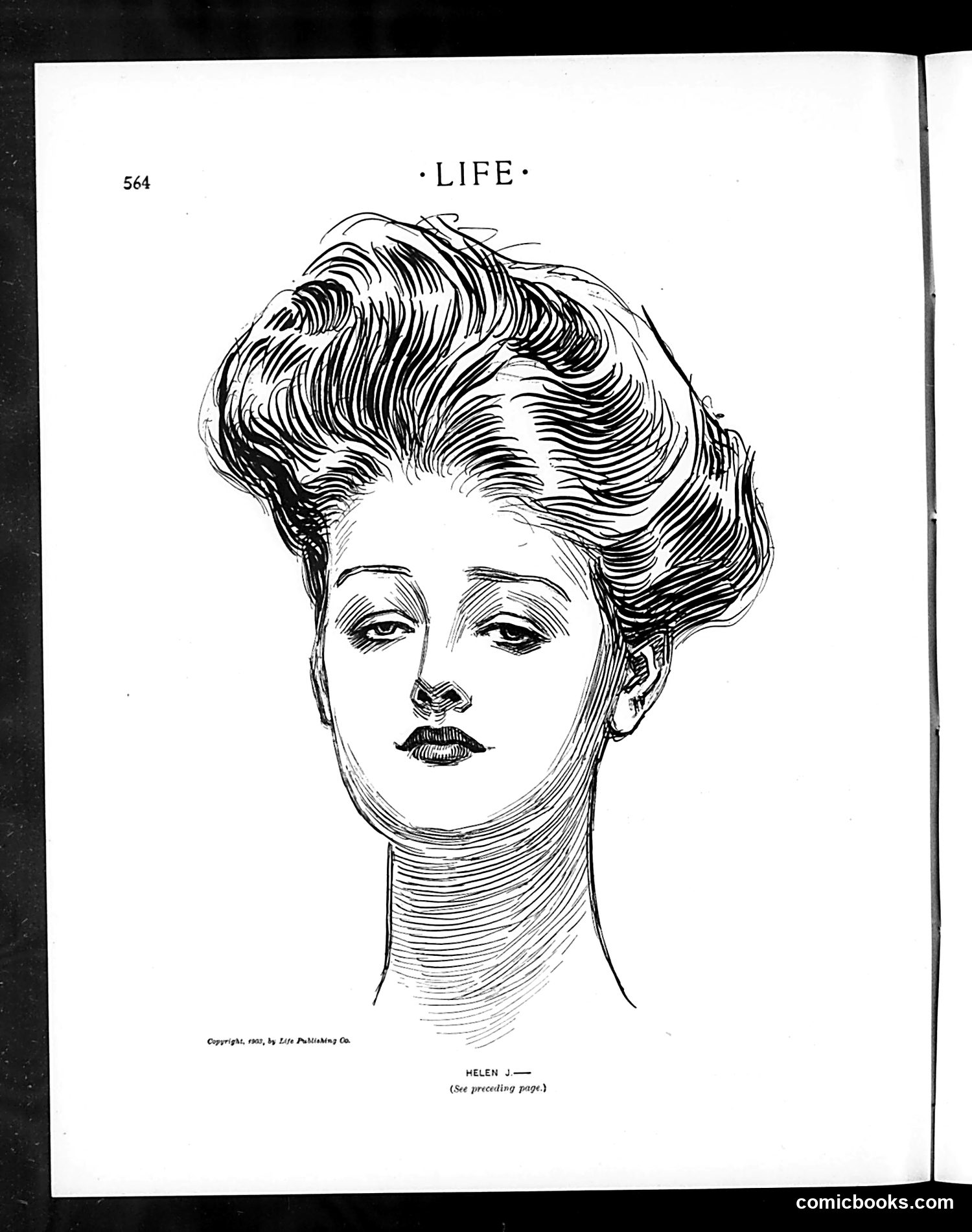
This page from *Life* magazine features a portrait illustration labeled "HELEN J—" with a note directing readers to "See preceding page" for context. The drawing is a formal line-art portrait of a woman with early 1900s styling—upswept hair, defined features, and an elongated neck characteristic of that era's aesthetic ideals. Without access to the preceding page, the specific identity and satirical purpose cannot be definitively determined. The portrait appears to be either a celebrity profile, society figure, or subject of contemporary commentary. The formal presentation and magazine placement suggest this was likely a notable public figure of the period, though the abbreviated name prevents certain identification. The artistic style is consistent with *Life's* illustrative tradition.
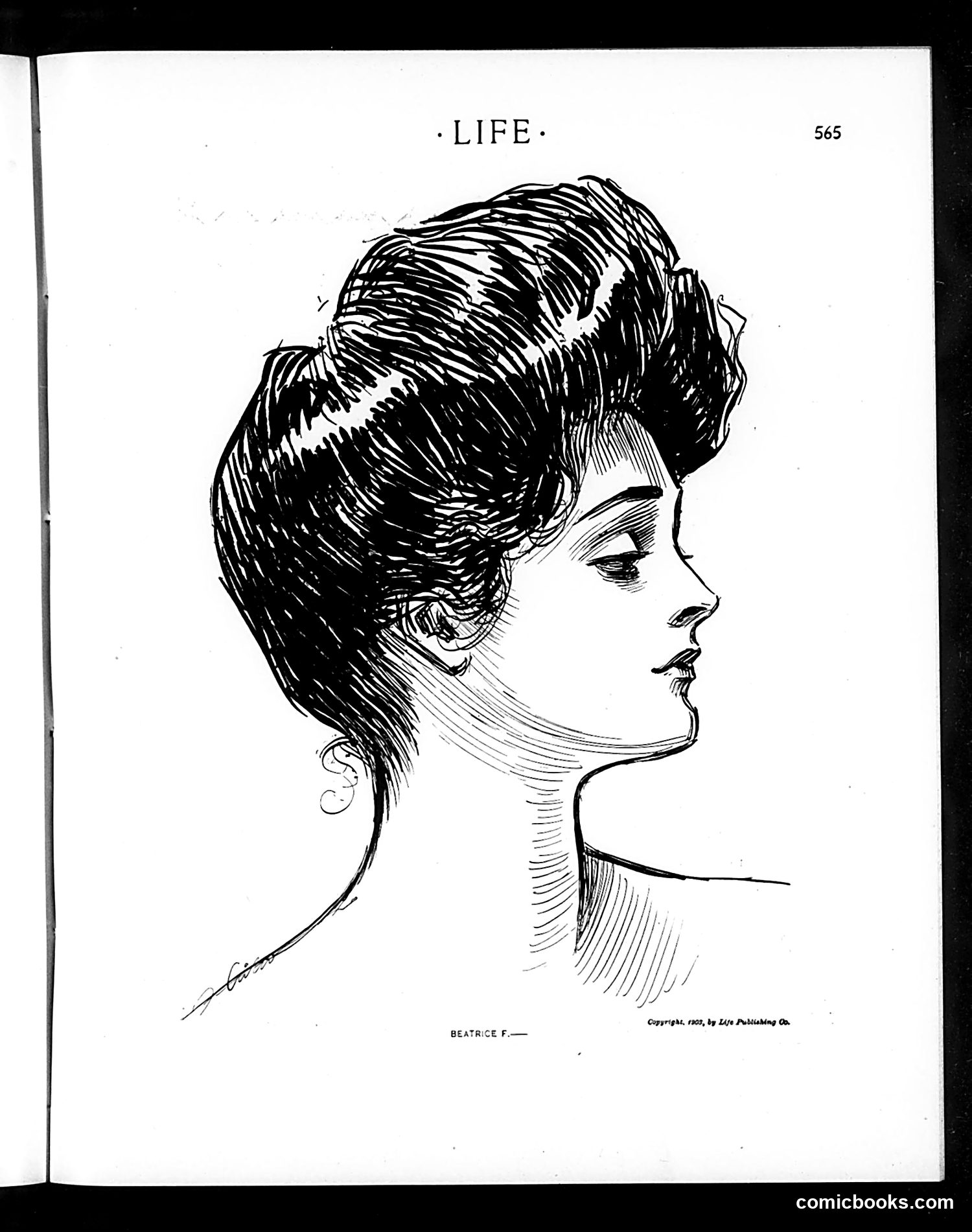
This page from *Life* magazine (page 565) features a single line-drawn portrait labeled "BEATRICE F." in profile, showing a woman with an elaborate upswept hairstyle typical of the early 1900s. The drawing is credited with a 1907 copyright to Life Publishing Co. The image appears to be a straightforward portrait illustration rather than political satire or caricature. Without additional context about who "Beatrice F." was or why she warranted inclusion in *Life*, the specific satirical point remains unclear. The refined execution suggests she was likely a notable public figure of the era—possibly in society, theater, or arts—but the page provides no accompanying text explaining the reference or any humorous intent.
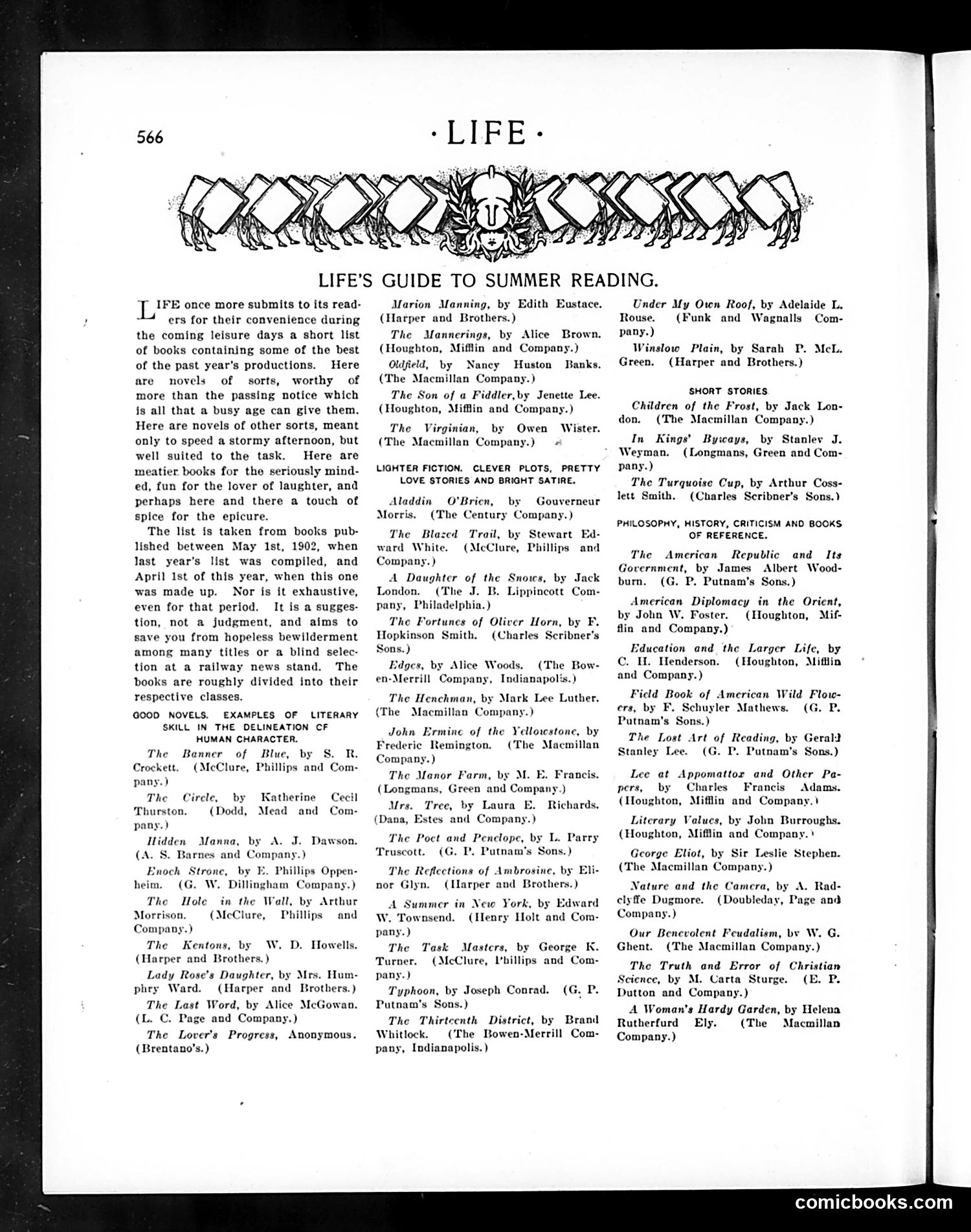
This page is primarily a **book recommendation list**, not a political cartoon. It presents "LIFE's Guide to Summer Reading" — a curated selection of novels, short stories, and non-fiction works organized by category. The list includes literary works by authors like Alice Brown, Nancy Huston Banks, and Owen Wister, along with their publishers. Categories include "Lighter Fiction," "Short Stories," and "Philosophy, History, Criticism and Books of Reference." This reflects Life magazine's role as a cultural arbiter for educated, leisure-class readers during the early 20th century. The selections suggest summer as an appropriate season for serious literary and intellectual engagement — a concept tied to genteel leisure culture of that era.
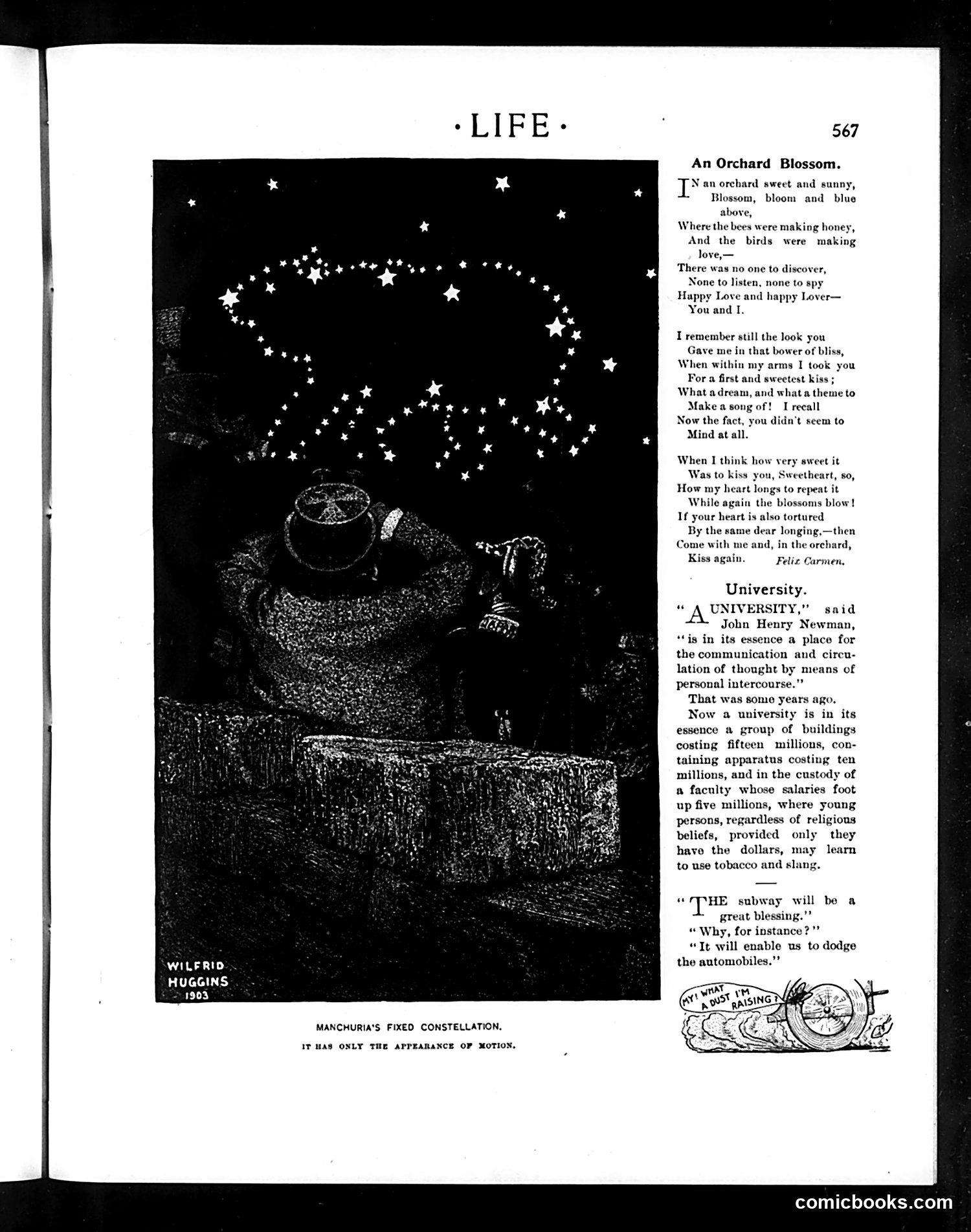
The main illustration is titled "Manchuria's Fixed Constellation. It Has Only the Appearance of Motion." This appears to be political satire about Manchuria, likely referencing the Russo-Japanese War era (the artist Wilfred Huggins signed/dated 1903). The image shows a figure gazing upward at stars arranged in a constellation pattern, but the caption's paradoxical message suggests that despite apparent movement or activity in Manchurian affairs, nothing substantive is actually changing—it's all optical illusion. The poetry and "University" essay on the right side appear unrelated to the cartoon. The page likely represents typical Life magazine content: political commentary combined with literary pieces and humor.
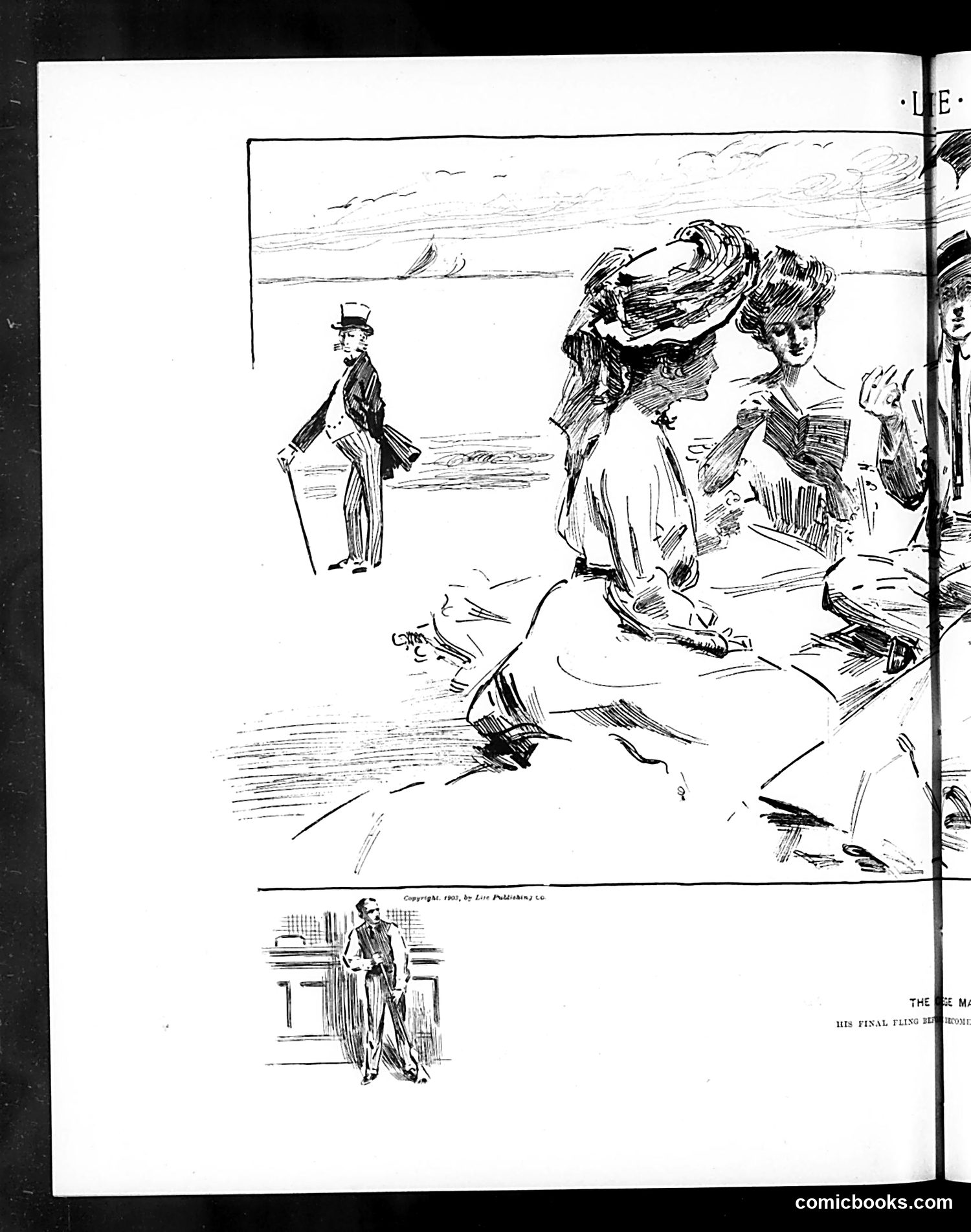
This appears to be a satirical illustration from *Life* magazine showing a beach or seaside scene. The main cartoon depicts a woman in a bathing costume seated prominently in the foreground, with fashionably dressed figures around her—including a man in a top hat and suit (left), a woman with an elaborate feathered hat, and what appears to be a military or formally dressed gentleman on the right. The satire likely targets Edwardian-era social pretension: the contrast between the woman's casual beach attire and the other figures' formal dress suggests mockery of how the wealthy maintained rigid social conventions even at leisure. The elaborate fashion—particularly the imposing feathered hat—appears exaggerated for comic effect. A smaller figure below shows a man with a bicycle, possibly emphasizing class contrasts or transportation themes. The copyright attribution to Life Publishing Co. is visible.
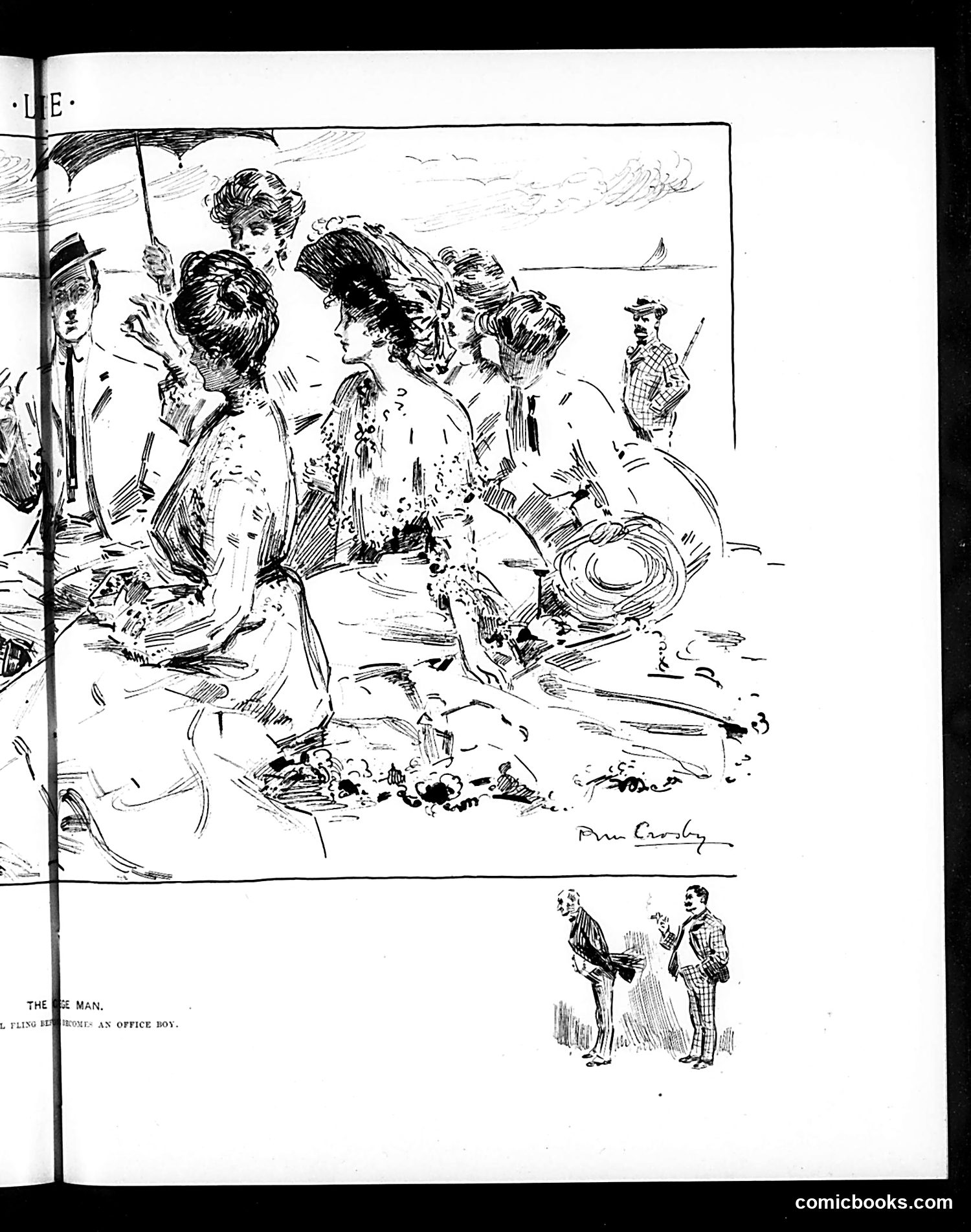
This page contains a satirical sketch by an artist named Carley (visible signature). The main cartoon depicts a beach or seaside scene with well-dressed women and men in Edwardian-era clothing. The figures appear to be engaging in social leisure activities typical of the period. The caption references "an office boy," suggesting social commentary about class distinctions. The smaller illustration below shows what appears to be two figures in conversation, likely providing context or a punchline to the scene above. Without clearer OCR text or additional context, the specific satirical point remains unclear—it may critique social pretensions, gender dynamics, or workplace hierarchies of the early 20th century. The sketchy drawing style is characteristic of Life magazine's editorial illustrations during this period.
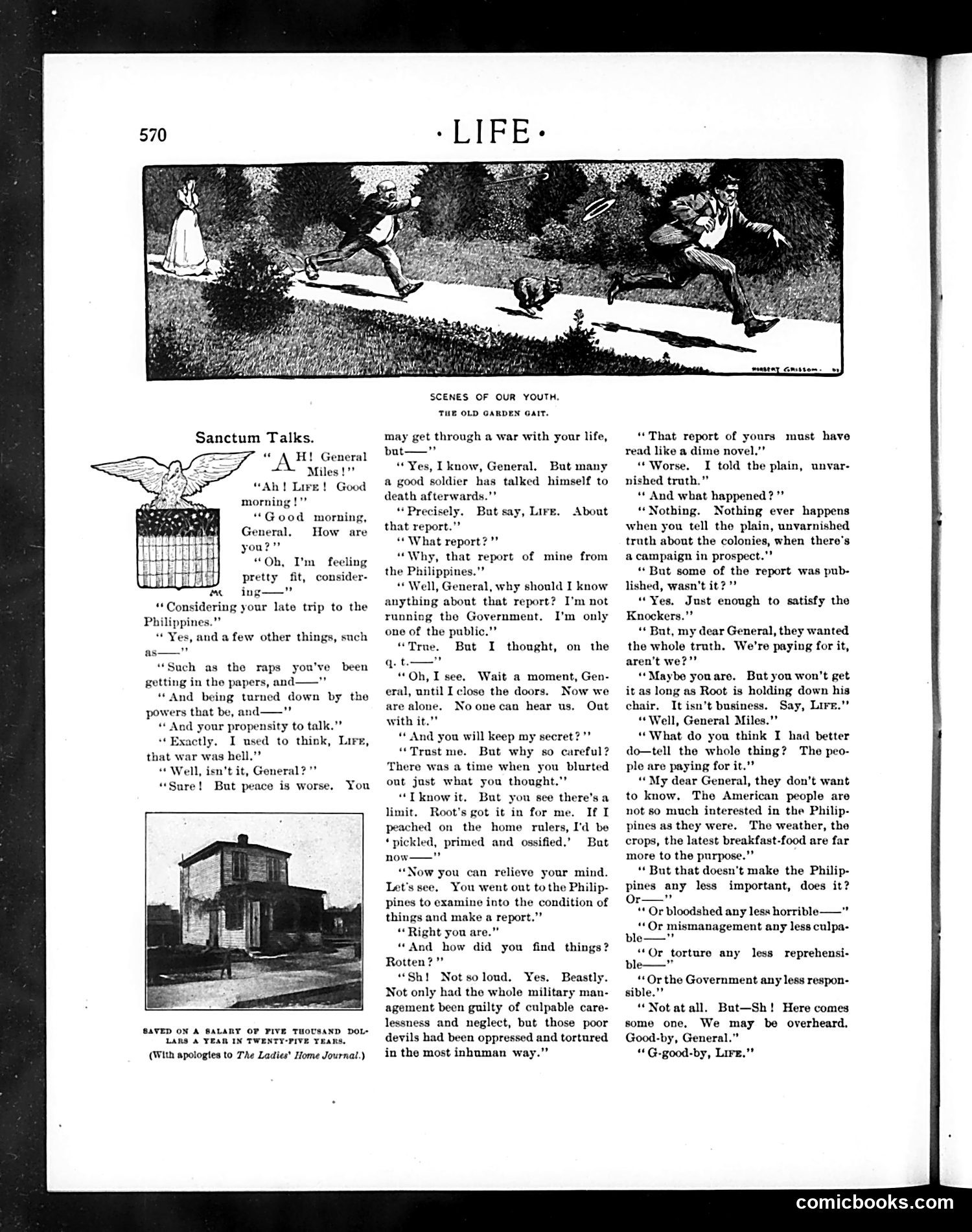
This satirical dialogue between General Nelson Miles (a prominent U.S. military figure) and "Life" (personified as a journalist) critiques American suppression of information about the Philippines during the early 1900s colonial conflict. **The Setup:** Miles returned from investigating conditions in the Philippines and filed a damning report documenting military mismanagement and torture of Filipino civilians. **The Satire's Point:** The conversation reveals how: - Secretary of War Elihu Root ("Root's got it in for me") suppressed the report's full publication - The American public lacks interest in colonial atrocities - Censorship occurs not through prohibition but through selective, limited release ("just enough to satisfy the Knockers") - Editors and officials prioritize trivial news (weather, food) over accountability The final nervous "Sh! Here comes someone" emphasizes that discussing imperial wrongdoing requires secrecy—suggesting Life magazine itself practices self-censorship. **Historical Context:** This critiques real suppression of Philippine War reports documenting American abuses, a major controversy of the McKinley administration (1898-1901).
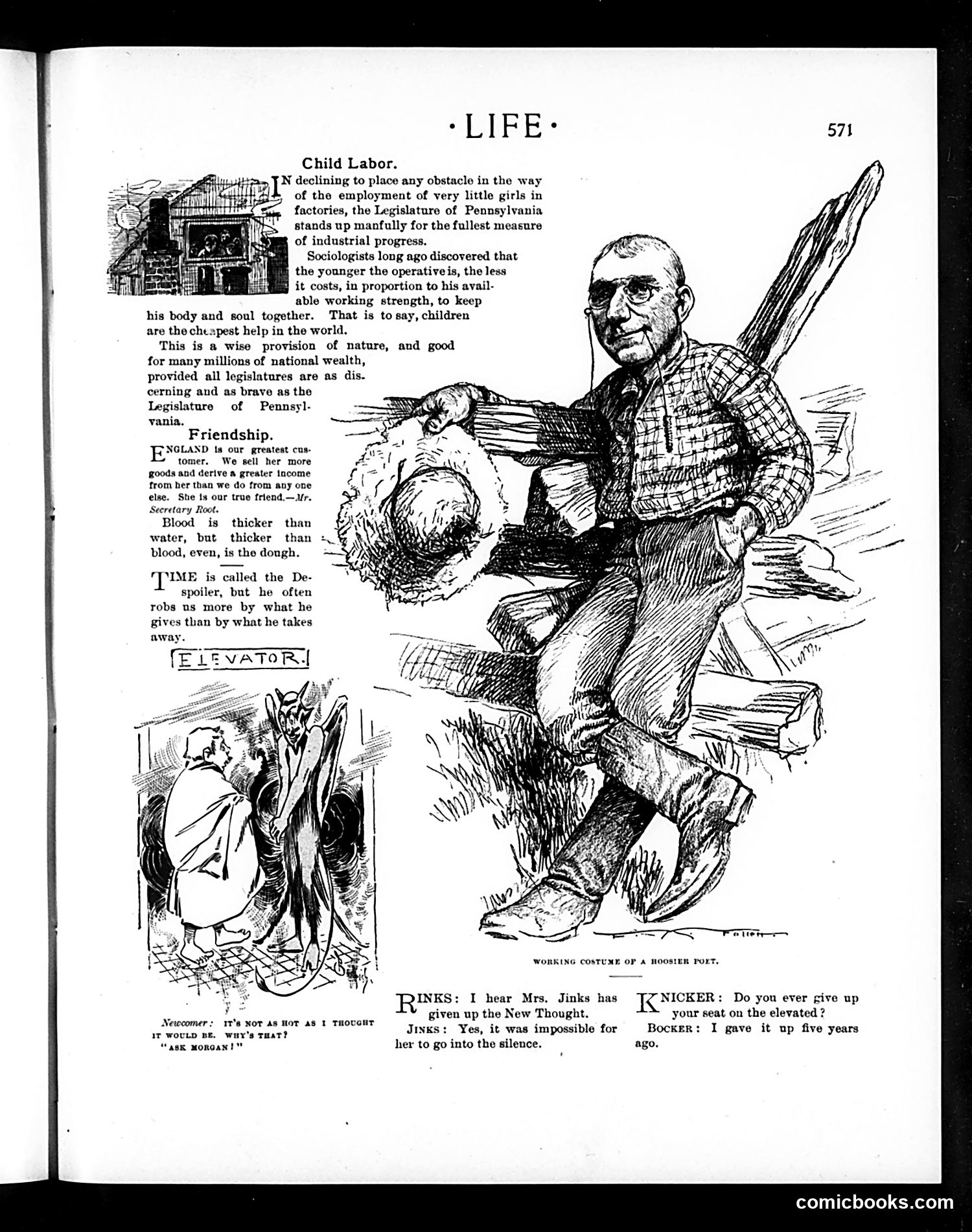
This page contains three separate satirical pieces: **"Child Labor"** attacks Pennsylvania's legislature for permitting child factory work. The sarcasm is heavy: the text praises children as "cheapest help" and calls exploitative labor a "wise provision of nature." The cartoon imagery (factory with small workers) illustrates the grim reality the text mockingly endorses. **"Friendship"** satirizes Secretary Root's claim that England is America's true friend because of trade profits. The punchline—"thicker than blood, even, is the dough"—suggests money, not genuine friendship, drives the relationship. **The remaining cartoons** appear to mock New Thought (a contemporary spiritual movement) and urban etiquette. The elevator scene joke contrasts a man's claim he gave up his seat "five years ago" with social expectations of immediate courtesy. All three pieces employ bitter irony to critique contemporary politics, commercialism, and social hypocrisy typical of early-20th-century *Life* magazine's satirical approach.
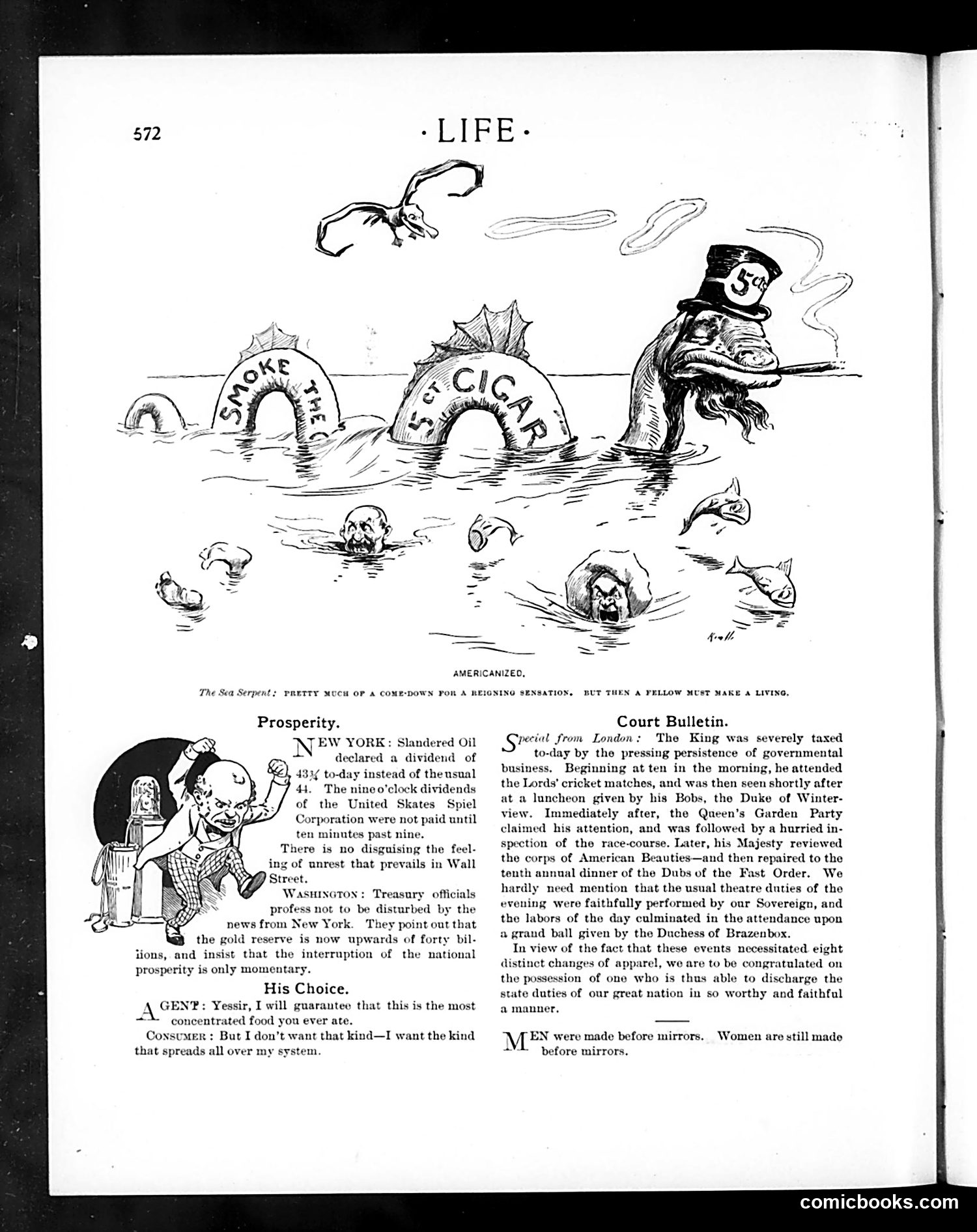
The main cartoon depicts a mythical sea serpent reduced to performing tricks in water for tourists—a visual metaphor for something once grand now commercialized and diminished. The caption notes this is "Americanized," suggesting American commercial culture strips dignity from traditions. Below are three satirical pieces: **"Prosperity"** mocks Wall Street anxiety: oil dividends dropped slightly, and stock exchanges delayed payments by minutes—trivial disruptions presented as national crises, while Treasury officials insist all is well. **"His Choice"** features a consumer rejecting concentrated food, wanting something that "spreads all over my system"—likely satirizing American preference for quantity and dispersed effects over efficiency. **"Court Bulletin"** ridicules British royalty's exhausting schedule of social obligations (cricket, garden parties, theater, balls, costume changes), suggesting the monarchy's actual governance is secondary to ceremonial duties. The page satirizes both American commercialism and European aristocratic excess.
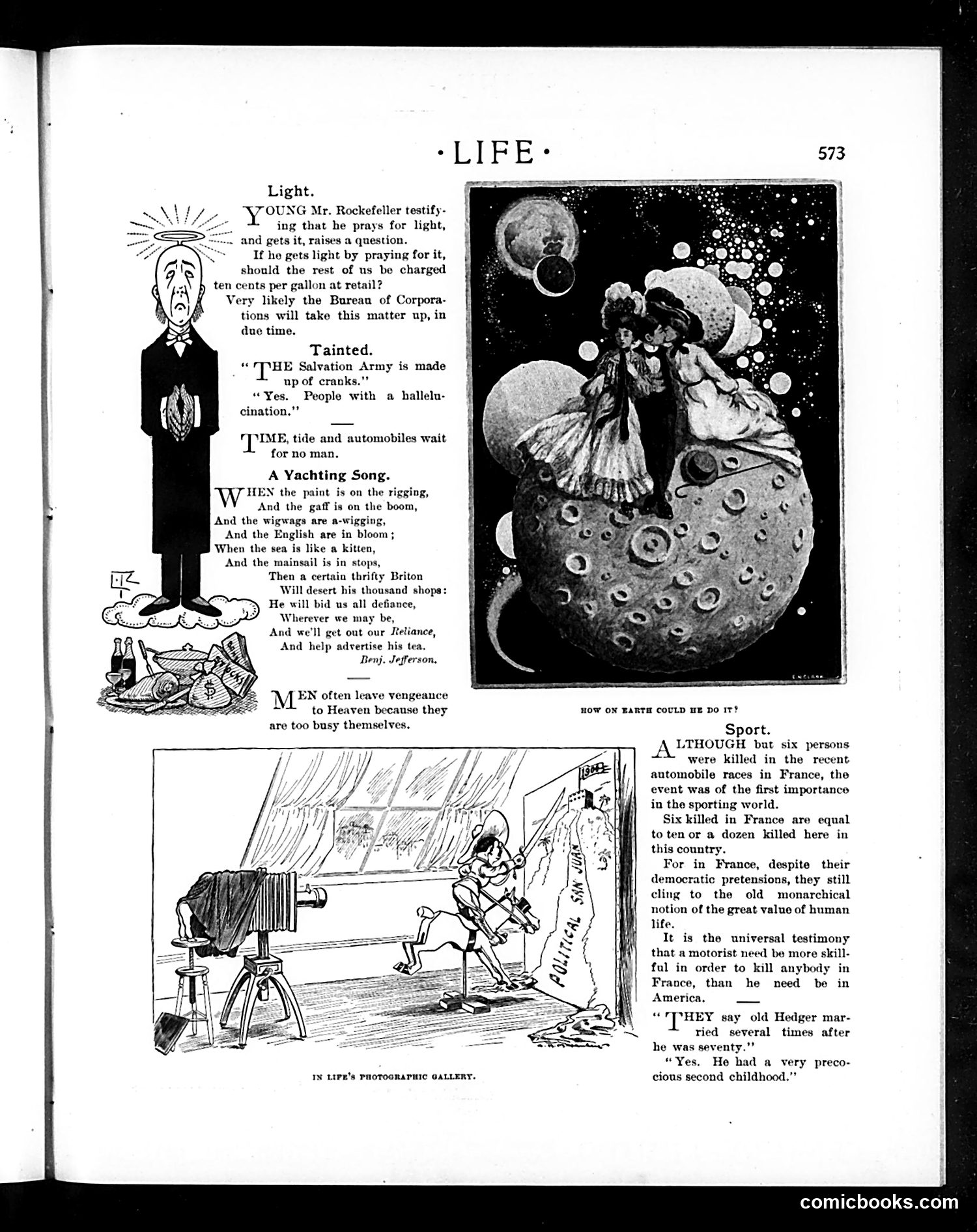
This page contains several brief satirical pieces typical of Life's style: **"Light"** mocks John D. Rockefeller Jr.'s testimony that prayer gives him light. The joke: if prayer provides light, why do ordinary Americans pay ten cents per gallon for electric lighting? It's sarcasm about wealth and privilege—suggesting the wealthy enjoy benefits (literal or metaphorical) that others must purchase. **"Tainted"** is a quick jab at the Salvation Army, dismissing its members as mentally unstable ("cranks" with "hallucinations"). **"Sport"** sarcastically compares automobile racing deaths in France versus America. The satire is dark: it argues that killing someone in France requires more skill than in America—implying American drivers are more reckless or careless. The underlying commentary appears to critique both countries' attitudes toward human life and safety. The illustrations show a self-righteous figure (possibly Rockefeller), a photographer taking portraits, and other supporting cartoons reinforcing these satirical points about wealth, religion, and modern dangers.
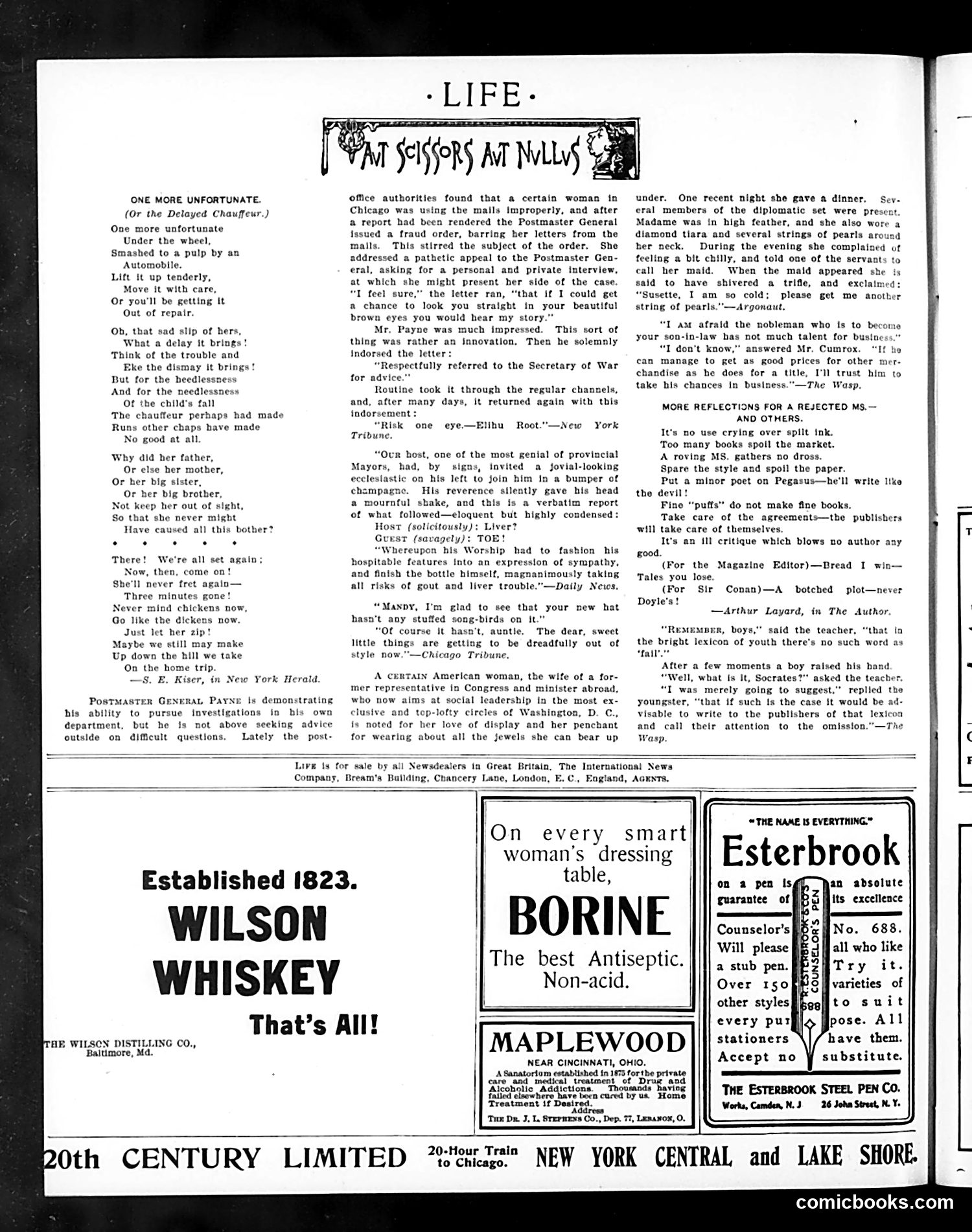
This page from Life magazine contains several satirical pieces mocking early 20th-century American social foibles: **"One More Unfortunate"** (poem by S.E. Kiser): A dark satire about an automobile accident involving a child. The poem criticizes parental negligence while the chauffeur callously prioritizes getting back on schedule—suggesting the dangerous callousness of early motorists and wealthy employers indifferent to human safety. **Postmaster General Payne anecdote**: Satirizes bureaucratic absurdity. A woman facing mail fraud charges appeals to Payne "personally," implying she could charm him with her appearance. Payne refers her to the Secretary of War, who responds with the dismissive "Risk one eye"—mocking the bureaucratic runaround and implied sexism in governance. **Social humor pieces**: Mock wealthy women's fashion obsessions (stuffed birds on hats), clerical hypocrisy (a priest rejecting champagne), and nouveau-riche pretension (a congressman's wife wearing excessive jewelry to appear superior in Washington society). The page satirizes automobile danger, governmental incompetence, and class pretension characteristic of Gilded Age/Progressive Era concerns.
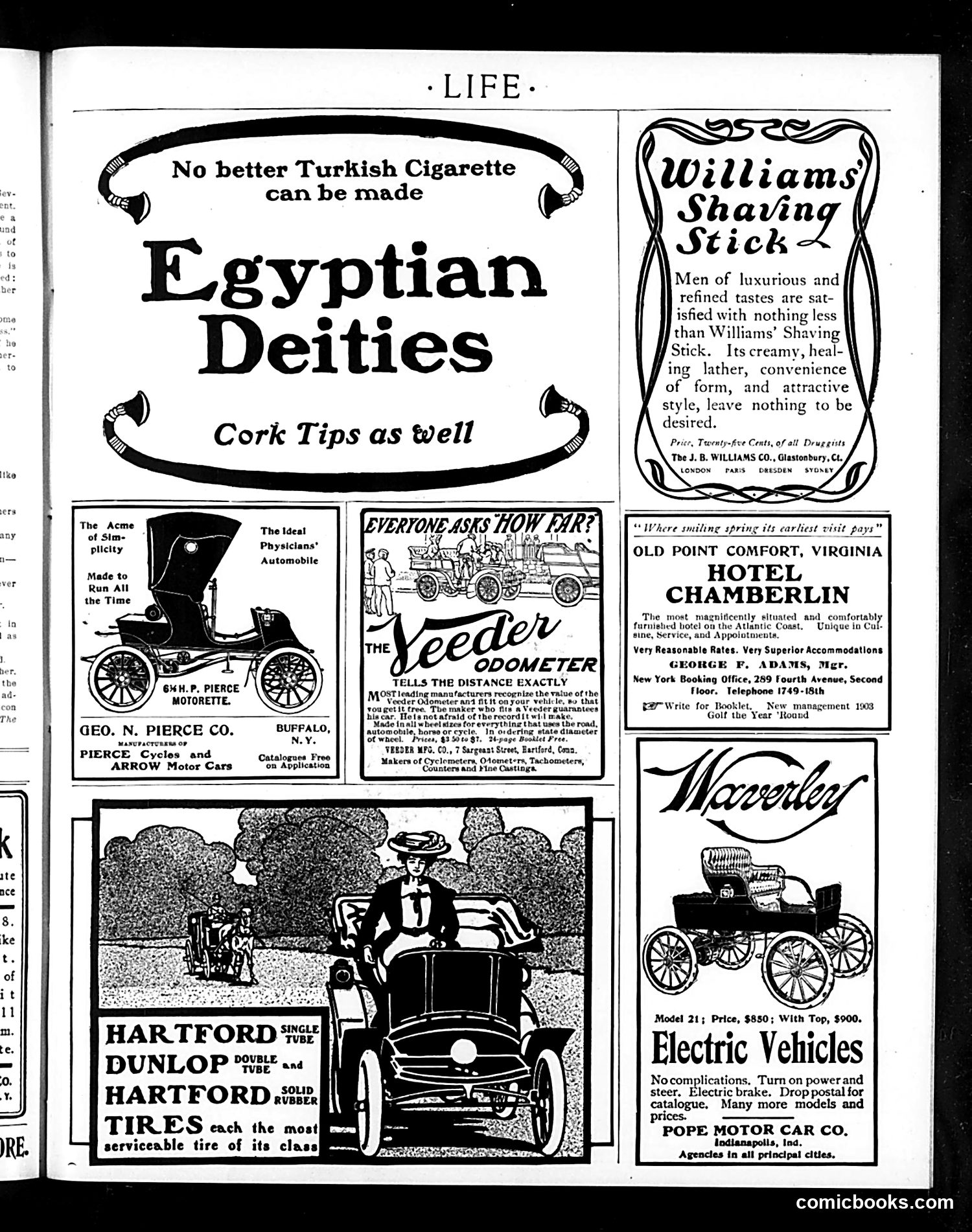
This page is primarily **advertising**, not satirical content. It features early 1900s product promotions: **Notable ads include:** - **Egyptian Deities cigarettes** with cork tips - **Pierce automobiles** and motorcycles - **Veeder Odometer** for measuring vehicle distance - **Williams Shaving Stick** for grooming - **Hartford Dunlop Tires** - **Hotel Chamberlin** in Virginia - **Pope Motor Car Company's electric vehicles** ($850-$900) The large central image shows a well-dressed man in an early automobile, likely promoting tire durability or vehicle reliability—common advertising themes of the era. **For modern readers:** These ads reveal early automotive culture when cars were luxury items, electric vehicles competed with gasoline engines, and personal grooming products were heavily marketed to affluent "men of refined tastes." The prices ($850+) and luxury language indicate these were premium products for wealthy consumers.
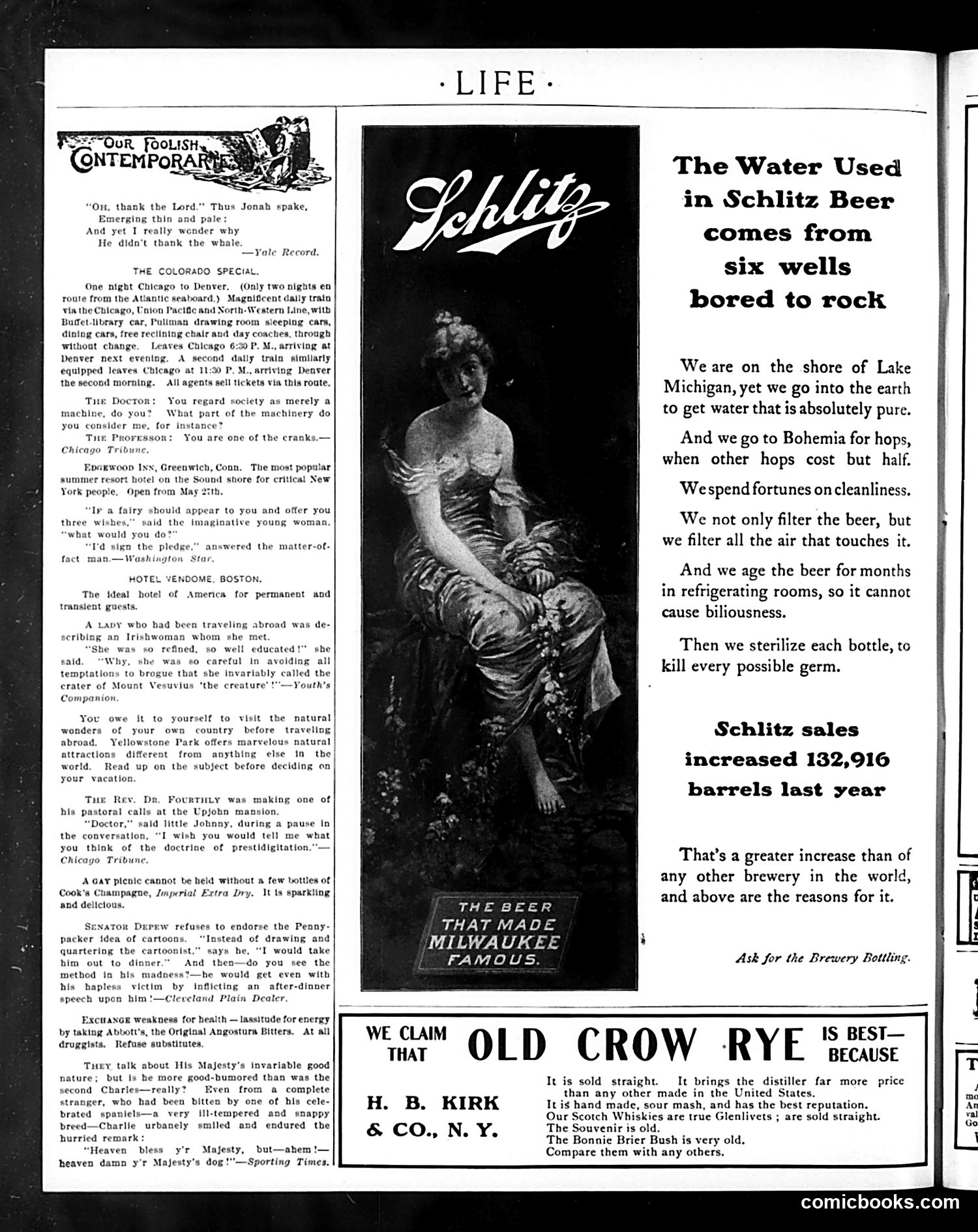
This is primarily an **advertising page**, not satirical content. The page features multiple short jokes and anecdotes in "Our Foolish Contemporaries" section (left column), but the dominant content is a **Schlitz Beer advertisement** (center-right). The ad emphasizes quality control and purity—claiming deep wells, Bohemian hops, filtration, refrigeration, and sterilization. This pitch reflects early 1900s concerns about contaminated water and food safety. The claimed sales increase (132,916 barrels) suggests competitive market positioning. The scattered jokes are mild social humor typical of *Life* magazine: a professor calling a doctor a "crank," a man pledging temperance, an Irishwoman avoiding her accent. None targets specific political figures or events—they're generic observations about contemporary manners and attitudes, intended for genteel readers of the era. The page represents *Life*'s mix of satire, social commentary, and premium advertising directed at educated, affluent audiences.
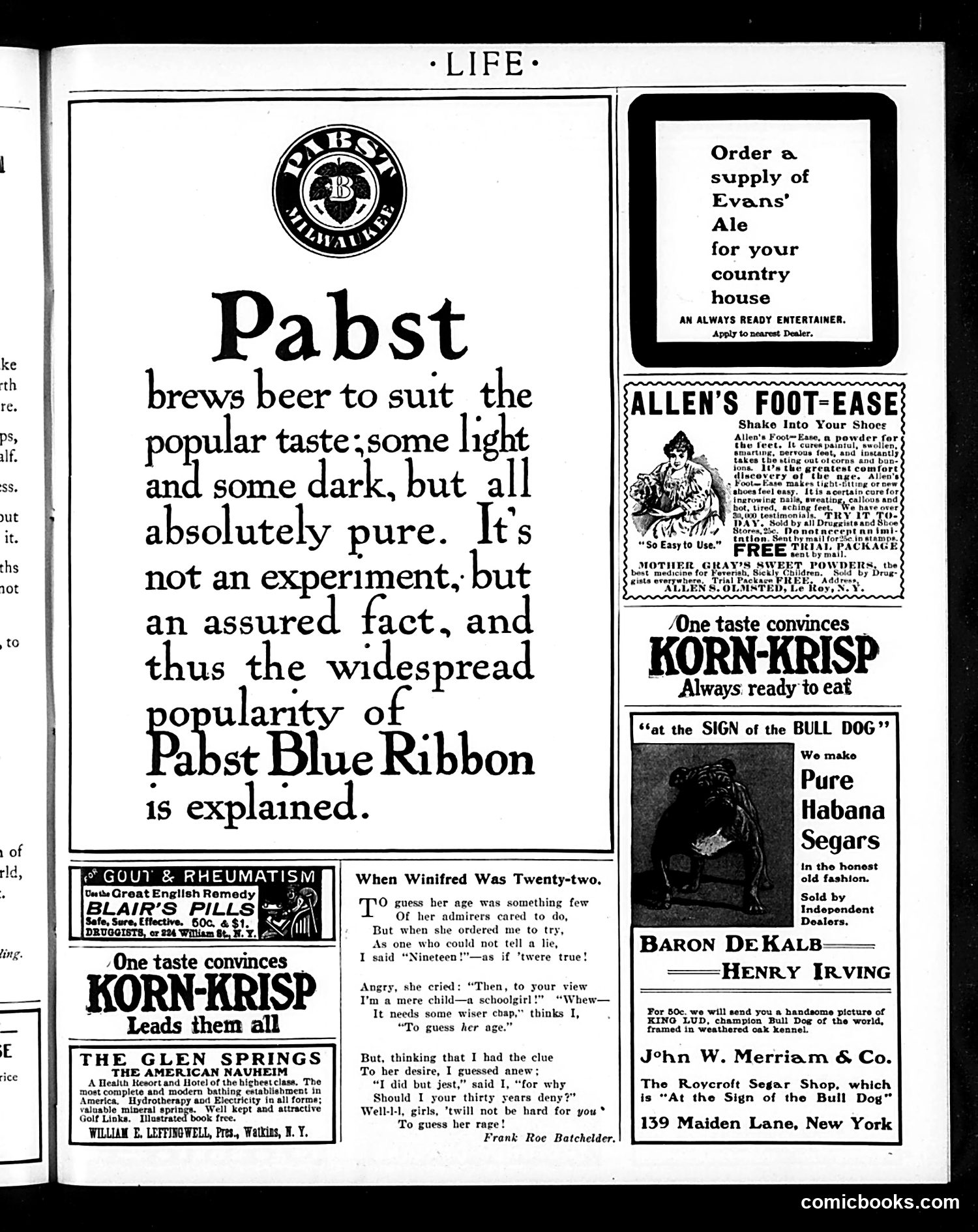
This page is primarily **advertising**, not editorial content or political satire. It contains product advertisements for early 1900s consumer goods arranged around a central humorous poem. The main featured ad is for **Pabst Blue Ribbon beer**, which claims to brew beer suited to popular taste—some light, some dark—but all "absolutely pure." This reflects the era's concerns about beer quality and purity, likely referencing competition among breweries. The surrounding advertisements include remedies (Blair's Pills for gout/rheumatism), foot powder (Allen's Foot-Ease), cereal (Korn-Krisp), a health resort (Glen Springs), and cigars (Baron de Kalb, Henry Irving brand). The central poem "When Winifred Was Twenty-two" is a light comedic piece about a man unable to guess a woman's age—first guessing too young (nineteen), then too old (thirty)—a joke about female vanity regarding aging. **No political satire is present.** This is a standard advertising page with commercial messaging and filler humor typical of Life's business model during this period.
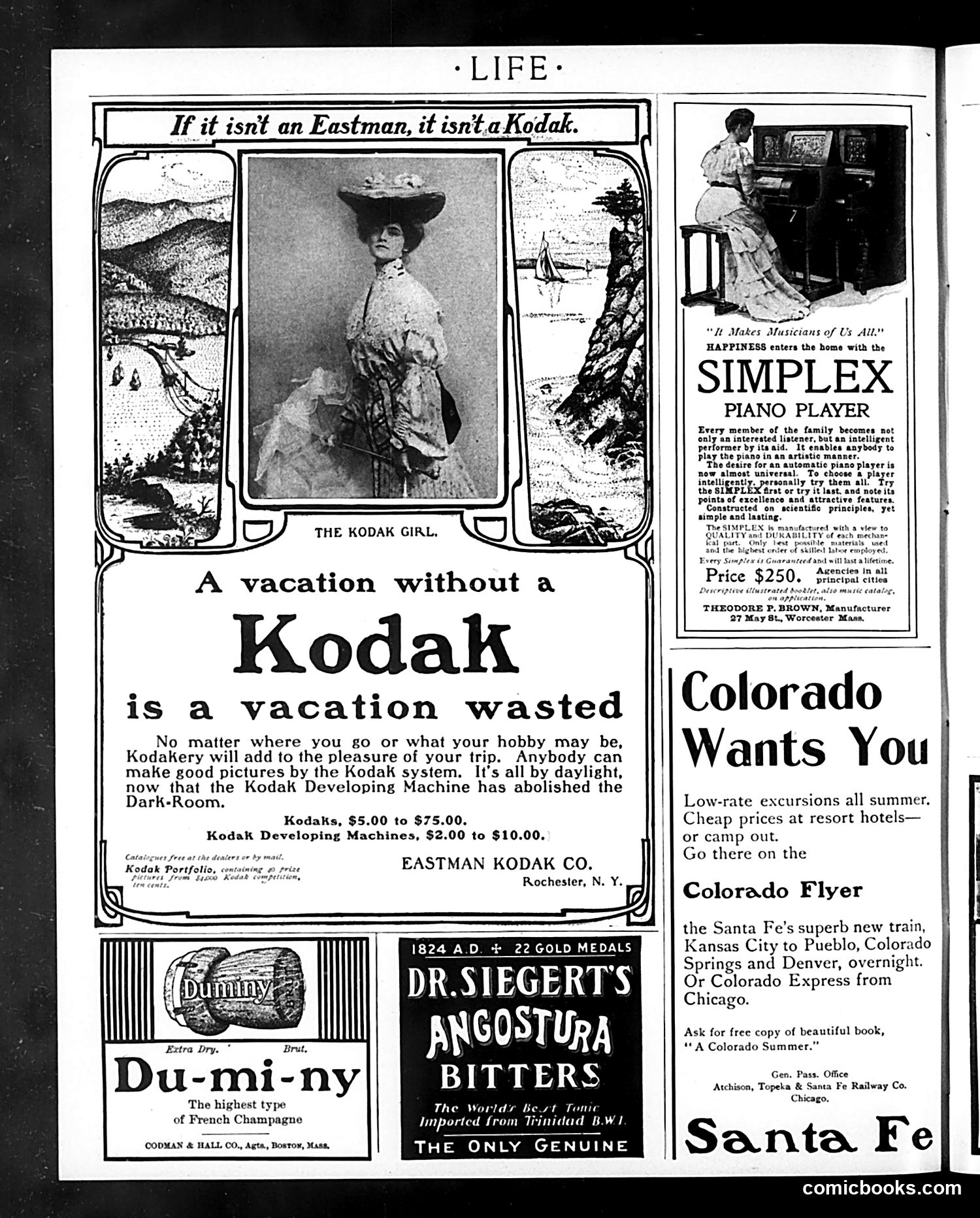
This page is primarily **advertising**, not political satire. It contains vintage product promotions from the early 1900s. The main editorial content is the Kodak advertisement featuring "The Kodak Girl"—a recurring marketing figure promoting photography as leisure activity. The slogan "A vacation without a Kodak is a vacation wasted" reflects the company's strategy of marketing cameras as essential travel accessories. The reference to the "Kodak Developing Machine" abolishing the "Dark-Room" highlights a genuine technological innovation making photography more accessible to amateurs. Supporting advertisements promote: - **Simplex Piano Player** (automatic player piano) - **Colorado tourism** via Santa Fe railway - **Du-mi-ny** champagne and **Dr. Siegert's Angostura Bitters** The page reflects early-20th-century consumer culture emphasizing leisure, technology, and travel as markers of modern life. There is no apparent political satire or commentary—it is straightforward product promotion aimed at middle-class consumers.
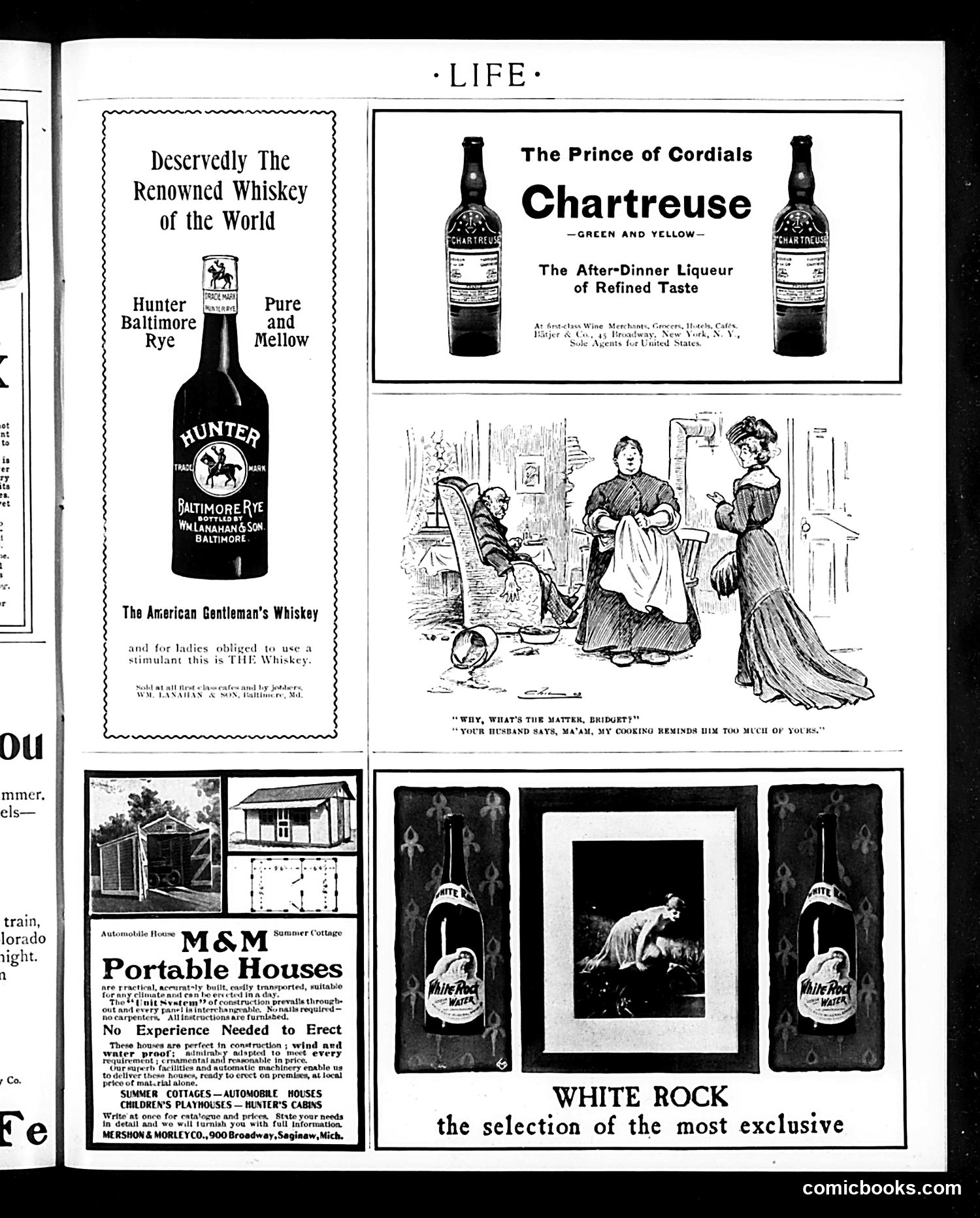
This is primarily an **advertising page** from an early 20th-century Life magazine, with one embedded cartoon. The single cartoon depicts a domestic comedy scene: a wife (labeled "Bridget," suggesting an Irish servant) complains to her employer (a wealthy woman) that the husband criticized her cooking by comparing it unfavorably to his wife's. The joke relies on a backhanded insult—the husband claims the servant's cooking reminds him *too much* of his wife's, implying his wife is also a poor cook. It's a mild marital humor piece playing on class dynamics (servant and employer) and gender stereotypes about women's domestic abilities. The page otherwise features period advertisements for whiskey (Hunter Baltimore Rye), liqueur (Chartreuse), portable prefabricated houses (M&M brand), and White Rock beverages—typical early 1900s luxury and consumer goods marketing with accompanying illustrations and product bottles.
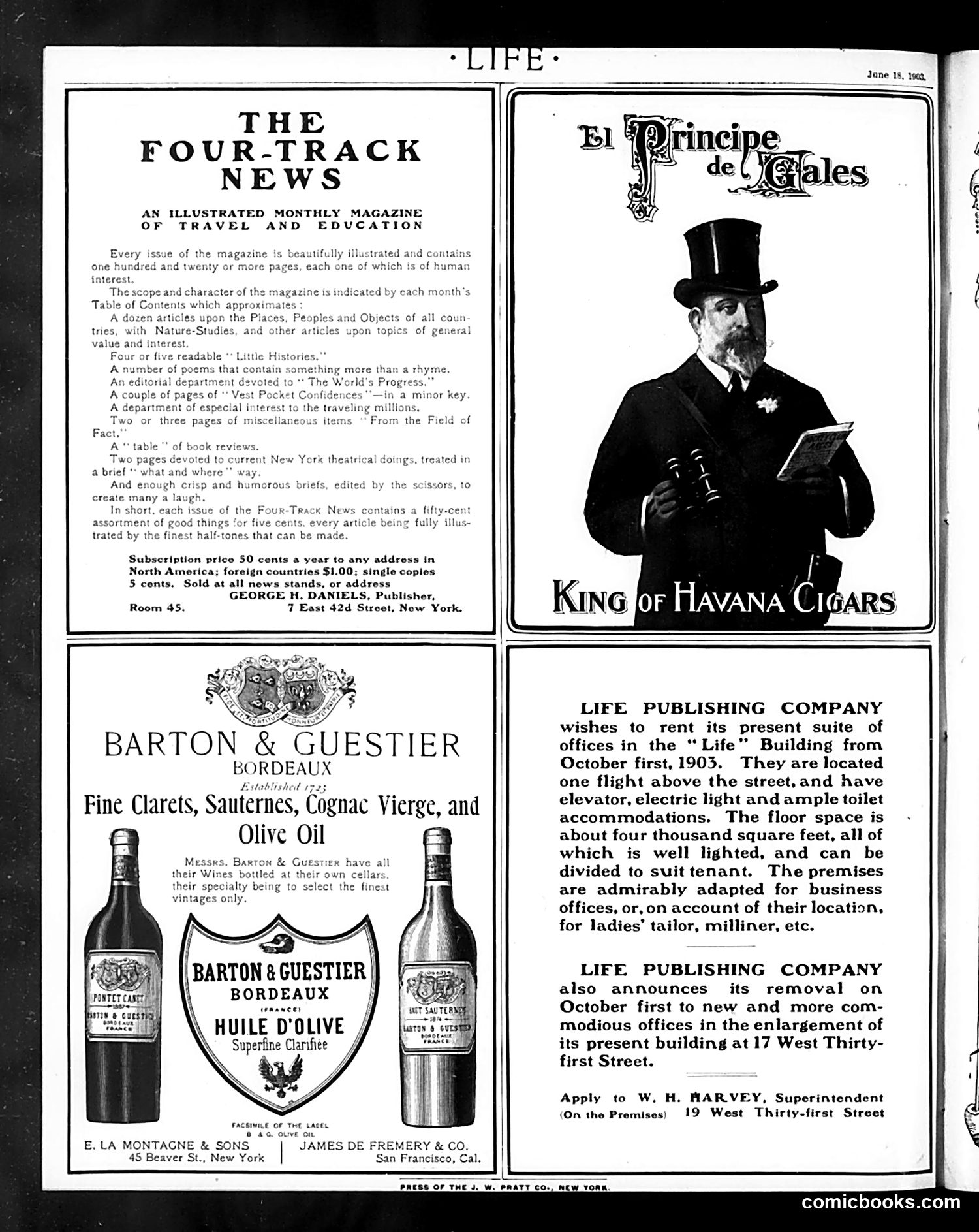
This is primarily an **advertising and announcements page** rather than satirical content. The page contains: **Left side:** Advertisements for *The Four-Track News* (a travel/education magazine) and wine/spirits from Barton & Guestier of Bordeaux. **Right side:** Two notices—one advertising El Príncipe de Gales cigars featuring a man in formal dress reading, and a substantial announcement from Life Publishing Company about relocating their offices from the "Life" Building to a new address at 17 West Thirty-first Street, effective October 1, 1903. **No political satire or cartoon content is present.** The page reflects typical early-1900s magazine layout: advertisements interspersed with company business notices. The cigar advertisement's imagery is standard commercial illustration of the era, not editorial commentary. This appears to be a transition or business page rather than editorial content.