
Life, 1903-06-18 · page 6 of 24
Life — June 18, 1903 — page 6: what you’re looking at
What you’re looking at
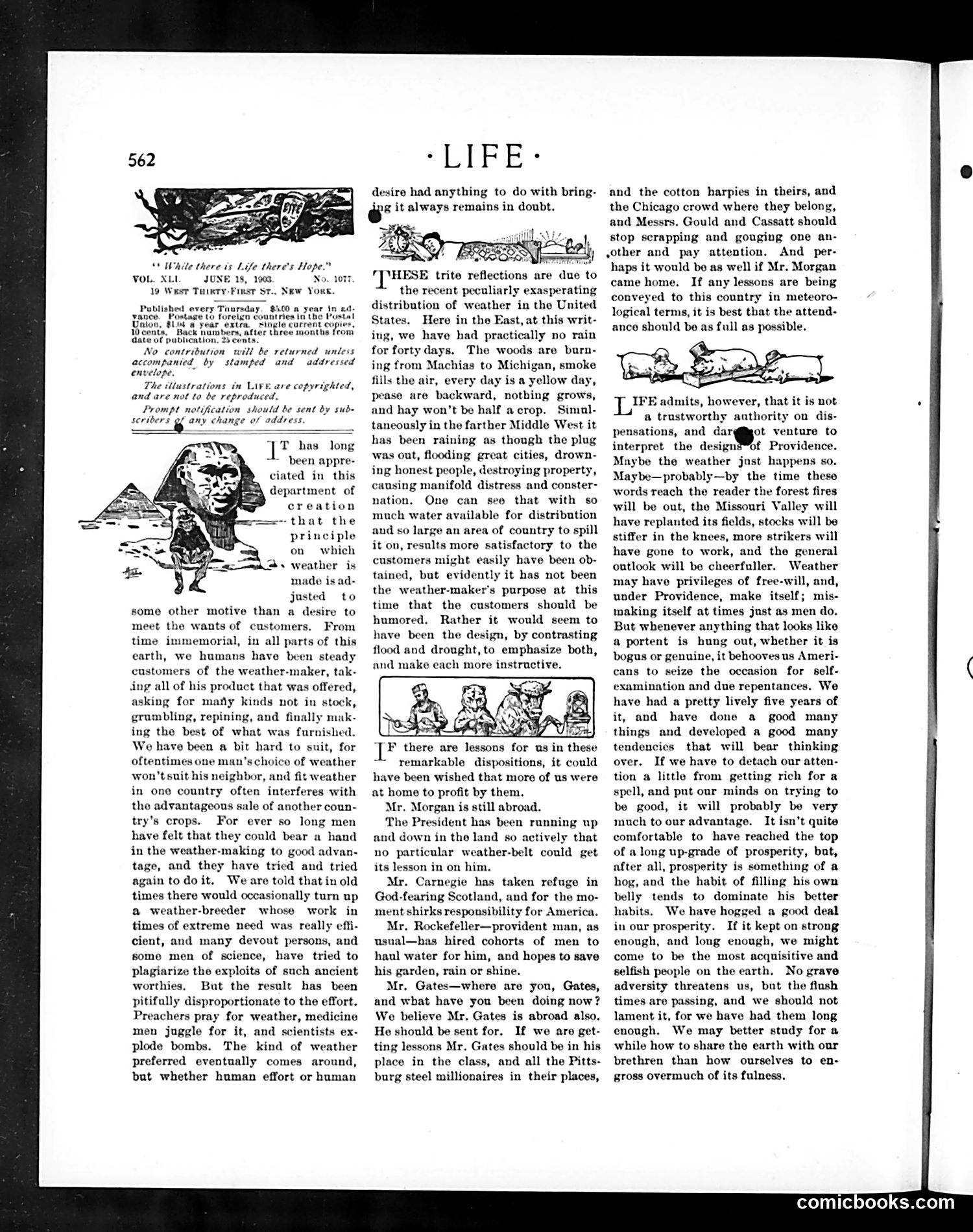
This editorial page critiques severe weather disruptions affecting America. The text references recent devastating floods and droughts spanning from the East to the Midwest, with particular mention of rain shortages lasting forty days and fires in Michigan. The cartoons appear to illustrate weather-related hardship, though specific figures are unclear from the image quality. The editorial names several prominent figures—Mr. Morgan, Mr. Carnegie, Mr. Rockefeller, and Mr. Gates—seemingly critiquing wealthy industrialists for their inadequate response to natural disaster victims, contrasting their prosperity with public suffering. The piece sarcastically suggests Providence and weather patterns, not human effort, determine outcomes, while implying wealthy philanthropists should do more to help affected communities endure environmental catastrophe.
📄 Transcribed text from this page (OCR, searchable)
Machine-transcribed from the original scan — historical spelling and the odd misread are preserved.
“While there is Life there's Hope.” VOL. XLL JUNE 18, 1903. No. 107 19 West Tairty-F: Publi vance. Postage Union, stn ay TOcents. Back huinbers after three months date of publication, 2 cents. No contribution will be returned untess accompanied by stamped and addressed envelope, The illustrations in Live are copyrighted, and are not to be reproduced, Prompt notification should be sent by sub= seribers gf any change of address. T has long been appre- ciated in this department of creation that the principle on which — ak Ss weather is made is ad- justed to some other motive than a desire to meet the wants of customers. From time immemorial, in all parts of this earth, we humans have been steady customers of the weather-maker, tak- dng all of his product that was offered, asking for mafy kinds not in stock, grambling, repining, and finally mak- ing the best of what was furnished. We have been a bit hard to suit, for oftentimes one man’s choice of weather won'tsuit his neighbor, and fit weather in one country often interferes with the advantageous sale of another coun- try’s crops. For ever so long men have felt that they could bear a hand in the weather-making to good advan- tage, and they have tried and tried again todoit, We are told thatinold times there would occasionally turn up a weather-breeder whose work in times of extreme need was really effi- cient, and many devout persons, and some men of science, have tried to plagiarize the exploits of such ancient worthies. But the result has been pitifally disproportionate to the effort. Preachers pray for weather, medicine men juggle for it, and scientists ex- plode bombs. The kind of weather preferred eventually comes around, but whether human effort or human eat over com LIFE desire had anything to do with bring- é it always remains in doubt. ‘THESE trite reflections are due to the recent peculiarly exasperating distribution of weather in the United States. Here in the East, at this writ- ing, we have had practically no rain for forty days. The woods are burn- ing from Machias to Michigan, smoke fills the air, every day is a yellow day, pease are backward, nothing grows, and hay won't be half a crop. Simul- taneously in the farther Middle West it has been raining as though the plug was out, flooding great cities, drown- ing honest people, destroying property, causing manifold distress and conster- nation, One can see that with so much water available for distribution and so large an area of country to spill it on, results more satisfactory to the customers might easily have been ob- tained, but evidently it has not been the weather-maker’s purpose at this time that the customers should be humored. Rather it would seem to have been the design, by contrasting flood and drought, to emphasize both, and make each more instructive. F there are lessons for us in these ~ remarkable dispositions, it could have been wished that more of us were at home to profit by them. Mr. Morgan is still abroad. The President has been running up and down in the land so actively that no particular weather-belt could get its lesson in on him. Mr. Carnegie has taken refuge in God-fearing Scotland, and for the mo- ment shirks responsibility for America. Mr. Rockefeller—provident man, as. usual—has hired cohorts of men to haul water for him, and hopes to save his garden, rain or shine. Mr. Gates—where are you, Gates, and what have you been doing now? We believe Mr. Gates is abroad also. He should be sent for. If we are get- ting lessons Mr. Gates should be in his place in the class, and all the Pitts- burg steel millionaires in their places, and the cotton harpies in theirs, and the Chicago crowd where they belong, and Messrs. Gould and Cassatt should stop scrapping and gouging one an- other and pay attention. And per- haps it would be as well if Mr. Morgan came home. If any lessons are being conveyed to this country in meteoro- logical terms, it is best that the attend- ance should be as full as possible. IFE admits, however, that it is not @ trustworthy anthority on dis- pensations, and cargyet venture to interpret the designs™of Providence. Maybe the weather just happens so. Maybe—probably—by the time these words reach the reader the forest fires will be out, the Missouri Valley will have replanted its fields, stocks will be stiffer in the knees, more strikers will have gone to work, and the general outlook will be cheerfuller. Weather may have privileges of free-will, and, under Providence, make itself; mi: making itself at times just as men do. But whenever anything that looks like a portent is hung out, whether it is bogus or genuine, it behooves us Ameri- cans to seize the occasion for self- examination and due repentances. We have had a pretty lively five years of it, and have done a good many things and developed a good many tendencies that will bear thinking over. If we have to detach our atten- tion a little from getting rich for a spell, and put our minds on trying to be good, it will probably be very much to our advantage. It isn’t quite comfortable to have reached the top of along up-grade of prosperity, bat, after all, prosperity is something of a hog, and the habit of filling his own belly tends to dominate his better habits. We have hogged a good deal in our prosperity. If it kept on strong enough, and long enough, we might come to be the most acquisitive and selfish people on the earth. No grave adversity threatens us, but the flush times are passing, and we should not lament it, for we have had them long enough. We may better study for a while how to share the earth with our brethren than how ourselves to en- gross overmuch of its fulness. comicbooks.com